Series: MAR 2024

Search 500 + past questions and counting.
  • Filter by Professional Bodies

  • Filter by Subject

  • Filter by Series

  • Filter by Topics

  • Filter by Levels

  • Filter by Professional Bodies

  • Filter by Subject

  • Filter by Series

  • Filter by Topics

  • Filter by Levels

AT – Mar 2024 – L3 – Q3c – Anti-avoidance measures

Describe and explain the four broad roles of NEDs identified in the Higgs Guidance (2003).

Prestige’s Board acknowledges that by adopting and implementing the highest standards of
corporate governance, this sets the standards and values for the entire Company. The
Company seeks to comply with best practice in all areas of corporate governance and
continues to review the Company’s procedures to maintain proper control and
accountability.
Required

There are nine members on Prestige’s Board of Directors. They include the Chairman, Chief Executive, three executive directors, and four non-executive directors (NEDs). Describe and explain four broad roles for NEDs identified in the document published in the UK in 2003, known as the Higgs Guidance.

  1. Strategy Role:
    • NEDs are responsible for contributing to the development of the company’s strategy. By providing an independent perspective, they help the board in shaping and reviewing the strategic direction and long-term plans of the company. NEDs must ensure that strategic decisions are in the best interest of the shareholders and other stakeholders.
  2. Monitoring and Control Role:
    • NEDs are tasked with monitoring the performance of the executive management and ensuring that the company is being run efficiently and in accordance with approved policies and standards. This includes overseeing financial performance, internal controls, and risk management procedures. NEDs play a critical role in holding executive directors accountable for their decisions and actions.
  3. Risk Management Role:
    • NEDs help to identify key risks facing the business and ensure that appropriate measures are in place to manage those risks. Their independent status allows them to challenge executive decisions and ensure that all significant risks are addressed before the board makes any major decisions.
  4. Corporate Governance Role:
    • NEDs ensure that the company adheres to high standards of corporate governance, including compliance with legal and regulatory requirements. They are responsible for ensuring that the board operates transparently and that the interests of minority shareholders and other stakeholders are protected. This role also includes ensuring that the company follows ethical practices and maintains a strong corporate culture.

Login or create a free account to see answers

Complete your registration to see answers

Find Related Questions by Tags, levels, etc.

Report an error

You're reporting an error for "AT – Mar 2024 – L3 – Q3c – Anti-avoidance measures"

AT – Mar 2024 – L3 – Q3c – Anti-avoidance measures

Describe and explain the four broad roles of NEDs identified in the Higgs Guidance (2003).

Prestige’s Board acknowledges that by adopting and implementing the highest standards of
corporate governance, this sets the standards and values for the entire Company. The
Company seeks to comply with best practice in all areas of corporate governance and
continues to review the Company’s procedures to maintain proper control and
accountability.
Required

There are nine members on Prestige’s Board of Directors. They include the Chairman, Chief Executive, three executive directors, and four non-executive directors (NEDs). Describe and explain four broad roles for NEDs identified in the document published in the UK in 2003, known as the Higgs Guidance.

  1. Strategy Role:
    • NEDs are responsible for contributing to the development of the company’s strategy. By providing an independent perspective, they help the board in shaping and reviewing the strategic direction and long-term plans of the company. NEDs must ensure that strategic decisions are in the best interest of the shareholders and other stakeholders.
  2. Monitoring and Control Role:
    • NEDs are tasked with monitoring the performance of the executive management and ensuring that the company is being run efficiently and in accordance with approved policies and standards. This includes overseeing financial performance, internal controls, and risk management procedures. NEDs play a critical role in holding executive directors accountable for their decisions and actions.
  3. Risk Management Role:
    • NEDs help to identify key risks facing the business and ensure that appropriate measures are in place to manage those risks. Their independent status allows them to challenge executive decisions and ensure that all significant risks are addressed before the board makes any major decisions.
  4. Corporate Governance Role:
    • NEDs ensure that the company adheres to high standards of corporate governance, including compliance with legal and regulatory requirements. They are responsible for ensuring that the board operates transparently and that the interests of minority shareholders and other stakeholders are protected. This role also includes ensuring that the company follows ethical practices and maintains a strong corporate culture.

Login or create a free account to see answers

Complete your registration to see answers

Find Related Questions by Tags, levels, etc.

Report an error

You're reporting an error for "AT – Mar 2024 – L3 – Q3c – Anti-avoidance measures"

SCS – MAR 2024 – L3 – Q6b – Strategy, stakeholders, and mission

Explain how Principles V and VI of the OECD Principles of Corporate Governance could be applied at Prestige.

Prestige’s Board acknowledges that by adopting and implementing the highest standards of
corporate governance, this sets the standards and values for the entire Company. The
Company seeks to comply with best practice in all areas of corporate governance and
continues to review the Company’s procedures to maintain proper control and
accountability.
Required

Describe and explain how Principles V and VI of the OECD Principles of Corporate Governance – 2015 Edition, could be applied at Prestige to ensure good corporate governance practices.

  1. Principle V – Disclosure and Transparency:
    • This principle emphasizes the importance of full and accurate disclosure of all material matters related to the company, including financial statements, ownership, and governance structures. At Prestige, applying this principle would involve ensuring that financial reports are transparent, timely, and comply with relevant regulations. Prestige would need to disclose key information such as conflicts of interest, related-party transactions, and executive compensation. Proper application of this principle would build trust among stakeholders and provide them with the information necessary to assess the company’s performance and governance.
  2. Principle VI – Responsibilities of the Board:
    • Principle VI highlights the need for the board to be accountable to the company and its shareholders and to act in the best interests of the company. At Prestige, this would involve the board taking responsibility for overseeing the company’s strategic direction, risk management, and overall governance framework. The board must act with due diligence, ensuring that it has appropriate internal controls and that all directors, both executive and non-executive, are held accountable for their actions. The board should also foster an ethical corporate culture and ensure that the company complies with both local and international legal and regulatory requirements.

Login or create a free account to see answers

Complete your registration to see answers

Find Related Questions by Tags, levels, etc.

Report an error

You're reporting an error for "SCS – MAR 2024 – L3 – Q6b – Strategy, stakeholders, and mission"

SCS – MAR 2024 – L3 – Q6b – Strategy, stakeholders, and mission

This Question Has a Case Study: 

Explain how Principles V and VI of the OECD Principles of Corporate Governance could be applied at Prestige.

Prestige’s Board acknowledges that by adopting and implementing the highest standards of
corporate governance, this sets the standards and values for the entire Company. The
Company seeks to comply with best practice in all areas of corporate governance and
continues to review the Company’s procedures to maintain proper control and
accountability.
Required

Describe and explain how Principles V and VI of the OECD Principles of Corporate Governance – 2015 Edition, could be applied at Prestige to ensure good corporate governance practices.

  1. Principle V – Disclosure and Transparency:
    • This principle emphasizes the importance of full and accurate disclosure of all material matters related to the company, including financial statements, ownership, and governance structures. At Prestige, applying this principle would involve ensuring that financial reports are transparent, timely, and comply with relevant regulations. Prestige would need to disclose key information such as conflicts of interest, related-party transactions, and executive compensation. Proper application of this principle would build trust among stakeholders and provide them with the information necessary to assess the company’s performance and governance.
  2. Principle VI – Responsibilities of the Board:
    • Principle VI highlights the need for the board to be accountable to the company and its shareholders and to act in the best interests of the company. At Prestige, this would involve the board taking responsibility for overseeing the company’s strategic direction, risk management, and overall governance framework. The board must act with due diligence, ensuring that it has appropriate internal controls and that all directors, both executive and non-executive, are held accountable for their actions. The board should also foster an ethical corporate culture and ensure that the company complies with both local and international legal and regulatory requirements.

Login or create a free account to see answers

Complete your registration to see answers

Find Related Questions by Tags, levels, etc.

Report an error

You're reporting an error for "SCS – MAR 2024 – L3 – Q6b – Strategy, stakeholders, and mission"

SCS – MAR 2024 – L3 – Q6a – Strategy, stakeholders, and mission

Describe and explain 5 key issues in corporate governance for Prestige.

Prestige’s Board acknowledges that by adopting and implementing the highest standards of corporate governance, this sets the standards and values for the entire Company. The Company seeks to comply with best practices in all areas of corporate governance and continues to review its procedures to maintain proper control and accountability.

Required:
Describe and explain five key issues in corporate governance that would establish how well or badly Prestige is governed.

  1. Board Structure and Independence:
    • A key issue is the composition of the board, ensuring that there is an appropriate mix of executive and non-executive directors (NEDs). The presence of independent NEDs is crucial in providing an objective perspective and balancing the power of the executive directors. At Prestige, the board’s structure, including the number of independent NEDs, will determine the board’s effectiveness.
  2. Accountability and Transparency:
    • Good corporate governance requires transparent decision-making and accountability to shareholders and stakeholders. Prestige must ensure that financial reports, internal controls, and risk management procedures are robust and disclosed accurately. The transparency of the board’s actions and its decisions, especially in areas like remuneration and major investments, will be a measure of good governance.
  3. Risk Management:
    • Effective corporate governance includes identifying, assessing, and mitigating risks. Prestige must have strong systems in place to manage operational, financial, and reputational risks. Failure to do so can harm the company’s performance and stakeholder confidence.
  4. Ethical Leadership and Corporate Social Responsibility (CSR):
    • The board should lead by example in promoting an ethical culture throughout the company. Prestige’s commitment to CSR, environmental sustainability, and ethical decision-making will influence how it is perceived by stakeholders. Poor ethical standards or failure to meet CSR obligations can damage the company’s reputation.
  5. Compliance with Regulations and Laws:
    • Ensuring compliance with local and international regulations is essential for good corporate governance. Prestige must ensure that it adheres to corporate governance codes, listing rules, and legal obligations. Failure to comply with relevant laws could result in legal penalties and damage to the company’s reputation.

Login or create a free account to see answers

Complete your registration to see answers

Find Related Questions by Tags, levels, etc.

Report an error

You're reporting an error for "SCS – MAR 2024 – L3 – Q6a – Strategy, stakeholders, and mission"

SCS – MAR 2024 – L3 – Q6a – Strategy, stakeholders, and mission

This Question Has a Case Study: 

Describe and explain 5 key issues in corporate governance for Prestige.

Prestige’s Board acknowledges that by adopting and implementing the highest standards of corporate governance, this sets the standards and values for the entire Company. The Company seeks to comply with best practices in all areas of corporate governance and continues to review its procedures to maintain proper control and accountability.

Required:
Describe and explain five key issues in corporate governance that would establish how well or badly Prestige is governed.

  1. Board Structure and Independence:
    • A key issue is the composition of the board, ensuring that there is an appropriate mix of executive and non-executive directors (NEDs). The presence of independent NEDs is crucial in providing an objective perspective and balancing the power of the executive directors. At Prestige, the board’s structure, including the number of independent NEDs, will determine the board’s effectiveness.
  2. Accountability and Transparency:
    • Good corporate governance requires transparent decision-making and accountability to shareholders and stakeholders. Prestige must ensure that financial reports, internal controls, and risk management procedures are robust and disclosed accurately. The transparency of the board’s actions and its decisions, especially in areas like remuneration and major investments, will be a measure of good governance.
  3. Risk Management:
    • Effective corporate governance includes identifying, assessing, and mitigating risks. Prestige must have strong systems in place to manage operational, financial, and reputational risks. Failure to do so can harm the company’s performance and stakeholder confidence.
  4. Ethical Leadership and Corporate Social Responsibility (CSR):
    • The board should lead by example in promoting an ethical culture throughout the company. Prestige’s commitment to CSR, environmental sustainability, and ethical decision-making will influence how it is perceived by stakeholders. Poor ethical standards or failure to meet CSR obligations can damage the company’s reputation.
  5. Compliance with Regulations and Laws:
    • Ensuring compliance with local and international regulations is essential for good corporate governance. Prestige must ensure that it adheres to corporate governance codes, listing rules, and legal obligations. Failure to comply with relevant laws could result in legal penalties and damage to the company’s reputation.

Login or create a free account to see answers

Complete your registration to see answers

Find Related Questions by Tags, levels, etc.

Report an error

You're reporting an error for "SCS – MAR 2024 – L3 – Q6a – Strategy, stakeholders, and mission"

SCS – MAR 2024 – L3 – Q5c – International financial management

Evaluate the factors restricting foreign investment despite potential good returns.

With reference to Option Three, evaluate the factors that restrict foreign investment despite the perceived potential for good returns. 

  1. Political Instability:
    • Countries with a history of political instability or where there is a risk of sudden government changes or social unrest can deter foreign investors, even if potential returns are high. The risk of expropriation or policy shifts is a significant concern.
  2. Weak Rule of Law:
    • In some regions, the enforcement of legal contracts and property rights can be weak or inconsistent. This makes it difficult for foreign investors to have confidence that their investments will be protected, thus limiting their willingness to enter the market.
  3. Regulatory Barriers:
    • Excessive regulation, complex bureaucratic processes, or restrictions on foreign ownership can act as a deterrent to investment. Some countries impose barriers such as high tariffs, restrictive labor laws, or industry-specific regulations that make it difficult for foreign companies to operate profitably.
  4. Currency and Exchange Rate Risk:
    • Volatile exchange rates can lead to unpredictable returns for foreign investors. If a country’s currency depreciates significantly, it could erode the value of profits made in that country when converted back to the investor’s home currency.
  5. Competition from Local and Other Foreign Firms:
    • Intense competition from local companies or other foreign investors, particularly those from emerging economies like China and India, can reduce the attractiveness of foreign direct investment. These competitors may have better local knowledge, lower cost structures, or favorable relationships with government officials, making it hard for new entrants to compete.

Login or create a free account to see answers

Complete your registration to see answers

Find Related Questions by Tags, levels, etc.

Report an error

You're reporting an error for "SCS – MAR 2024 – L3 – Q5c – International financial management"

SCS – MAR 2024 – L3 – Q5c – International financial management

This Question Has a Case Study: 

Evaluate the factors restricting foreign investment despite potential good returns.

With reference to Option Three, evaluate the factors that restrict foreign investment despite the perceived potential for good returns. 

  1. Political Instability:
    • Countries with a history of political instability or where there is a risk of sudden government changes or social unrest can deter foreign investors, even if potential returns are high. The risk of expropriation or policy shifts is a significant concern.
  2. Weak Rule of Law:
    • In some regions, the enforcement of legal contracts and property rights can be weak or inconsistent. This makes it difficult for foreign investors to have confidence that their investments will be protected, thus limiting their willingness to enter the market.
  3. Regulatory Barriers:
    • Excessive regulation, complex bureaucratic processes, or restrictions on foreign ownership can act as a deterrent to investment. Some countries impose barriers such as high tariffs, restrictive labor laws, or industry-specific regulations that make it difficult for foreign companies to operate profitably.
  4. Currency and Exchange Rate Risk:
    • Volatile exchange rates can lead to unpredictable returns for foreign investors. If a country’s currency depreciates significantly, it could erode the value of profits made in that country when converted back to the investor’s home currency.
  5. Competition from Local and Other Foreign Firms:
    • Intense competition from local companies or other foreign investors, particularly those from emerging economies like China and India, can reduce the attractiveness of foreign direct investment. These competitors may have better local knowledge, lower cost structures, or favorable relationships with government officials, making it hard for new entrants to compete.

Login or create a free account to see answers

Complete your registration to see answers

Find Related Questions by Tags, levels, etc.

Report an error

You're reporting an error for "SCS – MAR 2024 – L3 – Q5c – International financial management"

SCS – MAR 2024 – L3 – Q5b – Financial management

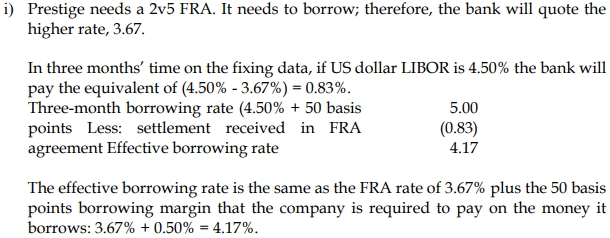
Calculate the effective rate of borrowing for three months and explain the advantages of convertible bonds.

With reference to Option Two:

i) What would be its effective rate of borrowing for the three months if US dollar LIBOR is 4.50% at the start of the notional interest period for the FRA? (2 marks)
ii) What are the advantages of Convertible Bonds? (3 marks)

ii) Advantages of Convertible Bonds:

  1. Lower Interest Rates: Convertible bonds typically offer lower interest rates than traditional bonds because investors are compensated by the option to convert the bonds into shares if the company’s stock performs well.
  2. Deferred Dilution: While convertible bonds offer the potential for equity conversion, dilution of ownership only occurs when the bonds are converted, allowing the company to defer issuing more shares and the impact on earnings per share.
  3. Attractive to Investors: Investors find convertible bonds appealing because they offer the stability of bond payments with the potential upside of converting into equity if the company’s stock price rises.
  4. Access to Capital: For companies like Prestige, convertible bonds can provide access to capital without immediately diluting shareholder equity and may be a more cost-effective option than issuing straight equity.

Login or create a free account to see answers

Complete your registration to see answers

Find Related Questions by Tags, levels, etc.

Report an error

You're reporting an error for "SCS – MAR 2024 – L3 – Q5b – Financial management"

SCS – MAR 2024 – L3 – Q5b – Financial management

This Question Has a Case Study: 

Calculate the effective rate of borrowing for three months and explain the advantages of convertible bonds.

With reference to Option Two:

i) What would be its effective rate of borrowing for the three months if US dollar LIBOR is 4.50% at the start of the notional interest period for the FRA? (2 marks)
ii) What are the advantages of Convertible Bonds? (3 marks)

ii) Advantages of Convertible Bonds:

  1. Lower Interest Rates: Convertible bonds typically offer lower interest rates than traditional bonds because investors are compensated by the option to convert the bonds into shares if the company’s stock performs well.
  2. Deferred Dilution: While convertible bonds offer the potential for equity conversion, dilution of ownership only occurs when the bonds are converted, allowing the company to defer issuing more shares and the impact on earnings per share.
  3. Attractive to Investors: Investors find convertible bonds appealing because they offer the stability of bond payments with the potential upside of converting into equity if the company’s stock price rises.
  4. Access to Capital: For companies like Prestige, convertible bonds can provide access to capital without immediately diluting shareholder equity and may be a more cost-effective option than issuing straight equity.

Login or create a free account to see answers

Complete your registration to see answers

Find Related Questions by Tags, levels, etc.

Report an error

You're reporting an error for "SCS – MAR 2024 – L3 – Q5b – Financial management"

SCS – MAR 2024 – L3 – Q5a – Financial management

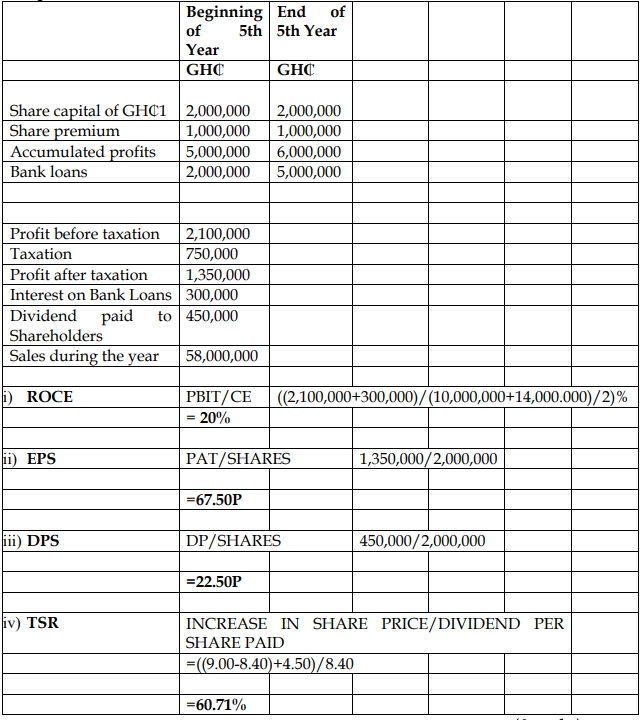
Calculate various financial ratios including ROCE, EPS, DPS, and TSR based on given financial data.

With reference to the information in Option One available to Prestige as presented by Professor Joseph Laing, a business consultant, calculate the following:

i) Return on Capital Employed (ROCE) (1 mark)
ii) Earnings Per Share (EPS) (1 mark)
iii) Dividend Per Share (DPS) (2 marks)
iv) Total Shareholders Return (TSR) (2 marks)
v) Explain the difference between ROCE and Accounting Rate of Return, their essential features, and relationship (4 marks)

v) Difference between ROCE and Accounting Rate of Return (ARR):

  • ROCE is a measure of the return on capital employed in the business, calculated by dividing the profit before interest and tax (PBIT) by the average capital employed. It reflects the overall efficiency of the company in generating profits from its available capital.
  • ARR, on the other hand, measures the accounting profit from a specific capital project, usually before interest and tax, as a percentage of the capital invested in that project.
  • The key difference lies in their scope: while ROCE assesses the return from the entire business or company, ARR focuses on specific capital projects. Both are used to evaluate the efficiency of capital usage, but ARR is project-specific, whereas ROCE is company-wide.

Login or create a free account to see answers

Complete your registration to see answers

Find Related Questions by Tags, levels, etc.

Report an error

You're reporting an error for "SCS – MAR 2024 – L3 – Q5a – Financial management"

SCS – MAR 2024 – L3 – Q5a – Financial management

This Question Has a Case Study: 

Calculate various financial ratios including ROCE, EPS, DPS, and TSR based on given financial data.

With reference to the information in Option One available to Prestige as presented by Professor Joseph Laing, a business consultant, calculate the following:

i) Return on Capital Employed (ROCE) (1 mark)
ii) Earnings Per Share (EPS) (1 mark)
iii) Dividend Per Share (DPS) (2 marks)
iv) Total Shareholders Return (TSR) (2 marks)
v) Explain the difference between ROCE and Accounting Rate of Return, their essential features, and relationship (4 marks)

v) Difference between ROCE and Accounting Rate of Return (ARR):

  • ROCE is a measure of the return on capital employed in the business, calculated by dividing the profit before interest and tax (PBIT) by the average capital employed. It reflects the overall efficiency of the company in generating profits from its available capital.
  • ARR, on the other hand, measures the accounting profit from a specific capital project, usually before interest and tax, as a percentage of the capital invested in that project.
  • The key difference lies in their scope: while ROCE assesses the return from the entire business or company, ARR focuses on specific capital projects. Both are used to evaluate the efficiency of capital usage, but ARR is project-specific, whereas ROCE is company-wide.

Login or create a free account to see answers

Complete your registration to see answers

Find Related Questions by Tags, levels, etc.

Report an error

You're reporting an error for "SCS – MAR 2024 – L3 – Q5a – Financial management"

SCS – MAR 2024 – L3 – Q4b – Strategy implementation

Advise on an appropriate HR strategy to harmonize the organizational structure for effective delivery at Prestige.

Each company acquired or merged by Prestige was allowed to maintain its human resource structure.

Required:
Analyze and advise on an appropriate HR strategy Prestige should adopt to harmonize the organizational structure for effective delivery of the company’s objectives.

  1. Strategic Workforce Planning:
    • Prestige should develop a workforce plan to address the complexities introduced by mergers and acquisitions. This plan should estimate the required number of employees, their skills, and potential future needs based on the company’s objectives, particularly in innovation and technology adoption.
  2. HR Consistency with Corporate Strategy:
    • The HR strategy should align with both the corporate and divisional strategies to ensure that the required number and type of employees are available at the right time to support business operations across regions.
  3. Assessment of Current Workforce:
    • Prestige should conduct an audit of its current workforce, assessing skills, experience, and attrition rates. This would help in identifying gaps and surpluses that need to be addressed through recruitment, training, or redundancy.
  4. Recruitment and Training:
    • The strategy should focus on recruiting the necessary talent to fill gaps, while also implementing training and development programs to upskill existing employees. This will help align employee capabilities with the company’s strategic needs, especially in areas such as IT, finance, and project management.
  5. Performance Management:
    • Implementing a robust performance appraisal system would enable Prestige to monitor the development of employees’ skills and performance, ensuring that key objectives are met. This would also identify areas where employees may require additional training or support.
  6. Promotion and Career Development:
    • Providing clear promotion paths and career development opportunities would encourage employee retention and foster motivation within the workforce, helping Prestige maintain a skilled and experienced team.
  7. Handling Redundancies:
    • Where there are surplus employees due to structural changes, Prestige should have a clear policy for managing redundancies in a way that minimizes disruption while ensuring fairness and compliance with labor laws.
  8. Labor Relations and Employee Welfare:
    • Ensuring good labor relations through clear communication and employee engagement initiatives will help reduce resistance to change. Compensation, health and safety, and employee well-being should be central to the HR strategy to foster a positive workplace environment.
  9. Technological Impact on HR:
    • Prestige should anticipate and manage the impact of technological changes on its workforce, particularly in relation to automation, digital skills, and remote working capabilities.

Factors to Consider:

  • Population trends and labor market conditions.
  • Changes in government policies affecting employment.
  • The availability of specific skills within the workforce.
  • Competition for talent from other businesses.
  • Trends in outsourcing and subcontracting.

Login or create a free account to see answers

Complete your registration to see answers

Find Related Questions by Tags, levels, etc.

Report an error

You're reporting an error for "SCS – MAR 2024 – L3 – Q4b – Strategy implementation"

SCS – MAR 2024 – L3 – Q4b – Strategy implementation

This Question Has a Case Study: 

Advise on an appropriate HR strategy to harmonize the organizational structure for effective delivery at Prestige.

Each company acquired or merged by Prestige was allowed to maintain its human resource structure.

Required:
Analyze and advise on an appropriate HR strategy Prestige should adopt to harmonize the organizational structure for effective delivery of the company’s objectives.

  1. Strategic Workforce Planning:
    • Prestige should develop a workforce plan to address the complexities introduced by mergers and acquisitions. This plan should estimate the required number of employees, their skills, and potential future needs based on the company’s objectives, particularly in innovation and technology adoption.
  2. HR Consistency with Corporate Strategy:
    • The HR strategy should align with both the corporate and divisional strategies to ensure that the required number and type of employees are available at the right time to support business operations across regions.
  3. Assessment of Current Workforce:
    • Prestige should conduct an audit of its current workforce, assessing skills, experience, and attrition rates. This would help in identifying gaps and surpluses that need to be addressed through recruitment, training, or redundancy.
  4. Recruitment and Training:
    • The strategy should focus on recruiting the necessary talent to fill gaps, while also implementing training and development programs to upskill existing employees. This will help align employee capabilities with the company’s strategic needs, especially in areas such as IT, finance, and project management.
  5. Performance Management:
    • Implementing a robust performance appraisal system would enable Prestige to monitor the development of employees’ skills and performance, ensuring that key objectives are met. This would also identify areas where employees may require additional training or support.
  6. Promotion and Career Development:
    • Providing clear promotion paths and career development opportunities would encourage employee retention and foster motivation within the workforce, helping Prestige maintain a skilled and experienced team.
  7. Handling Redundancies:
    • Where there are surplus employees due to structural changes, Prestige should have a clear policy for managing redundancies in a way that minimizes disruption while ensuring fairness and compliance with labor laws.
  8. Labor Relations and Employee Welfare:
    • Ensuring good labor relations through clear communication and employee engagement initiatives will help reduce resistance to change. Compensation, health and safety, and employee well-being should be central to the HR strategy to foster a positive workplace environment.
  9. Technological Impact on HR:
    • Prestige should anticipate and manage the impact of technological changes on its workforce, particularly in relation to automation, digital skills, and remote working capabilities.

Factors to Consider:

  • Population trends and labor market conditions.
  • Changes in government policies affecting employment.
  • The availability of specific skills within the workforce.
  • Competition for talent from other businesses.
  • Trends in outsourcing and subcontracting.

Login or create a free account to see answers

Complete your registration to see answers

Find Related Questions by Tags, levels, etc.

Report an error

You're reporting an error for "SCS – MAR 2024 – L3 – Q4b – Strategy implementation"

SCS – MAR 2024 – L3 – Q4a – Strategy implementation

Explain how Prestige could leverage ICT using the four broad stages of e-business development to compete.

Prestige’s Board has shifted from their long-standing reluctance to venture into foreign markets to seriously consider the possibility of expansion overseas. An important implication of this decision is that as the size of the market increases, competition becomes international. The main rivals are no longer local suppliers to a domestic market.

Required:
Using the four broad stages of development to a full e-business model, explain how Prestige could leverage ICT to compete.

  1. Web Presence:
    • Prestige could set up a website to display its property listings and services. The website can serve as a platform to provide detailed information about the houses for sale, available property types, and contact details. This would enhance visibility and reach beyond local markets.
  2. E-Commerce:
    • Prestige can integrate e-commerce capabilities on its website, allowing potential buyers to make inquiries, schedule viewings, or even complete purchases online. They can also use e-commerce platforms to manage orders and payments from suppliers and partners.
  3. Integrated E-Commerce:
    • Prestige could utilize ICT to gather and analyze customer data to understand their preferences and buying behavior. By establishing two-way communication channels, the company could use customer feedback to improve its product offerings and tailor marketing strategies, boosting customer satisfaction.
  4. E-Business:
    • ICT can drive Prestige’s business strategy by making e-business a fundamental part of its operations. E-business can enhance efficiency in sales, marketing, procurement, and customer service, aligning business operations with digital transformation to gain a competitive edge in the global market.

Login or create a free account to see answers

Complete your registration to see answers

Find Related Questions by Tags, levels, etc.

Report an error

You're reporting an error for "SCS – MAR 2024 – L3 – Q4a – Strategy implementation"

SCS – MAR 2024 – L3 – Q4a – Strategy implementation

This Question Has a Case Study: 

Explain how Prestige could leverage ICT using the four broad stages of e-business development to compete.

Prestige’s Board has shifted from their long-standing reluctance to venture into foreign markets to seriously consider the possibility of expansion overseas. An important implication of this decision is that as the size of the market increases, competition becomes international. The main rivals are no longer local suppliers to a domestic market.

Required:
Using the four broad stages of development to a full e-business model, explain how Prestige could leverage ICT to compete.

  1. Web Presence:
    • Prestige could set up a website to display its property listings and services. The website can serve as a platform to provide detailed information about the houses for sale, available property types, and contact details. This would enhance visibility and reach beyond local markets.
  2. E-Commerce:
    • Prestige can integrate e-commerce capabilities on its website, allowing potential buyers to make inquiries, schedule viewings, or even complete purchases online. They can also use e-commerce platforms to manage orders and payments from suppliers and partners.
  3. Integrated E-Commerce:
    • Prestige could utilize ICT to gather and analyze customer data to understand their preferences and buying behavior. By establishing two-way communication channels, the company could use customer feedback to improve its product offerings and tailor marketing strategies, boosting customer satisfaction.
  4. E-Business:
    • ICT can drive Prestige’s business strategy by making e-business a fundamental part of its operations. E-business can enhance efficiency in sales, marketing, procurement, and customer service, aligning business operations with digital transformation to gain a competitive edge in the global market.

Login or create a free account to see answers

Complete your registration to see answers

Find Related Questions by Tags, levels, etc.

Report an error

You're reporting an error for "SCS – MAR 2024 – L3 – Q4a – Strategy implementation"

SCS – MAR 2024 – L3 – Q3 – Functional strategies

Explain the potential benefits of resource sharing through common IT systems at Prestige.

When five years ago the present regional divisional structure of Greater Accra, Ashanti, and Eastern was formalized, an attempt was made to ensure that common systems and ways of working were adopted across each of the three regions. However, due to the pressures on the Company, this was never fully implemented.

Required:
Explain the potential benefits of resource sharing (configuring an organization’s computing system in such a way that the information and resources within it can be accessed, and remotely accessed, across multiple administrative domains) to Prestige if they adopt common IT systems.

  1. Ease of Access: A common IT system allows staff to access systems, software, and files from any location with an internet connection. This supports collaborative working across regions.
  2. Accuracy: Having a single source of data ensures accuracy by eliminating multiple similar versions scattered across the organization. This provides reliable information to all divisions.
  3. Cost Savings: Resource sharing avoids duplication of work across divisions. Generating similar data for similar purposes can be costly, so producing data once and sharing it reduces inefficiencies and costs for Prestige.
  4. Facilitates Remote Working: IT resource sharing enables remote working, increasing flexibility. Employees can work from any location, enhancing motivation and potentially creating cost savings by allowing work from home.
  5. Transparency: Resource sharing promotes transparency across the organization by making information easily accessible to all relevant parties. This can improve decision-making and operational efficiency.

Login or create a free account to see answers

Complete your registration to see answers

Find Related Questions by Tags, levels, etc.

Report an error

You're reporting an error for "SCS – MAR 2024 – L3 – Q3 – Functional strategies"

SCS – MAR 2024 – L3 – Q3 – Functional strategies

This Question Has a Case Study: 

Explain the potential benefits of resource sharing through common IT systems at Prestige.

When five years ago the present regional divisional structure of Greater Accra, Ashanti, and Eastern was formalized, an attempt was made to ensure that common systems and ways of working were adopted across each of the three regions. However, due to the pressures on the Company, this was never fully implemented.

Required:
Explain the potential benefits of resource sharing (configuring an organization’s computing system in such a way that the information and resources within it can be accessed, and remotely accessed, across multiple administrative domains) to Prestige if they adopt common IT systems.

  1. Ease of Access: A common IT system allows staff to access systems, software, and files from any location with an internet connection. This supports collaborative working across regions.
  2. Accuracy: Having a single source of data ensures accuracy by eliminating multiple similar versions scattered across the organization. This provides reliable information to all divisions.
  3. Cost Savings: Resource sharing avoids duplication of work across divisions. Generating similar data for similar purposes can be costly, so producing data once and sharing it reduces inefficiencies and costs for Prestige.
  4. Facilitates Remote Working: IT resource sharing enables remote working, increasing flexibility. Employees can work from any location, enhancing motivation and potentially creating cost savings by allowing work from home.
  5. Transparency: Resource sharing promotes transparency across the organization by making information easily accessible to all relevant parties. This can improve decision-making and operational efficiency.

Login or create a free account to see answers

Complete your registration to see answers

Find Related Questions by Tags, levels, etc.

Report an error

You're reporting an error for "SCS – MAR 2024 – L3 – Q3 – Functional strategies"

SCS – MAR 2024 – L3 – Q2 – Competitive advantage

Apply and appraise Porter’s three strategies for sustaining competitive advantage for Prestige Designers Ltd.

A strategic clock can be used to consider different business strategies for gaining competitive advantage, based on providing a combination of price and perceived benefits. Porter has suggested three strategies for sustaining competitive advantage over rival firms and their products or services. They are a cost leadership strategy, a differentiation strategy, and a focus strategy.

Required:
Apply and appraise how effective the suggested three strategies for sustaining competitive advantage over rival firms would be useful to Prestige. (10 marks)

  1. Cost Leadership Strategy:
    • Prestige must compete effectively on price by offering its housing stock at a lower price than rivals.
    • The company should have excellent cost control systems and continually plan for further reductions in costs to remain the cost leader in the market.
    • Prestige, being a large company, can benefit from economies of scale compared to smaller competitors.
    • To achieve reasonable profit margins, Prestige must sell large volumes of homes at a lower profit margin per unit.
  2. Differentiation Strategy:
    • Prestige’s products must be distinct from those of its competitors in a way that customers can recognize, potentially leveraging the “Vintage” brand which focuses on low-cost housing for young buyers.
    • The company could innovate and incorporate modern methods of construction (MMC) and sustainability-related methods to differentiate its products.
    • Customers might be willing to pay more for homes with unique features and higher perceived value.
    • Prestige should invest in delivering superior value to customers, even if that means higher upfront costs.
  3. Focus Strategy:
    • Prestige could focus on segmented consumer markets by selecting specific segments, such as the middle-class or younger first-time home buyers, as the primary market for their products.
    • The company could concentrate on serving a particular type of customer or region, allowing it to tailor its offerings to the unique demands of that segment.

Login or create a free account to see answers

Complete your registration to see answers

Find Related Questions by Tags, levels, etc.

Report an error

You're reporting an error for "SCS – MAR 2024 – L3 – Q2 – Competitive advantage"

SCS – MAR 2024 – L3 – Q2 – Competitive advantage

This Question Has a Case Study: 

Apply and appraise Porter’s three strategies for sustaining competitive advantage for Prestige Designers Ltd.

A strategic clock can be used to consider different business strategies for gaining competitive advantage, based on providing a combination of price and perceived benefits. Porter has suggested three strategies for sustaining competitive advantage over rival firms and their products or services. They are a cost leadership strategy, a differentiation strategy, and a focus strategy.

Required:
Apply and appraise how effective the suggested three strategies for sustaining competitive advantage over rival firms would be useful to Prestige. (10 marks)

  1. Cost Leadership Strategy:
    • Prestige must compete effectively on price by offering its housing stock at a lower price than rivals.
    • The company should have excellent cost control systems and continually plan for further reductions in costs to remain the cost leader in the market.
    • Prestige, being a large company, can benefit from economies of scale compared to smaller competitors.
    • To achieve reasonable profit margins, Prestige must sell large volumes of homes at a lower profit margin per unit.
  2. Differentiation Strategy:
    • Prestige’s products must be distinct from those of its competitors in a way that customers can recognize, potentially leveraging the “Vintage” brand which focuses on low-cost housing for young buyers.
    • The company could innovate and incorporate modern methods of construction (MMC) and sustainability-related methods to differentiate its products.
    • Customers might be willing to pay more for homes with unique features and higher perceived value.
    • Prestige should invest in delivering superior value to customers, even if that means higher upfront costs.
  3. Focus Strategy:
    • Prestige could focus on segmented consumer markets by selecting specific segments, such as the middle-class or younger first-time home buyers, as the primary market for their products.
    • The company could concentrate on serving a particular type of customer or region, allowing it to tailor its offerings to the unique demands of that segment.

Login or create a free account to see answers

Complete your registration to see answers

Find Related Questions by Tags, levels, etc.

Report an error

You're reporting an error for "SCS – MAR 2024 – L3 – Q2 – Competitive advantage"

AT – Mar 2024 – L3 – Q3c – Anti-avoidance measures

Explaining the difference between tax avoidance and tax evasion, examples of both, and limitations to tax planning.

According to the Organisation for Economic Co-operation and Development (OECD), tax avoidance and tax evasion are terms which are difficult to define but are generally used to describe the arrangement of a taxpayer’s affairs intended to reduce their tax liability.

Required:

i) Explain the differences between tax avoidance and tax evasion.
(3 marks)

ii) Enumerate THREE (3) examples of tax avoidance activities firms and individuals are likely to engage in.
(3 marks)

iii) Identify FOUR (4) examples of activities that are likely to be classified as tax evasion and not tax avoidance.
(2 marks)

iv) Explain TWO (2) limitations to effective tax planning.
(2 marks)

i) Differences between Tax Avoidance and Tax Evasion
Tax avoidance can be understood as a lawful scheme managed by an individual or by a company to reduce its tax liability. Tax avoidance is “the arrangement of one’s financial affairs to minimize tax liability within the law.” Tax avoidance exploits the loopholes in the laws that were not expected by the legislators.

Tax evasion is an illegal practice whereby someone using unlawful means purposely reduces his or her tax liabilities. This arrangement is exposed to criminal punishment and fines and is considered tax fraud. Tax evasion generally involves either deliberate under-reporting or non-reporting of receipts, or false claims to deductions. A taxpayer can only commit tax evasion if he or she has breached a relevant tax law.

The following points provide a summary of the distinction between avoidance and evasion:

  • Legal status: Tax avoidance is legal, but tax evasion is illegal.
  • Court cases in support: There are court cases that support the idea of tax avoidance but court cases on evasion show illegality.
  • Careful planning: Careful planning can lead to tax avoidance. There is no amount of tax planning that can lead to tax evasion.
  • Punishments: There is no punishment for tax avoidance schemes. But there are stiff punishments for tax evasion.

ii) Examples of Tax Avoidance Activities

  • Taking legitimate tax deductions to lower business tax liability.
  • Setting up a tax deferral plan to delay taxes until a later date.
  • Taking tax credits for spending money for legitimate purposes, like taking a credit for hiring fresh graduates for the business.
  • Locating a business in a strategic area to avoid paying taxes or pay less tax.
  • Increasing retirement savings. Individuals can contribute to retirement funds up to 35% of basic salaries.

iii) Examples of Tax Evasion Activities

  • Keeping two sets of books to record business transactions: one with actual transactions and another fraudulent one.
  • Doing an extra job for cash and not declaring the income.
  • Engaging in barter trade.
  • Non-disclosure of major sources of income.
  • Submitting false statements and returns to the GRA to reduce tax.
  • Making false entries in any books of account or other documents relating to the income subject to tax.

iv) Limitations to Effective Tax Planning
There are various factors that limit effective tax planning. These factors can be legislative, judicial, or uncertainty in character. The following are some examples:

  1. Legislative Constraints:
    This refers to circumstances that limit effective tax planning due to restrictions imposed by specific provisions in the tax laws. For instance, the Income Tax Act lists three anti-avoidance rules—Income Splitting, Transfer Pricing, and Thin Capitalization—that restrict some tax advantages.
  2. Judicial Constraints:
    Judicial doctrines like the business purpose doctrine, substance over form doctrine, and step transaction doctrine ensure tax planning strategies are not only legal but also consistent with the spirit of the law. For example, the business purpose doctrine disregards transactions with no commercial purpose other than tax avoidance.
  3. Uncertainty Constraints:
    Tax planning involves projecting future cash inflows and outflows based on assumptions that may not always be accurate. Fluctuations in income or changes in tax laws can make it difficult to project marginal tax rates, thus introducing uncertainty into tax planning.

Login or create a free account to see answers

Complete your registration to see answers

Find Related Questions by Tags, levels, etc.

Report an error

You're reporting an error for "AT – Mar 2024 – L3 – Q3c – Anti-avoidance measures"

AT – Mar 2024 – L3 – Q3c – Anti-avoidance measures

Explaining the difference between tax avoidance and tax evasion, examples of both, and limitations to tax planning.

According to the Organisation for Economic Co-operation and Development (OECD), tax avoidance and tax evasion are terms which are difficult to define but are generally used to describe the arrangement of a taxpayer’s affairs intended to reduce their tax liability.

Required:

i) Explain the differences between tax avoidance and tax evasion.
(3 marks)

ii) Enumerate THREE (3) examples of tax avoidance activities firms and individuals are likely to engage in.
(3 marks)

iii) Identify FOUR (4) examples of activities that are likely to be classified as tax evasion and not tax avoidance.
(2 marks)

iv) Explain TWO (2) limitations to effective tax planning.
(2 marks)

i) Differences between Tax Avoidance and Tax Evasion
Tax avoidance can be understood as a lawful scheme managed by an individual or by a company to reduce its tax liability. Tax avoidance is “the arrangement of one’s financial affairs to minimize tax liability within the law.” Tax avoidance exploits the loopholes in the laws that were not expected by the legislators.

Tax evasion is an illegal practice whereby someone using unlawful means purposely reduces his or her tax liabilities. This arrangement is exposed to criminal punishment and fines and is considered tax fraud. Tax evasion generally involves either deliberate under-reporting or non-reporting of receipts, or false claims to deductions. A taxpayer can only commit tax evasion if he or she has breached a relevant tax law.

The following points provide a summary of the distinction between avoidance and evasion:

  • Legal status: Tax avoidance is legal, but tax evasion is illegal.
  • Court cases in support: There are court cases that support the idea of tax avoidance but court cases on evasion show illegality.
  • Careful planning: Careful planning can lead to tax avoidance. There is no amount of tax planning that can lead to tax evasion.
  • Punishments: There is no punishment for tax avoidance schemes. But there are stiff punishments for tax evasion.

ii) Examples of Tax Avoidance Activities

  • Taking legitimate tax deductions to lower business tax liability.
  • Setting up a tax deferral plan to delay taxes until a later date.
  • Taking tax credits for spending money for legitimate purposes, like taking a credit for hiring fresh graduates for the business.
  • Locating a business in a strategic area to avoid paying taxes or pay less tax.
  • Increasing retirement savings. Individuals can contribute to retirement funds up to 35% of basic salaries.

iii) Examples of Tax Evasion Activities

  • Keeping two sets of books to record business transactions: one with actual transactions and another fraudulent one.
  • Doing an extra job for cash and not declaring the income.
  • Engaging in barter trade.
  • Non-disclosure of major sources of income.
  • Submitting false statements and returns to the GRA to reduce tax.
  • Making false entries in any books of account or other documents relating to the income subject to tax.

iv) Limitations to Effective Tax Planning
There are various factors that limit effective tax planning. These factors can be legislative, judicial, or uncertainty in character. The following are some examples:

  1. Legislative Constraints:
    This refers to circumstances that limit effective tax planning due to restrictions imposed by specific provisions in the tax laws. For instance, the Income Tax Act lists three anti-avoidance rules—Income Splitting, Transfer Pricing, and Thin Capitalization—that restrict some tax advantages.
  2. Judicial Constraints:
    Judicial doctrines like the business purpose doctrine, substance over form doctrine, and step transaction doctrine ensure tax planning strategies are not only legal but also consistent with the spirit of the law. For example, the business purpose doctrine disregards transactions with no commercial purpose other than tax avoidance.
  3. Uncertainty Constraints:
    Tax planning involves projecting future cash inflows and outflows based on assumptions that may not always be accurate. Fluctuations in income or changes in tax laws can make it difficult to project marginal tax rates, thus introducing uncertainty into tax planning.

Login or create a free account to see answers

Complete your registration to see answers

Find Related Questions by Tags, levels, etc.

Report an error

You're reporting an error for "AT – Mar 2024 – L3 – Q3c – Anti-avoidance measures"

AT – Mar 2024 – L3 – Q3b – International taxation

Explaining the difference between economic and juridical double taxation.

The Organisation for Economic Co-operation and Development (OECD) describes two kinds of double taxation agreements: economic and juridical.

Required:
Explain economic and juridical double taxation.

Economic Double Taxation:
Economic double taxation occurs when income from the same economic activity is taxed in the hands of different persons in more than one country. This typically happens when a company’s profits are taxed first at the corporate level and then taxed again as dividends in the hands of shareholders when distributed. The income is taxed twice, but in the hands of two different entities.
(2 marks)

Juridical Double Taxation:
Juridical double taxation arises when the same person is taxed on the same income by more than one jurisdiction. This occurs, for example, when a taxpayer is subject to tax in both their country of residence and the source country where the income was earned. The same income is taxed twice, but in the hands of the same taxpayer.
Juridical double taxation usually arises due to the following:
  • Source Principles or Rules
  • Residence Principles or Rules
    (2 marks)

Login or create a free account to see answers

Complete your registration to see answers

Find Related Questions by Tags, levels, etc.

Report an error

You're reporting an error for "AT – Mar 2024 – L3 – Q3b – International taxation"

AT – Mar 2024 – L3 – Q3b – International taxation

Explaining the difference between economic and juridical double taxation.

The Organisation for Economic Co-operation and Development (OECD) describes two kinds of double taxation agreements: economic and juridical.

Required:
Explain economic and juridical double taxation.

Economic Double Taxation:
Economic double taxation occurs when income from the same economic activity is taxed in the hands of different persons in more than one country. This typically happens when a company’s profits are taxed first at the corporate level and then taxed again as dividends in the hands of shareholders when distributed. The income is taxed twice, but in the hands of two different entities.
(2 marks)

Juridical Double Taxation:
Juridical double taxation arises when the same person is taxed on the same income by more than one jurisdiction. This occurs, for example, when a taxpayer is subject to tax in both their country of residence and the source country where the income was earned. The same income is taxed twice, but in the hands of the same taxpayer.
Juridical double taxation usually arises due to the following:
  • Source Principles or Rules
  • Residence Principles or Rules
    (2 marks)

Login or create a free account to see answers

Complete your registration to see answers

Find Related Questions by Tags, levels, etc.

Report an error

You're reporting an error for "AT – Mar 2024 – L3 – Q3b – International taxation"

AT – Mar 2024 – L3 – Q3a – Business income – Corporate income tax

Discussing the tax implications of providing an asset to a company as capital or loan contribution.

Agogo Ghana Ltd is a manufacturing entity in Ghana. Mr. Konto, a citizen and resident of Malaysia, owns 80% of the company’s shares. Mrs. Konto, a citizen and resident of Malaysia and wife of Mr. Konto, also owns 15% of the shares of the company. Mr. Bawa, the son of Mr. Konto, holds the remaining 5% of the shares in the company. As of 1st June 2023, the company had a share capital of GH¢400,000. A report submitted by the management to the Board of Directors indicated that the company needs to acquire a plant valued at GH¢1,000,000 to enable the company to increase its production capacity. Mr. Konto, who is the majority shareholder, has offered to finance the purchase of the plant for the company but is unsure whether to provide the plant as a loan or as capital.

Required:
Advise Mr. Konto on the income tax treatment of providing the asset to the company as capital or loan contribution.

The tax treatment differs depending on whether the asset is provided as capital or a loan:

1. Loan Contribution:

  • If Mr. Konto provides the GH¢1,000,000 as a loan, the company can deduct interest payments on the loan from its taxable income, thereby reducing its tax liability.
  • Interest payments made to Mr. Konto will be subject to a withholding tax of 8%.
  • The company may be subject to thin capitalization rules. If the debt-to-equity ratio exceeds 3:1, the excess interest paid on the loan will not be deductible for tax purposes. In this case, the share capital is GH¢400,000, and the loan would be GH¢1,000,000, which is within the allowable limit (3 times the share capital = GH¢1,200,000). Therefore, no thin capitalization issue arises.

2. Capital Contribution:

  • If Mr. Konto provides the GH¢1,000,000 as capital, the return on the capital is in the form of dividends.
  • Dividends paid to shareholders are not deductible by the company for tax purposes.
  • Dividends distributed to Mr. Konto will be subject to withholding tax at 8%.
  • If the company retains profits without distributing dividends, the Commissioner-General may treat part of the company’s undistributed profit as a deemed dividend subject to tax.
Conclusion:
It is more tax-efficient for Mr. Konto to finance the acquisition of the plant through a loan, as the company can benefit from tax-deductible interest payments, while dividends from capital contributions are not tax-deductible.
(6 marks)

Login or create a free account to see answers

Complete your registration to see answers

Find Related Questions by Tags, levels, etc.

Report an error

You're reporting an error for "AT – Mar 2024 – L3 – Q3a – Business income – Corporate income tax"

AT – Mar 2024 – L3 – Q3a – Business income – Corporate income tax

Discussing the tax implications of providing an asset to a company as capital or loan contribution.

Agogo Ghana Ltd is a manufacturing entity in Ghana. Mr. Konto, a citizen and resident of Malaysia, owns 80% of the company’s shares. Mrs. Konto, a citizen and resident of Malaysia and wife of Mr. Konto, also owns 15% of the shares of the company. Mr. Bawa, the son of Mr. Konto, holds the remaining 5% of the shares in the company. As of 1st June 2023, the company had a share capital of GH¢400,000. A report submitted by the management to the Board of Directors indicated that the company needs to acquire a plant valued at GH¢1,000,000 to enable the company to increase its production capacity. Mr. Konto, who is the majority shareholder, has offered to finance the purchase of the plant for the company but is unsure whether to provide the plant as a loan or as capital.

Required:
Advise Mr. Konto on the income tax treatment of providing the asset to the company as capital or loan contribution.

The tax treatment differs depending on whether the asset is provided as capital or a loan:

1. Loan Contribution:

  • If Mr. Konto provides the GH¢1,000,000 as a loan, the company can deduct interest payments on the loan from its taxable income, thereby reducing its tax liability.
  • Interest payments made to Mr. Konto will be subject to a withholding tax of 8%.
  • The company may be subject to thin capitalization rules. If the debt-to-equity ratio exceeds 3:1, the excess interest paid on the loan will not be deductible for tax purposes. In this case, the share capital is GH¢400,000, and the loan would be GH¢1,000,000, which is within the allowable limit (3 times the share capital = GH¢1,200,000). Therefore, no thin capitalization issue arises.

2. Capital Contribution:

  • If Mr. Konto provides the GH¢1,000,000 as capital, the return on the capital is in the form of dividends.
  • Dividends paid to shareholders are not deductible by the company for tax purposes.
  • Dividends distributed to Mr. Konto will be subject to withholding tax at 8%.
  • If the company retains profits without distributing dividends, the Commissioner-General may treat part of the company’s undistributed profit as a deemed dividend subject to tax.
Conclusion:
It is more tax-efficient for Mr. Konto to finance the acquisition of the plant through a loan, as the company can benefit from tax-deductible interest payments, while dividends from capital contributions are not tax-deductible.
(6 marks)

Login or create a free account to see answers

Complete your registration to see answers

Find Related Questions by Tags, levels, etc.

Report an error

You're reporting an error for "AT – Mar 2024 – L3 – Q3a – Business income – Corporate income tax"

AT – Mar 2024 – L3 – Q2c – Business income – Corporate income tax

Evaluating the tax benefits of manufacturing ceramics using local and foreign materials versus importing finished ceramics.

Talantula Ltd has engaged you as an ICAG final level candidate on the options that would provide enormous benefits to them and also to the government. The two options are:

  • To manufacture ceramics using both local and foreign materials. The products will be sold locally and on the international market.
  • To import finished ceramics for sale in Ghana.

Required:
Evaluate FIVE (5) tax benefits of either of the business options you will want them to associate with over the other.

Tax benefits of manufacturing ceramics using local and foreign materials over importing finished ceramics include:

  1. Locational tax incentive: Manufacturing entities located outside Accra and Tema receive tax rebates.
    • Accra/Tema: 25%
    • Regional Capitals: 18.75%
    • Other areas: 12.50%
  2. Fresh Graduate Incentive: Manufacturing companies can receive additional tax deductions based on employing fresh graduates.
    • Up to 1% of fresh graduates in the total workforce: 10% deduction on wages and salaries paid to fresh graduates.
    • Between 1% and 5% of fresh graduates: 30% deduction.
    • More than 5%: 50% deduction.
  3. Carry-over of losses: Manufacturing companies are allowed to carry forward tax losses for up to 5 years, reducing their tax burden in future profitable years.
  4. Customs Rebates: Manufacturers can register with Customs to receive duty rebates on imported raw materials used in production.
  5. Zero-rated exports: Manufacturing entities that export their products benefit from zero-rated VAT, making their exports more competitive internationally.
  6. No capital restrictions for foreign investors: Manufacturing in Ghana has no limitations on capital requirements for foreigners, unlike importation businesses.
  7. Claimable Input VAT: Manufacturers are eligible to claim back input VAT on raw materials used in production, enhancing cash flow.
(Any 5 points @ 2 marks each = 10 marks)

Login or create a free account to see answers

Complete your registration to see answers

Find Related Questions by Tags, levels, etc.

Report an error

You're reporting an error for "AT – Mar 2024 – L3 – Q2c – Business income – Corporate income tax"

AT – Mar 2024 – L3 – Q2c – Business income – Corporate income tax

Evaluating the tax benefits of manufacturing ceramics using local and foreign materials versus importing finished ceramics.

Talantula Ltd has engaged you as an ICAG final level candidate on the options that would provide enormous benefits to them and also to the government. The two options are:

  • To manufacture ceramics using both local and foreign materials. The products will be sold locally and on the international market.
  • To import finished ceramics for sale in Ghana.

Required:
Evaluate FIVE (5) tax benefits of either of the business options you will want them to associate with over the other.

Tax benefits of manufacturing ceramics using local and foreign materials over importing finished ceramics include:

  1. Locational tax incentive: Manufacturing entities located outside Accra and Tema receive tax rebates.
    • Accra/Tema: 25%
    • Regional Capitals: 18.75%
    • Other areas: 12.50%
  2. Fresh Graduate Incentive: Manufacturing companies can receive additional tax deductions based on employing fresh graduates.
    • Up to 1% of fresh graduates in the total workforce: 10% deduction on wages and salaries paid to fresh graduates.
    • Between 1% and 5% of fresh graduates: 30% deduction.
    • More than 5%: 50% deduction.
  3. Carry-over of losses: Manufacturing companies are allowed to carry forward tax losses for up to 5 years, reducing their tax burden in future profitable years.
  4. Customs Rebates: Manufacturers can register with Customs to receive duty rebates on imported raw materials used in production.
  5. Zero-rated exports: Manufacturing entities that export their products benefit from zero-rated VAT, making their exports more competitive internationally.
  6. No capital restrictions for foreign investors: Manufacturing in Ghana has no limitations on capital requirements for foreigners, unlike importation businesses.
  7. Claimable Input VAT: Manufacturers are eligible to claim back input VAT on raw materials used in production, enhancing cash flow.
(Any 5 points @ 2 marks each = 10 marks)

Login or create a free account to see answers

Complete your registration to see answers

Find Related Questions by Tags, levels, etc.

Report an error

You're reporting an error for "AT – Mar 2024 – L3 – Q2c – Business income – Corporate income tax"

AT – Mar 2024 – L3 – Q2b – Tax administration in Ghana

Identifying categories of persons benefiting from locational tax policies and their respective tax benefits.

Location of certain businesses creates value addition to owners of businesses. In light of the government agenda to accelerate development across certain geographical locations, tax policies are often used to create that drive in response to the 1992 Constitution that requires balanced growth of the country.

Required:
Identify THREE (3) categories of persons that stand to benefit from locational incentives and state their respective benefits.

Categories of persons and their benefits include:

  1. Farming, Agro-processing, and Cocoa by-products businesses
    • Tax rate varies based on location:
      • Accra/Tema: 20%
      • Regional capitals outside the northern savanna ecological zone: 15%
      • Other areas outside the northern savanna ecological zone: 10%
      • Northern Savanna Ecological Zone: 5%
  2. Young entrepreneurs up to 35 years old in specific industries (e.g., manufacturing, agro-processing, waste processing, ICT, tourism, creative arts, farming, energy, horticulture, and medicinal plant)
    • Tax rate varies based on location:
      • Accra/Tema: 15%
      • Regional capitals outside northern regions: 12.5%
      • Other areas outside northern regions: 10%
      • Northern regions: 5%
  3. Manufacturing Concerns
    • Tax rebate based on location:
      • Accra/Tema: 25%
      • Regional capitals: 18.75%
      • Other areas: 12.50%
        (6 marks)

Login or create a free account to see answers

Complete your registration to see answers

Find Related Questions by Tags, levels, etc.

Report an error

You're reporting an error for "AT – Mar 2024 – L3 – Q2b – Tax administration in Ghana"

AT – Mar 2024 – L3 – Q2b – Tax administration in Ghana

Identifying categories of persons benefiting from locational tax policies and their respective tax benefits.

Location of certain businesses creates value addition to owners of businesses. In light of the government agenda to accelerate development across certain geographical locations, tax policies are often used to create that drive in response to the 1992 Constitution that requires balanced growth of the country.

Required:
Identify THREE (3) categories of persons that stand to benefit from locational incentives and state their respective benefits.

Categories of persons and their benefits include:

  1. Farming, Agro-processing, and Cocoa by-products businesses
    • Tax rate varies based on location:
      • Accra/Tema: 20%
      • Regional capitals outside the northern savanna ecological zone: 15%
      • Other areas outside the northern savanna ecological zone: 10%
      • Northern Savanna Ecological Zone: 5%
  2. Young entrepreneurs up to 35 years old in specific industries (e.g., manufacturing, agro-processing, waste processing, ICT, tourism, creative arts, farming, energy, horticulture, and medicinal plant)
    • Tax rate varies based on location:
      • Accra/Tema: 15%
      • Regional capitals outside northern regions: 12.5%
      • Other areas outside northern regions: 10%
      • Northern regions: 5%
  3. Manufacturing Concerns
    • Tax rebate based on location:
      • Accra/Tema: 25%
      • Regional capitals: 18.75%
      • Other areas: 12.50%
        (6 marks)

Login or create a free account to see answers

Complete your registration to see answers

Find Related Questions by Tags, levels, etc.

Report an error

You're reporting an error for "AT – Mar 2024 – L3 – Q2b – Tax administration in Ghana"

AT – Mar 2024 – L3 – Q2a – International taxation

Discussing the tax implications of cross-border profit and transfer payments for non-resident companies.

Trolex Ltd was incorporated in the United Kingdom. It manufactures watches for sale only in the Asian Markets. The company is a success story from its commercial enterprise in its production of “wonder watches.”

Vielo Ltd, a locally incorporated company with 4 shareholders, scanned the environment with the bid to start a business that would make it successful. The management of Vielo Ltd heard of the “wonder watches” sold by Trolex Ltd. Consequently, the management of Vielo Ltd placed an order for 10 million watches from Trolex Ltd. From the analysis, Trolex Ltd would make £600,000 from this transaction as profit. The sales value to be transferred to Trolex Ltd by Vielo Ltd amounts to £900 million.

The management of Vielo Ltd has written to the Kaneshie Office of the Ghana Revenue Authority on the tax implication of the payment.

Required:
Advise the Commissioner-General through the office manager on the tax implication of the profit and the transfer payment.

From the available information, Trolex Ltd is not trading in Ghana but with Ghana. The profit generated from the transaction and the payment transferred are not subject to tax in Ghana. Vielo Ltd approached Trolex Ltd for the purchase of the wonder watches, and there is no indication that Trolex Ltd has any presence in Ghana that would make it liable to taxation in Ghana.

Conclusion:
Both the profit (£600,000) and the amount transferred (£900 million) are not liable to tax in Ghana.
(4 marks)

Login or create a free account to see answers

Complete your registration to see answers

Find Related Questions by Tags, levels, etc.

Report an error

You're reporting an error for "AT – Mar 2024 – L3 – Q2a – International taxation"

AT – Mar 2024 – L3 – Q2a – International taxation

Discussing the tax implications of cross-border profit and transfer payments for non-resident companies.

Trolex Ltd was incorporated in the United Kingdom. It manufactures watches for sale only in the Asian Markets. The company is a success story from its commercial enterprise in its production of “wonder watches.”

Vielo Ltd, a locally incorporated company with 4 shareholders, scanned the environment with the bid to start a business that would make it successful. The management of Vielo Ltd heard of the “wonder watches” sold by Trolex Ltd. Consequently, the management of Vielo Ltd placed an order for 10 million watches from Trolex Ltd. From the analysis, Trolex Ltd would make £600,000 from this transaction as profit. The sales value to be transferred to Trolex Ltd by Vielo Ltd amounts to £900 million.

The management of Vielo Ltd has written to the Kaneshie Office of the Ghana Revenue Authority on the tax implication of the payment.

Required:
Advise the Commissioner-General through the office manager on the tax implication of the profit and the transfer payment.

From the available information, Trolex Ltd is not trading in Ghana but with Ghana. The profit generated from the transaction and the payment transferred are not subject to tax in Ghana. Vielo Ltd approached Trolex Ltd for the purchase of the wonder watches, and there is no indication that Trolex Ltd has any presence in Ghana that would make it liable to taxation in Ghana.

Conclusion:
Both the profit (£600,000) and the amount transferred (£900 million) are not liable to tax in Ghana.
(4 marks)

Login or create a free account to see answers

Complete your registration to see answers

Find Related Questions by Tags, levels, etc.

Report an error

You're reporting an error for "AT – Mar 2024 – L3 – Q2a – International taxation"

AT – Mar 2024 – L3 – Q1b – International taxation

Discussing the challenges posed by double taxation agreements and the methods of granting double taxation relief.

There is growing attention on the question of tax treaties signed by developing countries. The costs of tax treaties to developing countries have been highlighted in recent years by NGOs such as ActionAid and SOMO (Lewis, 2013). During 2014, an influential IMF paper warned that developing countries “would be well-advised to sign treaties only with considerable caution” (IMF, Spillovers on International Corporate Taxation, 2014) and the OECD, as part of its Base Erosion and Profit Shifting (BEPS) project, proposes to add text to the commentary of its model treaty to help countries decide “whether a treaty should be concluded with a State but also whether a State should seek to modify or replace an existing treaty or even, as a last resort, terminate a treaty” (OECD, Preventing the Granting of Treaty Benefits in Inappropriate Circumstances, 2014).

Required:

i) Examine the challenges double taxation agreements pose to Ghana.
(4 marks)

ii) Explain the methods of granting double taxation reliefs.
(4 marks)

i) Challenges of Double Taxation Agreements to Ghana include:

  1. No credible evidence that tax treaties significantly boost Foreign Direct Investment (FDI) activity.
  2. Treaty negotiations are complex and may not fully meet the political and economic interests of both countries.
  3. Double taxation agreements (DTAs) can erode the tax base by shifting taxing rights away from Ghana.
  4. DTAs can be exploited by foreign and local companies to minimize or avoid tax entirely, often by profit-shifting practices.
    (4 marks)

ii) Methods of granting double taxation reliefs include:

  1. Exemption method: The income is taxed in the source country and not taxed again in the second country.
  2. Deduction method: Residual income is taxed in the second country after being taxed in the original country.
  3. Credit method: Taxes paid in the source country are credited against taxes due in the second country, ensuring no double taxation occurs.

Login or create a free account to see answers

Complete your registration to see answers

Find Related Questions by Tags, levels, etc.

Report an error

You're reporting an error for "AT – Mar 2024 – L3 – Q1b – International taxation"

AT – Mar 2024 – L3 – Q1b – International taxation

Discussing the challenges posed by double taxation agreements and the methods of granting double taxation relief.

There is growing attention on the question of tax treaties signed by developing countries. The costs of tax treaties to developing countries have been highlighted in recent years by NGOs such as ActionAid and SOMO (Lewis, 2013). During 2014, an influential IMF paper warned that developing countries “would be well-advised to sign treaties only with considerable caution” (IMF, Spillovers on International Corporate Taxation, 2014) and the OECD, as part of its Base Erosion and Profit Shifting (BEPS) project, proposes to add text to the commentary of its model treaty to help countries decide “whether a treaty should be concluded with a State but also whether a State should seek to modify or replace an existing treaty or even, as a last resort, terminate a treaty” (OECD, Preventing the Granting of Treaty Benefits in Inappropriate Circumstances, 2014).

Required:

i) Examine the challenges double taxation agreements pose to Ghana.
(4 marks)

ii) Explain the methods of granting double taxation reliefs.
(4 marks)

i) Challenges of Double Taxation Agreements to Ghana include:

  1. No credible evidence that tax treaties significantly boost Foreign Direct Investment (FDI) activity.
  2. Treaty negotiations are complex and may not fully meet the political and economic interests of both countries.
  3. Double taxation agreements (DTAs) can erode the tax base by shifting taxing rights away from Ghana.
  4. DTAs can be exploited by foreign and local companies to minimize or avoid tax entirely, often by profit-shifting practices.
    (4 marks)

ii) Methods of granting double taxation reliefs include:

  1. Exemption method: The income is taxed in the source country and not taxed again in the second country.
  2. Deduction method: Residual income is taxed in the second country after being taxed in the original country.
  3. Credit method: Taxes paid in the source country are credited against taxes due in the second country, ensuring no double taxation occurs.

Login or create a free account to see answers

Complete your registration to see answers

Find Related Questions by Tags, levels, etc.

Report an error

You're reporting an error for "AT – Mar 2024 – L3 – Q1b – International taxation"

AT – Mar 2024 – L3 – Q1a – Tax administration in Ghana

Explaining the concept of free zones, their policy rationale, and the benefits for investors.

The free zones enclave offers a fair business environment to all business operators irrespective of nationality, creed, or color. It has attracted both indigenes and foreigners. The benefits from the free zones appear very impressive, hence the numerous applications requesting to be granted free zone status.

Required:
i) Explain the concept of free zones.
(2 marks)

ii) Explain TWO (2) policy rationale for the establishment of the free zone.
(2 marks)

iii) Explain FOUR (4) reasons you would advise an investor to invest in a free zone enterprise.
(8 marks)

i) The free zone is a non-custom controlled territory. It is an export-led initiative. It can be an enclave or a single factory. Customs facilitate it but do not control it. The free zone is associated with huge tax incentives to make their products competitive.
(2 marks)

ii) The policy rationale for the establishment of the free zone includes:

  1. To support the growth of exports.
  2. To provide employment for the citizenry.
    (2 marks)

iii) Reasons to advise an investor to invest in a free zone enterprise include:

  1. Free zone enterprises are exempt from tax for the first 10 years of operation.
  2. After the first 10 years of operation, export is taxed at the rate of 15%.
  3. Imports into the free zone are exempt from tax.
  4. VAT, NHIL, GetFund, and Covid-19 levies are exempt from tax.
  5. Dividends paid to shareholders are exempt from tax.
    (8 marks)

Login or create a free account to see answers

Complete your registration to see answers

Find Related Questions by Tags, levels, etc.

Report an error

You're reporting an error for "AT – Mar 2024 – L3 – Q1a – Tax administration in Ghana"

AT – Mar 2024 – L3 – Q1a – Tax administration in Ghana

Explaining the concept of free zones, their policy rationale, and the benefits for investors.

The free zones enclave offers a fair business environment to all business operators irrespective of nationality, creed, or color. It has attracted both indigenes and foreigners. The benefits from the free zones appear very impressive, hence the numerous applications requesting to be granted free zone status.

Required:
i) Explain the concept of free zones.
(2 marks)

ii) Explain TWO (2) policy rationale for the establishment of the free zone.
(2 marks)

iii) Explain FOUR (4) reasons you would advise an investor to invest in a free zone enterprise.
(8 marks)

i) The free zone is a non-custom controlled territory. It is an export-led initiative. It can be an enclave or a single factory. Customs facilitate it but do not control it. The free zone is associated with huge tax incentives to make their products competitive.
(2 marks)

ii) The policy rationale for the establishment of the free zone includes:

  1. To support the growth of exports.
  2. To provide employment for the citizenry.
    (2 marks)

iii) Reasons to advise an investor to invest in a free zone enterprise include:

  1. Free zone enterprises are exempt from tax for the first 10 years of operation.
  2. After the first 10 years of operation, export is taxed at the rate of 15%.
  3. Imports into the free zone are exempt from tax.
  4. VAT, NHIL, GetFund, and Covid-19 levies are exempt from tax.
  5. Dividends paid to shareholders are exempt from tax.
    (8 marks)

Login or create a free account to see answers

Complete your registration to see answers

Find Related Questions by Tags, levels, etc.

Report an error

You're reporting an error for "AT – Mar 2024 – L3 – Q1a – Tax administration in Ghana"

MA – Mar 2024 – L2 – Q5 – Relevant cost and revenue | Decision making techniques

This question determines the optimal units for in-house production versus outsourcing based on machine hour constraints and relevant cost analysis.

Hwerema Technologies produces various components for telecom companies. The demand for these components is increasing. However, Hwerema Technologies’ production facility is restricted to 50,000 machine hours. Therefore, the company is considering whether to import certain components to make up for the shortfall in production to meet market demand. In this respect, the following information has been gathered:

Factory overheads include fixed overheads estimated at GH¢1.50 per machine hour.

Required:
a) Determine the optimal units to be produced in-house and units to be imported. (16 marks)
b) State FOUR (4) qualitative considerations relevant to make-or-buy decisions. (4 marks)

a) Optimal decision

b)

Non-financial considerations relevant to make or buy decisions

Risk of outsourcing works:

  • Suppliers may produce items to a lower standard of quality.
  • The supplier may fail to meet delivery date and the buyer may depend on the
    supplier to commit onward delivery to its buyer. In case of buying of a component,
    production process of the end-product may be held up by a lack of component.

Benefits of outsourcing work:

  •  Outsourcing work will enable the management to focus all its efforts on those
    aspects of operation the entity does best.
  • The external supplier may have specialist expertise which enables it to provide
    outsourced products more efficiently and at a cheaper price.

Login or create a free account to see answers

Complete your registration to see answers

Find Related Questions by Tags, levels, etc.

Report an error

You're reporting an error for "MA – Mar 2024 – L2 – Q5 – Relevant cost and revenue | Decision making techniques"

MA – Mar 2024 – L2 – Q5 – Relevant cost and revenue | Decision making techniques

This question determines the optimal units for in-house production versus outsourcing based on machine hour constraints and relevant cost analysis.

Hwerema Technologies produces various components for telecom companies. The demand for these components is increasing. However, Hwerema Technologies’ production facility is restricted to 50,000 machine hours. Therefore, the company is considering whether to import certain components to make up for the shortfall in production to meet market demand. In this respect, the following information has been gathered:

Factory overheads include fixed overheads estimated at GH¢1.50 per machine hour.

Required:
a) Determine the optimal units to be produced in-house and units to be imported. (16 marks)
b) State FOUR (4) qualitative considerations relevant to make-or-buy decisions. (4 marks)

a) Optimal decision

b)

Non-financial considerations relevant to make or buy decisions

Risk of outsourcing works:

  • Suppliers may produce items to a lower standard of quality.
  • The supplier may fail to meet delivery date and the buyer may depend on the
    supplier to commit onward delivery to its buyer. In case of buying of a component,
    production process of the end-product may be held up by a lack of component.

Benefits of outsourcing work:

  •  Outsourcing work will enable the management to focus all its efforts on those
    aspects of operation the entity does best.
  • The external supplier may have specialist expertise which enables it to provide
    outsourced products more efficiently and at a cheaper price.

Login or create a free account to see answers

Complete your registration to see answers

Find Related Questions by Tags, levels, etc.

Report an error

You're reporting an error for "MA – Mar 2024 – L2 – Q5 – Relevant cost and revenue | Decision making techniques"

MA – Mar 2024 – L2 – Q4b – Decision making techniques

This question identifies the challenges associated with the implementation of a Just-In-Time (JIT) inventory management system.

Just-In-Time (JIT) is an inventory management system in which goods are received from suppliers only as they are needed. The main objective of this method is to reduce inventory holding costs and increase inventory turnover. Despite the benefits of JIT, it has some disadvantages.

Required:
Examine THREE (3) challenges associated with the implementation of JIT Inventory Management System.

Challenges of Implementing JIT Inventory Management:

  1. Supplier Reliability:
    JIT relies heavily on the timely delivery of materials from suppliers. Any disruption in the supply chain, such as delays in transportation, strikes, or supplier issues, can halt production entirely since there is minimal inventory to cover any shortfalls.
  2. Demand Uncertainty:
    In industries where customer demand is unpredictable, it becomes difficult to implement JIT. Sudden fluctuations in demand can lead to stockouts, which may result in missed sales opportunities and customer dissatisfaction.
  3. Quality Control:
    JIT emphasizes minimal inventory, so defects or quality issues in delivered materials can significantly disrupt production. Ensuring defect-free supplies is crucial, as there is no buffer stock to cover any delays caused by returning defective goods or resolving quality issues.

Login or create a free account to see answers

Complete your registration to see answers

Find Related Questions by Tags, levels, etc.

Report an error

You're reporting an error for "MA – Mar 2024 – L2 – Q4b – Decision making techniques"

MA – Mar 2024 – L2 – Q4b – Decision making techniques

This question identifies the challenges associated with the implementation of a Just-In-Time (JIT) inventory management system.

Just-In-Time (JIT) is an inventory management system in which goods are received from suppliers only as they are needed. The main objective of this method is to reduce inventory holding costs and increase inventory turnover. Despite the benefits of JIT, it has some disadvantages.

Required:
Examine THREE (3) challenges associated with the implementation of JIT Inventory Management System.

Challenges of Implementing JIT Inventory Management:

  1. Supplier Reliability:
    JIT relies heavily on the timely delivery of materials from suppliers. Any disruption in the supply chain, such as delays in transportation, strikes, or supplier issues, can halt production entirely since there is minimal inventory to cover any shortfalls.
  2. Demand Uncertainty:
    In industries where customer demand is unpredictable, it becomes difficult to implement JIT. Sudden fluctuations in demand can lead to stockouts, which may result in missed sales opportunities and customer dissatisfaction.
  3. Quality Control:
    JIT emphasizes minimal inventory, so defects or quality issues in delivered materials can significantly disrupt production. Ensuring defect-free supplies is crucial, as there is no buffer stock to cover any delays caused by returning defective goods or resolving quality issues.

Login or create a free account to see answers

Complete your registration to see answers

Find Related Questions by Tags, levels, etc.

Report an error

You're reporting an error for "MA – Mar 2024 – L2 – Q4b – Decision making techniques"

error: Content is protected !!