Series: MAR 2024

Search 500 + past questions and counting.
  • Filter by Professional Bodies

  • Filter by Subject

  • Filter by Series

  • Filter by Topics

  • Filter by Levels

  • Filter by Professional Bodies

  • Filter by Subject

  • Filter by Series

  • Filter by Topics

  • Filter by Levels

BCL – Mar 2024 – L1 – Q5b – Types of Capital and the Financing of Companies

Describe and explain the four broad roles of NEDs identified in the Higgs Guidance (2003).

Prestige’s Board acknowledges that by adopting and implementing the highest standards of
corporate governance, this sets the standards and values for the entire Company. The
Company seeks to comply with best practice in all areas of corporate governance and
continues to review the Company’s procedures to maintain proper control and
accountability.
Required

There are nine members on Prestige’s Board of Directors. They include the Chairman, Chief Executive, three executive directors, and four non-executive directors (NEDs). Describe and explain four broad roles for NEDs identified in the document published in the UK in 2003, known as the Higgs Guidance.

  1. Strategy Role:
    • NEDs are responsible for contributing to the development of the company’s strategy. By providing an independent perspective, they help the board in shaping and reviewing the strategic direction and long-term plans of the company. NEDs must ensure that strategic decisions are in the best interest of the shareholders and other stakeholders.
  2. Monitoring and Control Role:
    • NEDs are tasked with monitoring the performance of the executive management and ensuring that the company is being run efficiently and in accordance with approved policies and standards. This includes overseeing financial performance, internal controls, and risk management procedures. NEDs play a critical role in holding executive directors accountable for their decisions and actions.
  3. Risk Management Role:
    • NEDs help to identify key risks facing the business and ensure that appropriate measures are in place to manage those risks. Their independent status allows them to challenge executive decisions and ensure that all significant risks are addressed before the board makes any major decisions.
  4. Corporate Governance Role:
    • NEDs ensure that the company adheres to high standards of corporate governance, including compliance with legal and regulatory requirements. They are responsible for ensuring that the board operates transparently and that the interests of minority shareholders and other stakeholders are protected. This role also includes ensuring that the company follows ethical practices and maintains a strong corporate culture.

Login or create a free account to see answers

Complete your registration to see answers

Find Related Questions by Tags, levels, etc.

Report an error

You're reporting an error for "BCL – Mar 2024 – L1 – Q5b – Types of Capital and the Financing of Companies"

BCL – Mar 2024 – L1 – Q5b – Types of Capital and the Financing of Companies

Describe and explain the four broad roles of NEDs identified in the Higgs Guidance (2003).

Prestige’s Board acknowledges that by adopting and implementing the highest standards of
corporate governance, this sets the standards and values for the entire Company. The
Company seeks to comply with best practice in all areas of corporate governance and
continues to review the Company’s procedures to maintain proper control and
accountability.
Required

There are nine members on Prestige’s Board of Directors. They include the Chairman, Chief Executive, three executive directors, and four non-executive directors (NEDs). Describe and explain four broad roles for NEDs identified in the document published in the UK in 2003, known as the Higgs Guidance.

  1. Strategy Role:
    • NEDs are responsible for contributing to the development of the company’s strategy. By providing an independent perspective, they help the board in shaping and reviewing the strategic direction and long-term plans of the company. NEDs must ensure that strategic decisions are in the best interest of the shareholders and other stakeholders.
  2. Monitoring and Control Role:
    • NEDs are tasked with monitoring the performance of the executive management and ensuring that the company is being run efficiently and in accordance with approved policies and standards. This includes overseeing financial performance, internal controls, and risk management procedures. NEDs play a critical role in holding executive directors accountable for their decisions and actions.
  3. Risk Management Role:
    • NEDs help to identify key risks facing the business and ensure that appropriate measures are in place to manage those risks. Their independent status allows them to challenge executive decisions and ensure that all significant risks are addressed before the board makes any major decisions.
  4. Corporate Governance Role:
    • NEDs ensure that the company adheres to high standards of corporate governance, including compliance with legal and regulatory requirements. They are responsible for ensuring that the board operates transparently and that the interests of minority shareholders and other stakeholders are protected. This role also includes ensuring that the company follows ethical practices and maintains a strong corporate culture.

Login or create a free account to see answers

Complete your registration to see answers

Find Related Questions by Tags, levels, etc.

Report an error

You're reporting an error for "BCL – Mar 2024 – L1 – Q5b – Types of Capital and the Financing of Companies"

SCS – MAR 2024 – L3 – Q6b – Strategy, stakeholders, and mission

Explain how Principles V and VI of the OECD Principles of Corporate Governance could be applied at Prestige.

Prestige’s Board acknowledges that by adopting and implementing the highest standards of
corporate governance, this sets the standards and values for the entire Company. The
Company seeks to comply with best practice in all areas of corporate governance and
continues to review the Company’s procedures to maintain proper control and
accountability.
Required

Describe and explain how Principles V and VI of the OECD Principles of Corporate Governance – 2015 Edition, could be applied at Prestige to ensure good corporate governance practices.

  1. Principle V – Disclosure and Transparency:
    • This principle emphasizes the importance of full and accurate disclosure of all material matters related to the company, including financial statements, ownership, and governance structures. At Prestige, applying this principle would involve ensuring that financial reports are transparent, timely, and comply with relevant regulations. Prestige would need to disclose key information such as conflicts of interest, related-party transactions, and executive compensation. Proper application of this principle would build trust among stakeholders and provide them with the information necessary to assess the company’s performance and governance.
  2. Principle VI – Responsibilities of the Board:
    • Principle VI highlights the need for the board to be accountable to the company and its shareholders and to act in the best interests of the company. At Prestige, this would involve the board taking responsibility for overseeing the company’s strategic direction, risk management, and overall governance framework. The board must act with due diligence, ensuring that it has appropriate internal controls and that all directors, both executive and non-executive, are held accountable for their actions. The board should also foster an ethical corporate culture and ensure that the company complies with both local and international legal and regulatory requirements.

Login or create a free account to see answers

Complete your registration to see answers

Find Related Questions by Tags, levels, etc.

Report an error

You're reporting an error for "SCS – MAR 2024 – L3 – Q6b – Strategy, stakeholders, and mission"

SCS – MAR 2024 – L3 – Q6b – Strategy, stakeholders, and mission

This Question Has a Case Study: 

Explain how Principles V and VI of the OECD Principles of Corporate Governance could be applied at Prestige.

Prestige’s Board acknowledges that by adopting and implementing the highest standards of
corporate governance, this sets the standards and values for the entire Company. The
Company seeks to comply with best practice in all areas of corporate governance and
continues to review the Company’s procedures to maintain proper control and
accountability.
Required

Describe and explain how Principles V and VI of the OECD Principles of Corporate Governance – 2015 Edition, could be applied at Prestige to ensure good corporate governance practices.

  1. Principle V – Disclosure and Transparency:
    • This principle emphasizes the importance of full and accurate disclosure of all material matters related to the company, including financial statements, ownership, and governance structures. At Prestige, applying this principle would involve ensuring that financial reports are transparent, timely, and comply with relevant regulations. Prestige would need to disclose key information such as conflicts of interest, related-party transactions, and executive compensation. Proper application of this principle would build trust among stakeholders and provide them with the information necessary to assess the company’s performance and governance.
  2. Principle VI – Responsibilities of the Board:
    • Principle VI highlights the need for the board to be accountable to the company and its shareholders and to act in the best interests of the company. At Prestige, this would involve the board taking responsibility for overseeing the company’s strategic direction, risk management, and overall governance framework. The board must act with due diligence, ensuring that it has appropriate internal controls and that all directors, both executive and non-executive, are held accountable for their actions. The board should also foster an ethical corporate culture and ensure that the company complies with both local and international legal and regulatory requirements.

Login or create a free account to see answers

Complete your registration to see answers

Find Related Questions by Tags, levels, etc.

Report an error

You're reporting an error for "SCS – MAR 2024 – L3 – Q6b – Strategy, stakeholders, and mission"

SCS – MAR 2024 – L3 – Q6a – Strategy, stakeholders, and mission

Describe and explain 5 key issues in corporate governance for Prestige.

Prestige’s Board acknowledges that by adopting and implementing the highest standards of corporate governance, this sets the standards and values for the entire Company. The Company seeks to comply with best practices in all areas of corporate governance and continues to review its procedures to maintain proper control and accountability.

Required:
Describe and explain five key issues in corporate governance that would establish how well or badly Prestige is governed.

  1. Board Structure and Independence:
    • A key issue is the composition of the board, ensuring that there is an appropriate mix of executive and non-executive directors (NEDs). The presence of independent NEDs is crucial in providing an objective perspective and balancing the power of the executive directors. At Prestige, the board’s structure, including the number of independent NEDs, will determine the board’s effectiveness.
  2. Accountability and Transparency:
    • Good corporate governance requires transparent decision-making and accountability to shareholders and stakeholders. Prestige must ensure that financial reports, internal controls, and risk management procedures are robust and disclosed accurately. The transparency of the board’s actions and its decisions, especially in areas like remuneration and major investments, will be a measure of good governance.
  3. Risk Management:
    • Effective corporate governance includes identifying, assessing, and mitigating risks. Prestige must have strong systems in place to manage operational, financial, and reputational risks. Failure to do so can harm the company’s performance and stakeholder confidence.
  4. Ethical Leadership and Corporate Social Responsibility (CSR):
    • The board should lead by example in promoting an ethical culture throughout the company. Prestige’s commitment to CSR, environmental sustainability, and ethical decision-making will influence how it is perceived by stakeholders. Poor ethical standards or failure to meet CSR obligations can damage the company’s reputation.
  5. Compliance with Regulations and Laws:
    • Ensuring compliance with local and international regulations is essential for good corporate governance. Prestige must ensure that it adheres to corporate governance codes, listing rules, and legal obligations. Failure to comply with relevant laws could result in legal penalties and damage to the company’s reputation.

Login or create a free account to see answers

Complete your registration to see answers

Find Related Questions by Tags, levels, etc.

Report an error

You're reporting an error for "SCS – MAR 2024 – L3 – Q6a – Strategy, stakeholders, and mission"

SCS – MAR 2024 – L3 – Q6a – Strategy, stakeholders, and mission

This Question Has a Case Study: 

Describe and explain 5 key issues in corporate governance for Prestige.

Prestige’s Board acknowledges that by adopting and implementing the highest standards of corporate governance, this sets the standards and values for the entire Company. The Company seeks to comply with best practices in all areas of corporate governance and continues to review its procedures to maintain proper control and accountability.

Required:
Describe and explain five key issues in corporate governance that would establish how well or badly Prestige is governed.

  1. Board Structure and Independence:
    • A key issue is the composition of the board, ensuring that there is an appropriate mix of executive and non-executive directors (NEDs). The presence of independent NEDs is crucial in providing an objective perspective and balancing the power of the executive directors. At Prestige, the board’s structure, including the number of independent NEDs, will determine the board’s effectiveness.
  2. Accountability and Transparency:
    • Good corporate governance requires transparent decision-making and accountability to shareholders and stakeholders. Prestige must ensure that financial reports, internal controls, and risk management procedures are robust and disclosed accurately. The transparency of the board’s actions and its decisions, especially in areas like remuneration and major investments, will be a measure of good governance.
  3. Risk Management:
    • Effective corporate governance includes identifying, assessing, and mitigating risks. Prestige must have strong systems in place to manage operational, financial, and reputational risks. Failure to do so can harm the company’s performance and stakeholder confidence.
  4. Ethical Leadership and Corporate Social Responsibility (CSR):
    • The board should lead by example in promoting an ethical culture throughout the company. Prestige’s commitment to CSR, environmental sustainability, and ethical decision-making will influence how it is perceived by stakeholders. Poor ethical standards or failure to meet CSR obligations can damage the company’s reputation.
  5. Compliance with Regulations and Laws:
    • Ensuring compliance with local and international regulations is essential for good corporate governance. Prestige must ensure that it adheres to corporate governance codes, listing rules, and legal obligations. Failure to comply with relevant laws could result in legal penalties and damage to the company’s reputation.

Login or create a free account to see answers

Complete your registration to see answers

Find Related Questions by Tags, levels, etc.

Report an error

You're reporting an error for "SCS – MAR 2024 – L3 – Q6a – Strategy, stakeholders, and mission"

SCS – MAR 2024 – L3 – Q5c – International financial management

Evaluate the factors restricting foreign investment despite potential good returns.

With reference to Option Three, evaluate the factors that restrict foreign investment despite the perceived potential for good returns. 

  1. Political Instability:
    • Countries with a history of political instability or where there is a risk of sudden government changes or social unrest can deter foreign investors, even if potential returns are high. The risk of expropriation or policy shifts is a significant concern.
  2. Weak Rule of Law:
    • In some regions, the enforcement of legal contracts and property rights can be weak or inconsistent. This makes it difficult for foreign investors to have confidence that their investments will be protected, thus limiting their willingness to enter the market.
  3. Regulatory Barriers:
    • Excessive regulation, complex bureaucratic processes, or restrictions on foreign ownership can act as a deterrent to investment. Some countries impose barriers such as high tariffs, restrictive labor laws, or industry-specific regulations that make it difficult for foreign companies to operate profitably.
  4. Currency and Exchange Rate Risk:
    • Volatile exchange rates can lead to unpredictable returns for foreign investors. If a country’s currency depreciates significantly, it could erode the value of profits made in that country when converted back to the investor’s home currency.
  5. Competition from Local and Other Foreign Firms:
    • Intense competition from local companies or other foreign investors, particularly those from emerging economies like China and India, can reduce the attractiveness of foreign direct investment. These competitors may have better local knowledge, lower cost structures, or favorable relationships with government officials, making it hard for new entrants to compete.

Login or create a free account to see answers

Complete your registration to see answers

Find Related Questions by Tags, levels, etc.

Report an error

You're reporting an error for "SCS – MAR 2024 – L3 – Q5c – International financial management"

SCS – MAR 2024 – L3 – Q5c – International financial management

This Question Has a Case Study: 

Evaluate the factors restricting foreign investment despite potential good returns.

With reference to Option Three, evaluate the factors that restrict foreign investment despite the perceived potential for good returns. 

  1. Political Instability:
    • Countries with a history of political instability or where there is a risk of sudden government changes or social unrest can deter foreign investors, even if potential returns are high. The risk of expropriation or policy shifts is a significant concern.
  2. Weak Rule of Law:
    • In some regions, the enforcement of legal contracts and property rights can be weak or inconsistent. This makes it difficult for foreign investors to have confidence that their investments will be protected, thus limiting their willingness to enter the market.
  3. Regulatory Barriers:
    • Excessive regulation, complex bureaucratic processes, or restrictions on foreign ownership can act as a deterrent to investment. Some countries impose barriers such as high tariffs, restrictive labor laws, or industry-specific regulations that make it difficult for foreign companies to operate profitably.
  4. Currency and Exchange Rate Risk:
    • Volatile exchange rates can lead to unpredictable returns for foreign investors. If a country’s currency depreciates significantly, it could erode the value of profits made in that country when converted back to the investor’s home currency.
  5. Competition from Local and Other Foreign Firms:
    • Intense competition from local companies or other foreign investors, particularly those from emerging economies like China and India, can reduce the attractiveness of foreign direct investment. These competitors may have better local knowledge, lower cost structures, or favorable relationships with government officials, making it hard for new entrants to compete.

Login or create a free account to see answers

Complete your registration to see answers

Find Related Questions by Tags, levels, etc.

Report an error

You're reporting an error for "SCS – MAR 2024 – L3 – Q5c – International financial management"

SCS – MAR 2024 – L3 – Q5b – Financial management

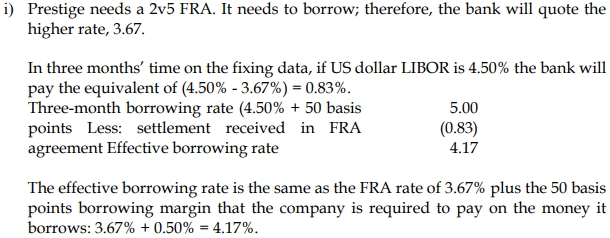
Calculate the effective rate of borrowing for three months and explain the advantages of convertible bonds.

With reference to Option Two:

i) What would be its effective rate of borrowing for the three months if US dollar LIBOR is 4.50% at the start of the notional interest period for the FRA? (2 marks)
ii) What are the advantages of Convertible Bonds? (3 marks)

ii) Advantages of Convertible Bonds:

  1. Lower Interest Rates: Convertible bonds typically offer lower interest rates than traditional bonds because investors are compensated by the option to convert the bonds into shares if the company’s stock performs well.
  2. Deferred Dilution: While convertible bonds offer the potential for equity conversion, dilution of ownership only occurs when the bonds are converted, allowing the company to defer issuing more shares and the impact on earnings per share.
  3. Attractive to Investors: Investors find convertible bonds appealing because they offer the stability of bond payments with the potential upside of converting into equity if the company’s stock price rises.
  4. Access to Capital: For companies like Prestige, convertible bonds can provide access to capital without immediately diluting shareholder equity and may be a more cost-effective option than issuing straight equity.

Login or create a free account to see answers

Complete your registration to see answers

Find Related Questions by Tags, levels, etc.

Report an error

You're reporting an error for "SCS – MAR 2024 – L3 – Q5b – Financial management"

SCS – MAR 2024 – L3 – Q5b – Financial management

This Question Has a Case Study: 

Calculate the effective rate of borrowing for three months and explain the advantages of convertible bonds.

With reference to Option Two:

i) What would be its effective rate of borrowing for the three months if US dollar LIBOR is 4.50% at the start of the notional interest period for the FRA? (2 marks)
ii) What are the advantages of Convertible Bonds? (3 marks)

ii) Advantages of Convertible Bonds:

  1. Lower Interest Rates: Convertible bonds typically offer lower interest rates than traditional bonds because investors are compensated by the option to convert the bonds into shares if the company’s stock performs well.
  2. Deferred Dilution: While convertible bonds offer the potential for equity conversion, dilution of ownership only occurs when the bonds are converted, allowing the company to defer issuing more shares and the impact on earnings per share.
  3. Attractive to Investors: Investors find convertible bonds appealing because they offer the stability of bond payments with the potential upside of converting into equity if the company’s stock price rises.
  4. Access to Capital: For companies like Prestige, convertible bonds can provide access to capital without immediately diluting shareholder equity and may be a more cost-effective option than issuing straight equity.

Login or create a free account to see answers

Complete your registration to see answers

Find Related Questions by Tags, levels, etc.

Report an error

You're reporting an error for "SCS – MAR 2024 – L3 – Q5b – Financial management"

SCS – MAR 2024 – L3 – Q5a – Financial management

Calculate various financial ratios including ROCE, EPS, DPS, and TSR based on given financial data.

With reference to the information in Option One available to Prestige as presented by Professor Joseph Laing, a business consultant, calculate the following:

i) Return on Capital Employed (ROCE) (1 mark)
ii) Earnings Per Share (EPS) (1 mark)
iii) Dividend Per Share (DPS) (2 marks)
iv) Total Shareholders Return (TSR) (2 marks)
v) Explain the difference between ROCE and Accounting Rate of Return, their essential features, and relationship (4 marks)

v) Difference between ROCE and Accounting Rate of Return (ARR):

  • ROCE is a measure of the return on capital employed in the business, calculated by dividing the profit before interest and tax (PBIT) by the average capital employed. It reflects the overall efficiency of the company in generating profits from its available capital.
  • ARR, on the other hand, measures the accounting profit from a specific capital project, usually before interest and tax, as a percentage of the capital invested in that project.
  • The key difference lies in their scope: while ROCE assesses the return from the entire business or company, ARR focuses on specific capital projects. Both are used to evaluate the efficiency of capital usage, but ARR is project-specific, whereas ROCE is company-wide.

Login or create a free account to see answers

Complete your registration to see answers

Find Related Questions by Tags, levels, etc.

Report an error

You're reporting an error for "SCS – MAR 2024 – L3 – Q5a – Financial management"

SCS – MAR 2024 – L3 – Q5a – Financial management

This Question Has a Case Study: 

Calculate various financial ratios including ROCE, EPS, DPS, and TSR based on given financial data.

With reference to the information in Option One available to Prestige as presented by Professor Joseph Laing, a business consultant, calculate the following:

i) Return on Capital Employed (ROCE) (1 mark)
ii) Earnings Per Share (EPS) (1 mark)
iii) Dividend Per Share (DPS) (2 marks)
iv) Total Shareholders Return (TSR) (2 marks)
v) Explain the difference between ROCE and Accounting Rate of Return, their essential features, and relationship (4 marks)

v) Difference between ROCE and Accounting Rate of Return (ARR):

  • ROCE is a measure of the return on capital employed in the business, calculated by dividing the profit before interest and tax (PBIT) by the average capital employed. It reflects the overall efficiency of the company in generating profits from its available capital.
  • ARR, on the other hand, measures the accounting profit from a specific capital project, usually before interest and tax, as a percentage of the capital invested in that project.
  • The key difference lies in their scope: while ROCE assesses the return from the entire business or company, ARR focuses on specific capital projects. Both are used to evaluate the efficiency of capital usage, but ARR is project-specific, whereas ROCE is company-wide.

Login or create a free account to see answers

Complete your registration to see answers

Find Related Questions by Tags, levels, etc.

Report an error

You're reporting an error for "SCS – MAR 2024 – L3 – Q5a – Financial management"

SCS – MAR 2024 – L3 – Q4b – Strategy implementation

Advise on an appropriate HR strategy to harmonize the organizational structure for effective delivery at Prestige.

Each company acquired or merged by Prestige was allowed to maintain its human resource structure.

Required:
Analyze and advise on an appropriate HR strategy Prestige should adopt to harmonize the organizational structure for effective delivery of the company’s objectives.

  1. Strategic Workforce Planning:
    • Prestige should develop a workforce plan to address the complexities introduced by mergers and acquisitions. This plan should estimate the required number of employees, their skills, and potential future needs based on the company’s objectives, particularly in innovation and technology adoption.
  2. HR Consistency with Corporate Strategy:
    • The HR strategy should align with both the corporate and divisional strategies to ensure that the required number and type of employees are available at the right time to support business operations across regions.
  3. Assessment of Current Workforce:
    • Prestige should conduct an audit of its current workforce, assessing skills, experience, and attrition rates. This would help in identifying gaps and surpluses that need to be addressed through recruitment, training, or redundancy.
  4. Recruitment and Training:
    • The strategy should focus on recruiting the necessary talent to fill gaps, while also implementing training and development programs to upskill existing employees. This will help align employee capabilities with the company’s strategic needs, especially in areas such as IT, finance, and project management.
  5. Performance Management:
    • Implementing a robust performance appraisal system would enable Prestige to monitor the development of employees’ skills and performance, ensuring that key objectives are met. This would also identify areas where employees may require additional training or support.
  6. Promotion and Career Development:
    • Providing clear promotion paths and career development opportunities would encourage employee retention and foster motivation within the workforce, helping Prestige maintain a skilled and experienced team.
  7. Handling Redundancies:
    • Where there are surplus employees due to structural changes, Prestige should have a clear policy for managing redundancies in a way that minimizes disruption while ensuring fairness and compliance with labor laws.
  8. Labor Relations and Employee Welfare:
    • Ensuring good labor relations through clear communication and employee engagement initiatives will help reduce resistance to change. Compensation, health and safety, and employee well-being should be central to the HR strategy to foster a positive workplace environment.
  9. Technological Impact on HR:
    • Prestige should anticipate and manage the impact of technological changes on its workforce, particularly in relation to automation, digital skills, and remote working capabilities.

Factors to Consider:

  • Population trends and labor market conditions.
  • Changes in government policies affecting employment.
  • The availability of specific skills within the workforce.
  • Competition for talent from other businesses.
  • Trends in outsourcing and subcontracting.

Login or create a free account to see answers

Complete your registration to see answers

Find Related Questions by Tags, levels, etc.

Report an error

You're reporting an error for "SCS – MAR 2024 – L3 – Q4b – Strategy implementation"

SCS – MAR 2024 – L3 – Q4b – Strategy implementation

This Question Has a Case Study: 

Advise on an appropriate HR strategy to harmonize the organizational structure for effective delivery at Prestige.

Each company acquired or merged by Prestige was allowed to maintain its human resource structure.

Required:
Analyze and advise on an appropriate HR strategy Prestige should adopt to harmonize the organizational structure for effective delivery of the company’s objectives.

  1. Strategic Workforce Planning:
    • Prestige should develop a workforce plan to address the complexities introduced by mergers and acquisitions. This plan should estimate the required number of employees, their skills, and potential future needs based on the company’s objectives, particularly in innovation and technology adoption.
  2. HR Consistency with Corporate Strategy:
    • The HR strategy should align with both the corporate and divisional strategies to ensure that the required number and type of employees are available at the right time to support business operations across regions.
  3. Assessment of Current Workforce:
    • Prestige should conduct an audit of its current workforce, assessing skills, experience, and attrition rates. This would help in identifying gaps and surpluses that need to be addressed through recruitment, training, or redundancy.
  4. Recruitment and Training:
    • The strategy should focus on recruiting the necessary talent to fill gaps, while also implementing training and development programs to upskill existing employees. This will help align employee capabilities with the company’s strategic needs, especially in areas such as IT, finance, and project management.
  5. Performance Management:
    • Implementing a robust performance appraisal system would enable Prestige to monitor the development of employees’ skills and performance, ensuring that key objectives are met. This would also identify areas where employees may require additional training or support.
  6. Promotion and Career Development:
    • Providing clear promotion paths and career development opportunities would encourage employee retention and foster motivation within the workforce, helping Prestige maintain a skilled and experienced team.
  7. Handling Redundancies:
    • Where there are surplus employees due to structural changes, Prestige should have a clear policy for managing redundancies in a way that minimizes disruption while ensuring fairness and compliance with labor laws.
  8. Labor Relations and Employee Welfare:
    • Ensuring good labor relations through clear communication and employee engagement initiatives will help reduce resistance to change. Compensation, health and safety, and employee well-being should be central to the HR strategy to foster a positive workplace environment.
  9. Technological Impact on HR:
    • Prestige should anticipate and manage the impact of technological changes on its workforce, particularly in relation to automation, digital skills, and remote working capabilities.

Factors to Consider:

  • Population trends and labor market conditions.
  • Changes in government policies affecting employment.
  • The availability of specific skills within the workforce.
  • Competition for talent from other businesses.
  • Trends in outsourcing and subcontracting.

Login or create a free account to see answers

Complete your registration to see answers

Find Related Questions by Tags, levels, etc.

Report an error

You're reporting an error for "SCS – MAR 2024 – L3 – Q4b – Strategy implementation"

SCS – MAR 2024 – L3 – Q4a – Strategy implementation

Explain how Prestige could leverage ICT using the four broad stages of e-business development to compete.

Prestige’s Board has shifted from their long-standing reluctance to venture into foreign markets to seriously consider the possibility of expansion overseas. An important implication of this decision is that as the size of the market increases, competition becomes international. The main rivals are no longer local suppliers to a domestic market.

Required:
Using the four broad stages of development to a full e-business model, explain how Prestige could leverage ICT to compete.

  1. Web Presence:
    • Prestige could set up a website to display its property listings and services. The website can serve as a platform to provide detailed information about the houses for sale, available property types, and contact details. This would enhance visibility and reach beyond local markets.
  2. E-Commerce:
    • Prestige can integrate e-commerce capabilities on its website, allowing potential buyers to make inquiries, schedule viewings, or even complete purchases online. They can also use e-commerce platforms to manage orders and payments from suppliers and partners.
  3. Integrated E-Commerce:
    • Prestige could utilize ICT to gather and analyze customer data to understand their preferences and buying behavior. By establishing two-way communication channels, the company could use customer feedback to improve its product offerings and tailor marketing strategies, boosting customer satisfaction.
  4. E-Business:
    • ICT can drive Prestige’s business strategy by making e-business a fundamental part of its operations. E-business can enhance efficiency in sales, marketing, procurement, and customer service, aligning business operations with digital transformation to gain a competitive edge in the global market.

Login or create a free account to see answers

Complete your registration to see answers

Find Related Questions by Tags, levels, etc.

Report an error

You're reporting an error for "SCS – MAR 2024 – L3 – Q4a – Strategy implementation"

SCS – MAR 2024 – L3 – Q4a – Strategy implementation

This Question Has a Case Study: 

Explain how Prestige could leverage ICT using the four broad stages of e-business development to compete.

Prestige’s Board has shifted from their long-standing reluctance to venture into foreign markets to seriously consider the possibility of expansion overseas. An important implication of this decision is that as the size of the market increases, competition becomes international. The main rivals are no longer local suppliers to a domestic market.

Required:
Using the four broad stages of development to a full e-business model, explain how Prestige could leverage ICT to compete.

  1. Web Presence:
    • Prestige could set up a website to display its property listings and services. The website can serve as a platform to provide detailed information about the houses for sale, available property types, and contact details. This would enhance visibility and reach beyond local markets.
  2. E-Commerce:
    • Prestige can integrate e-commerce capabilities on its website, allowing potential buyers to make inquiries, schedule viewings, or even complete purchases online. They can also use e-commerce platforms to manage orders and payments from suppliers and partners.
  3. Integrated E-Commerce:
    • Prestige could utilize ICT to gather and analyze customer data to understand their preferences and buying behavior. By establishing two-way communication channels, the company could use customer feedback to improve its product offerings and tailor marketing strategies, boosting customer satisfaction.
  4. E-Business:
    • ICT can drive Prestige’s business strategy by making e-business a fundamental part of its operations. E-business can enhance efficiency in sales, marketing, procurement, and customer service, aligning business operations with digital transformation to gain a competitive edge in the global market.

Login or create a free account to see answers

Complete your registration to see answers

Find Related Questions by Tags, levels, etc.

Report an error

You're reporting an error for "SCS – MAR 2024 – L3 – Q4a – Strategy implementation"

SCS – MAR 2024 – L3 – Q3 – Functional strategies

Explain the potential benefits of resource sharing through common IT systems at Prestige.

When five years ago the present regional divisional structure of Greater Accra, Ashanti, and Eastern was formalized, an attempt was made to ensure that common systems and ways of working were adopted across each of the three regions. However, due to the pressures on the Company, this was never fully implemented.

Required:
Explain the potential benefits of resource sharing (configuring an organization’s computing system in such a way that the information and resources within it can be accessed, and remotely accessed, across multiple administrative domains) to Prestige if they adopt common IT systems.

  1. Ease of Access: A common IT system allows staff to access systems, software, and files from any location with an internet connection. This supports collaborative working across regions.
  2. Accuracy: Having a single source of data ensures accuracy by eliminating multiple similar versions scattered across the organization. This provides reliable information to all divisions.
  3. Cost Savings: Resource sharing avoids duplication of work across divisions. Generating similar data for similar purposes can be costly, so producing data once and sharing it reduces inefficiencies and costs for Prestige.
  4. Facilitates Remote Working: IT resource sharing enables remote working, increasing flexibility. Employees can work from any location, enhancing motivation and potentially creating cost savings by allowing work from home.
  5. Transparency: Resource sharing promotes transparency across the organization by making information easily accessible to all relevant parties. This can improve decision-making and operational efficiency.

Login or create a free account to see answers

Complete your registration to see answers

Find Related Questions by Tags, levels, etc.

Report an error

You're reporting an error for "SCS – MAR 2024 – L3 – Q3 – Functional strategies"

SCS – MAR 2024 – L3 – Q3 – Functional strategies

This Question Has a Case Study: 

Explain the potential benefits of resource sharing through common IT systems at Prestige.

When five years ago the present regional divisional structure of Greater Accra, Ashanti, and Eastern was formalized, an attempt was made to ensure that common systems and ways of working were adopted across each of the three regions. However, due to the pressures on the Company, this was never fully implemented.

Required:
Explain the potential benefits of resource sharing (configuring an organization’s computing system in such a way that the information and resources within it can be accessed, and remotely accessed, across multiple administrative domains) to Prestige if they adopt common IT systems.

  1. Ease of Access: A common IT system allows staff to access systems, software, and files from any location with an internet connection. This supports collaborative working across regions.
  2. Accuracy: Having a single source of data ensures accuracy by eliminating multiple similar versions scattered across the organization. This provides reliable information to all divisions.
  3. Cost Savings: Resource sharing avoids duplication of work across divisions. Generating similar data for similar purposes can be costly, so producing data once and sharing it reduces inefficiencies and costs for Prestige.
  4. Facilitates Remote Working: IT resource sharing enables remote working, increasing flexibility. Employees can work from any location, enhancing motivation and potentially creating cost savings by allowing work from home.
  5. Transparency: Resource sharing promotes transparency across the organization by making information easily accessible to all relevant parties. This can improve decision-making and operational efficiency.

Login or create a free account to see answers

Complete your registration to see answers

Find Related Questions by Tags, levels, etc.

Report an error

You're reporting an error for "SCS – MAR 2024 – L3 – Q3 – Functional strategies"

SCS – MAR 2024 – L3 – Q2 – Competitive advantage

Apply and appraise Porter’s three strategies for sustaining competitive advantage for Prestige Designers Ltd.

A strategic clock can be used to consider different business strategies for gaining competitive advantage, based on providing a combination of price and perceived benefits. Porter has suggested three strategies for sustaining competitive advantage over rival firms and their products or services. They are a cost leadership strategy, a differentiation strategy, and a focus strategy.

Required:
Apply and appraise how effective the suggested three strategies for sustaining competitive advantage over rival firms would be useful to Prestige. (10 marks)

  1. Cost Leadership Strategy:
    • Prestige must compete effectively on price by offering its housing stock at a lower price than rivals.
    • The company should have excellent cost control systems and continually plan for further reductions in costs to remain the cost leader in the market.
    • Prestige, being a large company, can benefit from economies of scale compared to smaller competitors.
    • To achieve reasonable profit margins, Prestige must sell large volumes of homes at a lower profit margin per unit.
  2. Differentiation Strategy:
    • Prestige’s products must be distinct from those of its competitors in a way that customers can recognize, potentially leveraging the “Vintage” brand which focuses on low-cost housing for young buyers.
    • The company could innovate and incorporate modern methods of construction (MMC) and sustainability-related methods to differentiate its products.
    • Customers might be willing to pay more for homes with unique features and higher perceived value.
    • Prestige should invest in delivering superior value to customers, even if that means higher upfront costs.
  3. Focus Strategy:
    • Prestige could focus on segmented consumer markets by selecting specific segments, such as the middle-class or younger first-time home buyers, as the primary market for their products.
    • The company could concentrate on serving a particular type of customer or region, allowing it to tailor its offerings to the unique demands of that segment.

Login or create a free account to see answers

Complete your registration to see answers

Find Related Questions by Tags, levels, etc.

Report an error

You're reporting an error for "SCS – MAR 2024 – L3 – Q2 – Competitive advantage"

SCS – MAR 2024 – L3 – Q2 – Competitive advantage

This Question Has a Case Study: 

Apply and appraise Porter’s three strategies for sustaining competitive advantage for Prestige Designers Ltd.

A strategic clock can be used to consider different business strategies for gaining competitive advantage, based on providing a combination of price and perceived benefits. Porter has suggested three strategies for sustaining competitive advantage over rival firms and their products or services. They are a cost leadership strategy, a differentiation strategy, and a focus strategy.

Required:
Apply and appraise how effective the suggested three strategies for sustaining competitive advantage over rival firms would be useful to Prestige. (10 marks)

  1. Cost Leadership Strategy:
    • Prestige must compete effectively on price by offering its housing stock at a lower price than rivals.
    • The company should have excellent cost control systems and continually plan for further reductions in costs to remain the cost leader in the market.
    • Prestige, being a large company, can benefit from economies of scale compared to smaller competitors.
    • To achieve reasonable profit margins, Prestige must sell large volumes of homes at a lower profit margin per unit.
  2. Differentiation Strategy:
    • Prestige’s products must be distinct from those of its competitors in a way that customers can recognize, potentially leveraging the “Vintage” brand which focuses on low-cost housing for young buyers.
    • The company could innovate and incorporate modern methods of construction (MMC) and sustainability-related methods to differentiate its products.
    • Customers might be willing to pay more for homes with unique features and higher perceived value.
    • Prestige should invest in delivering superior value to customers, even if that means higher upfront costs.
  3. Focus Strategy:
    • Prestige could focus on segmented consumer markets by selecting specific segments, such as the middle-class or younger first-time home buyers, as the primary market for their products.
    • The company could concentrate on serving a particular type of customer or region, allowing it to tailor its offerings to the unique demands of that segment.

Login or create a free account to see answers

Complete your registration to see answers

Find Related Questions by Tags, levels, etc.

Report an error

You're reporting an error for "SCS – MAR 2024 – L3 – Q2 – Competitive advantage"

BCL – Mar 2024 – L1 – Q5b – Types of Capital and the Financing of Companies

Explain the concepts of a fixed charge and a bond in the context of company financing.

A loan taken by a company limited by shares may or may not be secured by a charge.

Required:

In reference to the above statement, explain the following:

i) A fixed charge (3 marks)

ii) A bond (3 marks)

i) A Fixed Charge:

Debentures form part of a company’s loan capital. There are two types of secured debentures: debentures secured by a fixed charge and those secured by a floating charge. A debenture secured by a fixed charge is a loan to the company for which specific property of the company, such as land, buildings, vehicles, plant machinery, or equipment, is used as security to ensure repayment of the loan. In contrast, a floating charge covers general assets or undertakings of the company, allowing the company to continue dealing with those assets until the occurrence of a certain event that “crystallizes” the floating charge into a fixed charge.

A fixed charge on a property has priority over a floating charge affecting that property unless the terms of the floating charge specifically prohibit the company from granting a later charge that has priority over the floating charge, and the person in whose favor that later charge was granted had actual notice of that prohibition at the time when the charge was granted.

(3 marks)

ii) A Bond:

A bond is a written promise to pay money. It is an obligation to pay a fixed sum of money at a definite time with stated interest, and it makes no difference whether a bond is designated by that name or by some other name, as it possesses the characteristics of a bond.

(3 marks)

Login or create a free account to see answers

Complete your registration to see answers

Find Related Questions by Tags, levels, etc.

Report an error

You're reporting an error for "BCL – Mar 2024 – L1 – Q5b – Types of Capital and the Financing of Companies"

BCL – Mar 2024 – L1 – Q5b – Types of Capital and the Financing of Companies

Explain the concepts of a fixed charge and a bond in the context of company financing.

A loan taken by a company limited by shares may or may not be secured by a charge.

Required:

In reference to the above statement, explain the following:

i) A fixed charge (3 marks)

ii) A bond (3 marks)

i) A Fixed Charge:

Debentures form part of a company’s loan capital. There are two types of secured debentures: debentures secured by a fixed charge and those secured by a floating charge. A debenture secured by a fixed charge is a loan to the company for which specific property of the company, such as land, buildings, vehicles, plant machinery, or equipment, is used as security to ensure repayment of the loan. In contrast, a floating charge covers general assets or undertakings of the company, allowing the company to continue dealing with those assets until the occurrence of a certain event that “crystallizes” the floating charge into a fixed charge.

A fixed charge on a property has priority over a floating charge affecting that property unless the terms of the floating charge specifically prohibit the company from granting a later charge that has priority over the floating charge, and the person in whose favor that later charge was granted had actual notice of that prohibition at the time when the charge was granted.

(3 marks)

ii) A Bond:

A bond is a written promise to pay money. It is an obligation to pay a fixed sum of money at a definite time with stated interest, and it makes no difference whether a bond is designated by that name or by some other name, as it possesses the characteristics of a bond.

(3 marks)

Login or create a free account to see answers

Complete your registration to see answers

Find Related Questions by Tags, levels, etc.

Report an error

You're reporting an error for "BCL – Mar 2024 – L1 – Q5b – Types of Capital and the Financing of Companies"

BCL – Mar 2024 – L1 – Q5a – Types of Capital and the Financing of Companies

Identify and explain prohibited transactions in shares under the Companies Act, 2019 (Act 992).

State TWO (2) prohibited transactions in shares under section 58(1) of the Companies Act, 2019, Act 992 where a company limited by shares is prohibited from transacting in its shares.

(4 marks)

A company shall not:

  • Alter the number of its shares or the amount of money remaining payable on those shares.
  • Release a shareholder or former shareholder from a liability on the shares.
  • Provide financial assistance, directly or indirectly, for the subscription or purchase of the shares of the company or the shares of its holding company.
  • Acquire, by way of purchase or otherwise, any of its issued shares or any shares of its holding company.

(Any 2 points @ 2 marks each = 4 marks)

Login or create a free account to see answers

Complete your registration to see answers

Find Related Questions by Tags, levels, etc.

Report an error

You're reporting an error for "BCL – Mar 2024 – L1 – Q5a – Types of Capital and the Financing of Companies"

BCL – Mar 2024 – L1 – Q5a – Types of Capital and the Financing of Companies

Identify and explain prohibited transactions in shares under the Companies Act, 2019 (Act 992).

State TWO (2) prohibited transactions in shares under section 58(1) of the Companies Act, 2019, Act 992 where a company limited by shares is prohibited from transacting in its shares.

(4 marks)

A company shall not:

  • Alter the number of its shares or the amount of money remaining payable on those shares.
  • Release a shareholder or former shareholder from a liability on the shares.
  • Provide financial assistance, directly or indirectly, for the subscription or purchase of the shares of the company or the shares of its holding company.
  • Acquire, by way of purchase or otherwise, any of its issued shares or any shares of its holding company.

(Any 2 points @ 2 marks each = 4 marks)

Login or create a free account to see answers

Complete your registration to see answers

Find Related Questions by Tags, levels, etc.

Report an error

You're reporting an error for "BCL – Mar 2024 – L1 – Q5a – Types of Capital and the Financing of Companies"

BCL – Mar 2024 – L1 – Q4c – Types of Capital and the Financing of Companies, Company Law

Explain the legal significance of statements made in a share certificate under the Companies Act, 2019 (Act 992).

“Statements made in a share certificate, especially where the certificate bears the common seal of the company, shall be absolute or unassailable evidence of the title of the person named in the Certificate.”

Required:

Explain if the above statement is the true position of the law in terms of the provisions of the Companies Act, Act 992.

(2 marks)

Statements made in a share certificate under the common seal of the company or as certified by two directors and the Company Secretary of the company, are prima facie evidence of the title to the shares of the person named in the certificate as the registered holder and of the amounts of money paid and payable on the certificate.

Section 56 of the Companies Act, 2019 (Act 992) affirms that the above statement is indeed the true position of the law. Therefore, the statements made in a share certificate are considered strong legal evidence of ownership and the details contained therein, making the certificate a critical document in establishing the rights of the shareholder named within.

(2 marks)

Login or create a free account to see answers

Complete your registration to see answers

Find Related Questions by Tags, levels, etc.

Report an error

You're reporting an error for "BCL – Mar 2024 – L1 – Q4c – Types of Capital and the Financing of Companies, Company Law"

BCL – Mar 2024 – L1 – Q4c – Types of Capital and the Financing of Companies, Company Law

Explain the legal significance of statements made in a share certificate under the Companies Act, 2019 (Act 992).

“Statements made in a share certificate, especially where the certificate bears the common seal of the company, shall be absolute or unassailable evidence of the title of the person named in the Certificate.”

Required:

Explain if the above statement is the true position of the law in terms of the provisions of the Companies Act, Act 992.

(2 marks)

Statements made in a share certificate under the common seal of the company or as certified by two directors and the Company Secretary of the company, are prima facie evidence of the title to the shares of the person named in the certificate as the registered holder and of the amounts of money paid and payable on the certificate.

Section 56 of the Companies Act, 2019 (Act 992) affirms that the above statement is indeed the true position of the law. Therefore, the statements made in a share certificate are considered strong legal evidence of ownership and the details contained therein, making the certificate a critical document in establishing the rights of the shareholder named within.

(2 marks)

Login or create a free account to see answers

Complete your registration to see answers

Find Related Questions by Tags, levels, etc.

Report an error

You're reporting an error for "BCL – Mar 2024 – L1 – Q4c – Types of Capital and the Financing of Companies, Company Law"

BCL – Mar 2024 – L1 – Q4b – Alternative Forms and Constitutions of Business Organisations

Discuss the existence of a partnership in the provided scenario and the liabilities associated with partnership actions.

Three persons, Booker, Weah, and Makafui agreed to set up a restaurant. The finance was provided almost entirely by one of them, Booker. Before the restaurant opened, furniture and equipment were purchased and a laundry contract was entered into. Advertisements were placed in the newspapers and on television, apart from the fact that premises were acquired by the person who supplied the money. The parties then fell out and the business did not proceed as planned.

Required:

i) Explain whether in the circumstances of the facts, there is a Partnership in terms of the provisions of the Incorporated Private Partnership Act, 1962 (Act 152). (5 marks)

ii) State TWO (2) liabilities of Partnership for action or transaction done in the course of a Partnership business.

(3 marks)

i) Existence of a Partnership:

Section 1 of the Incorporated Private Partnerships Act, 1962 (Act 152) defines a partnership as the association of two or more individuals carrying on business jointly for the purpose of making profits.

Section 3(1) of Act 152 requires a copy of the partnership agreement to be submitted to the Registrar upon registration of the partnership.

Based on the facts provided, there was an association of two or more individuals who agreed to set up a restaurant. The individuals agreed on the kind of business they intended to carry on. Implied in the facts is that there was a partnership agreement, with each partner contributing financially or in kind. However, from the facts, only one of them, Booker, contributed substantially, and the parties fell out before the business could proceed as planned.

The substantive requirement of a partnership under Section 1 is the carrying on of business jointly for the purpose of profit. Since the business did not proceed as planned, one cannot conclusively say that the parties were in a partnership for business.

(5 marks)

ii) Liabilities of Partnership for Actions or Transactions Done in the Course of Partnership Business:

Section 12 of the Incorporated Private Partnerships Act, 1962 (Act 152) provides that a partner is an agent of the firm for the purposes of the business of the firm. The acts of the partners bind the firm if:

  • The acts were authorized, expressly or impliedly, by the other partners or were subsequently ratified by them;
  • The acts were done for carrying on in the usual way business of the kind carried by the firm.

Where the acts of a partner are for a purpose apparently not connected with the firm’s ordinary course of business, the firm is not bound unless the partner is in fact authorized by other partners or the act is subsequently ratified by them.

When a tort is committed by a partner in the course of business approved by the partners, all the partners become jointly and severally liable to the person who has suffered a loss as a result.

(Any 2 points @ 1.5 marks each = 3 marks)

Login or create a free account to see answers

Complete your registration to see answers

Find Related Questions by Tags, levels, etc.

Report an error

You're reporting an error for "BCL – Mar 2024 – L1 – Q4b – Alternative Forms and Constitutions of Business Organisations"

BCL – Mar 2024 – L1 – Q4b – Alternative Forms and Constitutions of Business Organisations

Discuss the existence of a partnership in the provided scenario and the liabilities associated with partnership actions.

Three persons, Booker, Weah, and Makafui agreed to set up a restaurant. The finance was provided almost entirely by one of them, Booker. Before the restaurant opened, furniture and equipment were purchased and a laundry contract was entered into. Advertisements were placed in the newspapers and on television, apart from the fact that premises were acquired by the person who supplied the money. The parties then fell out and the business did not proceed as planned.

Required:

i) Explain whether in the circumstances of the facts, there is a Partnership in terms of the provisions of the Incorporated Private Partnership Act, 1962 (Act 152). (5 marks)

ii) State TWO (2) liabilities of Partnership for action or transaction done in the course of a Partnership business.

(3 marks)

i) Existence of a Partnership:

Section 1 of the Incorporated Private Partnerships Act, 1962 (Act 152) defines a partnership as the association of two or more individuals carrying on business jointly for the purpose of making profits.

Section 3(1) of Act 152 requires a copy of the partnership agreement to be submitted to the Registrar upon registration of the partnership.

Based on the facts provided, there was an association of two or more individuals who agreed to set up a restaurant. The individuals agreed on the kind of business they intended to carry on. Implied in the facts is that there was a partnership agreement, with each partner contributing financially or in kind. However, from the facts, only one of them, Booker, contributed substantially, and the parties fell out before the business could proceed as planned.

The substantive requirement of a partnership under Section 1 is the carrying on of business jointly for the purpose of profit. Since the business did not proceed as planned, one cannot conclusively say that the parties were in a partnership for business.

(5 marks)

ii) Liabilities of Partnership for Actions or Transactions Done in the Course of Partnership Business:

Section 12 of the Incorporated Private Partnerships Act, 1962 (Act 152) provides that a partner is an agent of the firm for the purposes of the business of the firm. The acts of the partners bind the firm if:

  • The acts were authorized, expressly or impliedly, by the other partners or were subsequently ratified by them;
  • The acts were done for carrying on in the usual way business of the kind carried by the firm.

Where the acts of a partner are for a purpose apparently not connected with the firm’s ordinary course of business, the firm is not bound unless the partner is in fact authorized by other partners or the act is subsequently ratified by them.

When a tort is committed by a partner in the course of business approved by the partners, all the partners become jointly and severally liable to the person who has suffered a loss as a result.

(Any 2 points @ 1.5 marks each = 3 marks)

Login or create a free account to see answers

Complete your registration to see answers

Find Related Questions by Tags, levels, etc.

Report an error

You're reporting an error for "BCL – Mar 2024 – L1 – Q4b – Alternative Forms and Constitutions of Business Organisations"

BCL – Mar 2024 – L1 – Q4a – Employment Law

Evaluate the chances of three individuals succeeding in a court action against MNS Bank for wrongful termination based on the Labour Act.

Three individuals, namely, Agogo, Djiku and Esinam, worked for MNS Bank, upon completing their National Service for a period of five years. It is the case of the workers that for a period of five years the Bank engaged them as temporary employees. Sometime in the year 2023, the workers received letters from a firm called Bansey HR Ltd, an employment agency, engaged by MNS Bank. In the letter, the three individuals had been offered a contract agreement for a six-month period from 2 May, 2023 to 2 November, 2023 by Bansey HR Ltd, and assigned to the Bank.

The letters sought to change their status from temporary employees of the Bank to temporary employees of Bansey HR Ltd. The three workers, however, tendered their resignations from MNS Bank effective 2 June, 2023. The three workers then commenced an action in the High Court, Accra, claiming damages for wrongful termination, arguing that having worked for more than six months with MNS Bank as contract workers, they had become permanent workers and could not be transferred to Bansey HR Ltd.

The Bank resisted the action, arguing that in accordance with a new Policy of the Bank, the Management decided to outsource the employment of all its temporary staff, which includes the three individuals, to Bansey HR Ltd. The Bank contended that upon receipt of the letters from Bansey HR Ltd, the three workers on their own volition resigned and are therefore not entitled to their claim.

Required:

In the light of the provisions of the Labour Act, 2003, Act 651, explain the chances of the three individuals in their court action against MNS Bank. (10 marks)

Section 12 of the Labour Act, 2003 (Act 651) provides that the employment of a worker by an employer for a period of six months or more, or for a number of working days equivalent to six months or more, shall be secured by a written contract of employment.

The three individuals, namely Agogo, Djiku, and Esinam, were said to have worked for 5 years as temporary workers in MNS Bank. On the strength of Section 12 of Act 651, MNS Bank should have secured the employment of the three as permanent workers by a written contract.

On the Bank’s failure to do so, the three individuals succeed in their court actions. As regards the resignation of the three individuals, Section 15 of Act 651 provides for the grounds for termination, stating that a contract of employment may be terminated, inter alia, by the worker on the grounds of ill-treatment.

Section 63(3) of Act 651 also provides that the termination of a worker’s employment is considered unfair if, with or without notice to the employer, the worker terminates the employment because of ill-treatment of the worker, having regard to the circumstances of the case.

The Act does not define what constitutes ill-treatment. However, the circumstances of the facts that they were denied what was legally due them by not securing their employment by written contract imply ill-treatment.

Section 63(4) further provides that a termination may be considered unfair if the employer fails to prove that:

(a) The reason for the termination is fair, or (b) The termination was in accordance with a fair procedure as provided by Act 651.

The three individuals terminated their employment by resignation. The argument by the Bank that their decision to outsource the employment of the three, based on the new Policy, is neither fair nor in accordance with fair procedure or as provided in Act 651 to secure the employment of three individuals by a written contract of employment.

On the basis of Section 63, the three individuals have a good chance of succeeding in their court action.

(10 marks)

Login or create a free account to see answers

Complete your registration to see answers

Find Related Questions by Tags, levels, etc.

Report an error

You're reporting an error for "BCL – Mar 2024 – L1 – Q4a – Employment Law"

BCL – Mar 2024 – L1 – Q4a – Employment Law

Evaluate the chances of three individuals succeeding in a court action against MNS Bank for wrongful termination based on the Labour Act.

Three individuals, namely, Agogo, Djiku and Esinam, worked for MNS Bank, upon completing their National Service for a period of five years. It is the case of the workers that for a period of five years the Bank engaged them as temporary employees. Sometime in the year 2023, the workers received letters from a firm called Bansey HR Ltd, an employment agency, engaged by MNS Bank. In the letter, the three individuals had been offered a contract agreement for a six-month period from 2 May, 2023 to 2 November, 2023 by Bansey HR Ltd, and assigned to the Bank.

The letters sought to change their status from temporary employees of the Bank to temporary employees of Bansey HR Ltd. The three workers, however, tendered their resignations from MNS Bank effective 2 June, 2023. The three workers then commenced an action in the High Court, Accra, claiming damages for wrongful termination, arguing that having worked for more than six months with MNS Bank as contract workers, they had become permanent workers and could not be transferred to Bansey HR Ltd.

The Bank resisted the action, arguing that in accordance with a new Policy of the Bank, the Management decided to outsource the employment of all its temporary staff, which includes the three individuals, to Bansey HR Ltd. The Bank contended that upon receipt of the letters from Bansey HR Ltd, the three workers on their own volition resigned and are therefore not entitled to their claim.

Required:

In the light of the provisions of the Labour Act, 2003, Act 651, explain the chances of the three individuals in their court action against MNS Bank. (10 marks)

Section 12 of the Labour Act, 2003 (Act 651) provides that the employment of a worker by an employer for a period of six months or more, or for a number of working days equivalent to six months or more, shall be secured by a written contract of employment.

The three individuals, namely Agogo, Djiku, and Esinam, were said to have worked for 5 years as temporary workers in MNS Bank. On the strength of Section 12 of Act 651, MNS Bank should have secured the employment of the three as permanent workers by a written contract.

On the Bank’s failure to do so, the three individuals succeed in their court actions. As regards the resignation of the three individuals, Section 15 of Act 651 provides for the grounds for termination, stating that a contract of employment may be terminated, inter alia, by the worker on the grounds of ill-treatment.

Section 63(3) of Act 651 also provides that the termination of a worker’s employment is considered unfair if, with or without notice to the employer, the worker terminates the employment because of ill-treatment of the worker, having regard to the circumstances of the case.

The Act does not define what constitutes ill-treatment. However, the circumstances of the facts that they were denied what was legally due them by not securing their employment by written contract imply ill-treatment.

Section 63(4) further provides that a termination may be considered unfair if the employer fails to prove that:

(a) The reason for the termination is fair, or (b) The termination was in accordance with a fair procedure as provided by Act 651.

The three individuals terminated their employment by resignation. The argument by the Bank that their decision to outsource the employment of the three, based on the new Policy, is neither fair nor in accordance with fair procedure or as provided in Act 651 to secure the employment of three individuals by a written contract of employment.

On the basis of Section 63, the three individuals have a good chance of succeeding in their court action.

(10 marks)

Login or create a free account to see answers

Complete your registration to see answers

Find Related Questions by Tags, levels, etc.

Report an error

You're reporting an error for "BCL – Mar 2024 – L1 – Q4a – Employment Law"

BCL – Mar 2024 – L1 – Q3b – Company Law

Analyze the chances of success for shareholders' action against the company under the Companies Act, 2019 (Act 992) and explain the organs through which a company acts.

Kofi Ameyaw and Salia Sule, shareholders of Bubra Ltd, commenced an action in court against the company alleging that properties of the company had been misapplied and wasted, and that certain mortgages were improperly secured as guarantee with the company’s properties. In their action, they also alleged that the company gave negligent advice which had resulted in their suffering economic loss which was personal and individual to them. Kofi Ameyaw and Salia Sule are seeking an order of the court for the company to account for the appointment of a Receiver.

Required:

i) Explain the chances of Kofi Ameyaw and Salia Sule in their court action, in the light of the provisions of the Companies Act, 2019 (Act 992). (9 marks)

ii) Explain FOUR (4) entities or organs through which a company can act pursuant to provisions of the Companies Act, 2019 (Act 992). (6 marks)

i) Chances of Success in Court Action:

Section 219 of the Companies Act, 2019 (Act 992) provides a remedy against oppression. A member or debenture holder of a company may apply to the court for an order under this section on the ground that:

  • The affairs of the company are being conducted or the powers of the directors are being exercised in a manner oppressive to one or more of the members or debenture holders or in disregard of the proper interests of those members, shareholders, officers, or debenture holders of the company; or
  • An act of the company has been done or is threatened, or a resolution of the members, debenture holders, or a class of them has been passed or is proposed, which unfairly discriminates against, or is otherwise unfairly prejudicial to, one or more of the members or debenture holders.

The issue is whether Kofi Ameyaw and Salia Sule can proceed as minority members on oppression. Section 219 of Act 992 is applicable to the scenario.

The complaint of Kofi Ameyaw and Salia Sule is that the properties of the company had been misapplied and wasted, and that mortgages were improperly secured as guarantees with the company’s properties. Furthermore, they claim that the company gave negligent advice which resulted in personal economic loss.

The two are likely to succeed pursuant to section 219, which provision gives the two members the right to action even though they may be in the minority.

(9 marks)

ii) Four Entities or Organs Through Which a Company Acts:

According to section 144 (1) of the Companies Act, 2019 (Act 992), a company shall act through the following entities or organs:

  • Board of Directors: The Board is the heart of the company. It decides on policy initiatives, ensures the declaration of dividends, and generally oversees the management of the company.
  • Managing Director: The Managing Director is responsible for running the company. He spearheads the implementation of the Board’s policy decisions and has the power to bind the company and take various decisions on its behalf.
  • Annual General Meeting (AGM): The AGM is a gathering of shareholders where they approve or disapprove the actions and business of the company, such as the declaration of dividends, election of directors, and approval of auditors’ reports.
  • Shareholders/Members: Shareholders are the owners of the company. Through their participation in meetings and other corporate actions, they influence the company’s operations.

(4 points @ 1.5 marks each = 6 marks)

Login or create a free account to see answers

Complete your registration to see answers

Find Related Questions by Tags, levels, etc.

Report an error

You're reporting an error for "BCL – Mar 2024 – L1 – Q3b – Company Law"

BCL – Mar 2024 – L1 – Q3b – Company Law

Analyze the chances of success for shareholders' action against the company under the Companies Act, 2019 (Act 992) and explain the organs through which a company acts.

Kofi Ameyaw and Salia Sule, shareholders of Bubra Ltd, commenced an action in court against the company alleging that properties of the company had been misapplied and wasted, and that certain mortgages were improperly secured as guarantee with the company’s properties. In their action, they also alleged that the company gave negligent advice which had resulted in their suffering economic loss which was personal and individual to them. Kofi Ameyaw and Salia Sule are seeking an order of the court for the company to account for the appointment of a Receiver.

Required:

i) Explain the chances of Kofi Ameyaw and Salia Sule in their court action, in the light of the provisions of the Companies Act, 2019 (Act 992). (9 marks)

ii) Explain FOUR (4) entities or organs through which a company can act pursuant to provisions of the Companies Act, 2019 (Act 992). (6 marks)

i) Chances of Success in Court Action:

Section 219 of the Companies Act, 2019 (Act 992) provides a remedy against oppression. A member or debenture holder of a company may apply to the court for an order under this section on the ground that:

  • The affairs of the company are being conducted or the powers of the directors are being exercised in a manner oppressive to one or more of the members or debenture holders or in disregard of the proper interests of those members, shareholders, officers, or debenture holders of the company; or
  • An act of the company has been done or is threatened, or a resolution of the members, debenture holders, or a class of them has been passed or is proposed, which unfairly discriminates against, or is otherwise unfairly prejudicial to, one or more of the members or debenture holders.

The issue is whether Kofi Ameyaw and Salia Sule can proceed as minority members on oppression. Section 219 of Act 992 is applicable to the scenario.

The complaint of Kofi Ameyaw and Salia Sule is that the properties of the company had been misapplied and wasted, and that mortgages were improperly secured as guarantees with the company’s properties. Furthermore, they claim that the company gave negligent advice which resulted in personal economic loss.

The two are likely to succeed pursuant to section 219, which provision gives the two members the right to action even though they may be in the minority.

(9 marks)

ii) Four Entities or Organs Through Which a Company Acts:

According to section 144 (1) of the Companies Act, 2019 (Act 992), a company shall act through the following entities or organs:

  • Board of Directors: The Board is the heart of the company. It decides on policy initiatives, ensures the declaration of dividends, and generally oversees the management of the company.
  • Managing Director: The Managing Director is responsible for running the company. He spearheads the implementation of the Board’s policy decisions and has the power to bind the company and take various decisions on its behalf.
  • Annual General Meeting (AGM): The AGM is a gathering of shareholders where they approve or disapprove the actions and business of the company, such as the declaration of dividends, election of directors, and approval of auditors’ reports.
  • Shareholders/Members: Shareholders are the owners of the company. Through their participation in meetings and other corporate actions, they influence the company’s operations.

(4 points @ 1.5 marks each = 6 marks)

Login or create a free account to see answers

Complete your registration to see answers

Find Related Questions by Tags, levels, etc.

Report an error

You're reporting an error for "BCL – Mar 2024 – L1 – Q3b – Company Law"

BCL – Mar 2024 – L1 – Q3a – Contract Law

Explain the three main kinds of mistakes recognized in contract law.

There are three main kinds of mistakes which are recognized at common law in the law of contract.

Required:

Explain the THREE (3) kinds of mistake. (5 marks)

The three kinds of operative mistake are:

  • Common Mistake: In common mistake, both parties make the same mistake. Each knows the intention of the other and accepts it, but each is mistaken about some underlying and fundamental fact. For example, the parties might be unaware that the subject matter of their contract has already perished.
  • Mutual Mistake: In mutual mistake, the parties misunderstand each other and are at cross-purposes. For example, A intends to offer his Nissan Sunny car for sale, but B believes that the offer relates to Nissan Corona, also owned by A.
  • Unilateral Mistake: In unilateral mistake, only one of the parties is mistaken. The other knows, or must be taken to know, of his mistake. For instance, A agrees to buy from B a specific painting which A believes to be genuinely that of painter Offei, but which in fact is not but a copy from Appia. If B is ignorant of A’s erroneous belief, the case is one of mutual mistake, but if he knows of it, it is a case of unilateral mistake.

(1.667 marks each = 5 marks)

Login or create a free account to see answers

Complete your registration to see answers

Find Related Questions by Tags, levels, etc.

Report an error

You're reporting an error for "BCL – Mar 2024 – L1 – Q3a – Contract Law"

BCL – Mar 2024 – L1 – Q3a – Contract Law

Explain the three main kinds of mistakes recognized in contract law.

There are three main kinds of mistakes which are recognized at common law in the law of contract.

Required:

Explain the THREE (3) kinds of mistake. (5 marks)

The three kinds of operative mistake are:

  • Common Mistake: In common mistake, both parties make the same mistake. Each knows the intention of the other and accepts it, but each is mistaken about some underlying and fundamental fact. For example, the parties might be unaware that the subject matter of their contract has already perished.
  • Mutual Mistake: In mutual mistake, the parties misunderstand each other and are at cross-purposes. For example, A intends to offer his Nissan Sunny car for sale, but B believes that the offer relates to Nissan Corona, also owned by A.
  • Unilateral Mistake: In unilateral mistake, only one of the parties is mistaken. The other knows, or must be taken to know, of his mistake. For instance, A agrees to buy from B a specific painting which A believes to be genuinely that of painter Offei, but which in fact is not but a copy from Appia. If B is ignorant of A’s erroneous belief, the case is one of mutual mistake, but if he knows of it, it is a case of unilateral mistake.

(1.667 marks each = 5 marks)

Login or create a free account to see answers

Complete your registration to see answers

Find Related Questions by Tags, levels, etc.

Report an error

You're reporting an error for "BCL – Mar 2024 – L1 – Q3a – Contract Law"

BCL – Mar 2024 – L1 – Q2c – Contract Law

Assess the accuracy of the statement regarding third-party rights in the context of contract law.

“A third party who, without notice of any fraud or deficiency, obtains a contractual benefit is entitled to keep it.”

Required:

Briefly explain the accuracy or otherwise of the statement above. (3 marks)

The accuracy or otherwise of the statement depends on the contractual setting. This occurs in unilateral mistake where a fraudulent person assumes the name of a person of repute. A contract is then concluded. The fraud then passes on the item of sale to a third party who purchases it in good faith. If there is no intention to avoid the contract, the third party benefits from the contract.

However, the scenario is different where the original owner intends to deal with the named person and the said person only, and attempts are made to avoid the contract with the fraudulent person. In that case, no title passes to the third party. The cases of Ingram vs Little, Phillips vs Brooks, and Cundy vs Lindsay explain the statement.

(3 marks)

Login or create a free account to see answers

Complete your registration to see answers

Find Related Questions by Tags, levels, etc.

Report an error

You're reporting an error for "BCL – Mar 2024 – L1 – Q2c – Contract Law"

BCL – Mar 2024 – L1 – Q2c – Contract Law

Assess the accuracy of the statement regarding third-party rights in the context of contract law.

“A third party who, without notice of any fraud or deficiency, obtains a contractual benefit is entitled to keep it.”

Required:

Briefly explain the accuracy or otherwise of the statement above. (3 marks)

The accuracy or otherwise of the statement depends on the contractual setting. This occurs in unilateral mistake where a fraudulent person assumes the name of a person of repute. A contract is then concluded. The fraud then passes on the item of sale to a third party who purchases it in good faith. If there is no intention to avoid the contract, the third party benefits from the contract.

However, the scenario is different where the original owner intends to deal with the named person and the said person only, and attempts are made to avoid the contract with the fraudulent person. In that case, no title passes to the third party. The cases of Ingram vs Little, Phillips vs Brooks, and Cundy vs Lindsay explain the statement.

(3 marks)

Login or create a free account to see answers

Complete your registration to see answers

Find Related Questions by Tags, levels, etc.

Report an error

You're reporting an error for "BCL – Mar 2024 – L1 – Q2c – Contract Law"

BCL – Mar 2024 – L1 – Q2b – Contract Law, Sale of goods/hire purchase

Evaluate whether Tinda Oil Ltd. can succeed in a court action against Azigipaa Ltd. based on the provisions of the Sale of Goods Act.

Azigipaa Ltd invited tenders for the purchase of a tanker, said to be lying off the Island Bebre, together with the oil it was said to contain. Tinda Oil Ltd submitted a tender for which Azigipaa Ltd accepted. Tinda Oil Ltd went through considerable trouble and expense to modify a ship that the company owned for salvage work, and also brought equipment and engaged a crew. There was no tanker anywhere near the Island as described by Azigipaa Ltd. Tinda Oil Ltd has decided to take action in court against Azigipaa Ltd.

Required:

i) In light of the provisions of the Sale of Goods Act, is Tinda Oil Ltd likely to succeed in its action? (5 marks)

ii) List TWO (2) fundamental obligations of a seller under the provisions of the Sale of Goods Act 1962, Act 137.

(4 marks)

i) Likelihood of Tinda Oil Ltd succeeding:

The question to begin with is whether or not the tanker falls under the definition of goods under the contract for the sale of goods.

Goods as defined under section 81 of the Sale of Goods Act, 1962 ACT 137 include movable property and growing crops or plants and any other things attached to or forming part of the land which are agreed to be severed before sale by or under the contract of sale.

The next question is whether the tanker lying off the island Bebre is specific or unascertained goods.

Section 5(1) of the Sale of Goods Act, 1962 ACT 137 provides that the goods which form the subject of the contract of sale may either be specific goods identified and agreed upon before or at the time when the contract is made or unascertained goods not being so identified and agreed upon.

Section 9 of the Sale of Goods Act, 1962 (Act 137) provides that in a contract for the sale of specific goods there is an implied condition on the part of the seller that the goods are in existence at the time when the contract is made.

The scenario relates to the case of McRae vs Commonwealth Disposal Commission, treated under common mistake. In that case, the court awarded damages to the plaintiff on the ground that the commission had implicitly warranted the existence of the tanker. The case, however, had found attraction to the sale of goods that although the view was expressed that it well may be to regard the contract for the sale of non-existing goods (tanker) as void.

As regards the application of the scenario to Act 137, the tanker which is non-existent neither falls under the category of unascertained goods which had not been identified.

The goods were non-existent, and therefore Tinda Oil Ltd succeeds in its action.

(5 marks)

ii) Fundamental obligations of a seller:

Section 8 of the Sale of Goods Act, ACT 137 provides that:

  • In the sale of specific goods, the fundamental obligation of the seller is to deliver those goods to the buyer.
  • In a sale of unascertained goods, the fundamental obligation of the seller is to deliver to the buyer goods substantially corresponding to the description or sample by which they were sold.
  • A provision in a contract of sale which is inconsistent with or repugnant to the fundamental obligation of the seller is void to the extent of the inconsistency or repugnance.

(Any 2 points @ 2 marks each = 4 marks)

Login or create a free account to see answers

Complete your registration to see answers

Find Related Questions by Tags, levels, etc.

Report an error

You're reporting an error for "BCL – Mar 2024 – L1 – Q2b – Contract Law, Sale of goods/hire purchase"

BCL – Mar 2024 – L1 – Q2b – Contract Law, Sale of goods/hire purchase

Evaluate whether Tinda Oil Ltd. can succeed in a court action against Azigipaa Ltd. based on the provisions of the Sale of Goods Act.

Azigipaa Ltd invited tenders for the purchase of a tanker, said to be lying off the Island Bebre, together with the oil it was said to contain. Tinda Oil Ltd submitted a tender for which Azigipaa Ltd accepted. Tinda Oil Ltd went through considerable trouble and expense to modify a ship that the company owned for salvage work, and also brought equipment and engaged a crew. There was no tanker anywhere near the Island as described by Azigipaa Ltd. Tinda Oil Ltd has decided to take action in court against Azigipaa Ltd.

Required:

i) In light of the provisions of the Sale of Goods Act, is Tinda Oil Ltd likely to succeed in its action? (5 marks)

ii) List TWO (2) fundamental obligations of a seller under the provisions of the Sale of Goods Act 1962, Act 137.

(4 marks)

i) Likelihood of Tinda Oil Ltd succeeding:

The question to begin with is whether or not the tanker falls under the definition of goods under the contract for the sale of goods.

Goods as defined under section 81 of the Sale of Goods Act, 1962 ACT 137 include movable property and growing crops or plants and any other things attached to or forming part of the land which are agreed to be severed before sale by or under the contract of sale.

The next question is whether the tanker lying off the island Bebre is specific or unascertained goods.

Section 5(1) of the Sale of Goods Act, 1962 ACT 137 provides that the goods which form the subject of the contract of sale may either be specific goods identified and agreed upon before or at the time when the contract is made or unascertained goods not being so identified and agreed upon.

Section 9 of the Sale of Goods Act, 1962 (Act 137) provides that in a contract for the sale of specific goods there is an implied condition on the part of the seller that the goods are in existence at the time when the contract is made.

The scenario relates to the case of McRae vs Commonwealth Disposal Commission, treated under common mistake. In that case, the court awarded damages to the plaintiff on the ground that the commission had implicitly warranted the existence of the tanker. The case, however, had found attraction to the sale of goods that although the view was expressed that it well may be to regard the contract for the sale of non-existing goods (tanker) as void.

As regards the application of the scenario to Act 137, the tanker which is non-existent neither falls under the category of unascertained goods which had not been identified.

The goods were non-existent, and therefore Tinda Oil Ltd succeeds in its action.

(5 marks)

ii) Fundamental obligations of a seller:

Section 8 of the Sale of Goods Act, ACT 137 provides that:

  • In the sale of specific goods, the fundamental obligation of the seller is to deliver those goods to the buyer.
  • In a sale of unascertained goods, the fundamental obligation of the seller is to deliver to the buyer goods substantially corresponding to the description or sample by which they were sold.
  • A provision in a contract of sale which is inconsistent with or repugnant to the fundamental obligation of the seller is void to the extent of the inconsistency or repugnance.

(Any 2 points @ 2 marks each = 4 marks)

Login or create a free account to see answers

Complete your registration to see answers

Find Related Questions by Tags, levels, etc.

Report an error

You're reporting an error for "BCL – Mar 2024 – L1 – Q2b – Contract Law, Sale of goods/hire purchase"

BCL – Mar 2024 – L1 – Q2a – Tort

Analyze whether Atta Mante and the other residents will succeed in a court action against the Adiso District Council for nuisance.

The Adiso District Council has been dumping garbage in a quarry close to a residential area at Abobo, where Atta Mante resides, and that Atta Mante alleged that the dumping of the refuse has often caused offensive and pestilential smell from vapours in the area, and that the stench emanating from the refuse had seriously interfered with their comfort and well-being. The Council denied having caused any discomfort to Atta Mante and the other residents and contended that the act complained of by Atta Mante and other residents, were conferred on the Council by law.

Required:

Explain whether Atta Mante and the other residents will succeed in any court action against Adiso District Council. (8 marks)

The area under consideration is nuisance. Nuisance is divided into public nuisance and private nuisance, although it is quite possible for the same conduct to amount to both.

A public nuisance is a crime, while private nuisance is a tort. Nuisance actions have concerned pollution by oil or noxious fumes, interference with leisure activities, offensive smells from premises for keeping animals, or noise from industrial installations.

The prevailing stance of nuisance liability is that of protection of private rights in the enjoyment of land, so that control of injurious activities for the benefit of the community is incidental.

In narrowing the scenario to private nuisance, Winfield and Jolowicz on Torts define private nuisance as unlawful interference with a person’s use or enjoyment of land, or in connection with some right over or in connection with it. Generally, the essence of nuisance is a state of affairs that is either continuous or recurrent or an activity that unduly interferes with the use or enjoyment of land. Not every slight annoyance, therefore, is actionable. Stenches, smoke, the escape of effluent, and a multitude of different things may amount to nuisance.

In the present scenario, the nuisance complained of is within the residential area of which Atta Mante and others reside. The claim is the recurrence of no more failing than the enjoyment of their rights to the land. The balance of interest is not being personal to Atta Mante but to the wider residential community.

Therefore, Atta Mante and the other residents will succeed in a court action against Adiso District Council.

(8 marks)

Login or create a free account to see answers

Complete your registration to see answers

Find Related Questions by Tags, levels, etc.

Report an error

You're reporting an error for "BCL – Mar 2024 – L1 – Q2a – Tort"

BCL – Mar 2024 – L1 – Q2a – Tort

Analyze whether Atta Mante and the other residents will succeed in a court action against the Adiso District Council for nuisance.

The Adiso District Council has been dumping garbage in a quarry close to a residential area at Abobo, where Atta Mante resides, and that Atta Mante alleged that the dumping of the refuse has often caused offensive and pestilential smell from vapours in the area, and that the stench emanating from the refuse had seriously interfered with their comfort and well-being. The Council denied having caused any discomfort to Atta Mante and the other residents and contended that the act complained of by Atta Mante and other residents, were conferred on the Council by law.

Required:

Explain whether Atta Mante and the other residents will succeed in any court action against Adiso District Council. (8 marks)

The area under consideration is nuisance. Nuisance is divided into public nuisance and private nuisance, although it is quite possible for the same conduct to amount to both.

A public nuisance is a crime, while private nuisance is a tort. Nuisance actions have concerned pollution by oil or noxious fumes, interference with leisure activities, offensive smells from premises for keeping animals, or noise from industrial installations.

The prevailing stance of nuisance liability is that of protection of private rights in the enjoyment of land, so that control of injurious activities for the benefit of the community is incidental.

In narrowing the scenario to private nuisance, Winfield and Jolowicz on Torts define private nuisance as unlawful interference with a person’s use or enjoyment of land, or in connection with some right over or in connection with it. Generally, the essence of nuisance is a state of affairs that is either continuous or recurrent or an activity that unduly interferes with the use or enjoyment of land. Not every slight annoyance, therefore, is actionable. Stenches, smoke, the escape of effluent, and a multitude of different things may amount to nuisance.

In the present scenario, the nuisance complained of is within the residential area of which Atta Mante and others reside. The claim is the recurrence of no more failing than the enjoyment of their rights to the land. The balance of interest is not being personal to Atta Mante but to the wider residential community.

Therefore, Atta Mante and the other residents will succeed in a court action against Adiso District Council.

(8 marks)

Login or create a free account to see answers

Complete your registration to see answers

Find Related Questions by Tags, levels, etc.

Report an error

You're reporting an error for "BCL – Mar 2024 – L1 – Q2a – Tort"

error: Content is protected !!