Series: MAR 2024

Search 500 + past questions and counting.
  • Filter by Professional Bodies

  • Filter by Subject

  • Filter by Series

  • Filter by Topics

  • Filter by Levels

  • Filter by Professional Bodies

  • Filter by Subject

  • Filter by Series

  • Filter by Topics

  • Filter by Levels

CR – Mar 2024 – Q3c – Regulatory framework and ethics

Describe and explain the four broad roles of NEDs identified in the Higgs Guidance (2003).

Prestige’s Board acknowledges that by adopting and implementing the highest standards of
corporate governance, this sets the standards and values for the entire Company. The
Company seeks to comply with best practice in all areas of corporate governance and
continues to review the Company’s procedures to maintain proper control and
accountability.
Required

There are nine members on Prestige’s Board of Directors. They include the Chairman, Chief Executive, three executive directors, and four non-executive directors (NEDs). Describe and explain four broad roles for NEDs identified in the document published in the UK in 2003, known as the Higgs Guidance.

  1. Strategy Role:
    • NEDs are responsible for contributing to the development of the company’s strategy. By providing an independent perspective, they help the board in shaping and reviewing the strategic direction and long-term plans of the company. NEDs must ensure that strategic decisions are in the best interest of the shareholders and other stakeholders.
  2. Monitoring and Control Role:
    • NEDs are tasked with monitoring the performance of the executive management and ensuring that the company is being run efficiently and in accordance with approved policies and standards. This includes overseeing financial performance, internal controls, and risk management procedures. NEDs play a critical role in holding executive directors accountable for their decisions and actions.
  3. Risk Management Role:
    • NEDs help to identify key risks facing the business and ensure that appropriate measures are in place to manage those risks. Their independent status allows them to challenge executive decisions and ensure that all significant risks are addressed before the board makes any major decisions.
  4. Corporate Governance Role:
    • NEDs ensure that the company adheres to high standards of corporate governance, including compliance with legal and regulatory requirements. They are responsible for ensuring that the board operates transparently and that the interests of minority shareholders and other stakeholders are protected. This role also includes ensuring that the company follows ethical practices and maintains a strong corporate culture.

Login or create a free account to see answers

Complete your registration to see answers

Find Related Questions by Tags, levels, etc.

Report an error

You're reporting an error for "CR – Mar 2024 – Q3c – Regulatory framework and ethics"

CR – Mar 2024 – Q3c – Regulatory framework and ethics

Describe and explain the four broad roles of NEDs identified in the Higgs Guidance (2003).

Prestige’s Board acknowledges that by adopting and implementing the highest standards of
corporate governance, this sets the standards and values for the entire Company. The
Company seeks to comply with best practice in all areas of corporate governance and
continues to review the Company’s procedures to maintain proper control and
accountability.
Required

There are nine members on Prestige’s Board of Directors. They include the Chairman, Chief Executive, three executive directors, and four non-executive directors (NEDs). Describe and explain four broad roles for NEDs identified in the document published in the UK in 2003, known as the Higgs Guidance.

  1. Strategy Role:
    • NEDs are responsible for contributing to the development of the company’s strategy. By providing an independent perspective, they help the board in shaping and reviewing the strategic direction and long-term plans of the company. NEDs must ensure that strategic decisions are in the best interest of the shareholders and other stakeholders.
  2. Monitoring and Control Role:
    • NEDs are tasked with monitoring the performance of the executive management and ensuring that the company is being run efficiently and in accordance with approved policies and standards. This includes overseeing financial performance, internal controls, and risk management procedures. NEDs play a critical role in holding executive directors accountable for their decisions and actions.
  3. Risk Management Role:
    • NEDs help to identify key risks facing the business and ensure that appropriate measures are in place to manage those risks. Their independent status allows them to challenge executive decisions and ensure that all significant risks are addressed before the board makes any major decisions.
  4. Corporate Governance Role:
    • NEDs ensure that the company adheres to high standards of corporate governance, including compliance with legal and regulatory requirements. They are responsible for ensuring that the board operates transparently and that the interests of minority shareholders and other stakeholders are protected. This role also includes ensuring that the company follows ethical practices and maintains a strong corporate culture.

Login or create a free account to see answers

Complete your registration to see answers

Find Related Questions by Tags, levels, etc.

Report an error

You're reporting an error for "CR – Mar 2024 – Q3c – Regulatory framework and ethics"

SCS – MAR 2024 – L3 – Q6b – Strategy, stakeholders, and mission

Explain how Principles V and VI of the OECD Principles of Corporate Governance could be applied at Prestige.

Prestige’s Board acknowledges that by adopting and implementing the highest standards of
corporate governance, this sets the standards and values for the entire Company. The
Company seeks to comply with best practice in all areas of corporate governance and
continues to review the Company’s procedures to maintain proper control and
accountability.
Required

Describe and explain how Principles V and VI of the OECD Principles of Corporate Governance – 2015 Edition, could be applied at Prestige to ensure good corporate governance practices.

  1. Principle V – Disclosure and Transparency:
    • This principle emphasizes the importance of full and accurate disclosure of all material matters related to the company, including financial statements, ownership, and governance structures. At Prestige, applying this principle would involve ensuring that financial reports are transparent, timely, and comply with relevant regulations. Prestige would need to disclose key information such as conflicts of interest, related-party transactions, and executive compensation. Proper application of this principle would build trust among stakeholders and provide them with the information necessary to assess the company’s performance and governance.
  2. Principle VI – Responsibilities of the Board:
    • Principle VI highlights the need for the board to be accountable to the company and its shareholders and to act in the best interests of the company. At Prestige, this would involve the board taking responsibility for overseeing the company’s strategic direction, risk management, and overall governance framework. The board must act with due diligence, ensuring that it has appropriate internal controls and that all directors, both executive and non-executive, are held accountable for their actions. The board should also foster an ethical corporate culture and ensure that the company complies with both local and international legal and regulatory requirements.

Login or create a free account to see answers

Complete your registration to see answers

Find Related Questions by Tags, levels, etc.

Report an error

You're reporting an error for "SCS – MAR 2024 – L3 – Q6b – Strategy, stakeholders, and mission"

SCS – MAR 2024 – L3 – Q6b – Strategy, stakeholders, and mission

This Question Has a Case Study: 

Explain how Principles V and VI of the OECD Principles of Corporate Governance could be applied at Prestige.

Prestige’s Board acknowledges that by adopting and implementing the highest standards of
corporate governance, this sets the standards and values for the entire Company. The
Company seeks to comply with best practice in all areas of corporate governance and
continues to review the Company’s procedures to maintain proper control and
accountability.
Required

Describe and explain how Principles V and VI of the OECD Principles of Corporate Governance – 2015 Edition, could be applied at Prestige to ensure good corporate governance practices.

  1. Principle V – Disclosure and Transparency:
    • This principle emphasizes the importance of full and accurate disclosure of all material matters related to the company, including financial statements, ownership, and governance structures. At Prestige, applying this principle would involve ensuring that financial reports are transparent, timely, and comply with relevant regulations. Prestige would need to disclose key information such as conflicts of interest, related-party transactions, and executive compensation. Proper application of this principle would build trust among stakeholders and provide them with the information necessary to assess the company’s performance and governance.
  2. Principle VI – Responsibilities of the Board:
    • Principle VI highlights the need for the board to be accountable to the company and its shareholders and to act in the best interests of the company. At Prestige, this would involve the board taking responsibility for overseeing the company’s strategic direction, risk management, and overall governance framework. The board must act with due diligence, ensuring that it has appropriate internal controls and that all directors, both executive and non-executive, are held accountable for their actions. The board should also foster an ethical corporate culture and ensure that the company complies with both local and international legal and regulatory requirements.

Login or create a free account to see answers

Complete your registration to see answers

Find Related Questions by Tags, levels, etc.

Report an error

You're reporting an error for "SCS – MAR 2024 – L3 – Q6b – Strategy, stakeholders, and mission"

SCS – MAR 2024 – L3 – Q6a – Strategy, stakeholders, and mission

Describe and explain 5 key issues in corporate governance for Prestige.

Prestige’s Board acknowledges that by adopting and implementing the highest standards of corporate governance, this sets the standards and values for the entire Company. The Company seeks to comply with best practices in all areas of corporate governance and continues to review its procedures to maintain proper control and accountability.

Required:
Describe and explain five key issues in corporate governance that would establish how well or badly Prestige is governed.

  1. Board Structure and Independence:
    • A key issue is the composition of the board, ensuring that there is an appropriate mix of executive and non-executive directors (NEDs). The presence of independent NEDs is crucial in providing an objective perspective and balancing the power of the executive directors. At Prestige, the board’s structure, including the number of independent NEDs, will determine the board’s effectiveness.
  2. Accountability and Transparency:
    • Good corporate governance requires transparent decision-making and accountability to shareholders and stakeholders. Prestige must ensure that financial reports, internal controls, and risk management procedures are robust and disclosed accurately. The transparency of the board’s actions and its decisions, especially in areas like remuneration and major investments, will be a measure of good governance.
  3. Risk Management:
    • Effective corporate governance includes identifying, assessing, and mitigating risks. Prestige must have strong systems in place to manage operational, financial, and reputational risks. Failure to do so can harm the company’s performance and stakeholder confidence.
  4. Ethical Leadership and Corporate Social Responsibility (CSR):
    • The board should lead by example in promoting an ethical culture throughout the company. Prestige’s commitment to CSR, environmental sustainability, and ethical decision-making will influence how it is perceived by stakeholders. Poor ethical standards or failure to meet CSR obligations can damage the company’s reputation.
  5. Compliance with Regulations and Laws:
    • Ensuring compliance with local and international regulations is essential for good corporate governance. Prestige must ensure that it adheres to corporate governance codes, listing rules, and legal obligations. Failure to comply with relevant laws could result in legal penalties and damage to the company’s reputation.

Login or create a free account to see answers

Complete your registration to see answers

Find Related Questions by Tags, levels, etc.

Report an error

You're reporting an error for "SCS – MAR 2024 – L3 – Q6a – Strategy, stakeholders, and mission"

SCS – MAR 2024 – L3 – Q6a – Strategy, stakeholders, and mission

This Question Has a Case Study: 

Describe and explain 5 key issues in corporate governance for Prestige.

Prestige’s Board acknowledges that by adopting and implementing the highest standards of corporate governance, this sets the standards and values for the entire Company. The Company seeks to comply with best practices in all areas of corporate governance and continues to review its procedures to maintain proper control and accountability.

Required:
Describe and explain five key issues in corporate governance that would establish how well or badly Prestige is governed.

  1. Board Structure and Independence:
    • A key issue is the composition of the board, ensuring that there is an appropriate mix of executive and non-executive directors (NEDs). The presence of independent NEDs is crucial in providing an objective perspective and balancing the power of the executive directors. At Prestige, the board’s structure, including the number of independent NEDs, will determine the board’s effectiveness.
  2. Accountability and Transparency:
    • Good corporate governance requires transparent decision-making and accountability to shareholders and stakeholders. Prestige must ensure that financial reports, internal controls, and risk management procedures are robust and disclosed accurately. The transparency of the board’s actions and its decisions, especially in areas like remuneration and major investments, will be a measure of good governance.
  3. Risk Management:
    • Effective corporate governance includes identifying, assessing, and mitigating risks. Prestige must have strong systems in place to manage operational, financial, and reputational risks. Failure to do so can harm the company’s performance and stakeholder confidence.
  4. Ethical Leadership and Corporate Social Responsibility (CSR):
    • The board should lead by example in promoting an ethical culture throughout the company. Prestige’s commitment to CSR, environmental sustainability, and ethical decision-making will influence how it is perceived by stakeholders. Poor ethical standards or failure to meet CSR obligations can damage the company’s reputation.
  5. Compliance with Regulations and Laws:
    • Ensuring compliance with local and international regulations is essential for good corporate governance. Prestige must ensure that it adheres to corporate governance codes, listing rules, and legal obligations. Failure to comply with relevant laws could result in legal penalties and damage to the company’s reputation.

Login or create a free account to see answers

Complete your registration to see answers

Find Related Questions by Tags, levels, etc.

Report an error

You're reporting an error for "SCS – MAR 2024 – L3 – Q6a – Strategy, stakeholders, and mission"

SCS – MAR 2024 – L3 – Q5c – International financial management

Evaluate the factors restricting foreign investment despite potential good returns.

With reference to Option Three, evaluate the factors that restrict foreign investment despite the perceived potential for good returns. 

  1. Political Instability:
    • Countries with a history of political instability or where there is a risk of sudden government changes or social unrest can deter foreign investors, even if potential returns are high. The risk of expropriation or policy shifts is a significant concern.
  2. Weak Rule of Law:
    • In some regions, the enforcement of legal contracts and property rights can be weak or inconsistent. This makes it difficult for foreign investors to have confidence that their investments will be protected, thus limiting their willingness to enter the market.
  3. Regulatory Barriers:
    • Excessive regulation, complex bureaucratic processes, or restrictions on foreign ownership can act as a deterrent to investment. Some countries impose barriers such as high tariffs, restrictive labor laws, or industry-specific regulations that make it difficult for foreign companies to operate profitably.
  4. Currency and Exchange Rate Risk:
    • Volatile exchange rates can lead to unpredictable returns for foreign investors. If a country’s currency depreciates significantly, it could erode the value of profits made in that country when converted back to the investor’s home currency.
  5. Competition from Local and Other Foreign Firms:
    • Intense competition from local companies or other foreign investors, particularly those from emerging economies like China and India, can reduce the attractiveness of foreign direct investment. These competitors may have better local knowledge, lower cost structures, or favorable relationships with government officials, making it hard for new entrants to compete.

Login or create a free account to see answers

Complete your registration to see answers

Find Related Questions by Tags, levels, etc.

Report an error

You're reporting an error for "SCS – MAR 2024 – L3 – Q5c – International financial management"

SCS – MAR 2024 – L3 – Q5c – International financial management

This Question Has a Case Study: 

Evaluate the factors restricting foreign investment despite potential good returns.

With reference to Option Three, evaluate the factors that restrict foreign investment despite the perceived potential for good returns. 

  1. Political Instability:
    • Countries with a history of political instability or where there is a risk of sudden government changes or social unrest can deter foreign investors, even if potential returns are high. The risk of expropriation or policy shifts is a significant concern.
  2. Weak Rule of Law:
    • In some regions, the enforcement of legal contracts and property rights can be weak or inconsistent. This makes it difficult for foreign investors to have confidence that their investments will be protected, thus limiting their willingness to enter the market.
  3. Regulatory Barriers:
    • Excessive regulation, complex bureaucratic processes, or restrictions on foreign ownership can act as a deterrent to investment. Some countries impose barriers such as high tariffs, restrictive labor laws, or industry-specific regulations that make it difficult for foreign companies to operate profitably.
  4. Currency and Exchange Rate Risk:
    • Volatile exchange rates can lead to unpredictable returns for foreign investors. If a country’s currency depreciates significantly, it could erode the value of profits made in that country when converted back to the investor’s home currency.
  5. Competition from Local and Other Foreign Firms:
    • Intense competition from local companies or other foreign investors, particularly those from emerging economies like China and India, can reduce the attractiveness of foreign direct investment. These competitors may have better local knowledge, lower cost structures, or favorable relationships with government officials, making it hard for new entrants to compete.

Login or create a free account to see answers

Complete your registration to see answers

Find Related Questions by Tags, levels, etc.

Report an error

You're reporting an error for "SCS – MAR 2024 – L3 – Q5c – International financial management"

SCS – MAR 2024 – L3 – Q5b – Financial management

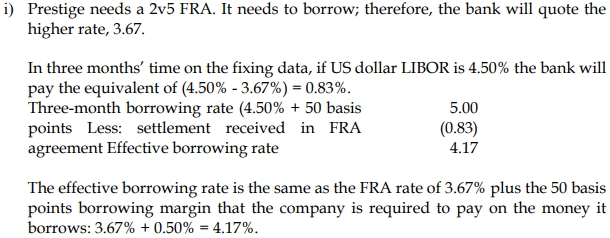
Calculate the effective rate of borrowing for three months and explain the advantages of convertible bonds.

With reference to Option Two:

i) What would be its effective rate of borrowing for the three months if US dollar LIBOR is 4.50% at the start of the notional interest period for the FRA? (2 marks)
ii) What are the advantages of Convertible Bonds? (3 marks)

ii) Advantages of Convertible Bonds:

  1. Lower Interest Rates: Convertible bonds typically offer lower interest rates than traditional bonds because investors are compensated by the option to convert the bonds into shares if the company’s stock performs well.
  2. Deferred Dilution: While convertible bonds offer the potential for equity conversion, dilution of ownership only occurs when the bonds are converted, allowing the company to defer issuing more shares and the impact on earnings per share.
  3. Attractive to Investors: Investors find convertible bonds appealing because they offer the stability of bond payments with the potential upside of converting into equity if the company’s stock price rises.
  4. Access to Capital: For companies like Prestige, convertible bonds can provide access to capital without immediately diluting shareholder equity and may be a more cost-effective option than issuing straight equity.

Login or create a free account to see answers

Complete your registration to see answers

Find Related Questions by Tags, levels, etc.

Report an error

You're reporting an error for "SCS – MAR 2024 – L3 – Q5b – Financial management"

SCS – MAR 2024 – L3 – Q5b – Financial management

This Question Has a Case Study: 

Calculate the effective rate of borrowing for three months and explain the advantages of convertible bonds.

With reference to Option Two:

i) What would be its effective rate of borrowing for the three months if US dollar LIBOR is 4.50% at the start of the notional interest period for the FRA? (2 marks)
ii) What are the advantages of Convertible Bonds? (3 marks)

ii) Advantages of Convertible Bonds:

  1. Lower Interest Rates: Convertible bonds typically offer lower interest rates than traditional bonds because investors are compensated by the option to convert the bonds into shares if the company’s stock performs well.
  2. Deferred Dilution: While convertible bonds offer the potential for equity conversion, dilution of ownership only occurs when the bonds are converted, allowing the company to defer issuing more shares and the impact on earnings per share.
  3. Attractive to Investors: Investors find convertible bonds appealing because they offer the stability of bond payments with the potential upside of converting into equity if the company’s stock price rises.
  4. Access to Capital: For companies like Prestige, convertible bonds can provide access to capital without immediately diluting shareholder equity and may be a more cost-effective option than issuing straight equity.

Login or create a free account to see answers

Complete your registration to see answers

Find Related Questions by Tags, levels, etc.

Report an error

You're reporting an error for "SCS – MAR 2024 – L3 – Q5b – Financial management"

SCS – MAR 2024 – L3 – Q5a – Financial management

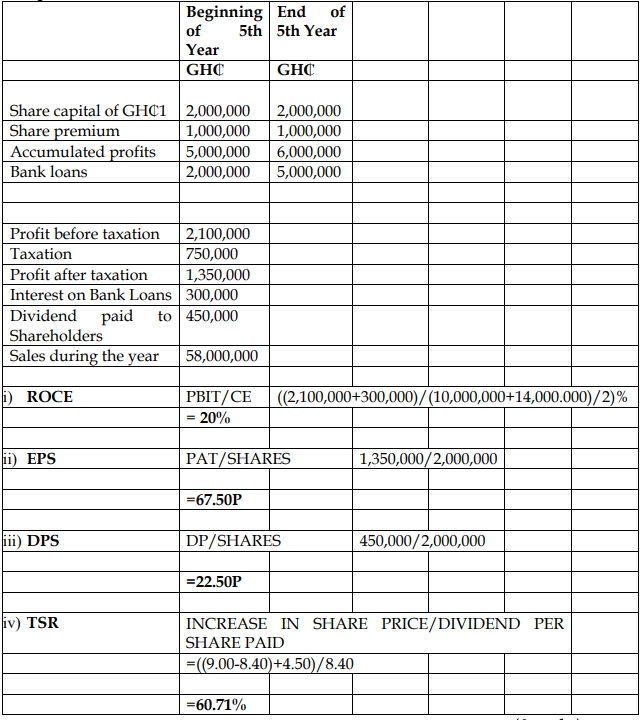
Calculate various financial ratios including ROCE, EPS, DPS, and TSR based on given financial data.

With reference to the information in Option One available to Prestige as presented by Professor Joseph Laing, a business consultant, calculate the following:

i) Return on Capital Employed (ROCE) (1 mark)
ii) Earnings Per Share (EPS) (1 mark)
iii) Dividend Per Share (DPS) (2 marks)
iv) Total Shareholders Return (TSR) (2 marks)
v) Explain the difference between ROCE and Accounting Rate of Return, their essential features, and relationship (4 marks)

v) Difference between ROCE and Accounting Rate of Return (ARR):

  • ROCE is a measure of the return on capital employed in the business, calculated by dividing the profit before interest and tax (PBIT) by the average capital employed. It reflects the overall efficiency of the company in generating profits from its available capital.
  • ARR, on the other hand, measures the accounting profit from a specific capital project, usually before interest and tax, as a percentage of the capital invested in that project.
  • The key difference lies in their scope: while ROCE assesses the return from the entire business or company, ARR focuses on specific capital projects. Both are used to evaluate the efficiency of capital usage, but ARR is project-specific, whereas ROCE is company-wide.

Login or create a free account to see answers

Complete your registration to see answers

Find Related Questions by Tags, levels, etc.

Report an error

You're reporting an error for "SCS – MAR 2024 – L3 – Q5a – Financial management"

SCS – MAR 2024 – L3 – Q5a – Financial management

This Question Has a Case Study: 

Calculate various financial ratios including ROCE, EPS, DPS, and TSR based on given financial data.

With reference to the information in Option One available to Prestige as presented by Professor Joseph Laing, a business consultant, calculate the following:

i) Return on Capital Employed (ROCE) (1 mark)
ii) Earnings Per Share (EPS) (1 mark)
iii) Dividend Per Share (DPS) (2 marks)
iv) Total Shareholders Return (TSR) (2 marks)
v) Explain the difference between ROCE and Accounting Rate of Return, their essential features, and relationship (4 marks)

v) Difference between ROCE and Accounting Rate of Return (ARR):

  • ROCE is a measure of the return on capital employed in the business, calculated by dividing the profit before interest and tax (PBIT) by the average capital employed. It reflects the overall efficiency of the company in generating profits from its available capital.
  • ARR, on the other hand, measures the accounting profit from a specific capital project, usually before interest and tax, as a percentage of the capital invested in that project.
  • The key difference lies in their scope: while ROCE assesses the return from the entire business or company, ARR focuses on specific capital projects. Both are used to evaluate the efficiency of capital usage, but ARR is project-specific, whereas ROCE is company-wide.

Login or create a free account to see answers

Complete your registration to see answers

Find Related Questions by Tags, levels, etc.

Report an error

You're reporting an error for "SCS – MAR 2024 – L3 – Q5a – Financial management"

SCS – MAR 2024 – L3 – Q4b – Strategy implementation

Advise on an appropriate HR strategy to harmonize the organizational structure for effective delivery at Prestige.

Each company acquired or merged by Prestige was allowed to maintain its human resource structure.

Required:
Analyze and advise on an appropriate HR strategy Prestige should adopt to harmonize the organizational structure for effective delivery of the company’s objectives.

  1. Strategic Workforce Planning:
    • Prestige should develop a workforce plan to address the complexities introduced by mergers and acquisitions. This plan should estimate the required number of employees, their skills, and potential future needs based on the company’s objectives, particularly in innovation and technology adoption.
  2. HR Consistency with Corporate Strategy:
    • The HR strategy should align with both the corporate and divisional strategies to ensure that the required number and type of employees are available at the right time to support business operations across regions.
  3. Assessment of Current Workforce:
    • Prestige should conduct an audit of its current workforce, assessing skills, experience, and attrition rates. This would help in identifying gaps and surpluses that need to be addressed through recruitment, training, or redundancy.
  4. Recruitment and Training:
    • The strategy should focus on recruiting the necessary talent to fill gaps, while also implementing training and development programs to upskill existing employees. This will help align employee capabilities with the company’s strategic needs, especially in areas such as IT, finance, and project management.
  5. Performance Management:
    • Implementing a robust performance appraisal system would enable Prestige to monitor the development of employees’ skills and performance, ensuring that key objectives are met. This would also identify areas where employees may require additional training or support.
  6. Promotion and Career Development:
    • Providing clear promotion paths and career development opportunities would encourage employee retention and foster motivation within the workforce, helping Prestige maintain a skilled and experienced team.
  7. Handling Redundancies:
    • Where there are surplus employees due to structural changes, Prestige should have a clear policy for managing redundancies in a way that minimizes disruption while ensuring fairness and compliance with labor laws.
  8. Labor Relations and Employee Welfare:
    • Ensuring good labor relations through clear communication and employee engagement initiatives will help reduce resistance to change. Compensation, health and safety, and employee well-being should be central to the HR strategy to foster a positive workplace environment.
  9. Technological Impact on HR:
    • Prestige should anticipate and manage the impact of technological changes on its workforce, particularly in relation to automation, digital skills, and remote working capabilities.

Factors to Consider:

  • Population trends and labor market conditions.
  • Changes in government policies affecting employment.
  • The availability of specific skills within the workforce.
  • Competition for talent from other businesses.
  • Trends in outsourcing and subcontracting.

Login or create a free account to see answers

Complete your registration to see answers

Find Related Questions by Tags, levels, etc.

Report an error

You're reporting an error for "SCS – MAR 2024 – L3 – Q4b – Strategy implementation"

SCS – MAR 2024 – L3 – Q4b – Strategy implementation

This Question Has a Case Study: 

Advise on an appropriate HR strategy to harmonize the organizational structure for effective delivery at Prestige.

Each company acquired or merged by Prestige was allowed to maintain its human resource structure.

Required:
Analyze and advise on an appropriate HR strategy Prestige should adopt to harmonize the organizational structure for effective delivery of the company’s objectives.

  1. Strategic Workforce Planning:
    • Prestige should develop a workforce plan to address the complexities introduced by mergers and acquisitions. This plan should estimate the required number of employees, their skills, and potential future needs based on the company’s objectives, particularly in innovation and technology adoption.
  2. HR Consistency with Corporate Strategy:
    • The HR strategy should align with both the corporate and divisional strategies to ensure that the required number and type of employees are available at the right time to support business operations across regions.
  3. Assessment of Current Workforce:
    • Prestige should conduct an audit of its current workforce, assessing skills, experience, and attrition rates. This would help in identifying gaps and surpluses that need to be addressed through recruitment, training, or redundancy.
  4. Recruitment and Training:
    • The strategy should focus on recruiting the necessary talent to fill gaps, while also implementing training and development programs to upskill existing employees. This will help align employee capabilities with the company’s strategic needs, especially in areas such as IT, finance, and project management.
  5. Performance Management:
    • Implementing a robust performance appraisal system would enable Prestige to monitor the development of employees’ skills and performance, ensuring that key objectives are met. This would also identify areas where employees may require additional training or support.
  6. Promotion and Career Development:
    • Providing clear promotion paths and career development opportunities would encourage employee retention and foster motivation within the workforce, helping Prestige maintain a skilled and experienced team.
  7. Handling Redundancies:
    • Where there are surplus employees due to structural changes, Prestige should have a clear policy for managing redundancies in a way that minimizes disruption while ensuring fairness and compliance with labor laws.
  8. Labor Relations and Employee Welfare:
    • Ensuring good labor relations through clear communication and employee engagement initiatives will help reduce resistance to change. Compensation, health and safety, and employee well-being should be central to the HR strategy to foster a positive workplace environment.
  9. Technological Impact on HR:
    • Prestige should anticipate and manage the impact of technological changes on its workforce, particularly in relation to automation, digital skills, and remote working capabilities.

Factors to Consider:

  • Population trends and labor market conditions.
  • Changes in government policies affecting employment.
  • The availability of specific skills within the workforce.
  • Competition for talent from other businesses.
  • Trends in outsourcing and subcontracting.

Login or create a free account to see answers

Complete your registration to see answers

Find Related Questions by Tags, levels, etc.

Report an error

You're reporting an error for "SCS – MAR 2024 – L3 – Q4b – Strategy implementation"

SCS – MAR 2024 – L3 – Q4a – Strategy implementation

Explain how Prestige could leverage ICT using the four broad stages of e-business development to compete.

Prestige’s Board has shifted from their long-standing reluctance to venture into foreign markets to seriously consider the possibility of expansion overseas. An important implication of this decision is that as the size of the market increases, competition becomes international. The main rivals are no longer local suppliers to a domestic market.

Required:
Using the four broad stages of development to a full e-business model, explain how Prestige could leverage ICT to compete.

  1. Web Presence:
    • Prestige could set up a website to display its property listings and services. The website can serve as a platform to provide detailed information about the houses for sale, available property types, and contact details. This would enhance visibility and reach beyond local markets.
  2. E-Commerce:
    • Prestige can integrate e-commerce capabilities on its website, allowing potential buyers to make inquiries, schedule viewings, or even complete purchases online. They can also use e-commerce platforms to manage orders and payments from suppliers and partners.
  3. Integrated E-Commerce:
    • Prestige could utilize ICT to gather and analyze customer data to understand their preferences and buying behavior. By establishing two-way communication channels, the company could use customer feedback to improve its product offerings and tailor marketing strategies, boosting customer satisfaction.
  4. E-Business:
    • ICT can drive Prestige’s business strategy by making e-business a fundamental part of its operations. E-business can enhance efficiency in sales, marketing, procurement, and customer service, aligning business operations with digital transformation to gain a competitive edge in the global market.

Login or create a free account to see answers

Complete your registration to see answers

Find Related Questions by Tags, levels, etc.

Report an error

You're reporting an error for "SCS – MAR 2024 – L3 – Q4a – Strategy implementation"

SCS – MAR 2024 – L3 – Q4a – Strategy implementation

This Question Has a Case Study: 

Explain how Prestige could leverage ICT using the four broad stages of e-business development to compete.

Prestige’s Board has shifted from their long-standing reluctance to venture into foreign markets to seriously consider the possibility of expansion overseas. An important implication of this decision is that as the size of the market increases, competition becomes international. The main rivals are no longer local suppliers to a domestic market.

Required:
Using the four broad stages of development to a full e-business model, explain how Prestige could leverage ICT to compete.

  1. Web Presence:
    • Prestige could set up a website to display its property listings and services. The website can serve as a platform to provide detailed information about the houses for sale, available property types, and contact details. This would enhance visibility and reach beyond local markets.
  2. E-Commerce:
    • Prestige can integrate e-commerce capabilities on its website, allowing potential buyers to make inquiries, schedule viewings, or even complete purchases online. They can also use e-commerce platforms to manage orders and payments from suppliers and partners.
  3. Integrated E-Commerce:
    • Prestige could utilize ICT to gather and analyze customer data to understand their preferences and buying behavior. By establishing two-way communication channels, the company could use customer feedback to improve its product offerings and tailor marketing strategies, boosting customer satisfaction.
  4. E-Business:
    • ICT can drive Prestige’s business strategy by making e-business a fundamental part of its operations. E-business can enhance efficiency in sales, marketing, procurement, and customer service, aligning business operations with digital transformation to gain a competitive edge in the global market.

Login or create a free account to see answers

Complete your registration to see answers

Find Related Questions by Tags, levels, etc.

Report an error

You're reporting an error for "SCS – MAR 2024 – L3 – Q4a – Strategy implementation"

SCS – MAR 2024 – L3 – Q3 – Functional strategies

Explain the potential benefits of resource sharing through common IT systems at Prestige.

When five years ago the present regional divisional structure of Greater Accra, Ashanti, and Eastern was formalized, an attempt was made to ensure that common systems and ways of working were adopted across each of the three regions. However, due to the pressures on the Company, this was never fully implemented.

Required:
Explain the potential benefits of resource sharing (configuring an organization’s computing system in such a way that the information and resources within it can be accessed, and remotely accessed, across multiple administrative domains) to Prestige if they adopt common IT systems.

  1. Ease of Access: A common IT system allows staff to access systems, software, and files from any location with an internet connection. This supports collaborative working across regions.
  2. Accuracy: Having a single source of data ensures accuracy by eliminating multiple similar versions scattered across the organization. This provides reliable information to all divisions.
  3. Cost Savings: Resource sharing avoids duplication of work across divisions. Generating similar data for similar purposes can be costly, so producing data once and sharing it reduces inefficiencies and costs for Prestige.
  4. Facilitates Remote Working: IT resource sharing enables remote working, increasing flexibility. Employees can work from any location, enhancing motivation and potentially creating cost savings by allowing work from home.
  5. Transparency: Resource sharing promotes transparency across the organization by making information easily accessible to all relevant parties. This can improve decision-making and operational efficiency.

Login or create a free account to see answers

Complete your registration to see answers

Find Related Questions by Tags, levels, etc.

Report an error

You're reporting an error for "SCS – MAR 2024 – L3 – Q3 – Functional strategies"

SCS – MAR 2024 – L3 – Q3 – Functional strategies

This Question Has a Case Study: 

Explain the potential benefits of resource sharing through common IT systems at Prestige.

When five years ago the present regional divisional structure of Greater Accra, Ashanti, and Eastern was formalized, an attempt was made to ensure that common systems and ways of working were adopted across each of the three regions. However, due to the pressures on the Company, this was never fully implemented.

Required:
Explain the potential benefits of resource sharing (configuring an organization’s computing system in such a way that the information and resources within it can be accessed, and remotely accessed, across multiple administrative domains) to Prestige if they adopt common IT systems.

  1. Ease of Access: A common IT system allows staff to access systems, software, and files from any location with an internet connection. This supports collaborative working across regions.
  2. Accuracy: Having a single source of data ensures accuracy by eliminating multiple similar versions scattered across the organization. This provides reliable information to all divisions.
  3. Cost Savings: Resource sharing avoids duplication of work across divisions. Generating similar data for similar purposes can be costly, so producing data once and sharing it reduces inefficiencies and costs for Prestige.
  4. Facilitates Remote Working: IT resource sharing enables remote working, increasing flexibility. Employees can work from any location, enhancing motivation and potentially creating cost savings by allowing work from home.
  5. Transparency: Resource sharing promotes transparency across the organization by making information easily accessible to all relevant parties. This can improve decision-making and operational efficiency.

Login or create a free account to see answers

Complete your registration to see answers

Find Related Questions by Tags, levels, etc.

Report an error

You're reporting an error for "SCS – MAR 2024 – L3 – Q3 – Functional strategies"

SCS – MAR 2024 – L3 – Q2 – Competitive advantage

Apply and appraise Porter’s three strategies for sustaining competitive advantage for Prestige Designers Ltd.

A strategic clock can be used to consider different business strategies for gaining competitive advantage, based on providing a combination of price and perceived benefits. Porter has suggested three strategies for sustaining competitive advantage over rival firms and their products or services. They are a cost leadership strategy, a differentiation strategy, and a focus strategy.

Required:
Apply and appraise how effective the suggested three strategies for sustaining competitive advantage over rival firms would be useful to Prestige. (10 marks)

  1. Cost Leadership Strategy:
    • Prestige must compete effectively on price by offering its housing stock at a lower price than rivals.
    • The company should have excellent cost control systems and continually plan for further reductions in costs to remain the cost leader in the market.
    • Prestige, being a large company, can benefit from economies of scale compared to smaller competitors.
    • To achieve reasonable profit margins, Prestige must sell large volumes of homes at a lower profit margin per unit.
  2. Differentiation Strategy:
    • Prestige’s products must be distinct from those of its competitors in a way that customers can recognize, potentially leveraging the “Vintage” brand which focuses on low-cost housing for young buyers.
    • The company could innovate and incorporate modern methods of construction (MMC) and sustainability-related methods to differentiate its products.
    • Customers might be willing to pay more for homes with unique features and higher perceived value.
    • Prestige should invest in delivering superior value to customers, even if that means higher upfront costs.
  3. Focus Strategy:
    • Prestige could focus on segmented consumer markets by selecting specific segments, such as the middle-class or younger first-time home buyers, as the primary market for their products.
    • The company could concentrate on serving a particular type of customer or region, allowing it to tailor its offerings to the unique demands of that segment.

Login or create a free account to see answers

Complete your registration to see answers

Find Related Questions by Tags, levels, etc.

Report an error

You're reporting an error for "SCS – MAR 2024 – L3 – Q2 – Competitive advantage"

SCS – MAR 2024 – L3 – Q2 – Competitive advantage

This Question Has a Case Study: 

Apply and appraise Porter’s three strategies for sustaining competitive advantage for Prestige Designers Ltd.

A strategic clock can be used to consider different business strategies for gaining competitive advantage, based on providing a combination of price and perceived benefits. Porter has suggested three strategies for sustaining competitive advantage over rival firms and their products or services. They are a cost leadership strategy, a differentiation strategy, and a focus strategy.

Required:
Apply and appraise how effective the suggested three strategies for sustaining competitive advantage over rival firms would be useful to Prestige. (10 marks)

  1. Cost Leadership Strategy:
    • Prestige must compete effectively on price by offering its housing stock at a lower price than rivals.
    • The company should have excellent cost control systems and continually plan for further reductions in costs to remain the cost leader in the market.
    • Prestige, being a large company, can benefit from economies of scale compared to smaller competitors.
    • To achieve reasonable profit margins, Prestige must sell large volumes of homes at a lower profit margin per unit.
  2. Differentiation Strategy:
    • Prestige’s products must be distinct from those of its competitors in a way that customers can recognize, potentially leveraging the “Vintage” brand which focuses on low-cost housing for young buyers.
    • The company could innovate and incorporate modern methods of construction (MMC) and sustainability-related methods to differentiate its products.
    • Customers might be willing to pay more for homes with unique features and higher perceived value.
    • Prestige should invest in delivering superior value to customers, even if that means higher upfront costs.
  3. Focus Strategy:
    • Prestige could focus on segmented consumer markets by selecting specific segments, such as the middle-class or younger first-time home buyers, as the primary market for their products.
    • The company could concentrate on serving a particular type of customer or region, allowing it to tailor its offerings to the unique demands of that segment.

Login or create a free account to see answers

Complete your registration to see answers

Find Related Questions by Tags, levels, etc.

Report an error

You're reporting an error for "SCS – MAR 2024 – L3 – Q2 – Competitive advantage"

CR – Mar 2024 – Q3c – Regulatory framework and ethics

Analyze ethical issues in a takeover scenario, including views on considering ethics and potential conflicts of interest.

The directors of Akilapa Ltd are involved in takeover talks with Bongo Partners. In the discussions, Mr Mensah, the Managing Director of Akilapa Ltd stated that there was no point in considering issues of ethics because the purpose of the takeover is to increase the market share of the company and ultimately increase the profit of the firm. In seconding his point, Miss Benkro indicated that in adopting a pragmatic approach to the takeover, there was no ethical issue in considering a third-party in relation to Bongo Partners because, in her opinion, the takeover will not benefit the third party but the company and the society.

During the meeting, Dr Worlanyo who was the previous Accountant of Bongo Partners before moving to Akilapa Ltd was involved in drafting the financial statements and provided a positive approval of the takeover bid. Upon receipt of the recommendation, a member of the board of directors found that there are indications that several of Bongo Partners’s Non-current assets might be impaired.

Required: i) Comment on the views of Mr Mensah and Miss Benkro regarding the fact that there is no point in considering ethical issues in the takeover bid. (4 marks)

ii) Assess the ethical issues in this scenario and explain how they should be addressed. (6 marks)

i) Comments on the views of Mr Mensah and Miss Benkro:

There are several reasons why ethical issues should be considered in a takeover bid, contrary to the views expressed by Mr Mensah and Miss Benkro:

  1. Integration of ethical cultures: A takeover involves integrating two companies’ ethics and compliance programs. This process is critical and begins well before the union of the companies. Ignoring ethical considerations can lead to conflicts in company cultures and values post-merger.
  2. Long-term success: Ethical considerations are crucial for the long-term success of the merged entity. Ignoring ethical issues or placing them on hold can endanger the success of the takeover bid and the future of the combined company.
  3. Stakeholder interests: Takeovers affect various stakeholders, including employees, customers, and the broader community. Considering ethical issues ensures that the interests of all stakeholders are taken into account, not just profit maximization.
  4. Legal and regulatory compliance: Ethical considerations often overlap with legal and regulatory requirements. Ignoring ethics could lead to non-compliance issues and potential legal risks.
  5. Reputation and brand value: Ethical behavior contributes to a company’s reputation and brand value. A takeover that ignores ethical issues could damage the reputation of both companies involved.

ii) Ethical issues in the scenario and how they should be addressed:

  1. Conflict of interest: Issue: Dr Worlanyo, the previous Accountant of Bongo Partners, is now involved in drafting financial statements and approving the takeover bid for Akilapa Ltd. How to address: Dr Worlanyo should recuse himself from any decision-making processes related to the takeover. An independent third party should be engaged to review the financial statements and takeover bid to ensure objectivity.
  2. Potential misrepresentation of financial information: Issue: There are indications that several of Bongo Partners’s non-current assets might be impaired, which was not reflected in Dr Worlanyo’s positive approval. How to address: A thorough and independent impairment review should be conducted. If impairments are confirmed, the financial statements should be restated, and the takeover bid should be reassessed based on the updated information.
  3. Duty of care and due diligence: Issue: The directors of Akilapa Ltd seem to be overlooking the importance of thorough due diligence, particularly regarding ethical and financial aspects of Bongo Partners. How to address: Conduct a comprehensive due diligence process, including ethical and financial audits. This should involve external experts to ensure objectivity and thoroughness.
  4. Transparency and disclosure: Issue: The potential impairment of Bongo Partners’s assets raises questions about the transparency of information provided during the takeover talks. How to address: Both companies should commit to full transparency, disclosing all material information that could affect the takeover decision. This includes any potential impairments or other financial issues.
  5. Professional conduct and integrity: Issue: Dr Worlanyo’s involvement in the process, given his previous position at Bongo Partners, raises questions about professional conduct and integrity. How to address: Implement clear guidelines for professional conduct in takeover situations. This should include policies on conflicts of interest and the involvement of former employees in sensitive business decisions.
  6. Stakeholder consideration: Issue: The focus solely on market share and profit increase ignores the broader implications of the takeover on other stakeholders. How to address: Conduct a stakeholder impact analysis to consider the effects of the takeover on employees, customers, suppliers, and the community. Use this analysis to inform decision-making and plan for post-merger integration.

By addressing these ethical issues, Akilapa Ltd can ensure a more transparent, fair, and sustainable takeover process, reducing risks and increasing the likelihood of long-term success for the merged entity.

Login or create a free account to see answers

Complete your registration to see answers

Find Related Questions by Tags, levels, etc.

Report an error

You're reporting an error for "CR – Mar 2024 – Q3c – Regulatory framework and ethics"

CR – Mar 2024 – Q3c – Regulatory framework and ethics

Analyze ethical issues in a takeover scenario, including views on considering ethics and potential conflicts of interest.

The directors of Akilapa Ltd are involved in takeover talks with Bongo Partners. In the discussions, Mr Mensah, the Managing Director of Akilapa Ltd stated that there was no point in considering issues of ethics because the purpose of the takeover is to increase the market share of the company and ultimately increase the profit of the firm. In seconding his point, Miss Benkro indicated that in adopting a pragmatic approach to the takeover, there was no ethical issue in considering a third-party in relation to Bongo Partners because, in her opinion, the takeover will not benefit the third party but the company and the society.

During the meeting, Dr Worlanyo who was the previous Accountant of Bongo Partners before moving to Akilapa Ltd was involved in drafting the financial statements and provided a positive approval of the takeover bid. Upon receipt of the recommendation, a member of the board of directors found that there are indications that several of Bongo Partners’s Non-current assets might be impaired.

Required: i) Comment on the views of Mr Mensah and Miss Benkro regarding the fact that there is no point in considering ethical issues in the takeover bid. (4 marks)

ii) Assess the ethical issues in this scenario and explain how they should be addressed. (6 marks)

i) Comments on the views of Mr Mensah and Miss Benkro:

There are several reasons why ethical issues should be considered in a takeover bid, contrary to the views expressed by Mr Mensah and Miss Benkro:

  1. Integration of ethical cultures: A takeover involves integrating two companies’ ethics and compliance programs. This process is critical and begins well before the union of the companies. Ignoring ethical considerations can lead to conflicts in company cultures and values post-merger.
  2. Long-term success: Ethical considerations are crucial for the long-term success of the merged entity. Ignoring ethical issues or placing them on hold can endanger the success of the takeover bid and the future of the combined company.
  3. Stakeholder interests: Takeovers affect various stakeholders, including employees, customers, and the broader community. Considering ethical issues ensures that the interests of all stakeholders are taken into account, not just profit maximization.
  4. Legal and regulatory compliance: Ethical considerations often overlap with legal and regulatory requirements. Ignoring ethics could lead to non-compliance issues and potential legal risks.
  5. Reputation and brand value: Ethical behavior contributes to a company’s reputation and brand value. A takeover that ignores ethical issues could damage the reputation of both companies involved.

ii) Ethical issues in the scenario and how they should be addressed:

  1. Conflict of interest: Issue: Dr Worlanyo, the previous Accountant of Bongo Partners, is now involved in drafting financial statements and approving the takeover bid for Akilapa Ltd. How to address: Dr Worlanyo should recuse himself from any decision-making processes related to the takeover. An independent third party should be engaged to review the financial statements and takeover bid to ensure objectivity.
  2. Potential misrepresentation of financial information: Issue: There are indications that several of Bongo Partners’s non-current assets might be impaired, which was not reflected in Dr Worlanyo’s positive approval. How to address: A thorough and independent impairment review should be conducted. If impairments are confirmed, the financial statements should be restated, and the takeover bid should be reassessed based on the updated information.
  3. Duty of care and due diligence: Issue: The directors of Akilapa Ltd seem to be overlooking the importance of thorough due diligence, particularly regarding ethical and financial aspects of Bongo Partners. How to address: Conduct a comprehensive due diligence process, including ethical and financial audits. This should involve external experts to ensure objectivity and thoroughness.
  4. Transparency and disclosure: Issue: The potential impairment of Bongo Partners’s assets raises questions about the transparency of information provided during the takeover talks. How to address: Both companies should commit to full transparency, disclosing all material information that could affect the takeover decision. This includes any potential impairments or other financial issues.
  5. Professional conduct and integrity: Issue: Dr Worlanyo’s involvement in the process, given his previous position at Bongo Partners, raises questions about professional conduct and integrity. How to address: Implement clear guidelines for professional conduct in takeover situations. This should include policies on conflicts of interest and the involvement of former employees in sensitive business decisions.
  6. Stakeholder consideration: Issue: The focus solely on market share and profit increase ignores the broader implications of the takeover on other stakeholders. How to address: Conduct a stakeholder impact analysis to consider the effects of the takeover on employees, customers, suppliers, and the community. Use this analysis to inform decision-making and plan for post-merger integration.

By addressing these ethical issues, Akilapa Ltd can ensure a more transparent, fair, and sustainable takeover process, reducing risks and increasing the likelihood of long-term success for the merged entity.

Login or create a free account to see answers

Complete your registration to see answers

Find Related Questions by Tags, levels, etc.

Report an error

You're reporting an error for "CR – Mar 2024 – Q3c – Regulatory framework and ethics"

CR – Mar 2024 – L3 – Q3b – IFRS 15: Revenue from Contracts with Customers

This question discusses the treatment of advance payments and significant financing components under IFRS 15 for Tieku Technologies.

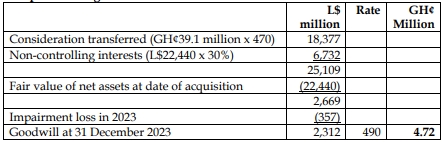
On 1 December 2022, Pinto Ltd (Pinto), a public company, acquired 70% of the ordinary share capital of Manpam Inc (Manpam), a private company in Liberia. The functional currency of Pinto is the GH¢, and the functional currency of Manpam is the Liberian Dollar (LS). Pinto paid GH¢39.1 million for its investment in Manpam on 1 December 2022, when the net fair value of the identifiable assets acquired and liabilities assumed of Manpam were LS22,440 million.

Given that Manpam is a private company, Pinto decided to measure the non-controlling interests at acquisition at the proportionate share of the fair value of the identifiable net assets of Manpam. An impairment test conducted at the group level on the investment in Manpam at 31 December 2023 indicated an impairment loss on goodwill of LS357 million (attributable to Pinto). No impairment loss adjustments had been necessary at the previous year end.

Relevant exchange rates were:

  • 1 December 2022: GH¢1 = LS470
  • 31 December 2022: GH¢1 = LS478
  • 31 December 2023: GH¢1 = LS490

Required:
In accordance with IFRS, calculate the goodwill figure to be recognized in the consolidated statement of financial position of Pinto for the year ended 31 December 2023 (to the nearest GH¢0.1 million).

Computation of goodwill

Login or create a free account to see answers

Complete your registration to see answers

Find Related Questions by Tags, levels, etc.

Report an error

You're reporting an error for "CR – Mar 2024 – L3 – Q3b – IFRS 15: Revenue from Contracts with Customers"

CR – Mar 2024 – L3 – Q3b – IFRS 15: Revenue from Contracts with Customers

This question discusses the treatment of advance payments and significant financing components under IFRS 15 for Tieku Technologies.

On 1 December 2022, Pinto Ltd (Pinto), a public company, acquired 70% of the ordinary share capital of Manpam Inc (Manpam), a private company in Liberia. The functional currency of Pinto is the GH¢, and the functional currency of Manpam is the Liberian Dollar (LS). Pinto paid GH¢39.1 million for its investment in Manpam on 1 December 2022, when the net fair value of the identifiable assets acquired and liabilities assumed of Manpam were LS22,440 million.

Given that Manpam is a private company, Pinto decided to measure the non-controlling interests at acquisition at the proportionate share of the fair value of the identifiable net assets of Manpam. An impairment test conducted at the group level on the investment in Manpam at 31 December 2023 indicated an impairment loss on goodwill of LS357 million (attributable to Pinto). No impairment loss adjustments had been necessary at the previous year end.

Relevant exchange rates were:

  • 1 December 2022: GH¢1 = LS470
  • 31 December 2022: GH¢1 = LS478
  • 31 December 2023: GH¢1 = LS490

Required:
In accordance with IFRS, calculate the goodwill figure to be recognized in the consolidated statement of financial position of Pinto for the year ended 31 December 2023 (to the nearest GH¢0.1 million).

Computation of goodwill

Login or create a free account to see answers

Complete your registration to see answers

Find Related Questions by Tags, levels, etc.

Report an error

You're reporting an error for "CR – Mar 2024 – L3 – Q3b – IFRS 15: Revenue from Contracts with Customers"

CR – Mar 2024 – L3 – Q3a – Foreign currency

This question involves determining the functional currency of Mongu Plc and discussing the factors influencing this decision.

Mongu Plc (Mongu) is a diversified entity listed on the Ghana Stock Exchange. Its financial year ends on 30 September. Mongu Plc operates through its local and foreign subsidiaries. Most of Mongu’s revenues come from its foreign operations, but Mongu incurs a significant portion of its costs locally in Ghana. The local currency is the Ghana Cedi (GH¢), but Mongu’s subsidiaries operate in regions that use other currencies.

Required:
In accordance with IAS 21: The Effects of Changes in Foreign Exchange Rates, identify the functional currency of Mongu Plc, considering the relevant factors, and explain how exchange differences should be accounted for.

Under IAS 21, the functional currency is the currency of the primary economic environment in which an entity operates. To determine the functional currency of Mongu Plc, the following factors must be considered:

  1. Primary Indicators:
    • Currency of Sales: Mongu Plc generates most of its revenue from foreign operations, where other currencies are used. Therefore, the currency in which the majority of revenues are denominated should be a key consideration.
    • Currency of Costs: Although Mongu incurs significant local costs in Ghana, these may be outweighed by foreign sales. The relative importance of costs and revenues in the local currency vs. foreign currency needs to be analyzed.

    Based on these indicators, if the foreign currency (where sales are generated) dominates, it is likely that the foreign currency would be Mongu Plc’s functional currency.

  2. Secondary Indicators:
    • Financing and Cash Flows: If Mongu finances its operations in Ghana Cedis (GH¢), but cash flows are primarily generated in foreign currencies, this further supports the case for the foreign currency being the functional currency.
  3. Accounting for Exchange Differences:
    • Once the functional currency is determined, IAS 21 requires that all transactions denominated in a currency other than the functional currency be translated into the functional currency at the exchange rate on the date of the transaction.
    • At the reporting date, monetary items are retranslated at the closing exchange rate, and any exchange differences are recognized in the profit or loss, except for differences on foreign currency borrowings, which are treated as part of the cost of the asset.

Login or create a free account to see answers

Complete your registration to see answers

Find Related Questions by Tags, levels, etc.

Report an error

You're reporting an error for "CR – Mar 2024 – L3 – Q3a – Foreign currency"

CR – Mar 2024 – L3 – Q3a – Foreign currency

This question involves determining the functional currency of Mongu Plc and discussing the factors influencing this decision.

Mongu Plc (Mongu) is a diversified entity listed on the Ghana Stock Exchange. Its financial year ends on 30 September. Mongu Plc operates through its local and foreign subsidiaries. Most of Mongu’s revenues come from its foreign operations, but Mongu incurs a significant portion of its costs locally in Ghana. The local currency is the Ghana Cedi (GH¢), but Mongu’s subsidiaries operate in regions that use other currencies.

Required:
In accordance with IAS 21: The Effects of Changes in Foreign Exchange Rates, identify the functional currency of Mongu Plc, considering the relevant factors, and explain how exchange differences should be accounted for.

Under IAS 21, the functional currency is the currency of the primary economic environment in which an entity operates. To determine the functional currency of Mongu Plc, the following factors must be considered:

  1. Primary Indicators:
    • Currency of Sales: Mongu Plc generates most of its revenue from foreign operations, where other currencies are used. Therefore, the currency in which the majority of revenues are denominated should be a key consideration.
    • Currency of Costs: Although Mongu incurs significant local costs in Ghana, these may be outweighed by foreign sales. The relative importance of costs and revenues in the local currency vs. foreign currency needs to be analyzed.

    Based on these indicators, if the foreign currency (where sales are generated) dominates, it is likely that the foreign currency would be Mongu Plc’s functional currency.

  2. Secondary Indicators:
    • Financing and Cash Flows: If Mongu finances its operations in Ghana Cedis (GH¢), but cash flows are primarily generated in foreign currencies, this further supports the case for the foreign currency being the functional currency.
  3. Accounting for Exchange Differences:
    • Once the functional currency is determined, IAS 21 requires that all transactions denominated in a currency other than the functional currency be translated into the functional currency at the exchange rate on the date of the transaction.
    • At the reporting date, monetary items are retranslated at the closing exchange rate, and any exchange differences are recognized in the profit or loss, except for differences on foreign currency borrowings, which are treated as part of the cost of the asset.

Login or create a free account to see answers

Complete your registration to see answers

Find Related Questions by Tags, levels, etc.

Report an error

You're reporting an error for "CR – Mar 2024 – L3 – Q3a – Foreign currency"

CR – Mar 2024 – L3 – Q2c – IFRS 15: Revenue from Contracts with Customers

This question requires determining whether Odjani Plc should recognize revenue as a principal or agent in the sale of airline tickets, based on IFRS 15.

Odjani Plc (Odjani) negotiates with major local and international airlines to purchase tickets at reduced rates compared with the price of tickets sold directly by the airlines to the public. Odjani agrees to buy a specific number of tickets and must pay for those tickets regardless of whether it is able to resell them. The reduced rate paid by Odjani for each ticket purchased is negotiated and agreed in advance. Odjani determines the prices at which the airline tickets will be sold to its customers. Odjani sells the tickets and collects the consideration from customers when the tickets are purchased. The entity also assists the customers in resolving complaints with the service provided by the airlines. However, each airline is responsible for fulfilling obligations associated with the ticket, including remedies to a customer for dissatisfaction with the service.

Required:
In line with IFRS 15: Revenue from Contracts with Customers, explain whether Odjani is a principal or agent and indicate how it would determine the amount of revenue to recognize from the ticket sales.

Under IFRS 15, the determination of whether an entity is acting as a principal or an agent is based on who controls the goods or services before they are transferred to the customer.

  1. Principal vs Agent Assessment:
    • Principal: An entity is a principal if it controls the goods or services before they are transferred to the customer. As a principal, Odjani would recognize revenue at the gross amount received from the customer.
    • Agent: An entity is an agent if it arranges for another party to provide the goods or services to the customer. The agent would recognize revenue as the net amount (i.e., the difference between what it receives from the customer and what it pays to the supplier).
  2. Odjani’s Role:
    • Odjani negotiates and purchases tickets in advance and assumes the risk of payment whether or not the tickets are resold. This indicates that Odjani controls the tickets before transferring them to customers.
    • Additionally, Odjani has the discretion to set the selling price for the tickets, which further suggests that Odjani is acting as the principal in the arrangement.
    • Although the airline fulfills the service obligations (i.e., providing the flight), Odjani’s control over the tickets and pricing means it is acting as a principal.
  3. Revenue Recognition:
    • Since Odjani is acting as a principal, it should recognize the gross amount received from customers as revenue.
    • The costs associated with purchasing the tickets from the airlines would be recognized as expenses, separate from the revenue recognized.

Login or create a free account to see answers

Complete your registration to see answers

Find Related Questions by Tags, levels, etc.

Report an error

You're reporting an error for "CR – Mar 2024 – L3 – Q2c – IFRS 15: Revenue from Contracts with Customers"

CR – Mar 2024 – L3 – Q2c – IFRS 15: Revenue from Contracts with Customers

This question requires determining whether Odjani Plc should recognize revenue as a principal or agent in the sale of airline tickets, based on IFRS 15.

Odjani Plc (Odjani) negotiates with major local and international airlines to purchase tickets at reduced rates compared with the price of tickets sold directly by the airlines to the public. Odjani agrees to buy a specific number of tickets and must pay for those tickets regardless of whether it is able to resell them. The reduced rate paid by Odjani for each ticket purchased is negotiated and agreed in advance. Odjani determines the prices at which the airline tickets will be sold to its customers. Odjani sells the tickets and collects the consideration from customers when the tickets are purchased. The entity also assists the customers in resolving complaints with the service provided by the airlines. However, each airline is responsible for fulfilling obligations associated with the ticket, including remedies to a customer for dissatisfaction with the service.

Required:
In line with IFRS 15: Revenue from Contracts with Customers, explain whether Odjani is a principal or agent and indicate how it would determine the amount of revenue to recognize from the ticket sales.

Under IFRS 15, the determination of whether an entity is acting as a principal or an agent is based on who controls the goods or services before they are transferred to the customer.

  1. Principal vs Agent Assessment:
    • Principal: An entity is a principal if it controls the goods or services before they are transferred to the customer. As a principal, Odjani would recognize revenue at the gross amount received from the customer.
    • Agent: An entity is an agent if it arranges for another party to provide the goods or services to the customer. The agent would recognize revenue as the net amount (i.e., the difference between what it receives from the customer and what it pays to the supplier).
  2. Odjani’s Role:
    • Odjani negotiates and purchases tickets in advance and assumes the risk of payment whether or not the tickets are resold. This indicates that Odjani controls the tickets before transferring them to customers.
    • Additionally, Odjani has the discretion to set the selling price for the tickets, which further suggests that Odjani is acting as the principal in the arrangement.
    • Although the airline fulfills the service obligations (i.e., providing the flight), Odjani’s control over the tickets and pricing means it is acting as a principal.
  3. Revenue Recognition:
    • Since Odjani is acting as a principal, it should recognize the gross amount received from customers as revenue.
    • The costs associated with purchasing the tickets from the airlines would be recognized as expenses, separate from the revenue recognized.

Login or create a free account to see answers

Complete your registration to see answers

Find Related Questions by Tags, levels, etc.

Report an error

You're reporting an error for "CR – Mar 2024 – L3 – Q2c – IFRS 15: Revenue from Contracts with Customers"

CR – Mar 2024 – L3 – Q2b – IAS 36: Impairment of Assets

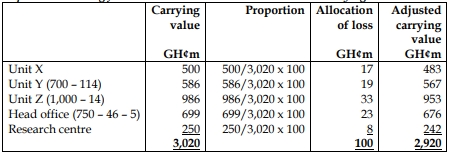
This question focuses on determining impairment losses and adjusting carrying values for the CGUs of Sikaman Plc, considering head office allocation.

Sikaman Plc has three cash-generating units (CGUs), a head office, and a research facility. The carrying amounts of the assets and their recoverable amounts are as follows:

Unit X Unit Y Unit Z Head Office Research Facility Sikaman Plc
Carrying value (GH¢m) 500 700 1,000 750 250 3,250
Recoverable amount (GH¢m) 645 820 1,355 2,920

The assets of the head office can be reasonably allocated to the three units as follows:

  • Unit X: GH¢95m
  • Unit Y: GH¢280m
  • Unit Z: GH¢375m

The assets of the research facility cannot be reasonably allocated to the CGUs.

Required:
Assuming all assets can be adjusted for impairment, show how the revised/adjusted carrying values of the assets of Sikaman Plc should be determined in line with IAS 36: Impairment of Assets after taking into account any impairment losses in the above scenario. Show the relevant financial statements extracts.

1. Allocation of Head Office Assets to CGUs

The assets of the head office must first be allocated to the CGUs (Unit X, Unit Y, and Unit Z) based on the amounts provided:

Unit Carrying Value Head Office Allocation Total Carrying Value
Unit X 500 95 595
Unit Y 700 280 980
Unit Z 1,000 375 1,375

2. Calculation of Impairment Loss

Next, compare the total carrying value of each CGU with its recoverable amount to determine if an impairment loss should be recognized.

3. Allocation of Impairment Loss to Head Office and Other Assets

Impairment losses are allocated proportionately to the head office assets and other assets in each CGU:

4. Impairment Testing for Sikaman Plc as a Whole

Since the research facility cannot be allocated to the CGUs, an impairment test is conducted on the entity as a whole. The total assets after impairment losses are:

Note: Allocation loss = 3,020 – 2,920 = 100

Login or create a free account to see answers

Complete your registration to see answers

Find Related Questions by Tags, levels, etc.

Report an error

You're reporting an error for "CR – Mar 2024 – L3 – Q2b – IAS 36: Impairment of Assets"

CR – Mar 2024 – L3 – Q2b – IAS 36: Impairment of Assets

This question focuses on determining impairment losses and adjusting carrying values for the CGUs of Sikaman Plc, considering head office allocation.

Sikaman Plc has three cash-generating units (CGUs), a head office, and a research facility. The carrying amounts of the assets and their recoverable amounts are as follows:

Unit X Unit Y Unit Z Head Office Research Facility Sikaman Plc
Carrying value (GH¢m) 500 700 1,000 750 250 3,250
Recoverable amount (GH¢m) 645 820 1,355 2,920

The assets of the head office can be reasonably allocated to the three units as follows:

  • Unit X: GH¢95m
  • Unit Y: GH¢280m
  • Unit Z: GH¢375m

The assets of the research facility cannot be reasonably allocated to the CGUs.

Required:
Assuming all assets can be adjusted for impairment, show how the revised/adjusted carrying values of the assets of Sikaman Plc should be determined in line with IAS 36: Impairment of Assets after taking into account any impairment losses in the above scenario. Show the relevant financial statements extracts.

1. Allocation of Head Office Assets to CGUs

The assets of the head office must first be allocated to the CGUs (Unit X, Unit Y, and Unit Z) based on the amounts provided:

Unit Carrying Value Head Office Allocation Total Carrying Value
Unit X 500 95 595
Unit Y 700 280 980
Unit Z 1,000 375 1,375

2. Calculation of Impairment Loss

Next, compare the total carrying value of each CGU with its recoverable amount to determine if an impairment loss should be recognized.

3. Allocation of Impairment Loss to Head Office and Other Assets

Impairment losses are allocated proportionately to the head office assets and other assets in each CGU:

4. Impairment Testing for Sikaman Plc as a Whole

Since the research facility cannot be allocated to the CGUs, an impairment test is conducted on the entity as a whole. The total assets after impairment losses are:

Note: Allocation loss = 3,020 – 2,920 = 100

Login or create a free account to see answers

Complete your registration to see answers

Find Related Questions by Tags, levels, etc.

Report an error

You're reporting an error for "CR – Mar 2024 – L3 – Q2b – IAS 36: Impairment of Assets"

CR – Mar 2024 – L3 – Q2a – IFRS 2: Share-Based Payments

This question requires the accounting treatment for a share-based payment scheme at Zara Plc over the years 2020, 2021, and 2022, under IFRS 2.

Zara Plc operates within the thriving food packaging industry in Ghana. At 1 January 2020, the firm agreed to grant 10,000 shares each to 500 employees, conditional on the employees remaining in the firm’s employment during the vesting period. The terms of the scheme indicated that the shares will vest at:

i) 31 December 2020, if the firm’s EPS growth is greater than 18%
ii) 31 December 2021, if the firm’s EPS growth is greater than an average of 13% per year over the 2-year period
iii) 31 December 2022, if the firm’s EPS growth is greater than an average of 10% per year over the 3-year period

The award was estimated to have a fair value of GH¢8 per share at the grant date. The following events took place during the three years at:

  • 31 December 2020: EPS was up 14%, and 30 staff left. The firm expected EPS to continue growing at the same level and hence for shares to vest at 31 December 2021. A further 30 employees were expected to leave in 2021.
  • 31 December 2021: EPS was up by only 10%, so shares did not vest. 28 employees left during the year. The firm expected a further 25 employees to leave in 2022 and that EPS would increase by greater than 6%, thereby achieving an average EPS growth rate of 10% per year.
  • 31 December 2022: 23 employees left, and EPS was up 8%. The average EPS over the three-year period was greater than 10%.

Required:
Recommend how Zara Plc would account for the share-based payment scheme during the years ended 31 December 2020, 2021, and 2022. Show extracts from only the 2021 financial statements.

Under IFRS 2: Share-Based Payments, Zara Plc must recognize an expense for the share-based payment scheme over the vesting period, based on the number of employees expected to receive shares and the fair value of the shares at the grant date. The accounting treatment is as follows:

Login or create a free account to see answers

Complete your registration to see answers

Find Related Questions by Tags, levels, etc.

Report an error

You're reporting an error for "CR – Mar 2024 – L3 – Q2a – IFRS 2: Share-Based Payments"

CR – Mar 2024 – L3 – Q2a – IFRS 2: Share-Based Payments

This question requires the accounting treatment for a share-based payment scheme at Zara Plc over the years 2020, 2021, and 2022, under IFRS 2.

Zara Plc operates within the thriving food packaging industry in Ghana. At 1 January 2020, the firm agreed to grant 10,000 shares each to 500 employees, conditional on the employees remaining in the firm’s employment during the vesting period. The terms of the scheme indicated that the shares will vest at:

i) 31 December 2020, if the firm’s EPS growth is greater than 18%
ii) 31 December 2021, if the firm’s EPS growth is greater than an average of 13% per year over the 2-year period
iii) 31 December 2022, if the firm’s EPS growth is greater than an average of 10% per year over the 3-year period

The award was estimated to have a fair value of GH¢8 per share at the grant date. The following events took place during the three years at:

  • 31 December 2020: EPS was up 14%, and 30 staff left. The firm expected EPS to continue growing at the same level and hence for shares to vest at 31 December 2021. A further 30 employees were expected to leave in 2021.
  • 31 December 2021: EPS was up by only 10%, so shares did not vest. 28 employees left during the year. The firm expected a further 25 employees to leave in 2022 and that EPS would increase by greater than 6%, thereby achieving an average EPS growth rate of 10% per year.
  • 31 December 2022: 23 employees left, and EPS was up 8%. The average EPS over the three-year period was greater than 10%.

Required:
Recommend how Zara Plc would account for the share-based payment scheme during the years ended 31 December 2020, 2021, and 2022. Show extracts from only the 2021 financial statements.

Under IFRS 2: Share-Based Payments, Zara Plc must recognize an expense for the share-based payment scheme over the vesting period, based on the number of employees expected to receive shares and the fair value of the shares at the grant date. The accounting treatment is as follows:

Login or create a free account to see answers

Complete your registration to see answers

Find Related Questions by Tags, levels, etc.

Report an error

You're reporting an error for "CR – Mar 2024 – L3 – Q2a – IFRS 2: Share-Based Payments"

CR – Mar 2024 – L3 – Q1 – Consolidated Financial Statements

This question requires preparing the consolidated statement of financial position for Sankom Group, including adjustments for goodwill impairment and fair value adjustments.

Sankom Ltd (Sankom) in the last three years acquired Makpa and Biiri. The statement of financial position for the three companies as at 31 December 2023 is as follows:

Additional Information:

i) The following information relates to the acquisition of Makpa and Biiri:

  • Makpa: Date of acquisition: 1 January 2021, Shareholding percentage: 80%, Goodwill arising from the acquisition: GH¢44,800,000
  • Biiri: Date of acquisition: 30 June 2022, Shareholding percentage: 60%, Goodwill arising from the acquisition: GH¢38,400,000

ii) An upward fair value adjustment of GH¢4,400,000 was required for Makpa’s production machinery with a useful life of five years.

iii) Makpa sold goods to Biiri worth GH¢2,240,000, with a margin of 20%, and 30% of the goods were unsold by Biiri as of 31 December 2023.

iv) No impairment losses were previously recognized, but impairment reviews at 31 December 2023 indicated the recoverable amounts of the net assets of Makpa and Biiri were GH¢133,244,800 and GH¢116,544,000, respectively.

v) Sankom rented a building to Makpa at an annual rental of GH¢2,000,000, which Sankom accounted for as investment property, recognizing a fair value gain of GH¢1,200,000.

Required:
Prepare the consolidated statement of financial position for Sankom Group as at 31 December 2023.

Sankom Ltd Group – Consolidated Statement of Financial Position as at 31 December 2023

Workings:

7. Intercompany Transactions:
Rental of property, intercompany profits, and depreciation adjustments have been incorporated.

Login or create a free account to see answers

Complete your registration to see answers

Find Related Questions by Tags, levels, etc.

Report an error

You're reporting an error for "CR – Mar 2024 – L3 – Q1 – Consolidated Financial Statements"

CR – Mar 2024 – L3 – Q1 – Consolidated Financial Statements

This question requires preparing the consolidated statement of financial position for Sankom Group, including adjustments for goodwill impairment and fair value adjustments.

Sankom Ltd (Sankom) in the last three years acquired Makpa and Biiri. The statement of financial position for the three companies as at 31 December 2023 is as follows:

Additional Information:

i) The following information relates to the acquisition of Makpa and Biiri:

  • Makpa: Date of acquisition: 1 January 2021, Shareholding percentage: 80%, Goodwill arising from the acquisition: GH¢44,800,000
  • Biiri: Date of acquisition: 30 June 2022, Shareholding percentage: 60%, Goodwill arising from the acquisition: GH¢38,400,000

ii) An upward fair value adjustment of GH¢4,400,000 was required for Makpa’s production machinery with a useful life of five years.

iii) Makpa sold goods to Biiri worth GH¢2,240,000, with a margin of 20%, and 30% of the goods were unsold by Biiri as of 31 December 2023.

iv) No impairment losses were previously recognized, but impairment reviews at 31 December 2023 indicated the recoverable amounts of the net assets of Makpa and Biiri were GH¢133,244,800 and GH¢116,544,000, respectively.

v) Sankom rented a building to Makpa at an annual rental of GH¢2,000,000, which Sankom accounted for as investment property, recognizing a fair value gain of GH¢1,200,000.

Required:
Prepare the consolidated statement of financial position for Sankom Group as at 31 December 2023.

Sankom Ltd Group – Consolidated Statement of Financial Position as at 31 December 2023

Workings:

7. Intercompany Transactions:
Rental of property, intercompany profits, and depreciation adjustments have been incorporated.

Login or create a free account to see answers

Complete your registration to see answers

Find Related Questions by Tags, levels, etc.

Report an error

You're reporting an error for "CR – Mar 2024 – L3 – Q1 – Consolidated Financial Statements"

AT – MAR 2024 – L3 – Q5b – Tax Administration in Ghana

Discusses the restrictions on foreign business activities and the tax benefits of sole proprietorship versus limited liability companies.

You are an external consultant to the Ministry of Trade and Industry. The Minister has received a delegation of both foreigners and Ghanaians to deliberate on investment opportunities available in Ghana.

Required:
i) Business activities that cannot be engaged in by foreigners. (5 marks)
ii) The tax benefits of establishing a sole proprietorship business as against a limited liability company. (5 marks)

i) Business Activities that Cannot Be Engaged in by Foreigners
A person who is not a citizen or an enterprise that is not wholly owned by Ghanaian citizens shall not invest or participate in the following activities:

  • The sale of goods or provision of services in a market, petty trading, hawking, or selling of goods in a stall.
  • The operation of taxi or car hire service in an enterprise that has a fleet of fewer than 25 vehicles.
  • The operation of a beauty salon or barber shop.
  • The printing of recharge scratch cards for telecommunications services.
  • The production of exercise books and other basic stationery.
  • The retail of finished pharmaceutical products.
  • The production, supply, and retail of sachet water.
  • All aspects of pool betting business and lotteries except football pools.

(5 marks)

ii) Tax Benefits of Establishing a Sole Proprietorship Business as Against a Limited Liability Company

  • Personal Reliefs: Sole proprietors enjoy personal reliefs, which help reduce their tax liabilities, whereas limited liability companies do not enjoy such benefits.
  • Pension Contributions: Sole proprietors can contribute to pension schemes (up to 35% of declared income), which helps reduce their tax burden, while limited liability companies do not enjoy this benefit.
  • Interest Income: Interest received by sole proprietors from resident financial institutions is exempt from tax, but companies pay an 8% tax on such interest.
  • Tax on Other Interest Income: Sole proprietors pay 1% tax on interest received from non-resident financial institutions, whereas companies pay an 8% tax.
  • No Stamp Duty: Establishing a sole proprietorship does not require the payment of stamp duty, unlike limited liability companies that need to pay stamp duty during their registration process.

(5 marks)

Login or create a free account to see answers

Complete your registration to see answers

Find Related Questions by Tags, levels, etc.

Report an error

You're reporting an error for "AT – MAR 2024 – L3 – Q5b – Tax Administration in Ghana"

AT – MAR 2024 – L3 – Q5b – Tax Administration in Ghana

Discusses the restrictions on foreign business activities and the tax benefits of sole proprietorship versus limited liability companies.

You are an external consultant to the Ministry of Trade and Industry. The Minister has received a delegation of both foreigners and Ghanaians to deliberate on investment opportunities available in Ghana.

Required:
i) Business activities that cannot be engaged in by foreigners. (5 marks)
ii) The tax benefits of establishing a sole proprietorship business as against a limited liability company. (5 marks)

i) Business Activities that Cannot Be Engaged in by Foreigners
A person who is not a citizen or an enterprise that is not wholly owned by Ghanaian citizens shall not invest or participate in the following activities:

  • The sale of goods or provision of services in a market, petty trading, hawking, or selling of goods in a stall.
  • The operation of taxi or car hire service in an enterprise that has a fleet of fewer than 25 vehicles.
  • The operation of a beauty salon or barber shop.
  • The printing of recharge scratch cards for telecommunications services.
  • The production of exercise books and other basic stationery.
  • The retail of finished pharmaceutical products.
  • The production, supply, and retail of sachet water.
  • All aspects of pool betting business and lotteries except football pools.

(5 marks)

ii) Tax Benefits of Establishing a Sole Proprietorship Business as Against a Limited Liability Company

  • Personal Reliefs: Sole proprietors enjoy personal reliefs, which help reduce their tax liabilities, whereas limited liability companies do not enjoy such benefits.
  • Pension Contributions: Sole proprietors can contribute to pension schemes (up to 35% of declared income), which helps reduce their tax burden, while limited liability companies do not enjoy this benefit.
  • Interest Income: Interest received by sole proprietors from resident financial institutions is exempt from tax, but companies pay an 8% tax on such interest.
  • Tax on Other Interest Income: Sole proprietors pay 1% tax on interest received from non-resident financial institutions, whereas companies pay an 8% tax.
  • No Stamp Duty: Establishing a sole proprietorship does not require the payment of stamp duty, unlike limited liability companies that need to pay stamp duty during their registration process.

(5 marks)

Login or create a free account to see answers

Complete your registration to see answers

Find Related Questions by Tags, levels, etc.

Report an error

You're reporting an error for "AT – MAR 2024 – L3 – Q5b – Tax Administration in Ghana"

AT – MAR 2024 – L3 – Q5a – Minerals and Mining

Discusses allowable deductions, rehabilitation fund treatment, and financial costs in the mining sector.

You have been invited as a student of Taxation to speak at a stakeholder workshop on mining and mineral operations in the extractive industry. In the letter of invitation, the Organisers indicated that you are to submit a detailed write-up of your presentation on the following issues.

Required:
i) Allowable deduction peculiar to the extractive industry. (3 marks)
ii) Approved Rehabilitation Fund and the tax treatment of contributions into the fund and expenses incurred in respect of rehabilitation under the Income Tax Act, 2015 (Act 896). (3 marks)
iii) The tax treatment of relevant financial costs included in the costs incurred in respect of minerals and mining operations under the Income Tax Act, 2015 (Act 896). (4 marks)

i) Allowable Deductions Peculiar to the Extractive Industry
In calculating a person’s income from a separate mineral operation for a year of assessment, the following deductions are allowed:

  • Ground rents and royalties paid by the person with respect to the mineral operation.
  • Contributions to and other expenses incurred in respect of an approved rehabilitation fund for the mineral operation.
  • Expenses incurred by the person during reclamation, rehabilitation, and closure of the mineral operation.
  • Capital allowances granted with respect to the mineral operation.
  • Carryover of losses related to the mineral operation.
  • Decommissioning and over-stripping costs.
  • Shaft sinking and processing costs.

(3 marks)

ii) Approved Rehabilitation Fund and Tax Treatment
These are funds set aside to take care of reclamation, rehabilitation, and closure of the mineral operation. Contributions into this fund are tax-exempt.

Tax treatment of rehabilitation expenses:

  • Where there is a surplus after the rehabilitation of a separate mineral operation conducted by the person, or in cases of breach of an approved rehabilitation agreement, the surplus shall be added to the person’s income from the mineral operation and taxed at the applicable rate.

(3 marks)

iii) Tax Treatment of Financial Costs in Mining
Under Section 67(4) of the Income Tax Act, relevant financial gains or relevant financial costs may be included in determining the income from a separate mineral operation. The following are important considerations:

  • Financial gain refers to income derived from interest on a financial instrument, and financial cost refers to losses incurred with respect to financial instruments.
  • Financial costs are deductible only to the extent that they do not exceed financial gains derived from the same operation in the year of assessment.
  • If a loss is incurred on a financial instrument, it may be carried forward and deducted from future financial gains for up to five years. The ordering rule (first-in, first-out) applies to determine which losses are carried forward first.
  • Losses on financial instruments may be set off against gains on financial instruments within the same year of assessment.

(4 marks)

Login or create a free account to see answers

Complete your registration to see answers

Find Related Questions by Tags, levels, etc.

Report an error

You're reporting an error for "AT – MAR 2024 – L3 – Q5a – Minerals and Mining"

AT – MAR 2024 – L3 – Q5a – Minerals and Mining

Discusses allowable deductions, rehabilitation fund treatment, and financial costs in the mining sector.

You have been invited as a student of Taxation to speak at a stakeholder workshop on mining and mineral operations in the extractive industry. In the letter of invitation, the Organisers indicated that you are to submit a detailed write-up of your presentation on the following issues.

Required:
i) Allowable deduction peculiar to the extractive industry. (3 marks)
ii) Approved Rehabilitation Fund and the tax treatment of contributions into the fund and expenses incurred in respect of rehabilitation under the Income Tax Act, 2015 (Act 896). (3 marks)
iii) The tax treatment of relevant financial costs included in the costs incurred in respect of minerals and mining operations under the Income Tax Act, 2015 (Act 896). (4 marks)

i) Allowable Deductions Peculiar to the Extractive Industry
In calculating a person’s income from a separate mineral operation for a year of assessment, the following deductions are allowed:

  • Ground rents and royalties paid by the person with respect to the mineral operation.
  • Contributions to and other expenses incurred in respect of an approved rehabilitation fund for the mineral operation.
  • Expenses incurred by the person during reclamation, rehabilitation, and closure of the mineral operation.
  • Capital allowances granted with respect to the mineral operation.
  • Carryover of losses related to the mineral operation.
  • Decommissioning and over-stripping costs.
  • Shaft sinking and processing costs.

(3 marks)

ii) Approved Rehabilitation Fund and Tax Treatment
These are funds set aside to take care of reclamation, rehabilitation, and closure of the mineral operation. Contributions into this fund are tax-exempt.

Tax treatment of rehabilitation expenses:

  • Where there is a surplus after the rehabilitation of a separate mineral operation conducted by the person, or in cases of breach of an approved rehabilitation agreement, the surplus shall be added to the person’s income from the mineral operation and taxed at the applicable rate.

(3 marks)

iii) Tax Treatment of Financial Costs in Mining
Under Section 67(4) of the Income Tax Act, relevant financial gains or relevant financial costs may be included in determining the income from a separate mineral operation. The following are important considerations:

  • Financial gain refers to income derived from interest on a financial instrument, and financial cost refers to losses incurred with respect to financial instruments.
  • Financial costs are deductible only to the extent that they do not exceed financial gains derived from the same operation in the year of assessment.
  • If a loss is incurred on a financial instrument, it may be carried forward and deducted from future financial gains for up to five years. The ordering rule (first-in, first-out) applies to determine which losses are carried forward first.
  • Losses on financial instruments may be set off against gains on financial instruments within the same year of assessment.

(4 marks)

Login or create a free account to see answers

Complete your registration to see answers

Find Related Questions by Tags, levels, etc.

Report an error

You're reporting an error for "AT – MAR 2024 – L3 – Q5a – Minerals and Mining"

AT – MAR 2024 – L3 – Q4 – Business Income – Corporate Income Tax | Capital Allowance

Covers capital allowance computation, tax rules on long-term contracts, and chargeable income calculation.

Finstruct Ltd has been awarded an airport terminal project. The project started on 1 January 2022 for a contract sum of GH¢60,000,000. The construction of the airport is to be completed on 31 December 2023.

Finstruct Ltd has a financial year ending on 31 December each year. On 31 December 2022, the accounts appropriate to the airport contract contained the following:

Cost Item GH¢
Cost of construction materials 25,500,000
Direct wages of construction staff 22,100,000
Hire of special equipment 300,000
Cost of soil test 100,000
Purchase of fuel and lubricants 750,000
Consultancy services 135,000

Additional information:
i) Materials costing GH¢340,000 sent to the site were returned to the company’s warehouse.
ii) Materials sent to the site worth GH¢675,000 were still unused at the construction site as of 31 December 2022.
iii) Finstruct Ltd pays some of its workers the first week of the ensuing month after the end of the current month. GH¢57,000 is still owed for wages as of the close of the year 2022, and this was not included in the accounts.
iv) A bill amounting to GH¢45,000 was submitted late by Finstruct Ltd, and as of 31 December 2022, the bill had not yet been paid. This was not included in the accounts.
v) It is estimated that the cost to complete the project as of 31 December 2022 should be GH¢8,265,180.
vi) The following details are available on assets of Finstruct Ltd:

Required:
a) Compute the capital allowance for Finstruct Ltd for the year 2022. (6 marks)
b) Explain the tax rules on long-term contracts and compute the percentage of contract completion of the project. (4 marks)
c) Compute the chargeable income of Finstruct Ltd for the year ended 31 December 2022. (10 marks)

a)

Computation of Capital Allowance

Assumptions:
1. There was no depreciation
2. Pick up was not restricted because of the nature of the sector

b) Explanation of Tax Rules on Long-Term Contracts and Calculation of Percentage Completion
Amounts to be included or deducted in calculating the person’s income related to a long-term contract are considered based on the percentage of the contract completed during each basis period. The percentage of completion is determined by comparing the total expenses allocated to the contract and incurred before the end of a basis period with the estimated total contract expenses as determined at the time of commencement of the contract.

Percentage of Completion =85.84%

(4 marks)

c) Computation of Chargeable Income for Finstruct Ltd for the year ended 31 December 2022

Description GH¢
Materials to site 25,500,000
Less: Materials returned (340,000)
Less: Closing stock (Unused materials) (675,000)
Net Material Cost 24,485,000
Wages Paid 22,100,000
Add: Wages Owed 57,000
Net Wages Cost 22,157,000
Hire of Special Equipment 300,000
Cost of Soil Test 100,000
Fuel and Lubricant 750,000
Consultancy Services 180,000
Capital Allowance 2,146,320
Total Cost to Date 50,118,320
Estimated Cost to Complete 8,265,180
Total Cost of Completion 58,383,500

Stage of Completion = 85.84%
Revenue: 85.84% x GH¢60,000,000 = GH¢51,504,000
Cost of Sale: 85.84% x GH¢58,364,000 = GH¢50,099,658

Chargeable Income: GH¢1,404,342

Login or create a free account to see answers

Complete your registration to see answers

Find Related Questions by Tags, levels, etc.

Report an error

You're reporting an error for "AT – MAR 2024 – L3 – Q4 – Business Income – Corporate Income Tax | Capital Allowance"

AT – MAR 2024 – L3 – Q4 – Business Income – Corporate Income Tax | Capital Allowance

Covers capital allowance computation, tax rules on long-term contracts, and chargeable income calculation.

Finstruct Ltd has been awarded an airport terminal project. The project started on 1 January 2022 for a contract sum of GH¢60,000,000. The construction of the airport is to be completed on 31 December 2023.

Finstruct Ltd has a financial year ending on 31 December each year. On 31 December 2022, the accounts appropriate to the airport contract contained the following:

Cost Item GH¢
Cost of construction materials 25,500,000
Direct wages of construction staff 22,100,000
Hire of special equipment 300,000
Cost of soil test 100,000
Purchase of fuel and lubricants 750,000
Consultancy services 135,000

Additional information:
i) Materials costing GH¢340,000 sent to the site were returned to the company’s warehouse.
ii) Materials sent to the site worth GH¢675,000 were still unused at the construction site as of 31 December 2022.
iii) Finstruct Ltd pays some of its workers the first week of the ensuing month after the end of the current month. GH¢57,000 is still owed for wages as of the close of the year 2022, and this was not included in the accounts.
iv) A bill amounting to GH¢45,000 was submitted late by Finstruct Ltd, and as of 31 December 2022, the bill had not yet been paid. This was not included in the accounts.
v) It is estimated that the cost to complete the project as of 31 December 2022 should be GH¢8,265,180.
vi) The following details are available on assets of Finstruct Ltd:

Required:
a) Compute the capital allowance for Finstruct Ltd for the year 2022. (6 marks)
b) Explain the tax rules on long-term contracts and compute the percentage of contract completion of the project. (4 marks)
c) Compute the chargeable income of Finstruct Ltd for the year ended 31 December 2022. (10 marks)

a)

Computation of Capital Allowance

Assumptions:
1. There was no depreciation
2. Pick up was not restricted because of the nature of the sector

b) Explanation of Tax Rules on Long-Term Contracts and Calculation of Percentage Completion
Amounts to be included or deducted in calculating the person’s income related to a long-term contract are considered based on the percentage of the contract completed during each basis period. The percentage of completion is determined by comparing the total expenses allocated to the contract and incurred before the end of a basis period with the estimated total contract expenses as determined at the time of commencement of the contract.

Percentage of Completion =85.84%

(4 marks)

c) Computation of Chargeable Income for Finstruct Ltd for the year ended 31 December 2022

Description GH¢
Materials to site 25,500,000
Less: Materials returned (340,000)
Less: Closing stock (Unused materials) (675,000)
Net Material Cost 24,485,000
Wages Paid 22,100,000
Add: Wages Owed 57,000
Net Wages Cost 22,157,000
Hire of Special Equipment 300,000
Cost of Soil Test 100,000
Fuel and Lubricant 750,000
Consultancy Services 180,000
Capital Allowance 2,146,320
Total Cost to Date 50,118,320
Estimated Cost to Complete 8,265,180
Total Cost of Completion 58,383,500

Stage of Completion = 85.84%
Revenue: 85.84% x GH¢60,000,000 = GH¢51,504,000
Cost of Sale: 85.84% x GH¢58,364,000 = GH¢50,099,658

Chargeable Income: GH¢1,404,342

Login or create a free account to see answers

Complete your registration to see answers

Find Related Questions by Tags, levels, etc.

Report an error

You're reporting an error for "AT – MAR 2024 – L3 – Q4 – Business Income – Corporate Income Tax | Capital Allowance"

error: Content is protected !!