Series: MAR 2024

Search 500 + past questions and counting.
  • Filter by Professional Bodies

  • Filter by Subject

  • Filter by Series

  • Filter by Topics

  • Filter by Levels

  • Filter by Professional Bodies

  • Filter by Subject

  • Filter by Series

  • Filter by Topics

  • Filter by Levels

PT – Mar 2024 – L2 – Q2c – Income Tax Liabilities

Describe and explain the four broad roles of NEDs identified in the Higgs Guidance (2003).

Prestige’s Board acknowledges that by adopting and implementing the highest standards of
corporate governance, this sets the standards and values for the entire Company. The
Company seeks to comply with best practice in all areas of corporate governance and
continues to review the Company’s procedures to maintain proper control and
accountability.
Required

There are nine members on Prestige’s Board of Directors. They include the Chairman, Chief Executive, three executive directors, and four non-executive directors (NEDs). Describe and explain four broad roles for NEDs identified in the document published in the UK in 2003, known as the Higgs Guidance.

  1. Strategy Role:
    • NEDs are responsible for contributing to the development of the company’s strategy. By providing an independent perspective, they help the board in shaping and reviewing the strategic direction and long-term plans of the company. NEDs must ensure that strategic decisions are in the best interest of the shareholders and other stakeholders.
  2. Monitoring and Control Role:
    • NEDs are tasked with monitoring the performance of the executive management and ensuring that the company is being run efficiently and in accordance with approved policies and standards. This includes overseeing financial performance, internal controls, and risk management procedures. NEDs play a critical role in holding executive directors accountable for their decisions and actions.
  3. Risk Management Role:
    • NEDs help to identify key risks facing the business and ensure that appropriate measures are in place to manage those risks. Their independent status allows them to challenge executive decisions and ensure that all significant risks are addressed before the board makes any major decisions.
  4. Corporate Governance Role:
    • NEDs ensure that the company adheres to high standards of corporate governance, including compliance with legal and regulatory requirements. They are responsible for ensuring that the board operates transparently and that the interests of minority shareholders and other stakeholders are protected. This role also includes ensuring that the company follows ethical practices and maintains a strong corporate culture.

Login or create a free account to see answers

Complete your registration to see answers

Find Related Questions by Tags, levels, etc.

Report an error

You're reporting an error for "PT – Mar 2024 – L2 – Q2c – Income Tax Liabilities"

PT – Mar 2024 – L2 – Q2c – Income Tax Liabilities

Describe and explain the four broad roles of NEDs identified in the Higgs Guidance (2003).

Prestige’s Board acknowledges that by adopting and implementing the highest standards of
corporate governance, this sets the standards and values for the entire Company. The
Company seeks to comply with best practice in all areas of corporate governance and
continues to review the Company’s procedures to maintain proper control and
accountability.
Required

There are nine members on Prestige’s Board of Directors. They include the Chairman, Chief Executive, three executive directors, and four non-executive directors (NEDs). Describe and explain four broad roles for NEDs identified in the document published in the UK in 2003, known as the Higgs Guidance.

  1. Strategy Role:
    • NEDs are responsible for contributing to the development of the company’s strategy. By providing an independent perspective, they help the board in shaping and reviewing the strategic direction and long-term plans of the company. NEDs must ensure that strategic decisions are in the best interest of the shareholders and other stakeholders.
  2. Monitoring and Control Role:
    • NEDs are tasked with monitoring the performance of the executive management and ensuring that the company is being run efficiently and in accordance with approved policies and standards. This includes overseeing financial performance, internal controls, and risk management procedures. NEDs play a critical role in holding executive directors accountable for their decisions and actions.
  3. Risk Management Role:
    • NEDs help to identify key risks facing the business and ensure that appropriate measures are in place to manage those risks. Their independent status allows them to challenge executive decisions and ensure that all significant risks are addressed before the board makes any major decisions.
  4. Corporate Governance Role:
    • NEDs ensure that the company adheres to high standards of corporate governance, including compliance with legal and regulatory requirements. They are responsible for ensuring that the board operates transparently and that the interests of minority shareholders and other stakeholders are protected. This role also includes ensuring that the company follows ethical practices and maintains a strong corporate culture.

Login or create a free account to see answers

Complete your registration to see answers

Find Related Questions by Tags, levels, etc.

Report an error

You're reporting an error for "PT – Mar 2024 – L2 – Q2c – Income Tax Liabilities"

SCS – MAR 2024 – L3 – Q6b – Strategy, stakeholders, and mission

Explain how Principles V and VI of the OECD Principles of Corporate Governance could be applied at Prestige.

Prestige’s Board acknowledges that by adopting and implementing the highest standards of
corporate governance, this sets the standards and values for the entire Company. The
Company seeks to comply with best practice in all areas of corporate governance and
continues to review the Company’s procedures to maintain proper control and
accountability.
Required

Describe and explain how Principles V and VI of the OECD Principles of Corporate Governance – 2015 Edition, could be applied at Prestige to ensure good corporate governance practices.

  1. Principle V – Disclosure and Transparency:
    • This principle emphasizes the importance of full and accurate disclosure of all material matters related to the company, including financial statements, ownership, and governance structures. At Prestige, applying this principle would involve ensuring that financial reports are transparent, timely, and comply with relevant regulations. Prestige would need to disclose key information such as conflicts of interest, related-party transactions, and executive compensation. Proper application of this principle would build trust among stakeholders and provide them with the information necessary to assess the company’s performance and governance.
  2. Principle VI – Responsibilities of the Board:
    • Principle VI highlights the need for the board to be accountable to the company and its shareholders and to act in the best interests of the company. At Prestige, this would involve the board taking responsibility for overseeing the company’s strategic direction, risk management, and overall governance framework. The board must act with due diligence, ensuring that it has appropriate internal controls and that all directors, both executive and non-executive, are held accountable for their actions. The board should also foster an ethical corporate culture and ensure that the company complies with both local and international legal and regulatory requirements.

Login or create a free account to see answers

Complete your registration to see answers

Find Related Questions by Tags, levels, etc.

Report an error

You're reporting an error for "SCS – MAR 2024 – L3 – Q6b – Strategy, stakeholders, and mission"

SCS – MAR 2024 – L3 – Q6b – Strategy, stakeholders, and mission

This Question Has a Case Study: 

Explain how Principles V and VI of the OECD Principles of Corporate Governance could be applied at Prestige.

Prestige’s Board acknowledges that by adopting and implementing the highest standards of
corporate governance, this sets the standards and values for the entire Company. The
Company seeks to comply with best practice in all areas of corporate governance and
continues to review the Company’s procedures to maintain proper control and
accountability.
Required

Describe and explain how Principles V and VI of the OECD Principles of Corporate Governance – 2015 Edition, could be applied at Prestige to ensure good corporate governance practices.

  1. Principle V – Disclosure and Transparency:
    • This principle emphasizes the importance of full and accurate disclosure of all material matters related to the company, including financial statements, ownership, and governance structures. At Prestige, applying this principle would involve ensuring that financial reports are transparent, timely, and comply with relevant regulations. Prestige would need to disclose key information such as conflicts of interest, related-party transactions, and executive compensation. Proper application of this principle would build trust among stakeholders and provide them with the information necessary to assess the company’s performance and governance.
  2. Principle VI – Responsibilities of the Board:
    • Principle VI highlights the need for the board to be accountable to the company and its shareholders and to act in the best interests of the company. At Prestige, this would involve the board taking responsibility for overseeing the company’s strategic direction, risk management, and overall governance framework. The board must act with due diligence, ensuring that it has appropriate internal controls and that all directors, both executive and non-executive, are held accountable for their actions. The board should also foster an ethical corporate culture and ensure that the company complies with both local and international legal and regulatory requirements.

Login or create a free account to see answers

Complete your registration to see answers

Find Related Questions by Tags, levels, etc.

Report an error

You're reporting an error for "SCS – MAR 2024 – L3 – Q6b – Strategy, stakeholders, and mission"

SCS – MAR 2024 – L3 – Q6a – Strategy, stakeholders, and mission

Describe and explain 5 key issues in corporate governance for Prestige.

Prestige’s Board acknowledges that by adopting and implementing the highest standards of corporate governance, this sets the standards and values for the entire Company. The Company seeks to comply with best practices in all areas of corporate governance and continues to review its procedures to maintain proper control and accountability.

Required:
Describe and explain five key issues in corporate governance that would establish how well or badly Prestige is governed.

  1. Board Structure and Independence:
    • A key issue is the composition of the board, ensuring that there is an appropriate mix of executive and non-executive directors (NEDs). The presence of independent NEDs is crucial in providing an objective perspective and balancing the power of the executive directors. At Prestige, the board’s structure, including the number of independent NEDs, will determine the board’s effectiveness.
  2. Accountability and Transparency:
    • Good corporate governance requires transparent decision-making and accountability to shareholders and stakeholders. Prestige must ensure that financial reports, internal controls, and risk management procedures are robust and disclosed accurately. The transparency of the board’s actions and its decisions, especially in areas like remuneration and major investments, will be a measure of good governance.
  3. Risk Management:
    • Effective corporate governance includes identifying, assessing, and mitigating risks. Prestige must have strong systems in place to manage operational, financial, and reputational risks. Failure to do so can harm the company’s performance and stakeholder confidence.
  4. Ethical Leadership and Corporate Social Responsibility (CSR):
    • The board should lead by example in promoting an ethical culture throughout the company. Prestige’s commitment to CSR, environmental sustainability, and ethical decision-making will influence how it is perceived by stakeholders. Poor ethical standards or failure to meet CSR obligations can damage the company’s reputation.
  5. Compliance with Regulations and Laws:
    • Ensuring compliance with local and international regulations is essential for good corporate governance. Prestige must ensure that it adheres to corporate governance codes, listing rules, and legal obligations. Failure to comply with relevant laws could result in legal penalties and damage to the company’s reputation.

Login or create a free account to see answers

Complete your registration to see answers

Find Related Questions by Tags, levels, etc.

Report an error

You're reporting an error for "SCS – MAR 2024 – L3 – Q6a – Strategy, stakeholders, and mission"

SCS – MAR 2024 – L3 – Q6a – Strategy, stakeholders, and mission

This Question Has a Case Study: 

Describe and explain 5 key issues in corporate governance for Prestige.

Prestige’s Board acknowledges that by adopting and implementing the highest standards of corporate governance, this sets the standards and values for the entire Company. The Company seeks to comply with best practices in all areas of corporate governance and continues to review its procedures to maintain proper control and accountability.

Required:
Describe and explain five key issues in corporate governance that would establish how well or badly Prestige is governed.

  1. Board Structure and Independence:
    • A key issue is the composition of the board, ensuring that there is an appropriate mix of executive and non-executive directors (NEDs). The presence of independent NEDs is crucial in providing an objective perspective and balancing the power of the executive directors. At Prestige, the board’s structure, including the number of independent NEDs, will determine the board’s effectiveness.
  2. Accountability and Transparency:
    • Good corporate governance requires transparent decision-making and accountability to shareholders and stakeholders. Prestige must ensure that financial reports, internal controls, and risk management procedures are robust and disclosed accurately. The transparency of the board’s actions and its decisions, especially in areas like remuneration and major investments, will be a measure of good governance.
  3. Risk Management:
    • Effective corporate governance includes identifying, assessing, and mitigating risks. Prestige must have strong systems in place to manage operational, financial, and reputational risks. Failure to do so can harm the company’s performance and stakeholder confidence.
  4. Ethical Leadership and Corporate Social Responsibility (CSR):
    • The board should lead by example in promoting an ethical culture throughout the company. Prestige’s commitment to CSR, environmental sustainability, and ethical decision-making will influence how it is perceived by stakeholders. Poor ethical standards or failure to meet CSR obligations can damage the company’s reputation.
  5. Compliance with Regulations and Laws:
    • Ensuring compliance with local and international regulations is essential for good corporate governance. Prestige must ensure that it adheres to corporate governance codes, listing rules, and legal obligations. Failure to comply with relevant laws could result in legal penalties and damage to the company’s reputation.

Login or create a free account to see answers

Complete your registration to see answers

Find Related Questions by Tags, levels, etc.

Report an error

You're reporting an error for "SCS – MAR 2024 – L3 – Q6a – Strategy, stakeholders, and mission"

SCS – MAR 2024 – L3 – Q5c – International financial management

Evaluate the factors restricting foreign investment despite potential good returns.

With reference to Option Three, evaluate the factors that restrict foreign investment despite the perceived potential for good returns. 

  1. Political Instability:
    • Countries with a history of political instability or where there is a risk of sudden government changes or social unrest can deter foreign investors, even if potential returns are high. The risk of expropriation or policy shifts is a significant concern.
  2. Weak Rule of Law:
    • In some regions, the enforcement of legal contracts and property rights can be weak or inconsistent. This makes it difficult for foreign investors to have confidence that their investments will be protected, thus limiting their willingness to enter the market.
  3. Regulatory Barriers:
    • Excessive regulation, complex bureaucratic processes, or restrictions on foreign ownership can act as a deterrent to investment. Some countries impose barriers such as high tariffs, restrictive labor laws, or industry-specific regulations that make it difficult for foreign companies to operate profitably.
  4. Currency and Exchange Rate Risk:
    • Volatile exchange rates can lead to unpredictable returns for foreign investors. If a country’s currency depreciates significantly, it could erode the value of profits made in that country when converted back to the investor’s home currency.
  5. Competition from Local and Other Foreign Firms:
    • Intense competition from local companies or other foreign investors, particularly those from emerging economies like China and India, can reduce the attractiveness of foreign direct investment. These competitors may have better local knowledge, lower cost structures, or favorable relationships with government officials, making it hard for new entrants to compete.

Login or create a free account to see answers

Complete your registration to see answers

Find Related Questions by Tags, levels, etc.

Report an error

You're reporting an error for "SCS – MAR 2024 – L3 – Q5c – International financial management"

SCS – MAR 2024 – L3 – Q5c – International financial management

This Question Has a Case Study: 

Evaluate the factors restricting foreign investment despite potential good returns.

With reference to Option Three, evaluate the factors that restrict foreign investment despite the perceived potential for good returns. 

  1. Political Instability:
    • Countries with a history of political instability or where there is a risk of sudden government changes or social unrest can deter foreign investors, even if potential returns are high. The risk of expropriation or policy shifts is a significant concern.
  2. Weak Rule of Law:
    • In some regions, the enforcement of legal contracts and property rights can be weak or inconsistent. This makes it difficult for foreign investors to have confidence that their investments will be protected, thus limiting their willingness to enter the market.
  3. Regulatory Barriers:
    • Excessive regulation, complex bureaucratic processes, or restrictions on foreign ownership can act as a deterrent to investment. Some countries impose barriers such as high tariffs, restrictive labor laws, or industry-specific regulations that make it difficult for foreign companies to operate profitably.
  4. Currency and Exchange Rate Risk:
    • Volatile exchange rates can lead to unpredictable returns for foreign investors. If a country’s currency depreciates significantly, it could erode the value of profits made in that country when converted back to the investor’s home currency.
  5. Competition from Local and Other Foreign Firms:
    • Intense competition from local companies or other foreign investors, particularly those from emerging economies like China and India, can reduce the attractiveness of foreign direct investment. These competitors may have better local knowledge, lower cost structures, or favorable relationships with government officials, making it hard for new entrants to compete.

Login or create a free account to see answers

Complete your registration to see answers

Find Related Questions by Tags, levels, etc.

Report an error

You're reporting an error for "SCS – MAR 2024 – L3 – Q5c – International financial management"

SCS – MAR 2024 – L3 – Q5b – Financial management

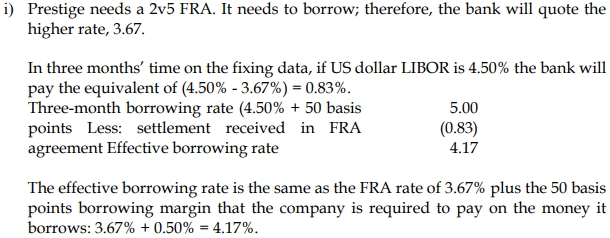
Calculate the effective rate of borrowing for three months and explain the advantages of convertible bonds.

With reference to Option Two:

i) What would be its effective rate of borrowing for the three months if US dollar LIBOR is 4.50% at the start of the notional interest period for the FRA? (2 marks)
ii) What are the advantages of Convertible Bonds? (3 marks)

ii) Advantages of Convertible Bonds:

  1. Lower Interest Rates: Convertible bonds typically offer lower interest rates than traditional bonds because investors are compensated by the option to convert the bonds into shares if the company’s stock performs well.
  2. Deferred Dilution: While convertible bonds offer the potential for equity conversion, dilution of ownership only occurs when the bonds are converted, allowing the company to defer issuing more shares and the impact on earnings per share.
  3. Attractive to Investors: Investors find convertible bonds appealing because they offer the stability of bond payments with the potential upside of converting into equity if the company’s stock price rises.
  4. Access to Capital: For companies like Prestige, convertible bonds can provide access to capital without immediately diluting shareholder equity and may be a more cost-effective option than issuing straight equity.

Login or create a free account to see answers

Complete your registration to see answers

Find Related Questions by Tags, levels, etc.

Report an error

You're reporting an error for "SCS – MAR 2024 – L3 – Q5b – Financial management"

SCS – MAR 2024 – L3 – Q5b – Financial management

This Question Has a Case Study: 

Calculate the effective rate of borrowing for three months and explain the advantages of convertible bonds.

With reference to Option Two:

i) What would be its effective rate of borrowing for the three months if US dollar LIBOR is 4.50% at the start of the notional interest period for the FRA? (2 marks)
ii) What are the advantages of Convertible Bonds? (3 marks)

ii) Advantages of Convertible Bonds:

  1. Lower Interest Rates: Convertible bonds typically offer lower interest rates than traditional bonds because investors are compensated by the option to convert the bonds into shares if the company’s stock performs well.
  2. Deferred Dilution: While convertible bonds offer the potential for equity conversion, dilution of ownership only occurs when the bonds are converted, allowing the company to defer issuing more shares and the impact on earnings per share.
  3. Attractive to Investors: Investors find convertible bonds appealing because they offer the stability of bond payments with the potential upside of converting into equity if the company’s stock price rises.
  4. Access to Capital: For companies like Prestige, convertible bonds can provide access to capital without immediately diluting shareholder equity and may be a more cost-effective option than issuing straight equity.

Login or create a free account to see answers

Complete your registration to see answers

Find Related Questions by Tags, levels, etc.

Report an error

You're reporting an error for "SCS – MAR 2024 – L3 – Q5b – Financial management"

SCS – MAR 2024 – L3 – Q5a – Financial management

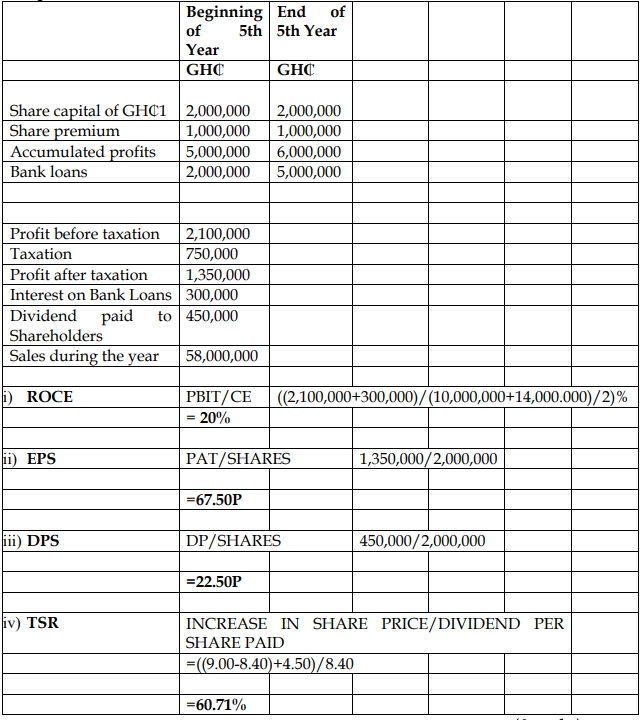
Calculate various financial ratios including ROCE, EPS, DPS, and TSR based on given financial data.

With reference to the information in Option One available to Prestige as presented by Professor Joseph Laing, a business consultant, calculate the following:

i) Return on Capital Employed (ROCE) (1 mark)
ii) Earnings Per Share (EPS) (1 mark)
iii) Dividend Per Share (DPS) (2 marks)
iv) Total Shareholders Return (TSR) (2 marks)
v) Explain the difference between ROCE and Accounting Rate of Return, their essential features, and relationship (4 marks)

v) Difference between ROCE and Accounting Rate of Return (ARR):

  • ROCE is a measure of the return on capital employed in the business, calculated by dividing the profit before interest and tax (PBIT) by the average capital employed. It reflects the overall efficiency of the company in generating profits from its available capital.
  • ARR, on the other hand, measures the accounting profit from a specific capital project, usually before interest and tax, as a percentage of the capital invested in that project.
  • The key difference lies in their scope: while ROCE assesses the return from the entire business or company, ARR focuses on specific capital projects. Both are used to evaluate the efficiency of capital usage, but ARR is project-specific, whereas ROCE is company-wide.

Login or create a free account to see answers

Complete your registration to see answers

Find Related Questions by Tags, levels, etc.

Report an error

You're reporting an error for "SCS – MAR 2024 – L3 – Q5a – Financial management"

SCS – MAR 2024 – L3 – Q5a – Financial management

This Question Has a Case Study: 

Calculate various financial ratios including ROCE, EPS, DPS, and TSR based on given financial data.

With reference to the information in Option One available to Prestige as presented by Professor Joseph Laing, a business consultant, calculate the following:

i) Return on Capital Employed (ROCE) (1 mark)
ii) Earnings Per Share (EPS) (1 mark)
iii) Dividend Per Share (DPS) (2 marks)
iv) Total Shareholders Return (TSR) (2 marks)
v) Explain the difference between ROCE and Accounting Rate of Return, their essential features, and relationship (4 marks)

v) Difference between ROCE and Accounting Rate of Return (ARR):

  • ROCE is a measure of the return on capital employed in the business, calculated by dividing the profit before interest and tax (PBIT) by the average capital employed. It reflects the overall efficiency of the company in generating profits from its available capital.
  • ARR, on the other hand, measures the accounting profit from a specific capital project, usually before interest and tax, as a percentage of the capital invested in that project.
  • The key difference lies in their scope: while ROCE assesses the return from the entire business or company, ARR focuses on specific capital projects. Both are used to evaluate the efficiency of capital usage, but ARR is project-specific, whereas ROCE is company-wide.

Login or create a free account to see answers

Complete your registration to see answers

Find Related Questions by Tags, levels, etc.

Report an error

You're reporting an error for "SCS – MAR 2024 – L3 – Q5a – Financial management"

SCS – MAR 2024 – L3 – Q4b – Strategy implementation

Advise on an appropriate HR strategy to harmonize the organizational structure for effective delivery at Prestige.

Each company acquired or merged by Prestige was allowed to maintain its human resource structure.

Required:
Analyze and advise on an appropriate HR strategy Prestige should adopt to harmonize the organizational structure for effective delivery of the company’s objectives.

  1. Strategic Workforce Planning:
    • Prestige should develop a workforce plan to address the complexities introduced by mergers and acquisitions. This plan should estimate the required number of employees, their skills, and potential future needs based on the company’s objectives, particularly in innovation and technology adoption.
  2. HR Consistency with Corporate Strategy:
    • The HR strategy should align with both the corporate and divisional strategies to ensure that the required number and type of employees are available at the right time to support business operations across regions.
  3. Assessment of Current Workforce:
    • Prestige should conduct an audit of its current workforce, assessing skills, experience, and attrition rates. This would help in identifying gaps and surpluses that need to be addressed through recruitment, training, or redundancy.
  4. Recruitment and Training:
    • The strategy should focus on recruiting the necessary talent to fill gaps, while also implementing training and development programs to upskill existing employees. This will help align employee capabilities with the company’s strategic needs, especially in areas such as IT, finance, and project management.
  5. Performance Management:
    • Implementing a robust performance appraisal system would enable Prestige to monitor the development of employees’ skills and performance, ensuring that key objectives are met. This would also identify areas where employees may require additional training or support.
  6. Promotion and Career Development:
    • Providing clear promotion paths and career development opportunities would encourage employee retention and foster motivation within the workforce, helping Prestige maintain a skilled and experienced team.
  7. Handling Redundancies:
    • Where there are surplus employees due to structural changes, Prestige should have a clear policy for managing redundancies in a way that minimizes disruption while ensuring fairness and compliance with labor laws.
  8. Labor Relations and Employee Welfare:
    • Ensuring good labor relations through clear communication and employee engagement initiatives will help reduce resistance to change. Compensation, health and safety, and employee well-being should be central to the HR strategy to foster a positive workplace environment.
  9. Technological Impact on HR:
    • Prestige should anticipate and manage the impact of technological changes on its workforce, particularly in relation to automation, digital skills, and remote working capabilities.

Factors to Consider:

  • Population trends and labor market conditions.
  • Changes in government policies affecting employment.
  • The availability of specific skills within the workforce.
  • Competition for talent from other businesses.
  • Trends in outsourcing and subcontracting.

Login or create a free account to see answers

Complete your registration to see answers

Find Related Questions by Tags, levels, etc.

Report an error

You're reporting an error for "SCS – MAR 2024 – L3 – Q4b – Strategy implementation"

SCS – MAR 2024 – L3 – Q4b – Strategy implementation

This Question Has a Case Study: 

Advise on an appropriate HR strategy to harmonize the organizational structure for effective delivery at Prestige.

Each company acquired or merged by Prestige was allowed to maintain its human resource structure.

Required:
Analyze and advise on an appropriate HR strategy Prestige should adopt to harmonize the organizational structure for effective delivery of the company’s objectives.

  1. Strategic Workforce Planning:
    • Prestige should develop a workforce plan to address the complexities introduced by mergers and acquisitions. This plan should estimate the required number of employees, their skills, and potential future needs based on the company’s objectives, particularly in innovation and technology adoption.
  2. HR Consistency with Corporate Strategy:
    • The HR strategy should align with both the corporate and divisional strategies to ensure that the required number and type of employees are available at the right time to support business operations across regions.
  3. Assessment of Current Workforce:
    • Prestige should conduct an audit of its current workforce, assessing skills, experience, and attrition rates. This would help in identifying gaps and surpluses that need to be addressed through recruitment, training, or redundancy.
  4. Recruitment and Training:
    • The strategy should focus on recruiting the necessary talent to fill gaps, while also implementing training and development programs to upskill existing employees. This will help align employee capabilities with the company’s strategic needs, especially in areas such as IT, finance, and project management.
  5. Performance Management:
    • Implementing a robust performance appraisal system would enable Prestige to monitor the development of employees’ skills and performance, ensuring that key objectives are met. This would also identify areas where employees may require additional training or support.
  6. Promotion and Career Development:
    • Providing clear promotion paths and career development opportunities would encourage employee retention and foster motivation within the workforce, helping Prestige maintain a skilled and experienced team.
  7. Handling Redundancies:
    • Where there are surplus employees due to structural changes, Prestige should have a clear policy for managing redundancies in a way that minimizes disruption while ensuring fairness and compliance with labor laws.
  8. Labor Relations and Employee Welfare:
    • Ensuring good labor relations through clear communication and employee engagement initiatives will help reduce resistance to change. Compensation, health and safety, and employee well-being should be central to the HR strategy to foster a positive workplace environment.
  9. Technological Impact on HR:
    • Prestige should anticipate and manage the impact of technological changes on its workforce, particularly in relation to automation, digital skills, and remote working capabilities.

Factors to Consider:

  • Population trends and labor market conditions.
  • Changes in government policies affecting employment.
  • The availability of specific skills within the workforce.
  • Competition for talent from other businesses.
  • Trends in outsourcing and subcontracting.

Login or create a free account to see answers

Complete your registration to see answers

Find Related Questions by Tags, levels, etc.

Report an error

You're reporting an error for "SCS – MAR 2024 – L3 – Q4b – Strategy implementation"

SCS – MAR 2024 – L3 – Q4a – Strategy implementation

Explain how Prestige could leverage ICT using the four broad stages of e-business development to compete.

Prestige’s Board has shifted from their long-standing reluctance to venture into foreign markets to seriously consider the possibility of expansion overseas. An important implication of this decision is that as the size of the market increases, competition becomes international. The main rivals are no longer local suppliers to a domestic market.

Required:
Using the four broad stages of development to a full e-business model, explain how Prestige could leverage ICT to compete.

  1. Web Presence:
    • Prestige could set up a website to display its property listings and services. The website can serve as a platform to provide detailed information about the houses for sale, available property types, and contact details. This would enhance visibility and reach beyond local markets.
  2. E-Commerce:
    • Prestige can integrate e-commerce capabilities on its website, allowing potential buyers to make inquiries, schedule viewings, or even complete purchases online. They can also use e-commerce platforms to manage orders and payments from suppliers and partners.
  3. Integrated E-Commerce:
    • Prestige could utilize ICT to gather and analyze customer data to understand their preferences and buying behavior. By establishing two-way communication channels, the company could use customer feedback to improve its product offerings and tailor marketing strategies, boosting customer satisfaction.
  4. E-Business:
    • ICT can drive Prestige’s business strategy by making e-business a fundamental part of its operations. E-business can enhance efficiency in sales, marketing, procurement, and customer service, aligning business operations with digital transformation to gain a competitive edge in the global market.

Login or create a free account to see answers

Complete your registration to see answers

Find Related Questions by Tags, levels, etc.

Report an error

You're reporting an error for "SCS – MAR 2024 – L3 – Q4a – Strategy implementation"

SCS – MAR 2024 – L3 – Q4a – Strategy implementation

This Question Has a Case Study: 

Explain how Prestige could leverage ICT using the four broad stages of e-business development to compete.

Prestige’s Board has shifted from their long-standing reluctance to venture into foreign markets to seriously consider the possibility of expansion overseas. An important implication of this decision is that as the size of the market increases, competition becomes international. The main rivals are no longer local suppliers to a domestic market.

Required:
Using the four broad stages of development to a full e-business model, explain how Prestige could leverage ICT to compete.

  1. Web Presence:
    • Prestige could set up a website to display its property listings and services. The website can serve as a platform to provide detailed information about the houses for sale, available property types, and contact details. This would enhance visibility and reach beyond local markets.
  2. E-Commerce:
    • Prestige can integrate e-commerce capabilities on its website, allowing potential buyers to make inquiries, schedule viewings, or even complete purchases online. They can also use e-commerce platforms to manage orders and payments from suppliers and partners.
  3. Integrated E-Commerce:
    • Prestige could utilize ICT to gather and analyze customer data to understand their preferences and buying behavior. By establishing two-way communication channels, the company could use customer feedback to improve its product offerings and tailor marketing strategies, boosting customer satisfaction.
  4. E-Business:
    • ICT can drive Prestige’s business strategy by making e-business a fundamental part of its operations. E-business can enhance efficiency in sales, marketing, procurement, and customer service, aligning business operations with digital transformation to gain a competitive edge in the global market.

Login or create a free account to see answers

Complete your registration to see answers

Find Related Questions by Tags, levels, etc.

Report an error

You're reporting an error for "SCS – MAR 2024 – L3 – Q4a – Strategy implementation"

SCS – MAR 2024 – L3 – Q3 – Functional strategies

Explain the potential benefits of resource sharing through common IT systems at Prestige.

When five years ago the present regional divisional structure of Greater Accra, Ashanti, and Eastern was formalized, an attempt was made to ensure that common systems and ways of working were adopted across each of the three regions. However, due to the pressures on the Company, this was never fully implemented.

Required:
Explain the potential benefits of resource sharing (configuring an organization’s computing system in such a way that the information and resources within it can be accessed, and remotely accessed, across multiple administrative domains) to Prestige if they adopt common IT systems.

  1. Ease of Access: A common IT system allows staff to access systems, software, and files from any location with an internet connection. This supports collaborative working across regions.
  2. Accuracy: Having a single source of data ensures accuracy by eliminating multiple similar versions scattered across the organization. This provides reliable information to all divisions.
  3. Cost Savings: Resource sharing avoids duplication of work across divisions. Generating similar data for similar purposes can be costly, so producing data once and sharing it reduces inefficiencies and costs for Prestige.
  4. Facilitates Remote Working: IT resource sharing enables remote working, increasing flexibility. Employees can work from any location, enhancing motivation and potentially creating cost savings by allowing work from home.
  5. Transparency: Resource sharing promotes transparency across the organization by making information easily accessible to all relevant parties. This can improve decision-making and operational efficiency.

Login or create a free account to see answers

Complete your registration to see answers

Find Related Questions by Tags, levels, etc.

Report an error

You're reporting an error for "SCS – MAR 2024 – L3 – Q3 – Functional strategies"

SCS – MAR 2024 – L3 – Q3 – Functional strategies

This Question Has a Case Study: 

Explain the potential benefits of resource sharing through common IT systems at Prestige.

When five years ago the present regional divisional structure of Greater Accra, Ashanti, and Eastern was formalized, an attempt was made to ensure that common systems and ways of working were adopted across each of the three regions. However, due to the pressures on the Company, this was never fully implemented.

Required:
Explain the potential benefits of resource sharing (configuring an organization’s computing system in such a way that the information and resources within it can be accessed, and remotely accessed, across multiple administrative domains) to Prestige if they adopt common IT systems.

  1. Ease of Access: A common IT system allows staff to access systems, software, and files from any location with an internet connection. This supports collaborative working across regions.
  2. Accuracy: Having a single source of data ensures accuracy by eliminating multiple similar versions scattered across the organization. This provides reliable information to all divisions.
  3. Cost Savings: Resource sharing avoids duplication of work across divisions. Generating similar data for similar purposes can be costly, so producing data once and sharing it reduces inefficiencies and costs for Prestige.
  4. Facilitates Remote Working: IT resource sharing enables remote working, increasing flexibility. Employees can work from any location, enhancing motivation and potentially creating cost savings by allowing work from home.
  5. Transparency: Resource sharing promotes transparency across the organization by making information easily accessible to all relevant parties. This can improve decision-making and operational efficiency.

Login or create a free account to see answers

Complete your registration to see answers

Find Related Questions by Tags, levels, etc.

Report an error

You're reporting an error for "SCS – MAR 2024 – L3 – Q3 – Functional strategies"

SCS – MAR 2024 – L3 – Q2 – Competitive advantage

Apply and appraise Porter’s three strategies for sustaining competitive advantage for Prestige Designers Ltd.

A strategic clock can be used to consider different business strategies for gaining competitive advantage, based on providing a combination of price and perceived benefits. Porter has suggested three strategies for sustaining competitive advantage over rival firms and their products or services. They are a cost leadership strategy, a differentiation strategy, and a focus strategy.

Required:
Apply and appraise how effective the suggested three strategies for sustaining competitive advantage over rival firms would be useful to Prestige. (10 marks)

  1. Cost Leadership Strategy:
    • Prestige must compete effectively on price by offering its housing stock at a lower price than rivals.
    • The company should have excellent cost control systems and continually plan for further reductions in costs to remain the cost leader in the market.
    • Prestige, being a large company, can benefit from economies of scale compared to smaller competitors.
    • To achieve reasonable profit margins, Prestige must sell large volumes of homes at a lower profit margin per unit.
  2. Differentiation Strategy:
    • Prestige’s products must be distinct from those of its competitors in a way that customers can recognize, potentially leveraging the “Vintage” brand which focuses on low-cost housing for young buyers.
    • The company could innovate and incorporate modern methods of construction (MMC) and sustainability-related methods to differentiate its products.
    • Customers might be willing to pay more for homes with unique features and higher perceived value.
    • Prestige should invest in delivering superior value to customers, even if that means higher upfront costs.
  3. Focus Strategy:
    • Prestige could focus on segmented consumer markets by selecting specific segments, such as the middle-class or younger first-time home buyers, as the primary market for their products.
    • The company could concentrate on serving a particular type of customer or region, allowing it to tailor its offerings to the unique demands of that segment.

Login or create a free account to see answers

Complete your registration to see answers

Find Related Questions by Tags, levels, etc.

Report an error

You're reporting an error for "SCS – MAR 2024 – L3 – Q2 – Competitive advantage"

SCS – MAR 2024 – L3 – Q2 – Competitive advantage

This Question Has a Case Study: 

Apply and appraise Porter’s three strategies for sustaining competitive advantage for Prestige Designers Ltd.

A strategic clock can be used to consider different business strategies for gaining competitive advantage, based on providing a combination of price and perceived benefits. Porter has suggested three strategies for sustaining competitive advantage over rival firms and their products or services. They are a cost leadership strategy, a differentiation strategy, and a focus strategy.

Required:
Apply and appraise how effective the suggested three strategies for sustaining competitive advantage over rival firms would be useful to Prestige. (10 marks)

  1. Cost Leadership Strategy:
    • Prestige must compete effectively on price by offering its housing stock at a lower price than rivals.
    • The company should have excellent cost control systems and continually plan for further reductions in costs to remain the cost leader in the market.
    • Prestige, being a large company, can benefit from economies of scale compared to smaller competitors.
    • To achieve reasonable profit margins, Prestige must sell large volumes of homes at a lower profit margin per unit.
  2. Differentiation Strategy:
    • Prestige’s products must be distinct from those of its competitors in a way that customers can recognize, potentially leveraging the “Vintage” brand which focuses on low-cost housing for young buyers.
    • The company could innovate and incorporate modern methods of construction (MMC) and sustainability-related methods to differentiate its products.
    • Customers might be willing to pay more for homes with unique features and higher perceived value.
    • Prestige should invest in delivering superior value to customers, even if that means higher upfront costs.
  3. Focus Strategy:
    • Prestige could focus on segmented consumer markets by selecting specific segments, such as the middle-class or younger first-time home buyers, as the primary market for their products.
    • The company could concentrate on serving a particular type of customer or region, allowing it to tailor its offerings to the unique demands of that segment.

Login or create a free account to see answers

Complete your registration to see answers

Find Related Questions by Tags, levels, etc.

Report an error

You're reporting an error for "SCS – MAR 2024 – L3 – Q2 – Competitive advantage"

PT – Mar 2024 – L2 – Q2c – Income Tax Liabilities

Compute the monthly pension payable to Ama Adaklu after retirement based on her last five years' salary.

Ama Adaklu retired in December 2022 after contributing to SSNIT for 300 months, working with three different employers. The last 5 years of her annual salary are as follows:

Year Annual Salary (GH¢)
2018 200,000
2019 220,000
2020 250,000
2021 450,000
2022 500,000

Required:
Compute the monthly pension payable to Ama Adaklu. (5 marks

Computation of Monthly Pension Pay
Pension = (Three years average salary × Pension right × Early retirement reduction factor)

Three years average salary = (250,000 + 450,000 + 500,000) / 3
= GH¢400,000

Pension right:

  • Minimum right: 37.5%
  • Additional percentage: (300 months – 180 months) × 0.09375 = 11.25%
  • Total pension right: 48.75%

Since Ama Adaklu retired at age 60 after working for 25 years, there is no early retirement reduction factor.

Pension = 48.75% × GH¢400,000
= GH¢195,000

Monthly pension pay = Pension entitlement / 12 months
= GH¢195,000 / 12
= GH¢16,250

Login or create a free account to see answers

Complete your registration to see answers

Find Related Questions by Tags, levels, etc.

Report an error

You're reporting an error for "PT – Mar 2024 – L2 – Q2c – Income Tax Liabilities"

PT – Mar 2024 – L2 – Q2c – Income Tax Liabilities

Compute the monthly pension payable to Ama Adaklu after retirement based on her last five years' salary.

Ama Adaklu retired in December 2022 after contributing to SSNIT for 300 months, working with three different employers. The last 5 years of her annual salary are as follows:

Year Annual Salary (GH¢)
2018 200,000
2019 220,000
2020 250,000
2021 450,000
2022 500,000

Required:
Compute the monthly pension payable to Ama Adaklu. (5 marks

Computation of Monthly Pension Pay
Pension = (Three years average salary × Pension right × Early retirement reduction factor)

Three years average salary = (250,000 + 450,000 + 500,000) / 3
= GH¢400,000

Pension right:

  • Minimum right: 37.5%
  • Additional percentage: (300 months – 180 months) × 0.09375 = 11.25%
  • Total pension right: 48.75%

Since Ama Adaklu retired at age 60 after working for 25 years, there is no early retirement reduction factor.

Pension = 48.75% × GH¢400,000
= GH¢195,000

Monthly pension pay = Pension entitlement / 12 months
= GH¢195,000 / 12
= GH¢16,250

Login or create a free account to see answers

Complete your registration to see answers

Find Related Questions by Tags, levels, etc.

Report an error

You're reporting an error for "PT – Mar 2024 – L2 – Q2c – Income Tax Liabilities"

PT – Mar 2024 – L2 – Q2b – Value-Added Tax (VAT), Customs, and Excise Duties

State five conditions under which goods supplied on "sale or return" basis become taxable.

State FIVE (5) conditions under which goods supplied on “sales or return” basis become taxable.

The following are the conditions under which goods supplied on a “sale or return” basis become taxable:

  1. The date when the purchaser chooses to keep the goods.
  2. The issue of a tax invoice by the seller.
  3. The receipt of payment by the seller, other than a deposit.
  4. The expiry of the period within which the customer may return the goods.
  5. Twelve months after the date of dispatch by the seller.

Login or create a free account to see answers

Complete your registration to see answers

Find Related Questions by Tags, levels, etc.

Report an error

You're reporting an error for "PT – Mar 2024 – L2 – Q2b – Value-Added Tax (VAT), Customs, and Excise Duties"

PT – Mar 2024 – L2 – Q2b – Value-Added Tax (VAT), Customs, and Excise Duties

State five conditions under which goods supplied on "sale or return" basis become taxable.

State FIVE (5) conditions under which goods supplied on “sales or return” basis become taxable.

The following are the conditions under which goods supplied on a “sale or return” basis become taxable:

  1. The date when the purchaser chooses to keep the goods.
  2. The issue of a tax invoice by the seller.
  3. The receipt of payment by the seller, other than a deposit.
  4. The expiry of the period within which the customer may return the goods.
  5. Twelve months after the date of dispatch by the seller.

Login or create a free account to see answers

Complete your registration to see answers

Find Related Questions by Tags, levels, etc.

Report an error

You're reporting an error for "PT – Mar 2024 – L2 – Q2b – Value-Added Tax (VAT), Customs, and Excise Duties"

PT – Mar 2024 – L2 – Q2a -Value-Added Tax (VAT), Customs, and Excise Duties

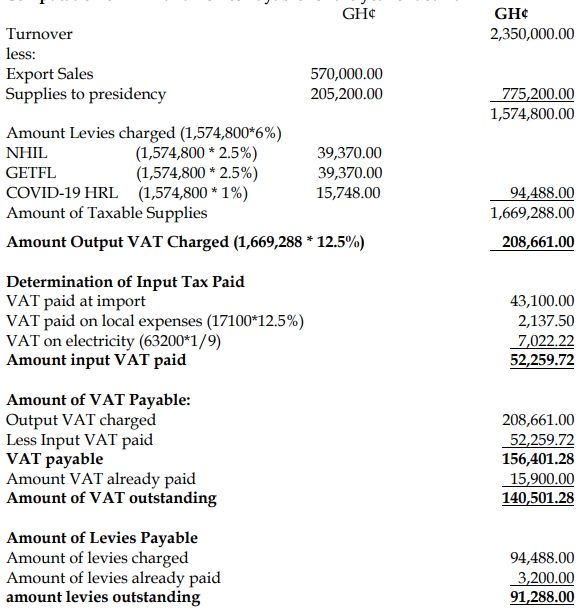
Compute VAT and Levies payable by Pioneer Products Ltd for the year 2023.

Pioneer Products Ltd (PPL) is a manufacturer of plastic products which are supplied into both domestic and foreign markets.

The following transactions took place in the year 2023:

Transaction Amount (GH¢)
Turnover for the year 2,350,000
Export sales 570,000
Supplies to the presidency of Ghana for maintenance 205,200
Import duties paid 12,900
Import VAT Paid 43,100
Cost of local purchases (Excluding VAT) 17,100
Cost of electricity bills paid (Including VAT) 63,200
VAT paid to Ghana Revenue Authority during the year 15,900
Levies paid to Ghana Revenue Authority during the year 3,200

Required:
Compute VAT and Levies payable at the end of the year 2023. (10 marks)

Computation of VAT and Levies Payable for the year ended 2023

Login or create a free account to see answers

Complete your registration to see answers

Find Related Questions by Tags, levels, etc.

Report an error

You're reporting an error for "PT – Mar 2024 – L2 – Q2a -Value-Added Tax (VAT), Customs, and Excise Duties"

PT – Mar 2024 – L2 – Q2a -Value-Added Tax (VAT), Customs, and Excise Duties

Compute VAT and Levies payable by Pioneer Products Ltd for the year 2023.

Pioneer Products Ltd (PPL) is a manufacturer of plastic products which are supplied into both domestic and foreign markets.

The following transactions took place in the year 2023:

Transaction Amount (GH¢)
Turnover for the year 2,350,000
Export sales 570,000
Supplies to the presidency of Ghana for maintenance 205,200
Import duties paid 12,900
Import VAT Paid 43,100
Cost of local purchases (Excluding VAT) 17,100
Cost of electricity bills paid (Including VAT) 63,200
VAT paid to Ghana Revenue Authority during the year 15,900
Levies paid to Ghana Revenue Authority during the year 3,200

Required:
Compute VAT and Levies payable at the end of the year 2023. (10 marks)

Computation of VAT and Levies Payable for the year ended 2023

Login or create a free account to see answers

Complete your registration to see answers

Find Related Questions by Tags, levels, etc.

Report an error

You're reporting an error for "PT – Mar 2024 – L2 – Q2a -Value-Added Tax (VAT), Customs, and Excise Duties"

PT – Mar 2024 – L2 – Q1d – Tax Administration

State five benefits of integrating the revenue agencies into the Ghana Revenue Authority (GRA).

The erstwhile revenue agencies (VAT, IRS & CEPS) were integrated into the Ghana Revenue Authority (GRA) in 2009. It was envisaged that the integration of the Revenue Agencies would bring certain benefits to taxpayers and tax administration.

Required:
State FIVE (5) of such benefits. (5 marks)

Five benefits of integrating the revenue agencies into the Ghana Revenue Authority are:

  1. Reduced administrative and tax compliance cost.
  2. Better service delivery.
  3. Improved departmental information flow.
  4. Holistic approach to domestic tax and customs administration.
  5. Enhanced revenue mobilisation.

Login or create a free account to see answers

Complete your registration to see answers

Find Related Questions by Tags, levels, etc.

Report an error

You're reporting an error for "PT – Mar 2024 – L2 – Q1d – Tax Administration"

PT – Mar 2024 – L2 – Q1d – Tax Administration

State five benefits of integrating the revenue agencies into the Ghana Revenue Authority (GRA).

The erstwhile revenue agencies (VAT, IRS & CEPS) were integrated into the Ghana Revenue Authority (GRA) in 2009. It was envisaged that the integration of the Revenue Agencies would bring certain benefits to taxpayers and tax administration.

Required:
State FIVE (5) of such benefits. (5 marks)

Five benefits of integrating the revenue agencies into the Ghana Revenue Authority are:

  1. Reduced administrative and tax compliance cost.
  2. Better service delivery.
  3. Improved departmental information flow.
  4. Holistic approach to domestic tax and customs administration.
  5. Enhanced revenue mobilisation.

Login or create a free account to see answers

Complete your registration to see answers

Find Related Questions by Tags, levels, etc.

Report an error

You're reporting an error for "PT – Mar 2024 – L2 – Q1d – Tax Administration"

PT – Mar 2024 – L2 – Q1c – Tax Administration

State five direct taxes administered by the Domestic Tax Revenue Division (DTRD) of GRA.

The Ghana Revenue Authority is made up of two operational divisions: Domestic Tax Revenue Division (DTRD) and Customs Division (CD) with assistance from the Support Services Division (SSD).

Required:
In reference to the statement above, state FIVE (5) direct taxes administered by the Domestic Tax Revenue Division of the Ghana Revenue Authority. (5 marks)

Five direct taxes administered by the Domestic Tax Revenue Division (DTRD) are:

  1. Corporate Income Tax
  2. Personal Income Tax
  3. Pay As You Earn (PAYE)
  4. Tax Stamp
  5. Mineral Royalties
  6. Capital Gains Tax
  7. Gift Tax
  8. Rent Tax

Login or create a free account to see answers

Complete your registration to see answers

Find Related Questions by Tags, levels, etc.

Report an error

You're reporting an error for "PT – Mar 2024 – L2 – Q1c – Tax Administration"

PT – Mar 2024 – L2 – Q1c – Tax Administration

State five direct taxes administered by the Domestic Tax Revenue Division (DTRD) of GRA.

The Ghana Revenue Authority is made up of two operational divisions: Domestic Tax Revenue Division (DTRD) and Customs Division (CD) with assistance from the Support Services Division (SSD).

Required:
In reference to the statement above, state FIVE (5) direct taxes administered by the Domestic Tax Revenue Division of the Ghana Revenue Authority. (5 marks)

Five direct taxes administered by the Domestic Tax Revenue Division (DTRD) are:

  1. Corporate Income Tax
  2. Personal Income Tax
  3. Pay As You Earn (PAYE)
  4. Tax Stamp
  5. Mineral Royalties
  6. Capital Gains Tax
  7. Gift Tax
  8. Rent Tax

Login or create a free account to see answers

Complete your registration to see answers

Find Related Questions by Tags, levels, etc.

Report an error

You're reporting an error for "PT – Mar 2024 – L2 – Q1c – Tax Administration"

PT – Mar 2024 – L2 – Q1b – Overview of the Ghanaian Tax System and Fiscal Policy

Explain the features that distinguish progressive, proportional, and regressive taxes.

A tax may be described in a number of ways based on the relationship between income earned by a person and the tax rate applicable to that income. Again, an important feature of a tax system is the percentage of the tax burden relative to income or consumption, thus, the terms progressive, proportional, and regressive are used to describe the way the rate of tax progresses from low to high; from high to low or proportionally.

Required:
In relation to the scenario above, explain progressive, proportional, and regressive taxes, stating the main features that distinguish them. (5 marks)

  • Progressive Tax:
    This tax regime involves the ratio of tax liability to income rising as income increases. A greater percentage of income is taxed as income rises, meaning higher earners pay a higher tax rate. This system helps in redistributing income, ensuring that the rich bear more tax than the poor. An example is the graduated tax rate applicable to individuals in the First Schedule of the Income Tax Act, 2015 (Act 896) as amended.
  • Proportional Tax:
    In a proportional tax system, the effective tax rate remains the same irrespective of income level. Both the rich and the poor are taxed at the same percentage of their income or expenditure.
  • Regressive Tax:
    In a regressive tax system, the tax ratio decreases as income increases. This system places a smaller tax burden on higher-income earners compared to lower-income earners. It is generally seen as inequitable and indirect taxes like VAT are often regressive.

Login or create a free account to see answers

Complete your registration to see answers

Find Related Questions by Tags, levels, etc.

Report an error

You're reporting an error for "PT – Mar 2024 – L2 – Q1b – Overview of the Ghanaian Tax System and Fiscal Policy"

PT – Mar 2024 – L2 – Q1b – Overview of the Ghanaian Tax System and Fiscal Policy

Explain the features that distinguish progressive, proportional, and regressive taxes.

A tax may be described in a number of ways based on the relationship between income earned by a person and the tax rate applicable to that income. Again, an important feature of a tax system is the percentage of the tax burden relative to income or consumption, thus, the terms progressive, proportional, and regressive are used to describe the way the rate of tax progresses from low to high; from high to low or proportionally.

Required:
In relation to the scenario above, explain progressive, proportional, and regressive taxes, stating the main features that distinguish them. (5 marks)

  • Progressive Tax:
    This tax regime involves the ratio of tax liability to income rising as income increases. A greater percentage of income is taxed as income rises, meaning higher earners pay a higher tax rate. This system helps in redistributing income, ensuring that the rich bear more tax than the poor. An example is the graduated tax rate applicable to individuals in the First Schedule of the Income Tax Act, 2015 (Act 896) as amended.
  • Proportional Tax:
    In a proportional tax system, the effective tax rate remains the same irrespective of income level. Both the rich and the poor are taxed at the same percentage of their income or expenditure.
  • Regressive Tax:
    In a regressive tax system, the tax ratio decreases as income increases. This system places a smaller tax burden on higher-income earners compared to lower-income earners. It is generally seen as inequitable and indirect taxes like VAT are often regressive.

Login or create a free account to see answers

Complete your registration to see answers

Find Related Questions by Tags, levels, etc.

Report an error

You're reporting an error for "PT – Mar 2024 – L2 – Q1b – Overview of the Ghanaian Tax System and Fiscal Policy"

PT – Mar 2024 – L2 – Q1a – Tax Administration

Explain the benefits of the new tax administration reforms in Ghana for taxpayers and GRA.

In recent years, the Ghana Revenue Authority (GRA) has embarked on some tax administrative reforms. One of the key administrative reforms is the merger of the Medium Taxpayer Office (MTO) and Small Taxpayer Office (STO) systems in the management of taxpayers, which has resulted in the introduction of the Taxpayer Services Centres (TSCs) concept whereby taxpayers are migrated to tax offices closer to their business locations, irrespective of their turnovers.

Required:

i) Explain TWO (2) benefits of the new tax administration reform to the taxpayer. (2 marks)

ii) Explain THREE (3) benefits of the new tax administration reform to the GRA. (3 marks)

i) Benefits of Tax Service Centres to the taxpayer:

  • Reduced tax compliance cost – Long distance covered by taxpayers to interact with DTRD offices is reduced.
  • Receive better customer service from GRA.
  • Have queries and issues quickly addressed.
    (Any 2 points @ 1 mark each = 2 marks)

ii) Benefits of Tax Service Centres to GRA:

  • It enhances effectiveness in compliance checks and monitoring of taxpayers due to their proximity to Taxpayer Service Centres.
  • Diversified knowledge and understanding of varied taxpayer sizes by tax officers across tax offices.
  • Improved customer services and better service delivery to taxpayers.
  • Improved tax revenue growth due to improved compliance.

Login or create a free account to see answers

Complete your registration to see answers

Find Related Questions by Tags, levels, etc.

Report an error

You're reporting an error for "PT – Mar 2024 – L2 – Q1a – Tax Administration"

PT – Mar 2024 – L2 – Q1a – Tax Administration

Explain the benefits of the new tax administration reforms in Ghana for taxpayers and GRA.

In recent years, the Ghana Revenue Authority (GRA) has embarked on some tax administrative reforms. One of the key administrative reforms is the merger of the Medium Taxpayer Office (MTO) and Small Taxpayer Office (STO) systems in the management of taxpayers, which has resulted in the introduction of the Taxpayer Services Centres (TSCs) concept whereby taxpayers are migrated to tax offices closer to their business locations, irrespective of their turnovers.

Required:

i) Explain TWO (2) benefits of the new tax administration reform to the taxpayer. (2 marks)

ii) Explain THREE (3) benefits of the new tax administration reform to the GRA. (3 marks)

i) Benefits of Tax Service Centres to the taxpayer:

  • Reduced tax compliance cost – Long distance covered by taxpayers to interact with DTRD offices is reduced.
  • Receive better customer service from GRA.
  • Have queries and issues quickly addressed.
    (Any 2 points @ 1 mark each = 2 marks)

ii) Benefits of Tax Service Centres to GRA:

  • It enhances effectiveness in compliance checks and monitoring of taxpayers due to their proximity to Taxpayer Service Centres.
  • Diversified knowledge and understanding of varied taxpayer sizes by tax officers across tax offices.
  • Improved customer services and better service delivery to taxpayers.
  • Improved tax revenue growth due to improved compliance.

Login or create a free account to see answers

Complete your registration to see answers

Find Related Questions by Tags, levels, etc.

Report an error

You're reporting an error for "PT – Mar 2024 – L2 – Q1a – Tax Administration"

CR – Mar 2024 – Q5 – Analysis and interpretation of financial statements

Analyze and compare cash flow statements of two companies to recommend an investment choice between them.

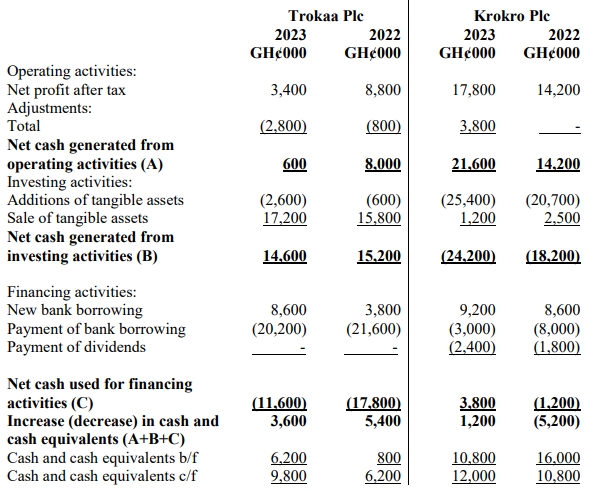
You are the Financial Consultant of Nkoso Funds, a pension fund in Ghana. Your company has identified two companies which you have been asked to evaluate as possible investments. The two companies, Trokaa Plc (Trokaa Plc) and Krokro Plc (Krokro Plc), are both publicly held and similar in size. Assume that all other publicly available information, including all climate, sustainability, and governance disclosures, have already been analysed and the decision concerning which company’s shares to acquire depends on their cash flow data given below:

Statement of cash flows for the years ended December 31, 2023 and 2022 Trokaa Plc Krokro Plc

Required:
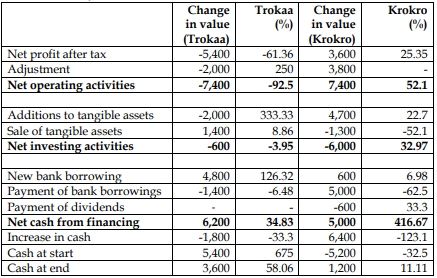
a) Conduct a horizontal analysis for each of the two companies. (6 marks)

b) Write a report to the investment manager of Nkoso Funds discussing the relative strengths and weaknesses of each of the two companies. Conclude your report by recommending one company’s share as an investment avenue. (14 marks)

a) Horizontal Analysis

b) Report to the Investment Manager of Nkoso Funds

Report
To: Investment Manager, Nkoso Funds
From: Financial Consultant, Nkoso Funds
Date: xx/xx/xx
Subject: Relative cash flow analysis of Trokaa Plc and Krokro Plc

This report presents analysis of cash flow information of two companies: Trokaa Plc and Krokro Plc as part of a broad financial analysis carried out on these companies to decide which of them represents a better target to invest in. The analysis is undertaken under four different headings: cash flows from operating activities, cash flows from investing activities, cash flows from financing activities, and changes in cash and cash equivalents.

Cash flows from operating activities
From the cash flow statements, it is clear that both companies have remained profitable across the two years. However, while Trokaa Plc’s net profit has declined by 61.36% [(8800 – 3400)*100/8800] Krokro Plc’s profit has increased by 25.35% [(17800-14200)*100/14200]. This implies, albeit loosely, that Krokro’s profit figures are not only higher than those of Trokaa but also seem to be faring better over time.

The picture painted by the profit figures is same as what the net operating cash flows reveal. Both companies generated more cash than they spent on operations across both years. Trokaa’s net cash generated from operating activities decreased very significantly whereas Krokro matched the improved profitability with increased operating cash flows between the two periods.

A closer look at the numbers suggests that Trokaa’s poor cash management in 2023 did not result from only the reduced profitability but also from the increases in the negative adjustments. This most probably signifies a deterioration in net working capital management; more cash tied up in inventories and receivables. Another implication is that the poor current asset management has undone the impact of any addbacks of material non-cash expenses such as depreciation. In the case of Krokro, the nil adjustment indicates that 2022’s positive and negative adjustments may have cancelled each out. But in 2023 the adjustments represented an addition to profit to increase the operating cash flows. This may suggest a better working capital management and/or a simple addback of non-cash expenses.

Krokro Plc also appears to have had more quality profit than Trokaa Plc. In both years, Krokro Plc’s net operating cash flows exceeded the related net profits, indicating that the profit figures were not just an outcome of accounting gimmicks, but figures which are sufficiently backed by cash. On the contrary, Trokaa’s profits were higher than the related net operating cash flows in both years. For instance, in 2023, with operating cash flows sharply dropping, Trokaa’s profit was backed only 17.65% (600*100/3400) by operating cash flows for that year.

Cash flows from investing activities
Cash flows from investing activities are basically concerned with the acquisition and disposal of non-current assets and related items.

The cash flow statements reveal that Trokaa Plc has experienced net cash inflows from investing activities while Krokro Plc has recorded net cash outflows. This clearly indicates that Trokaa Plc is selling off and sizing down on its operations while Krokro Plc is investing long-term and expanding its activities.

Though the asset sales have generated material figures for Trokaa Plc across the two years, this action could raise going concern issue for the company unless there are plans to reinvest the proceeds in different ventures. Thus, these cash flows suggest that there are doubts about Trokaa’s future while Krokro Plc appears to be motivated by the good profit figures to be investing in new assets and creating even more positive outlook into the future.

The increased net investment activities by Krokro Plc however imply that free cash flows are negative in both years. The indication is that Krokro Plc did not fund the new acquisitions in both periods only with internally generated cash but also with funds from lenders as can be seen under financing activities. Conversely, Trokaa Plc’s increased divestment activities created positive free cash flows in both years.

Cash flows from financing activities
Cash flows from financing activities are concerned with activities which result in changes in an entity’s mix of equity and debt capital. These cash flows result from transactions between the entity on one hand and shareholders and lenders on the other.

Trokaa Plc reported net cash outflows from financing activities, albeit lower in 2023 than in 2022, across both years while Krokro Plc presented net cash outflows only in 2022. These figures show that Trokaa Plc spent the positive free cash flows (as discussed under investing) on capital holders while Krokro Plc rather had to raise additional monies (especially in 2023 when the net flows became positive) to finance its deficient free cash flows.

A closer look at the section breakdown shows that both entities obtained new funds from only lenders in both years. While at this point, it is apparently clear how the new borrowings by Krokro Plc were applied as discussed under investment activities, it is not for Trokaa Plc. However, the immediate next line shows that huge debt repayments were made by Trokaa Plc, compared to Krokro Plc. The proceeds from asset sales did not find their way into idle accounts or short-term investments for later use but were utilized to repay loans. This thus offers a confirmation that the company does not intend to invest in new projects or replace ones sold.

But then as a lot of repayments are occurring at Trokaa, its gearing position is expected to improve while future interest payments can be projected to fall. Krokro Plc’s loan build-ups in both years would worsen its gearing ratio and cause future interest payments to rise. However, it seems this does not create much concern as its strong profitability and operating cash flows should be able to allay any fears that lenders might harbour.

A more worrying picture painted by the 2023 figures of Trokaa is how the company has used the new loan. Instead of investing the loan proceeds in new assets, it appears Trokaa has used a good chunk to augment the asset sales to redeem the existing debts. This situation can easily push the company into debt distress as falling profitability coupled with failure to find and invest in new viable projects may impair the firm’s debt servicing capacity despite the improving gearing and lower future interest costs.

Only Krokro Plc paid dividends to shareholders in both years, with the 2023’s payment being one-third higher. Krokro Plc’s decisions to pay dividends and increase amount this year look very apt as the amounts in both years are sufficiently below the net cash generated from operating activities. The implication is that these payments can be sustained going forward. But the failure of Trokaa Plc to return anything to shareholders just adduces additional evidence of the apparent cash flow problems that its earlier numbers seem to be revealing.

Changes in cash and cash equivalents
Trokaa’s net cash changes have remained positive across the two periods even though the net cash increase of GH¢3.6 million in 2023 falls below what occurred in 2022 by 33 1/3 % [(5400 – 3600) * 100/5400].

These positive changes have been driven by cash generated from net asset disposals and net operating cash inflows, with the larger contributor being the former. Net cash from financing activities has been negative in both periods. But the reduction in net cash increment appears to have occurred largely because of the significant dip in net cash from operations (from GH¢8 million to GH¢0.6 million). This drop, combined with the small decrease in net investing inflows, was too huge to be compensated for by the significant decrease in the net cash used on financing activities.

The fact that Trokaa’s positive net cash changes are disproportionately dependent on proceeds from asset sales does not leave an all-that-good picture. In fact, without these inflows, the company would have net decreases in cash and cash equivalents. Meanwhile these flows are not sustainable as the firm cannot continue disposing of its assets to raise new funds. Else, it would be out of business.

It appears that Krokro’s cash flows situation gives a more encouraging picture than Trokaa’s. Krokro’s net cash changes improved from being a net negative figure last year to becoming a positive one this year. This improvement in net cash changes translates into an increment of GH¢6.4 million (GH¢1.2 million + GH¢5.2 m) from 2022 to 2023.

This improved performance was due to the significant rise in the net cash generated from both operating and financing activities. These huge increases led to the improvement we see because they exceeded how much more cash was required for the additional cash investments in 2023. Krokro’s turnaround appears even more impressive given that the firm generated much of the improvement from its own operating activities.

Overall, the cash flow data of the two companies suggest that not only has Krokro Plc been more profitable (in absolute terms, at least) across and over the two years but it has also handled and managed its cash flows better than Trokaa Plc. Krokro Plc has generated more cash from its own operations, is expanding its activities by buying new assets, is committed to sustainable dividend payments and is leveraging its strong potential to use a cheaper source of finance – debts – to fund its investments. I therefore recommend that we consider Krokro Plc for the share investment.

Login or create a free account to see answers

Complete your registration to see answers

Find Related Questions by Tags, levels, etc.

Report an error

You're reporting an error for "CR – Mar 2024 – Q5 – Analysis and interpretation of financial statements"

CR – Mar 2024 – Q5 – Analysis and interpretation of financial statements

Analyze and compare cash flow statements of two companies to recommend an investment choice between them.

You are the Financial Consultant of Nkoso Funds, a pension fund in Ghana. Your company has identified two companies which you have been asked to evaluate as possible investments. The two companies, Trokaa Plc (Trokaa Plc) and Krokro Plc (Krokro Plc), are both publicly held and similar in size. Assume that all other publicly available information, including all climate, sustainability, and governance disclosures, have already been analysed and the decision concerning which company’s shares to acquire depends on their cash flow data given below:

Statement of cash flows for the years ended December 31, 2023 and 2022 Trokaa Plc Krokro Plc

Required:
a) Conduct a horizontal analysis for each of the two companies. (6 marks)

b) Write a report to the investment manager of Nkoso Funds discussing the relative strengths and weaknesses of each of the two companies. Conclude your report by recommending one company’s share as an investment avenue. (14 marks)

a) Horizontal Analysis

b) Report to the Investment Manager of Nkoso Funds

Report
To: Investment Manager, Nkoso Funds
From: Financial Consultant, Nkoso Funds
Date: xx/xx/xx
Subject: Relative cash flow analysis of Trokaa Plc and Krokro Plc

This report presents analysis of cash flow information of two companies: Trokaa Plc and Krokro Plc as part of a broad financial analysis carried out on these companies to decide which of them represents a better target to invest in. The analysis is undertaken under four different headings: cash flows from operating activities, cash flows from investing activities, cash flows from financing activities, and changes in cash and cash equivalents.

Cash flows from operating activities
From the cash flow statements, it is clear that both companies have remained profitable across the two years. However, while Trokaa Plc’s net profit has declined by 61.36% [(8800 – 3400)*100/8800] Krokro Plc’s profit has increased by 25.35% [(17800-14200)*100/14200]. This implies, albeit loosely, that Krokro’s profit figures are not only higher than those of Trokaa but also seem to be faring better over time.

The picture painted by the profit figures is same as what the net operating cash flows reveal. Both companies generated more cash than they spent on operations across both years. Trokaa’s net cash generated from operating activities decreased very significantly whereas Krokro matched the improved profitability with increased operating cash flows between the two periods.

A closer look at the numbers suggests that Trokaa’s poor cash management in 2023 did not result from only the reduced profitability but also from the increases in the negative adjustments. This most probably signifies a deterioration in net working capital management; more cash tied up in inventories and receivables. Another implication is that the poor current asset management has undone the impact of any addbacks of material non-cash expenses such as depreciation. In the case of Krokro, the nil adjustment indicates that 2022’s positive and negative adjustments may have cancelled each out. But in 2023 the adjustments represented an addition to profit to increase the operating cash flows. This may suggest a better working capital management and/or a simple addback of non-cash expenses.

Krokro Plc also appears to have had more quality profit than Trokaa Plc. In both years, Krokro Plc’s net operating cash flows exceeded the related net profits, indicating that the profit figures were not just an outcome of accounting gimmicks, but figures which are sufficiently backed by cash. On the contrary, Trokaa’s profits were higher than the related net operating cash flows in both years. For instance, in 2023, with operating cash flows sharply dropping, Trokaa’s profit was backed only 17.65% (600*100/3400) by operating cash flows for that year.

Cash flows from investing activities
Cash flows from investing activities are basically concerned with the acquisition and disposal of non-current assets and related items.

The cash flow statements reveal that Trokaa Plc has experienced net cash inflows from investing activities while Krokro Plc has recorded net cash outflows. This clearly indicates that Trokaa Plc is selling off and sizing down on its operations while Krokro Plc is investing long-term and expanding its activities.

Though the asset sales have generated material figures for Trokaa Plc across the two years, this action could raise going concern issue for the company unless there are plans to reinvest the proceeds in different ventures. Thus, these cash flows suggest that there are doubts about Trokaa’s future while Krokro Plc appears to be motivated by the good profit figures to be investing in new assets and creating even more positive outlook into the future.

The increased net investment activities by Krokro Plc however imply that free cash flows are negative in both years. The indication is that Krokro Plc did not fund the new acquisitions in both periods only with internally generated cash but also with funds from lenders as can be seen under financing activities. Conversely, Trokaa Plc’s increased divestment activities created positive free cash flows in both years.

Cash flows from financing activities
Cash flows from financing activities are concerned with activities which result in changes in an entity’s mix of equity and debt capital. These cash flows result from transactions between the entity on one hand and shareholders and lenders on the other.

Trokaa Plc reported net cash outflows from financing activities, albeit lower in 2023 than in 2022, across both years while Krokro Plc presented net cash outflows only in 2022. These figures show that Trokaa Plc spent the positive free cash flows (as discussed under investing) on capital holders while Krokro Plc rather had to raise additional monies (especially in 2023 when the net flows became positive) to finance its deficient free cash flows.

A closer look at the section breakdown shows that both entities obtained new funds from only lenders in both years. While at this point, it is apparently clear how the new borrowings by Krokro Plc were applied as discussed under investment activities, it is not for Trokaa Plc. However, the immediate next line shows that huge debt repayments were made by Trokaa Plc, compared to Krokro Plc. The proceeds from asset sales did not find their way into idle accounts or short-term investments for later use but were utilized to repay loans. This thus offers a confirmation that the company does not intend to invest in new projects or replace ones sold.

But then as a lot of repayments are occurring at Trokaa, its gearing position is expected to improve while future interest payments can be projected to fall. Krokro Plc’s loan build-ups in both years would worsen its gearing ratio and cause future interest payments to rise. However, it seems this does not create much concern as its strong profitability and operating cash flows should be able to allay any fears that lenders might harbour.

A more worrying picture painted by the 2023 figures of Trokaa is how the company has used the new loan. Instead of investing the loan proceeds in new assets, it appears Trokaa has used a good chunk to augment the asset sales to redeem the existing debts. This situation can easily push the company into debt distress as falling profitability coupled with failure to find and invest in new viable projects may impair the firm’s debt servicing capacity despite the improving gearing and lower future interest costs.

Only Krokro Plc paid dividends to shareholders in both years, with the 2023’s payment being one-third higher. Krokro Plc’s decisions to pay dividends and increase amount this year look very apt as the amounts in both years are sufficiently below the net cash generated from operating activities. The implication is that these payments can be sustained going forward. But the failure of Trokaa Plc to return anything to shareholders just adduces additional evidence of the apparent cash flow problems that its earlier numbers seem to be revealing.

Changes in cash and cash equivalents
Trokaa’s net cash changes have remained positive across the two periods even though the net cash increase of GH¢3.6 million in 2023 falls below what occurred in 2022 by 33 1/3 % [(5400 – 3600) * 100/5400].

These positive changes have been driven by cash generated from net asset disposals and net operating cash inflows, with the larger contributor being the former. Net cash from financing activities has been negative in both periods. But the reduction in net cash increment appears to have occurred largely because of the significant dip in net cash from operations (from GH¢8 million to GH¢0.6 million). This drop, combined with the small decrease in net investing inflows, was too huge to be compensated for by the significant decrease in the net cash used on financing activities.

The fact that Trokaa’s positive net cash changes are disproportionately dependent on proceeds from asset sales does not leave an all-that-good picture. In fact, without these inflows, the company would have net decreases in cash and cash equivalents. Meanwhile these flows are not sustainable as the firm cannot continue disposing of its assets to raise new funds. Else, it would be out of business.

It appears that Krokro’s cash flows situation gives a more encouraging picture than Trokaa’s. Krokro’s net cash changes improved from being a net negative figure last year to becoming a positive one this year. This improvement in net cash changes translates into an increment of GH¢6.4 million (GH¢1.2 million + GH¢5.2 m) from 2022 to 2023.

This improved performance was due to the significant rise in the net cash generated from both operating and financing activities. These huge increases led to the improvement we see because they exceeded how much more cash was required for the additional cash investments in 2023. Krokro’s turnaround appears even more impressive given that the firm generated much of the improvement from its own operating activities.

Overall, the cash flow data of the two companies suggest that not only has Krokro Plc been more profitable (in absolute terms, at least) across and over the two years but it has also handled and managed its cash flows better than Trokaa Plc. Krokro Plc has generated more cash from its own operations, is expanding its activities by buying new assets, is committed to sustainable dividend payments and is leveraging its strong potential to use a cheaper source of finance – debts – to fund its investments. I therefore recommend that we consider Krokro Plc for the share investment.

Login or create a free account to see answers

Complete your registration to see answers

Find Related Questions by Tags, levels, etc.

Report an error

You're reporting an error for "CR – Mar 2024 – Q5 – Analysis and interpretation of financial statements"

CR – Mar 2024 – Q4b – Business combinations and consolidation

Identify factors to consider when determining if reacquired rights constitute identifiable intangible assets in a business combination.

An acquirer may reacquire a right that it had previously granted to the acquiree to use one or more of the acquirer’s recognised or unrecognised assets. Examples of such rights include a right to use the acquirer’s trade name under a franchise agreement or a right to use the acquirer’s technology under a technology licensing agreement. Such reacquired rights generally are identifiable intangible assets that the acquirer separately recognises from goodwill.

Required: Identify FOUR (4) factors that should be considered in deciding on whether reacquired rights constitute an identifiable intangible asset.

When determining whether reacquired rights constitute an identifiable intangible asset in a business combination, the following factors should be considered:

  1. Structure and accounting of the original relationship: The structure and accounting procedure used for the original relationship between the parties prior to the business combination should be examined. This includes considering the intent of both parties at the inception of the original agreement. Understanding how the relationship was initially structured and accounted for can provide insights into whether it meets the criteria for an identifiable intangible asset.
  2. Nature of the original transaction: Consider whether the original relationship was an outright sale with immediate revenue recognition or if it involved deferred revenue. Also, examine whether the original payment was a one-time upfront payment or an ongoing payment stream. The nature of the original transaction can influence whether the reacquired right qualifies as an identifiable intangible asset.
  3. Creation method of the original relationship: Assess whether the original relationship was created through a capital transaction or through an operating (executory) arrangement. If it resulted in the ability or right to resell some tangible or intangible rights, this could indicate that it’s more likely to qualify as an identifiable intangible asset.
  4. Enhanced or incremental value: Evaluate whether there has been any enhanced or incremental value to the acquirer since the original transaction. If the reacquired right has appreciated in value or provides additional benefits beyond the original agreement, it’s more likely to be considered an identifiable intangible asset.

These factors help in assessing whether the reacquired right meets the recognition criteria for intangible assets under IFRS 3: Business Combinations, which requires that the asset be identifiable, controlled by the entity, and expected to provide future economic benefits. By considering these factors, acquirers can make informed decisions about whether to recognize reacquired rights separately from goodwill in a business combination.

Login or create a free account to see answers

Complete your registration to see answers

Find Related Questions by Tags, levels, etc.

Report an error

You're reporting an error for "CR – Mar 2024 – Q4b – Business combinations and consolidation"

CR – Mar 2024 – Q4b – Business combinations and consolidation

Identify factors to consider when determining if reacquired rights constitute identifiable intangible assets in a business combination.

An acquirer may reacquire a right that it had previously granted to the acquiree to use one or more of the acquirer’s recognised or unrecognised assets. Examples of such rights include a right to use the acquirer’s trade name under a franchise agreement or a right to use the acquirer’s technology under a technology licensing agreement. Such reacquired rights generally are identifiable intangible assets that the acquirer separately recognises from goodwill.

Required: Identify FOUR (4) factors that should be considered in deciding on whether reacquired rights constitute an identifiable intangible asset.

When determining whether reacquired rights constitute an identifiable intangible asset in a business combination, the following factors should be considered:

  1. Structure and accounting of the original relationship: The structure and accounting procedure used for the original relationship between the parties prior to the business combination should be examined. This includes considering the intent of both parties at the inception of the original agreement. Understanding how the relationship was initially structured and accounted for can provide insights into whether it meets the criteria for an identifiable intangible asset.
  2. Nature of the original transaction: Consider whether the original relationship was an outright sale with immediate revenue recognition or if it involved deferred revenue. Also, examine whether the original payment was a one-time upfront payment or an ongoing payment stream. The nature of the original transaction can influence whether the reacquired right qualifies as an identifiable intangible asset.
  3. Creation method of the original relationship: Assess whether the original relationship was created through a capital transaction or through an operating (executory) arrangement. If it resulted in the ability or right to resell some tangible or intangible rights, this could indicate that it’s more likely to qualify as an identifiable intangible asset.
  4. Enhanced or incremental value: Evaluate whether there has been any enhanced or incremental value to the acquirer since the original transaction. If the reacquired right has appreciated in value or provides additional benefits beyond the original agreement, it’s more likely to be considered an identifiable intangible asset.

These factors help in assessing whether the reacquired right meets the recognition criteria for intangible assets under IFRS 3: Business Combinations, which requires that the asset be identifiable, controlled by the entity, and expected to provide future economic benefits. By considering these factors, acquirers can make informed decisions about whether to recognize reacquired rights separately from goodwill in a business combination.

Login or create a free account to see answers

Complete your registration to see answers

Find Related Questions by Tags, levels, etc.

Report an error

You're reporting an error for "CR – Mar 2024 – Q4b – Business combinations and consolidation"

CR – Mar 2024 – Q4a – Business valuation

Apply various valuation methods to determine the value of Meddy Ltd's shares in a potential merger scenario with Flossybeats Ltd.

Flossybeats Ltd is a major competitor of Meddy Ltd in the telecommunication industry. Flossybeats Ltd is listed on the Ghana Stock Exchange with a P/E ratio of 11 and a dividend yield of 7.2%. Directors of Flossybeats Ltd have been presented with a proposal to merge with Meddy Ltd which owns 45% of the market share but not yet listed. The summarized financial statements of Meddy Ltd for the year 2023 are given below:

Statement of Financial Position as at 31 December 2023

Additional information: i) An existing property included in property, plant and equipment with a carrying value of GH¢675,000 could be developed as a site for residential use at a cost of GH¢75,000 and would then be worth GH¢975,000. The remaining property, plant and equipment can be used to generate a net cashflow of GH¢300,000 each year for the foreseeable future.

ii) The worth of the Investment Property is difficult to value, as there is no active market. A normal sale in the present condition could be reasonably expected to yield GH¢600,000 based on an analysis of transactions in similar assets.

iii) The trademark represents a license to produce and sell a special product which is expected to generate an after-tax profit of GH¢1,500,000 over the next four years. The expected after-tax profit projection was made without the consideration of amortisation of the book value of the trademark over the same period.

iv) The discounted present value of future cash payments in respect of long-term loan is GH¢975,000. The discount rate of Meddy Ltd is 25% per annum but the financial controller asserts that beta of the company is 1.5. The Treasury bill rate and the return on the market are estimated to be 16% and 23% respectively.

v) Dividend payments of Meddy Ltd in 2022 was GH¢112,500. The dividend growth achieved in 2023 is expected to be sustained in the foreseeable future.

Required: Advise the directors of Meddy Ltd on the value to be placed on the ordinary shares using:

  • Net Assets Method
  • Constant Dividend Method
  • Dividend Growth Method
  • Earning based (P/E) Method

i) Asset Based Method
Value of Business = Total Asset – Total Liability

ii) Earning Method – P/E Ratio
Value of Business = Earnings Per Share (EPS) × P/E Ratio

The Net Assets Method and Earning Method provide similar valuations, which are significantly higher than the dividend-based methods. This suggests that the company’s assets and earnings potential are valued more highly than its current dividend payments.

The low valuation from the dividend methods might indicate that the company is retaining a significant portion of its earnings for growth or that the market expects higher dividend growth in the future.

Given the company’s strong market share (45%) and potential for growth, the directors should consider the higher valuations from the Net Assets and Earning methods as more representative of the company’s true value. However, they should also be prepared to justify this valuation to potential investors or merger partners, especially given the discrepancy with the dividend-based valuations.

The directors should also consider:

  1. The potential synergies from the merger that could increase the company’s value beyond these standalone valuations.
  2. The strategic value of the company’s market share and trademark.
  3. The potential for future growth and increased dividends that might not be fully captured in these valuation methods.

In negotiations, the directors could use the higher valuations (around GH¢2.3 per share) as a starting point, but should be prepared to discuss and potentially adjust based on Flossybeats Ltd’s own valuation methods and perspectives on Meddy Ltd’s future potential.

Login or create a free account to see answers

Complete your registration to see answers

Find Related Questions by Tags, levels, etc.

Report an error

You're reporting an error for "CR – Mar 2024 – Q4a – Business valuation"

CR – Mar 2024 – Q4a – Business valuation

Apply various valuation methods to determine the value of Meddy Ltd's shares in a potential merger scenario with Flossybeats Ltd.

Flossybeats Ltd is a major competitor of Meddy Ltd in the telecommunication industry. Flossybeats Ltd is listed on the Ghana Stock Exchange with a P/E ratio of 11 and a dividend yield of 7.2%. Directors of Flossybeats Ltd have been presented with a proposal to merge with Meddy Ltd which owns 45% of the market share but not yet listed. The summarized financial statements of Meddy Ltd for the year 2023 are given below:

Statement of Financial Position as at 31 December 2023

Additional information: i) An existing property included in property, plant and equipment with a carrying value of GH¢675,000 could be developed as a site for residential use at a cost of GH¢75,000 and would then be worth GH¢975,000. The remaining property, plant and equipment can be used to generate a net cashflow of GH¢300,000 each year for the foreseeable future.

ii) The worth of the Investment Property is difficult to value, as there is no active market. A normal sale in the present condition could be reasonably expected to yield GH¢600,000 based on an analysis of transactions in similar assets.

iii) The trademark represents a license to produce and sell a special product which is expected to generate an after-tax profit of GH¢1,500,000 over the next four years. The expected after-tax profit projection was made without the consideration of amortisation of the book value of the trademark over the same period.

iv) The discounted present value of future cash payments in respect of long-term loan is GH¢975,000. The discount rate of Meddy Ltd is 25% per annum but the financial controller asserts that beta of the company is 1.5. The Treasury bill rate and the return on the market are estimated to be 16% and 23% respectively.

v) Dividend payments of Meddy Ltd in 2022 was GH¢112,500. The dividend growth achieved in 2023 is expected to be sustained in the foreseeable future.

Required: Advise the directors of Meddy Ltd on the value to be placed on the ordinary shares using:

  • Net Assets Method
  • Constant Dividend Method
  • Dividend Growth Method
  • Earning based (P/E) Method

i) Asset Based Method
Value of Business = Total Asset – Total Liability

ii) Earning Method – P/E Ratio
Value of Business = Earnings Per Share (EPS) × P/E Ratio

The Net Assets Method and Earning Method provide similar valuations, which are significantly higher than the dividend-based methods. This suggests that the company’s assets and earnings potential are valued more highly than its current dividend payments.

The low valuation from the dividend methods might indicate that the company is retaining a significant portion of its earnings for growth or that the market expects higher dividend growth in the future.

Given the company’s strong market share (45%) and potential for growth, the directors should consider the higher valuations from the Net Assets and Earning methods as more representative of the company’s true value. However, they should also be prepared to justify this valuation to potential investors or merger partners, especially given the discrepancy with the dividend-based valuations.

The directors should also consider:

  1. The potential synergies from the merger that could increase the company’s value beyond these standalone valuations.
  2. The strategic value of the company’s market share and trademark.
  3. The potential for future growth and increased dividends that might not be fully captured in these valuation methods.

In negotiations, the directors could use the higher valuations (around GH¢2.3 per share) as a starting point, but should be prepared to discuss and potentially adjust based on Flossybeats Ltd’s own valuation methods and perspectives on Meddy Ltd’s future potential.

Login or create a free account to see answers

Complete your registration to see answers

Find Related Questions by Tags, levels, etc.

Report an error

You're reporting an error for "CR – Mar 2024 – Q4a – Business valuation"

error: Content is protected !!