Series: MAR 2024

Search 500 + past questions and counting.
  • Filter by Professional Bodies

  • Filter by Subject

  • Filter by Series

  • Filter by Topics

  • Filter by Levels

  • Filter by Professional Bodies

  • Filter by Subject

  • Filter by Series

  • Filter by Topics

  • Filter by Levels

AA – Mar 2024 – L2 – Q1b – Planning and Approach for Audit and Assurance Engagements

Describe and explain the four broad roles of NEDs identified in the Higgs Guidance (2003).

Prestige’s Board acknowledges that by adopting and implementing the highest standards of
corporate governance, this sets the standards and values for the entire Company. The
Company seeks to comply with best practice in all areas of corporate governance and
continues to review the Company’s procedures to maintain proper control and
accountability.
Required

There are nine members on Prestige’s Board of Directors. They include the Chairman, Chief Executive, three executive directors, and four non-executive directors (NEDs). Describe and explain four broad roles for NEDs identified in the document published in the UK in 2003, known as the Higgs Guidance.

  1. Strategy Role:
    • NEDs are responsible for contributing to the development of the company’s strategy. By providing an independent perspective, they help the board in shaping and reviewing the strategic direction and long-term plans of the company. NEDs must ensure that strategic decisions are in the best interest of the shareholders and other stakeholders.
  2. Monitoring and Control Role:
    • NEDs are tasked with monitoring the performance of the executive management and ensuring that the company is being run efficiently and in accordance with approved policies and standards. This includes overseeing financial performance, internal controls, and risk management procedures. NEDs play a critical role in holding executive directors accountable for their decisions and actions.
  3. Risk Management Role:
    • NEDs help to identify key risks facing the business and ensure that appropriate measures are in place to manage those risks. Their independent status allows them to challenge executive decisions and ensure that all significant risks are addressed before the board makes any major decisions.
  4. Corporate Governance Role:
    • NEDs ensure that the company adheres to high standards of corporate governance, including compliance with legal and regulatory requirements. They are responsible for ensuring that the board operates transparently and that the interests of minority shareholders and other stakeholders are protected. This role also includes ensuring that the company follows ethical practices and maintains a strong corporate culture.

Login or create a free account to see answers

Complete your registration to see answers

Find Related Questions by Tags, levels, etc.

Report an error

You're reporting an error for "AA – Mar 2024 – L2 – Q1b – Planning and Approach for Audit and Assurance Engagements"

AA – Mar 2024 – L2 – Q1b – Planning and Approach for Audit and Assurance Engagements

Describe and explain the four broad roles of NEDs identified in the Higgs Guidance (2003).

Prestige’s Board acknowledges that by adopting and implementing the highest standards of
corporate governance, this sets the standards and values for the entire Company. The
Company seeks to comply with best practice in all areas of corporate governance and
continues to review the Company’s procedures to maintain proper control and
accountability.
Required

There are nine members on Prestige’s Board of Directors. They include the Chairman, Chief Executive, three executive directors, and four non-executive directors (NEDs). Describe and explain four broad roles for NEDs identified in the document published in the UK in 2003, known as the Higgs Guidance.

  1. Strategy Role:
    • NEDs are responsible for contributing to the development of the company’s strategy. By providing an independent perspective, they help the board in shaping and reviewing the strategic direction and long-term plans of the company. NEDs must ensure that strategic decisions are in the best interest of the shareholders and other stakeholders.
  2. Monitoring and Control Role:
    • NEDs are tasked with monitoring the performance of the executive management and ensuring that the company is being run efficiently and in accordance with approved policies and standards. This includes overseeing financial performance, internal controls, and risk management procedures. NEDs play a critical role in holding executive directors accountable for their decisions and actions.
  3. Risk Management Role:
    • NEDs help to identify key risks facing the business and ensure that appropriate measures are in place to manage those risks. Their independent status allows them to challenge executive decisions and ensure that all significant risks are addressed before the board makes any major decisions.
  4. Corporate Governance Role:
    • NEDs ensure that the company adheres to high standards of corporate governance, including compliance with legal and regulatory requirements. They are responsible for ensuring that the board operates transparently and that the interests of minority shareholders and other stakeholders are protected. This role also includes ensuring that the company follows ethical practices and maintains a strong corporate culture.

Login or create a free account to see answers

Complete your registration to see answers

Find Related Questions by Tags, levels, etc.

Report an error

You're reporting an error for "AA – Mar 2024 – L2 – Q1b – Planning and Approach for Audit and Assurance Engagements"

SCS – MAR 2024 – L3 – Q6b – Strategy, stakeholders, and mission

Explain how Principles V and VI of the OECD Principles of Corporate Governance could be applied at Prestige.

Prestige’s Board acknowledges that by adopting and implementing the highest standards of
corporate governance, this sets the standards and values for the entire Company. The
Company seeks to comply with best practice in all areas of corporate governance and
continues to review the Company’s procedures to maintain proper control and
accountability.
Required

Describe and explain how Principles V and VI of the OECD Principles of Corporate Governance – 2015 Edition, could be applied at Prestige to ensure good corporate governance practices.

  1. Principle V – Disclosure and Transparency:
    • This principle emphasizes the importance of full and accurate disclosure of all material matters related to the company, including financial statements, ownership, and governance structures. At Prestige, applying this principle would involve ensuring that financial reports are transparent, timely, and comply with relevant regulations. Prestige would need to disclose key information such as conflicts of interest, related-party transactions, and executive compensation. Proper application of this principle would build trust among stakeholders and provide them with the information necessary to assess the company’s performance and governance.
  2. Principle VI – Responsibilities of the Board:
    • Principle VI highlights the need for the board to be accountable to the company and its shareholders and to act in the best interests of the company. At Prestige, this would involve the board taking responsibility for overseeing the company’s strategic direction, risk management, and overall governance framework. The board must act with due diligence, ensuring that it has appropriate internal controls and that all directors, both executive and non-executive, are held accountable for their actions. The board should also foster an ethical corporate culture and ensure that the company complies with both local and international legal and regulatory requirements.

Login or create a free account to see answers

Complete your registration to see answers

Find Related Questions by Tags, levels, etc.

Report an error

You're reporting an error for "SCS – MAR 2024 – L3 – Q6b – Strategy, stakeholders, and mission"

SCS – MAR 2024 – L3 – Q6b – Strategy, stakeholders, and mission

This Question Has a Case Study: 

Explain how Principles V and VI of the OECD Principles of Corporate Governance could be applied at Prestige.

Prestige’s Board acknowledges that by adopting and implementing the highest standards of
corporate governance, this sets the standards and values for the entire Company. The
Company seeks to comply with best practice in all areas of corporate governance and
continues to review the Company’s procedures to maintain proper control and
accountability.
Required

Describe and explain how Principles V and VI of the OECD Principles of Corporate Governance – 2015 Edition, could be applied at Prestige to ensure good corporate governance practices.

  1. Principle V – Disclosure and Transparency:
    • This principle emphasizes the importance of full and accurate disclosure of all material matters related to the company, including financial statements, ownership, and governance structures. At Prestige, applying this principle would involve ensuring that financial reports are transparent, timely, and comply with relevant regulations. Prestige would need to disclose key information such as conflicts of interest, related-party transactions, and executive compensation. Proper application of this principle would build trust among stakeholders and provide them with the information necessary to assess the company’s performance and governance.
  2. Principle VI – Responsibilities of the Board:
    • Principle VI highlights the need for the board to be accountable to the company and its shareholders and to act in the best interests of the company. At Prestige, this would involve the board taking responsibility for overseeing the company’s strategic direction, risk management, and overall governance framework. The board must act with due diligence, ensuring that it has appropriate internal controls and that all directors, both executive and non-executive, are held accountable for their actions. The board should also foster an ethical corporate culture and ensure that the company complies with both local and international legal and regulatory requirements.

Login or create a free account to see answers

Complete your registration to see answers

Find Related Questions by Tags, levels, etc.

Report an error

You're reporting an error for "SCS – MAR 2024 – L3 – Q6b – Strategy, stakeholders, and mission"

SCS – MAR 2024 – L3 – Q6a – Strategy, stakeholders, and mission

Describe and explain 5 key issues in corporate governance for Prestige.

Prestige’s Board acknowledges that by adopting and implementing the highest standards of corporate governance, this sets the standards and values for the entire Company. The Company seeks to comply with best practices in all areas of corporate governance and continues to review its procedures to maintain proper control and accountability.

Required:
Describe and explain five key issues in corporate governance that would establish how well or badly Prestige is governed.

  1. Board Structure and Independence:
    • A key issue is the composition of the board, ensuring that there is an appropriate mix of executive and non-executive directors (NEDs). The presence of independent NEDs is crucial in providing an objective perspective and balancing the power of the executive directors. At Prestige, the board’s structure, including the number of independent NEDs, will determine the board’s effectiveness.
  2. Accountability and Transparency:
    • Good corporate governance requires transparent decision-making and accountability to shareholders and stakeholders. Prestige must ensure that financial reports, internal controls, and risk management procedures are robust and disclosed accurately. The transparency of the board’s actions and its decisions, especially in areas like remuneration and major investments, will be a measure of good governance.
  3. Risk Management:
    • Effective corporate governance includes identifying, assessing, and mitigating risks. Prestige must have strong systems in place to manage operational, financial, and reputational risks. Failure to do so can harm the company’s performance and stakeholder confidence.
  4. Ethical Leadership and Corporate Social Responsibility (CSR):
    • The board should lead by example in promoting an ethical culture throughout the company. Prestige’s commitment to CSR, environmental sustainability, and ethical decision-making will influence how it is perceived by stakeholders. Poor ethical standards or failure to meet CSR obligations can damage the company’s reputation.
  5. Compliance with Regulations and Laws:
    • Ensuring compliance with local and international regulations is essential for good corporate governance. Prestige must ensure that it adheres to corporate governance codes, listing rules, and legal obligations. Failure to comply with relevant laws could result in legal penalties and damage to the company’s reputation.

Login or create a free account to see answers

Complete your registration to see answers

Find Related Questions by Tags, levels, etc.

Report an error

You're reporting an error for "SCS – MAR 2024 – L3 – Q6a – Strategy, stakeholders, and mission"

SCS – MAR 2024 – L3 – Q6a – Strategy, stakeholders, and mission

This Question Has a Case Study: 

Describe and explain 5 key issues in corporate governance for Prestige.

Prestige’s Board acknowledges that by adopting and implementing the highest standards of corporate governance, this sets the standards and values for the entire Company. The Company seeks to comply with best practices in all areas of corporate governance and continues to review its procedures to maintain proper control and accountability.

Required:
Describe and explain five key issues in corporate governance that would establish how well or badly Prestige is governed.

  1. Board Structure and Independence:
    • A key issue is the composition of the board, ensuring that there is an appropriate mix of executive and non-executive directors (NEDs). The presence of independent NEDs is crucial in providing an objective perspective and balancing the power of the executive directors. At Prestige, the board’s structure, including the number of independent NEDs, will determine the board’s effectiveness.
  2. Accountability and Transparency:
    • Good corporate governance requires transparent decision-making and accountability to shareholders and stakeholders. Prestige must ensure that financial reports, internal controls, and risk management procedures are robust and disclosed accurately. The transparency of the board’s actions and its decisions, especially in areas like remuneration and major investments, will be a measure of good governance.
  3. Risk Management:
    • Effective corporate governance includes identifying, assessing, and mitigating risks. Prestige must have strong systems in place to manage operational, financial, and reputational risks. Failure to do so can harm the company’s performance and stakeholder confidence.
  4. Ethical Leadership and Corporate Social Responsibility (CSR):
    • The board should lead by example in promoting an ethical culture throughout the company. Prestige’s commitment to CSR, environmental sustainability, and ethical decision-making will influence how it is perceived by stakeholders. Poor ethical standards or failure to meet CSR obligations can damage the company’s reputation.
  5. Compliance with Regulations and Laws:
    • Ensuring compliance with local and international regulations is essential for good corporate governance. Prestige must ensure that it adheres to corporate governance codes, listing rules, and legal obligations. Failure to comply with relevant laws could result in legal penalties and damage to the company’s reputation.

Login or create a free account to see answers

Complete your registration to see answers

Find Related Questions by Tags, levels, etc.

Report an error

You're reporting an error for "SCS – MAR 2024 – L3 – Q6a – Strategy, stakeholders, and mission"

SCS – MAR 2024 – L3 – Q5c – International financial management

Evaluate the factors restricting foreign investment despite potential good returns.

With reference to Option Three, evaluate the factors that restrict foreign investment despite the perceived potential for good returns. 

  1. Political Instability:
    • Countries with a history of political instability or where there is a risk of sudden government changes or social unrest can deter foreign investors, even if potential returns are high. The risk of expropriation or policy shifts is a significant concern.
  2. Weak Rule of Law:
    • In some regions, the enforcement of legal contracts and property rights can be weak or inconsistent. This makes it difficult for foreign investors to have confidence that their investments will be protected, thus limiting their willingness to enter the market.
  3. Regulatory Barriers:
    • Excessive regulation, complex bureaucratic processes, or restrictions on foreign ownership can act as a deterrent to investment. Some countries impose barriers such as high tariffs, restrictive labor laws, or industry-specific regulations that make it difficult for foreign companies to operate profitably.
  4. Currency and Exchange Rate Risk:
    • Volatile exchange rates can lead to unpredictable returns for foreign investors. If a country’s currency depreciates significantly, it could erode the value of profits made in that country when converted back to the investor’s home currency.
  5. Competition from Local and Other Foreign Firms:
    • Intense competition from local companies or other foreign investors, particularly those from emerging economies like China and India, can reduce the attractiveness of foreign direct investment. These competitors may have better local knowledge, lower cost structures, or favorable relationships with government officials, making it hard for new entrants to compete.

Login or create a free account to see answers

Complete your registration to see answers

Find Related Questions by Tags, levels, etc.

Report an error

You're reporting an error for "SCS – MAR 2024 – L3 – Q5c – International financial management"

SCS – MAR 2024 – L3 – Q5c – International financial management

This Question Has a Case Study: 

Evaluate the factors restricting foreign investment despite potential good returns.

With reference to Option Three, evaluate the factors that restrict foreign investment despite the perceived potential for good returns. 

  1. Political Instability:
    • Countries with a history of political instability or where there is a risk of sudden government changes or social unrest can deter foreign investors, even if potential returns are high. The risk of expropriation or policy shifts is a significant concern.
  2. Weak Rule of Law:
    • In some regions, the enforcement of legal contracts and property rights can be weak or inconsistent. This makes it difficult for foreign investors to have confidence that their investments will be protected, thus limiting their willingness to enter the market.
  3. Regulatory Barriers:
    • Excessive regulation, complex bureaucratic processes, or restrictions on foreign ownership can act as a deterrent to investment. Some countries impose barriers such as high tariffs, restrictive labor laws, or industry-specific regulations that make it difficult for foreign companies to operate profitably.
  4. Currency and Exchange Rate Risk:
    • Volatile exchange rates can lead to unpredictable returns for foreign investors. If a country’s currency depreciates significantly, it could erode the value of profits made in that country when converted back to the investor’s home currency.
  5. Competition from Local and Other Foreign Firms:
    • Intense competition from local companies or other foreign investors, particularly those from emerging economies like China and India, can reduce the attractiveness of foreign direct investment. These competitors may have better local knowledge, lower cost structures, or favorable relationships with government officials, making it hard for new entrants to compete.

Login or create a free account to see answers

Complete your registration to see answers

Find Related Questions by Tags, levels, etc.

Report an error

You're reporting an error for "SCS – MAR 2024 – L3 – Q5c – International financial management"

SCS – MAR 2024 – L3 – Q5b – Financial management

Calculate the effective rate of borrowing for three months and explain the advantages of convertible bonds.

With reference to Option Two:

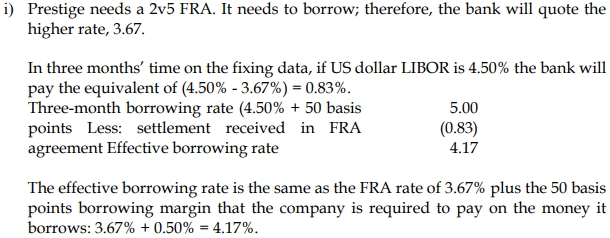
i) What would be its effective rate of borrowing for the three months if US dollar LIBOR is 4.50% at the start of the notional interest period for the FRA? (2 marks)
ii) What are the advantages of Convertible Bonds? (3 marks)

ii) Advantages of Convertible Bonds:

  1. Lower Interest Rates: Convertible bonds typically offer lower interest rates than traditional bonds because investors are compensated by the option to convert the bonds into shares if the company’s stock performs well.
  2. Deferred Dilution: While convertible bonds offer the potential for equity conversion, dilution of ownership only occurs when the bonds are converted, allowing the company to defer issuing more shares and the impact on earnings per share.
  3. Attractive to Investors: Investors find convertible bonds appealing because they offer the stability of bond payments with the potential upside of converting into equity if the company’s stock price rises.
  4. Access to Capital: For companies like Prestige, convertible bonds can provide access to capital without immediately diluting shareholder equity and may be a more cost-effective option than issuing straight equity.

Login or create a free account to see answers

Complete your registration to see answers

Find Related Questions by Tags, levels, etc.

Report an error

You're reporting an error for "SCS – MAR 2024 – L3 – Q5b – Financial management"

SCS – MAR 2024 – L3 – Q5b – Financial management

This Question Has a Case Study: 

Calculate the effective rate of borrowing for three months and explain the advantages of convertible bonds.

With reference to Option Two:

i) What would be its effective rate of borrowing for the three months if US dollar LIBOR is 4.50% at the start of the notional interest period for the FRA? (2 marks)
ii) What are the advantages of Convertible Bonds? (3 marks)

ii) Advantages of Convertible Bonds:

  1. Lower Interest Rates: Convertible bonds typically offer lower interest rates than traditional bonds because investors are compensated by the option to convert the bonds into shares if the company’s stock performs well.
  2. Deferred Dilution: While convertible bonds offer the potential for equity conversion, dilution of ownership only occurs when the bonds are converted, allowing the company to defer issuing more shares and the impact on earnings per share.
  3. Attractive to Investors: Investors find convertible bonds appealing because they offer the stability of bond payments with the potential upside of converting into equity if the company’s stock price rises.
  4. Access to Capital: For companies like Prestige, convertible bonds can provide access to capital without immediately diluting shareholder equity and may be a more cost-effective option than issuing straight equity.

Login or create a free account to see answers

Complete your registration to see answers

Find Related Questions by Tags, levels, etc.

Report an error

You're reporting an error for "SCS – MAR 2024 – L3 – Q5b – Financial management"

SCS – MAR 2024 – L3 – Q5a – Financial management

Calculate various financial ratios including ROCE, EPS, DPS, and TSR based on given financial data.

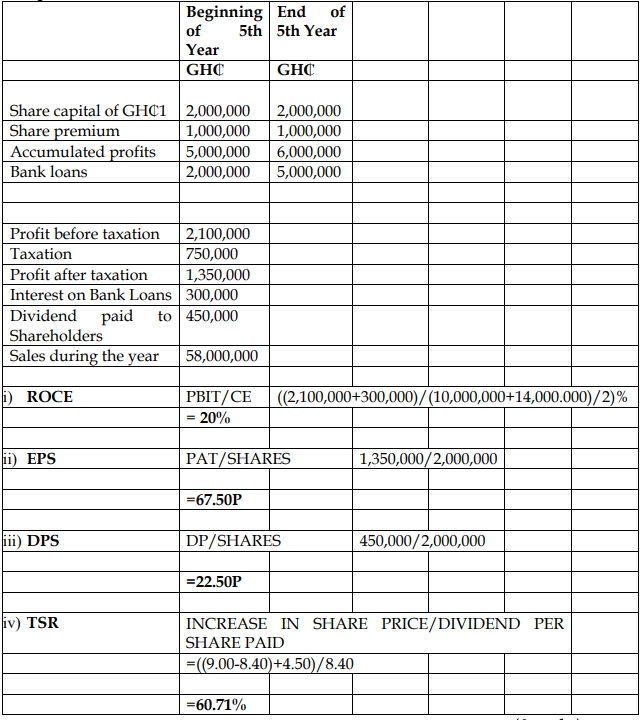
With reference to the information in Option One available to Prestige as presented by Professor Joseph Laing, a business consultant, calculate the following:

i) Return on Capital Employed (ROCE) (1 mark)
ii) Earnings Per Share (EPS) (1 mark)
iii) Dividend Per Share (DPS) (2 marks)
iv) Total Shareholders Return (TSR) (2 marks)
v) Explain the difference between ROCE and Accounting Rate of Return, their essential features, and relationship (4 marks)

v) Difference between ROCE and Accounting Rate of Return (ARR):

  • ROCE is a measure of the return on capital employed in the business, calculated by dividing the profit before interest and tax (PBIT) by the average capital employed. It reflects the overall efficiency of the company in generating profits from its available capital.
  • ARR, on the other hand, measures the accounting profit from a specific capital project, usually before interest and tax, as a percentage of the capital invested in that project.
  • The key difference lies in their scope: while ROCE assesses the return from the entire business or company, ARR focuses on specific capital projects. Both are used to evaluate the efficiency of capital usage, but ARR is project-specific, whereas ROCE is company-wide.

Login or create a free account to see answers

Complete your registration to see answers

Find Related Questions by Tags, levels, etc.

Report an error

You're reporting an error for "SCS – MAR 2024 – L3 – Q5a – Financial management"

SCS – MAR 2024 – L3 – Q5a – Financial management

This Question Has a Case Study: 

Calculate various financial ratios including ROCE, EPS, DPS, and TSR based on given financial data.

With reference to the information in Option One available to Prestige as presented by Professor Joseph Laing, a business consultant, calculate the following:

i) Return on Capital Employed (ROCE) (1 mark)
ii) Earnings Per Share (EPS) (1 mark)
iii) Dividend Per Share (DPS) (2 marks)
iv) Total Shareholders Return (TSR) (2 marks)
v) Explain the difference between ROCE and Accounting Rate of Return, their essential features, and relationship (4 marks)

v) Difference between ROCE and Accounting Rate of Return (ARR):

  • ROCE is a measure of the return on capital employed in the business, calculated by dividing the profit before interest and tax (PBIT) by the average capital employed. It reflects the overall efficiency of the company in generating profits from its available capital.
  • ARR, on the other hand, measures the accounting profit from a specific capital project, usually before interest and tax, as a percentage of the capital invested in that project.
  • The key difference lies in their scope: while ROCE assesses the return from the entire business or company, ARR focuses on specific capital projects. Both are used to evaluate the efficiency of capital usage, but ARR is project-specific, whereas ROCE is company-wide.

Login or create a free account to see answers

Complete your registration to see answers

Find Related Questions by Tags, levels, etc.

Report an error

You're reporting an error for "SCS – MAR 2024 – L3 – Q5a – Financial management"

SCS – MAR 2024 – L3 – Q4b – Strategy implementation

Advise on an appropriate HR strategy to harmonize the organizational structure for effective delivery at Prestige.

Each company acquired or merged by Prestige was allowed to maintain its human resource structure.

Required:
Analyze and advise on an appropriate HR strategy Prestige should adopt to harmonize the organizational structure for effective delivery of the company’s objectives.

  1. Strategic Workforce Planning:
    • Prestige should develop a workforce plan to address the complexities introduced by mergers and acquisitions. This plan should estimate the required number of employees, their skills, and potential future needs based on the company’s objectives, particularly in innovation and technology adoption.
  2. HR Consistency with Corporate Strategy:
    • The HR strategy should align with both the corporate and divisional strategies to ensure that the required number and type of employees are available at the right time to support business operations across regions.
  3. Assessment of Current Workforce:
    • Prestige should conduct an audit of its current workforce, assessing skills, experience, and attrition rates. This would help in identifying gaps and surpluses that need to be addressed through recruitment, training, or redundancy.
  4. Recruitment and Training:
    • The strategy should focus on recruiting the necessary talent to fill gaps, while also implementing training and development programs to upskill existing employees. This will help align employee capabilities with the company’s strategic needs, especially in areas such as IT, finance, and project management.
  5. Performance Management:
    • Implementing a robust performance appraisal system would enable Prestige to monitor the development of employees’ skills and performance, ensuring that key objectives are met. This would also identify areas where employees may require additional training or support.
  6. Promotion and Career Development:
    • Providing clear promotion paths and career development opportunities would encourage employee retention and foster motivation within the workforce, helping Prestige maintain a skilled and experienced team.
  7. Handling Redundancies:
    • Where there are surplus employees due to structural changes, Prestige should have a clear policy for managing redundancies in a way that minimizes disruption while ensuring fairness and compliance with labor laws.
  8. Labor Relations and Employee Welfare:
    • Ensuring good labor relations through clear communication and employee engagement initiatives will help reduce resistance to change. Compensation, health and safety, and employee well-being should be central to the HR strategy to foster a positive workplace environment.
  9. Technological Impact on HR:
    • Prestige should anticipate and manage the impact of technological changes on its workforce, particularly in relation to automation, digital skills, and remote working capabilities.

Factors to Consider:

  • Population trends and labor market conditions.
  • Changes in government policies affecting employment.
  • The availability of specific skills within the workforce.
  • Competition for talent from other businesses.
  • Trends in outsourcing and subcontracting.

Login or create a free account to see answers

Complete your registration to see answers

Find Related Questions by Tags, levels, etc.

Report an error

You're reporting an error for "SCS – MAR 2024 – L3 – Q4b – Strategy implementation"

SCS – MAR 2024 – L3 – Q4b – Strategy implementation

This Question Has a Case Study: 

Advise on an appropriate HR strategy to harmonize the organizational structure for effective delivery at Prestige.

Each company acquired or merged by Prestige was allowed to maintain its human resource structure.

Required:
Analyze and advise on an appropriate HR strategy Prestige should adopt to harmonize the organizational structure for effective delivery of the company’s objectives.

  1. Strategic Workforce Planning:
    • Prestige should develop a workforce plan to address the complexities introduced by mergers and acquisitions. This plan should estimate the required number of employees, their skills, and potential future needs based on the company’s objectives, particularly in innovation and technology adoption.
  2. HR Consistency with Corporate Strategy:
    • The HR strategy should align with both the corporate and divisional strategies to ensure that the required number and type of employees are available at the right time to support business operations across regions.
  3. Assessment of Current Workforce:
    • Prestige should conduct an audit of its current workforce, assessing skills, experience, and attrition rates. This would help in identifying gaps and surpluses that need to be addressed through recruitment, training, or redundancy.
  4. Recruitment and Training:
    • The strategy should focus on recruiting the necessary talent to fill gaps, while also implementing training and development programs to upskill existing employees. This will help align employee capabilities with the company’s strategic needs, especially in areas such as IT, finance, and project management.
  5. Performance Management:
    • Implementing a robust performance appraisal system would enable Prestige to monitor the development of employees’ skills and performance, ensuring that key objectives are met. This would also identify areas where employees may require additional training or support.
  6. Promotion and Career Development:
    • Providing clear promotion paths and career development opportunities would encourage employee retention and foster motivation within the workforce, helping Prestige maintain a skilled and experienced team.
  7. Handling Redundancies:
    • Where there are surplus employees due to structural changes, Prestige should have a clear policy for managing redundancies in a way that minimizes disruption while ensuring fairness and compliance with labor laws.
  8. Labor Relations and Employee Welfare:
    • Ensuring good labor relations through clear communication and employee engagement initiatives will help reduce resistance to change. Compensation, health and safety, and employee well-being should be central to the HR strategy to foster a positive workplace environment.
  9. Technological Impact on HR:
    • Prestige should anticipate and manage the impact of technological changes on its workforce, particularly in relation to automation, digital skills, and remote working capabilities.

Factors to Consider:

  • Population trends and labor market conditions.
  • Changes in government policies affecting employment.
  • The availability of specific skills within the workforce.
  • Competition for talent from other businesses.
  • Trends in outsourcing and subcontracting.

Login or create a free account to see answers

Complete your registration to see answers

Find Related Questions by Tags, levels, etc.

Report an error

You're reporting an error for "SCS – MAR 2024 – L3 – Q4b – Strategy implementation"

SCS – MAR 2024 – L3 – Q4a – Strategy implementation

Explain how Prestige could leverage ICT using the four broad stages of e-business development to compete.

Prestige’s Board has shifted from their long-standing reluctance to venture into foreign markets to seriously consider the possibility of expansion overseas. An important implication of this decision is that as the size of the market increases, competition becomes international. The main rivals are no longer local suppliers to a domestic market.

Required:
Using the four broad stages of development to a full e-business model, explain how Prestige could leverage ICT to compete.

  1. Web Presence:
    • Prestige could set up a website to display its property listings and services. The website can serve as a platform to provide detailed information about the houses for sale, available property types, and contact details. This would enhance visibility and reach beyond local markets.
  2. E-Commerce:
    • Prestige can integrate e-commerce capabilities on its website, allowing potential buyers to make inquiries, schedule viewings, or even complete purchases online. They can also use e-commerce platforms to manage orders and payments from suppliers and partners.
  3. Integrated E-Commerce:
    • Prestige could utilize ICT to gather and analyze customer data to understand their preferences and buying behavior. By establishing two-way communication channels, the company could use customer feedback to improve its product offerings and tailor marketing strategies, boosting customer satisfaction.
  4. E-Business:
    • ICT can drive Prestige’s business strategy by making e-business a fundamental part of its operations. E-business can enhance efficiency in sales, marketing, procurement, and customer service, aligning business operations with digital transformation to gain a competitive edge in the global market.

Login or create a free account to see answers

Complete your registration to see answers

Find Related Questions by Tags, levels, etc.

Report an error

You're reporting an error for "SCS – MAR 2024 – L3 – Q4a – Strategy implementation"

SCS – MAR 2024 – L3 – Q4a – Strategy implementation

This Question Has a Case Study: 

Explain how Prestige could leverage ICT using the four broad stages of e-business development to compete.

Prestige’s Board has shifted from their long-standing reluctance to venture into foreign markets to seriously consider the possibility of expansion overseas. An important implication of this decision is that as the size of the market increases, competition becomes international. The main rivals are no longer local suppliers to a domestic market.

Required:
Using the four broad stages of development to a full e-business model, explain how Prestige could leverage ICT to compete.

  1. Web Presence:
    • Prestige could set up a website to display its property listings and services. The website can serve as a platform to provide detailed information about the houses for sale, available property types, and contact details. This would enhance visibility and reach beyond local markets.
  2. E-Commerce:
    • Prestige can integrate e-commerce capabilities on its website, allowing potential buyers to make inquiries, schedule viewings, or even complete purchases online. They can also use e-commerce platforms to manage orders and payments from suppliers and partners.
  3. Integrated E-Commerce:
    • Prestige could utilize ICT to gather and analyze customer data to understand their preferences and buying behavior. By establishing two-way communication channels, the company could use customer feedback to improve its product offerings and tailor marketing strategies, boosting customer satisfaction.
  4. E-Business:
    • ICT can drive Prestige’s business strategy by making e-business a fundamental part of its operations. E-business can enhance efficiency in sales, marketing, procurement, and customer service, aligning business operations with digital transformation to gain a competitive edge in the global market.

Login or create a free account to see answers

Complete your registration to see answers

Find Related Questions by Tags, levels, etc.

Report an error

You're reporting an error for "SCS – MAR 2024 – L3 – Q4a – Strategy implementation"

SCS – MAR 2024 – L3 – Q3 – Functional strategies

Explain the potential benefits of resource sharing through common IT systems at Prestige.

When five years ago the present regional divisional structure of Greater Accra, Ashanti, and Eastern was formalized, an attempt was made to ensure that common systems and ways of working were adopted across each of the three regions. However, due to the pressures on the Company, this was never fully implemented.

Required:
Explain the potential benefits of resource sharing (configuring an organization’s computing system in such a way that the information and resources within it can be accessed, and remotely accessed, across multiple administrative domains) to Prestige if they adopt common IT systems.

  1. Ease of Access: A common IT system allows staff to access systems, software, and files from any location with an internet connection. This supports collaborative working across regions.
  2. Accuracy: Having a single source of data ensures accuracy by eliminating multiple similar versions scattered across the organization. This provides reliable information to all divisions.
  3. Cost Savings: Resource sharing avoids duplication of work across divisions. Generating similar data for similar purposes can be costly, so producing data once and sharing it reduces inefficiencies and costs for Prestige.
  4. Facilitates Remote Working: IT resource sharing enables remote working, increasing flexibility. Employees can work from any location, enhancing motivation and potentially creating cost savings by allowing work from home.
  5. Transparency: Resource sharing promotes transparency across the organization by making information easily accessible to all relevant parties. This can improve decision-making and operational efficiency.

Login or create a free account to see answers

Complete your registration to see answers

Find Related Questions by Tags, levels, etc.

Report an error

You're reporting an error for "SCS – MAR 2024 – L3 – Q3 – Functional strategies"

SCS – MAR 2024 – L3 – Q3 – Functional strategies

This Question Has a Case Study: 

Explain the potential benefits of resource sharing through common IT systems at Prestige.

When five years ago the present regional divisional structure of Greater Accra, Ashanti, and Eastern was formalized, an attempt was made to ensure that common systems and ways of working were adopted across each of the three regions. However, due to the pressures on the Company, this was never fully implemented.

Required:
Explain the potential benefits of resource sharing (configuring an organization’s computing system in such a way that the information and resources within it can be accessed, and remotely accessed, across multiple administrative domains) to Prestige if they adopt common IT systems.

  1. Ease of Access: A common IT system allows staff to access systems, software, and files from any location with an internet connection. This supports collaborative working across regions.
  2. Accuracy: Having a single source of data ensures accuracy by eliminating multiple similar versions scattered across the organization. This provides reliable information to all divisions.
  3. Cost Savings: Resource sharing avoids duplication of work across divisions. Generating similar data for similar purposes can be costly, so producing data once and sharing it reduces inefficiencies and costs for Prestige.
  4. Facilitates Remote Working: IT resource sharing enables remote working, increasing flexibility. Employees can work from any location, enhancing motivation and potentially creating cost savings by allowing work from home.
  5. Transparency: Resource sharing promotes transparency across the organization by making information easily accessible to all relevant parties. This can improve decision-making and operational efficiency.

Login or create a free account to see answers

Complete your registration to see answers

Find Related Questions by Tags, levels, etc.

Report an error

You're reporting an error for "SCS – MAR 2024 – L3 – Q3 – Functional strategies"

SCS – MAR 2024 – L3 – Q2 – Competitive advantage

Apply and appraise Porter’s three strategies for sustaining competitive advantage for Prestige Designers Ltd.

A strategic clock can be used to consider different business strategies for gaining competitive advantage, based on providing a combination of price and perceived benefits. Porter has suggested three strategies for sustaining competitive advantage over rival firms and their products or services. They are a cost leadership strategy, a differentiation strategy, and a focus strategy.

Required:
Apply and appraise how effective the suggested three strategies for sustaining competitive advantage over rival firms would be useful to Prestige. (10 marks)

  1. Cost Leadership Strategy:
    • Prestige must compete effectively on price by offering its housing stock at a lower price than rivals.
    • The company should have excellent cost control systems and continually plan for further reductions in costs to remain the cost leader in the market.
    • Prestige, being a large company, can benefit from economies of scale compared to smaller competitors.
    • To achieve reasonable profit margins, Prestige must sell large volumes of homes at a lower profit margin per unit.
  2. Differentiation Strategy:
    • Prestige’s products must be distinct from those of its competitors in a way that customers can recognize, potentially leveraging the “Vintage” brand which focuses on low-cost housing for young buyers.
    • The company could innovate and incorporate modern methods of construction (MMC) and sustainability-related methods to differentiate its products.
    • Customers might be willing to pay more for homes with unique features and higher perceived value.
    • Prestige should invest in delivering superior value to customers, even if that means higher upfront costs.
  3. Focus Strategy:
    • Prestige could focus on segmented consumer markets by selecting specific segments, such as the middle-class or younger first-time home buyers, as the primary market for their products.
    • The company could concentrate on serving a particular type of customer or region, allowing it to tailor its offerings to the unique demands of that segment.

Login or create a free account to see answers

Complete your registration to see answers

Find Related Questions by Tags, levels, etc.

Report an error

You're reporting an error for "SCS – MAR 2024 – L3 – Q2 – Competitive advantage"

SCS – MAR 2024 – L3 – Q2 – Competitive advantage

This Question Has a Case Study: 

Apply and appraise Porter’s three strategies for sustaining competitive advantage for Prestige Designers Ltd.

A strategic clock can be used to consider different business strategies for gaining competitive advantage, based on providing a combination of price and perceived benefits. Porter has suggested three strategies for sustaining competitive advantage over rival firms and their products or services. They are a cost leadership strategy, a differentiation strategy, and a focus strategy.

Required:
Apply and appraise how effective the suggested three strategies for sustaining competitive advantage over rival firms would be useful to Prestige. (10 marks)

  1. Cost Leadership Strategy:
    • Prestige must compete effectively on price by offering its housing stock at a lower price than rivals.
    • The company should have excellent cost control systems and continually plan for further reductions in costs to remain the cost leader in the market.
    • Prestige, being a large company, can benefit from economies of scale compared to smaller competitors.
    • To achieve reasonable profit margins, Prestige must sell large volumes of homes at a lower profit margin per unit.
  2. Differentiation Strategy:
    • Prestige’s products must be distinct from those of its competitors in a way that customers can recognize, potentially leveraging the “Vintage” brand which focuses on low-cost housing for young buyers.
    • The company could innovate and incorporate modern methods of construction (MMC) and sustainability-related methods to differentiate its products.
    • Customers might be willing to pay more for homes with unique features and higher perceived value.
    • Prestige should invest in delivering superior value to customers, even if that means higher upfront costs.
  3. Focus Strategy:
    • Prestige could focus on segmented consumer markets by selecting specific segments, such as the middle-class or younger first-time home buyers, as the primary market for their products.
    • The company could concentrate on serving a particular type of customer or region, allowing it to tailor its offerings to the unique demands of that segment.

Login or create a free account to see answers

Complete your registration to see answers

Find Related Questions by Tags, levels, etc.

Report an error

You're reporting an error for "SCS – MAR 2024 – L3 – Q2 – Competitive advantage"

AA – Mar 2024 – L2 – Q1b – Planning and Approach for Audit and Assurance Engagements

Distinguish between audit strategy and audit plan and identify their contents as required by ISA 200 and ISA 300.

ISA 200: Overall Objectives of Independent Auditor and the Conduct of an Audit and ISA 300: Planning an Audit of Financial Statements require that auditors should plan in order to conduct the audit in an effective, efficient, and timely manner. The plan should include an overall audit strategy and a detailed audit plan.

Required:
i) Clearly distinguish between audit strategy and audit plan. (5 marks)
ii) Identify the contents of audit strategy and audit plan. (10 marks)

i) Difference between audit strategy and audit plan:

  • Audit strategy: Sets the overall scope, timing, and direction of the audit and serves as a guide to develop a more detailed audit plan. It is broader and outlines high-level goals for the audit.
  • Audit plan: A detailed procedure setting out the specific work to be done to achieve the audit strategy. It provides clear instructions to the audit team on the steps and audit procedures to be carried out.

(2.5 marks each = 5 marks)

ii) Contents of audit strategy:

  • The characteristics of the engagement that define its scope (e.g., reporting standards).
  • The industry-specific reporting requirements.
  • Reporting objectives and deadlines.
  • Communication and reporting requirements.
  • The focus areas for the audit based on risk assessment.
  • Materiality assessment.
  • Nature, timing, and extent of audit resources needed (personnel, audit techniques, etc.).
  • The overall audit approach (e.g., reliance on internal controls or substantive testing).
    (Any 5 points @ 1 mark each = 5 marks)

Contents of audit plan:

  • Procedures for assessing risk of material misstatements.
  • Detailed audit procedures in response to the assessed risks.
  • Materiality levels.
  • Use of analytical procedures for risk assessment.
  • Test of internal controls.
  • Detailed instructions for audit team members.
  • Timing and extent of audit work.
    (Any 5 points @ 1 mark each = 5 marks)

Login or create a free account to see answers

Complete your registration to see answers

Find Related Questions by Tags, levels, etc.

Report an error

You're reporting an error for "AA – Mar 2024 – L2 – Q1b – Planning and Approach for Audit and Assurance Engagements"

AA – Mar 2024 – L2 – Q1b – Planning and Approach for Audit and Assurance Engagements

Distinguish between audit strategy and audit plan and identify their contents as required by ISA 200 and ISA 300.

ISA 200: Overall Objectives of Independent Auditor and the Conduct of an Audit and ISA 300: Planning an Audit of Financial Statements require that auditors should plan in order to conduct the audit in an effective, efficient, and timely manner. The plan should include an overall audit strategy and a detailed audit plan.

Required:
i) Clearly distinguish between audit strategy and audit plan. (5 marks)
ii) Identify the contents of audit strategy and audit plan. (10 marks)

i) Difference between audit strategy and audit plan:

  • Audit strategy: Sets the overall scope, timing, and direction of the audit and serves as a guide to develop a more detailed audit plan. It is broader and outlines high-level goals for the audit.
  • Audit plan: A detailed procedure setting out the specific work to be done to achieve the audit strategy. It provides clear instructions to the audit team on the steps and audit procedures to be carried out.

(2.5 marks each = 5 marks)

ii) Contents of audit strategy:

  • The characteristics of the engagement that define its scope (e.g., reporting standards).
  • The industry-specific reporting requirements.
  • Reporting objectives and deadlines.
  • Communication and reporting requirements.
  • The focus areas for the audit based on risk assessment.
  • Materiality assessment.
  • Nature, timing, and extent of audit resources needed (personnel, audit techniques, etc.).
  • The overall audit approach (e.g., reliance on internal controls or substantive testing).
    (Any 5 points @ 1 mark each = 5 marks)

Contents of audit plan:

  • Procedures for assessing risk of material misstatements.
  • Detailed audit procedures in response to the assessed risks.
  • Materiality levels.
  • Use of analytical procedures for risk assessment.
  • Test of internal controls.
  • Detailed instructions for audit team members.
  • Timing and extent of audit work.
    (Any 5 points @ 1 mark each = 5 marks)

Login or create a free account to see answers

Complete your registration to see answers

Find Related Questions by Tags, levels, etc.

Report an error

You're reporting an error for "AA – Mar 2024 – L2 – Q1b – Planning and Approach for Audit and Assurance Engagements"

AA – Mar 2024 – L2 – Q1a – Audit and Assurance Evidence

Ways in which management can support auditors in obtaining appropriate and sufficient audit evidence.

Management of Bagabu Ltd has a filing system that is largely manual. Their external auditors have expressed concern about how to obtain appropriate and sufficient evidence to support their opinion.
Required:
State FIVE (5) ways management of Bagabu Ltd can support the auditors to obtain appropriate and sufficient audit evidence to support their opinion.

To fulfill this responsibility, management should:

  • Provide complete and accurate financial statement data, including supporting documents and records.
  • Provide access to all relevant information, including personnel, documents, and records related to the financial statements.
  • Provide timely responses to auditor inquiries and address discrepancies promptly.
  • Implement effective internal controls to ensure accuracy and completeness of the financial statements.
  • Ensure overall cooperation with the auditor by providing unrestricted access and support during the audit process.

Login or create a free account to see answers

Complete your registration to see answers

Find Related Questions by Tags, levels, etc.

Report an error

You're reporting an error for "AA – Mar 2024 – L2 – Q1a – Audit and Assurance Evidence"

AA – Mar 2024 – L2 – Q1a – Audit and Assurance Evidence

Ways in which management can support auditors in obtaining appropriate and sufficient audit evidence.

Management of Bagabu Ltd has a filing system that is largely manual. Their external auditors have expressed concern about how to obtain appropriate and sufficient evidence to support their opinion.
Required:
State FIVE (5) ways management of Bagabu Ltd can support the auditors to obtain appropriate and sufficient audit evidence to support their opinion.

To fulfill this responsibility, management should:

  • Provide complete and accurate financial statement data, including supporting documents and records.
  • Provide access to all relevant information, including personnel, documents, and records related to the financial statements.
  • Provide timely responses to auditor inquiries and address discrepancies promptly.
  • Implement effective internal controls to ensure accuracy and completeness of the financial statements.
  • Ensure overall cooperation with the auditor by providing unrestricted access and support during the audit process.

Login or create a free account to see answers

Complete your registration to see answers

Find Related Questions by Tags, levels, etc.

Report an error

You're reporting an error for "AA – Mar 2024 – L2 – Q1a – Audit and Assurance Evidence"

FR – March 2024 – L2 – Q5d – Financial Reporting Standards and Their Applications

Identify factors that indicate significant influence under IAS 28.

Significant influence is the power to participate in the financial and operating policy decisions of the investee but is not control or joint control over those policies.

Required:
Outline FIVE (5) factors/conditions that indicate significant influence (other than shareholding).
(5 marks)

The existence of significant influence by an investor is usually evidenced by one or more of the following factors, in accordance with IAS 28:

  1. Representation on the Board of Directors:
    Significant influence is likely when the investor has one or more seats on the board of directors or equivalent governing body of the investee. This allows the investor to participate in key decisions regarding the financial and operating policies of the investee.
  2. Participation in Policy-Making Processes:
    The ability to participate in decisions about dividends, operational strategies, budgets, or capital expenditures indicates significant influence. This involvement in decision-making is a strong indicator of influence over the investee’s activities.
  3. Material Transactions Between the Investor and Investee:
    Frequent or significant business transactions between the investor and the investee, such as sales or purchases of goods and services, demonstrate a relationship that supports significant influence.
  4. Interchange of Managerial Personnel:
    When an investor has the ability to appoint or influence the appointment of key management personnel within the investee, it shows that the investor has significant influence over operational decisions.
  5. Provision of Essential Technical Information:
    If the investor provides critical technical knowledge or expertise to the investee, this indicates that the investor has a role in shaping operational or strategic decisions, reflecting significant influence.

(Marks evenly spread = 5 marks)

Login or create a free account to see answers

Complete your registration to see answers

Find Related Questions by Tags, levels, etc.

Report an error

You're reporting an error for "FR – March 2024 – L2 – Q5d – Financial Reporting Standards and Their Applications"

FR – March 2024 – L2 – Q5d – Financial Reporting Standards and Their Applications

Identify factors that indicate significant influence under IAS 28.

Significant influence is the power to participate in the financial and operating policy decisions of the investee but is not control or joint control over those policies.

Required:
Outline FIVE (5) factors/conditions that indicate significant influence (other than shareholding).
(5 marks)

The existence of significant influence by an investor is usually evidenced by one or more of the following factors, in accordance with IAS 28:

  1. Representation on the Board of Directors:
    Significant influence is likely when the investor has one or more seats on the board of directors or equivalent governing body of the investee. This allows the investor to participate in key decisions regarding the financial and operating policies of the investee.
  2. Participation in Policy-Making Processes:
    The ability to participate in decisions about dividends, operational strategies, budgets, or capital expenditures indicates significant influence. This involvement in decision-making is a strong indicator of influence over the investee’s activities.
  3. Material Transactions Between the Investor and Investee:
    Frequent or significant business transactions between the investor and the investee, such as sales or purchases of goods and services, demonstrate a relationship that supports significant influence.
  4. Interchange of Managerial Personnel:
    When an investor has the ability to appoint or influence the appointment of key management personnel within the investee, it shows that the investor has significant influence over operational decisions.
  5. Provision of Essential Technical Information:
    If the investor provides critical technical knowledge or expertise to the investee, this indicates that the investor has a role in shaping operational or strategic decisions, reflecting significant influence.

(Marks evenly spread = 5 marks)

Login or create a free account to see answers

Complete your registration to see answers

Find Related Questions by Tags, levels, etc.

Report an error

You're reporting an error for "FR – March 2024 – L2 – Q5d – Financial Reporting Standards and Their Applications"

FR – March 2024 – L2 – Q5c – Financial Reporting Standards and Their Applications

Identify the qualities required in information when management uses judgment in developing accounting policies under IAS 8.

According to IAS 8: Accounting Policies, Changes in Accounting Estimates and Errors, when an IFRS specifically applies to a transaction, other event, or condition, the accounting policy applied to that item shall be determined by applying the IFRS. In the absence of an IFRS that specifically applies to a transaction, other event, or condition, management shall use its judgment in developing and applying an accounting policy that results in information that has certain qualities.

Required:
Identify the qualities that must be present in the resultant information when management of an entity uses its judgment in developing and applying an accounting policy.
(5 marks)

When management uses judgment in developing and applying an accounting policy in the absence of a specific IFRS, the resultant information must have the following qualities:

  1. Relevance:
    The information should be relevant to users’ decision-making needs. This means that the accounting policies chosen must provide financial information that influences economic decisions and reflects the entity’s financial performance and position accurately.
  2. Faithful Representation:
    The information must faithfully represent the entity’s financial position, performance, and cash flows. It should capture the economic substance of transactions and not just their legal form, ensuring the financial information is complete, neutral, and free from bias.
  3. Neutrality:
    The financial information must be neutral, meaning it should not be manipulated to achieve a predetermined outcome. Accounting policies should be applied objectively without favoring one outcome over another.
  4. Prudence:
    The financial information must be prepared with caution, ensuring that assets and income are not overstated, and liabilities and expenses are not understated. Prudence ensures that uncertainties are appropriately accounted for.
  5. Completeness:
    The information provided must be complete in all material respects. This means all necessary information required to understand the entity’s financial position, performance, and cash flows should be included.

(Marks evenly spread = 5 marks)

Login or create a free account to see answers

Complete your registration to see answers

Find Related Questions by Tags, levels, etc.

Report an error

You're reporting an error for "FR – March 2024 – L2 – Q5c – Financial Reporting Standards and Their Applications"

FR – March 2024 – L2 – Q5c – Financial Reporting Standards and Their Applications

Identify the qualities required in information when management uses judgment in developing accounting policies under IAS 8.

According to IAS 8: Accounting Policies, Changes in Accounting Estimates and Errors, when an IFRS specifically applies to a transaction, other event, or condition, the accounting policy applied to that item shall be determined by applying the IFRS. In the absence of an IFRS that specifically applies to a transaction, other event, or condition, management shall use its judgment in developing and applying an accounting policy that results in information that has certain qualities.

Required:
Identify the qualities that must be present in the resultant information when management of an entity uses its judgment in developing and applying an accounting policy.
(5 marks)

When management uses judgment in developing and applying an accounting policy in the absence of a specific IFRS, the resultant information must have the following qualities:

  1. Relevance:
    The information should be relevant to users’ decision-making needs. This means that the accounting policies chosen must provide financial information that influences economic decisions and reflects the entity’s financial performance and position accurately.
  2. Faithful Representation:
    The information must faithfully represent the entity’s financial position, performance, and cash flows. It should capture the economic substance of transactions and not just their legal form, ensuring the financial information is complete, neutral, and free from bias.
  3. Neutrality:
    The financial information must be neutral, meaning it should not be manipulated to achieve a predetermined outcome. Accounting policies should be applied objectively without favoring one outcome over another.
  4. Prudence:
    The financial information must be prepared with caution, ensuring that assets and income are not overstated, and liabilities and expenses are not understated. Prudence ensures that uncertainties are appropriately accounted for.
  5. Completeness:
    The information provided must be complete in all material respects. This means all necessary information required to understand the entity’s financial position, performance, and cash flows should be included.

(Marks evenly spread = 5 marks)

Login or create a free account to see answers

Complete your registration to see answers

Find Related Questions by Tags, levels, etc.

Report an error

You're reporting an error for "FR – March 2024 – L2 – Q5c – Financial Reporting Standards and Their Applications"

FR – March 2024 – L2 – Q5b – Conceptual Framework for Financial Reporting

Discuss the reasons for the need of a conceptual framework in the standard-setting process.

Discuss FIVE (5) reasons for the need of a conceptual framework in the standard-setting process.
(5 marks)

  1. Consistency in Standards Development:
    A conceptual framework provides a structured basis for developing consistent accounting standards. Without it, there could be a risk of setting standards in an ad-hoc or piecemeal manner, leading to inconsistencies across different standards.
  2. Address Emerging Accounting Issues:
    The framework helps guide the development of new standards in response to emerging accounting issues, such as new types of transactions or financial instruments. It ensures that new standards are based on agreed-upon principles, rather than short-term fixes.
  3. Assists in Interpretation of Standards:
    It helps preparers and users of financial statements interpret and apply standards, particularly in complex or ambiguous situations. The framework provides a foundation for making judgments when a specific accounting issue is not covered by a standard.
  4. Enhances Credibility of Financial Reporting:
    A well-defined conceptual framework enhances the credibility of financial reporting by ensuring that the standards are grounded in clear, transparent principles. This improves users’ confidence in the accuracy and relevance of financial information.
  5. Reduces Political and Lobbying Pressure:
    The framework provides a robust set of principles that reduces the influence of political or lobbying pressures in the standard-setting process. It ensures that standards are set based on the needs of users and sound accounting principles, rather than being influenced by vested interests.

(Marks evenly spread = 5 marks)

Login or create a free account to see answers

Complete your registration to see answers

Find Related Questions by Tags, levels, etc.

Report an error

You're reporting an error for "FR – March 2024 – L2 – Q5b – Conceptual Framework for Financial Reporting"

FR – March 2024 – L2 – Q5b – Conceptual Framework for Financial Reporting

Discuss the reasons for the need of a conceptual framework in the standard-setting process.

Discuss FIVE (5) reasons for the need of a conceptual framework in the standard-setting process.
(5 marks)

  1. Consistency in Standards Development:
    A conceptual framework provides a structured basis for developing consistent accounting standards. Without it, there could be a risk of setting standards in an ad-hoc or piecemeal manner, leading to inconsistencies across different standards.
  2. Address Emerging Accounting Issues:
    The framework helps guide the development of new standards in response to emerging accounting issues, such as new types of transactions or financial instruments. It ensures that new standards are based on agreed-upon principles, rather than short-term fixes.
  3. Assists in Interpretation of Standards:
    It helps preparers and users of financial statements interpret and apply standards, particularly in complex or ambiguous situations. The framework provides a foundation for making judgments when a specific accounting issue is not covered by a standard.
  4. Enhances Credibility of Financial Reporting:
    A well-defined conceptual framework enhances the credibility of financial reporting by ensuring that the standards are grounded in clear, transparent principles. This improves users’ confidence in the accuracy and relevance of financial information.
  5. Reduces Political and Lobbying Pressure:
    The framework provides a robust set of principles that reduces the influence of political or lobbying pressures in the standard-setting process. It ensures that standards are set based on the needs of users and sound accounting principles, rather than being influenced by vested interests.

(Marks evenly spread = 5 marks)

Login or create a free account to see answers

Complete your registration to see answers

Find Related Questions by Tags, levels, etc.

Report an error

You're reporting an error for "FR – March 2024 – L2 – Q5b – Conceptual Framework for Financial Reporting"

FR – March 2024 – L2 – Q5a – Professional and Ethical Issues in Financial Reporting

Advise Esther on the appropriate actions to take in response to unethical pressure in financial reporting.

Esther is a Chartered Accountant who works in a team that reports to Ameka, the Finance Director of Novak Ltd. Ameka is also a Chartered Accountant and has a domineering personality. Novak Ltd revalues commercial properties in line with IAS 16: Property, Plant and Equipment. Valuation information received last year showed that the fair value of the property portfolio was 2% less than the carrying amount of the properties (with no single property being more than 4% difference). A downward revaluation was not recognised on the grounds that the carrying amount was not materially different from the fair value.

This year’s valuation shows a continued decline in the fair value of the property portfolio. It is now 5% less than the carrying amount of the properties with some properties now being 15% below the carrying amount. Esther submitted workings to Ameka in which she had recognised the downward revaluations in accordance with IAS 16. Ameka has sent Esther an email in response in which he wrote: “Stop bothering me with this rubbish. There is no need to write the properties down. The fair value of the portfolio is only 5% different from its carrying amount. Restate the numbers immediately.”

Required:
Advise Esther on the appropriate actions to take.
(5 marks)

Esther faces an ethical dilemma where she is being asked to act contrary to the requirements of IAS 16 and misstate financial information. The following are the appropriate actions Esther should take:

  1. Explain the Ethical Issue to Ameka:
    Esther should first arrange a meeting with Ameka to explain that under IAS 16, when the fair value of revalued assets differs materially from their carrying amount, a revaluation must be recognised. A 5% decline is material, especially with some properties being 15% below their carrying amount, and it would be unethical to ignore the revaluation.
  2. Refer to Professional Ethics:
    Esther should remind Ameka of their professional obligations under the IESBA Code of Ethics for Professional Accountants, which requires accountants to act with integrity, objectivity, and professional competence. Failing to revalue the assets would result in misleading financial statements and could damage the credibility of the company’s financial reports.
  3. Involve Senior Management or the Audit Committee:
    If Ameka insists on not recognising the revaluation, Esther should escalate the issue to higher levels of management or the company’s audit committee. This will ensure that the ethical and financial reporting standards are followed, and Esther will have documented her concerns appropriately.
  4. Document All Actions Taken:
    Esther should maintain a record of all communications and actions taken in response to the issue. This includes keeping a copy of the email from Ameka and documenting her response and any discussions held. This will protect her in case of future investigations or consequences.
  5. Consider Resignation or Whistleblowing if Necessary:
    If the issue remains unresolved and Esther continues to face pressure to misstate the financial statements, she may need to consider resigning to maintain her professional integrity. She may also consider whistleblowing in accordance with local regulations, while ensuring that confidentiality requirements are respected.

(Marks evenly spread = 5 marks)

Login or create a free account to see answers

Complete your registration to see answers

Find Related Questions by Tags, levels, etc.

Report an error

You're reporting an error for "FR – March 2024 – L2 – Q5a – Professional and Ethical Issues in Financial Reporting"

FR – March 2024 – L2 – Q5a – Professional and Ethical Issues in Financial Reporting

Advise Esther on the appropriate actions to take in response to unethical pressure in financial reporting.

Esther is a Chartered Accountant who works in a team that reports to Ameka, the Finance Director of Novak Ltd. Ameka is also a Chartered Accountant and has a domineering personality. Novak Ltd revalues commercial properties in line with IAS 16: Property, Plant and Equipment. Valuation information received last year showed that the fair value of the property portfolio was 2% less than the carrying amount of the properties (with no single property being more than 4% difference). A downward revaluation was not recognised on the grounds that the carrying amount was not materially different from the fair value.

This year’s valuation shows a continued decline in the fair value of the property portfolio. It is now 5% less than the carrying amount of the properties with some properties now being 15% below the carrying amount. Esther submitted workings to Ameka in which she had recognised the downward revaluations in accordance with IAS 16. Ameka has sent Esther an email in response in which he wrote: “Stop bothering me with this rubbish. There is no need to write the properties down. The fair value of the portfolio is only 5% different from its carrying amount. Restate the numbers immediately.”

Required:
Advise Esther on the appropriate actions to take.
(5 marks)

Esther faces an ethical dilemma where she is being asked to act contrary to the requirements of IAS 16 and misstate financial information. The following are the appropriate actions Esther should take:

  1. Explain the Ethical Issue to Ameka:
    Esther should first arrange a meeting with Ameka to explain that under IAS 16, when the fair value of revalued assets differs materially from their carrying amount, a revaluation must be recognised. A 5% decline is material, especially with some properties being 15% below their carrying amount, and it would be unethical to ignore the revaluation.
  2. Refer to Professional Ethics:
    Esther should remind Ameka of their professional obligations under the IESBA Code of Ethics for Professional Accountants, which requires accountants to act with integrity, objectivity, and professional competence. Failing to revalue the assets would result in misleading financial statements and could damage the credibility of the company’s financial reports.
  3. Involve Senior Management or the Audit Committee:
    If Ameka insists on not recognising the revaluation, Esther should escalate the issue to higher levels of management or the company’s audit committee. This will ensure that the ethical and financial reporting standards are followed, and Esther will have documented her concerns appropriately.
  4. Document All Actions Taken:
    Esther should maintain a record of all communications and actions taken in response to the issue. This includes keeping a copy of the email from Ameka and documenting her response and any discussions held. This will protect her in case of future investigations or consequences.
  5. Consider Resignation or Whistleblowing if Necessary:
    If the issue remains unresolved and Esther continues to face pressure to misstate the financial statements, she may need to consider resigning to maintain her professional integrity. She may also consider whistleblowing in accordance with local regulations, while ensuring that confidentiality requirements are respected.

(Marks evenly spread = 5 marks)

Login or create a free account to see answers

Complete your registration to see answers

Find Related Questions by Tags, levels, etc.

Report an error

You're reporting an error for "FR – March 2024 – L2 – Q5a – Professional and Ethical Issues in Financial Reporting"

FR – March 2024 – L2 – Q4a – Financial Statement Analysis

Calculate financial ratios for Mantemante Ltd and compare them with industry averages.

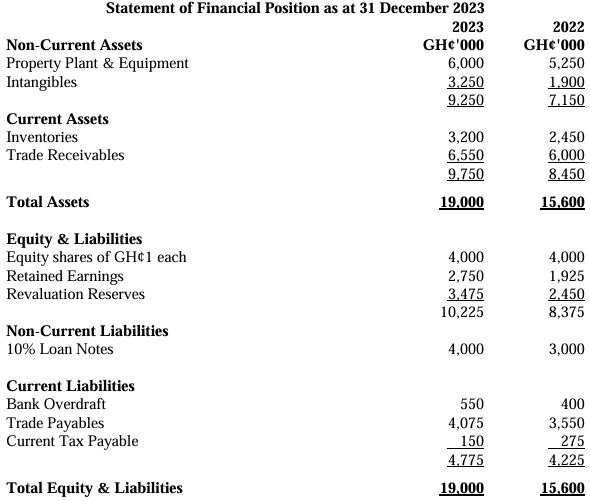
The following information has been extracted from the Financial Statements of Mantemante Ltd.

Statement of Financial Position as at 31 December 2023

Additional information, including ratios such as Return on Capital Employed, Net Profit Margin, Asset Turnover, Gearing, etc., is also provided.

Required:
a) Compute the comparable ratios for Mantemante Ltd for the years 2022 and 2023.
(10 marks)
b) Write a report for the Board of Directors analyzing the performance of Mantemante Ltd with references to the ratios for the two years and industry averages.
(10 marks)

a) Computation of Ratios

S/N Ratio 2023 2022 Industry
1 Current Ratio = Current Assets / Current Liabilities 9,750 / 4,775 = 2.04:1 8,450 / 4,225 = 2.00:1 1.94:1
2 Return on Capital Employed = PBIT / Capital Employed * 100 (2,325 + 400) / (19,000 – 4,775) * 100 = 19.16% (1,600 + 300) / (15,600 – 4,225) * 100 = 16.70% 17.60%
3 Net Profit Margin = Profit / Revenue * 100 2,325 / 56,000 * 100 = 4.04% 1,600 / 48,750 * 100 = 3.28% 3.95%
4 Total Asset Turnover = Revenue / Total Assets 56,000 / 19,000 = 2.95:1 48,750 / 15,600 = 3.13:1 3.26:1
5 Acid Test Ratio = (Current Assets – Inventories) / Current Liabilities (9,750 – 3,200) / 4,775 = 1.37:1 (8,450 – 2,450) / 4,225 = 1.42:1 1.15:1
6 Gross Profit Margin = Gross Profit / Revenue * 100 (56,000 – 42,300) / 56,000 * 100 = 24.46% (48,750 – 34,125) / 48,750 * 100 = 30.00% 33.42%
7 Receivables Collection Period = Receivables / Revenue * 365 6,550 / 56,000 * 365 = 43 days 6,000 / 48,750 * 365 = 45 days 48 days
8 Payables Payment Period = Payables / Cost of Sales * 365 4,075 / 42,300 * 365 = 35 days 3,550 / 34,125 * 365 = 40 days 42 days
9 Inventories Turnover = Cost of Sales / Inventories 42,300 / 3,200 = 13.2 times 34,125 / 2,450 = 13.93 times 16.7 times
10 Gearing = Non-Current Liabilities / (Total Assets – Current Liabilities) * 100 4,000 / (19,000 – 4,775) * 100 = 28.12% 3,000 / (15,600 – 4,225) * 100 = 26.37% 34.21%

(1 mark for each ratio = 10 marks)

b) Report to the Board of Directors

To: Board of Directors
From: Management Accountant
Subject: Analysis of Performance of Mantemante Ltd

Introduction
This report provides an analysis of the performance of Mantemante Ltd for the year ended 31 December 2023, compared to the year 2022 and the industry averages. The analysis will focus on profitability, liquidity, efficiency, and gearing ratios.

Profitability
Return on Capital Employed (ROCE) has improved significantly, moving from 16.70% in 2022 to 19.16% in 2023, surpassing the industry average of 17.60%. This suggests better utilization of capital. Similarly, the Net Profit Margin has increased to 4.04%, slightly above the industry average of 3.95%, indicating enhanced profitability. However, the Gross Profit Margin has dropped from 30% to 24.46%, below the industry average of 33.42%, which may suggest higher costs or pricing pressures.

Liquidity
The Current Ratio has improved slightly to 2.04:1, comfortably above the industry average of 1.94:1, indicating that the company can cover its short-term liabilities. The Acid Test Ratio, however, has decreased marginally to 1.37:1 but remains above the industry average of 1.15:1, indicating no immediate liquidity concerns.

Efficiency
Receivables Collection Period has remained relatively stable at 43 days, slightly better than the industry average of 48 days. The Payables Payment Period has shortened to 35 days, below the industry average of 42 days, suggesting quicker payments to suppliers, which might need review to improve cash flow management. Inventories Turnover has decreased slightly but remains lower than the industry average, indicating potential inefficiencies in managing stock levels.

Gearing
The company’s Gearing Ratio has increased marginally but remains lower than the industry average, suggesting the company has room to increase its debt if necessary.

Conclusion
Mantemante Ltd has shown improvements in profitability and liquidity over the past year. However, the decline in Gross Profit Margin and inventories turnover indicates potential areas for improvement. The company’s gearing remains conservative, leaving room for strategic financing if required.

(Total: 20 marks)

Login or create a free account to see answers

Complete your registration to see answers

Find Related Questions by Tags, levels, etc.

Report an error

You're reporting an error for "FR – March 2024 – L2 – Q4a – Financial Statement Analysis"

FR – March 2024 – L2 – Q4a – Financial Statement Analysis

Calculate financial ratios for Mantemante Ltd and compare them with industry averages.

The following information has been extracted from the Financial Statements of Mantemante Ltd.

Statement of Financial Position as at 31 December 2023

Additional information, including ratios such as Return on Capital Employed, Net Profit Margin, Asset Turnover, Gearing, etc., is also provided.

Required:
a) Compute the comparable ratios for Mantemante Ltd for the years 2022 and 2023.
(10 marks)
b) Write a report for the Board of Directors analyzing the performance of Mantemante Ltd with references to the ratios for the two years and industry averages.
(10 marks)

a) Computation of Ratios

S/N Ratio 2023 2022 Industry
1 Current Ratio = Current Assets / Current Liabilities 9,750 / 4,775 = 2.04:1 8,450 / 4,225 = 2.00:1 1.94:1
2 Return on Capital Employed = PBIT / Capital Employed * 100 (2,325 + 400) / (19,000 – 4,775) * 100 = 19.16% (1,600 + 300) / (15,600 – 4,225) * 100 = 16.70% 17.60%
3 Net Profit Margin = Profit / Revenue * 100 2,325 / 56,000 * 100 = 4.04% 1,600 / 48,750 * 100 = 3.28% 3.95%
4 Total Asset Turnover = Revenue / Total Assets 56,000 / 19,000 = 2.95:1 48,750 / 15,600 = 3.13:1 3.26:1
5 Acid Test Ratio = (Current Assets – Inventories) / Current Liabilities (9,750 – 3,200) / 4,775 = 1.37:1 (8,450 – 2,450) / 4,225 = 1.42:1 1.15:1
6 Gross Profit Margin = Gross Profit / Revenue * 100 (56,000 – 42,300) / 56,000 * 100 = 24.46% (48,750 – 34,125) / 48,750 * 100 = 30.00% 33.42%
7 Receivables Collection Period = Receivables / Revenue * 365 6,550 / 56,000 * 365 = 43 days 6,000 / 48,750 * 365 = 45 days 48 days
8 Payables Payment Period = Payables / Cost of Sales * 365 4,075 / 42,300 * 365 = 35 days 3,550 / 34,125 * 365 = 40 days 42 days
9 Inventories Turnover = Cost of Sales / Inventories 42,300 / 3,200 = 13.2 times 34,125 / 2,450 = 13.93 times 16.7 times
10 Gearing = Non-Current Liabilities / (Total Assets – Current Liabilities) * 100 4,000 / (19,000 – 4,775) * 100 = 28.12% 3,000 / (15,600 – 4,225) * 100 = 26.37% 34.21%

(1 mark for each ratio = 10 marks)

b) Report to the Board of Directors

To: Board of Directors
From: Management Accountant
Subject: Analysis of Performance of Mantemante Ltd

Introduction
This report provides an analysis of the performance of Mantemante Ltd for the year ended 31 December 2023, compared to the year 2022 and the industry averages. The analysis will focus on profitability, liquidity, efficiency, and gearing ratios.

Profitability
Return on Capital Employed (ROCE) has improved significantly, moving from 16.70% in 2022 to 19.16% in 2023, surpassing the industry average of 17.60%. This suggests better utilization of capital. Similarly, the Net Profit Margin has increased to 4.04%, slightly above the industry average of 3.95%, indicating enhanced profitability. However, the Gross Profit Margin has dropped from 30% to 24.46%, below the industry average of 33.42%, which may suggest higher costs or pricing pressures.

Liquidity
The Current Ratio has improved slightly to 2.04:1, comfortably above the industry average of 1.94:1, indicating that the company can cover its short-term liabilities. The Acid Test Ratio, however, has decreased marginally to 1.37:1 but remains above the industry average of 1.15:1, indicating no immediate liquidity concerns.

Efficiency
Receivables Collection Period has remained relatively stable at 43 days, slightly better than the industry average of 48 days. The Payables Payment Period has shortened to 35 days, below the industry average of 42 days, suggesting quicker payments to suppliers, which might need review to improve cash flow management. Inventories Turnover has decreased slightly but remains lower than the industry average, indicating potential inefficiencies in managing stock levels.

Gearing
The company’s Gearing Ratio has increased marginally but remains lower than the industry average, suggesting the company has room to increase its debt if necessary.

Conclusion
Mantemante Ltd has shown improvements in profitability and liquidity over the past year. However, the decline in Gross Profit Margin and inventories turnover indicates potential areas for improvement. The company’s gearing remains conservative, leaving room for strategic financing if required.

(Total: 20 marks)

Login or create a free account to see answers

Complete your registration to see answers

Find Related Questions by Tags, levels, etc.

Report an error

You're reporting an error for "FR – March 2024 – L2 – Q4a – Financial Statement Analysis"

FR – March 2024 – L2 – Q3 – Preparation of Financial Statements

Preparation of the statement of comprehensive income for Skolom Ltd.

The following figures have been extracted from the accounting records of Skolom Ltd on 31 December 2022:

Additional information provided includes notes on Skolom Ltd’s agency arrangements with Keke Ltd, joint venture details, and depreciation policies.

Required:
Prepare for Skolom Ltd in accordance with International Financial Reporting Standards (IFRSs):
a) Statement of Comprehensive Income for the year ended 31 December 2022
b) Statement of Financial Position as at 31 December 2022


Login or create a free account to see answers

Complete your registration to see answers

Find Related Questions by Tags, levels, etc.

Report an error

You're reporting an error for "FR – March 2024 – L2 – Q3 – Preparation of Financial Statements"

FR – March 2024 – L2 – Q3 – Preparation of Financial Statements

Preparation of the statement of comprehensive income for Skolom Ltd.

The following figures have been extracted from the accounting records of Skolom Ltd on 31 December 2022:

Additional information provided includes notes on Skolom Ltd’s agency arrangements with Keke Ltd, joint venture details, and depreciation policies.

Required:
Prepare for Skolom Ltd in accordance with International Financial Reporting Standards (IFRSs):
a) Statement of Comprehensive Income for the year ended 31 December 2022
b) Statement of Financial Position as at 31 December 2022


Login or create a free account to see answers

Complete your registration to see answers

Find Related Questions by Tags, levels, etc.

Report an error

You're reporting an error for "FR – March 2024 – L2 – Q3 – Preparation of Financial Statements"

FR – March 2024 – L2 – Q2c – Financial Reporting Standards and Their Applications

Accounting treatment of distribution rights purchased by Mankeni Ltd in accordance with IAS 38.

Mankeni Ltd (Mankeni) is one of Africa’s leading entertainment companies which creates and secures the rights to phenomenal content from all over the world. Mankeni has entered into the following transactions during the financial year ended 30 November 2023:
i) On December 1, 2022, Mankeni purchased the sole West African distribution rights for a special digital set-top box for home entertainment. The rights were purchased for GH¢5.25 million over a three-year period.
(3 marks)

ii) Mankeni started working on building the brand and increasing sales of the item mentioned in (i) above on December 1, 2022. Due to the enormous success of this endeavour, the “Mankeni” brand became popular. Mankeni wishes to include the brand in its financial statements for the year ended 30 November 2023 at its estimated fair value of GH¢30 million.
(2 marks)

iii) Mankeni wishes to replicate its West African success in Eastern African countries by selling the product in other markets. The company has spent GH¢1.25 million during the year researching the Eritrea market and wishes to capitalise this expenditure as an intangible asset.
(2 marks)

i) This is an intangible asset, acquired as a separate asset for cash consideration. This should be capitalised at cost, GH¢5.25 million. The asset should be amortised over its useful economic life, in this case 3 years.
Amortisation to be charged in the year ended 30 November 2023 is GH¢1.75 million.

On initial recognition
Dr Intangible asset GH¢5.25m
Cr Cash GH¢5.25m

At the end of each year
Dr Profit or loss GH¢1.75m
Cr Accumulated amortisation – intangible asset GH¢1.75m

ii) The Mankeni Ltd brand falls into the category of an internally generated intangible asset. Under IAS 38, internally generated assets cannot be recognised unless they can be valued by reference to an active market in identical assets. Since every brand is unique, there cannot, by definition, be an active market in identical assets. The development of a brand does not meet the criteria for capitalising development costs. Hence, the costs of developing the brand must be expensed, and the fair value of the brand may not be recognised under IAS 38.

iii) The expenditure on researching the Eritrea market falls into the category of market research. IAS 38 specifically precludes the capitalisation of market research costs. Hence, the GH¢1.25 million must be expensed as incurred.

Login or create a free account to see answers

Complete your registration to see answers

Find Related Questions by Tags, levels, etc.

Report an error

You're reporting an error for "FR – March 2024 – L2 – Q2c – Financial Reporting Standards and Their Applications"

FR – March 2024 – L2 – Q2c – Financial Reporting Standards and Their Applications

Accounting treatment of distribution rights purchased by Mankeni Ltd in accordance with IAS 38.

Mankeni Ltd (Mankeni) is one of Africa’s leading entertainment companies which creates and secures the rights to phenomenal content from all over the world. Mankeni has entered into the following transactions during the financial year ended 30 November 2023:
i) On December 1, 2022, Mankeni purchased the sole West African distribution rights for a special digital set-top box for home entertainment. The rights were purchased for GH¢5.25 million over a three-year period.
(3 marks)

ii) Mankeni started working on building the brand and increasing sales of the item mentioned in (i) above on December 1, 2022. Due to the enormous success of this endeavour, the “Mankeni” brand became popular. Mankeni wishes to include the brand in its financial statements for the year ended 30 November 2023 at its estimated fair value of GH¢30 million.
(2 marks)

iii) Mankeni wishes to replicate its West African success in Eastern African countries by selling the product in other markets. The company has spent GH¢1.25 million during the year researching the Eritrea market and wishes to capitalise this expenditure as an intangible asset.
(2 marks)

i) This is an intangible asset, acquired as a separate asset for cash consideration. This should be capitalised at cost, GH¢5.25 million. The asset should be amortised over its useful economic life, in this case 3 years.
Amortisation to be charged in the year ended 30 November 2023 is GH¢1.75 million.

On initial recognition
Dr Intangible asset GH¢5.25m
Cr Cash GH¢5.25m

At the end of each year
Dr Profit or loss GH¢1.75m
Cr Accumulated amortisation – intangible asset GH¢1.75m

ii) The Mankeni Ltd brand falls into the category of an internally generated intangible asset. Under IAS 38, internally generated assets cannot be recognised unless they can be valued by reference to an active market in identical assets. Since every brand is unique, there cannot, by definition, be an active market in identical assets. The development of a brand does not meet the criteria for capitalising development costs. Hence, the costs of developing the brand must be expensed, and the fair value of the brand may not be recognised under IAS 38.

iii) The expenditure on researching the Eritrea market falls into the category of market research. IAS 38 specifically precludes the capitalisation of market research costs. Hence, the GH¢1.25 million must be expensed as incurred.

Login or create a free account to see answers

Complete your registration to see answers

Find Related Questions by Tags, levels, etc.

Report an error

You're reporting an error for "FR – March 2024 – L2 – Q2c – Financial Reporting Standards and Their Applications"

FR – March 2024 – L2 – Q2b – Financial Reporting Standards and Their Applications,

Explain the differences between operating segments and reportable segments as per IFRS 8.

IFRS 8: Operating Segments requires particular classes of entities (essentially those with publicly traded securities) to disclose information about their operating segments. Information is based on internal management reports, both in the identification of operating segments and measurement of disclosed segment information. It applies to the separate or individual financial statements of an entity and to the consolidated financial statements of a group.

Required:
Distinguish between operating segments and reportable segments.

Operating Segments Reportable Segments
An operating segment is a component of an entity that engages in business activities from which it may earn revenues and incur expenses, whose operating results are regularly reviewed by the entity’s chief operating decision maker, and for which discrete financial information is available. Reportable segments are operating segments or aggregations of operating segments that meet specific quantitative thresholds. These thresholds include:
Revenue: Reportable if its reported revenue is 10% or more of the combined revenue, internal and external, of all operating segments.
Profit or Loss: Reportable if its reported profit or loss is 10% or more of the combined profit or loss of all operating segments that report a profit or a loss, whichever is greater.
Assets: Reportable if its assets are 10% or more of the combined assets of all operating segments.

The key difference between the two is that operating segments represent components of a business, whereas reportable segments meet certain thresholds and must be disclosed in the financial statements.

Login or create a free account to see answers

Complete your registration to see answers

Find Related Questions by Tags, levels, etc.

Report an error

You're reporting an error for "FR – March 2024 – L2 – Q2b – Financial Reporting Standards and Their Applications,"

FR – March 2024 – L2 – Q2b – Financial Reporting Standards and Their Applications,

Explain the differences between operating segments and reportable segments as per IFRS 8.

IFRS 8: Operating Segments requires particular classes of entities (essentially those with publicly traded securities) to disclose information about their operating segments. Information is based on internal management reports, both in the identification of operating segments and measurement of disclosed segment information. It applies to the separate or individual financial statements of an entity and to the consolidated financial statements of a group.

Required:
Distinguish between operating segments and reportable segments.

Operating Segments Reportable Segments
An operating segment is a component of an entity that engages in business activities from which it may earn revenues and incur expenses, whose operating results are regularly reviewed by the entity’s chief operating decision maker, and for which discrete financial information is available. Reportable segments are operating segments or aggregations of operating segments that meet specific quantitative thresholds. These thresholds include:
Revenue: Reportable if its reported revenue is 10% or more of the combined revenue, internal and external, of all operating segments.
Profit or Loss: Reportable if its reported profit or loss is 10% or more of the combined profit or loss of all operating segments that report a profit or a loss, whichever is greater.
Assets: Reportable if its assets are 10% or more of the combined assets of all operating segments.

The key difference between the two is that operating segments represent components of a business, whereas reportable segments meet certain thresholds and must be disclosed in the financial statements.

Login or create a free account to see answers

Complete your registration to see answers

Find Related Questions by Tags, levels, etc.

Report an error

You're reporting an error for "FR – March 2024 – L2 – Q2b – Financial Reporting Standards and Their Applications,"

error: Content is protected !!