Series: MAY 2020

Search 500 + past questions and counting.
  • Filter by Professional Bodies

  • Filter by Subject

  • Filter by Series

  • Filter by Topics

  • Filter by Levels

  • Filter by Professional Bodies

  • Filter by Subject

  • Filter by Series

  • Filter by Topics

  • Filter by Levels

CR – May 2020 – L3 – Q3a – Foreign Currency Transactions

Foreign currency transactions related to purchases, sales, and investment property with exchange rate variations and reporting implications.

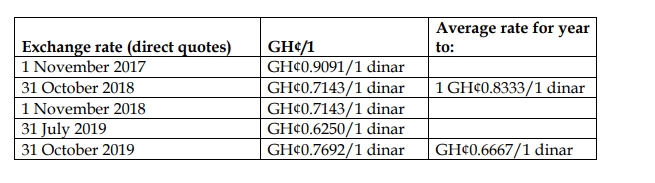
Medina Power Ltd has carried out certain transactions denominated in foreign currency during its financial year ended 31 October 2019 and has also conducted foreign operations through a foreign entity. Medina Power Ltd.’s functional and presentation currency is the cedi.

On 31 July 2019, Medina Power Ltd purchased goods from a foreign supplier for 16 million dinars. At 31 October 2019, the supplier had not yet been paid and the goods were still held in inventory by Medina Power Ltd.

On 31 July, Medina Power Ltd sold goods to a foreign customer for 8 million dinars, and it received payment for the goods in dinars on 31 October 2019.

Medina Power Ltd had also purchased an investment property on 1 November 2018 for 56 million dinars. At 31 October 2019, the investment property had a fair value of 48 million dinars. The company uses the fair value model in accounting for investment properties.

Medina Power Ltd wants advice on how to treat these transactions in the financial statements for the year ended 31 October 2019.

question table

Required:
Discuss the accounting treatment of the above transactions in accordance with the advice required by the directors. (You should show detailed workings as well as a discussion of the accounting treatment used.)


Inventory and payable

  • The inventory and trade payable would be recorded initially at GH¢10 million (16 million dinars x GH¢0.6250).
  • At the year-end on 31 October 2019, the amount payable is still outstanding. It should be re-translated at the closing rate to GH¢12.3 million (16 million dinars x GH¢0.7692).
  • This creates an exchange loss of GH¢2.3 million (12.3 – 10) which should be recognized in profit or loss.
  • Unless it has been impaired, the inventory (a non-monetary asset) should be recorded at GH¢10 million at the year-end.

Sale of goods

  • The sale of goods should be recorded at GH¢5 million (8 million dinars x GH¢0.6250) as revenue and as a trade receivable.
  • Payment in dinars was received on 31 October 2019 and the actual cedi value of the dinars received was GH¢6.2 million (8 million dinars x GH¢0.7692).
  • This creates a gain on exchange of GH¢1.2 million (6.2 – 5) which should be recognized in profit or loss.

Investment property

  • The investment property should be recognized on 1 November 2018 at GH¢40 million (56 million dinars x GH¢0.7143).
  • At the year-end on 31 October 2019, the property should be recognized at its fair value of GH¢36.9 million (48 million dinars x GH¢0.7692).
  • The fall in fair value (40 – 36.9 = 3.1) should be recognized in profit and loss as a loss on investment property.
  • The property is a non-monetary asset and when a gain or loss on a non-monetary item is recognized in profit or loss, the element of the gain or loss relating to exchange rates is also recognized in profit or loss.

Login or create a free account to see answers

Complete your registration to see answers

Find Related Questions by Tags, levels, etc.

Report an error

You're reporting an error for "CR – May 2020 – L3 – Q3a – Foreign Currency Transactions"

CR – May 2020 – L3 – Q3a – Foreign Currency Transactions

Foreign currency transactions related to purchases, sales, and investment property with exchange rate variations and reporting implications.

Medina Power Ltd has carried out certain transactions denominated in foreign currency during its financial year ended 31 October 2019 and has also conducted foreign operations through a foreign entity. Medina Power Ltd.’s functional and presentation currency is the cedi.

On 31 July 2019, Medina Power Ltd purchased goods from a foreign supplier for 16 million dinars. At 31 October 2019, the supplier had not yet been paid and the goods were still held in inventory by Medina Power Ltd.

On 31 July, Medina Power Ltd sold goods to a foreign customer for 8 million dinars, and it received payment for the goods in dinars on 31 October 2019.

Medina Power Ltd had also purchased an investment property on 1 November 2018 for 56 million dinars. At 31 October 2019, the investment property had a fair value of 48 million dinars. The company uses the fair value model in accounting for investment properties.

Medina Power Ltd wants advice on how to treat these transactions in the financial statements for the year ended 31 October 2019.

question table

Required:
Discuss the accounting treatment of the above transactions in accordance with the advice required by the directors. (You should show detailed workings as well as a discussion of the accounting treatment used.)


Inventory and payable

  • The inventory and trade payable would be recorded initially at GH¢10 million (16 million dinars x GH¢0.6250).
  • At the year-end on 31 October 2019, the amount payable is still outstanding. It should be re-translated at the closing rate to GH¢12.3 million (16 million dinars x GH¢0.7692).
  • This creates an exchange loss of GH¢2.3 million (12.3 – 10) which should be recognized in profit or loss.
  • Unless it has been impaired, the inventory (a non-monetary asset) should be recorded at GH¢10 million at the year-end.

Sale of goods

  • The sale of goods should be recorded at GH¢5 million (8 million dinars x GH¢0.6250) as revenue and as a trade receivable.
  • Payment in dinars was received on 31 October 2019 and the actual cedi value of the dinars received was GH¢6.2 million (8 million dinars x GH¢0.7692).
  • This creates a gain on exchange of GH¢1.2 million (6.2 – 5) which should be recognized in profit or loss.

Investment property

  • The investment property should be recognized on 1 November 2018 at GH¢40 million (56 million dinars x GH¢0.7143).
  • At the year-end on 31 October 2019, the property should be recognized at its fair value of GH¢36.9 million (48 million dinars x GH¢0.7692).
  • The fall in fair value (40 – 36.9 = 3.1) should be recognized in profit and loss as a loss on investment property.
  • The property is a non-monetary asset and when a gain or loss on a non-monetary item is recognized in profit or loss, the element of the gain or loss relating to exchange rates is also recognized in profit or loss.

Login or create a free account to see answers

Complete your registration to see answers

Find Related Questions by Tags, levels, etc.

Report an error

You're reporting an error for "CR – May 2020 – L3 – Q3a – Foreign Currency Transactions"

CR – May 2020 – Q3b(i) – Ethical Issues in Contract Bidding

This question requires a discussion on the ethical issues related to conflict of interest, confidentiality, and professional behavior in a contract bidding scenario.

You have just obtained your full membership with the Institute of Chartered Accountants (Ghana). Following this successful achievement, you have been appointed as the Head of Finance at Asasiyemedeh Company Limited, a Ghanaian company, which provides catering services. Your former employer, Akwaba Limited, is a large public sector organization operating in Accra, where, as the Financial Accountant, you had the opportunity to work on areas relating to financial accounting, procurement, contracts, and bids. One of Asasiyemedeh Company Limited’s major contracts is with Akwaba Limited, your former employer. The contract is now due for renewal, and Asasiyemedeh Company Limited is preparing a competitive bid for this contract.

You have been tasked to lead the team responsible for bidding for this contract, but you are concerned as a professional that you might breach confidentiality if you accept this role. You also suspect that your knowledge and experience of Akwaba Limited were seen as good reasons for appointing you to the position of Head of Finance at Asasiyemedeh Company Limited. You do not in any way want to let your new employer down as you are aware that the loss of such a major contract would have a significant effect on the financial performance of Asasiyemedeh Company Limited, and its performance-related bonus scheme for management members.

Required:
Discuss the ethical issues raised in the above scenario.

The ethical issues raised in the scenario include:

  1. Objectivity:
    There is a self-interest threat that arises due to the impact that losing Akwaba Limited’s contract would have on Asasiyemedeh Company Limited’s financial performance and reward policy. There is also an intimidation threat because other employees in the company may be affected by the financial implications of the contract not being renewed. Additionally, you may feel a strong desire to impress your new employer by helping to secure the renewal of the contract. The key question is whether you can safeguard against the self-interest threat posed by Asasiyemedeh Company Limited’s performance-related bonus scheme.
  2. Confidentiality:
    Clearly, there is a confidentiality threat here as you have worked with Akwaba Ltd in the past. Your previous employment with Akwaba Ltd has provided you with information which may be of value to Asasiyemedeh Company Limited. The principle of confidentiality prohibits the use of confidential information acquired as a result of your previous employment for your advantage or that of your current employer. While you have a responsibility to advance the legitimate aims of your employing organization, this should not extend to a breach of confidentiality. In this case, you (because of Asasiyemedeh Company Limited’s performance-related bonus) and Asasiyemedeh Company Limited stand to benefit from the confidential information about how bids are assessed at Akwaba Ltd. The principle would not be breached if you were in possession of information that was in the public domain, or if you were simply to use experience gained in your previous employment, so long as you do not use confidential knowledge that you acquired as a result of that employment.                           If you accept this role, can you ensure that you do not use confidential information relating to your former employer to your advantage or to the advantage of your current employer? You must be careful and professional as winning that contracts may leads to confidential breaches against you or your current employers perhaps from those bidders of the same contracts who might lose the bids
  3. Professional Behavior:
    You must demonstrate professionalism here. For example, what can you do to safeguard your reputation as a professional, the reputation of your employer, and the accountancy profession to which you belong? You must consider the Institute of Chartered Accountants (Ghana) code of ethics, applicable laws (procurement Act 914), and regulations, your current and previous contracts of employment, and your employer’s policies and procedures.

Login or create a free account to see answers

Complete your registration to see answers

Find Related Questions by Tags, levels, etc.

Report an error

You're reporting an error for "CR – May 2020 – Q3b(i) – Ethical Issues in Contract Bidding"

CR – May 2020 – Q3b(i) – Ethical Issues in Contract Bidding

This question requires a discussion on the ethical issues related to conflict of interest, confidentiality, and professional behavior in a contract bidding scenario.

You have just obtained your full membership with the Institute of Chartered Accountants (Ghana). Following this successful achievement, you have been appointed as the Head of Finance at Asasiyemedeh Company Limited, a Ghanaian company, which provides catering services. Your former employer, Akwaba Limited, is a large public sector organization operating in Accra, where, as the Financial Accountant, you had the opportunity to work on areas relating to financial accounting, procurement, contracts, and bids. One of Asasiyemedeh Company Limited’s major contracts is with Akwaba Limited, your former employer. The contract is now due for renewal, and Asasiyemedeh Company Limited is preparing a competitive bid for this contract.

You have been tasked to lead the team responsible for bidding for this contract, but you are concerned as a professional that you might breach confidentiality if you accept this role. You also suspect that your knowledge and experience of Akwaba Limited were seen as good reasons for appointing you to the position of Head of Finance at Asasiyemedeh Company Limited. You do not in any way want to let your new employer down as you are aware that the loss of such a major contract would have a significant effect on the financial performance of Asasiyemedeh Company Limited, and its performance-related bonus scheme for management members.

Required:
Discuss the ethical issues raised in the above scenario.

The ethical issues raised in the scenario include:

  1. Objectivity:
    There is a self-interest threat that arises due to the impact that losing Akwaba Limited’s contract would have on Asasiyemedeh Company Limited’s financial performance and reward policy. There is also an intimidation threat because other employees in the company may be affected by the financial implications of the contract not being renewed. Additionally, you may feel a strong desire to impress your new employer by helping to secure the renewal of the contract. The key question is whether you can safeguard against the self-interest threat posed by Asasiyemedeh Company Limited’s performance-related bonus scheme.
  2. Confidentiality:
    Clearly, there is a confidentiality threat here as you have worked with Akwaba Ltd in the past. Your previous employment with Akwaba Ltd has provided you with information which may be of value to Asasiyemedeh Company Limited. The principle of confidentiality prohibits the use of confidential information acquired as a result of your previous employment for your advantage or that of your current employer. While you have a responsibility to advance the legitimate aims of your employing organization, this should not extend to a breach of confidentiality. In this case, you (because of Asasiyemedeh Company Limited’s performance-related bonus) and Asasiyemedeh Company Limited stand to benefit from the confidential information about how bids are assessed at Akwaba Ltd. The principle would not be breached if you were in possession of information that was in the public domain, or if you were simply to use experience gained in your previous employment, so long as you do not use confidential knowledge that you acquired as a result of that employment.                           If you accept this role, can you ensure that you do not use confidential information relating to your former employer to your advantage or to the advantage of your current employer? You must be careful and professional as winning that contracts may leads to confidential breaches against you or your current employers perhaps from those bidders of the same contracts who might lose the bids
  3. Professional Behavior:
    You must demonstrate professionalism here. For example, what can you do to safeguard your reputation as a professional, the reputation of your employer, and the accountancy profession to which you belong? You must consider the Institute of Chartered Accountants (Ghana) code of ethics, applicable laws (procurement Act 914), and regulations, your current and previous contracts of employment, and your employer’s policies and procedures.

Login or create a free account to see answers

Complete your registration to see answers

Find Related Questions by Tags, levels, etc.

Report an error

You're reporting an error for "CR – May 2020 – Q3b(i) – Ethical Issues in Contract Bidding"

CR – May 2020 – Q3b(ii) – Ethical Actions in Contract Bidding

This question requires recommendations for maintaining ethical standards in a contract bidding situation involving a conflict of interest.

Recommend the possible courses of action that you will take in order to be ethically responsible as expected from a Professional Accountant.


Possible courses of action

  • You should discuss the situation and your obligations with your managing director in the first place and, ask for your involvement in the preparation of the contract bid to be limited. For example, you may be able to contribute to aspects of the bid that do not in any way require you to refer to confidential knowledge about your previous employment with Akwaba Ltd.
  • If the managing director fails to understand the conflict that you are facing, probably he is not in your profession, you should request that you both discuss the matter with the board chairman or another member of staff. During these discussions, you should refer to the company’s ethical code, if it has one, as well as that of the Institute of Chartered Accountants (Ghana).
  • If there are no other formal channels available, you should make the entire board aware of your dilemma by writing formally to them. If necessary, you must refuse to take part in the bid without necessary safeguards being implemented.
  • Ultimately, disassociating yourself from Asasiyemedeh Company Limited may be the only solution. However, before taking such a step, you should seek legal advice on your employment.
  • Rights and responsibilities (subject to the rules and guidance of the Institute of Chartered Accountants, (Ghana)).
  • You should document, in detail, the steps that you take in resolving your dilemma, in case your ethical judgment is challenged in future periods.
  • Looking at this issue from Asasiyemedeh Company Limited’s perspective, it may be appropriate to suggest to the managing director or the board of your employer that a policy on conflicts of interest be developed and that the remuneration and bonus policy be reviewed in light of this contract bid with Akwaba Ltd.

Login or create a free account to see answers

Complete your registration to see answers

Find Related Questions by Tags, levels, etc.

Report an error

You're reporting an error for "CR – May 2020 – Q3b(ii) – Ethical Actions in Contract Bidding"

CR – May 2020 – Q3b(ii) – Ethical Actions in Contract Bidding

This question requires recommendations for maintaining ethical standards in a contract bidding situation involving a conflict of interest.

Recommend the possible courses of action that you will take in order to be ethically responsible as expected from a Professional Accountant.


Possible courses of action

  • You should discuss the situation and your obligations with your managing director in the first place and, ask for your involvement in the preparation of the contract bid to be limited. For example, you may be able to contribute to aspects of the bid that do not in any way require you to refer to confidential knowledge about your previous employment with Akwaba Ltd.
  • If the managing director fails to understand the conflict that you are facing, probably he is not in your profession, you should request that you both discuss the matter with the board chairman or another member of staff. During these discussions, you should refer to the company’s ethical code, if it has one, as well as that of the Institute of Chartered Accountants (Ghana).
  • If there are no other formal channels available, you should make the entire board aware of your dilemma by writing formally to them. If necessary, you must refuse to take part in the bid without necessary safeguards being implemented.
  • Ultimately, disassociating yourself from Asasiyemedeh Company Limited may be the only solution. However, before taking such a step, you should seek legal advice on your employment.
  • Rights and responsibilities (subject to the rules and guidance of the Institute of Chartered Accountants, (Ghana)).
  • You should document, in detail, the steps that you take in resolving your dilemma, in case your ethical judgment is challenged in future periods.
  • Looking at this issue from Asasiyemedeh Company Limited’s perspective, it may be appropriate to suggest to the managing director or the board of your employer that a policy on conflicts of interest be developed and that the remuneration and bonus policy be reviewed in light of this contract bid with Akwaba Ltd.

Login or create a free account to see answers

Complete your registration to see answers

Find Related Questions by Tags, levels, etc.

Report an error

You're reporting an error for "CR – May 2020 – Q3b(ii) – Ethical Actions in Contract Bidding"

CR – May 2020 – L3 – Q1 – Consolidated Statement of Financial Position

Prepare the consolidated statement of financial position for Phato Ltd and its subsidiaries as at 30 September 2019, including relevant calculations for goodwill, non-controlling interest, and asset impairments.

Phato Ltd, is a Public Limited Liability Company which operates in the service sector in Ghana. Phato Ltd has a business relationship with two other Ghanaian companies, Sakara Ltd and Saadi Ltd, which are public limited liability companies too. The draft statements of financial position of these three companies are as below as at 30 September 2019.

Phato Ltd GH¢ million Sakara Ltd GH¢ million Saadi Ltd GH¢ million
Assets:
Non-current assets
Property, plant, and equipment 460.0 150.0
Investment in subsidiaries
Sakara Ltd 365.0
Saadi Ltd 160.0
Investment in Azuri Ltd 24.0
Intangible assets 99.0 15.0
Total Non-current assets 948.0 325.0
Current assets 447.5 240.0
Total assets 1,395.5 565.0
Equity and liabilities:
Equity:
Share capital 460.0 200.0
Other components of equity 36.5 18.5
Retained earnings 447.5 221.0
Total equity 944.0 439.5
Non-current liabilities 247.5 61.5
Current liabilities 204.0 64.0
Total liabilities 451.5 125.5
Total equity and liabilities 1,395.5 565.0

Additional relevant information:

  1. Phato Ltd, on 1 October 2017, acquired 60% of the equity interests of Sakara Ltd. The cost of the investment comprised cash of GH¢360 million. At acquisition, the fair value of the non-controlling interest in Sakara Ltd was estimated at GH¢146 million. The fair value of the identifiable net assets acquired totaled GH¢417.5 million, including retained earnings of GH¢159.5 million and other components of equity at GH¢13.5 million. The excess in fair value results from non-depreciable land.
  2. Sakara Ltd, on 1 October 2018, acquired 70% of Saadi Ltd for GH¢160 million. The fair value of non-controlling interest was estimated at GH¢36 million. The fair value of the identifiable net assets of Saadi Ltd at acquisition was GH¢181 million, retained earnings GH¢53 million, and other components of equity GH¢10 million.
  3. Phato Ltd acquired a 14% interest in Azuri Ltd for GH¢9 million on 1 October 2017. On 1 April 2019, Phato Ltd acquired an additional 16% interest in Azuri Ltd for GH¢13.5 million, achieving significant influence.
  4. Phato Ltd purchased patents for GH¢5 million and incurred other development costs for product development.
  5. Impairment tests were conducted on Sakara Ltd and Saadi Ltd.

Required:
Prepare the consolidated statement of financial position for the Phato Ltd Group as at 30 September 2019.

Phato Ltd Group
Consolidated Statement of Financial Position as at 30 September 2019

Assets GH¢ million
Non-current assets
Property, plant, and equipment (460 + 150 + 155 + 44.5 + 18) 827.5
Goodwill (W3) 93.5
Intangible assets (99 + 15 + 17.5 – 4.5 -13.5) 113.5
Investment in Azuri (W7) 25.25
Total non-current assets 1,059.75
Current assets 812.5
Total assets 1,872.25
Equity and Liabilities GH¢ million
Equity attributable to owners of parent
Share capital 460
Retained earnings (W5) 489.41
Other components of equity (W5) 38.05
Total Equity attributable to owners 987.46
Non-controlling interest (W4) 192.29
Total Equity 1,179.75
Non-current liabilities 355.5
Current liabilities 337.0
Total Liabilities 692.5
Total Equity and Liabilities 1,872.25

workings for answering


Login or create a free account to see answers

Complete your registration to see answers

Find Related Questions by Tags, levels, etc.

Report an error

You're reporting an error for "CR – May 2020 – L3 – Q1 – Consolidated Statement of Financial Position"

CR – May 2020 – L3 – Q1 – Consolidated Statement of Financial Position

Prepare the consolidated statement of financial position for Phato Ltd and its subsidiaries as at 30 September 2019, including relevant calculations for goodwill, non-controlling interest, and asset impairments.

Phato Ltd, is a Public Limited Liability Company which operates in the service sector in Ghana. Phato Ltd has a business relationship with two other Ghanaian companies, Sakara Ltd and Saadi Ltd, which are public limited liability companies too. The draft statements of financial position of these three companies are as below as at 30 September 2019.

Phato Ltd GH¢ million Sakara Ltd GH¢ million Saadi Ltd GH¢ million
Assets:
Non-current assets
Property, plant, and equipment 460.0 150.0
Investment in subsidiaries
Sakara Ltd 365.0
Saadi Ltd 160.0
Investment in Azuri Ltd 24.0
Intangible assets 99.0 15.0
Total Non-current assets 948.0 325.0
Current assets 447.5 240.0
Total assets 1,395.5 565.0
Equity and liabilities:
Equity:
Share capital 460.0 200.0
Other components of equity 36.5 18.5
Retained earnings 447.5 221.0
Total equity 944.0 439.5
Non-current liabilities 247.5 61.5
Current liabilities 204.0 64.0
Total liabilities 451.5 125.5
Total equity and liabilities 1,395.5 565.0

Additional relevant information:

  1. Phato Ltd, on 1 October 2017, acquired 60% of the equity interests of Sakara Ltd. The cost of the investment comprised cash of GH¢360 million. At acquisition, the fair value of the non-controlling interest in Sakara Ltd was estimated at GH¢146 million. The fair value of the identifiable net assets acquired totaled GH¢417.5 million, including retained earnings of GH¢159.5 million and other components of equity at GH¢13.5 million. The excess in fair value results from non-depreciable land.
  2. Sakara Ltd, on 1 October 2018, acquired 70% of Saadi Ltd for GH¢160 million. The fair value of non-controlling interest was estimated at GH¢36 million. The fair value of the identifiable net assets of Saadi Ltd at acquisition was GH¢181 million, retained earnings GH¢53 million, and other components of equity GH¢10 million.
  3. Phato Ltd acquired a 14% interest in Azuri Ltd for GH¢9 million on 1 October 2017. On 1 April 2019, Phato Ltd acquired an additional 16% interest in Azuri Ltd for GH¢13.5 million, achieving significant influence.
  4. Phato Ltd purchased patents for GH¢5 million and incurred other development costs for product development.
  5. Impairment tests were conducted on Sakara Ltd and Saadi Ltd.

Required:
Prepare the consolidated statement of financial position for the Phato Ltd Group as at 30 September 2019.

Phato Ltd Group
Consolidated Statement of Financial Position as at 30 September 2019

Assets GH¢ million
Non-current assets
Property, plant, and equipment (460 + 150 + 155 + 44.5 + 18) 827.5
Goodwill (W3) 93.5
Intangible assets (99 + 15 + 17.5 – 4.5 -13.5) 113.5
Investment in Azuri (W7) 25.25
Total non-current assets 1,059.75
Current assets 812.5
Total assets 1,872.25
Equity and Liabilities GH¢ million
Equity attributable to owners of parent
Share capital 460
Retained earnings (W5) 489.41
Other components of equity (W5) 38.05
Total Equity attributable to owners 987.46
Non-controlling interest (W4) 192.29
Total Equity 1,179.75
Non-current liabilities 355.5
Current liabilities 337.0
Total Liabilities 692.5
Total Equity and Liabilities 1,872.25

workings for answering


Login or create a free account to see answers

Complete your registration to see answers

Find Related Questions by Tags, levels, etc.

Report an error

You're reporting an error for "CR – May 2020 – L3 – Q1 – Consolidated Statement of Financial Position"

CR – May 2020 – L3 – Q2a – Government Grants for Factory Construction

Discuss the accounting treatment for a government grant received for the construction of a factory, showing calculations and relevant entries.

On 1 January 2018, Asankragua Ltd (Asankragua) applied to a government agency for a grant to assist with the construction of a factory in Enchi. The proposed construction cost of the factory was GH¢52 million and the company projected that 350 people would be employed after completion. The land was already owned by Asankragua.

On 1 March 2018, the government agency offered to grant a sum amounting to 25% of the factory’s construction cost to a maximum of GH¢13 million. The grant aid was to be advanced on completion and would be repayable on demand if total employment at the factory fell below 300 people within 5 years of completion.

At the financial year end, 31 March 2018, Asankragua had accepted the offer of grant aid and had signed contracts for the construction of the factory at a total cost of GH¢52 million. Construction work was due to commence on 1 April 2018.

By 31 March 2019, the factory had been completed on budget, 400 people were employed ready to commence manufacturing activities, and the government agency agreed that the conditions necessary for the drawdown of the grant had been met.

On 1 April 2019, the factory was brought into use. It was estimated that it would have a ten-year useful economic life. On 1 June 2019, the government agency paid over the agreed GH¢13 million. In addition, the company sought and was paid an employment grant of GH¢1.2 million as employment exceeded original projections. This is expected to be payable annually for 5 years in total, at a rate of GH¢12,000 per additional person employed over 300 in each year. There are no repayment provisions attached to the employment grant.

The directors of Asankragua expect employment levels to exceed 350 people for at least 4 further years from 31 March 2020.

Required:
Demonstrate, showing calculations and relevant entries, how Asankragua Ltd should record the above transactions and events in its financial statements for years ended 31 March 2018, 2019, and 2020.

Year ended 31 March 2018:
No accounting entry is made in this financial year, as no transaction has yet been entered into. A capital commitment exists and should be disclosed in the notes. The grant approval should be disclosed also.

Year ended 31 March 2019:
At this date, the factory should be recorded at its cost of GH¢52 million. As all conditions for the payment of the grant have been met, recognition should be made of this amount receivable also. As the factory has not yet been brought into use, no depreciation will be charged for the year. Similarly, no amortisation of the grant will take place in the period.

Recognition of factory:
Dr Property, plant & equipment: GH¢52 million
Cr Cash: GH¢52 million (New factory constructed at a cost of GH¢52 million)

Recognition of grant:
Option 1:
Dr Government grant receivable (current asset): GH¢13 million
Cr Property, plant & equipment: GH¢13 million (Government grant approved, not received yet)

Option 2:
Dr Government grant receivable (current asset): GH¢13 million
Cr Deferred income – current liability: GH¢1.3 million
Cr Deferred income – non-current liability: GH¢11.7 million (Government grant approved, not received yet)

Year ended 31 March 2020:
There are several transactions to record based on the new factory. These are (1) depreciation and (2) amortisation of the grant. In addition, the cash was received from the government agency.

Receipt of grant:
Dr Cash: GH¢13 million
Cr Government grant receivable: GH¢13 million (Receipt of cash grant from government agency)

Option 1 (Depreciation of factory):
Dr Profit or loss: GH¢3.9 million
Cr Accumulated Depreciation – PPE: GH¢3.9 million (Depreciation of the cost of factory net of grant over 10 years)

Option 2 (Depreciation of factory):
Dr Profit or loss: GH¢5.2 million
Cr Accumulated Depreciation – PPE: GH¢5.2 million (Depreciation of gross factory cost over 10 years)

Amortisation of grant:
Dr Deferred income: GH¢1.3 million
Cr Profit or loss: GH¢1.3 million (Amortization of grant over 10 years, reflecting the proportional expensing of the factory to which the grant relates)

The employment grant relates entirely to the cost of employing staff in that year. Hence it should be entirely recognized as income in the year ended 31 March 2020.

Recognition of employment grant:
Dr Cash: GH¢1.2 million
Cr Profit or loss: GH¢1.2 million (Recognition of employment grant as income as received)

Initial recognition of the factory in 2019: 1 mark
Page 19 of 28
Recognition of the grant in 2019: 2 marks
Treatment of receipt of grant in 2020: 2 marks
Depreciation of factory in 2020: 1 mark
Treatment of amortization of grant: 1.5 marks
Recognition of employment grant: 1.5 marks

Login or create a free account to see answers

Complete your registration to see answers

Find Related Questions by Tags, levels, etc.

Report an error

You're reporting an error for "CR – May 2020 – L3 – Q2a – Government Grants for Factory Construction"

CR – May 2020 – L3 – Q2a – Government Grants for Factory Construction

Discuss the accounting treatment for a government grant received for the construction of a factory, showing calculations and relevant entries.

On 1 January 2018, Asankragua Ltd (Asankragua) applied to a government agency for a grant to assist with the construction of a factory in Enchi. The proposed construction cost of the factory was GH¢52 million and the company projected that 350 people would be employed after completion. The land was already owned by Asankragua.

On 1 March 2018, the government agency offered to grant a sum amounting to 25% of the factory’s construction cost to a maximum of GH¢13 million. The grant aid was to be advanced on completion and would be repayable on demand if total employment at the factory fell below 300 people within 5 years of completion.

At the financial year end, 31 March 2018, Asankragua had accepted the offer of grant aid and had signed contracts for the construction of the factory at a total cost of GH¢52 million. Construction work was due to commence on 1 April 2018.

By 31 March 2019, the factory had been completed on budget, 400 people were employed ready to commence manufacturing activities, and the government agency agreed that the conditions necessary for the drawdown of the grant had been met.

On 1 April 2019, the factory was brought into use. It was estimated that it would have a ten-year useful economic life. On 1 June 2019, the government agency paid over the agreed GH¢13 million. In addition, the company sought and was paid an employment grant of GH¢1.2 million as employment exceeded original projections. This is expected to be payable annually for 5 years in total, at a rate of GH¢12,000 per additional person employed over 300 in each year. There are no repayment provisions attached to the employment grant.

The directors of Asankragua expect employment levels to exceed 350 people for at least 4 further years from 31 March 2020.

Required:
Demonstrate, showing calculations and relevant entries, how Asankragua Ltd should record the above transactions and events in its financial statements for years ended 31 March 2018, 2019, and 2020.

Year ended 31 March 2018:
No accounting entry is made in this financial year, as no transaction has yet been entered into. A capital commitment exists and should be disclosed in the notes. The grant approval should be disclosed also.

Year ended 31 March 2019:
At this date, the factory should be recorded at its cost of GH¢52 million. As all conditions for the payment of the grant have been met, recognition should be made of this amount receivable also. As the factory has not yet been brought into use, no depreciation will be charged for the year. Similarly, no amortisation of the grant will take place in the period.

Recognition of factory:
Dr Property, plant & equipment: GH¢52 million
Cr Cash: GH¢52 million (New factory constructed at a cost of GH¢52 million)

Recognition of grant:
Option 1:
Dr Government grant receivable (current asset): GH¢13 million
Cr Property, plant & equipment: GH¢13 million (Government grant approved, not received yet)

Option 2:
Dr Government grant receivable (current asset): GH¢13 million
Cr Deferred income – current liability: GH¢1.3 million
Cr Deferred income – non-current liability: GH¢11.7 million (Government grant approved, not received yet)

Year ended 31 March 2020:
There are several transactions to record based on the new factory. These are (1) depreciation and (2) amortisation of the grant. In addition, the cash was received from the government agency.

Receipt of grant:
Dr Cash: GH¢13 million
Cr Government grant receivable: GH¢13 million (Receipt of cash grant from government agency)

Option 1 (Depreciation of factory):
Dr Profit or loss: GH¢3.9 million
Cr Accumulated Depreciation – PPE: GH¢3.9 million (Depreciation of the cost of factory net of grant over 10 years)

Option 2 (Depreciation of factory):
Dr Profit or loss: GH¢5.2 million
Cr Accumulated Depreciation – PPE: GH¢5.2 million (Depreciation of gross factory cost over 10 years)

Amortisation of grant:
Dr Deferred income: GH¢1.3 million
Cr Profit or loss: GH¢1.3 million (Amortization of grant over 10 years, reflecting the proportional expensing of the factory to which the grant relates)

The employment grant relates entirely to the cost of employing staff in that year. Hence it should be entirely recognized as income in the year ended 31 March 2020.

Recognition of employment grant:
Dr Cash: GH¢1.2 million
Cr Profit or loss: GH¢1.2 million (Recognition of employment grant as income as received)

Initial recognition of the factory in 2019: 1 mark
Page 19 of 28
Recognition of the grant in 2019: 2 marks
Treatment of receipt of grant in 2020: 2 marks
Depreciation of factory in 2020: 1 mark
Treatment of amortization of grant: 1.5 marks
Recognition of employment grant: 1.5 marks

Login or create a free account to see answers

Complete your registration to see answers

Find Related Questions by Tags, levels, etc.

Report an error

You're reporting an error for "CR – May 2020 – L3 – Q2a – Government Grants for Factory Construction"

CR – May 2020 – L3 – Q2b – Capitalization of Borrowing Costs

Dompoase Ltd incurred the following borrowing costs during the financial year 2018:

GH¢’000
Overdraft interest 12
Foreign currency loan interest (correctly translated into GH¢) 84
Foreign currency loan exchange differences on capital 140

In addition, a three-year fixed-rate GH¢2 million loan was taken out on 1 January 2018 at 6.5%. A loan set-up fee was charged at GH¢20,000. This increased the effective interest rate on the loan to 6.88%.

Required:
Determine the maximum amount that could potentially be capitalized as borrowing costs during the period (assuming an asset was being financed using all available finance).


GH¢’000
Overdraft 12
Foreign currency loan interest 84
Foreign currency loan exchange differences on capital
Effective interest on loan ((2,000 – 20) x 6.88%) 136.2

The maximum amount to capitalize is GH¢232.2k.

Login or create a free account to see answers

Complete your registration to see answers

Find Related Questions by Tags, levels, etc.

Report an error

You're reporting an error for "CR – May 2020 – L3 – Q2b – Capitalization of Borrowing Costs"

CR – May 2020 – L3 – Q2b – Capitalization of Borrowing Costs

Dompoase Ltd incurred the following borrowing costs during the financial year 2018:

GH¢’000
Overdraft interest 12
Foreign currency loan interest (correctly translated into GH¢) 84
Foreign currency loan exchange differences on capital 140

In addition, a three-year fixed-rate GH¢2 million loan was taken out on 1 January 2018 at 6.5%. A loan set-up fee was charged at GH¢20,000. This increased the effective interest rate on the loan to 6.88%.

Required:
Determine the maximum amount that could potentially be capitalized as borrowing costs during the period (assuming an asset was being financed using all available finance).


GH¢’000
Overdraft 12
Foreign currency loan interest 84
Foreign currency loan exchange differences on capital
Effective interest on loan ((2,000 – 20) x 6.88%) 136.2

The maximum amount to capitalize is GH¢232.2k.

Login or create a free account to see answers

Complete your registration to see answers

Find Related Questions by Tags, levels, etc.

Report an error

You're reporting an error for "CR – May 2020 – L3 – Q2b – Capitalization of Borrowing Costs"

CR – May 2020 – L3 – Q2c – Defined Benefit Pension Plan

Recommend the accounting treatment for a defined benefit pension plan with supporting calculations.

Nzema prepares its financial statements in accordance with International Financial Reporting Standards (IFRS) with a financial year end of 31 December 2018. On 1 January 2018, Nzema commenced a defined benefit pension plan for a number of head office employees. Under the pension scheme, Nzema has an obligation to provide these staff with agreed post-employment benefits. Nzema carries the actuarial and investment risk associated with the pension scheme.

The following information has been compiled from workings by Nzema’s accounting staff and actuarial reports for the 2018 financial year:

GH¢
Interest income on plan assets 16,500
Employer contributions to plan 550,000
Current service cost 600,000
Interest on plan liability 18,000
Fair value of plan assets at 31/12/2018 580,000
Present value of plan obligation at 31/12/2018 620,000

The Accountant was not sure which accounting standard to apply when accounting for the pension scheme. The only adjustment made to account for the scheme was to expense the company’s contributions of GH¢550,000 for the 2018 financial year in the Statement of Profit or Loss and Other Comprehensive Income and to credit the ‘Cash’ account.

Required:
Recommend, with appropriate calculations, the necessary accounting treatment for this accounting issue.

The applicable accounting standard is IAS 19: Employee Benefits. Nzema’s pension plan is a defined benefit plan since Nzema has an obligation to provide agreed post-employment benefits and carries the actuarial and investment risk.

The employer contributions were accounted for incorrectly. Under IAS 19, a defined benefit liability (or asset) is recognized on the balance sheet as the present value of the defined benefit obligation minus the fair value of plan assets.

Workings – Calculation of Actuarial Gain/Loss:

Pension Asset:

Description GH¢
Opening balance 0
Return on assets 16,500
Employer contributions 550,000
Remeasurement – Actuarial Gain 13,500
Closing balance (31/12/2018) 580,000

Pension Liability:

Description GH¢
Opening balance 0
Interest Cost 18,000
Current Service Cost 600,000
Remeasurement – Actuarial Loss 2,000
Closing balance (31/12/2018) 620,000

Net Actuarial Gain:
GH¢13,500 (gain on pension assets) – GH¢2,000 (loss on pension liabilities) = GH¢11,500

Journal Entries:

  1. Net Interest Expense (Profit or Loss):
    Dr Net Interest Expense (Profit or Loss) GH¢1,500
    Cr Pension Liability GH¢1,500
    (Net interest expense: 18,000 – 16,500)
  2. Current Service Cost (Profit or Loss):
    Dr Current Service Cost GH¢600,000
    Cr Pension Liability GH¢600,000
    (Recognition of current service cost)
  3. Actuarial Gain (Other Comprehensive Income):
    Dr Pension Liability GH¢11,500
    Cr Remeasurement – Actuarial Gain (Other Comprehensive Income) GH¢11,500
    (Recognition of actuarial gain)
  4. Correction of Previous Accounting Treatment:
    Dr Pension Liability GH¢550,000
    Cr Pension Contribution Expense (Profit or Loss) GH¢550,000
    (Correcting previous entry where contributions were expensed)
  5. Identification of the appropriate standard to be applied: 1 mark
    Net interest expense to Profit or Loss: 1 mark
    Actuarial gain on pension asset: 1 mark
    Actuarial loss on pension liability: 1 mark
    Net actuarial gain to OCI: 1 mark
    Currents service cost: 1 mark
    (Total: 20 marks)

Login or create a free account to see answers

Complete your registration to see answers

Find Related Questions by Tags, levels, etc.

Report an error

You're reporting an error for "CR – May 2020 – L3 – Q2c – Defined Benefit Pension Plan"

CR – May 2020 – L3 – Q2c – Defined Benefit Pension Plan

Recommend the accounting treatment for a defined benefit pension plan with supporting calculations.

Nzema prepares its financial statements in accordance with International Financial Reporting Standards (IFRS) with a financial year end of 31 December 2018. On 1 January 2018, Nzema commenced a defined benefit pension plan for a number of head office employees. Under the pension scheme, Nzema has an obligation to provide these staff with agreed post-employment benefits. Nzema carries the actuarial and investment risk associated with the pension scheme.

The following information has been compiled from workings by Nzema’s accounting staff and actuarial reports for the 2018 financial year:

GH¢
Interest income on plan assets 16,500
Employer contributions to plan 550,000
Current service cost 600,000
Interest on plan liability 18,000
Fair value of plan assets at 31/12/2018 580,000
Present value of plan obligation at 31/12/2018 620,000

The Accountant was not sure which accounting standard to apply when accounting for the pension scheme. The only adjustment made to account for the scheme was to expense the company’s contributions of GH¢550,000 for the 2018 financial year in the Statement of Profit or Loss and Other Comprehensive Income and to credit the ‘Cash’ account.

Required:
Recommend, with appropriate calculations, the necessary accounting treatment for this accounting issue.

The applicable accounting standard is IAS 19: Employee Benefits. Nzema’s pension plan is a defined benefit plan since Nzema has an obligation to provide agreed post-employment benefits and carries the actuarial and investment risk.

The employer contributions were accounted for incorrectly. Under IAS 19, a defined benefit liability (or asset) is recognized on the balance sheet as the present value of the defined benefit obligation minus the fair value of plan assets.

Workings – Calculation of Actuarial Gain/Loss:

Pension Asset:

Description GH¢
Opening balance 0
Return on assets 16,500
Employer contributions 550,000
Remeasurement – Actuarial Gain 13,500
Closing balance (31/12/2018) 580,000

Pension Liability:

Description GH¢
Opening balance 0
Interest Cost 18,000
Current Service Cost 600,000
Remeasurement – Actuarial Loss 2,000
Closing balance (31/12/2018) 620,000

Net Actuarial Gain:
GH¢13,500 (gain on pension assets) – GH¢2,000 (loss on pension liabilities) = GH¢11,500

Journal Entries:

  1. Net Interest Expense (Profit or Loss):
    Dr Net Interest Expense (Profit or Loss) GH¢1,500
    Cr Pension Liability GH¢1,500
    (Net interest expense: 18,000 – 16,500)
  2. Current Service Cost (Profit or Loss):
    Dr Current Service Cost GH¢600,000
    Cr Pension Liability GH¢600,000
    (Recognition of current service cost)
  3. Actuarial Gain (Other Comprehensive Income):
    Dr Pension Liability GH¢11,500
    Cr Remeasurement – Actuarial Gain (Other Comprehensive Income) GH¢11,500
    (Recognition of actuarial gain)
  4. Correction of Previous Accounting Treatment:
    Dr Pension Liability GH¢550,000
    Cr Pension Contribution Expense (Profit or Loss) GH¢550,000
    (Correcting previous entry where contributions were expensed)
  5. Identification of the appropriate standard to be applied: 1 mark
    Net interest expense to Profit or Loss: 1 mark
    Actuarial gain on pension asset: 1 mark
    Actuarial loss on pension liability: 1 mark
    Net actuarial gain to OCI: 1 mark
    Currents service cost: 1 mark
    (Total: 20 marks)

Login or create a free account to see answers

Complete your registration to see answers

Find Related Questions by Tags, levels, etc.

Report an error

You're reporting an error for "CR – May 2020 – L3 – Q2c – Defined Benefit Pension Plan"

CR – May 2020 – Q4a – Capital Reduction Account

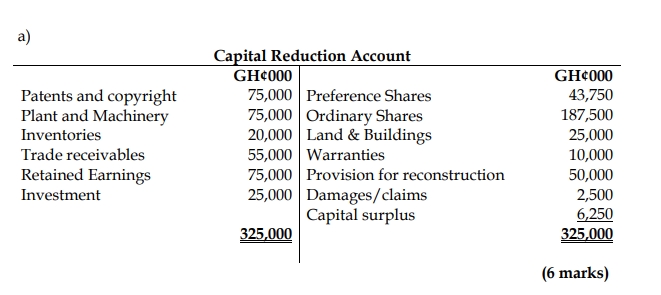
This question requires the preparation of a Capital Reduction Account for Sasasila Ltd following a reorganization.

Sasasila Ltd has been operating profitably for a number of years. However, in recent times, the company has been making losses. Below is the statement of financial position as at 30 June 2019:

Assets GH¢000
Non-Current Assets
Patents and copyrights 75,000
Land and buildings (net) 200,000
Plant and machinery (net) 150,000
Current Assets
Inventories 125,000
Trade receivables 125,000
Bank 37,500
Investments (cost) 100,000
Total Assets 812,500
Equity and liabilities:
Equity
Ordinary share capital (issued at GH¢10 each) 375,000
20% cumulative preference shares (issued at GH¢10 each) 175,000
Retained earnings (75,000)
Non-current Liabilities
15% Debentures 125,000
Current Liabilities
Interest on debentures 18,750
Trade payables 93,750
Provision for business restructuring 50,000
Provision for legal damages & claims 12,500
Provision for warranties 37,500
Total Equity and Liabilities 812,500

Additional relevant information: The following scheme of reconstruction was approved by all parties as well as the High Court with the exception of only one ordinary shareholder:

  1. The ordinary shares were to be reduced to GH¢5 per share.
  2. The preference shares were to be reduced to GH¢7.5 per share and arrears in dividends for three years were to be canceled from the company’s books.
  3. The fair values of the assets were agreed at the following values:
    • Patents and copyrights: Nil
    • Land and buildings: GH¢225,000
    • Plant and machinery: GH¢75,000
    • Investments: GH¢75,000
    • Inventories: GH¢105,000
    • Trade receivables: GH¢70,000
  4. The balance on retained earnings is to be eliminated in full.
  5. The liability for legal damages and claims was to be settled for GH¢10 million, and the provision for warranties reduced to GH¢27.5 million.
  6. The accrued debenture interest was to be paid in cash.
  7. Investments with a carrying amount of GH¢52.5 million were to be sold for cash at that value to strengthen the working capital position.
  8. The amount set aside for business restructuring was to be eliminated as well.
  9. The High Court directed a payment of GH¢0.2 million to a member who opposed the scheme for 50 ordinary shares held by him.

Prepare the Capital Reduction Account as at 30 June 2019.

answer to the question

Login or create a free account to see answers

Complete your registration to see answers

Find Related Questions by Tags, levels, etc.

Report an error

You're reporting an error for "CR – May 2020 – Q4a – Capital Reduction Account"

CR – May 2020 – Q4a – Capital Reduction Account

This question requires the preparation of a Capital Reduction Account for Sasasila Ltd following a reorganization.

Sasasila Ltd has been operating profitably for a number of years. However, in recent times, the company has been making losses. Below is the statement of financial position as at 30 June 2019:

Assets GH¢000
Non-Current Assets
Patents and copyrights 75,000
Land and buildings (net) 200,000
Plant and machinery (net) 150,000
Current Assets
Inventories 125,000
Trade receivables 125,000
Bank 37,500
Investments (cost) 100,000
Total Assets 812,500
Equity and liabilities:
Equity
Ordinary share capital (issued at GH¢10 each) 375,000
20% cumulative preference shares (issued at GH¢10 each) 175,000
Retained earnings (75,000)
Non-current Liabilities
15% Debentures 125,000
Current Liabilities
Interest on debentures 18,750
Trade payables 93,750
Provision for business restructuring 50,000
Provision for legal damages & claims 12,500
Provision for warranties 37,500
Total Equity and Liabilities 812,500

Additional relevant information: The following scheme of reconstruction was approved by all parties as well as the High Court with the exception of only one ordinary shareholder:

  1. The ordinary shares were to be reduced to GH¢5 per share.
  2. The preference shares were to be reduced to GH¢7.5 per share and arrears in dividends for three years were to be canceled from the company’s books.
  3. The fair values of the assets were agreed at the following values:
    • Patents and copyrights: Nil
    • Land and buildings: GH¢225,000
    • Plant and machinery: GH¢75,000
    • Investments: GH¢75,000
    • Inventories: GH¢105,000
    • Trade receivables: GH¢70,000
  4. The balance on retained earnings is to be eliminated in full.
  5. The liability for legal damages and claims was to be settled for GH¢10 million, and the provision for warranties reduced to GH¢27.5 million.
  6. The accrued debenture interest was to be paid in cash.
  7. Investments with a carrying amount of GH¢52.5 million were to be sold for cash at that value to strengthen the working capital position.
  8. The amount set aside for business restructuring was to be eliminated as well.
  9. The High Court directed a payment of GH¢0.2 million to a member who opposed the scheme for 50 ordinary shares held by him.

Prepare the Capital Reduction Account as at 30 June 2019.

answer to the question

Login or create a free account to see answers

Complete your registration to see answers

Find Related Questions by Tags, levels, etc.

Report an error

You're reporting an error for "CR – May 2020 – Q4a – Capital Reduction Account"

CR – May 2020 – Q4b – Statement of Financial Position for Sasasila Ltd

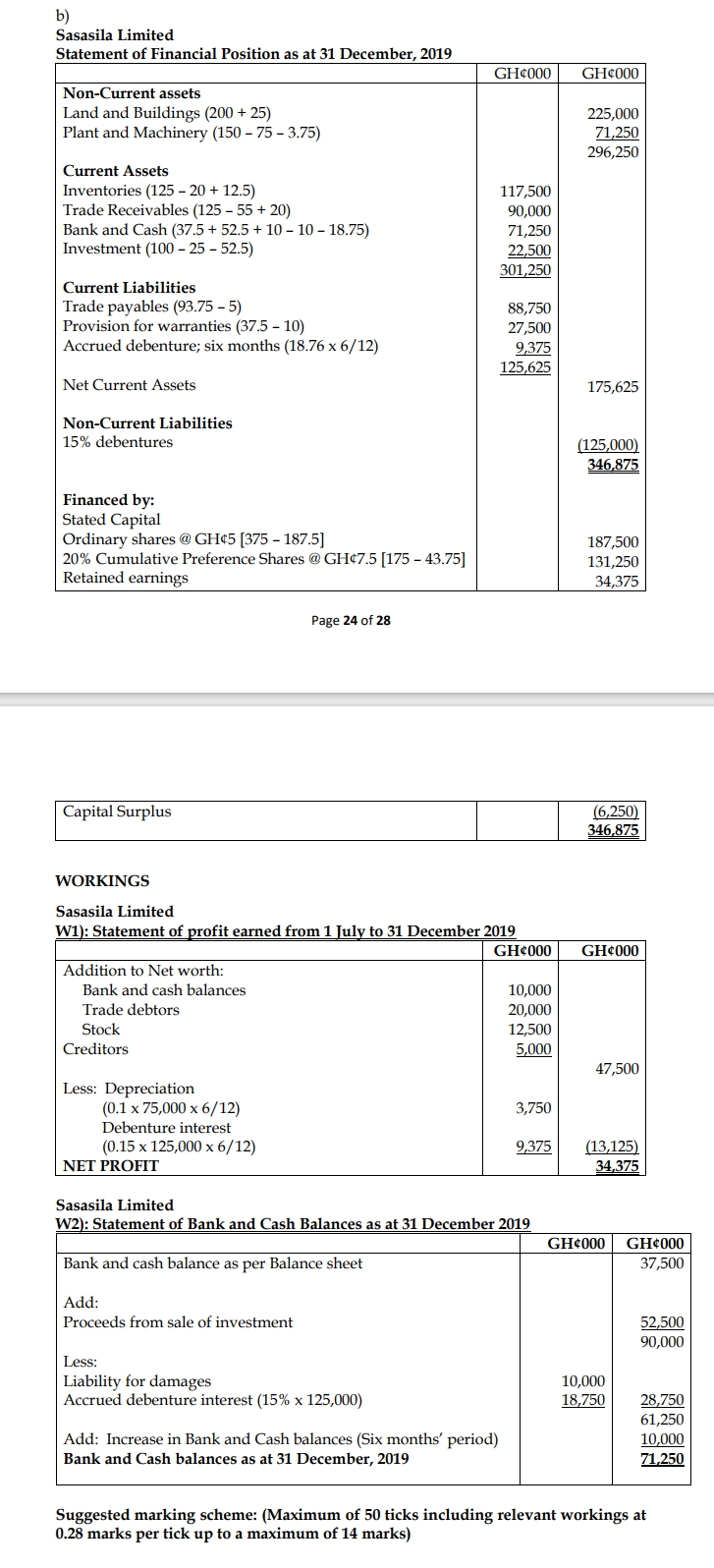
This question requires the preparation of a statement of financial position for Sasasila Ltd following its restructuring.

Prepare the statement of financial position as at 31 December 2019 for Sasasila Ltd.


Login or create a free account to see answers

Complete your registration to see answers

Find Related Questions by Tags, levels, etc.

Report an error

You're reporting an error for "CR – May 2020 – Q4b – Statement of Financial Position for Sasasila Ltd"

CR – May 2020 – Q4b – Statement of Financial Position for Sasasila Ltd

This question requires the preparation of a statement of financial position for Sasasila Ltd following its restructuring.

Prepare the statement of financial position as at 31 December 2019 for Sasasila Ltd.


Login or create a free account to see answers

Complete your registration to see answers

Find Related Questions by Tags, levels, etc.

Report an error

You're reporting an error for "CR – May 2020 – Q4b – Statement of Financial Position for Sasasila Ltd"

CR – May 2020 – Q5 – Financial Performance and Position of Bossman Ltd

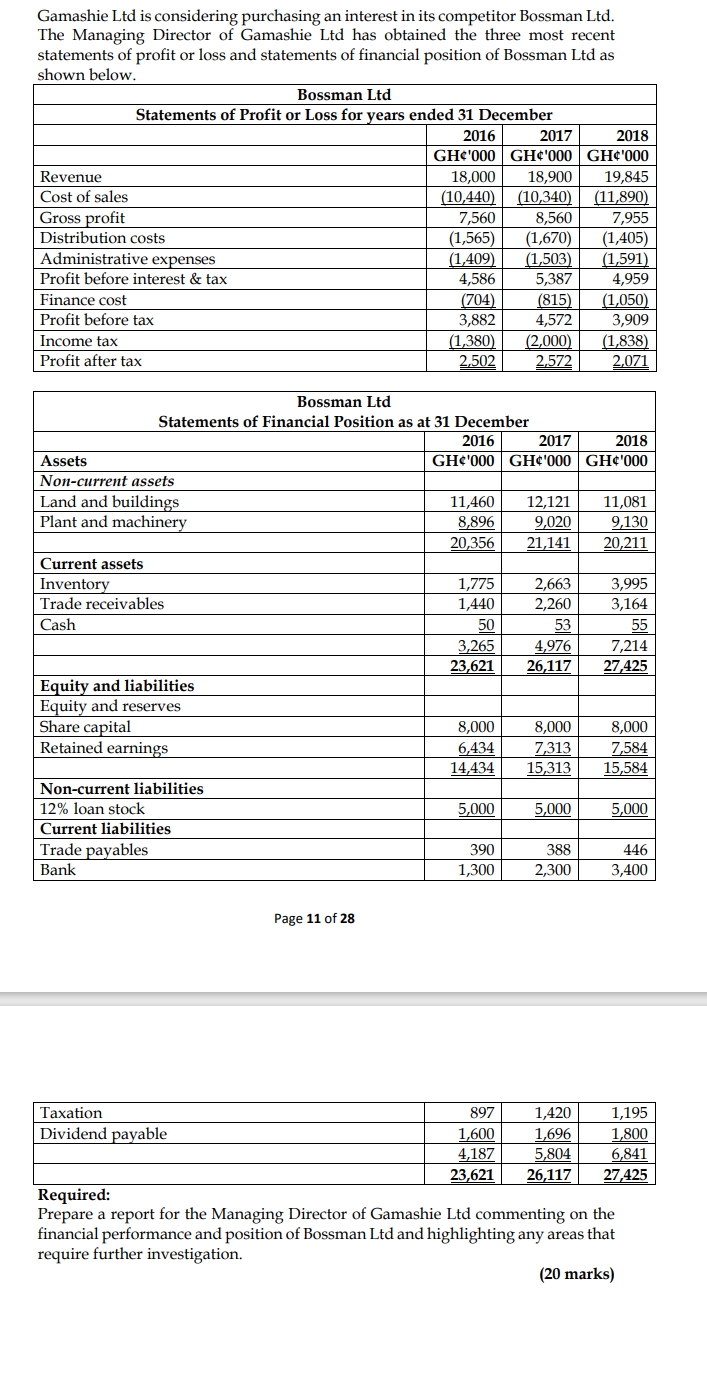
This question involves analyzing the financial performance and position of Bossman Ltd over three years using ratio analysis.

To: Managing Director, Gamashie Ltd
From: An Accountant
Date: 01/01/19
Subject: The Financial Position and Performance of Bossman Ltd


Introduction:

This report is based on the financial statements of Bossman Ltd for the years 2016, 2017, and 2018. It includes an analysis of the financial performance and position, with attention to key financial ratios calculated from the attached statements.


Financial Performance:

  • Revenue Growth: Bossman Ltd has experienced consistent revenue growth at approximately 5% per annum from GH¢18,000,000 in 2016 to GH¢19,845,000 in 2018.
  • Gross Profit Margin: The gross profit margin improved in 2017 but fell in 2018, indicating fluctuations in cost management. The margins were:
    • 2016: 42%
    • 2017: 45%
    • 2018: 40%
  • Operating Profit: Operating profit as a percentage of sales showed a similar trend to the gross profit margin. It increased from 25.5% in 2016 to 28.5% in 2017, before falling back to 25% in 2018. The decline in 2018 needs to be investigated to understand the reasons for the reduction.
  • Profit Before Tax (PBT): PBT decreased from GH¢3,882,000 in 2017 to GH¢3,909,000 in 2018, primarily due to increased finance costs. This indicates an increase in borrowing costs, which requires further investigation.

Financial Position:

  • Liquidity:
    • Current Ratio: The current ratio improved from 0.78 in 2016 to 1.05 in 2018, indicating better liquidity. However, it was below 1 in 2016 and 2017, suggesting that the company may have struggled to meet its short-term obligations during those years.
    • Quick Ratio: The quick ratio remained below 0.5 across all three years, highlighting potential issues with converting current assets (excluding inventory) into liquid assets. This indicates the company may be heavily reliant on inventory for liquidity.
  • Solvency:
    • Debt Ratio: The debt ratio increased steadily over the three years from 38.9% in 2016 to 43.2% in 2018, suggesting the company’s reliance on debt financing is increasing. This should be monitored, as it may impact the company’s financial flexibility.
  • Efficiency:
    • Receivables Collection Period: The collection period increased from 29.2 days in 2016 to 58.2 days in 2018. This could indicate deteriorating credit control or extended payment terms.
    • Inventory Turnover: Inventory turnover worsened, increasing from 62 days in 2016 to 122.6 days in 2018. This may indicate overstocking or slow-moving inventory, which ties up working capital.

Conclusion:

Bossman Ltd has shown consistent revenue growth but declining profitability. Liquidity has improved, but the quick ratio is concerning. The company’s growing reliance on debt and the extended receivables and inventory turnover periods should be investigated further to identify potential risks to financial stability.


Appendix – Ratio Analysis:

Ratios 2016 2017 2018
Gross Profit Margin 42% 45% 40%
Operating Profit Margin 25.5% 28.5% 25%
Return on Capital Employed 23.6% 27% 24.1%
Debt Ratio 38.9% 41.4% 43.2%
Current Ratio 0.78 0.86 1.05
Quick Ratio 0.36 0.40 0.47
Receivables Collection Period (days) 29.2 43.6 58.2
Inventory Turnover Period (days) 62 94 122.6

Login or create a free account to see answers

Complete your registration to see answers

Find Related Questions by Tags, levels, etc.

Report an error

You're reporting an error for "CR – May 2020 – Q5 – Financial Performance and Position of Bossman Ltd"

CR – May 2020 – Q5 – Financial Performance and Position of Bossman Ltd

This question involves analyzing the financial performance and position of Bossman Ltd over three years using ratio analysis.

To: Managing Director, Gamashie Ltd
From: An Accountant
Date: 01/01/19
Subject: The Financial Position and Performance of Bossman Ltd


Introduction:

This report is based on the financial statements of Bossman Ltd for the years 2016, 2017, and 2018. It includes an analysis of the financial performance and position, with attention to key financial ratios calculated from the attached statements.


Financial Performance:

  • Revenue Growth: Bossman Ltd has experienced consistent revenue growth at approximately 5% per annum from GH¢18,000,000 in 2016 to GH¢19,845,000 in 2018.
  • Gross Profit Margin: The gross profit margin improved in 2017 but fell in 2018, indicating fluctuations in cost management. The margins were:
    • 2016: 42%
    • 2017: 45%
    • 2018: 40%
  • Operating Profit: Operating profit as a percentage of sales showed a similar trend to the gross profit margin. It increased from 25.5% in 2016 to 28.5% in 2017, before falling back to 25% in 2018. The decline in 2018 needs to be investigated to understand the reasons for the reduction.
  • Profit Before Tax (PBT): PBT decreased from GH¢3,882,000 in 2017 to GH¢3,909,000 in 2018, primarily due to increased finance costs. This indicates an increase in borrowing costs, which requires further investigation.

Financial Position:

  • Liquidity:
    • Current Ratio: The current ratio improved from 0.78 in 2016 to 1.05 in 2018, indicating better liquidity. However, it was below 1 in 2016 and 2017, suggesting that the company may have struggled to meet its short-term obligations during those years.
    • Quick Ratio: The quick ratio remained below 0.5 across all three years, highlighting potential issues with converting current assets (excluding inventory) into liquid assets. This indicates the company may be heavily reliant on inventory for liquidity.
  • Solvency:
    • Debt Ratio: The debt ratio increased steadily over the three years from 38.9% in 2016 to 43.2% in 2018, suggesting the company’s reliance on debt financing is increasing. This should be monitored, as it may impact the company’s financial flexibility.
  • Efficiency:
    • Receivables Collection Period: The collection period increased from 29.2 days in 2016 to 58.2 days in 2018. This could indicate deteriorating credit control or extended payment terms.
    • Inventory Turnover: Inventory turnover worsened, increasing from 62 days in 2016 to 122.6 days in 2018. This may indicate overstocking or slow-moving inventory, which ties up working capital.

Conclusion:

Bossman Ltd has shown consistent revenue growth but declining profitability. Liquidity has improved, but the quick ratio is concerning. The company’s growing reliance on debt and the extended receivables and inventory turnover periods should be investigated further to identify potential risks to financial stability.


Appendix – Ratio Analysis:

Ratios 2016 2017 2018
Gross Profit Margin 42% 45% 40%
Operating Profit Margin 25.5% 28.5% 25%
Return on Capital Employed 23.6% 27% 24.1%
Debt Ratio 38.9% 41.4% 43.2%
Current Ratio 0.78 0.86 1.05
Quick Ratio 0.36 0.40 0.47
Receivables Collection Period (days) 29.2 43.6 58.2
Inventory Turnover Period (days) 62 94 122.6

Login or create a free account to see answers

Complete your registration to see answers

Find Related Questions by Tags, levels, etc.

Report an error

You're reporting an error for "CR – May 2020 – Q5 – Financial Performance and Position of Bossman Ltd"

BMIS – May 2020 – L1 – Q5a – The internet, cloud computing, IS security and blockchain

Explain types of cyber-attacks that might cause a company’s website to shut down.

Your company’s website has been shut down as a result of a cyber-attack.

Required:
Explain SEVEN (7) types of attacks that might have caused the shutdown. (10 marks)

Types of Cyber-Attacks That Might Cause Website Shutdown

  1. Identity Theft:
    This occurs when an imposter obtains key pieces of employees’ identity information in order to impersonate them. The information could then be used to obtain credit, merchandise, or services in the name of the victims. The company may shut down the website upon detection of such activity to take the necessary corrective actions.
  2. Hacking:
    This is unauthorized access to information on the company’s website. Hackers might monitor employees’ emails or file transfers to extract passwords or steal files or information for their personal use.
  3. Phishing:
    Phishing involves an individual attempting to obtain secured and sensitive information from users of the company’s website for malicious personal use. When such activity is detected, the website may be shut down for the necessary corrective measures and devices to be installed to prevent similar attacks in the future.
  4. Electronic Spamming (Spams):
    This involves the sending of unsolicited messages to the company’s email users. Spamming can cause data jams and potentially trigger a shutdown if the website has been programmed to do so as a protective measure. Spams may contain executable files that can cause damage to the company’s website.
  5. Virus or Worms:
    A virus is a computer program that replicates and transfers itself to other computer programs, causing destruction to the programs and files in the company’s website. Worms are parasitic programs that operate unaided, replicating and spreading themselves with the goal of consuming resources and causing system failures. Both can lead to a website shutdown.
  6. Denial of Service (DoS) Attack:
    This type of attack floods the company’s website with an overwhelming amount of traffic, making it inaccessible to legitimate users. The overload can cause the server to crash, resulting in a shutdown of the website.
  7. SQL Injection:
    This attack targets the company’s website database, allowing attackers to execute malicious SQL statements. This can lead to unauthorized access to data, data breaches, and potentially shutting down the website to prevent further damage.

(7 points @ 1.43 marks each = 10 marks)

Login or create a free account to see answers

Complete your registration to see answers

Find Related Questions by Tags, levels, etc.

Report an error

You're reporting an error for "BMIS – May 2020 – L1 – Q5a – The internet, cloud computing, IS security and blockchain"

BMIS – May 2020 – L1 – Q5a – The internet, cloud computing, IS security and blockchain

Explain types of cyber-attacks that might cause a company’s website to shut down.

Your company’s website has been shut down as a result of a cyber-attack.

Required:
Explain SEVEN (7) types of attacks that might have caused the shutdown. (10 marks)

Types of Cyber-Attacks That Might Cause Website Shutdown

  1. Identity Theft:
    This occurs when an imposter obtains key pieces of employees’ identity information in order to impersonate them. The information could then be used to obtain credit, merchandise, or services in the name of the victims. The company may shut down the website upon detection of such activity to take the necessary corrective actions.
  2. Hacking:
    This is unauthorized access to information on the company’s website. Hackers might monitor employees’ emails or file transfers to extract passwords or steal files or information for their personal use.
  3. Phishing:
    Phishing involves an individual attempting to obtain secured and sensitive information from users of the company’s website for malicious personal use. When such activity is detected, the website may be shut down for the necessary corrective measures and devices to be installed to prevent similar attacks in the future.
  4. Electronic Spamming (Spams):
    This involves the sending of unsolicited messages to the company’s email users. Spamming can cause data jams and potentially trigger a shutdown if the website has been programmed to do so as a protective measure. Spams may contain executable files that can cause damage to the company’s website.
  5. Virus or Worms:
    A virus is a computer program that replicates and transfers itself to other computer programs, causing destruction to the programs and files in the company’s website. Worms are parasitic programs that operate unaided, replicating and spreading themselves with the goal of consuming resources and causing system failures. Both can lead to a website shutdown.
  6. Denial of Service (DoS) Attack:
    This type of attack floods the company’s website with an overwhelming amount of traffic, making it inaccessible to legitimate users. The overload can cause the server to crash, resulting in a shutdown of the website.
  7. SQL Injection:
    This attack targets the company’s website database, allowing attackers to execute malicious SQL statements. This can lead to unauthorized access to data, data breaches, and potentially shutting down the website to prevent further damage.

(7 points @ 1.43 marks each = 10 marks)

Login or create a free account to see answers

Complete your registration to see answers

Find Related Questions by Tags, levels, etc.

Report an error

You're reporting an error for "BMIS – May 2020 – L1 – Q5a – The internet, cloud computing, IS security and blockchain"

BMIS – May 2020 – L1 – Q4b – HR – Other human resources functions

Explain health and safety measures to ensure a safe working environment.

A fishing boat manufacturing company at Elmina intends to expand its business and has decided to locate another production facility at Winneba.

Required:
Explain FIVE (5) health and safety measures to facilitate a working environment devoid of accidents for the company’s employees. (10 marks)

Health and Safety Measures to Prevent Accidents

  1. Effective employee resourcing:
    The company must structure its people resourcing strategy to ensure that the right people with the right skills are employed to fill vacant positions.
  2. Establish safety policy:
    The company must establish a health and safety policy to guide all employees in the dispensation of their assigned responsibilities. Such a policy must emphasize the company’s desire to have an accident-free working environment.
  3. Reduce job overload:
    Employees must be assigned with moderate work responsibilities. This ensures that employees are able to dispense their work within the appropriate time duration without the need for rushing to beat time or schedules.
  4. Risk assessment:
    The company must also conduct regular risk assessments for all jobs and assignments. Such an assessment would enable the management of the company to easily identify all risks associated with all jobs and implement necessary preventive measures.
  5. Constant review:
    There should be constant review of all protective and preventive measures. This would determine whether protective and preventive measures implemented are working according to plans, and where deviations are identified, corrective measures should be put in place.
  6. Safety training:
    Employees should be given regular safety training to ensure they understand and adhere to safety practices and procedures, reducing the likelihood of accidents.
  7. Proper maintenance of equipment:
    All machinery and equipment should be regularly maintained to ensure they are in safe working condition, preventing malfunctions that could lead to accidents.
  8. Emergency procedures:
    Clear and effective emergency procedures should be established, communicated, and regularly drilled to ensure all employees know how to respond to emergencies quickly and safely.

(8 points @ 1.25 marks each = 10 marks)

Login or create a free account to see answers

Complete your registration to see answers

Find Related Questions by Tags, levels, etc.

Report an error

You're reporting an error for "BMIS – May 2020 – L1 – Q4b – HR – Other human resources functions"

BMIS – May 2020 – L1 – Q4b – HR – Other human resources functions

Explain health and safety measures to ensure a safe working environment.

A fishing boat manufacturing company at Elmina intends to expand its business and has decided to locate another production facility at Winneba.

Required:
Explain FIVE (5) health and safety measures to facilitate a working environment devoid of accidents for the company’s employees. (10 marks)

Health and Safety Measures to Prevent Accidents

  1. Effective employee resourcing:
    The company must structure its people resourcing strategy to ensure that the right people with the right skills are employed to fill vacant positions.
  2. Establish safety policy:
    The company must establish a health and safety policy to guide all employees in the dispensation of their assigned responsibilities. Such a policy must emphasize the company’s desire to have an accident-free working environment.
  3. Reduce job overload:
    Employees must be assigned with moderate work responsibilities. This ensures that employees are able to dispense their work within the appropriate time duration without the need for rushing to beat time or schedules.
  4. Risk assessment:
    The company must also conduct regular risk assessments for all jobs and assignments. Such an assessment would enable the management of the company to easily identify all risks associated with all jobs and implement necessary preventive measures.
  5. Constant review:
    There should be constant review of all protective and preventive measures. This would determine whether protective and preventive measures implemented are working according to plans, and where deviations are identified, corrective measures should be put in place.
  6. Safety training:
    Employees should be given regular safety training to ensure they understand and adhere to safety practices and procedures, reducing the likelihood of accidents.
  7. Proper maintenance of equipment:
    All machinery and equipment should be regularly maintained to ensure they are in safe working condition, preventing malfunctions that could lead to accidents.
  8. Emergency procedures:
    Clear and effective emergency procedures should be established, communicated, and regularly drilled to ensure all employees know how to respond to emergencies quickly and safely.

(8 points @ 1.25 marks each = 10 marks)

Login or create a free account to see answers

Complete your registration to see answers

Find Related Questions by Tags, levels, etc.

Report an error

You're reporting an error for "BMIS – May 2020 – L1 – Q4b – HR – Other human resources functions"

BMIS – May 2020 – L1 – Q4a – Operations strategy

Identify and explain the most appropriate plant layout for a fishing boat manufacturing company and outline its advantages.

A fishing boat manufacturing company at Elmina intends to expand its business and has decided to locate another production facility at Winneba.

Required:
Identify and explain the most appropriate plant layout for the company’s operations and explain FOUR (4) advantages associated with the selected plant layout. (10 marks)

a) Plant Layout for the Fishing Boat Manufacturer

The most appropriate plant layout for the fishing boat manufacturer is the fixed-position layout. In this layout, the product (fishing boat) remains stationary for the entire manufacturing cycle, while workers, materials, and equipment are moved as needed.

Advantages of Fixed-Position Plant Layout:

  1. Reduction in Damage:
    Since the product remains stationary, the risk of damage caused by moving the product is minimized.
  2. Cost Reduction:
    There is a reduction in operational costs as there is no need to move the product between different locations during the production process.
  3. Reduced Need for Re-Planning:
    The continuity of work until the manufacturing process is complete reduces the need for continual re-planning.
  4. Reduced Worker Monotony:
    Workers with different skills are brought in at various stages of the production process, reducing monotony and increasing efficiency.
  5. Fast Completion:
    Projects using a fixed-position layout are completed more quickly due to the continuous workflow.
  6. Project Supervisor Skill Development:
    Project supervisors gain valuable experience working with various skilled groups, enhancing their overall expertise.

(4 points for 2 marks each = 8 marks for advantages + 2 marks for identifying and explaining the layout = 10 marks)

Login or create a free account to see answers

Complete your registration to see answers

Find Related Questions by Tags, levels, etc.

Report an error

You're reporting an error for "BMIS – May 2020 – L1 – Q4a – Operations strategy"

BMIS – May 2020 – L1 – Q4a – Operations strategy

Identify and explain the most appropriate plant layout for a fishing boat manufacturing company and outline its advantages.

A fishing boat manufacturing company at Elmina intends to expand its business and has decided to locate another production facility at Winneba.

Required:
Identify and explain the most appropriate plant layout for the company’s operations and explain FOUR (4) advantages associated with the selected plant layout. (10 marks)

a) Plant Layout for the Fishing Boat Manufacturer

The most appropriate plant layout for the fishing boat manufacturer is the fixed-position layout. In this layout, the product (fishing boat) remains stationary for the entire manufacturing cycle, while workers, materials, and equipment are moved as needed.

Advantages of Fixed-Position Plant Layout:

  1. Reduction in Damage:
    Since the product remains stationary, the risk of damage caused by moving the product is minimized.
  2. Cost Reduction:
    There is a reduction in operational costs as there is no need to move the product between different locations during the production process.
  3. Reduced Need for Re-Planning:
    The continuity of work until the manufacturing process is complete reduces the need for continual re-planning.
  4. Reduced Worker Monotony:
    Workers with different skills are brought in at various stages of the production process, reducing monotony and increasing efficiency.
  5. Fast Completion:
    Projects using a fixed-position layout are completed more quickly due to the continuous workflow.
  6. Project Supervisor Skill Development:
    Project supervisors gain valuable experience working with various skilled groups, enhancing their overall expertise.

(4 points for 2 marks each = 8 marks for advantages + 2 marks for identifying and explaining the layout = 10 marks)

Login or create a free account to see answers

Complete your registration to see answers

Find Related Questions by Tags, levels, etc.

Report an error

You're reporting an error for "BMIS – May 2020 – L1 – Q4a – Operations strategy"

BMIS – May 2020 – L1 – Q3b – Teams

Identify and explain factors that could affect group cohesion in an organization.

The management of Megalab Company Limited is concerned with how weak and less cohesive the groups in the company are, and its effect on general organisational performance. The management is currently investigating reasons for this poor group cohesion and you have been approached for possible factors that could be responsible.

Required:
Identify and explain FOUR (4) of such possible factors. (8 marks)

Factor Explanation
Size of group Smaller groups tend to display greater cohesion than larger groups.
Heterogeneous vs. Homogeneous Homogeneous groups who share common characteristics such as race, gender, and religion will typically demonstrate greater cohesion than groups who are more diverse (heterogeneous), sharing fewer common characteristics.
Group success This is arguably a ‘self-fulfilling prophecy’—the more successful a group, the greater the incentive to be part of it and hence the greater the cohesion. The less successful, the lower the cohesion.
Barriers to entry and prestige Human nature means that the more difficult it is to become a member of a group, the greater the desire for outsiders to join the group. Subsequently, the group becomes prestigious and more cohesive. A good example might be an elite academic institution.
Task cohesion The greater the need for a task to be completed by a group rather than individuals (e.g., a sports team or military operation), the more cohesive the group becomes as members of the whole accept the need to work together to achieve the shared objective.
Rewards and punishment The availability of rewards for membership and/or punishment for leaving can have a bearing on the attractiveness of being part of a group and hence influence group cohesion.
Competition from external groups A lack of competition from alternative groups can lead to erosion in cohesion as members do not feel any pressure to perform. However, with the emergence of competition, groups typically become more cohesive as their competitive instincts amplify and the desire to defeat a rival drives them on.
Location Groups who enjoy segregation from others will tend to be more cohesive as strong interpersonal communication patterns develop and a sense of visible identity builds.
Leadership style An effective leadership style that matches the skills and personalities of the group can have a significant impact on promoting group cohesion. An ineffective leadership style for that particular group of people is likely to have the opposite effect and erode group cohesion.
Social cohesion Social cohesion is the degree to which group members enjoy each other’s company and how much they like each other. Group cohesion will be highest when members enjoy the social side of being part of the group.

(Any four points at 2 marks each = 8 marks)

Login or create a free account to see answers

Complete your registration to see answers

Find Related Questions by Tags, levels, etc.

Report an error

You're reporting an error for "BMIS – May 2020 – L1 – Q3b – Teams"

BMIS – May 2020 – L1 – Q3b – Teams

Identify and explain factors that could affect group cohesion in an organization.

The management of Megalab Company Limited is concerned with how weak and less cohesive the groups in the company are, and its effect on general organisational performance. The management is currently investigating reasons for this poor group cohesion and you have been approached for possible factors that could be responsible.

Required:
Identify and explain FOUR (4) of such possible factors. (8 marks)

Factor Explanation
Size of group Smaller groups tend to display greater cohesion than larger groups.
Heterogeneous vs. Homogeneous Homogeneous groups who share common characteristics such as race, gender, and religion will typically demonstrate greater cohesion than groups who are more diverse (heterogeneous), sharing fewer common characteristics.
Group success This is arguably a ‘self-fulfilling prophecy’—the more successful a group, the greater the incentive to be part of it and hence the greater the cohesion. The less successful, the lower the cohesion.
Barriers to entry and prestige Human nature means that the more difficult it is to become a member of a group, the greater the desire for outsiders to join the group. Subsequently, the group becomes prestigious and more cohesive. A good example might be an elite academic institution.
Task cohesion The greater the need for a task to be completed by a group rather than individuals (e.g., a sports team or military operation), the more cohesive the group becomes as members of the whole accept the need to work together to achieve the shared objective.
Rewards and punishment The availability of rewards for membership and/or punishment for leaving can have a bearing on the attractiveness of being part of a group and hence influence group cohesion.
Competition from external groups A lack of competition from alternative groups can lead to erosion in cohesion as members do not feel any pressure to perform. However, with the emergence of competition, groups typically become more cohesive as their competitive instincts amplify and the desire to defeat a rival drives them on.
Location Groups who enjoy segregation from others will tend to be more cohesive as strong interpersonal communication patterns develop and a sense of visible identity builds.
Leadership style An effective leadership style that matches the skills and personalities of the group can have a significant impact on promoting group cohesion. An ineffective leadership style for that particular group of people is likely to have the opposite effect and erode group cohesion.
Social cohesion Social cohesion is the degree to which group members enjoy each other’s company and how much they like each other. Group cohesion will be highest when members enjoy the social side of being part of the group.

(Any four points at 2 marks each = 8 marks)

Login or create a free account to see answers

Complete your registration to see answers

Find Related Questions by Tags, levels, etc.

Report an error

You're reporting an error for "BMIS – May 2020 – L1 – Q3b – Teams"

BMIS – May 2020 – L1 – Q3a – Introduction to business strategy

Explain deliberate, emergent, and incremental strategies in organizations.

Strategies in organizations develop in different ways, and one way of explaining strategies is to make a distinction between deliberate strategy, emergent strategy, and incremental strategy.

Required:
Explain each of the strategies outlined above. (12 marks)

Deliberate Strategy:
Deliberate strategy, also known as prescriptive or planned strategy, is the result of a formal strategic planning process. In this process, management typically carries out a strategic position analysis, identifies and evaluates strategic alternatives, makes strategic choices, and implements the chosen strategies. These strategies are set out in a formal business plan or strategic plan, which is regularly reviewed and amended if necessary. Formal strategic planning also involves the use of management aids and planning techniques, such as SWOT analysis and the use of models like Porter’s Diamond and Porter’s Five Forces.

Emergent Strategy:
Emergent strategy is not formally planned but arises in response to unforeseen developments and opportunities. These strategies may emerge from employees or junior managers, rather than senior management. Once a new strategy has emerged, the organization applies it consistently. Companies often develop both deliberate and emergent strategies. An emergent strategy might eventually be included in a formal business plan, thus becoming part of a deliberate strategy.

Incremental Strategy:
Incremental strategy refers to a strategy that is developed slowly over time by making small changes to existing strategies. These changes are often not large or far-reaching because management does not see the need for significant changes. However, when the business environment is changing rapidly, small changes may not be sufficient to ensure the survival of the organization, potentially leading to strategic drift. Incremental strategy is safer in a very stable environment where changes are small and gradual.

(4 marks for each well-explained strategy = 12 marks)

Login or create a free account to see answers

Complete your registration to see answers

Find Related Questions by Tags, levels, etc.

Report an error

You're reporting an error for "BMIS – May 2020 – L1 – Q3a – Introduction to business strategy"

BMIS – May 2020 – L1 – Q3a – Introduction to business strategy

Explain deliberate, emergent, and incremental strategies in organizations.

Strategies in organizations develop in different ways, and one way of explaining strategies is to make a distinction between deliberate strategy, emergent strategy, and incremental strategy.

Required:
Explain each of the strategies outlined above. (12 marks)

Deliberate Strategy:
Deliberate strategy, also known as prescriptive or planned strategy, is the result of a formal strategic planning process. In this process, management typically carries out a strategic position analysis, identifies and evaluates strategic alternatives, makes strategic choices, and implements the chosen strategies. These strategies are set out in a formal business plan or strategic plan, which is regularly reviewed and amended if necessary. Formal strategic planning also involves the use of management aids and planning techniques, such as SWOT analysis and the use of models like Porter’s Diamond and Porter’s Five Forces.

Emergent Strategy:
Emergent strategy is not formally planned but arises in response to unforeseen developments and opportunities. These strategies may emerge from employees or junior managers, rather than senior management. Once a new strategy has emerged, the organization applies it consistently. Companies often develop both deliberate and emergent strategies. An emergent strategy might eventually be included in a formal business plan, thus becoming part of a deliberate strategy.

Incremental Strategy:
Incremental strategy refers to a strategy that is developed slowly over time by making small changes to existing strategies. These changes are often not large or far-reaching because management does not see the need for significant changes. However, when the business environment is changing rapidly, small changes may not be sufficient to ensure the survival of the organization, potentially leading to strategic drift. Incremental strategy is safer in a very stable environment where changes are small and gradual.

(4 marks for each well-explained strategy = 12 marks)

Login or create a free account to see answers

Complete your registration to see answers

Find Related Questions by Tags, levels, etc.

Report an error

You're reporting an error for "BMIS – May 2020 – L1 – Q3a – Introduction to business strategy"

BMIS – May 2020 – L1 – Q2b – Finance, R&D and marketing strategies

Match products to their probable stages in the product life cycle.

A typical product life cycle has four main phases: introduction, growth, maturity, and decline.

Required:
Twelve products are listed below. Match these products to the stage they have probably reached in their life cycle, by filling in the following table.

Products:

  • Online music downloads
  • SMS messaging
  • (Hand-written) postcards
  • Personal identity cards using ‘iris-based’ technology
  • Folding screen mobile phones
  • Credit cards
  • Personal computers
  • Fifth generation (5G) mobile telephones
  • Cheque books
  • Typewriters
  • Smart cards (in banking)
  • E–Conferencing

Table:

Introduction Growth Maturity Decline
Personal identity cards using ‘iris-based’ technology Smart cards (in banking) Credit cards Cheque books
Fifth generation (5G) mobile telephones Online music downloads Personal computers Typewriters
Folding screen mobile phones E-Conferencing SMS messaging Postcards

(6 marks evenly spread using ticks)

Login or create a free account to see answers

Complete your registration to see answers

Find Related Questions by Tags, levels, etc.

Report an error

You're reporting an error for "BMIS – May 2020 – L1 – Q2b – Finance, R&D and marketing strategies"

BMIS – May 2020 – L1 – Q2b – Finance, R&D and marketing strategies

Match products to their probable stages in the product life cycle.

A typical product life cycle has four main phases: introduction, growth, maturity, and decline.

Required:
Twelve products are listed below. Match these products to the stage they have probably reached in their life cycle, by filling in the following table.

Products:

  • Online music downloads
  • SMS messaging
  • (Hand-written) postcards
  • Personal identity cards using ‘iris-based’ technology
  • Folding screen mobile phones
  • Credit cards
  • Personal computers
  • Fifth generation (5G) mobile telephones
  • Cheque books
  • Typewriters
  • Smart cards (in banking)
  • E–Conferencing

Table:

Introduction Growth Maturity Decline
Personal identity cards using ‘iris-based’ technology Smart cards (in banking) Credit cards Cheque books
Fifth generation (5G) mobile telephones Online music downloads Personal computers Typewriters
Folding screen mobile phones E-Conferencing SMS messaging Postcards

(6 marks evenly spread using ticks)

Login or create a free account to see answers

Complete your registration to see answers

Find Related Questions by Tags, levels, etc.

Report an error

You're reporting an error for "BMIS – May 2020 – L1 – Q2b – Finance, R&D and marketing strategies"

BMIS – May 2020 – L1 – Q2a – Finance, R&D and marketing strategies

Calculate the price elasticity of demand and explain factors affecting it.

You are the Accounts Officer of Seafarers Cafe, a company that sells cocoa drink to a wide range of consumers. The company sells a cup of cocoa drink for GH¢2.00, which yielded a sales output of 10 million cups for the year ending 2017. As part of a promotional package to celebrate its silver jubilee, the company reduced its price to GH¢1.50, which increased its total sales output to 15 million cups for the year ending 2018.

Required:
i) Calculate the Café’s price elasticity of demand. (4 marks)
ii) Explain SIX (6) factors that might have determined the company’s price elasticity of demand. (10 marks)

i) Price Elasticity of Demand

Price elasticity of demand = % change in quantity demanded / % change in price

  • Percentage change in quantity demanded = (15million−10million)/10million × 100 = 50%
  • Percentage change in price = (GH¢1.50−GH¢2.00)/GH¢2.00 × 100 = -25%

Price elasticity of demand = 50% / -25% = -2.0

(4 marks)

ii) Factors Determining the Café’s Price Elasticity of Demand

  1. Availability of substitutes:
    The existence of close substitutes to the cocoa drink sold by the company could affect the price elasticity of demand. If consumers have alternatives like coffee, they may switch if the price of cocoa increases, making demand more elastic.
  2. Degree of necessity:
    If the cocoa drink is considered a necessity, demand might be inelastic as consumers will continue buying despite price changes. Conversely, if it is viewed as a luxury, demand might be more elastic.
  3. Consumers’ income:
    The disposable income of consumers influences price sensitivity. Higher income levels may reduce the sensitivity to price changes, making demand less elastic.
  4. Adjustment period:
    Over time, consumers may find alternatives or adjust their consumption habits, making demand more elastic in the long run compared to the short run.
  5. Scope of the market:
    How the market perceives the product affects its elasticity. If consumers view sugar-based drinks as unhealthy, a price increase may lead to a significant drop in demand, making it elastic.
  6. Brand loyalty:
    Strong brand loyalty can make demand less elastic. If consumers are highly loyal to the Seafarers Café brand, they may continue purchasing despite price increases.

(6 points well explained @ 1.67 marks each = 10 marks)

Login or create a free account to see answers

Complete your registration to see answers

Find Related Questions by Tags, levels, etc.

Report an error

You're reporting an error for "BMIS – May 2020 – L1 – Q2a – Finance, R&D and marketing strategies"

BMIS – May 2020 – L1 – Q2a – Finance, R&D and marketing strategies

Calculate the price elasticity of demand and explain factors affecting it.

You are the Accounts Officer of Seafarers Cafe, a company that sells cocoa drink to a wide range of consumers. The company sells a cup of cocoa drink for GH¢2.00, which yielded a sales output of 10 million cups for the year ending 2017. As part of a promotional package to celebrate its silver jubilee, the company reduced its price to GH¢1.50, which increased its total sales output to 15 million cups for the year ending 2018.

Required:
i) Calculate the Café’s price elasticity of demand. (4 marks)
ii) Explain SIX (6) factors that might have determined the company’s price elasticity of demand. (10 marks)

i) Price Elasticity of Demand

Price elasticity of demand = % change in quantity demanded / % change in price

  • Percentage change in quantity demanded = (15million−10million)/10million × 100 = 50%
  • Percentage change in price = (GH¢1.50−GH¢2.00)/GH¢2.00 × 100 = -25%

Price elasticity of demand = 50% / -25% = -2.0

(4 marks)

ii) Factors Determining the Café’s Price Elasticity of Demand

  1. Availability of substitutes:
    The existence of close substitutes to the cocoa drink sold by the company could affect the price elasticity of demand. If consumers have alternatives like coffee, they may switch if the price of cocoa increases, making demand more elastic.
  2. Degree of necessity:
    If the cocoa drink is considered a necessity, demand might be inelastic as consumers will continue buying despite price changes. Conversely, if it is viewed as a luxury, demand might be more elastic.
  3. Consumers’ income:
    The disposable income of consumers influences price sensitivity. Higher income levels may reduce the sensitivity to price changes, making demand less elastic.
  4. Adjustment period:
    Over time, consumers may find alternatives or adjust their consumption habits, making demand more elastic in the long run compared to the short run.
  5. Scope of the market:
    How the market perceives the product affects its elasticity. If consumers view sugar-based drinks as unhealthy, a price increase may lead to a significant drop in demand, making it elastic.
  6. Brand loyalty:
    Strong brand loyalty can make demand less elastic. If consumers are highly loyal to the Seafarers Café brand, they may continue purchasing despite price increases.

(6 points well explained @ 1.67 marks each = 10 marks)

Login or create a free account to see answers

Complete your registration to see answers

Find Related Questions by Tags, levels, etc.

Report an error

You're reporting an error for "BMIS – May 2020 – L1 – Q2a – Finance, R&D and marketing strategies"

BMIS – May 2020 – L1 – Q1c – Organisation culture in business

Identify the type of organizational culture likely to exist in various organizations based on Charles Handy's model.

Charles Handy identified four types of culture that are found in organisations.

Required:
Which of these cultures is most likely to exist in each of the following organisations? Give your reasons.

i) A large department store with fifteen departments spread across six floors of a building, with an accounts and administration office.

ii) A rail transport company providing passenger transport services.

iii) A firm of architects specialising in the design of small office buildings: the founder of the firm is the senior architect, and there are six other junior architects, none of them partners in the firm.

iv) A software company with a team of eight software experts, providing bespoke software to corporate and government clients.

v) A school providing education to children between the ages of 7 and 18.

i) Large Department Store:

  • Culture Type: Role Culture
  • Reason: This store is likely to have a formal organisation structure with hierarchical lines of authority from the store manager to floor workers and administrators, with clearly-defined roles for each employee.

ii) Rail Transport Company:

  • Culture Type: Role Culture
  • Reason: Similar to the department store, the rail transport company will have a formal structure with clearly-defined roles and responsibilities, which is characteristic of a role culture.

iii) Firm of Architects:

  • Culture Type: Power Culture
  • Reason: The founder of the firm is the senior architect and dominates decision-making, which is typical of a power culture where authority is centralized in one person or a small group.

iv) Software Company:

  • Culture Type: Task Culture
  • Reason: The small team of software experts likely works in project teams, which fosters a task culture where the focus is on completing specific tasks and solving problems.

v) School:

  • Culture Type: Role Culture
  • Reason: The school is likely to have a role culture, as teaching institutions usually have clearly-defined roles such as teacher, head of department, and so on, making it difficult to achieve a task culture.

(6 marks)

Login or create a free account to see answers

Complete your registration to see answers

Find Related Questions by Tags, levels, etc.

Report an error

You're reporting an error for "BMIS – May 2020 – L1 – Q1c – Organisation culture in business"

BMIS – May 2020 – L1 – Q1c – Organisation culture in business

Identify the type of organizational culture likely to exist in various organizations based on Charles Handy's model.

Charles Handy identified four types of culture that are found in organisations.

Required:
Which of these cultures is most likely to exist in each of the following organisations? Give your reasons.

i) A large department store with fifteen departments spread across six floors of a building, with an accounts and administration office.

ii) A rail transport company providing passenger transport services.

iii) A firm of architects specialising in the design of small office buildings: the founder of the firm is the senior architect, and there are six other junior architects, none of them partners in the firm.

iv) A software company with a team of eight software experts, providing bespoke software to corporate and government clients.

v) A school providing education to children between the ages of 7 and 18.

i) Large Department Store:

  • Culture Type: Role Culture
  • Reason: This store is likely to have a formal organisation structure with hierarchical lines of authority from the store manager to floor workers and administrators, with clearly-defined roles for each employee.

ii) Rail Transport Company:

  • Culture Type: Role Culture
  • Reason: Similar to the department store, the rail transport company will have a formal structure with clearly-defined roles and responsibilities, which is characteristic of a role culture.

iii) Firm of Architects:

  • Culture Type: Power Culture
  • Reason: The founder of the firm is the senior architect and dominates decision-making, which is typical of a power culture where authority is centralized in one person or a small group.

iv) Software Company:

  • Culture Type: Task Culture
  • Reason: The small team of software experts likely works in project teams, which fosters a task culture where the focus is on completing specific tasks and solving problems.

v) School:

  • Culture Type: Role Culture
  • Reason: The school is likely to have a role culture, as teaching institutions usually have clearly-defined roles such as teacher, head of department, and so on, making it difficult to achieve a task culture.

(6 marks)

Login or create a free account to see answers

Complete your registration to see answers

Find Related Questions by Tags, levels, etc.

Report an error

You're reporting an error for "BMIS – May 2020 – L1 – Q1c – Organisation culture in business"

BMIS – May 2020 – L1 – Q1b – Management and leadership

Identify decision-makers for various management tasks in a hospital.

Within the same business organisation, some decision-making might be centralized, with decisions made by senior management. Other decisions might be decentralized and taken by managers or employees involved in operations.

A company owns and operates five private hospitals. It has a head office, a management team, and staff in each hospital (including medical staff such as doctors and nurses). Decisions now need to be made on the following:

i) Decisions about the medical treatment or surgical treatment for individual patients.
ii) Establishing policy on hygiene standards in the hospitals.
iii) Scheduling operations in the operating theatres of each hospital.
iv) Discharging patients from the hospital.
v) Deciding the visiting times for patients in each hospital.
vi) Prescribing drugs for the treatment of patients.
vii) Hiring new staff, such as hospital porters and nurses.
viii) Dealing with payments from insurance companies for the treatment of insured patients.

Required:
For each of the decisions above, identify from the list below whom you would expect to make the decision and briefly explain why.

  • Head Office Management
  • The Management of each hospital
  • Staff in each hospital

i) Medical treatment or surgical treatment: Staff in each hospital. This decision should be made by medical staff (doctors and nurses) as they are directly responsible for patient care and have the necessary expertise.

ii) Policy on hygiene standards: Head Office Management. The policy on hygiene standards should be consistent across all hospitals and thus should be established by the head office. However, enforcement of these standards would be the responsibility of hospital management.

iii) Scheduling operations in the operating theatres: The Management of each hospital. The scheduling of operations is a day-to-day activity that is best handled at the hospital level where the specific needs and resources are understood.

iv) Discharging patients: Staff in each hospital. This decision should be made by the medical staff responsible for the patient’s care based on their health condition and treatment progress.

v) Deciding visiting times: The Management of each hospital. Visiting times can be influenced by local circumstances and needs, so this decision can be best made by the management of each hospital.

vi) Prescribing drugs: Staff in each hospital. Medical staff are best placed to prescribe drugs based on the specific needs of patients. However, there may be overarching policies from head office concerning the use of certain drugs.

vii) Hiring new staff: The Management of each hospital. While head office may set hiring policies, the actual recruitment of staff such as porters and nurses would typically be managed locally to meet specific operational needs.

viii) Dealing with insurance payments: Head Office Management. Centralizing the process of dealing with insurance companies ensures consistency and efficiency, as it involves financial transactions that might require specialized knowledge or agreements that apply across the organization.

Login or create a free account to see answers

Complete your registration to see answers

Find Related Questions by Tags, levels, etc.

Report an error

You're reporting an error for "BMIS – May 2020 – L1 – Q1b – Management and leadership"

BMIS – May 2020 – L1 – Q1b – Management and leadership

Identify decision-makers for various management tasks in a hospital.

Within the same business organisation, some decision-making might be centralized, with decisions made by senior management. Other decisions might be decentralized and taken by managers or employees involved in operations.

A company owns and operates five private hospitals. It has a head office, a management team, and staff in each hospital (including medical staff such as doctors and nurses). Decisions now need to be made on the following:

i) Decisions about the medical treatment or surgical treatment for individual patients.
ii) Establishing policy on hygiene standards in the hospitals.
iii) Scheduling operations in the operating theatres of each hospital.
iv) Discharging patients from the hospital.
v) Deciding the visiting times for patients in each hospital.
vi) Prescribing drugs for the treatment of patients.
vii) Hiring new staff, such as hospital porters and nurses.
viii) Dealing with payments from insurance companies for the treatment of insured patients.

Required:
For each of the decisions above, identify from the list below whom you would expect to make the decision and briefly explain why.

  • Head Office Management
  • The Management of each hospital
  • Staff in each hospital

i) Medical treatment or surgical treatment: Staff in each hospital. This decision should be made by medical staff (doctors and nurses) as they are directly responsible for patient care and have the necessary expertise.

ii) Policy on hygiene standards: Head Office Management. The policy on hygiene standards should be consistent across all hospitals and thus should be established by the head office. However, enforcement of these standards would be the responsibility of hospital management.

iii) Scheduling operations in the operating theatres: The Management of each hospital. The scheduling of operations is a day-to-day activity that is best handled at the hospital level where the specific needs and resources are understood.

iv) Discharging patients: Staff in each hospital. This decision should be made by the medical staff responsible for the patient’s care based on their health condition and treatment progress.

v) Deciding visiting times: The Management of each hospital. Visiting times can be influenced by local circumstances and needs, so this decision can be best made by the management of each hospital.

vi) Prescribing drugs: Staff in each hospital. Medical staff are best placed to prescribe drugs based on the specific needs of patients. However, there may be overarching policies from head office concerning the use of certain drugs.

vii) Hiring new staff: The Management of each hospital. While head office may set hiring policies, the actual recruitment of staff such as porters and nurses would typically be managed locally to meet specific operational needs.

viii) Dealing with insurance payments: Head Office Management. Centralizing the process of dealing with insurance companies ensures consistency and efficiency, as it involves financial transactions that might require specialized knowledge or agreements that apply across the organization.

Login or create a free account to see answers

Complete your registration to see answers

Find Related Questions by Tags, levels, etc.

Report an error

You're reporting an error for "BMIS – May 2020 – L1 – Q1b – Management and leadership"

BMIS – May 2020 – L1 – Q1a – The business organisation and its stakeholders

Classify various entities into appropriate categories of organizations and justify the classification.

Organisations can be categorised into the following types:

  • Business organisations
  • Public sector organisations
  • Non-government not-for-profit organisations.

Required:
To which category or categories of organisation do the following entities belong, and why?
i) A charity receiving 60% of its annual funding from central government.
ii) A basic school.
iii) State-owned Electricity Company.
(6 marks)

i) A charity receiving 60% of its annual funding from central government:
This entity is classified as a non-government not-for-profit organisation. Even though it receives a significant portion of its funding from the government, its primary goal is not to generate profit but to serve a social cause.

ii) A basic school:
This entity can belong to either the public sector if it is government-owned or to business organisations if it is privately owned with the intention of generating profit. Alternatively, it could also be a non-government not-for-profit organisation if it operates as a charity or relies on donations.

iii) State-owned Electricity Company:
This entity is classified as a public sector organisation. It is owned and operated by the government. However, it may also be considered a business organisation if it operates with the intention of making a profit.

(2 marks for each well-explained point = 6 marks)

Login or create a free account to see answers

Complete your registration to see answers

Find Related Questions by Tags, levels, etc.

Report an error

You're reporting an error for "BMIS – May 2020 – L1 – Q1a – The business organisation and its stakeholders"

BMIS – May 2020 – L1 – Q1a – The business organisation and its stakeholders

Classify various entities into appropriate categories of organizations and justify the classification.

Organisations can be categorised into the following types:

  • Business organisations
  • Public sector organisations
  • Non-government not-for-profit organisations.

Required:
To which category or categories of organisation do the following entities belong, and why?
i) A charity receiving 60% of its annual funding from central government.
ii) A basic school.
iii) State-owned Electricity Company.
(6 marks)

i) A charity receiving 60% of its annual funding from central government:
This entity is classified as a non-government not-for-profit organisation. Even though it receives a significant portion of its funding from the government, its primary goal is not to generate profit but to serve a social cause.

ii) A basic school:
This entity can belong to either the public sector if it is government-owned or to business organisations if it is privately owned with the intention of generating profit. Alternatively, it could also be a non-government not-for-profit organisation if it operates as a charity or relies on donations.

iii) State-owned Electricity Company:
This entity is classified as a public sector organisation. It is owned and operated by the government. However, it may also be considered a business organisation if it operates with the intention of making a profit.

(2 marks for each well-explained point = 6 marks)

Login or create a free account to see answers

Complete your registration to see answers

Find Related Questions by Tags, levels, etc.

Report an error

You're reporting an error for "BMIS – May 2020 – L1 – Q1a – The business organisation and its stakeholders"

error: Content is protected !!