Series: MAY 2020

Search 500 + past questions and counting.
  • Filter by Professional Bodies

  • Filter by Subject

  • Filter by Series

  • Filter by Topics

  • Filter by Levels

  • Filter by Professional Bodies

  • Filter by Subject

  • Filter by Series

  • Filter by Topics

  • Filter by Levels

CR – May 2020 – L3 – Q1 – Consolidated Statement of Financial Position

Prepare the consolidated statement of financial position for Phato Ltd and its subsidiaries as at 30 September 2019, including relevant calculations for goodwill, non-controlling interest, and asset impairments.

Phato Ltd, is a Public Limited Liability Company which operates in the service sector in Ghana. Phato Ltd has a business relationship with two other Ghanaian companies, Sakara Ltd and Saadi Ltd, which are public limited liability companies too. The draft statements of financial position of these three companies are as below as at 30 September 2019.

Phato Ltd GH¢ million Sakara Ltd GH¢ million Saadi Ltd GH¢ million
Assets:
Non-current assets
Property, plant, and equipment 460.0 150.0
Investment in subsidiaries
Sakara Ltd 365.0
Saadi Ltd 160.0
Investment in Azuri Ltd 24.0
Intangible assets 99.0 15.0
Total Non-current assets 948.0 325.0
Current assets 447.5 240.0
Total assets 1,395.5 565.0
Equity and liabilities:
Equity:
Share capital 460.0 200.0
Other components of equity 36.5 18.5
Retained earnings 447.5 221.0
Total equity 944.0 439.5
Non-current liabilities 247.5 61.5
Current liabilities 204.0 64.0
Total liabilities 451.5 125.5
Total equity and liabilities 1,395.5 565.0

Additional relevant information:

  1. Phato Ltd, on 1 October 2017, acquired 60% of the equity interests of Sakara Ltd. The cost of the investment comprised cash of GH¢360 million. At acquisition, the fair value of the non-controlling interest in Sakara Ltd was estimated at GH¢146 million. The fair value of the identifiable net assets acquired totaled GH¢417.5 million, including retained earnings of GH¢159.5 million and other components of equity at GH¢13.5 million. The excess in fair value results from non-depreciable land.
  2. Sakara Ltd, on 1 October 2018, acquired 70% of Saadi Ltd for GH¢160 million. The fair value of non-controlling interest was estimated at GH¢36 million. The fair value of the identifiable net assets of Saadi Ltd at acquisition was GH¢181 million, retained earnings GH¢53 million, and other components of equity GH¢10 million.
  3. Phato Ltd acquired a 14% interest in Azuri Ltd for GH¢9 million on 1 October 2017. On 1 April 2019, Phato Ltd acquired an additional 16% interest in Azuri Ltd for GH¢13.5 million, achieving significant influence.
  4. Phato Ltd purchased patents for GH¢5 million and incurred other development costs for product development.
  5. Impairment tests were conducted on Sakara Ltd and Saadi Ltd.

Required:
Prepare the consolidated statement of financial position for the Phato Ltd Group as at 30 September 2019.

Phato Ltd Group
Consolidated Statement of Financial Position as at 30 September 2019

Assets GH¢ million
Non-current assets
Property, plant, and equipment (460 + 150 + 155 + 44.5 + 18) 827.5
Goodwill (W3) 93.5
Intangible assets (99 + 15 + 17.5 – 4.5 -13.5) 113.5
Investment in Azuri (W7) 25.25
Total non-current assets 1,059.75
Current assets 812.5
Total assets 1,872.25
Equity and Liabilities GH¢ million
Equity attributable to owners of parent
Share capital 460
Retained earnings (W5) 489.41
Other components of equity (W5) 38.05
Total Equity attributable to owners 987.46
Non-controlling interest (W4) 192.29
Total Equity 1,179.75
Non-current liabilities 355.5
Current liabilities 337.0
Total Liabilities 692.5
Total Equity and Liabilities 1,872.25

workings for answering


Login or create a free account to see answers

Complete your registration to see answers

Find Related Questions by Tags, levels, etc.

Report an error

You're reporting an error for "CR – May 2020 – L3 – Q1 – Consolidated Statement of Financial Position"

CR – May 2020 – L3 – Q1 – Consolidated Statement of Financial Position

Prepare the consolidated statement of financial position for Phato Ltd and its subsidiaries as at 30 September 2019, including relevant calculations for goodwill, non-controlling interest, and asset impairments.

Phato Ltd, is a Public Limited Liability Company which operates in the service sector in Ghana. Phato Ltd has a business relationship with two other Ghanaian companies, Sakara Ltd and Saadi Ltd, which are public limited liability companies too. The draft statements of financial position of these three companies are as below as at 30 September 2019.

Phato Ltd GH¢ million Sakara Ltd GH¢ million Saadi Ltd GH¢ million
Assets:
Non-current assets
Property, plant, and equipment 460.0 150.0
Investment in subsidiaries
Sakara Ltd 365.0
Saadi Ltd 160.0
Investment in Azuri Ltd 24.0
Intangible assets 99.0 15.0
Total Non-current assets 948.0 325.0
Current assets 447.5 240.0
Total assets 1,395.5 565.0
Equity and liabilities:
Equity:
Share capital 460.0 200.0
Other components of equity 36.5 18.5
Retained earnings 447.5 221.0
Total equity 944.0 439.5
Non-current liabilities 247.5 61.5
Current liabilities 204.0 64.0
Total liabilities 451.5 125.5
Total equity and liabilities 1,395.5 565.0

Additional relevant information:

  1. Phato Ltd, on 1 October 2017, acquired 60% of the equity interests of Sakara Ltd. The cost of the investment comprised cash of GH¢360 million. At acquisition, the fair value of the non-controlling interest in Sakara Ltd was estimated at GH¢146 million. The fair value of the identifiable net assets acquired totaled GH¢417.5 million, including retained earnings of GH¢159.5 million and other components of equity at GH¢13.5 million. The excess in fair value results from non-depreciable land.
  2. Sakara Ltd, on 1 October 2018, acquired 70% of Saadi Ltd for GH¢160 million. The fair value of non-controlling interest was estimated at GH¢36 million. The fair value of the identifiable net assets of Saadi Ltd at acquisition was GH¢181 million, retained earnings GH¢53 million, and other components of equity GH¢10 million.
  3. Phato Ltd acquired a 14% interest in Azuri Ltd for GH¢9 million on 1 October 2017. On 1 April 2019, Phato Ltd acquired an additional 16% interest in Azuri Ltd for GH¢13.5 million, achieving significant influence.
  4. Phato Ltd purchased patents for GH¢5 million and incurred other development costs for product development.
  5. Impairment tests were conducted on Sakara Ltd and Saadi Ltd.

Required:
Prepare the consolidated statement of financial position for the Phato Ltd Group as at 30 September 2019.

Phato Ltd Group
Consolidated Statement of Financial Position as at 30 September 2019

Assets GH¢ million
Non-current assets
Property, plant, and equipment (460 + 150 + 155 + 44.5 + 18) 827.5
Goodwill (W3) 93.5
Intangible assets (99 + 15 + 17.5 – 4.5 -13.5) 113.5
Investment in Azuri (W7) 25.25
Total non-current assets 1,059.75
Current assets 812.5
Total assets 1,872.25
Equity and Liabilities GH¢ million
Equity attributable to owners of parent
Share capital 460
Retained earnings (W5) 489.41
Other components of equity (W5) 38.05
Total Equity attributable to owners 987.46
Non-controlling interest (W4) 192.29
Total Equity 1,179.75
Non-current liabilities 355.5
Current liabilities 337.0
Total Liabilities 692.5
Total Equity and Liabilities 1,872.25

workings for answering


Login or create a free account to see answers

Complete your registration to see answers

Find Related Questions by Tags, levels, etc.

Report an error

You're reporting an error for "CR – May 2020 – L3 – Q1 – Consolidated Statement of Financial Position"

CR – May 2020 – L3 – Q2a – Government Grants for Factory Construction

Discuss the accounting treatment for a government grant received for the construction of a factory, showing calculations and relevant entries.

On 1 January 2018, Asankragua Ltd (Asankragua) applied to a government agency for a grant to assist with the construction of a factory in Enchi. The proposed construction cost of the factory was GH¢52 million and the company projected that 350 people would be employed after completion. The land was already owned by Asankragua.

On 1 March 2018, the government agency offered to grant a sum amounting to 25% of the factory’s construction cost to a maximum of GH¢13 million. The grant aid was to be advanced on completion and would be repayable on demand if total employment at the factory fell below 300 people within 5 years of completion.

At the financial year end, 31 March 2018, Asankragua had accepted the offer of grant aid and had signed contracts for the construction of the factory at a total cost of GH¢52 million. Construction work was due to commence on 1 April 2018.

By 31 March 2019, the factory had been completed on budget, 400 people were employed ready to commence manufacturing activities, and the government agency agreed that the conditions necessary for the drawdown of the grant had been met.

On 1 April 2019, the factory was brought into use. It was estimated that it would have a ten-year useful economic life. On 1 June 2019, the government agency paid over the agreed GH¢13 million. In addition, the company sought and was paid an employment grant of GH¢1.2 million as employment exceeded original projections. This is expected to be payable annually for 5 years in total, at a rate of GH¢12,000 per additional person employed over 300 in each year. There are no repayment provisions attached to the employment grant.

The directors of Asankragua expect employment levels to exceed 350 people for at least 4 further years from 31 March 2020.

Required:
Demonstrate, showing calculations and relevant entries, how Asankragua Ltd should record the above transactions and events in its financial statements for years ended 31 March 2018, 2019, and 2020.

Year ended 31 March 2018:
No accounting entry is made in this financial year, as no transaction has yet been entered into. A capital commitment exists and should be disclosed in the notes. The grant approval should be disclosed also.

Year ended 31 March 2019:
At this date, the factory should be recorded at its cost of GH¢52 million. As all conditions for the payment of the grant have been met, recognition should be made of this amount receivable also. As the factory has not yet been brought into use, no depreciation will be charged for the year. Similarly, no amortisation of the grant will take place in the period.

Recognition of factory:
Dr Property, plant & equipment: GH¢52 million
Cr Cash: GH¢52 million (New factory constructed at a cost of GH¢52 million)

Recognition of grant:
Option 1:
Dr Government grant receivable (current asset): GH¢13 million
Cr Property, plant & equipment: GH¢13 million (Government grant approved, not received yet)

Option 2:
Dr Government grant receivable (current asset): GH¢13 million
Cr Deferred income – current liability: GH¢1.3 million
Cr Deferred income – non-current liability: GH¢11.7 million (Government grant approved, not received yet)

Year ended 31 March 2020:
There are several transactions to record based on the new factory. These are (1) depreciation and (2) amortisation of the grant. In addition, the cash was received from the government agency.

Receipt of grant:
Dr Cash: GH¢13 million
Cr Government grant receivable: GH¢13 million (Receipt of cash grant from government agency)

Option 1 (Depreciation of factory):
Dr Profit or loss: GH¢3.9 million
Cr Accumulated Depreciation – PPE: GH¢3.9 million (Depreciation of the cost of factory net of grant over 10 years)

Option 2 (Depreciation of factory):
Dr Profit or loss: GH¢5.2 million
Cr Accumulated Depreciation – PPE: GH¢5.2 million (Depreciation of gross factory cost over 10 years)

Amortisation of grant:
Dr Deferred income: GH¢1.3 million
Cr Profit or loss: GH¢1.3 million (Amortization of grant over 10 years, reflecting the proportional expensing of the factory to which the grant relates)

The employment grant relates entirely to the cost of employing staff in that year. Hence it should be entirely recognized as income in the year ended 31 March 2020.

Recognition of employment grant:
Dr Cash: GH¢1.2 million
Cr Profit or loss: GH¢1.2 million (Recognition of employment grant as income as received)

Initial recognition of the factory in 2019: 1 mark
Page 19 of 28
Recognition of the grant in 2019: 2 marks
Treatment of receipt of grant in 2020: 2 marks
Depreciation of factory in 2020: 1 mark
Treatment of amortization of grant: 1.5 marks
Recognition of employment grant: 1.5 marks

Login or create a free account to see answers

Complete your registration to see answers

Find Related Questions by Tags, levels, etc.

Report an error

You're reporting an error for "CR – May 2020 – L3 – Q2a – Government Grants for Factory Construction"

CR – May 2020 – L3 – Q2a – Government Grants for Factory Construction

Discuss the accounting treatment for a government grant received for the construction of a factory, showing calculations and relevant entries.

On 1 January 2018, Asankragua Ltd (Asankragua) applied to a government agency for a grant to assist with the construction of a factory in Enchi. The proposed construction cost of the factory was GH¢52 million and the company projected that 350 people would be employed after completion. The land was already owned by Asankragua.

On 1 March 2018, the government agency offered to grant a sum amounting to 25% of the factory’s construction cost to a maximum of GH¢13 million. The grant aid was to be advanced on completion and would be repayable on demand if total employment at the factory fell below 300 people within 5 years of completion.

At the financial year end, 31 March 2018, Asankragua had accepted the offer of grant aid and had signed contracts for the construction of the factory at a total cost of GH¢52 million. Construction work was due to commence on 1 April 2018.

By 31 March 2019, the factory had been completed on budget, 400 people were employed ready to commence manufacturing activities, and the government agency agreed that the conditions necessary for the drawdown of the grant had been met.

On 1 April 2019, the factory was brought into use. It was estimated that it would have a ten-year useful economic life. On 1 June 2019, the government agency paid over the agreed GH¢13 million. In addition, the company sought and was paid an employment grant of GH¢1.2 million as employment exceeded original projections. This is expected to be payable annually for 5 years in total, at a rate of GH¢12,000 per additional person employed over 300 in each year. There are no repayment provisions attached to the employment grant.

The directors of Asankragua expect employment levels to exceed 350 people for at least 4 further years from 31 March 2020.

Required:
Demonstrate, showing calculations and relevant entries, how Asankragua Ltd should record the above transactions and events in its financial statements for years ended 31 March 2018, 2019, and 2020.

Year ended 31 March 2018:
No accounting entry is made in this financial year, as no transaction has yet been entered into. A capital commitment exists and should be disclosed in the notes. The grant approval should be disclosed also.

Year ended 31 March 2019:
At this date, the factory should be recorded at its cost of GH¢52 million. As all conditions for the payment of the grant have been met, recognition should be made of this amount receivable also. As the factory has not yet been brought into use, no depreciation will be charged for the year. Similarly, no amortisation of the grant will take place in the period.

Recognition of factory:
Dr Property, plant & equipment: GH¢52 million
Cr Cash: GH¢52 million (New factory constructed at a cost of GH¢52 million)

Recognition of grant:
Option 1:
Dr Government grant receivable (current asset): GH¢13 million
Cr Property, plant & equipment: GH¢13 million (Government grant approved, not received yet)

Option 2:
Dr Government grant receivable (current asset): GH¢13 million
Cr Deferred income – current liability: GH¢1.3 million
Cr Deferred income – non-current liability: GH¢11.7 million (Government grant approved, not received yet)

Year ended 31 March 2020:
There are several transactions to record based on the new factory. These are (1) depreciation and (2) amortisation of the grant. In addition, the cash was received from the government agency.

Receipt of grant:
Dr Cash: GH¢13 million
Cr Government grant receivable: GH¢13 million (Receipt of cash grant from government agency)

Option 1 (Depreciation of factory):
Dr Profit or loss: GH¢3.9 million
Cr Accumulated Depreciation – PPE: GH¢3.9 million (Depreciation of the cost of factory net of grant over 10 years)

Option 2 (Depreciation of factory):
Dr Profit or loss: GH¢5.2 million
Cr Accumulated Depreciation – PPE: GH¢5.2 million (Depreciation of gross factory cost over 10 years)

Amortisation of grant:
Dr Deferred income: GH¢1.3 million
Cr Profit or loss: GH¢1.3 million (Amortization of grant over 10 years, reflecting the proportional expensing of the factory to which the grant relates)

The employment grant relates entirely to the cost of employing staff in that year. Hence it should be entirely recognized as income in the year ended 31 March 2020.

Recognition of employment grant:
Dr Cash: GH¢1.2 million
Cr Profit or loss: GH¢1.2 million (Recognition of employment grant as income as received)

Initial recognition of the factory in 2019: 1 mark
Page 19 of 28
Recognition of the grant in 2019: 2 marks
Treatment of receipt of grant in 2020: 2 marks
Depreciation of factory in 2020: 1 mark
Treatment of amortization of grant: 1.5 marks
Recognition of employment grant: 1.5 marks

Login or create a free account to see answers

Complete your registration to see answers

Find Related Questions by Tags, levels, etc.

Report an error

You're reporting an error for "CR – May 2020 – L3 – Q2a – Government Grants for Factory Construction"

CR – May 2020 – L3 – Q2b – Capitalization of Borrowing Costs

Dompoase Ltd incurred the following borrowing costs during the financial year 2018:

GH¢’000
Overdraft interest 12
Foreign currency loan interest (correctly translated into GH¢) 84
Foreign currency loan exchange differences on capital 140

In addition, a three-year fixed-rate GH¢2 million loan was taken out on 1 January 2018 at 6.5%. A loan set-up fee was charged at GH¢20,000. This increased the effective interest rate on the loan to 6.88%.

Required:
Determine the maximum amount that could potentially be capitalized as borrowing costs during the period (assuming an asset was being financed using all available finance).


GH¢’000
Overdraft 12
Foreign currency loan interest 84
Foreign currency loan exchange differences on capital
Effective interest on loan ((2,000 – 20) x 6.88%) 136.2

The maximum amount to capitalize is GH¢232.2k.

Login or create a free account to see answers

Complete your registration to see answers

Find Related Questions by Tags, levels, etc.

Report an error

You're reporting an error for "CR – May 2020 – L3 – Q2b – Capitalization of Borrowing Costs"

CR – May 2020 – L3 – Q2b – Capitalization of Borrowing Costs

Dompoase Ltd incurred the following borrowing costs during the financial year 2018:

GH¢’000
Overdraft interest 12
Foreign currency loan interest (correctly translated into GH¢) 84
Foreign currency loan exchange differences on capital 140

In addition, a three-year fixed-rate GH¢2 million loan was taken out on 1 January 2018 at 6.5%. A loan set-up fee was charged at GH¢20,000. This increased the effective interest rate on the loan to 6.88%.

Required:
Determine the maximum amount that could potentially be capitalized as borrowing costs during the period (assuming an asset was being financed using all available finance).


GH¢’000
Overdraft 12
Foreign currency loan interest 84
Foreign currency loan exchange differences on capital
Effective interest on loan ((2,000 – 20) x 6.88%) 136.2

The maximum amount to capitalize is GH¢232.2k.

Login or create a free account to see answers

Complete your registration to see answers

Find Related Questions by Tags, levels, etc.

Report an error

You're reporting an error for "CR – May 2020 – L3 – Q2b – Capitalization of Borrowing Costs"

CR – May 2020 – L3 – Q2c – Defined Benefit Pension Plan

Recommend the accounting treatment for a defined benefit pension plan with supporting calculations.

Nzema prepares its financial statements in accordance with International Financial Reporting Standards (IFRS) with a financial year end of 31 December 2018. On 1 January 2018, Nzema commenced a defined benefit pension plan for a number of head office employees. Under the pension scheme, Nzema has an obligation to provide these staff with agreed post-employment benefits. Nzema carries the actuarial and investment risk associated with the pension scheme.

The following information has been compiled from workings by Nzema’s accounting staff and actuarial reports for the 2018 financial year:

GH¢
Interest income on plan assets 16,500
Employer contributions to plan 550,000
Current service cost 600,000
Interest on plan liability 18,000
Fair value of plan assets at 31/12/2018 580,000
Present value of plan obligation at 31/12/2018 620,000

The Accountant was not sure which accounting standard to apply when accounting for the pension scheme. The only adjustment made to account for the scheme was to expense the company’s contributions of GH¢550,000 for the 2018 financial year in the Statement of Profit or Loss and Other Comprehensive Income and to credit the ‘Cash’ account.

Required:
Recommend, with appropriate calculations, the necessary accounting treatment for this accounting issue.

The applicable accounting standard is IAS 19: Employee Benefits. Nzema’s pension plan is a defined benefit plan since Nzema has an obligation to provide agreed post-employment benefits and carries the actuarial and investment risk.

The employer contributions were accounted for incorrectly. Under IAS 19, a defined benefit liability (or asset) is recognized on the balance sheet as the present value of the defined benefit obligation minus the fair value of plan assets.

Workings – Calculation of Actuarial Gain/Loss:

Pension Asset:

Description GH¢
Opening balance 0
Return on assets 16,500
Employer contributions 550,000
Remeasurement – Actuarial Gain 13,500
Closing balance (31/12/2018) 580,000

Pension Liability:

Description GH¢
Opening balance 0
Interest Cost 18,000
Current Service Cost 600,000
Remeasurement – Actuarial Loss 2,000
Closing balance (31/12/2018) 620,000

Net Actuarial Gain:
GH¢13,500 (gain on pension assets) – GH¢2,000 (loss on pension liabilities) = GH¢11,500

Journal Entries:

  1. Net Interest Expense (Profit or Loss):
    Dr Net Interest Expense (Profit or Loss) GH¢1,500
    Cr Pension Liability GH¢1,500
    (Net interest expense: 18,000 – 16,500)
  2. Current Service Cost (Profit or Loss):
    Dr Current Service Cost GH¢600,000
    Cr Pension Liability GH¢600,000
    (Recognition of current service cost)
  3. Actuarial Gain (Other Comprehensive Income):
    Dr Pension Liability GH¢11,500
    Cr Remeasurement – Actuarial Gain (Other Comprehensive Income) GH¢11,500
    (Recognition of actuarial gain)
  4. Correction of Previous Accounting Treatment:
    Dr Pension Liability GH¢550,000
    Cr Pension Contribution Expense (Profit or Loss) GH¢550,000
    (Correcting previous entry where contributions were expensed)
  5. Identification of the appropriate standard to be applied: 1 mark
    Net interest expense to Profit or Loss: 1 mark
    Actuarial gain on pension asset: 1 mark
    Actuarial loss on pension liability: 1 mark
    Net actuarial gain to OCI: 1 mark
    Currents service cost: 1 mark
    (Total: 20 marks)

Login or create a free account to see answers

Complete your registration to see answers

Find Related Questions by Tags, levels, etc.

Report an error

You're reporting an error for "CR – May 2020 – L3 – Q2c – Defined Benefit Pension Plan"

CR – May 2020 – L3 – Q2c – Defined Benefit Pension Plan

Recommend the accounting treatment for a defined benefit pension plan with supporting calculations.

Nzema prepares its financial statements in accordance with International Financial Reporting Standards (IFRS) with a financial year end of 31 December 2018. On 1 January 2018, Nzema commenced a defined benefit pension plan for a number of head office employees. Under the pension scheme, Nzema has an obligation to provide these staff with agreed post-employment benefits. Nzema carries the actuarial and investment risk associated with the pension scheme.

The following information has been compiled from workings by Nzema’s accounting staff and actuarial reports for the 2018 financial year:

GH¢
Interest income on plan assets 16,500
Employer contributions to plan 550,000
Current service cost 600,000
Interest on plan liability 18,000
Fair value of plan assets at 31/12/2018 580,000
Present value of plan obligation at 31/12/2018 620,000

The Accountant was not sure which accounting standard to apply when accounting for the pension scheme. The only adjustment made to account for the scheme was to expense the company’s contributions of GH¢550,000 for the 2018 financial year in the Statement of Profit or Loss and Other Comprehensive Income and to credit the ‘Cash’ account.

Required:
Recommend, with appropriate calculations, the necessary accounting treatment for this accounting issue.

The applicable accounting standard is IAS 19: Employee Benefits. Nzema’s pension plan is a defined benefit plan since Nzema has an obligation to provide agreed post-employment benefits and carries the actuarial and investment risk.

The employer contributions were accounted for incorrectly. Under IAS 19, a defined benefit liability (or asset) is recognized on the balance sheet as the present value of the defined benefit obligation minus the fair value of plan assets.

Workings – Calculation of Actuarial Gain/Loss:

Pension Asset:

Description GH¢
Opening balance 0
Return on assets 16,500
Employer contributions 550,000
Remeasurement – Actuarial Gain 13,500
Closing balance (31/12/2018) 580,000

Pension Liability:

Description GH¢
Opening balance 0
Interest Cost 18,000
Current Service Cost 600,000
Remeasurement – Actuarial Loss 2,000
Closing balance (31/12/2018) 620,000

Net Actuarial Gain:
GH¢13,500 (gain on pension assets) – GH¢2,000 (loss on pension liabilities) = GH¢11,500

Journal Entries:

  1. Net Interest Expense (Profit or Loss):
    Dr Net Interest Expense (Profit or Loss) GH¢1,500
    Cr Pension Liability GH¢1,500
    (Net interest expense: 18,000 – 16,500)
  2. Current Service Cost (Profit or Loss):
    Dr Current Service Cost GH¢600,000
    Cr Pension Liability GH¢600,000
    (Recognition of current service cost)
  3. Actuarial Gain (Other Comprehensive Income):
    Dr Pension Liability GH¢11,500
    Cr Remeasurement – Actuarial Gain (Other Comprehensive Income) GH¢11,500
    (Recognition of actuarial gain)
  4. Correction of Previous Accounting Treatment:
    Dr Pension Liability GH¢550,000
    Cr Pension Contribution Expense (Profit or Loss) GH¢550,000
    (Correcting previous entry where contributions were expensed)
  5. Identification of the appropriate standard to be applied: 1 mark
    Net interest expense to Profit or Loss: 1 mark
    Actuarial gain on pension asset: 1 mark
    Actuarial loss on pension liability: 1 mark
    Net actuarial gain to OCI: 1 mark
    Currents service cost: 1 mark
    (Total: 20 marks)

Login or create a free account to see answers

Complete your registration to see answers

Find Related Questions by Tags, levels, etc.

Report an error

You're reporting an error for "CR – May 2020 – L3 – Q2c – Defined Benefit Pension Plan"

CR – May 2020 – L3 – Q3a – Foreign Currency Transactions

Foreign currency transactions related to purchases, sales, and investment property with exchange rate variations and reporting implications.

Medina Power Ltd has carried out certain transactions denominated in foreign currency during its financial year ended 31 October 2019 and has also conducted foreign operations through a foreign entity. Medina Power Ltd.’s functional and presentation currency is the cedi.

On 31 July 2019, Medina Power Ltd purchased goods from a foreign supplier for 16 million dinars. At 31 October 2019, the supplier had not yet been paid and the goods were still held in inventory by Medina Power Ltd.

On 31 July, Medina Power Ltd sold goods to a foreign customer for 8 million dinars, and it received payment for the goods in dinars on 31 October 2019.

Medina Power Ltd had also purchased an investment property on 1 November 2018 for 56 million dinars. At 31 October 2019, the investment property had a fair value of 48 million dinars. The company uses the fair value model in accounting for investment properties.

Medina Power Ltd wants advice on how to treat these transactions in the financial statements for the year ended 31 October 2019.
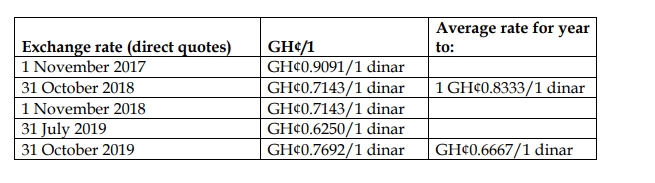
question table

Required:
Discuss the accounting treatment of the above transactions in accordance with the advice required by the directors. (You should show detailed workings as well as a discussion of the accounting treatment used.)

 

Inventory and payable

  • The inventory and trade payable would be recorded initially at GH¢10 million (16 million dinars x GH¢0.6250).
  • At the year-end on 31 October 2019, the amount payable is still outstanding. It should be re-translated at the closing rate to GH¢12.3 million (16 million dinars x GH¢0.7692).
  • This creates an exchange loss of GH¢2.3 million (12.3 – 10) which should be recognized in profit or loss.
  • Unless it has been impaired, the inventory (a non-monetary asset) should be recorded at GH¢10 million at the year-end.

Sale of goods

  • The sale of goods should be recorded at GH¢5 million (8 million dinars x GH¢0.6250) as revenue and as a trade receivable.
  • Payment in dinars was received on 31 October 2019 and the actual cedi value of the dinars received was GH¢6.2 million (8 million dinars x GH¢0.7692).
  • This creates a gain on exchange of GH¢1.2 million (6.2 – 5) which should be recognized in profit or loss.

Investment property

  • The investment property should be recognized on 1 November 2018 at GH¢40 million (56 million dinars x GH¢0.7143).
  • At the year-end on 31 October 2019, the property should be recognized at its fair value of GH¢36.9 million (48 million dinars x GH¢0.7692).
  • The fall in fair value (40 – 36.9 = 3.1) should be recognized in profit and loss as a loss on investment property.
  • The property is a non-monetary asset and when a gain or loss on a non-monetary item is recognized in profit or loss, the element of the gain or loss relating to exchange rates is also recognized in profit or loss.

Login or create a free account to see answers

Complete your registration to see answers

Find Related Questions by Tags, levels, etc.

Report an error

You're reporting an error for "CR – May 2020 – L3 – Q3a – Foreign Currency Transactions"

CR – May 2020 – L3 – Q3a – Foreign Currency Transactions

Foreign currency transactions related to purchases, sales, and investment property with exchange rate variations and reporting implications.

Medina Power Ltd has carried out certain transactions denominated in foreign currency during its financial year ended 31 October 2019 and has also conducted foreign operations through a foreign entity. Medina Power Ltd.’s functional and presentation currency is the cedi.

On 31 July 2019, Medina Power Ltd purchased goods from a foreign supplier for 16 million dinars. At 31 October 2019, the supplier had not yet been paid and the goods were still held in inventory by Medina Power Ltd.

On 31 July, Medina Power Ltd sold goods to a foreign customer for 8 million dinars, and it received payment for the goods in dinars on 31 October 2019.

Medina Power Ltd had also purchased an investment property on 1 November 2018 for 56 million dinars. At 31 October 2019, the investment property had a fair value of 48 million dinars. The company uses the fair value model in accounting for investment properties.

Medina Power Ltd wants advice on how to treat these transactions in the financial statements for the year ended 31 October 2019.

question table

Required:
Discuss the accounting treatment of the above transactions in accordance with the advice required by the directors. (You should show detailed workings as well as a discussion of the accounting treatment used.)
 

Inventory and payable

  • The inventory and trade payable would be recorded initially at GH¢10 million (16 million dinars x GH¢0.6250).
  • At the year-end on 31 October 2019, the amount payable is still outstanding. It should be re-translated at the closing rate to GH¢12.3 million (16 million dinars x GH¢0.7692).
  • This creates an exchange loss of GH¢2.3 million (12.3 – 10) which should be recognized in profit or loss.
  • Unless it has been impaired, the inventory (a non-monetary asset) should be recorded at GH¢10 million at the year-end.

Sale of goods

  • The sale of goods should be recorded at GH¢5 million (8 million dinars x GH¢0.6250) as revenue and as a trade receivable.
  • Payment in dinars was received on 31 October 2019 and the actual cedi value of the dinars received was GH¢6.2 million (8 million dinars x GH¢0.7692).
  • This creates a gain on exchange of GH¢1.2 million (6.2 – 5) which should be recognized in profit or loss.

Investment property

  • The investment property should be recognized on 1 November 2018 at GH¢40 million (56 million dinars x GH¢0.7143).
  • At the year-end on 31 October 2019, the property should be recognized at its fair value of GH¢36.9 million (48 million dinars x GH¢0.7692).
  • The fall in fair value (40 – 36.9 = 3.1) should be recognized in profit and loss as a loss on investment property.
  • The property is a non-monetary asset and when a gain or loss on a non-monetary item is recognized in profit or loss, the element of the gain or loss relating to exchange rates is also recognized in profit or loss.

Login or create a free account to see answers

Complete your registration to see answers

Find Related Questions by Tags, levels, etc.

Report an error

You're reporting an error for "CR – May 2020 – L3 – Q3a – Foreign Currency Transactions"

CR – May 2020 – Q3b(i) – Ethical Issues in Contract Bidding

This question requires a discussion on the ethical issues related to conflict of interest, confidentiality, and professional behavior in a contract bidding scenario.

You have just obtained your full membership with the Institute of Chartered Accountants (Ghana). Following this successful achievement, you have been appointed as the Head of Finance at Asasiyemedeh Company Limited, a Ghanaian company, which provides catering services. Your former employer, Akwaba Limited, is a large public sector organization operating in Accra, where, as the Financial Accountant, you had the opportunity to work on areas relating to financial accounting, procurement, contracts, and bids. One of Asasiyemedeh Company Limited’s major contracts is with Akwaba Limited, your former employer. The contract is now due for renewal, and Asasiyemedeh Company Limited is preparing a competitive bid for this contract.

You have been tasked to lead the team responsible for bidding for this contract, but you are concerned as a professional that you might breach confidentiality if you accept this role. You also suspect that your knowledge and experience of Akwaba Limited were seen as good reasons for appointing you to the position of Head of Finance at Asasiyemedeh Company Limited. You do not in any way want to let your new employer down as you are aware that the loss of such a major contract would have a significant effect on the financial performance of Asasiyemedeh Company Limited, and its performance-related bonus scheme for management members.

Required:
Discuss the ethical issues raised in the above scenario.

The ethical issues raised in the scenario include:

  1. Objectivity:
    There is a self-interest threat that arises due to the impact that losing Akwaba Limited’s contract would have on Asasiyemedeh Company Limited’s financial performance and reward policy. There is also an intimidation threat because other employees in the company may be affected by the financial implications of the contract not being renewed. Additionally, you may feel a strong desire to impress your new employer by helping to secure the renewal of the contract. The key question is whether you can safeguard against the self-interest threat posed by Asasiyemedeh Company Limited’s performance-related bonus scheme.
  2. Confidentiality:
    Clearly, there is a confidentiality threat here as you have worked with Akwaba Ltd in the past. Your previous employment with Akwaba Ltd has provided you with information which may be of value to Asasiyemedeh Company Limited. The principle of confidentiality prohibits the use of confidential information acquired as a result of your previous employment for your advantage or that of your current employer. While you have a responsibility to advance the legitimate aims of your employing organization, this should not extend to a breach of confidentiality. In this case, you (because of Asasiyemedeh Company Limited’s performance-related bonus) and Asasiyemedeh Company Limited stand to benefit from the confidential information about how bids are assessed at Akwaba Ltd. The principle would not be breached if you were in possession of information that was in the public domain, or if you were simply to use experience gained in your previous employment, so long as you do not use confidential knowledge that you acquired as a result of that employment.                           If you accept this role, can you ensure that you do not use confidential information relating to your former employer to your advantage or to the advantage of your current employer? You must be careful and professional as winning that contracts may leads to confidential breaches against you or your current employers perhaps from those bidders of the same contracts who might lose the bids
  3. Professional Behavior:
    You must demonstrate professionalism here. For example, what can you do to safeguard your reputation as a professional, the reputation of your employer, and the accountancy profession to which you belong? You must consider the Institute of Chartered Accountants (Ghana) code of ethics, applicable laws (procurement Act 914), and regulations, your current and previous contracts of employment, and your employer’s policies and procedures.

Login or create a free account to see answers

Complete your registration to see answers

Find Related Questions by Tags, levels, etc.

Report an error

You're reporting an error for "CR – May 2020 – Q3b(i) – Ethical Issues in Contract Bidding"

CR – May 2020 – Q3b(i) – Ethical Issues in Contract Bidding

This question requires a discussion on the ethical issues related to conflict of interest, confidentiality, and professional behavior in a contract bidding scenario.

You have just obtained your full membership with the Institute of Chartered Accountants (Ghana). Following this successful achievement, you have been appointed as the Head of Finance at Asasiyemedeh Company Limited, a Ghanaian company, which provides catering services. Your former employer, Akwaba Limited, is a large public sector organization operating in Accra, where, as the Financial Accountant, you had the opportunity to work on areas relating to financial accounting, procurement, contracts, and bids. One of Asasiyemedeh Company Limited’s major contracts is with Akwaba Limited, your former employer. The contract is now due for renewal, and Asasiyemedeh Company Limited is preparing a competitive bid for this contract.

You have been tasked to lead the team responsible for bidding for this contract, but you are concerned as a professional that you might breach confidentiality if you accept this role. You also suspect that your knowledge and experience of Akwaba Limited were seen as good reasons for appointing you to the position of Head of Finance at Asasiyemedeh Company Limited. You do not in any way want to let your new employer down as you are aware that the loss of such a major contract would have a significant effect on the financial performance of Asasiyemedeh Company Limited, and its performance-related bonus scheme for management members.

Required:
Discuss the ethical issues raised in the above scenario.

The ethical issues raised in the scenario include:

  1. Objectivity:
    There is a self-interest threat that arises due to the impact that losing Akwaba Limited’s contract would have on Asasiyemedeh Company Limited’s financial performance and reward policy. There is also an intimidation threat because other employees in the company may be affected by the financial implications of the contract not being renewed. Additionally, you may feel a strong desire to impress your new employer by helping to secure the renewal of the contract. The key question is whether you can safeguard against the self-interest threat posed by Asasiyemedeh Company Limited’s performance-related bonus scheme.
  2. Confidentiality:
    Clearly, there is a confidentiality threat here as you have worked with Akwaba Ltd in the past. Your previous employment with Akwaba Ltd has provided you with information which may be of value to Asasiyemedeh Company Limited. The principle of confidentiality prohibits the use of confidential information acquired as a result of your previous employment for your advantage or that of your current employer. While you have a responsibility to advance the legitimate aims of your employing organization, this should not extend to a breach of confidentiality. In this case, you (because of Asasiyemedeh Company Limited’s performance-related bonus) and Asasiyemedeh Company Limited stand to benefit from the confidential information about how bids are assessed at Akwaba Ltd. The principle would not be breached if you were in possession of information that was in the public domain, or if you were simply to use experience gained in your previous employment, so long as you do not use confidential knowledge that you acquired as a result of that employment.                           If you accept this role, can you ensure that you do not use confidential information relating to your former employer to your advantage or to the advantage of your current employer? You must be careful and professional as winning that contracts may leads to confidential breaches against you or your current employers perhaps from those bidders of the same contracts who might lose the bids
  3. Professional Behavior:
    You must demonstrate professionalism here. For example, what can you do to safeguard your reputation as a professional, the reputation of your employer, and the accountancy profession to which you belong? You must consider the Institute of Chartered Accountants (Ghana) code of ethics, applicable laws (procurement Act 914), and regulations, your current and previous contracts of employment, and your employer’s policies and procedures.

Login or create a free account to see answers

Complete your registration to see answers

Find Related Questions by Tags, levels, etc.

Report an error

You're reporting an error for "CR – May 2020 – Q3b(i) – Ethical Issues in Contract Bidding"

CR – May 2020 – Q3b(ii) – Ethical Actions in Contract Bidding

This question requires recommendations for maintaining ethical standards in a contract bidding situation involving a conflict of interest.

Recommend the possible courses of action that you will take in order to be ethically responsible as expected from a Professional Accountant.


Possible courses of action

  • You should discuss the situation and your obligations with your managing director in the first place and, ask for your involvement in the preparation of the contract bid to be limited. For example, you may be able to contribute to aspects of the bid that do not in any way require you to refer to confidential knowledge about your previous employment with Akwaba Ltd.
  • If the managing director fails to understand the conflict that you are facing, probably he is not in your profession, you should request that you both discuss the matter with the board chairman or another member of staff. During these discussions, you should refer to the company’s ethical code, if it has one, as well as that of the Institute of Chartered Accountants (Ghana).
  • If there are no other formal channels available, you should make the entire board aware of your dilemma by writing formally to them. If necessary, you must refuse to take part in the bid without necessary safeguards being implemented.
  • Ultimately, disassociating yourself from Asasiyemedeh Company Limited may be the only solution. However, before taking such a step, you should seek legal advice on your employment.
  • Rights and responsibilities (subject to the rules and guidance of the Institute of Chartered Accountants, (Ghana)).
  • You should document, in detail, the steps that you take in resolving your dilemma, in case your ethical judgment is challenged in future periods.
  • Looking at this issue from Asasiyemedeh Company Limited’s perspective, it may be appropriate to suggest to the managing director or the board of your employer that a policy on conflicts of interest be developed and that the remuneration and bonus policy be reviewed in light of this contract bid with Akwaba Ltd.

Login or create a free account to see answers

Complete your registration to see answers

Find Related Questions by Tags, levels, etc.

Report an error

You're reporting an error for "CR – May 2020 – Q3b(ii) – Ethical Actions in Contract Bidding"

CR – May 2020 – Q3b(ii) – Ethical Actions in Contract Bidding

This question requires recommendations for maintaining ethical standards in a contract bidding situation involving a conflict of interest.

Recommend the possible courses of action that you will take in order to be ethically responsible as expected from a Professional Accountant.


Possible courses of action

  • You should discuss the situation and your obligations with your managing director in the first place and, ask for your involvement in the preparation of the contract bid to be limited. For example, you may be able to contribute to aspects of the bid that do not in any way require you to refer to confidential knowledge about your previous employment with Akwaba Ltd.
  • If the managing director fails to understand the conflict that you are facing, probably he is not in your profession, you should request that you both discuss the matter with the board chairman or another member of staff. During these discussions, you should refer to the company’s ethical code, if it has one, as well as that of the Institute of Chartered Accountants (Ghana).
  • If there are no other formal channels available, you should make the entire board aware of your dilemma by writing formally to them. If necessary, you must refuse to take part in the bid without necessary safeguards being implemented.
  • Ultimately, disassociating yourself from Asasiyemedeh Company Limited may be the only solution. However, before taking such a step, you should seek legal advice on your employment.
  • Rights and responsibilities (subject to the rules and guidance of the Institute of Chartered Accountants, (Ghana)).
  • You should document, in detail, the steps that you take in resolving your dilemma, in case your ethical judgment is challenged in future periods.
  • Looking at this issue from Asasiyemedeh Company Limited’s perspective, it may be appropriate to suggest to the managing director or the board of your employer that a policy on conflicts of interest be developed and that the remuneration and bonus policy be reviewed in light of this contract bid with Akwaba Ltd.

Login or create a free account to see answers

Complete your registration to see answers

Find Related Questions by Tags, levels, etc.

Report an error

You're reporting an error for "CR – May 2020 – Q3b(ii) – Ethical Actions in Contract Bidding"

CR – May 2020 – Q4a – Capital Reduction Account

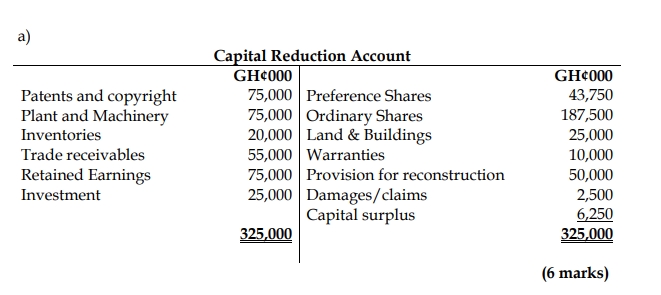
This question requires the preparation of a Capital Reduction Account for Sasasila Ltd following a reorganization.

Sasasila Ltd has been operating profitably for a number of years. However, in recent times, the company has been making losses. Below is the statement of financial position as at 30 June 2019:

Assets GH¢000
Non-Current Assets
Patents and copyrights 75,000
Land and buildings (net) 200,000
Plant and machinery (net) 150,000
Current Assets
Inventories 125,000
Trade receivables 125,000
Bank 37,500
Investments (cost) 100,000
Total Assets 812,500
Equity and liabilities:
Equity
Ordinary share capital (issued at GH¢10 each) 375,000
20% cumulative preference shares (issued at GH¢10 each) 175,000
Retained earnings (75,000)
Non-current Liabilities
15% Debentures 125,000
Current Liabilities
Interest on debentures 18,750
Trade payables 93,750
Provision for business restructuring 50,000
Provision for legal damages & claims 12,500
Provision for warranties 37,500
Total Equity and Liabilities 812,500

Additional relevant information: The following scheme of reconstruction was approved by all parties as well as the High Court with the exception of only one ordinary shareholder:

  1. The ordinary shares were to be reduced to GH¢5 per share.
  2. The preference shares were to be reduced to GH¢7.5 per share and arrears in dividends for three years were to be canceled from the company’s books.
  3. The fair values of the assets were agreed at the following values:
    • Patents and copyrights: Nil
    • Land and buildings: GH¢225,000
    • Plant and machinery: GH¢75,000
    • Investments: GH¢75,000
    • Inventories: GH¢105,000
    • Trade receivables: GH¢70,000
  4. The balance on retained earnings is to be eliminated in full.
  5. The liability for legal damages and claims was to be settled for GH¢10 million, and the provision for warranties reduced to GH¢27.5 million.
  6. The accrued debenture interest was to be paid in cash.
  7. Investments with a carrying amount of GH¢52.5 million were to be sold for cash at that value to strengthen the working capital position.
  8. The amount set aside for business restructuring was to be eliminated as well.
  9. The High Court directed a payment of GH¢0.2 million to a member who opposed the scheme for 50 ordinary shares held by him.

Prepare the Capital Reduction Account as at 30 June 2019.

answer to the question

Login or create a free account to see answers

Complete your registration to see answers

Find Related Questions by Tags, levels, etc.

Report an error

You're reporting an error for "CR – May 2020 – Q4a – Capital Reduction Account"

CR – May 2020 – Q4a – Capital Reduction Account

This question requires the preparation of a Capital Reduction Account for Sasasila Ltd following a reorganization.

Sasasila Ltd has been operating profitably for a number of years. However, in recent times, the company has been making losses. Below is the statement of financial position as at 30 June 2019:

Assets GH¢000
Non-Current Assets
Patents and copyrights 75,000
Land and buildings (net) 200,000
Plant and machinery (net) 150,000
Current Assets
Inventories 125,000
Trade receivables 125,000
Bank 37,500
Investments (cost) 100,000
Total Assets 812,500
Equity and liabilities:
Equity
Ordinary share capital (issued at GH¢10 each) 375,000
20% cumulative preference shares (issued at GH¢10 each) 175,000
Retained earnings (75,000)
Non-current Liabilities
15% Debentures 125,000
Current Liabilities
Interest on debentures 18,750
Trade payables 93,750
Provision for business restructuring 50,000
Provision for legal damages & claims 12,500
Provision for warranties 37,500
Total Equity and Liabilities 812,500

Additional relevant information: The following scheme of reconstruction was approved by all parties as well as the High Court with the exception of only one ordinary shareholder:

  1. The ordinary shares were to be reduced to GH¢5 per share.
  2. The preference shares were to be reduced to GH¢7.5 per share and arrears in dividends for three years were to be canceled from the company’s books.
  3. The fair values of the assets were agreed at the following values:
    • Patents and copyrights: Nil
    • Land and buildings: GH¢225,000
    • Plant and machinery: GH¢75,000
    • Investments: GH¢75,000
    • Inventories: GH¢105,000
    • Trade receivables: GH¢70,000
  4. The balance on retained earnings is to be eliminated in full.
  5. The liability for legal damages and claims was to be settled for GH¢10 million, and the provision for warranties reduced to GH¢27.5 million.
  6. The accrued debenture interest was to be paid in cash.
  7. Investments with a carrying amount of GH¢52.5 million were to be sold for cash at that value to strengthen the working capital position.
  8. The amount set aside for business restructuring was to be eliminated as well.
  9. The High Court directed a payment of GH¢0.2 million to a member who opposed the scheme for 50 ordinary shares held by him.

Prepare the Capital Reduction Account as at 30 June 2019.

answer to the question

Login or create a free account to see answers

Complete your registration to see answers

Find Related Questions by Tags, levels, etc.

Report an error

You're reporting an error for "CR – May 2020 – Q4a – Capital Reduction Account"

CR – May 2020 – Q4b – Statement of Financial Position for Sasasila Ltd

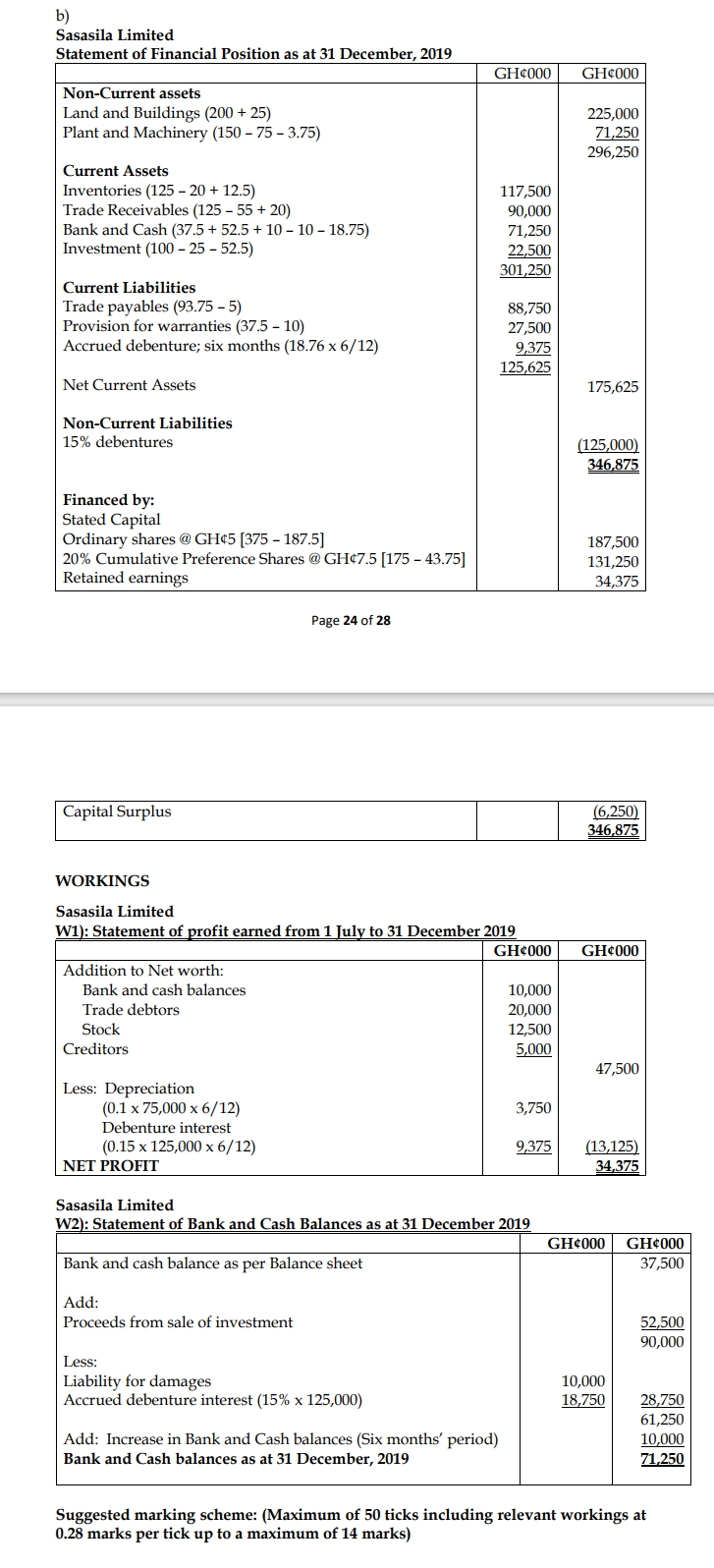
This question requires the preparation of a statement of financial position for Sasasila Ltd following its restructuring.

Prepare the statement of financial position as at 31 December 2019 for Sasasila Ltd.


Login or create a free account to see answers

Complete your registration to see answers

Find Related Questions by Tags, levels, etc.

Report an error

You're reporting an error for "CR – May 2020 – Q4b – Statement of Financial Position for Sasasila Ltd"

CR – May 2020 – Q4b – Statement of Financial Position for Sasasila Ltd

This question requires the preparation of a statement of financial position for Sasasila Ltd following its restructuring.

Prepare the statement of financial position as at 31 December 2019 for Sasasila Ltd.


Login or create a free account to see answers

Complete your registration to see answers

Find Related Questions by Tags, levels, etc.

Report an error

You're reporting an error for "CR – May 2020 – Q4b – Statement of Financial Position for Sasasila Ltd"

CR – May 2020 – Q5 – Financial Performance and Position of Bossman Ltd

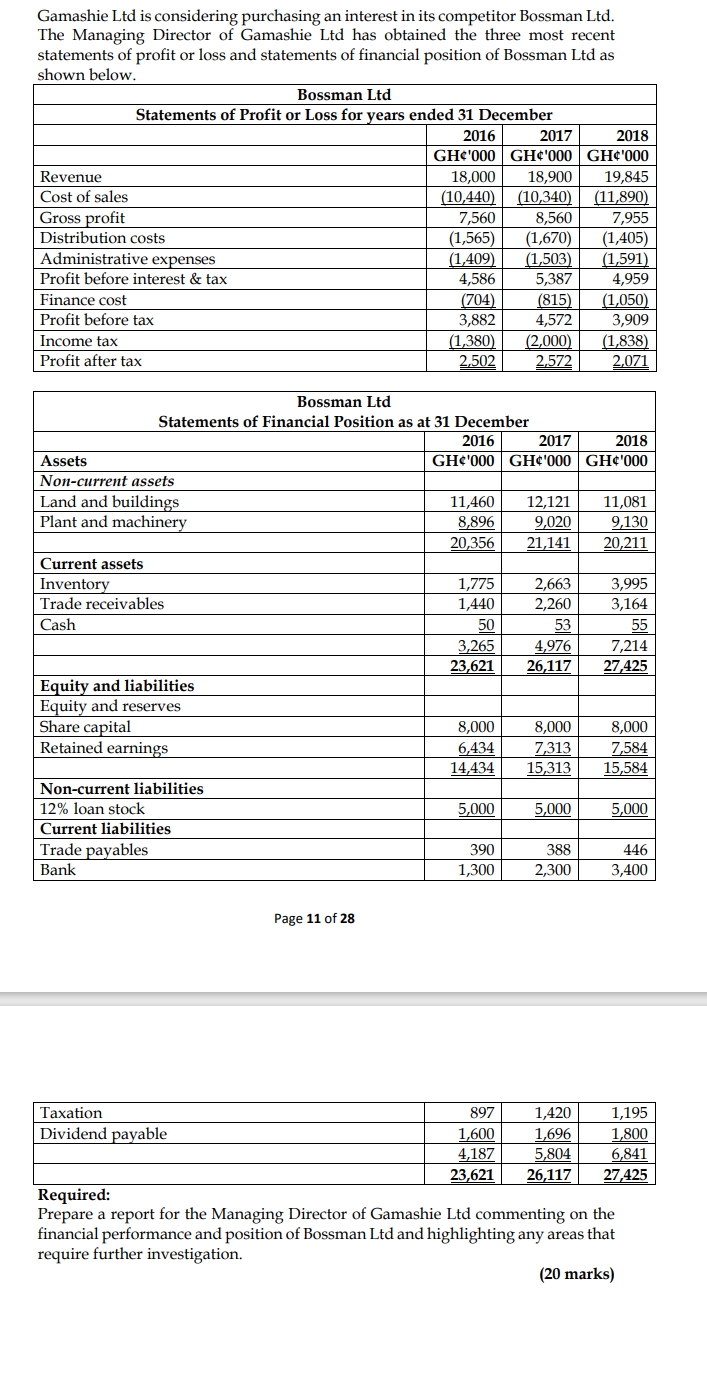
This question involves analyzing the financial performance and position of Bossman Ltd over three years using ratio analysis.

To: Managing Director, Gamashie Ltd
From: An Accountant
Date: 01/01/19
Subject: The Financial Position and Performance of Bossman Ltd


Introduction:

This report is based on the financial statements of Bossman Ltd for the years 2016, 2017, and 2018. It includes an analysis of the financial performance and position, with attention to key financial ratios calculated from the attached statements.


Financial Performance:

  • Revenue Growth: Bossman Ltd has experienced consistent revenue growth at approximately 5% per annum from GH¢18,000,000 in 2016 to GH¢19,845,000 in 2018.
  • Gross Profit Margin: The gross profit margin improved in 2017 but fell in 2018, indicating fluctuations in cost management. The margins were:
    • 2016: 42%
    • 2017: 45%
    • 2018: 40%
  • Operating Profit: Operating profit as a percentage of sales showed a similar trend to the gross profit margin. It increased from 25.5% in 2016 to 28.5% in 2017, before falling back to 25% in 2018. The decline in 2018 needs to be investigated to understand the reasons for the reduction.
  • Profit Before Tax (PBT): PBT decreased from GH¢3,882,000 in 2017 to GH¢3,909,000 in 2018, primarily due to increased finance costs. This indicates an increase in borrowing costs, which requires further investigation.

Financial Position:

  • Liquidity:
    • Current Ratio: The current ratio improved from 0.78 in 2016 to 1.05 in 2018, indicating better liquidity. However, it was below 1 in 2016 and 2017, suggesting that the company may have struggled to meet its short-term obligations during those years.
    • Quick Ratio: The quick ratio remained below 0.5 across all three years, highlighting potential issues with converting current assets (excluding inventory) into liquid assets. This indicates the company may be heavily reliant on inventory for liquidity.
  • Solvency:
    • Debt Ratio: The debt ratio increased steadily over the three years from 38.9% in 2016 to 43.2% in 2018, suggesting the company’s reliance on debt financing is increasing. This should be monitored, as it may impact the company’s financial flexibility.
  • Efficiency:
    • Receivables Collection Period: The collection period increased from 29.2 days in 2016 to 58.2 days in 2018. This could indicate deteriorating credit control or extended payment terms.
    • Inventory Turnover: Inventory turnover worsened, increasing from 62 days in 2016 to 122.6 days in 2018. This may indicate overstocking or slow-moving inventory, which ties up working capital.

Conclusion:

Bossman Ltd has shown consistent revenue growth but declining profitability. Liquidity has improved, but the quick ratio is concerning. The company’s growing reliance on debt and the extended receivables and inventory turnover periods should be investigated further to identify potential risks to financial stability.


Appendix – Ratio Analysis:

Ratios 2016 2017 2018
Gross Profit Margin 42% 45% 40%
Operating Profit Margin 25.5% 28.5% 25%
Return on Capital Employed 23.6% 27% 24.1%
Debt Ratio 38.9% 41.4% 43.2%
Current Ratio 0.78 0.86 1.05
Quick Ratio 0.36 0.40 0.47
Receivables Collection Period (days) 29.2 43.6 58.2
Inventory Turnover Period (days) 62 94 122.6

Login or create a free account to see answers

Complete your registration to see answers

Find Related Questions by Tags, levels, etc.

Report an error

You're reporting an error for "CR – May 2020 – Q5 – Financial Performance and Position of Bossman Ltd"

CR – May 2020 – Q5 – Financial Performance and Position of Bossman Ltd

This question involves analyzing the financial performance and position of Bossman Ltd over three years using ratio analysis.

To: Managing Director, Gamashie Ltd
From: An Accountant
Date: 01/01/19
Subject: The Financial Position and Performance of Bossman Ltd


Introduction:

This report is based on the financial statements of Bossman Ltd for the years 2016, 2017, and 2018. It includes an analysis of the financial performance and position, with attention to key financial ratios calculated from the attached statements.


Financial Performance:

  • Revenue Growth: Bossman Ltd has experienced consistent revenue growth at approximately 5% per annum from GH¢18,000,000 in 2016 to GH¢19,845,000 in 2018.
  • Gross Profit Margin: The gross profit margin improved in 2017 but fell in 2018, indicating fluctuations in cost management. The margins were:
    • 2016: 42%
    • 2017: 45%
    • 2018: 40%
  • Operating Profit: Operating profit as a percentage of sales showed a similar trend to the gross profit margin. It increased from 25.5% in 2016 to 28.5% in 2017, before falling back to 25% in 2018. The decline in 2018 needs to be investigated to understand the reasons for the reduction.
  • Profit Before Tax (PBT): PBT decreased from GH¢3,882,000 in 2017 to GH¢3,909,000 in 2018, primarily due to increased finance costs. This indicates an increase in borrowing costs, which requires further investigation.

Financial Position:

  • Liquidity:
    • Current Ratio: The current ratio improved from 0.78 in 2016 to 1.05 in 2018, indicating better liquidity. However, it was below 1 in 2016 and 2017, suggesting that the company may have struggled to meet its short-term obligations during those years.
    • Quick Ratio: The quick ratio remained below 0.5 across all three years, highlighting potential issues with converting current assets (excluding inventory) into liquid assets. This indicates the company may be heavily reliant on inventory for liquidity.
  • Solvency:
    • Debt Ratio: The debt ratio increased steadily over the three years from 38.9% in 2016 to 43.2% in 2018, suggesting the company’s reliance on debt financing is increasing. This should be monitored, as it may impact the company’s financial flexibility.
  • Efficiency:
    • Receivables Collection Period: The collection period increased from 29.2 days in 2016 to 58.2 days in 2018. This could indicate deteriorating credit control or extended payment terms.
    • Inventory Turnover: Inventory turnover worsened, increasing from 62 days in 2016 to 122.6 days in 2018. This may indicate overstocking or slow-moving inventory, which ties up working capital.

Conclusion:

Bossman Ltd has shown consistent revenue growth but declining profitability. Liquidity has improved, but the quick ratio is concerning. The company’s growing reliance on debt and the extended receivables and inventory turnover periods should be investigated further to identify potential risks to financial stability.


Appendix – Ratio Analysis:

Ratios 2016 2017 2018
Gross Profit Margin 42% 45% 40%
Operating Profit Margin 25.5% 28.5% 25%
Return on Capital Employed 23.6% 27% 24.1%
Debt Ratio 38.9% 41.4% 43.2%
Current Ratio 0.78 0.86 1.05
Quick Ratio 0.36 0.40 0.47
Receivables Collection Period (days) 29.2 43.6 58.2
Inventory Turnover Period (days) 62 94 122.6

Login or create a free account to see answers

Complete your registration to see answers

Find Related Questions by Tags, levels, etc.

Report an error

You're reporting an error for "CR – May 2020 – Q5 – Financial Performance and Position of Bossman Ltd"

BCL – May 2020 – L2 – Q3d – Governance and Ethical Issues Relating to Business

Identify three codes of ethics for accountants in Ghana.

Code of Ethics are drawn up to be followed by all the company’s structures and professionals. It serves as a guide to professional conduct and guarantees concerns about efficiency, competitiveness, and profitability.

Required:

Identify THREE (3) codes of ethics for Accountants in Ghana.
(3 marks)

Three codes of ethics for accountants in Ghana include:

  1. Integrity: Accountants must be straightforward and honest in all professional and business relationships.
  2. Confidentiality: Accountants must respect the confidentiality of information acquired as a result of professional and business relationships and should not disclose any such information to third parties without proper and specific authority unless there is a legal or professional right or duty to disclose.
  3. Objectivity: Accountants must not allow bias, conflict of interest, or undue influence of others to override professional or business judgments.


Login or create a free account to see answers

Complete your registration to see answers

Find Related Questions by Tags, levels, etc.

Report an error

You're reporting an error for "BCL – May 2020 – L2 – Q3d – Governance and Ethical Issues Relating to Business"

BCL – May 2020 – L2 – Q3d – Governance and Ethical Issues Relating to Business

Identify three codes of ethics for accountants in Ghana.

Code of Ethics are drawn up to be followed by all the company’s structures and professionals. It serves as a guide to professional conduct and guarantees concerns about efficiency, competitiveness, and profitability.

Required:

Identify THREE (3) codes of ethics for Accountants in Ghana.
(3 marks)

Three codes of ethics for accountants in Ghana include:

  1. Integrity: Accountants must be straightforward and honest in all professional and business relationships.
  2. Confidentiality: Accountants must respect the confidentiality of information acquired as a result of professional and business relationships and should not disclose any such information to third parties without proper and specific authority unless there is a legal or professional right or duty to disclose.
  3. Objectivity: Accountants must not allow bias, conflict of interest, or undue influence of others to override professional or business judgments.


Login or create a free account to see answers

Complete your registration to see answers

Find Related Questions by Tags, levels, etc.

Report an error

You're reporting an error for "BCL – May 2020 – L2 – Q3d – Governance and Ethical Issues Relating to Business"

BCL – May 2020 – L2 – Q3c – Human Rights

List three fundamental human rights that must be protected and enforced under the 1992 Constitution of Ghana.

List THREE (3) fundamental human rights that must be protected and enforced as provided for in the 1992 Constitution in the Republic of Ghana.
(3 marks)

Three fundamental human rights provided for in the 1992 Constitution of Ghana include:

  1. Protection of Right to Life (Article 13)
  2. Protection of Personal Liberty (Article 14)
  3. Respect for Human Dignity (Article 15)

(Any 3 points for 3 marks)


Login or create a free account to see answers

Complete your registration to see answers

Find Related Questions by Tags, levels, etc.

Report an error

You're reporting an error for "BCL – May 2020 – L2 – Q3c – Human Rights"

BCL – May 2020 – L2 – Q3c – Human Rights

List three fundamental human rights that must be protected and enforced under the 1992 Constitution of Ghana.

List THREE (3) fundamental human rights that must be protected and enforced as provided for in the 1992 Constitution in the Republic of Ghana.
(3 marks)

Three fundamental human rights provided for in the 1992 Constitution of Ghana include:

  1. Protection of Right to Life (Article 13)
  2. Protection of Personal Liberty (Article 14)
  3. Respect for Human Dignity (Article 15)

(Any 3 points for 3 marks)


Login or create a free account to see answers

Complete your registration to see answers

Find Related Questions by Tags, levels, etc.

Report an error

You're reporting an error for "BCL – May 2020 – L2 – Q3c – Human Rights"

BCL – May 2020 – L2 – Q3b – Employment Law

Discuss the stakeholders in a sexual harassment case and the impact of employees' prior knowledge on their right to claim.

‘Las Panas’ is a successful chain of restaurants and bars that features female waitresses in white spaghetti tops and very short red skirts. Five former waitresses filed a class action lawsuit, alleging that the atmosphere ‘Las Panas’ created in its restaurants allowed them to be sexually harassed by customers, cooks, and managers. Ama Smith, one of the waitresses, noted on a radio super morning show program that the ‘Las Panas’ mandatory uniforms caused them to be sexually harassed. Meanwhile, ‘Las Panas’ continues to enjoy great success, and it recently received an award as the Best Marketing Company.

Required:

i) Identify the key stakeholders in this case.
(2 marks)

ii) Supposing the women knew of the problems when they agreed to work at ‘Las Panas’, what bearing should such knowledge have on their right to the alleged harassment?
(2 marks)


i) Key Stakeholders:

  • Las Panas: The restaurant chain is central to the issue due to its policies and the working environment it created.
  • Former Waitresses (Plaintiffs): They are directly involved as the individuals alleging harassment.
  • Customers, Cooks, and Managers: These groups are implicated in the harassment allegations.
  • General Public and Media: As influencers of public perception and amplifiers of the issue through media coverage.

(2 marks)

ii) Impact of Prior Knowledge (Volenti Non Fit Injuria):

  • Volenti Non Fit Injuria: This legal principle implies that if the waitresses knew of the potential for harassment when they agreed to work at ‘Las Panas’, they may have consented to the risk associated with the work environment.
  • Legal Bearing: The principle suggests that individuals who voluntarily expose themselves to known risks may have limited grounds for claiming compensation for resulting harm. However, this does not absolve the employer of responsibility if the work environment was inherently unsafe or the harassment exceeded reasonable expectations.

(2 marks)

Login or create a free account to see answers

Complete your registration to see answers

Find Related Questions by Tags, levels, etc.

Report an error

You're reporting an error for "BCL – May 2020 – L2 – Q3b – Employment Law"

BCL – May 2020 – L2 – Q3b – Employment Law

Discuss the stakeholders in a sexual harassment case and the impact of employees' prior knowledge on their right to claim.

‘Las Panas’ is a successful chain of restaurants and bars that features female waitresses in white spaghetti tops and very short red skirts. Five former waitresses filed a class action lawsuit, alleging that the atmosphere ‘Las Panas’ created in its restaurants allowed them to be sexually harassed by customers, cooks, and managers. Ama Smith, one of the waitresses, noted on a radio super morning show program that the ‘Las Panas’ mandatory uniforms caused them to be sexually harassed. Meanwhile, ‘Las Panas’ continues to enjoy great success, and it recently received an award as the Best Marketing Company.

Required:

i) Identify the key stakeholders in this case.
(2 marks)

ii) Supposing the women knew of the problems when they agreed to work at ‘Las Panas’, what bearing should such knowledge have on their right to the alleged harassment?
(2 marks)


i) Key Stakeholders:

  • Las Panas: The restaurant chain is central to the issue due to its policies and the working environment it created.
  • Former Waitresses (Plaintiffs): They are directly involved as the individuals alleging harassment.
  • Customers, Cooks, and Managers: These groups are implicated in the harassment allegations.
  • General Public and Media: As influencers of public perception and amplifiers of the issue through media coverage.

(2 marks)

ii) Impact of Prior Knowledge (Volenti Non Fit Injuria):

  • Volenti Non Fit Injuria: This legal principle implies that if the waitresses knew of the potential for harassment when they agreed to work at ‘Las Panas’, they may have consented to the risk associated with the work environment.
  • Legal Bearing: The principle suggests that individuals who voluntarily expose themselves to known risks may have limited grounds for claiming compensation for resulting harm. However, this does not absolve the employer of responsibility if the work environment was inherently unsafe or the harassment exceeded reasonable expectations.

(2 marks)

Login or create a free account to see answers

Complete your registration to see answers

Find Related Questions by Tags, levels, etc.

Report an error

You're reporting an error for "BCL – May 2020 – L2 – Q3b – Employment Law"

BCL – May 2020 – L2 – Q3a – Company Meetings and Resolutions

Explain what constitutes the ordinary business of an AGM and the procedure for private liquidation.

On 26th February 2018, Gold Link Limited, a public limited liability company trading on the Ghana Stock Exchange sent a notice to its shareholders inviting them to an Annual General Meeting (AGM) on 2nd March 2019. The notice simply states that the ‘purpose is to transact the ordinary business’. Namoale is a shareholder of Gold Link Limited and is very disturbed about the vagueness of the notice. He is also not satisfied with the performance of the company and is seeking to requisition for a special resolution to liquidate the company.

Required:

i) Explain to Namoale, what constitutes ‘the ordinary business of an annual general meeting’ and state TWO (2) other information, Namoale must see in the notice for an AGM.
(5 marks)

ii) Advise Namoale on the procedure for private liquidation.
(5 marks)

i) Ordinary Business of an Annual General Meeting (AGM):

  • According to Section 153 of the Companies Act, 1963 (Act 179), the notice of a general meeting must contain sufficient details to enable persons entitled to attend to decide whether to attend and to prepare their minds on how to vote.
  • The phrase ‘to transact the ordinary business’ of an AGM typically refers to the following items:
    • Declaration of dividends.
    • Election of directors in place of those retiring.
    • Consideration of the accounts and reports of auditors and directors.
    • Fixing the remuneration of auditors.
    • Removal and election of auditors and directors in accordance with sections 135 and 185 respectively.
  • Additional information that must be included in the notice for an AGM:
    • Date, time, and place of the meeting.
    • Statement that a member has the right to appoint a proxy to attend on their behalf.

(5 marks)

ii) Procedure for Private Liquidation:

  • Affidavit of Solvency: Directors must make an affidavit of solvency, confirming that they have thoroughly inquired into the company’s affairs and believe it can pay its debts within 12 months from the start of the liquidation.
  • Resolution for Winding Up: A special resolution must be passed by at least 75% of the company’s shareholders to approve the liquidation. The resolution should also include the appointment of a liquidator.
  • Liquidator’s Consent: The person named as the liquidator must have previously consented in writing to the appointment.
  • Registrar Notification: Within fourteen days of passing the resolution, the company must send a copy of the resolution to the Registrar, who will publish it in the Companies Bulletin.
  • Transfer of Powers: Upon appointment, the powers of the board of directors vest in the liquidator, and the authority of directors ceases except for any necessary actions permitted by the liquidator.

(5 marks)

Login or create a free account to see answers

Complete your registration to see answers

Find Related Questions by Tags, levels, etc.

Report an error

You're reporting an error for "BCL – May 2020 – L2 – Q3a – Company Meetings and Resolutions"

BCL – May 2020 – L2 – Q3a – Company Meetings and Resolutions

Explain what constitutes the ordinary business of an AGM and the procedure for private liquidation.

On 26th February 2018, Gold Link Limited, a public limited liability company trading on the Ghana Stock Exchange sent a notice to its shareholders inviting them to an Annual General Meeting (AGM) on 2nd March 2019. The notice simply states that the ‘purpose is to transact the ordinary business’. Namoale is a shareholder of Gold Link Limited and is very disturbed about the vagueness of the notice. He is also not satisfied with the performance of the company and is seeking to requisition for a special resolution to liquidate the company.

Required:

i) Explain to Namoale, what constitutes ‘the ordinary business of an annual general meeting’ and state TWO (2) other information, Namoale must see in the notice for an AGM.
(5 marks)

ii) Advise Namoale on the procedure for private liquidation.
(5 marks)

i) Ordinary Business of an Annual General Meeting (AGM):

  • According to Section 153 of the Companies Act, 1963 (Act 179), the notice of a general meeting must contain sufficient details to enable persons entitled to attend to decide whether to attend and to prepare their minds on how to vote.
  • The phrase ‘to transact the ordinary business’ of an AGM typically refers to the following items:
    • Declaration of dividends.
    • Election of directors in place of those retiring.
    • Consideration of the accounts and reports of auditors and directors.
    • Fixing the remuneration of auditors.
    • Removal and election of auditors and directors in accordance with sections 135 and 185 respectively.
  • Additional information that must be included in the notice for an AGM:
    • Date, time, and place of the meeting.
    • Statement that a member has the right to appoint a proxy to attend on their behalf.

(5 marks)

ii) Procedure for Private Liquidation:

  • Affidavit of Solvency: Directors must make an affidavit of solvency, confirming that they have thoroughly inquired into the company’s affairs and believe it can pay its debts within 12 months from the start of the liquidation.
  • Resolution for Winding Up: A special resolution must be passed by at least 75% of the company’s shareholders to approve the liquidation. The resolution should also include the appointment of a liquidator.
  • Liquidator’s Consent: The person named as the liquidator must have previously consented in writing to the appointment.
  • Registrar Notification: Within fourteen days of passing the resolution, the company must send a copy of the resolution to the Registrar, who will publish it in the Companies Bulletin.
  • Transfer of Powers: Upon appointment, the powers of the board of directors vest in the liquidator, and the authority of directors ceases except for any necessary actions permitted by the liquidator.

(5 marks)

Login or create a free account to see answers

Complete your registration to see answers

Find Related Questions by Tags, levels, etc.

Report an error

You're reporting an error for "BCL – May 2020 – L2 – Q3a – Company Meetings and Resolutions"

BCL – May 2020 – L2 – Q2b – Company Law

Discuss the entitlement of preferential shareholders to further dividends and principles relating to minimum capital for companies.

A group of young members of Nob Company Limited petitioned the Board of Directors of the Company over dividend payments at the close of the company’s annual general meeting. They claimed that they were preferential shareholders and that after dividends were declared for them, they had the privilege for fair participation in the distribution of the remaining shares.

Required:

i) From the above scenario, are the preferential shareholders entitled to any further dividend?
(6 marks)

ii) State TWO (2) principles relating to minimum capital for a company limited by shares pursuant to provisions of the law.
(4 marks)

i) Entitlement of Preferential Shareholders:

  • According to Section 48 of the Companies Act, 1963 (Act 179), a preference share is defined as a share that does not entitle the holder to a right to participate beyond a specified amount in a distribution, whether by way of dividend, redemption, or winding up.
  • Preferential shareholders are entitled to dividends as specified but do not have the right to further participation in the distribution of equity shares or ordinary shares.
  • Therefore, the young preferential shareholders are not entitled to any further dividend beyond what was declared as specified in their rights.

(6 marks)

ii) Principles Relating to Minimum Capital:

  • Principle 1: Before a company limited by shares can transact business, exercise borrowing power, or incur indebtedness, there must have been a payment made to the company for the issue of its shares, with consideration to the value of at least a prescribed amount.
  • Principle 2: Of the consideration paid, at least a prescribed lesser amount must have been paid in cash. The company must also have delivered to the Registrar of Companies a declaration in the prescribed form, signed by all the directors and secretary of the company, verifying that these payments have been received.

(4 marks)

Login or create a free account to see answers

Complete your registration to see answers

Find Related Questions by Tags, levels, etc.

Report an error

You're reporting an error for "BCL – May 2020 – L2 – Q2b – Company Law"

BCL – May 2020 – L2 – Q2b – Company Law

Discuss the entitlement of preferential shareholders to further dividends and principles relating to minimum capital for companies.

A group of young members of Nob Company Limited petitioned the Board of Directors of the Company over dividend payments at the close of the company’s annual general meeting. They claimed that they were preferential shareholders and that after dividends were declared for them, they had the privilege for fair participation in the distribution of the remaining shares.

Required:

i) From the above scenario, are the preferential shareholders entitled to any further dividend?
(6 marks)

ii) State TWO (2) principles relating to minimum capital for a company limited by shares pursuant to provisions of the law.
(4 marks)

i) Entitlement of Preferential Shareholders:

  • According to Section 48 of the Companies Act, 1963 (Act 179), a preference share is defined as a share that does not entitle the holder to a right to participate beyond a specified amount in a distribution, whether by way of dividend, redemption, or winding up.
  • Preferential shareholders are entitled to dividends as specified but do not have the right to further participation in the distribution of equity shares or ordinary shares.
  • Therefore, the young preferential shareholders are not entitled to any further dividend beyond what was declared as specified in their rights.

(6 marks)

ii) Principles Relating to Minimum Capital:

  • Principle 1: Before a company limited by shares can transact business, exercise borrowing power, or incur indebtedness, there must have been a payment made to the company for the issue of its shares, with consideration to the value of at least a prescribed amount.
  • Principle 2: Of the consideration paid, at least a prescribed lesser amount must have been paid in cash. The company must also have delivered to the Registrar of Companies a declaration in the prescribed form, signed by all the directors and secretary of the company, verifying that these payments have been received.

(4 marks)

Login or create a free account to see answers

Complete your registration to see answers

Find Related Questions by Tags, levels, etc.

Report an error

You're reporting an error for "BCL – May 2020 – L2 – Q2b – Company Law"

BCL – May 2020 – L2 – Q2a – Agency

Advise on whether a firm should bear the cost of an expenditure incurred by a partner during an assignment.

Jabi is a partner of an Accounting Firm. The firm’s office is located in Accra. In May 2019, Jabi was assigned an approved accounting duty outside Accra with the use of the Firm’s car. During the journey, the car had a burst tyre. The driver of the car, for unexplained reasons, had no spare tyre on the car. He therefore recommended the purchase of a brand new tyre, which Jabi bought with his personal money. He obtained a receipt in the name of the Firm.

Jabi sought for a refund of his money amounting to GH¢1,280 for the tyres bought. The Managing Partner refused the refund, saying it was the sole responsibility of Jabi to bear the expenditure.

Required:

i) Advise the Manager as to why the Firm should bear the full or part of the cost and not only Jabi.
(4 marks)

ii) Advise Jabi why it is not the sole responsibility of the firm to bear the cost.
(6 marks)

i) Advise the Manager:

  • Sections 4, 10, and 14 of the Incorporated Private Partnerships Act, 1962, Act 152 provide the relevant legal framework.
  • Section 4: Upon registration, a firm becomes a corporate entity, and the certificate states that the partners’ liability is not limited.
  • Section 10: A registered firm has the powers of a natural person and full capacity. While the firm is a corporate entity, each partner is liable for the firm’s debts and obligations, with an entitlement to indemnity from the firm.
  • Section 14: Partners are jointly and severally liable with the firm and other partners for the firm’s debts and obligations incurred while they remain partners.
  • Therefore, the firm, being a corporate entity with shared responsibilities, should bear the full or part of the cost.

(4 marks)

ii) Advise Jabi:

  • Section 10: The firm has a corporate nature and full capacity, making it responsible for the reimbursement of the expenditure on the tyres. However, Jabi, as a partner, shares responsibility with the firm and other partners.
  • Under Section 4: Jabi, as a partner, has liability towards the firm’s obligations and is entitled to indemnity from the firm.
  • Section 14: Jabi is jointly and severally liable with other partners for the firm’s debts, indicating a shared responsibility for the incurred cost.

(6 marks)

Login or create a free account to see answers

Complete your registration to see answers

Find Related Questions by Tags, levels, etc.

Report an error

You're reporting an error for "BCL – May 2020 – L2 – Q2a – Agency"

BCL – May 2020 – L2 – Q2a – Agency

Advise on whether a firm should bear the cost of an expenditure incurred by a partner during an assignment.

Jabi is a partner of an Accounting Firm. The firm’s office is located in Accra. In May 2019, Jabi was assigned an approved accounting duty outside Accra with the use of the Firm’s car. During the journey, the car had a burst tyre. The driver of the car, for unexplained reasons, had no spare tyre on the car. He therefore recommended the purchase of a brand new tyre, which Jabi bought with his personal money. He obtained a receipt in the name of the Firm.

Jabi sought for a refund of his money amounting to GH¢1,280 for the tyres bought. The Managing Partner refused the refund, saying it was the sole responsibility of Jabi to bear the expenditure.

Required:

i) Advise the Manager as to why the Firm should bear the full or part of the cost and not only Jabi.
(4 marks)

ii) Advise Jabi why it is not the sole responsibility of the firm to bear the cost.
(6 marks)

i) Advise the Manager:

  • Sections 4, 10, and 14 of the Incorporated Private Partnerships Act, 1962, Act 152 provide the relevant legal framework.
  • Section 4: Upon registration, a firm becomes a corporate entity, and the certificate states that the partners’ liability is not limited.
  • Section 10: A registered firm has the powers of a natural person and full capacity. While the firm is a corporate entity, each partner is liable for the firm’s debts and obligations, with an entitlement to indemnity from the firm.
  • Section 14: Partners are jointly and severally liable with the firm and other partners for the firm’s debts and obligations incurred while they remain partners.
  • Therefore, the firm, being a corporate entity with shared responsibilities, should bear the full or part of the cost.

(4 marks)

ii) Advise Jabi:

  • Section 10: The firm has a corporate nature and full capacity, making it responsible for the reimbursement of the expenditure on the tyres. However, Jabi, as a partner, shares responsibility with the firm and other partners.
  • Under Section 4: Jabi, as a partner, has liability towards the firm’s obligations and is entitled to indemnity from the firm.
  • Section 14: Jabi is jointly and severally liable with other partners for the firm’s debts, indicating a shared responsibility for the incurred cost.

(6 marks)

Login or create a free account to see answers

Complete your registration to see answers

Find Related Questions by Tags, levels, etc.

Report an error

You're reporting an error for "BCL – May 2020 – L2 – Q2a – Agency"

BCL – May 2020 – L2 – Q1c – Tort

Discuss whether an employee can claim damages for an injury caused by slipping at the workplace.

Following flood damage as a result of three (3) continuous days of rainfall, the Management of Adusa Confectionery Ltd, carefully sprinkled sawdust over the factory floor to prevent employees’ slippage until the floor could be properly cleared. A small patch remained uncovered and Mary Ansah, a pregnant employee, slipped and got injured. She sued the company.

Required:
Explain whether the employee can claim any damages against the management of Adusa Confectionery Ltd.
(10 marks)


Section 9 of the Labour Act, 2003, Act 651 states the duties of the employer. Specifically, Section 9(c) states:

“Take all practicable steps to ensure that the worker is free from risk of personal injury or damage to his/her health during and in the course of the worker’s employment or while lawfully on the employer’s premises.”

  • In this case, the issue is whether the employer was reasonable or negligent in not providing a safe environment for the employees.
  • The situation that led to the slip of Mary Ansah, resulting in her injury, was unexpected due to three days of continuous rainfall.
  • The management of Adusa Confectionery Ltd, as an interim measure, sprinkled sawdust on the floor to prevent any slippage, although a small portion was not covered by the sawdust.
  • There is no evidence that prior to the downpour, the factory floor had been unsafe due to negligence by the management of Adusa Confectionery Ltd.
  • Therefore, it is not arguable that the management in this instance breached Section 9(c) of Act 651 and is liable for negligence under common law.
  • Given the circumstances, the employer did not act unreasonably or negligently in breach of Section 9(c) of Act 651.
  • As a result, Mary Ansah is not likely to succeed in any action against the management.

(4 points for 2.5 marks each = 10 marks)

Login or create a free account to see answers

Complete your registration to see answers

Find Related Questions by Tags, levels, etc.

Report an error

You're reporting an error for "BCL – May 2020 – L2 – Q1c – Tort"

BCL – May 2020 – L2 – Q1c – Tort

Discuss whether an employee can claim damages for an injury caused by slipping at the workplace.

Following flood damage as a result of three (3) continuous days of rainfall, the Management of Adusa Confectionery Ltd, carefully sprinkled sawdust over the factory floor to prevent employees’ slippage until the floor could be properly cleared. A small patch remained uncovered and Mary Ansah, a pregnant employee, slipped and got injured. She sued the company.

Required:
Explain whether the employee can claim any damages against the management of Adusa Confectionery Ltd.
(10 marks)


Section 9 of the Labour Act, 2003, Act 651 states the duties of the employer. Specifically, Section 9(c) states:

“Take all practicable steps to ensure that the worker is free from risk of personal injury or damage to his/her health during and in the course of the worker’s employment or while lawfully on the employer’s premises.”

  • In this case, the issue is whether the employer was reasonable or negligent in not providing a safe environment for the employees.
  • The situation that led to the slip of Mary Ansah, resulting in her injury, was unexpected due to three days of continuous rainfall.
  • The management of Adusa Confectionery Ltd, as an interim measure, sprinkled sawdust on the floor to prevent any slippage, although a small portion was not covered by the sawdust.
  • There is no evidence that prior to the downpour, the factory floor had been unsafe due to negligence by the management of Adusa Confectionery Ltd.
  • Therefore, it is not arguable that the management in this instance breached Section 9(c) of Act 651 and is liable for negligence under common law.
  • Given the circumstances, the employer did not act unreasonably or negligently in breach of Section 9(c) of Act 651.
  • As a result, Mary Ansah is not likely to succeed in any action against the management.

(4 points for 2.5 marks each = 10 marks)

Login or create a free account to see answers

Complete your registration to see answers

Find Related Questions by Tags, levels, etc.

Report an error

You're reporting an error for "BCL – May 2020 – L2 – Q1c – Tort"

BCL – May 2020 – L2 – Q1b – Sources of Law

Explain three discretionary remedies that could be granted by the court.

Equitable remedies are not granted as of right but at the discretion of the court.

Required:
Explain THREE (3) discretional remedies that could be granted by the court.
(6 marks)

  1. Injunctions: Injunctions are equitable remedies granted at the discretion of the court. They come in two main forms:
    • Prohibitory Injunction: Prevents a party from doing something.
    • Mandatory Injunction: Compels a party to perform a specific act. Injunctions can also be quia timet (preventive), final, or interim.
  2. Specific Performance: Specific performance is a court order compelling a party to fulfill their obligations under a contract. It is an alternative to damages and is granted at the court’s discretion when damages are inadequate.
  3. Restitution: Restitution involves restoring a party to the position they were in before a contract was breached. It ensures that a party who has been unjustly enriched at the expense of another is required to return what was gained.

(3 points well explained @ 2 marks each = 6 marks)

Login or create a free account to see answers

Complete your registration to see answers

Find Related Questions by Tags, levels, etc.

Report an error

You're reporting an error for "BCL – May 2020 – L2 – Q1b – Sources of Law"

BCL – May 2020 – L2 – Q1b – Sources of Law

Explain three discretionary remedies that could be granted by the court.

Equitable remedies are not granted as of right but at the discretion of the court.

Required:
Explain THREE (3) discretional remedies that could be granted by the court.
(6 marks)

  1. Injunctions: Injunctions are equitable remedies granted at the discretion of the court. They come in two main forms:
    • Prohibitory Injunction: Prevents a party from doing something.
    • Mandatory Injunction: Compels a party to perform a specific act. Injunctions can also be quia timet (preventive), final, or interim.
  2. Specific Performance: Specific performance is a court order compelling a party to fulfill their obligations under a contract. It is an alternative to damages and is granted at the court’s discretion when damages are inadequate.
  3. Restitution: Restitution involves restoring a party to the position they were in before a contract was breached. It ensures that a party who has been unjustly enriched at the expense of another is required to return what was gained.

(3 points well explained @ 2 marks each = 6 marks)

Login or create a free account to see answers

Complete your registration to see answers

Find Related Questions by Tags, levels, etc.

Report an error

You're reporting an error for "BCL – May 2020 – L2 – Q1b – Sources of Law"

BCL – May 2020 – L2 – Q1a – Sources of Law

Identify four maxims of equity.

Equity is a term which applies to a specific set of legal principles which were developed to supplement the common law and to ensure fairness in the adjudication of matters.

Required:
Identify FOUR (4) maxims of equity.
(4 marks)

Maxims of Equity include:

  • Equity will not suffer a wrong to be without a remedy.
  • Equity follows the law.
  • He who seeks equity must do equity.
  • He who comes to equity must come with clean hands.
  • Delay defeats equity.
  • Equality is Equity.
  • Equity looks to the intent rather than the form.
  • Equity acts in personam.
    (Any 4 points for 4 marks)

Login or create a free account to see answers

Complete your registration to see answers

Find Related Questions by Tags, levels, etc.

Report an error

You're reporting an error for "BCL – May 2020 – L2 – Q1a – Sources of Law"

BCL – May 2020 – L2 – Q1a – Sources of Law

Identify four maxims of equity.

Equity is a term which applies to a specific set of legal principles which were developed to supplement the common law and to ensure fairness in the adjudication of matters.

Required:
Identify FOUR (4) maxims of equity.
(4 marks)

Maxims of Equity include:

  • Equity will not suffer a wrong to be without a remedy.
  • Equity follows the law.
  • He who seeks equity must do equity.
  • He who comes to equity must come with clean hands.
  • Delay defeats equity.
  • Equality is Equity.
  • Equity looks to the intent rather than the form.
  • Equity acts in personam.
    (Any 4 points for 4 marks)

Login or create a free account to see answers

Complete your registration to see answers

Find Related Questions by Tags, levels, etc.

Report an error

You're reporting an error for "BCL – May 2020 – L2 – Q1a – Sources of Law"

BMIS – May 2020 – L1 – Q5b – Introduction to business strategy

Identify and explain the four categories in the Boston Consulting Group (BCG) matrix.

Boston Consulting Group (BCG) matrix analysis is used to classify Strategic Business Units (SBUs) within an organization’s portfolio of products and services based on their respective market share and growth rate. It is a key aspect of strategic capability to ensure that the portfolio is strong.

Required:
Identify and explain the FOUR (4) categories in the model. (10 marks)

Categories in the Boston Consulting Group (BCG) Matrix

  1. Stars (High Growth Rate, High Market Share):
    Stars represent business units or products that have a high market share in a fast-growing industry. These products typically require significant investment to maintain their position but can generate large amounts of cash once they reach maturity. If they continue to succeed, they eventually become cash cows when the market growth rate slows down.
  2. Cash Cows (Low Growth Rate, High Market Share):
    Cash cows are products or business units that have a high market share in a mature, slow-growing industry. These products generate more cash than they consume, providing funding for other business units or products within the organization. They are the backbone of the business, providing stability and funding for innovation.
  3. Question Marks (High Growth Rate, Low Market Share):
    Question marks, also known as problem children, operate in high-growth markets but have a low market share. They require significant investment to increase their market share, but it is uncertain whether they will succeed. If successful, they can become stars; if not, they risk becoming dogs.
  4. Dogs (Low Growth Rate, Low Market Share):
    Dogs represent products or business units with low market share in a slow-growing or declining industry. These products typically do not generate significant cash and may even drain resources. Organizations often divest or discontinue these products to focus on more profitable areas.

(4 points @ 2.5 marks each = 10 marks)


Login or create a free account to see answers

Complete your registration to see answers

Find Related Questions by Tags, levels, etc.

Report an error

You're reporting an error for "BMIS – May 2020 – L1 – Q5b – Introduction to business strategy"

BMIS – May 2020 – L1 – Q5b – Introduction to business strategy

Identify and explain the four categories in the Boston Consulting Group (BCG) matrix.

Boston Consulting Group (BCG) matrix analysis is used to classify Strategic Business Units (SBUs) within an organization’s portfolio of products and services based on their respective market share and growth rate. It is a key aspect of strategic capability to ensure that the portfolio is strong.

Required:
Identify and explain the FOUR (4) categories in the model. (10 marks)

Categories in the Boston Consulting Group (BCG) Matrix

  1. Stars (High Growth Rate, High Market Share):
    Stars represent business units or products that have a high market share in a fast-growing industry. These products typically require significant investment to maintain their position but can generate large amounts of cash once they reach maturity. If they continue to succeed, they eventually become cash cows when the market growth rate slows down.
  2. Cash Cows (Low Growth Rate, High Market Share):
    Cash cows are products or business units that have a high market share in a mature, slow-growing industry. These products generate more cash than they consume, providing funding for other business units or products within the organization. They are the backbone of the business, providing stability and funding for innovation.
  3. Question Marks (High Growth Rate, Low Market Share):
    Question marks, also known as problem children, operate in high-growth markets but have a low market share. They require significant investment to increase their market share, but it is uncertain whether they will succeed. If successful, they can become stars; if not, they risk becoming dogs.
  4. Dogs (Low Growth Rate, Low Market Share):
    Dogs represent products or business units with low market share in a slow-growing or declining industry. These products typically do not generate significant cash and may even drain resources. Organizations often divest or discontinue these products to focus on more profitable areas.

(4 points @ 2.5 marks each = 10 marks)


Login or create a free account to see answers

Complete your registration to see answers

Find Related Questions by Tags, levels, etc.

Report an error

You're reporting an error for "BMIS – May 2020 – L1 – Q5b – Introduction to business strategy"

error: Content is protected !!