Series: MAY 2020

Search 500 + past questions and counting.
  • Filter by Professional Bodies

  • Filter by Subject

  • Filter by Series

  • Filter by Topics

  • Filter by Levels

  • Filter by Professional Bodies

  • Filter by Subject

  • Filter by Series

  • Filter by Topics

  • Filter by Levels

CR – May 2020 – L3 – Q3a – Foreign Currency Transactions

Foreign currency transactions related to purchases, sales, and investment property with exchange rate variations and reporting implications.

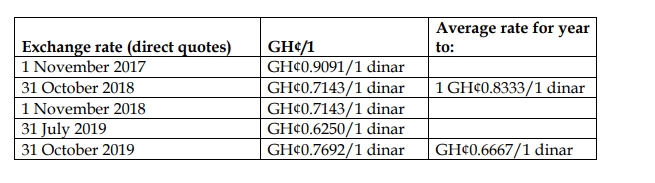
Medina Power Ltd has carried out certain transactions denominated in foreign currency during its financial year ended 31 October 2019 and has also conducted foreign operations through a foreign entity. Medina Power Ltd.’s functional and presentation currency is the cedi.

On 31 July 2019, Medina Power Ltd purchased goods from a foreign supplier for 16 million dinars. At 31 October 2019, the supplier had not yet been paid and the goods were still held in inventory by Medina Power Ltd.

On 31 July, Medina Power Ltd sold goods to a foreign customer for 8 million dinars, and it received payment for the goods in dinars on 31 October 2019.

Medina Power Ltd had also purchased an investment property on 1 November 2018 for 56 million dinars. At 31 October 2019, the investment property had a fair value of 48 million dinars. The company uses the fair value model in accounting for investment properties.

Medina Power Ltd wants advice on how to treat these transactions in the financial statements for the year ended 31 October 2019.

question table

Required:
Discuss the accounting treatment of the above transactions in accordance with the advice required by the directors. (You should show detailed workings as well as a discussion of the accounting treatment used.)


Inventory and payable

  • The inventory and trade payable would be recorded initially at GH¢10 million (16 million dinars x GH¢0.6250).
  • At the year-end on 31 October 2019, the amount payable is still outstanding. It should be re-translated at the closing rate to GH¢12.3 million (16 million dinars x GH¢0.7692).
  • This creates an exchange loss of GH¢2.3 million (12.3 – 10) which should be recognized in profit or loss.
  • Unless it has been impaired, the inventory (a non-monetary asset) should be recorded at GH¢10 million at the year-end.

Sale of goods

  • The sale of goods should be recorded at GH¢5 million (8 million dinars x GH¢0.6250) as revenue and as a trade receivable.
  • Payment in dinars was received on 31 October 2019 and the actual cedi value of the dinars received was GH¢6.2 million (8 million dinars x GH¢0.7692).
  • This creates a gain on exchange of GH¢1.2 million (6.2 – 5) which should be recognized in profit or loss.

Investment property

  • The investment property should be recognized on 1 November 2018 at GH¢40 million (56 million dinars x GH¢0.7143).
  • At the year-end on 31 October 2019, the property should be recognized at its fair value of GH¢36.9 million (48 million dinars x GH¢0.7692).
  • The fall in fair value (40 – 36.9 = 3.1) should be recognized in profit and loss as a loss on investment property.
  • The property is a non-monetary asset and when a gain or loss on a non-monetary item is recognized in profit or loss, the element of the gain or loss relating to exchange rates is also recognized in profit or loss.

Login or create a free account to see answers

Complete your registration to see answers

Find Related Questions by Tags, levels, etc.

Report an error

You're reporting an error for "CR – May 2020 – L3 – Q3a – Foreign Currency Transactions"

CR – May 2020 – L3 – Q3a – Foreign Currency Transactions

Foreign currency transactions related to purchases, sales, and investment property with exchange rate variations and reporting implications.

Medina Power Ltd has carried out certain transactions denominated in foreign currency during its financial year ended 31 October 2019 and has also conducted foreign operations through a foreign entity. Medina Power Ltd.’s functional and presentation currency is the cedi.

On 31 July 2019, Medina Power Ltd purchased goods from a foreign supplier for 16 million dinars. At 31 October 2019, the supplier had not yet been paid and the goods were still held in inventory by Medina Power Ltd.

On 31 July, Medina Power Ltd sold goods to a foreign customer for 8 million dinars, and it received payment for the goods in dinars on 31 October 2019.

Medina Power Ltd had also purchased an investment property on 1 November 2018 for 56 million dinars. At 31 October 2019, the investment property had a fair value of 48 million dinars. The company uses the fair value model in accounting for investment properties.

Medina Power Ltd wants advice on how to treat these transactions in the financial statements for the year ended 31 October 2019.

question table

Required:
Discuss the accounting treatment of the above transactions in accordance with the advice required by the directors. (You should show detailed workings as well as a discussion of the accounting treatment used.)


Inventory and payable

  • The inventory and trade payable would be recorded initially at GH¢10 million (16 million dinars x GH¢0.6250).
  • At the year-end on 31 October 2019, the amount payable is still outstanding. It should be re-translated at the closing rate to GH¢12.3 million (16 million dinars x GH¢0.7692).
  • This creates an exchange loss of GH¢2.3 million (12.3 – 10) which should be recognized in profit or loss.
  • Unless it has been impaired, the inventory (a non-monetary asset) should be recorded at GH¢10 million at the year-end.

Sale of goods

  • The sale of goods should be recorded at GH¢5 million (8 million dinars x GH¢0.6250) as revenue and as a trade receivable.
  • Payment in dinars was received on 31 October 2019 and the actual cedi value of the dinars received was GH¢6.2 million (8 million dinars x GH¢0.7692).
  • This creates a gain on exchange of GH¢1.2 million (6.2 – 5) which should be recognized in profit or loss.

Investment property

  • The investment property should be recognized on 1 November 2018 at GH¢40 million (56 million dinars x GH¢0.7143).
  • At the year-end on 31 October 2019, the property should be recognized at its fair value of GH¢36.9 million (48 million dinars x GH¢0.7692).
  • The fall in fair value (40 – 36.9 = 3.1) should be recognized in profit and loss as a loss on investment property.
  • The property is a non-monetary asset and when a gain or loss on a non-monetary item is recognized in profit or loss, the element of the gain or loss relating to exchange rates is also recognized in profit or loss.

Login or create a free account to see answers

Complete your registration to see answers

Find Related Questions by Tags, levels, etc.

Report an error

You're reporting an error for "CR – May 2020 – L3 – Q3a – Foreign Currency Transactions"

CR – May 2020 – Q3b(i) – Ethical Issues in Contract Bidding

This question requires a discussion on the ethical issues related to conflict of interest, confidentiality, and professional behavior in a contract bidding scenario.

You have just obtained your full membership with the Institute of Chartered Accountants (Ghana). Following this successful achievement, you have been appointed as the Head of Finance at Asasiyemedeh Company Limited, a Ghanaian company, which provides catering services. Your former employer, Akwaba Limited, is a large public sector organization operating in Accra, where, as the Financial Accountant, you had the opportunity to work on areas relating to financial accounting, procurement, contracts, and bids. One of Asasiyemedeh Company Limited’s major contracts is with Akwaba Limited, your former employer. The contract is now due for renewal, and Asasiyemedeh Company Limited is preparing a competitive bid for this contract.

You have been tasked to lead the team responsible for bidding for this contract, but you are concerned as a professional that you might breach confidentiality if you accept this role. You also suspect that your knowledge and experience of Akwaba Limited were seen as good reasons for appointing you to the position of Head of Finance at Asasiyemedeh Company Limited. You do not in any way want to let your new employer down as you are aware that the loss of such a major contract would have a significant effect on the financial performance of Asasiyemedeh Company Limited, and its performance-related bonus scheme for management members.

Required:
Discuss the ethical issues raised in the above scenario.

The ethical issues raised in the scenario include:

  1. Objectivity:
    There is a self-interest threat that arises due to the impact that losing Akwaba Limited’s contract would have on Asasiyemedeh Company Limited’s financial performance and reward policy. There is also an intimidation threat because other employees in the company may be affected by the financial implications of the contract not being renewed. Additionally, you may feel a strong desire to impress your new employer by helping to secure the renewal of the contract. The key question is whether you can safeguard against the self-interest threat posed by Asasiyemedeh Company Limited’s performance-related bonus scheme.
  2. Confidentiality:
    Clearly, there is a confidentiality threat here as you have worked with Akwaba Ltd in the past. Your previous employment with Akwaba Ltd has provided you with information which may be of value to Asasiyemedeh Company Limited. The principle of confidentiality prohibits the use of confidential information acquired as a result of your previous employment for your advantage or that of your current employer. While you have a responsibility to advance the legitimate aims of your employing organization, this should not extend to a breach of confidentiality. In this case, you (because of Asasiyemedeh Company Limited’s performance-related bonus) and Asasiyemedeh Company Limited stand to benefit from the confidential information about how bids are assessed at Akwaba Ltd. The principle would not be breached if you were in possession of information that was in the public domain, or if you were simply to use experience gained in your previous employment, so long as you do not use confidential knowledge that you acquired as a result of that employment.                           If you accept this role, can you ensure that you do not use confidential information relating to your former employer to your advantage or to the advantage of your current employer? You must be careful and professional as winning that contracts may leads to confidential breaches against you or your current employers perhaps from those bidders of the same contracts who might lose the bids
  3. Professional Behavior:
    You must demonstrate professionalism here. For example, what can you do to safeguard your reputation as a professional, the reputation of your employer, and the accountancy profession to which you belong? You must consider the Institute of Chartered Accountants (Ghana) code of ethics, applicable laws (procurement Act 914), and regulations, your current and previous contracts of employment, and your employer’s policies and procedures.

Login or create a free account to see answers

Complete your registration to see answers

Find Related Questions by Tags, levels, etc.

Report an error

You're reporting an error for "CR – May 2020 – Q3b(i) – Ethical Issues in Contract Bidding"

CR – May 2020 – Q3b(i) – Ethical Issues in Contract Bidding

This question requires a discussion on the ethical issues related to conflict of interest, confidentiality, and professional behavior in a contract bidding scenario.

You have just obtained your full membership with the Institute of Chartered Accountants (Ghana). Following this successful achievement, you have been appointed as the Head of Finance at Asasiyemedeh Company Limited, a Ghanaian company, which provides catering services. Your former employer, Akwaba Limited, is a large public sector organization operating in Accra, where, as the Financial Accountant, you had the opportunity to work on areas relating to financial accounting, procurement, contracts, and bids. One of Asasiyemedeh Company Limited’s major contracts is with Akwaba Limited, your former employer. The contract is now due for renewal, and Asasiyemedeh Company Limited is preparing a competitive bid for this contract.

You have been tasked to lead the team responsible for bidding for this contract, but you are concerned as a professional that you might breach confidentiality if you accept this role. You also suspect that your knowledge and experience of Akwaba Limited were seen as good reasons for appointing you to the position of Head of Finance at Asasiyemedeh Company Limited. You do not in any way want to let your new employer down as you are aware that the loss of such a major contract would have a significant effect on the financial performance of Asasiyemedeh Company Limited, and its performance-related bonus scheme for management members.

Required:
Discuss the ethical issues raised in the above scenario.

The ethical issues raised in the scenario include:

  1. Objectivity:
    There is a self-interest threat that arises due to the impact that losing Akwaba Limited’s contract would have on Asasiyemedeh Company Limited’s financial performance and reward policy. There is also an intimidation threat because other employees in the company may be affected by the financial implications of the contract not being renewed. Additionally, you may feel a strong desire to impress your new employer by helping to secure the renewal of the contract. The key question is whether you can safeguard against the self-interest threat posed by Asasiyemedeh Company Limited’s performance-related bonus scheme.
  2. Confidentiality:
    Clearly, there is a confidentiality threat here as you have worked with Akwaba Ltd in the past. Your previous employment with Akwaba Ltd has provided you with information which may be of value to Asasiyemedeh Company Limited. The principle of confidentiality prohibits the use of confidential information acquired as a result of your previous employment for your advantage or that of your current employer. While you have a responsibility to advance the legitimate aims of your employing organization, this should not extend to a breach of confidentiality. In this case, you (because of Asasiyemedeh Company Limited’s performance-related bonus) and Asasiyemedeh Company Limited stand to benefit from the confidential information about how bids are assessed at Akwaba Ltd. The principle would not be breached if you were in possession of information that was in the public domain, or if you were simply to use experience gained in your previous employment, so long as you do not use confidential knowledge that you acquired as a result of that employment.                           If you accept this role, can you ensure that you do not use confidential information relating to your former employer to your advantage or to the advantage of your current employer? You must be careful and professional as winning that contracts may leads to confidential breaches against you or your current employers perhaps from those bidders of the same contracts who might lose the bids
  3. Professional Behavior:
    You must demonstrate professionalism here. For example, what can you do to safeguard your reputation as a professional, the reputation of your employer, and the accountancy profession to which you belong? You must consider the Institute of Chartered Accountants (Ghana) code of ethics, applicable laws (procurement Act 914), and regulations, your current and previous contracts of employment, and your employer’s policies and procedures.

Login or create a free account to see answers

Complete your registration to see answers

Find Related Questions by Tags, levels, etc.

Report an error

You're reporting an error for "CR – May 2020 – Q3b(i) – Ethical Issues in Contract Bidding"

CR – May 2020 – Q3b(ii) – Ethical Actions in Contract Bidding

This question requires recommendations for maintaining ethical standards in a contract bidding situation involving a conflict of interest.

Recommend the possible courses of action that you will take in order to be ethically responsible as expected from a Professional Accountant.


Possible courses of action

  • You should discuss the situation and your obligations with your managing director in the first place and, ask for your involvement in the preparation of the contract bid to be limited. For example, you may be able to contribute to aspects of the bid that do not in any way require you to refer to confidential knowledge about your previous employment with Akwaba Ltd.
  • If the managing director fails to understand the conflict that you are facing, probably he is not in your profession, you should request that you both discuss the matter with the board chairman or another member of staff. During these discussions, you should refer to the company’s ethical code, if it has one, as well as that of the Institute of Chartered Accountants (Ghana).
  • If there are no other formal channels available, you should make the entire board aware of your dilemma by writing formally to them. If necessary, you must refuse to take part in the bid without necessary safeguards being implemented.
  • Ultimately, disassociating yourself from Asasiyemedeh Company Limited may be the only solution. However, before taking such a step, you should seek legal advice on your employment.
  • Rights and responsibilities (subject to the rules and guidance of the Institute of Chartered Accountants, (Ghana)).
  • You should document, in detail, the steps that you take in resolving your dilemma, in case your ethical judgment is challenged in future periods.
  • Looking at this issue from Asasiyemedeh Company Limited’s perspective, it may be appropriate to suggest to the managing director or the board of your employer that a policy on conflicts of interest be developed and that the remuneration and bonus policy be reviewed in light of this contract bid with Akwaba Ltd.

Login or create a free account to see answers

Complete your registration to see answers

Find Related Questions by Tags, levels, etc.

Report an error

You're reporting an error for "CR – May 2020 – Q3b(ii) – Ethical Actions in Contract Bidding"

CR – May 2020 – Q3b(ii) – Ethical Actions in Contract Bidding

This question requires recommendations for maintaining ethical standards in a contract bidding situation involving a conflict of interest.

Recommend the possible courses of action that you will take in order to be ethically responsible as expected from a Professional Accountant.


Possible courses of action

  • You should discuss the situation and your obligations with your managing director in the first place and, ask for your involvement in the preparation of the contract bid to be limited. For example, you may be able to contribute to aspects of the bid that do not in any way require you to refer to confidential knowledge about your previous employment with Akwaba Ltd.
  • If the managing director fails to understand the conflict that you are facing, probably he is not in your profession, you should request that you both discuss the matter with the board chairman or another member of staff. During these discussions, you should refer to the company’s ethical code, if it has one, as well as that of the Institute of Chartered Accountants (Ghana).
  • If there are no other formal channels available, you should make the entire board aware of your dilemma by writing formally to them. If necessary, you must refuse to take part in the bid without necessary safeguards being implemented.
  • Ultimately, disassociating yourself from Asasiyemedeh Company Limited may be the only solution. However, before taking such a step, you should seek legal advice on your employment.
  • Rights and responsibilities (subject to the rules and guidance of the Institute of Chartered Accountants, (Ghana)).
  • You should document, in detail, the steps that you take in resolving your dilemma, in case your ethical judgment is challenged in future periods.
  • Looking at this issue from Asasiyemedeh Company Limited’s perspective, it may be appropriate to suggest to the managing director or the board of your employer that a policy on conflicts of interest be developed and that the remuneration and bonus policy be reviewed in light of this contract bid with Akwaba Ltd.

Login or create a free account to see answers

Complete your registration to see answers

Find Related Questions by Tags, levels, etc.

Report an error

You're reporting an error for "CR – May 2020 – Q3b(ii) – Ethical Actions in Contract Bidding"

CR – May 2020 – L3 – Q1 – Consolidated Statement of Financial Position

Prepare the consolidated statement of financial position for Phato Ltd and its subsidiaries as at 30 September 2019, including relevant calculations for goodwill, non-controlling interest, and asset impairments.

Phato Ltd, is a Public Limited Liability Company which operates in the service sector in Ghana. Phato Ltd has a business relationship with two other Ghanaian companies, Sakara Ltd and Saadi Ltd, which are public limited liability companies too. The draft statements of financial position of these three companies are as below as at 30 September 2019.

Phato Ltd GH¢ million Sakara Ltd GH¢ million Saadi Ltd GH¢ million
Assets:
Non-current assets
Property, plant, and equipment 460.0 150.0
Investment in subsidiaries
Sakara Ltd 365.0
Saadi Ltd 160.0
Investment in Azuri Ltd 24.0
Intangible assets 99.0 15.0
Total Non-current assets 948.0 325.0
Current assets 447.5 240.0
Total assets 1,395.5 565.0
Equity and liabilities:
Equity:
Share capital 460.0 200.0
Other components of equity 36.5 18.5
Retained earnings 447.5 221.0
Total equity 944.0 439.5
Non-current liabilities 247.5 61.5
Current liabilities 204.0 64.0
Total liabilities 451.5 125.5
Total equity and liabilities 1,395.5 565.0

Additional relevant information:

  1. Phato Ltd, on 1 October 2017, acquired 60% of the equity interests of Sakara Ltd. The cost of the investment comprised cash of GH¢360 million. At acquisition, the fair value of the non-controlling interest in Sakara Ltd was estimated at GH¢146 million. The fair value of the identifiable net assets acquired totaled GH¢417.5 million, including retained earnings of GH¢159.5 million and other components of equity at GH¢13.5 million. The excess in fair value results from non-depreciable land.
  2. Sakara Ltd, on 1 October 2018, acquired 70% of Saadi Ltd for GH¢160 million. The fair value of non-controlling interest was estimated at GH¢36 million. The fair value of the identifiable net assets of Saadi Ltd at acquisition was GH¢181 million, retained earnings GH¢53 million, and other components of equity GH¢10 million.
  3. Phato Ltd acquired a 14% interest in Azuri Ltd for GH¢9 million on 1 October 2017. On 1 April 2019, Phato Ltd acquired an additional 16% interest in Azuri Ltd for GH¢13.5 million, achieving significant influence.
  4. Phato Ltd purchased patents for GH¢5 million and incurred other development costs for product development.
  5. Impairment tests were conducted on Sakara Ltd and Saadi Ltd.

Required:
Prepare the consolidated statement of financial position for the Phato Ltd Group as at 30 September 2019.

Phato Ltd Group
Consolidated Statement of Financial Position as at 30 September 2019

Assets GH¢ million
Non-current assets
Property, plant, and equipment (460 + 150 + 155 + 44.5 + 18) 827.5
Goodwill (W3) 93.5
Intangible assets (99 + 15 + 17.5 – 4.5 -13.5) 113.5
Investment in Azuri (W7) 25.25
Total non-current assets 1,059.75
Current assets 812.5
Total assets 1,872.25
Equity and Liabilities GH¢ million
Equity attributable to owners of parent
Share capital 460
Retained earnings (W5) 489.41
Other components of equity (W5) 38.05
Total Equity attributable to owners 987.46
Non-controlling interest (W4) 192.29
Total Equity 1,179.75
Non-current liabilities 355.5
Current liabilities 337.0
Total Liabilities 692.5
Total Equity and Liabilities 1,872.25

workings for answering


Login or create a free account to see answers

Complete your registration to see answers

Find Related Questions by Tags, levels, etc.

Report an error

You're reporting an error for "CR – May 2020 – L3 – Q1 – Consolidated Statement of Financial Position"

CR – May 2020 – L3 – Q1 – Consolidated Statement of Financial Position

Prepare the consolidated statement of financial position for Phato Ltd and its subsidiaries as at 30 September 2019, including relevant calculations for goodwill, non-controlling interest, and asset impairments.

Phato Ltd, is a Public Limited Liability Company which operates in the service sector in Ghana. Phato Ltd has a business relationship with two other Ghanaian companies, Sakara Ltd and Saadi Ltd, which are public limited liability companies too. The draft statements of financial position of these three companies are as below as at 30 September 2019.

Phato Ltd GH¢ million Sakara Ltd GH¢ million Saadi Ltd GH¢ million
Assets:
Non-current assets
Property, plant, and equipment 460.0 150.0
Investment in subsidiaries
Sakara Ltd 365.0
Saadi Ltd 160.0
Investment in Azuri Ltd 24.0
Intangible assets 99.0 15.0
Total Non-current assets 948.0 325.0
Current assets 447.5 240.0
Total assets 1,395.5 565.0
Equity and liabilities:
Equity:
Share capital 460.0 200.0
Other components of equity 36.5 18.5
Retained earnings 447.5 221.0
Total equity 944.0 439.5
Non-current liabilities 247.5 61.5
Current liabilities 204.0 64.0
Total liabilities 451.5 125.5
Total equity and liabilities 1,395.5 565.0

Additional relevant information:

  1. Phato Ltd, on 1 October 2017, acquired 60% of the equity interests of Sakara Ltd. The cost of the investment comprised cash of GH¢360 million. At acquisition, the fair value of the non-controlling interest in Sakara Ltd was estimated at GH¢146 million. The fair value of the identifiable net assets acquired totaled GH¢417.5 million, including retained earnings of GH¢159.5 million and other components of equity at GH¢13.5 million. The excess in fair value results from non-depreciable land.
  2. Sakara Ltd, on 1 October 2018, acquired 70% of Saadi Ltd for GH¢160 million. The fair value of non-controlling interest was estimated at GH¢36 million. The fair value of the identifiable net assets of Saadi Ltd at acquisition was GH¢181 million, retained earnings GH¢53 million, and other components of equity GH¢10 million.
  3. Phato Ltd acquired a 14% interest in Azuri Ltd for GH¢9 million on 1 October 2017. On 1 April 2019, Phato Ltd acquired an additional 16% interest in Azuri Ltd for GH¢13.5 million, achieving significant influence.
  4. Phato Ltd purchased patents for GH¢5 million and incurred other development costs for product development.
  5. Impairment tests were conducted on Sakara Ltd and Saadi Ltd.

Required:
Prepare the consolidated statement of financial position for the Phato Ltd Group as at 30 September 2019.

Phato Ltd Group
Consolidated Statement of Financial Position as at 30 September 2019

Assets GH¢ million
Non-current assets
Property, plant, and equipment (460 + 150 + 155 + 44.5 + 18) 827.5
Goodwill (W3) 93.5
Intangible assets (99 + 15 + 17.5 – 4.5 -13.5) 113.5
Investment in Azuri (W7) 25.25
Total non-current assets 1,059.75
Current assets 812.5
Total assets 1,872.25
Equity and Liabilities GH¢ million
Equity attributable to owners of parent
Share capital 460
Retained earnings (W5) 489.41
Other components of equity (W5) 38.05
Total Equity attributable to owners 987.46
Non-controlling interest (W4) 192.29
Total Equity 1,179.75
Non-current liabilities 355.5
Current liabilities 337.0
Total Liabilities 692.5
Total Equity and Liabilities 1,872.25

workings for answering


Login or create a free account to see answers

Complete your registration to see answers

Find Related Questions by Tags, levels, etc.

Report an error

You're reporting an error for "CR – May 2020 – L3 – Q1 – Consolidated Statement of Financial Position"

CR – May 2020 – L3 – Q2a – Government Grants for Factory Construction

Discuss the accounting treatment for a government grant received for the construction of a factory, showing calculations and relevant entries.

On 1 January 2018, Asankragua Ltd (Asankragua) applied to a government agency for a grant to assist with the construction of a factory in Enchi. The proposed construction cost of the factory was GH¢52 million and the company projected that 350 people would be employed after completion. The land was already owned by Asankragua.

On 1 March 2018, the government agency offered to grant a sum amounting to 25% of the factory’s construction cost to a maximum of GH¢13 million. The grant aid was to be advanced on completion and would be repayable on demand if total employment at the factory fell below 300 people within 5 years of completion.

At the financial year end, 31 March 2018, Asankragua had accepted the offer of grant aid and had signed contracts for the construction of the factory at a total cost of GH¢52 million. Construction work was due to commence on 1 April 2018.

By 31 March 2019, the factory had been completed on budget, 400 people were employed ready to commence manufacturing activities, and the government agency agreed that the conditions necessary for the drawdown of the grant had been met.

On 1 April 2019, the factory was brought into use. It was estimated that it would have a ten-year useful economic life. On 1 June 2019, the government agency paid over the agreed GH¢13 million. In addition, the company sought and was paid an employment grant of GH¢1.2 million as employment exceeded original projections. This is expected to be payable annually for 5 years in total, at a rate of GH¢12,000 per additional person employed over 300 in each year. There are no repayment provisions attached to the employment grant.

The directors of Asankragua expect employment levels to exceed 350 people for at least 4 further years from 31 March 2020.

Required:
Demonstrate, showing calculations and relevant entries, how Asankragua Ltd should record the above transactions and events in its financial statements for years ended 31 March 2018, 2019, and 2020.

Year ended 31 March 2018:
No accounting entry is made in this financial year, as no transaction has yet been entered into. A capital commitment exists and should be disclosed in the notes. The grant approval should be disclosed also.

Year ended 31 March 2019:
At this date, the factory should be recorded at its cost of GH¢52 million. As all conditions for the payment of the grant have been met, recognition should be made of this amount receivable also. As the factory has not yet been brought into use, no depreciation will be charged for the year. Similarly, no amortisation of the grant will take place in the period.

Recognition of factory:
Dr Property, plant & equipment: GH¢52 million
Cr Cash: GH¢52 million (New factory constructed at a cost of GH¢52 million)

Recognition of grant:
Option 1:
Dr Government grant receivable (current asset): GH¢13 million
Cr Property, plant & equipment: GH¢13 million (Government grant approved, not received yet)

Option 2:
Dr Government grant receivable (current asset): GH¢13 million
Cr Deferred income – current liability: GH¢1.3 million
Cr Deferred income – non-current liability: GH¢11.7 million (Government grant approved, not received yet)

Year ended 31 March 2020:
There are several transactions to record based on the new factory. These are (1) depreciation and (2) amortisation of the grant. In addition, the cash was received from the government agency.

Receipt of grant:
Dr Cash: GH¢13 million
Cr Government grant receivable: GH¢13 million (Receipt of cash grant from government agency)

Option 1 (Depreciation of factory):
Dr Profit or loss: GH¢3.9 million
Cr Accumulated Depreciation – PPE: GH¢3.9 million (Depreciation of the cost of factory net of grant over 10 years)

Option 2 (Depreciation of factory):
Dr Profit or loss: GH¢5.2 million
Cr Accumulated Depreciation – PPE: GH¢5.2 million (Depreciation of gross factory cost over 10 years)

Amortisation of grant:
Dr Deferred income: GH¢1.3 million
Cr Profit or loss: GH¢1.3 million (Amortization of grant over 10 years, reflecting the proportional expensing of the factory to which the grant relates)

The employment grant relates entirely to the cost of employing staff in that year. Hence it should be entirely recognized as income in the year ended 31 March 2020.

Recognition of employment grant:
Dr Cash: GH¢1.2 million
Cr Profit or loss: GH¢1.2 million (Recognition of employment grant as income as received)

Initial recognition of the factory in 2019: 1 mark
Page 19 of 28
Recognition of the grant in 2019: 2 marks
Treatment of receipt of grant in 2020: 2 marks
Depreciation of factory in 2020: 1 mark
Treatment of amortization of grant: 1.5 marks
Recognition of employment grant: 1.5 marks

Login or create a free account to see answers

Complete your registration to see answers

Find Related Questions by Tags, levels, etc.

Report an error

You're reporting an error for "CR – May 2020 – L3 – Q2a – Government Grants for Factory Construction"

CR – May 2020 – L3 – Q2a – Government Grants for Factory Construction

Discuss the accounting treatment for a government grant received for the construction of a factory, showing calculations and relevant entries.

On 1 January 2018, Asankragua Ltd (Asankragua) applied to a government agency for a grant to assist with the construction of a factory in Enchi. The proposed construction cost of the factory was GH¢52 million and the company projected that 350 people would be employed after completion. The land was already owned by Asankragua.

On 1 March 2018, the government agency offered to grant a sum amounting to 25% of the factory’s construction cost to a maximum of GH¢13 million. The grant aid was to be advanced on completion and would be repayable on demand if total employment at the factory fell below 300 people within 5 years of completion.

At the financial year end, 31 March 2018, Asankragua had accepted the offer of grant aid and had signed contracts for the construction of the factory at a total cost of GH¢52 million. Construction work was due to commence on 1 April 2018.

By 31 March 2019, the factory had been completed on budget, 400 people were employed ready to commence manufacturing activities, and the government agency agreed that the conditions necessary for the drawdown of the grant had been met.

On 1 April 2019, the factory was brought into use. It was estimated that it would have a ten-year useful economic life. On 1 June 2019, the government agency paid over the agreed GH¢13 million. In addition, the company sought and was paid an employment grant of GH¢1.2 million as employment exceeded original projections. This is expected to be payable annually for 5 years in total, at a rate of GH¢12,000 per additional person employed over 300 in each year. There are no repayment provisions attached to the employment grant.

The directors of Asankragua expect employment levels to exceed 350 people for at least 4 further years from 31 March 2020.

Required:
Demonstrate, showing calculations and relevant entries, how Asankragua Ltd should record the above transactions and events in its financial statements for years ended 31 March 2018, 2019, and 2020.

Year ended 31 March 2018:
No accounting entry is made in this financial year, as no transaction has yet been entered into. A capital commitment exists and should be disclosed in the notes. The grant approval should be disclosed also.

Year ended 31 March 2019:
At this date, the factory should be recorded at its cost of GH¢52 million. As all conditions for the payment of the grant have been met, recognition should be made of this amount receivable also. As the factory has not yet been brought into use, no depreciation will be charged for the year. Similarly, no amortisation of the grant will take place in the period.

Recognition of factory:
Dr Property, plant & equipment: GH¢52 million
Cr Cash: GH¢52 million (New factory constructed at a cost of GH¢52 million)

Recognition of grant:
Option 1:
Dr Government grant receivable (current asset): GH¢13 million
Cr Property, plant & equipment: GH¢13 million (Government grant approved, not received yet)

Option 2:
Dr Government grant receivable (current asset): GH¢13 million
Cr Deferred income – current liability: GH¢1.3 million
Cr Deferred income – non-current liability: GH¢11.7 million (Government grant approved, not received yet)

Year ended 31 March 2020:
There are several transactions to record based on the new factory. These are (1) depreciation and (2) amortisation of the grant. In addition, the cash was received from the government agency.

Receipt of grant:
Dr Cash: GH¢13 million
Cr Government grant receivable: GH¢13 million (Receipt of cash grant from government agency)

Option 1 (Depreciation of factory):
Dr Profit or loss: GH¢3.9 million
Cr Accumulated Depreciation – PPE: GH¢3.9 million (Depreciation of the cost of factory net of grant over 10 years)

Option 2 (Depreciation of factory):
Dr Profit or loss: GH¢5.2 million
Cr Accumulated Depreciation – PPE: GH¢5.2 million (Depreciation of gross factory cost over 10 years)

Amortisation of grant:
Dr Deferred income: GH¢1.3 million
Cr Profit or loss: GH¢1.3 million (Amortization of grant over 10 years, reflecting the proportional expensing of the factory to which the grant relates)

The employment grant relates entirely to the cost of employing staff in that year. Hence it should be entirely recognized as income in the year ended 31 March 2020.

Recognition of employment grant:
Dr Cash: GH¢1.2 million
Cr Profit or loss: GH¢1.2 million (Recognition of employment grant as income as received)

Initial recognition of the factory in 2019: 1 mark
Page 19 of 28
Recognition of the grant in 2019: 2 marks
Treatment of receipt of grant in 2020: 2 marks
Depreciation of factory in 2020: 1 mark
Treatment of amortization of grant: 1.5 marks
Recognition of employment grant: 1.5 marks

Login or create a free account to see answers

Complete your registration to see answers

Find Related Questions by Tags, levels, etc.

Report an error

You're reporting an error for "CR – May 2020 – L3 – Q2a – Government Grants for Factory Construction"

CR – May 2020 – L3 – Q2b – Capitalization of Borrowing Costs

Dompoase Ltd incurred the following borrowing costs during the financial year 2018:

GH¢’000
Overdraft interest 12
Foreign currency loan interest (correctly translated into GH¢) 84
Foreign currency loan exchange differences on capital 140

In addition, a three-year fixed-rate GH¢2 million loan was taken out on 1 January 2018 at 6.5%. A loan set-up fee was charged at GH¢20,000. This increased the effective interest rate on the loan to 6.88%.

Required:
Determine the maximum amount that could potentially be capitalized as borrowing costs during the period (assuming an asset was being financed using all available finance).


GH¢’000
Overdraft 12
Foreign currency loan interest 84
Foreign currency loan exchange differences on capital
Effective interest on loan ((2,000 – 20) x 6.88%) 136.2

The maximum amount to capitalize is GH¢232.2k.

Login or create a free account to see answers

Complete your registration to see answers

Find Related Questions by Tags, levels, etc.

Report an error

You're reporting an error for "CR – May 2020 – L3 – Q2b – Capitalization of Borrowing Costs"

CR – May 2020 – L3 – Q2b – Capitalization of Borrowing Costs

Dompoase Ltd incurred the following borrowing costs during the financial year 2018:

GH¢’000
Overdraft interest 12
Foreign currency loan interest (correctly translated into GH¢) 84
Foreign currency loan exchange differences on capital 140

In addition, a three-year fixed-rate GH¢2 million loan was taken out on 1 January 2018 at 6.5%. A loan set-up fee was charged at GH¢20,000. This increased the effective interest rate on the loan to 6.88%.

Required:
Determine the maximum amount that could potentially be capitalized as borrowing costs during the period (assuming an asset was being financed using all available finance).


GH¢’000
Overdraft 12
Foreign currency loan interest 84
Foreign currency loan exchange differences on capital
Effective interest on loan ((2,000 – 20) x 6.88%) 136.2

The maximum amount to capitalize is GH¢232.2k.

Login or create a free account to see answers

Complete your registration to see answers

Find Related Questions by Tags, levels, etc.

Report an error

You're reporting an error for "CR – May 2020 – L3 – Q2b – Capitalization of Borrowing Costs"

CR – May 2020 – L3 – Q2c – Defined Benefit Pension Plan

Recommend the accounting treatment for a defined benefit pension plan with supporting calculations.

Nzema prepares its financial statements in accordance with International Financial Reporting Standards (IFRS) with a financial year end of 31 December 2018. On 1 January 2018, Nzema commenced a defined benefit pension plan for a number of head office employees. Under the pension scheme, Nzema has an obligation to provide these staff with agreed post-employment benefits. Nzema carries the actuarial and investment risk associated with the pension scheme.

The following information has been compiled from workings by Nzema’s accounting staff and actuarial reports for the 2018 financial year:

GH¢
Interest income on plan assets 16,500
Employer contributions to plan 550,000
Current service cost 600,000
Interest on plan liability 18,000
Fair value of plan assets at 31/12/2018 580,000
Present value of plan obligation at 31/12/2018 620,000

The Accountant was not sure which accounting standard to apply when accounting for the pension scheme. The only adjustment made to account for the scheme was to expense the company’s contributions of GH¢550,000 for the 2018 financial year in the Statement of Profit or Loss and Other Comprehensive Income and to credit the ‘Cash’ account.

Required:
Recommend, with appropriate calculations, the necessary accounting treatment for this accounting issue.

The applicable accounting standard is IAS 19: Employee Benefits. Nzema’s pension plan is a defined benefit plan since Nzema has an obligation to provide agreed post-employment benefits and carries the actuarial and investment risk.

The employer contributions were accounted for incorrectly. Under IAS 19, a defined benefit liability (or asset) is recognized on the balance sheet as the present value of the defined benefit obligation minus the fair value of plan assets.

Workings – Calculation of Actuarial Gain/Loss:

Pension Asset:

Description GH¢
Opening balance 0
Return on assets 16,500
Employer contributions 550,000
Remeasurement – Actuarial Gain 13,500
Closing balance (31/12/2018) 580,000

Pension Liability:

Description GH¢
Opening balance 0
Interest Cost 18,000
Current Service Cost 600,000
Remeasurement – Actuarial Loss 2,000
Closing balance (31/12/2018) 620,000

Net Actuarial Gain:
GH¢13,500 (gain on pension assets) – GH¢2,000 (loss on pension liabilities) = GH¢11,500

Journal Entries:

  1. Net Interest Expense (Profit or Loss):
    Dr Net Interest Expense (Profit or Loss) GH¢1,500
    Cr Pension Liability GH¢1,500
    (Net interest expense: 18,000 – 16,500)
  2. Current Service Cost (Profit or Loss):
    Dr Current Service Cost GH¢600,000
    Cr Pension Liability GH¢600,000
    (Recognition of current service cost)
  3. Actuarial Gain (Other Comprehensive Income):
    Dr Pension Liability GH¢11,500
    Cr Remeasurement – Actuarial Gain (Other Comprehensive Income) GH¢11,500
    (Recognition of actuarial gain)
  4. Correction of Previous Accounting Treatment:
    Dr Pension Liability GH¢550,000
    Cr Pension Contribution Expense (Profit or Loss) GH¢550,000
    (Correcting previous entry where contributions were expensed)
  5. Identification of the appropriate standard to be applied: 1 mark
    Net interest expense to Profit or Loss: 1 mark
    Actuarial gain on pension asset: 1 mark
    Actuarial loss on pension liability: 1 mark
    Net actuarial gain to OCI: 1 mark
    Currents service cost: 1 mark
    (Total: 20 marks)

Login or create a free account to see answers

Complete your registration to see answers

Find Related Questions by Tags, levels, etc.

Report an error

You're reporting an error for "CR – May 2020 – L3 – Q2c – Defined Benefit Pension Plan"

CR – May 2020 – L3 – Q2c – Defined Benefit Pension Plan

Recommend the accounting treatment for a defined benefit pension plan with supporting calculations.

Nzema prepares its financial statements in accordance with International Financial Reporting Standards (IFRS) with a financial year end of 31 December 2018. On 1 January 2018, Nzema commenced a defined benefit pension plan for a number of head office employees. Under the pension scheme, Nzema has an obligation to provide these staff with agreed post-employment benefits. Nzema carries the actuarial and investment risk associated with the pension scheme.

The following information has been compiled from workings by Nzema’s accounting staff and actuarial reports for the 2018 financial year:

GH¢
Interest income on plan assets 16,500
Employer contributions to plan 550,000
Current service cost 600,000
Interest on plan liability 18,000
Fair value of plan assets at 31/12/2018 580,000
Present value of plan obligation at 31/12/2018 620,000

The Accountant was not sure which accounting standard to apply when accounting for the pension scheme. The only adjustment made to account for the scheme was to expense the company’s contributions of GH¢550,000 for the 2018 financial year in the Statement of Profit or Loss and Other Comprehensive Income and to credit the ‘Cash’ account.

Required:
Recommend, with appropriate calculations, the necessary accounting treatment for this accounting issue.

The applicable accounting standard is IAS 19: Employee Benefits. Nzema’s pension plan is a defined benefit plan since Nzema has an obligation to provide agreed post-employment benefits and carries the actuarial and investment risk.

The employer contributions were accounted for incorrectly. Under IAS 19, a defined benefit liability (or asset) is recognized on the balance sheet as the present value of the defined benefit obligation minus the fair value of plan assets.

Workings – Calculation of Actuarial Gain/Loss:

Pension Asset:

Description GH¢
Opening balance 0
Return on assets 16,500
Employer contributions 550,000
Remeasurement – Actuarial Gain 13,500
Closing balance (31/12/2018) 580,000

Pension Liability:

Description GH¢
Opening balance 0
Interest Cost 18,000
Current Service Cost 600,000
Remeasurement – Actuarial Loss 2,000
Closing balance (31/12/2018) 620,000

Net Actuarial Gain:
GH¢13,500 (gain on pension assets) – GH¢2,000 (loss on pension liabilities) = GH¢11,500

Journal Entries:

  1. Net Interest Expense (Profit or Loss):
    Dr Net Interest Expense (Profit or Loss) GH¢1,500
    Cr Pension Liability GH¢1,500
    (Net interest expense: 18,000 – 16,500)
  2. Current Service Cost (Profit or Loss):
    Dr Current Service Cost GH¢600,000
    Cr Pension Liability GH¢600,000
    (Recognition of current service cost)
  3. Actuarial Gain (Other Comprehensive Income):
    Dr Pension Liability GH¢11,500
    Cr Remeasurement – Actuarial Gain (Other Comprehensive Income) GH¢11,500
    (Recognition of actuarial gain)
  4. Correction of Previous Accounting Treatment:
    Dr Pension Liability GH¢550,000
    Cr Pension Contribution Expense (Profit or Loss) GH¢550,000
    (Correcting previous entry where contributions were expensed)
  5. Identification of the appropriate standard to be applied: 1 mark
    Net interest expense to Profit or Loss: 1 mark
    Actuarial gain on pension asset: 1 mark
    Actuarial loss on pension liability: 1 mark
    Net actuarial gain to OCI: 1 mark
    Currents service cost: 1 mark
    (Total: 20 marks)

Login or create a free account to see answers

Complete your registration to see answers

Find Related Questions by Tags, levels, etc.

Report an error

You're reporting an error for "CR – May 2020 – L3 – Q2c – Defined Benefit Pension Plan"

CR – May 2020 – Q4a – Capital Reduction Account

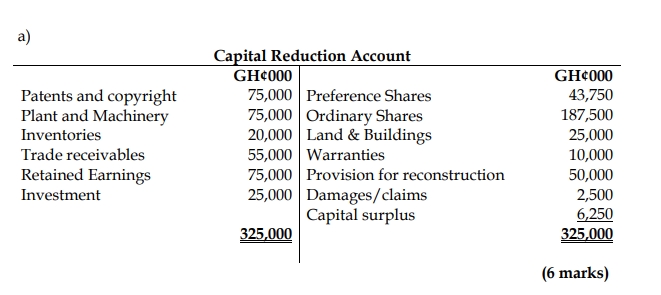
This question requires the preparation of a Capital Reduction Account for Sasasila Ltd following a reorganization.

Sasasila Ltd has been operating profitably for a number of years. However, in recent times, the company has been making losses. Below is the statement of financial position as at 30 June 2019:

Assets GH¢000
Non-Current Assets
Patents and copyrights 75,000
Land and buildings (net) 200,000
Plant and machinery (net) 150,000
Current Assets
Inventories 125,000
Trade receivables 125,000
Bank 37,500
Investments (cost) 100,000
Total Assets 812,500
Equity and liabilities:
Equity
Ordinary share capital (issued at GH¢10 each) 375,000
20% cumulative preference shares (issued at GH¢10 each) 175,000
Retained earnings (75,000)
Non-current Liabilities
15% Debentures 125,000
Current Liabilities
Interest on debentures 18,750
Trade payables 93,750
Provision for business restructuring 50,000
Provision for legal damages & claims 12,500
Provision for warranties 37,500
Total Equity and Liabilities 812,500

Additional relevant information: The following scheme of reconstruction was approved by all parties as well as the High Court with the exception of only one ordinary shareholder:

  1. The ordinary shares were to be reduced to GH¢5 per share.
  2. The preference shares were to be reduced to GH¢7.5 per share and arrears in dividends for three years were to be canceled from the company’s books.
  3. The fair values of the assets were agreed at the following values:
    • Patents and copyrights: Nil
    • Land and buildings: GH¢225,000
    • Plant and machinery: GH¢75,000
    • Investments: GH¢75,000
    • Inventories: GH¢105,000
    • Trade receivables: GH¢70,000
  4. The balance on retained earnings is to be eliminated in full.
  5. The liability for legal damages and claims was to be settled for GH¢10 million, and the provision for warranties reduced to GH¢27.5 million.
  6. The accrued debenture interest was to be paid in cash.
  7. Investments with a carrying amount of GH¢52.5 million were to be sold for cash at that value to strengthen the working capital position.
  8. The amount set aside for business restructuring was to be eliminated as well.
  9. The High Court directed a payment of GH¢0.2 million to a member who opposed the scheme for 50 ordinary shares held by him.

Prepare the Capital Reduction Account as at 30 June 2019.

answer to the question

Login or create a free account to see answers

Complete your registration to see answers

Find Related Questions by Tags, levels, etc.

Report an error

You're reporting an error for "CR – May 2020 – Q4a – Capital Reduction Account"

CR – May 2020 – Q4a – Capital Reduction Account

This question requires the preparation of a Capital Reduction Account for Sasasila Ltd following a reorganization.

Sasasila Ltd has been operating profitably for a number of years. However, in recent times, the company has been making losses. Below is the statement of financial position as at 30 June 2019:

Assets GH¢000
Non-Current Assets
Patents and copyrights 75,000
Land and buildings (net) 200,000
Plant and machinery (net) 150,000
Current Assets
Inventories 125,000
Trade receivables 125,000
Bank 37,500
Investments (cost) 100,000
Total Assets 812,500
Equity and liabilities:
Equity
Ordinary share capital (issued at GH¢10 each) 375,000
20% cumulative preference shares (issued at GH¢10 each) 175,000
Retained earnings (75,000)
Non-current Liabilities
15% Debentures 125,000
Current Liabilities
Interest on debentures 18,750
Trade payables 93,750
Provision for business restructuring 50,000
Provision for legal damages & claims 12,500
Provision for warranties 37,500
Total Equity and Liabilities 812,500

Additional relevant information: The following scheme of reconstruction was approved by all parties as well as the High Court with the exception of only one ordinary shareholder:

  1. The ordinary shares were to be reduced to GH¢5 per share.
  2. The preference shares were to be reduced to GH¢7.5 per share and arrears in dividends for three years were to be canceled from the company’s books.
  3. The fair values of the assets were agreed at the following values:
    • Patents and copyrights: Nil
    • Land and buildings: GH¢225,000
    • Plant and machinery: GH¢75,000
    • Investments: GH¢75,000
    • Inventories: GH¢105,000
    • Trade receivables: GH¢70,000
  4. The balance on retained earnings is to be eliminated in full.
  5. The liability for legal damages and claims was to be settled for GH¢10 million, and the provision for warranties reduced to GH¢27.5 million.
  6. The accrued debenture interest was to be paid in cash.
  7. Investments with a carrying amount of GH¢52.5 million were to be sold for cash at that value to strengthen the working capital position.
  8. The amount set aside for business restructuring was to be eliminated as well.
  9. The High Court directed a payment of GH¢0.2 million to a member who opposed the scheme for 50 ordinary shares held by him.

Prepare the Capital Reduction Account as at 30 June 2019.

answer to the question

Login or create a free account to see answers

Complete your registration to see answers

Find Related Questions by Tags, levels, etc.

Report an error

You're reporting an error for "CR – May 2020 – Q4a – Capital Reduction Account"

CR – May 2020 – Q4b – Statement of Financial Position for Sasasila Ltd

This question requires the preparation of a statement of financial position for Sasasila Ltd following its restructuring.

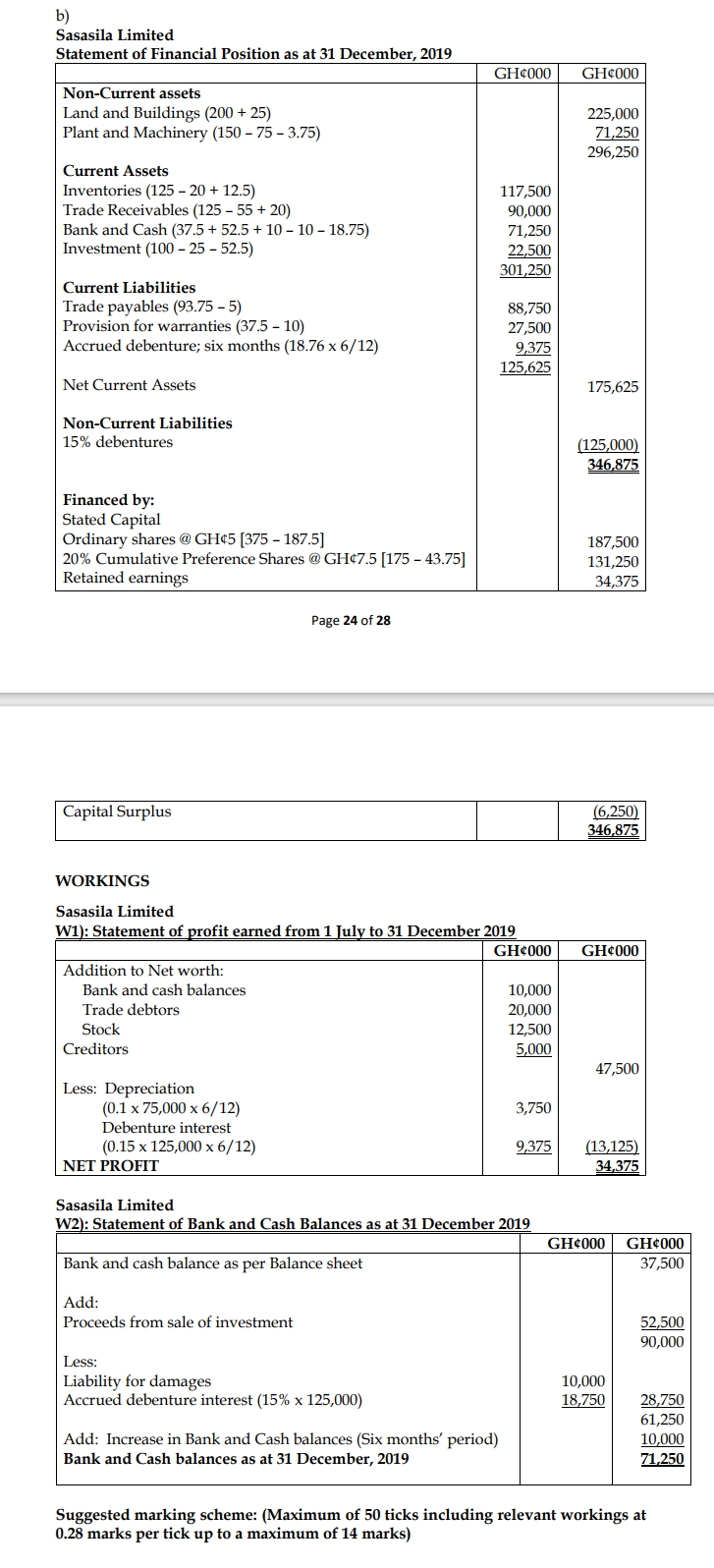
Prepare the statement of financial position as at 31 December 2019 for Sasasila Ltd.


Login or create a free account to see answers

Complete your registration to see answers

Find Related Questions by Tags, levels, etc.

Report an error

You're reporting an error for "CR – May 2020 – Q4b – Statement of Financial Position for Sasasila Ltd"

CR – May 2020 – Q4b – Statement of Financial Position for Sasasila Ltd

This question requires the preparation of a statement of financial position for Sasasila Ltd following its restructuring.

Prepare the statement of financial position as at 31 December 2019 for Sasasila Ltd.


Login or create a free account to see answers

Complete your registration to see answers

Find Related Questions by Tags, levels, etc.

Report an error

You're reporting an error for "CR – May 2020 – Q4b – Statement of Financial Position for Sasasila Ltd"

CR – May 2020 – Q5 – Financial Performance and Position of Bossman Ltd

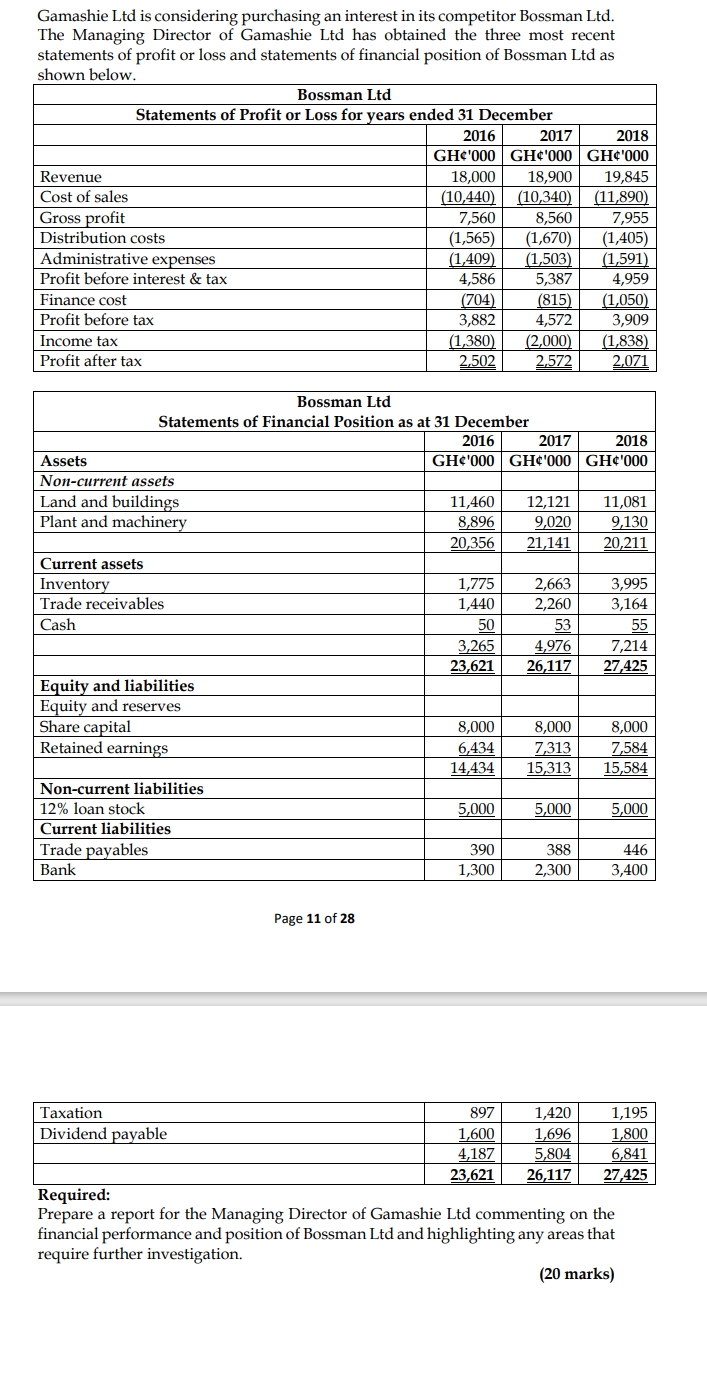
This question involves analyzing the financial performance and position of Bossman Ltd over three years using ratio analysis.

To: Managing Director, Gamashie Ltd
From: An Accountant
Date: 01/01/19
Subject: The Financial Position and Performance of Bossman Ltd


Introduction:

This report is based on the financial statements of Bossman Ltd for the years 2016, 2017, and 2018. It includes an analysis of the financial performance and position, with attention to key financial ratios calculated from the attached statements.


Financial Performance:

  • Revenue Growth: Bossman Ltd has experienced consistent revenue growth at approximately 5% per annum from GH¢18,000,000 in 2016 to GH¢19,845,000 in 2018.
  • Gross Profit Margin: The gross profit margin improved in 2017 but fell in 2018, indicating fluctuations in cost management. The margins were:
    • 2016: 42%
    • 2017: 45%
    • 2018: 40%
  • Operating Profit: Operating profit as a percentage of sales showed a similar trend to the gross profit margin. It increased from 25.5% in 2016 to 28.5% in 2017, before falling back to 25% in 2018. The decline in 2018 needs to be investigated to understand the reasons for the reduction.
  • Profit Before Tax (PBT): PBT decreased from GH¢3,882,000 in 2017 to GH¢3,909,000 in 2018, primarily due to increased finance costs. This indicates an increase in borrowing costs, which requires further investigation.

Financial Position:

  • Liquidity:
    • Current Ratio: The current ratio improved from 0.78 in 2016 to 1.05 in 2018, indicating better liquidity. However, it was below 1 in 2016 and 2017, suggesting that the company may have struggled to meet its short-term obligations during those years.
    • Quick Ratio: The quick ratio remained below 0.5 across all three years, highlighting potential issues with converting current assets (excluding inventory) into liquid assets. This indicates the company may be heavily reliant on inventory for liquidity.
  • Solvency:
    • Debt Ratio: The debt ratio increased steadily over the three years from 38.9% in 2016 to 43.2% in 2018, suggesting the company’s reliance on debt financing is increasing. This should be monitored, as it may impact the company’s financial flexibility.
  • Efficiency:
    • Receivables Collection Period: The collection period increased from 29.2 days in 2016 to 58.2 days in 2018. This could indicate deteriorating credit control or extended payment terms.
    • Inventory Turnover: Inventory turnover worsened, increasing from 62 days in 2016 to 122.6 days in 2018. This may indicate overstocking or slow-moving inventory, which ties up working capital.

Conclusion:

Bossman Ltd has shown consistent revenue growth but declining profitability. Liquidity has improved, but the quick ratio is concerning. The company’s growing reliance on debt and the extended receivables and inventory turnover periods should be investigated further to identify potential risks to financial stability.


Appendix – Ratio Analysis:

Ratios 2016 2017 2018
Gross Profit Margin 42% 45% 40%
Operating Profit Margin 25.5% 28.5% 25%
Return on Capital Employed 23.6% 27% 24.1%
Debt Ratio 38.9% 41.4% 43.2%
Current Ratio 0.78 0.86 1.05
Quick Ratio 0.36 0.40 0.47
Receivables Collection Period (days) 29.2 43.6 58.2
Inventory Turnover Period (days) 62 94 122.6

Login or create a free account to see answers

Complete your registration to see answers

Find Related Questions by Tags, levels, etc.

Report an error

You're reporting an error for "CR – May 2020 – Q5 – Financial Performance and Position of Bossman Ltd"

CR – May 2020 – Q5 – Financial Performance and Position of Bossman Ltd

This question involves analyzing the financial performance and position of Bossman Ltd over three years using ratio analysis.

To: Managing Director, Gamashie Ltd
From: An Accountant
Date: 01/01/19
Subject: The Financial Position and Performance of Bossman Ltd


Introduction:

This report is based on the financial statements of Bossman Ltd for the years 2016, 2017, and 2018. It includes an analysis of the financial performance and position, with attention to key financial ratios calculated from the attached statements.


Financial Performance:

  • Revenue Growth: Bossman Ltd has experienced consistent revenue growth at approximately 5% per annum from GH¢18,000,000 in 2016 to GH¢19,845,000 in 2018.
  • Gross Profit Margin: The gross profit margin improved in 2017 but fell in 2018, indicating fluctuations in cost management. The margins were:
    • 2016: 42%
    • 2017: 45%
    • 2018: 40%
  • Operating Profit: Operating profit as a percentage of sales showed a similar trend to the gross profit margin. It increased from 25.5% in 2016 to 28.5% in 2017, before falling back to 25% in 2018. The decline in 2018 needs to be investigated to understand the reasons for the reduction.
  • Profit Before Tax (PBT): PBT decreased from GH¢3,882,000 in 2017 to GH¢3,909,000 in 2018, primarily due to increased finance costs. This indicates an increase in borrowing costs, which requires further investigation.

Financial Position:

  • Liquidity:
    • Current Ratio: The current ratio improved from 0.78 in 2016 to 1.05 in 2018, indicating better liquidity. However, it was below 1 in 2016 and 2017, suggesting that the company may have struggled to meet its short-term obligations during those years.
    • Quick Ratio: The quick ratio remained below 0.5 across all three years, highlighting potential issues with converting current assets (excluding inventory) into liquid assets. This indicates the company may be heavily reliant on inventory for liquidity.
  • Solvency:
    • Debt Ratio: The debt ratio increased steadily over the three years from 38.9% in 2016 to 43.2% in 2018, suggesting the company’s reliance on debt financing is increasing. This should be monitored, as it may impact the company’s financial flexibility.
  • Efficiency:
    • Receivables Collection Period: The collection period increased from 29.2 days in 2016 to 58.2 days in 2018. This could indicate deteriorating credit control or extended payment terms.
    • Inventory Turnover: Inventory turnover worsened, increasing from 62 days in 2016 to 122.6 days in 2018. This may indicate overstocking or slow-moving inventory, which ties up working capital.

Conclusion:

Bossman Ltd has shown consistent revenue growth but declining profitability. Liquidity has improved, but the quick ratio is concerning. The company’s growing reliance on debt and the extended receivables and inventory turnover periods should be investigated further to identify potential risks to financial stability.


Appendix – Ratio Analysis:

Ratios 2016 2017 2018
Gross Profit Margin 42% 45% 40%
Operating Profit Margin 25.5% 28.5% 25%
Return on Capital Employed 23.6% 27% 24.1%
Debt Ratio 38.9% 41.4% 43.2%
Current Ratio 0.78 0.86 1.05
Quick Ratio 0.36 0.40 0.47
Receivables Collection Period (days) 29.2 43.6 58.2
Inventory Turnover Period (days) 62 94 122.6

Login or create a free account to see answers

Complete your registration to see answers

Find Related Questions by Tags, levels, etc.

Report an error

You're reporting an error for "CR – May 2020 – Q5 – Financial Performance and Position of Bossman Ltd"

FR – May 2020 – L2 – Q4b – Financial Performance Analysis

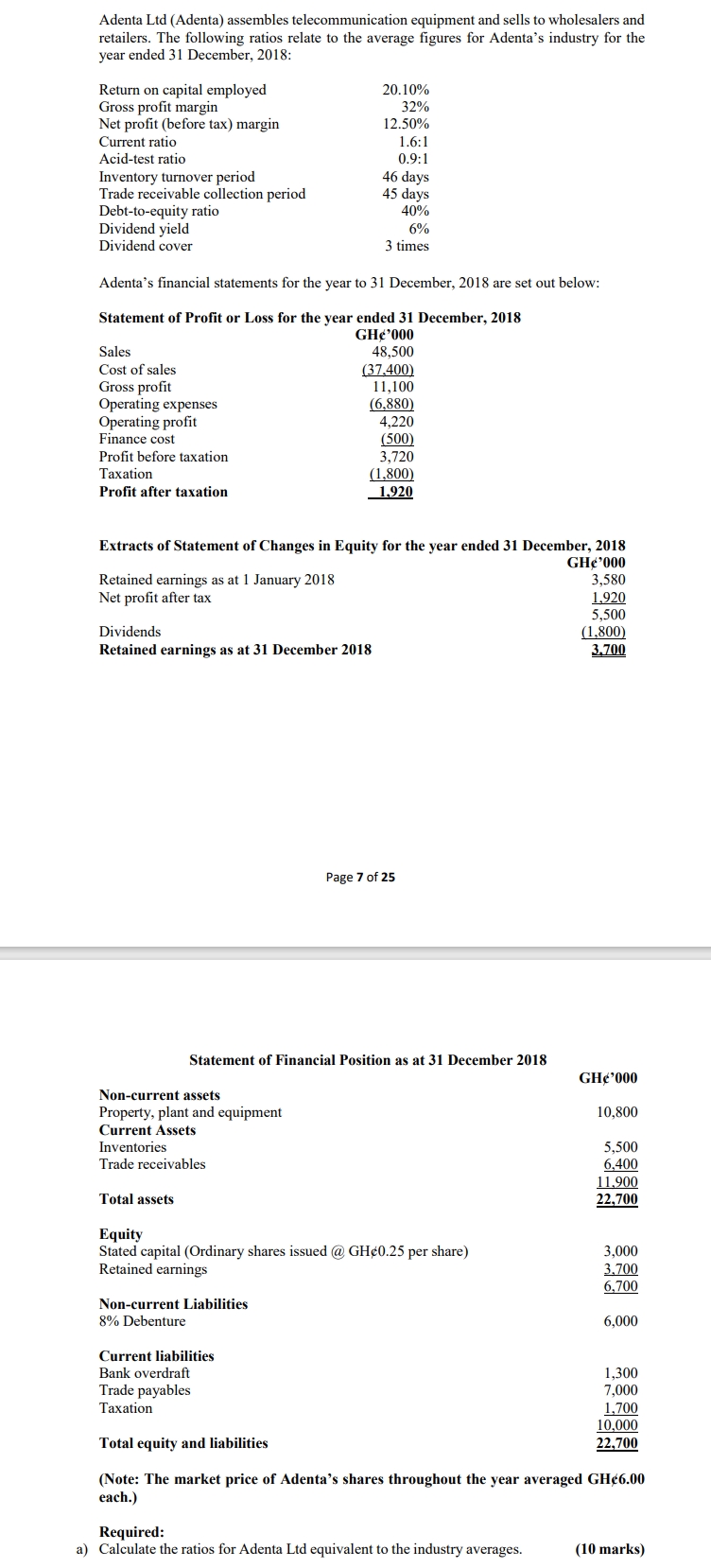
Write a report analyzing Adenta Ltd's financial performance in comparison to industry averages for 2018.

As the Financial Controller of Adenta Ltd, write a report to the Board of Directors analyzing the financial performance of Adenta Ltd based on a comparison with the industry averages. (10 marks)


Report to the Board of Directors
To: The Board
From: Financial Controller
Date: 1 November, 2019
Subject: Analysis of Adenta Limited’s financial performance compared to industry average for the year to 31 December, 2018.

Introduction
This report presents an analysis of the financial performance of Adenta Ltd compared to the industry averages.

Profitability
The return on capital employed of Adenta is impressive, being higher than the industry average. The company is employing its assets more efficiently and effectively in generating more revenue and hence income. However, gross profit margin and net profit margin of Adenta are comparatively lower than the industry averages. This implies that the company is incurring more costs in generating its revenue.

Liquidity
Adenta Ltd’s current and quick ratios are much worse than the industry average, and indeed far below expected norms. Current liquidity problems appear due to high levels of trade payables and a high bank overdraft. The high level of inventories constitutes to the poor acid test ratio and may be indicative of further obsolete inventories. The trade receivables’ collection figure is reasonable compared to the industry average.

Gearing
Adenta Ltd’s gearing is more than twice the level of the industry average. The company is making an overall return of 33.23% but only paying 8% interest on its loans notes. The gearing level may become a serious issue if Adenta becomes unable to maintain the finance costs. The company already has an overdraft and the ability to make further interest payments could be in doubt.

Investment Ratios
Despite reasonable profitability figures, Adenta’s dividend yield is poor compared to the sector average. From the extracts of the changes in equity, it can be seen that total dividends are GH¢1.8 million out of available profit for the year of only GH¢1.92 million, hence the very low dividend cover, compared to the industry average.

Conclusion
The company compares favourably with the industry average figures for profitability, however, the company’s liquidity and gearing position is quite poor and gives cause for concern.

Signed
Financial Controller


Login or create a free account to see answers

Complete your registration to see answers

Find Related Questions by Tags, levels, etc.

Report an error

You're reporting an error for "FR – May 2020 – L2 – Q4b – Financial Performance Analysis"

FR – May 2020 – L2 – Q4b – Financial Performance Analysis

Write a report analyzing Adenta Ltd's financial performance in comparison to industry averages for 2018.

As the Financial Controller of Adenta Ltd, write a report to the Board of Directors analyzing the financial performance of Adenta Ltd based on a comparison with the industry averages. (10 marks)


Report to the Board of Directors
To: The Board
From: Financial Controller
Date: 1 November, 2019
Subject: Analysis of Adenta Limited’s financial performance compared to industry average for the year to 31 December, 2018.

Introduction
This report presents an analysis of the financial performance of Adenta Ltd compared to the industry averages.

Profitability
The return on capital employed of Adenta is impressive, being higher than the industry average. The company is employing its assets more efficiently and effectively in generating more revenue and hence income. However, gross profit margin and net profit margin of Adenta are comparatively lower than the industry averages. This implies that the company is incurring more costs in generating its revenue.

Liquidity
Adenta Ltd’s current and quick ratios are much worse than the industry average, and indeed far below expected norms. Current liquidity problems appear due to high levels of trade payables and a high bank overdraft. The high level of inventories constitutes to the poor acid test ratio and may be indicative of further obsolete inventories. The trade receivables’ collection figure is reasonable compared to the industry average.

Gearing
Adenta Ltd’s gearing is more than twice the level of the industry average. The company is making an overall return of 33.23% but only paying 8% interest on its loans notes. The gearing level may become a serious issue if Adenta becomes unable to maintain the finance costs. The company already has an overdraft and the ability to make further interest payments could be in doubt.

Investment Ratios
Despite reasonable profitability figures, Adenta’s dividend yield is poor compared to the sector average. From the extracts of the changes in equity, it can be seen that total dividends are GH¢1.8 million out of available profit for the year of only GH¢1.92 million, hence the very low dividend cover, compared to the industry average.

Conclusion
The company compares favourably with the industry average figures for profitability, however, the company’s liquidity and gearing position is quite poor and gives cause for concern.

Signed
Financial Controller


Login or create a free account to see answers

Complete your registration to see answers

Find Related Questions by Tags, levels, etc.

Report an error

You're reporting an error for "FR – May 2020 – L2 – Q4b – Financial Performance Analysis"

FR – May 2020 – L2 – Q5b – Determining Liability Under the Conceptual Framework

This question tests the application of the conceptual framework to determine a liability in the event of an accident and subsequent lawsuit.

Amankwatia Ltd (Amankwatia) is a local construction company. The regulation in the construction sector requires employers to provide personal protective equipment for every employee. The company failed to do that, and a Plumber got involved in an accident in the course of work resulting in a serious and costly injury. The Plumber has sued the company.

The Solicitors of the company have prepared to vigorously defend the company in the lawsuit. They estimated that the company would have to make a compensation of GH¢17,000 to cover the injured party’s costs. A court decision, however, is not expected for at least a year.

Required:
What aspects of the conceptual framework might help you in determining the appropriate accounting treatment for this situation?


The definition of liability can help decide the accounting treatment of the situation. Under the conceptual framework, a liability is a present obligation of the entity arising from past events, the settlement of which is expected to result in an outflow from the entity of resources embodying economic benefits. In this case, the past event is the fall and injury to the pedestrian.

Present obligation depends on the probability of payment. The solicitors have advised that a GH¢17,000 loss is probable. Therefore, appropriate accounting involves recognizing a liability for the probable payment. An expense would also be recognized.

(Criteria for recognition of liability – 2 marks)
(Explanation of whether or not the liability can be recognized – 2 marks)


Login or create a free account to see answers

Complete your registration to see answers

Find Related Questions by Tags, levels, etc.

Report an error

You're reporting an error for "FR – May 2020 – L2 – Q5b – Determining Liability Under the Conceptual Framework"

FR – May 2020 – L2 – Q5b – Determining Liability Under the Conceptual Framework

This question tests the application of the conceptual framework to determine a liability in the event of an accident and subsequent lawsuit.

Amankwatia Ltd (Amankwatia) is a local construction company. The regulation in the construction sector requires employers to provide personal protective equipment for every employee. The company failed to do that, and a Plumber got involved in an accident in the course of work resulting in a serious and costly injury. The Plumber has sued the company.

The Solicitors of the company have prepared to vigorously defend the company in the lawsuit. They estimated that the company would have to make a compensation of GH¢17,000 to cover the injured party’s costs. A court decision, however, is not expected for at least a year.

Required:
What aspects of the conceptual framework might help you in determining the appropriate accounting treatment for this situation?


The definition of liability can help decide the accounting treatment of the situation. Under the conceptual framework, a liability is a present obligation of the entity arising from past events, the settlement of which is expected to result in an outflow from the entity of resources embodying economic benefits. In this case, the past event is the fall and injury to the pedestrian.

Present obligation depends on the probability of payment. The solicitors have advised that a GH¢17,000 loss is probable. Therefore, appropriate accounting involves recognizing a liability for the probable payment. An expense would also be recognized.

(Criteria for recognition of liability – 2 marks)
(Explanation of whether or not the liability can be recognized – 2 marks)


Login or create a free account to see answers

Complete your registration to see answers

Find Related Questions by Tags, levels, etc.

Report an error

You're reporting an error for "FR – May 2020 – L2 – Q5b – Determining Liability Under the Conceptual Framework"

FR – May 2020 – L2 – Q5c – Functional Currency

Discuss the functional currency concept in accordance with IAS 21 and how it is determined.

Discuss what is meant by the concept of an entity’s functional currency and how it may be determined in accordance with IAS 21: The Effects of Changes in Foreign Exchange Rates. (5 marks)


The functional currency of an entity can be understood literally as the currency in which the entity functions. The choice of functional currency is a judgment that must be made under IAS 21. The judgment involves assessing the facts and deciding the currency on which the entity is most economically dependent.

For most entities, the functional currency is a clear judgment, as most entities operate primarily within a single economy or currency zone. However, IAS 21 provides guidance when the judgment proves difficult, especially if more than one currency is important to the entity.

IAS 21 suggests the following factors in determining the functional currency:

  1. The currency that mainly influences sales prices for goods and services.
  2. The currency of the country whose competitive forces and regulations primarily determine sales prices.
  3. The currency that mainly influences labour, material, and other costs of providing goods or services.
  4. The currency in which funds from financing activities are generated.
  5. The currency in which receipts from operating activities are usually retained.

A combination of these factors is used to determine the functional currency that most closely reflects the primary economic environment in which the entity operates. (5 marks)

Login or create a free account to see answers

Complete your registration to see answers

Find Related Questions by Tags, levels, etc.

Report an error

You're reporting an error for "FR – May 2020 – L2 – Q5c – Functional Currency"

FR – May 2020 – L2 – Q5c – Functional Currency

Discuss the functional currency concept in accordance with IAS 21 and how it is determined.

Discuss what is meant by the concept of an entity’s functional currency and how it may be determined in accordance with IAS 21: The Effects of Changes in Foreign Exchange Rates. (5 marks)


The functional currency of an entity can be understood literally as the currency in which the entity functions. The choice of functional currency is a judgment that must be made under IAS 21. The judgment involves assessing the facts and deciding the currency on which the entity is most economically dependent.

For most entities, the functional currency is a clear judgment, as most entities operate primarily within a single economy or currency zone. However, IAS 21 provides guidance when the judgment proves difficult, especially if more than one currency is important to the entity.

IAS 21 suggests the following factors in determining the functional currency:

  1. The currency that mainly influences sales prices for goods and services.
  2. The currency of the country whose competitive forces and regulations primarily determine sales prices.
  3. The currency that mainly influences labour, material, and other costs of providing goods or services.
  4. The currency in which funds from financing activities are generated.
  5. The currency in which receipts from operating activities are usually retained.

A combination of these factors is used to determine the functional currency that most closely reflects the primary economic environment in which the entity operates. (5 marks)

Login or create a free account to see answers

Complete your registration to see answers

Find Related Questions by Tags, levels, etc.

Report an error

You're reporting an error for "FR – May 2020 – L2 – Q5c – Functional Currency"

FR – May 2020 – L2 – Q5d – Consolidated Financial Statements

Explain the concept of consolidated financial statements and identify exemptions from preparing them.

d) IFRS 10: Consolidated Financial Statements outlines the requirements for the preparation and presentation of consolidated financial statements, requiring entities to consolidate other entities it controls. The control principle in IFRS 10 sets out the following three elements of control: power over the investee; exposure, or rights, to variable returns from involvement with the investee; and the ability to use power over the investee to affect the amount of those returns.

i) What are Consolidated Financial Statements? (1 mark)

ii) Identify FOUR (4) circumstances under which a company may gain control over another company but will not be allowed to prepare consolidated financial statements. (4 marks)


According to IFRS 10: Consolidated Financial Statements are the financial statements of a parent and its subsidiaries presented as if they are the financial statements of a single economic entity. (1 mark)

ii) Exemption from preparing consolidated financial statements:

  • It is itself a wholly-owned subsidiary, or is partially-owned with the consent of the non-controlling interest (Non-Controlling interest);
  • Its debt or equity instruments are not publicly traded;
  • It did not or is not in the process of filing its financial statements with a regulatory organization for the purpose of publicly issuing financial instruments;
  • The ultimate or any intermediate parent produces consolidated financial statements available for public use that comply with IFRS. (4 marks)

Login or create a free account to see answers

Complete your registration to see answers

Find Related Questions by Tags, levels, etc.

Report an error

You're reporting an error for "FR – May 2020 – L2 – Q5d – Consolidated Financial Statements"

FR – May 2020 – L2 – Q5d – Consolidated Financial Statements

Explain the concept of consolidated financial statements and identify exemptions from preparing them.

d) IFRS 10: Consolidated Financial Statements outlines the requirements for the preparation and presentation of consolidated financial statements, requiring entities to consolidate other entities it controls. The control principle in IFRS 10 sets out the following three elements of control: power over the investee; exposure, or rights, to variable returns from involvement with the investee; and the ability to use power over the investee to affect the amount of those returns.

i) What are Consolidated Financial Statements? (1 mark)

ii) Identify FOUR (4) circumstances under which a company may gain control over another company but will not be allowed to prepare consolidated financial statements. (4 marks)


According to IFRS 10: Consolidated Financial Statements are the financial statements of a parent and its subsidiaries presented as if they are the financial statements of a single economic entity. (1 mark)

ii) Exemption from preparing consolidated financial statements:

  • It is itself a wholly-owned subsidiary, or is partially-owned with the consent of the non-controlling interest (Non-Controlling interest);
  • Its debt or equity instruments are not publicly traded;
  • It did not or is not in the process of filing its financial statements with a regulatory organization for the purpose of publicly issuing financial instruments;
  • The ultimate or any intermediate parent produces consolidated financial statements available for public use that comply with IFRS. (4 marks)

Login or create a free account to see answers

Complete your registration to see answers

Find Related Questions by Tags, levels, etc.

Report an error

You're reporting an error for "FR – May 2020 – L2 – Q5d – Consolidated Financial Statements"

FR – May 2020 – L2 – Q3c – Statement of Changes in Equity

Prepare a statement of changes in equity for Badu Trading Ltd, including dividends, revaluation reserves, and retained profits adjustments for the year ending May 31, 2020.

Prepare the following information in a form suitable for publication for Badu Trading Ltd’s financial statements for the year ended 31 May 2020.

c) Statement of changes in equity. (6 marks)


Login or create a free account to see answers

Complete your registration to see answers

Find Related Questions by Tags, levels, etc.

Report an error

You're reporting an error for "FR – May 2020 – L2 – Q3c – Statement of Changes in Equity"

FR – May 2020 – L2 – Q3c – Statement of Changes in Equity

Prepare a statement of changes in equity for Badu Trading Ltd, including dividends, revaluation reserves, and retained profits adjustments for the year ending May 31, 2020.

Prepare the following information in a form suitable for publication for Badu Trading Ltd’s financial statements for the year ended 31 May 2020.

c) Statement of changes in equity. (6 marks)


Login or create a free account to see answers

Complete your registration to see answers

Find Related Questions by Tags, levels, etc.

Report an error

You're reporting an error for "FR – May 2020 – L2 – Q3c – Statement of Changes in Equity"

SCS – May 2020 – L3 – Q8 – Identifying and assessing risk

Provide a recommendation on whether Customer Focused Ltd should accept Look and Like Ltd’s proposal, with supporting reasons.

Customer Focused Ltd has received a proposal from a potential supplier, Look and Like
Ltd, to provide fresh produce (Exhibit 2a) and is considering whether to accept. Kpakpo
Armah has written a note (Exhibit 2b) about Look and Like Ltd.
Required:
Using the information available, including information you feel relevant from your answer
to Section A:

Provide a recommendation, with reasons, as to whether the proposed contract should be accepted.

Recommendation on Look and Like Ltd’s Proposal

Recommendation:
Customer Focused Ltd should reject the contract proposal from Look and Like Ltd based on the following reasons:

  1. Financial Impact
    • While the proposal offers potential increases in sales and profit, the financial returns are marginal and not commensurate with the risks involved. The incremental profit after tax for 6 months is only GH¢41,800, with an annual profit increase of GH¢83,600. This level of return does not justify the significant commitment and operational demands posed by the contract, particularly over a three-year period.
  2. High Risk of Wastage
    • The contract assumes a wastage rate of 20%, which is typical for well-managed businesses. However, Customer Focused Ltd’s known inventory management issues may result in higher wastage, potentially eliminating any profit. If wastage increases to 26%, profitability could be wiped out, turning the contract into a loss-making venture. This poses a substantial risk, especially given the company’s current weaknesses in managing inventory.
  3. Operational and Management Challenges
    • Managing the fresh produce supply chain requires more intensive operational involvement, including quality control, proper handling, and regulatory compliance. The company currently lacks the systems and expertise to manage these challenges effectively, which increases the likelihood of operational failures and financial losses.
  4. Ethical Concerns
    • There are ethical concerns regarding Look and Like Ltd’s labor practices and relationships with suppliers, such as paying low wages and charging farmers fixed fees. These practices may not align with the long-term values or reputation of Customer Focused Ltd. Accepting this contract could expose the company to reputational risks, which may outweigh the short-term financial gains.

Conclusion:
The contract proposal from Look and Like Ltd introduces too many risks, both operational and ethical, and does not provide sufficient financial return to justify these risks. Customer Focused Ltd should reject the contract and focus on improving its internal processes and exploring alternative growth opportunities that align with its strategic objectives and ethical standards.

Login or create a free account to see answers

Complete your registration to see answers

Find Related Questions by Tags, levels, etc.

Report an error

You're reporting an error for "SCS – May 2020 – L3 – Q8 – Identifying and assessing risk"

SCS – May 2020 – L3 – Q8 – Identifying and assessing risk

This Question Has a Case Study: 

Provide a recommendation on whether Customer Focused Ltd should accept Look and Like Ltd’s proposal, with supporting reasons.

Customer Focused Ltd has received a proposal from a potential supplier, Look and Like
Ltd, to provide fresh produce (Exhibit 2a) and is considering whether to accept. Kpakpo
Armah has written a note (Exhibit 2b) about Look and Like Ltd.
Required:
Using the information available, including information you feel relevant from your answer
to Section A:

Provide a recommendation, with reasons, as to whether the proposed contract should be accepted.

Recommendation on Look and Like Ltd’s Proposal

Recommendation:
Customer Focused Ltd should reject the contract proposal from Look and Like Ltd based on the following reasons:

  1. Financial Impact
    • While the proposal offers potential increases in sales and profit, the financial returns are marginal and not commensurate with the risks involved. The incremental profit after tax for 6 months is only GH¢41,800, with an annual profit increase of GH¢83,600. This level of return does not justify the significant commitment and operational demands posed by the contract, particularly over a three-year period.
  2. High Risk of Wastage
    • The contract assumes a wastage rate of 20%, which is typical for well-managed businesses. However, Customer Focused Ltd’s known inventory management issues may result in higher wastage, potentially eliminating any profit. If wastage increases to 26%, profitability could be wiped out, turning the contract into a loss-making venture. This poses a substantial risk, especially given the company’s current weaknesses in managing inventory.
  3. Operational and Management Challenges
    • Managing the fresh produce supply chain requires more intensive operational involvement, including quality control, proper handling, and regulatory compliance. The company currently lacks the systems and expertise to manage these challenges effectively, which increases the likelihood of operational failures and financial losses.
  4. Ethical Concerns
    • There are ethical concerns regarding Look and Like Ltd’s labor practices and relationships with suppliers, such as paying low wages and charging farmers fixed fees. These practices may not align with the long-term values or reputation of Customer Focused Ltd. Accepting this contract could expose the company to reputational risks, which may outweigh the short-term financial gains.

Conclusion:
The contract proposal from Look and Like Ltd introduces too many risks, both operational and ethical, and does not provide sufficient financial return to justify these risks. Customer Focused Ltd should reject the contract and focus on improving its internal processes and exploring alternative growth opportunities that align with its strategic objectives and ethical standards.

Login or create a free account to see answers

Complete your registration to see answers

Find Related Questions by Tags, levels, etc.

Report an error

You're reporting an error for "SCS – May 2020 – L3 – Q8 – Identifying and assessing risk"

SCS – May 2020 – L3 – Q7 – Ethics and Social Responsibility

Identify and explain the ethical issues for Customer Focused Ltd in accepting Look and Like Ltd's proposed contract using an ethical decision model.

Customer Focused Ltd has received a proposal from a potential supplier, Look and Like
Ltd, to provide fresh produce (Exhibit 2a) and is considering whether to accept. Kpakpo
Armah has written a note (Exhibit 2b) about Look and Like Ltd.
Required:
Using the information available, including information you feel relevant from your answer
to Section A:

Explain any ethical issues for Customer Focused Ltd in accepting the proposed contract. Use an ethical decision model to support your explanation.

Ethical Issues in Accepting Look and Like Ltd’s Proposal

Introduction:

  • There is no indication that Look and Like Ltd has broken any laws, so the ethical concerns raised by Kpakpo Armah are primarily business ethics issues.
  • Customer Focused Ltd does not have an established ethical policy, making it important to assess the contract based on general business ethics principles.
  • Two ethical models that can guide decision-making in this scenario are Tucker’s Five-Question Model and the American Accounting Association (AAA) Model.

Application of Tucker’s Five-Question Model:

  1. Is it profitable?
    • The proposed contract is likely to generate profit for Customer Focused Ltd, but the margin is slim, and wastage management issues could reduce profitability. Answer: Yes, conditionally.
  2. Is it legal?
    • There are no explicit legal violations in the contract, but concerns about Look and Like Ltd’s labor practices (low wages) and fees charged to farmers might raise ethical questions. These practices, although potentially exploitative, do not breach any laws. Answer: Yes.
  3. Is it fair?
    • The fairness of Look and Like Ltd’s practices is questionable. While the company may be operating within legal limits, paying low wages and charging farmers fixed fees could be viewed as unethical, particularly if Customer Focused Ltd’s values prioritize fairness and worker treatment. The company must decide if these practices align with its own ethical standards. Answer: No.
  4. Is it right?
    • Even if legal, Look and Like Ltd’s practices may not align with what is ethically “right.” For example, charging suppliers to be on a preferred list can seem exploitative, and paying low wages may conflict with social responsibility expectations. Answer: Uncertain.
  5. Is it sustainable or environmentally sound?
    • There are concerns about the sustainability and environmental impact of Look and Like Ltd’s operations, especially related to produce wastage. Customer Focused Ltd should assess if engaging with a supplier that may not prioritize sustainability is in line with its long-term goals. Answer: Uncertain.

Application of the American Accounting Association (AAA) Model:

  1. What are the facts?
    • Look and Like Ltd is a fast-growing, aggressive company, but there are concerns about its employment practices and relationships with suppliers (low wages, fixed fees for farmers).
  2. What are the ethical issues?
    • Ethical concerns include low wages, supplier exploitation through fees, and the potential for environmental unsustainability in Look and Like Ltd’s practices.
  3. What moral principles, values, or norms are relevant?
    • Principles of fairness, social responsibility, and environmental sustainability are relevant. Customer Focused Ltd should evaluate whether it is comfortable working with a supplier that may not uphold these values.
  4. What are the possible alternatives?
    • Customer Focused Ltd could:
      1. Reject the contract based on ethical concerns.
      2. Investigate the facts further before making a decision.
      3. Engage Look and Like Ltd to encourage improvements in ethical practices.
  5. Which alternative is best?
    • The best alternative would depend on Customer Focused Ltd’s internal ethical values. If the company prioritizes fairness and sustainability, it might consider rejecting the contract or negotiating better practices with Look and Like Ltd.
  6. What are the consequences of each possible action?
    • Rejecting the contract: Customer Focused Ltd may lose out on a potentially profitable opportunity, but it would maintain its ethical standards.
    • Accepting the contract: It could lead to financial gain, but could damage Customer Focused Ltd’s reputation if Look and Like Ltd’s practices are seen as unethical.
  7. What is the decision?
    • Customer Focused Ltd must balance profitability with ethical concerns. If the ethical practices of Look and Like Ltd are deemed unacceptable, it may decide to reject the contract to maintain its integrity.

Conclusion: The decision to accept or reject the contract depends on Customer Focused Ltd’s stance on social responsibility and business ethics. While the contract may be legally sound and potentially profitable, the ethical issues surrounding Look and Like Ltd’s labor practices and relationships with suppliers may warrant rejecting the proposal or requesting further investigation.

Login or create a free account to see answers

Complete your registration to see answers

Find Related Questions by Tags, levels, etc.

Report an error

You're reporting an error for "SCS – May 2020 – L3 – Q7 – Ethics and Social Responsibility"

SCS – May 2020 – L3 – Q7 – Ethics and Social Responsibility

This Question Has a Case Study: 

Identify and explain the ethical issues for Customer Focused Ltd in accepting Look and Like Ltd's proposed contract using an ethical decision model.

Customer Focused Ltd has received a proposal from a potential supplier, Look and Like
Ltd, to provide fresh produce (Exhibit 2a) and is considering whether to accept. Kpakpo
Armah has written a note (Exhibit 2b) about Look and Like Ltd.
Required:
Using the information available, including information you feel relevant from your answer
to Section A:

Explain any ethical issues for Customer Focused Ltd in accepting the proposed contract. Use an ethical decision model to support your explanation.

Ethical Issues in Accepting Look and Like Ltd’s Proposal

Introduction:

  • There is no indication that Look and Like Ltd has broken any laws, so the ethical concerns raised by Kpakpo Armah are primarily business ethics issues.
  • Customer Focused Ltd does not have an established ethical policy, making it important to assess the contract based on general business ethics principles.
  • Two ethical models that can guide decision-making in this scenario are Tucker’s Five-Question Model and the American Accounting Association (AAA) Model.

Application of Tucker’s Five-Question Model:

  1. Is it profitable?
    • The proposed contract is likely to generate profit for Customer Focused Ltd, but the margin is slim, and wastage management issues could reduce profitability. Answer: Yes, conditionally.
  2. Is it legal?
    • There are no explicit legal violations in the contract, but concerns about Look and Like Ltd’s labor practices (low wages) and fees charged to farmers might raise ethical questions. These practices, although potentially exploitative, do not breach any laws. Answer: Yes.
  3. Is it fair?
    • The fairness of Look and Like Ltd’s practices is questionable. While the company may be operating within legal limits, paying low wages and charging farmers fixed fees could be viewed as unethical, particularly if Customer Focused Ltd’s values prioritize fairness and worker treatment. The company must decide if these practices align with its own ethical standards. Answer: No.
  4. Is it right?
    • Even if legal, Look and Like Ltd’s practices may not align with what is ethically “right.” For example, charging suppliers to be on a preferred list can seem exploitative, and paying low wages may conflict with social responsibility expectations. Answer: Uncertain.
  5. Is it sustainable or environmentally sound?
    • There are concerns about the sustainability and environmental impact of Look and Like Ltd’s operations, especially related to produce wastage. Customer Focused Ltd should assess if engaging with a supplier that may not prioritize sustainability is in line with its long-term goals. Answer: Uncertain.

Application of the American Accounting Association (AAA) Model:

  1. What are the facts?
    • Look and Like Ltd is a fast-growing, aggressive company, but there are concerns about its employment practices and relationships with suppliers (low wages, fixed fees for farmers).
  2. What are the ethical issues?
    • Ethical concerns include low wages, supplier exploitation through fees, and the potential for environmental unsustainability in Look and Like Ltd’s practices.
  3. What moral principles, values, or norms are relevant?
    • Principles of fairness, social responsibility, and environmental sustainability are relevant. Customer Focused Ltd should evaluate whether it is comfortable working with a supplier that may not uphold these values.
  4. What are the possible alternatives?
    • Customer Focused Ltd could:
      1. Reject the contract based on ethical concerns.
      2. Investigate the facts further before making a decision.
      3. Engage Look and Like Ltd to encourage improvements in ethical practices.
  5. Which alternative is best?
    • The best alternative would depend on Customer Focused Ltd’s internal ethical values. If the company prioritizes fairness and sustainability, it might consider rejecting the contract or negotiating better practices with Look and Like Ltd.
  6. What are the consequences of each possible action?
    • Rejecting the contract: Customer Focused Ltd may lose out on a potentially profitable opportunity, but it would maintain its ethical standards.
    • Accepting the contract: It could lead to financial gain, but could damage Customer Focused Ltd’s reputation if Look and Like Ltd’s practices are seen as unethical.
  7. What is the decision?
    • Customer Focused Ltd must balance profitability with ethical concerns. If the ethical practices of Look and Like Ltd are deemed unacceptable, it may decide to reject the contract to maintain its integrity.

Conclusion: The decision to accept or reject the contract depends on Customer Focused Ltd’s stance on social responsibility and business ethics. While the contract may be legally sound and potentially profitable, the ethical issues surrounding Look and Like Ltd’s labor practices and relationships with suppliers may warrant rejecting the proposal or requesting further investigation.

Login or create a free account to see answers

Complete your registration to see answers

Find Related Questions by Tags, levels, etc.

Report an error

You're reporting an error for "SCS – May 2020 – L3 – Q7 – Ethics and Social Responsibility"

SCS – May 2020 – L3 – Q6 – International Financial Management

Explain a suitable foreign currency risk hedging method for Customer Focused Ltd in relation to the Look and Like Ltd contract.

Customer Focused Ltd has received a proposal from a potential supplier, Look and Like
Ltd, to provide fresh produce (Exhibit 2a) and is considering whether to accept. Kpakpo
Armah has written a note (Exhibit 2b) about Look and Like Ltd.
Required:
Using the information available, including information you feel relevant from your answer
to Section A:

Describe an appropriate foreign currency risk management hedging method for the risk the company might face in the future as described in Exhibit 2b.

Foreign Currency Risk: Hedging Strategy

  • Identification of Transaction Risk
    Kpakpo Armah has described a transaction risk arising from foreign currency fluctuations. This risk occurs when a company commits to paying or receiving foreign currency at a future date, but the exchange rate fluctuates before settlement. In this case, the risk pertains to imported produce from Look and Like Ltd, which may be subject to foreign currency volatility. If the value of the foreign currency increases relative to the local currency, Customer Focused Ltd could face higher costs than anticipated.
  • Recommended Hedging Method: Forward Contracts
    forward exchange contract is the most suitable method to manage this foreign exchange risk. A forward contract allows Customer Focused Ltd to lock in an exchange rate today for a transaction that will occur at a future date. By fixing the exchange rate, the company can protect itself from unfavorable currency movements and gain certainty over its future cash flows related to the imported produce. This is a flexible and relatively simple approach that aligns with the company’s needs without introducing significant costs or complexity.

    How Forward Contracts Work:

    • A forward contract is an agreement between Customer Focused Ltd and a financial institution to exchange a specified amount of foreign currency at a pre-agreed rate on a set future date.
    • This eliminates the uncertainty of currency fluctuations and provides more predictable costs for the company’s purchases from Look and Like Ltd.
    • Given that the company has indicated that more expensive options like futures or options are not appropriate, a forward contract offers a cost-effective solution.
  • Exclusions of Other Hedging Methods:
    • Options and futures contracts are not recommended as they may introduce unnecessary complexity and cost for Customer Focused Ltd, which does not appear to have the financial sophistication to manage these instruments.
    • Money market hedges or currency swaps are also ruled out, as they would likely be too complex for the company given the relatively small size of the foreign currency transactions.

Conclusion:
By using forward contracts, Customer Focused Ltd can effectively mitigate foreign currency risk associated with the Look and Like Ltd contract, ensuring stable costs for imported produce and protecting the company from adverse exchange rate movements.

Login or create a free account to see answers

Complete your registration to see answers

Find Related Questions by Tags, levels, etc.

Report an error

You're reporting an error for "SCS – May 2020 – L3 – Q6 – International Financial Management"

SCS – May 2020 – L3 – Q6 – International Financial Management

This Question Has a Case Study: 

Explain a suitable foreign currency risk hedging method for Customer Focused Ltd in relation to the Look and Like Ltd contract.

Customer Focused Ltd has received a proposal from a potential supplier, Look and Like
Ltd, to provide fresh produce (Exhibit 2a) and is considering whether to accept. Kpakpo
Armah has written a note (Exhibit 2b) about Look and Like Ltd.
Required:
Using the information available, including information you feel relevant from your answer
to Section A:

Describe an appropriate foreign currency risk management hedging method for the risk the company might face in the future as described in Exhibit 2b.

Foreign Currency Risk: Hedging Strategy

  • Identification of Transaction Risk
    Kpakpo Armah has described a transaction risk arising from foreign currency fluctuations. This risk occurs when a company commits to paying or receiving foreign currency at a future date, but the exchange rate fluctuates before settlement. In this case, the risk pertains to imported produce from Look and Like Ltd, which may be subject to foreign currency volatility. If the value of the foreign currency increases relative to the local currency, Customer Focused Ltd could face higher costs than anticipated.
  • Recommended Hedging Method: Forward Contracts
    forward exchange contract is the most suitable method to manage this foreign exchange risk. A forward contract allows Customer Focused Ltd to lock in an exchange rate today for a transaction that will occur at a future date. By fixing the exchange rate, the company can protect itself from unfavorable currency movements and gain certainty over its future cash flows related to the imported produce. This is a flexible and relatively simple approach that aligns with the company’s needs without introducing significant costs or complexity.

    How Forward Contracts Work:

    • A forward contract is an agreement between Customer Focused Ltd and a financial institution to exchange a specified amount of foreign currency at a pre-agreed rate on a set future date.
    • This eliminates the uncertainty of currency fluctuations and provides more predictable costs for the company’s purchases from Look and Like Ltd.
    • Given that the company has indicated that more expensive options like futures or options are not appropriate, a forward contract offers a cost-effective solution.
  • Exclusions of Other Hedging Methods:
    • Options and futures contracts are not recommended as they may introduce unnecessary complexity and cost for Customer Focused Ltd, which does not appear to have the financial sophistication to manage these instruments.
    • Money market hedges or currency swaps are also ruled out, as they would likely be too complex for the company given the relatively small size of the foreign currency transactions.

Conclusion:
By using forward contracts, Customer Focused Ltd can effectively mitigate foreign currency risk associated with the Look and Like Ltd contract, ensuring stable costs for imported produce and protecting the company from adverse exchange rate movements.

Login or create a free account to see answers

Complete your registration to see answers

Find Related Questions by Tags, levels, etc.

Report an error

You're reporting an error for "SCS – May 2020 – L3 – Q6 – International Financial Management"

SCS – May 2020 – L3 – Q5 – Strategy implementation

Identify and explain the specific risks faced by Customer Focused Ltd in the proposed contract with Look and Like Ltd.

Customer Focused Ltd has received a proposal from a potential supplier, Look and Like
Ltd, to provide fresh produce (Exhibit 2a) and is considering whether to accept. Kpakpo
Armah has written a note (Exhibit 2b) about Look and Like Ltd.
Required:
Using the information available, including information you feel relevant from your answer
to Section A:

Identify and explain the specific risks faced by Customer Focused Ltd in the proposed contract.

Specific Risks in the Look and Like Ltd Proposal

  1. Inventory Management Risks
    • Expanding into fresh produce will require more active and vigilant inventory management. The company must place orders twice weekly and monitor inventory closely to minimize wastage. Any delay in returning substandard goods must be reported the day after delivery. These operational demands pose a significant risk given that Customer Focused Ltd has previously struggled with inventory management. Failure to control these risks could lead to increased wastage and financial loss.
  2. Product Shelf Life and Regulatory Responsibilities
    • Fresh produce has a limited shelf life and will require accurate handling, storage, and sales expertise. The company will also need to ensure compliance with regulatory labelling standards, including expiration dates. This may require the acquisition of better refrigeration units, which represents an additional cost and operational responsibility.
  3. Price and Demand Uncertainty
    • The prices for fresh produce are subject to fluctuations in market conditions, with the range for price changes set between 90% and 120%. This creates a significant downside risk for Customer Focused Ltd, as price increases are more likely than price decreases. Moreover, the contract does not guarantee that Customer Focused Ltd will be able to pass on these cost increases to its customers, which could impact profitability.
  4. Wastage and Mark-Up Risk
    • While the proposed mark-up is 40%, wastage is expected to be around 20%. If actual wastage exceeds this estimate, the contract could easily turn unprofitable. Given that Customer Focused Ltd has poor inventory management practices, the risk of exceeding the expected wastage levels is substantial, threatening the overall profitability of the contract.
  5. Operational Complexity and Hidden Costs
    • Managing fresh produce involves more operational complexity and higher demands on management and staff. This includes handling quality control, managing shelf replenishment, and meeting regulatory standards. These additional tasks introduce hidden risks that may not be fully accounted for in the financial projections.
  6. Financial Commitment and Long-Term Contract Risks
    • The contract is for a minimum of three years, locking Customer Focused Ltd into a long-term commitment. Over this period, the market for fresh produce may fluctuate, and unforeseen risks may arise, making it difficult for the company to exit the contract if it becomes financially unsustainable. The business should evaluate potential exit strategies and legal advice should be sought to assess the risks of early termination.
  7. Supplier Dependency and Payment Terms
    • Customer Focused Ltd will be dependent on Look and Like Ltd for regular supply of fresh produce. The payment terms of 30 days are relatively short, and penalties for non-payment are steep at 18%. Customer Focused Ltd will need to manage its cash flow carefully to avoid these penalties, which could exacerbate its liquidity issues.
  8. Product Liability and Legal Risks
    • Look and Like Ltd does not offer indemnities against any legal actions taken by customers who may suffer from issues related to the freshness of the produce. This exposes Customer Focused Ltd to potential product liability risks, which could result in legal costs or reputational damage.

Overall Assessment:

Customer Focused Ltd faces significant risks in accepting this contract. While the opportunity to expand into fresh produce could drive sales growth, the operational, financial, and legal risks may outweigh the benefits. The company should carefully assess its capacity to manage these risks before committing to the contract.

Login or create a free account to see answers

Complete your registration to see answers

Find Related Questions by Tags, levels, etc.

Report an error

You're reporting an error for "SCS – May 2020 – L3 – Q5 – Strategy implementation"

SCS – May 2020 – L3 – Q5 – Strategy implementation

This Question Has a Case Study: 

Identify and explain the specific risks faced by Customer Focused Ltd in the proposed contract with Look and Like Ltd.

Customer Focused Ltd has received a proposal from a potential supplier, Look and Like
Ltd, to provide fresh produce (Exhibit 2a) and is considering whether to accept. Kpakpo
Armah has written a note (Exhibit 2b) about Look and Like Ltd.
Required:
Using the information available, including information you feel relevant from your answer
to Section A:

Identify and explain the specific risks faced by Customer Focused Ltd in the proposed contract.

Specific Risks in the Look and Like Ltd Proposal

  1. Inventory Management Risks
    • Expanding into fresh produce will require more active and vigilant inventory management. The company must place orders twice weekly and monitor inventory closely to minimize wastage. Any delay in returning substandard goods must be reported the day after delivery. These operational demands pose a significant risk given that Customer Focused Ltd has previously struggled with inventory management. Failure to control these risks could lead to increased wastage and financial loss.
  2. Product Shelf Life and Regulatory Responsibilities
    • Fresh produce has a limited shelf life and will require accurate handling, storage, and sales expertise. The company will also need to ensure compliance with regulatory labelling standards, including expiration dates. This may require the acquisition of better refrigeration units, which represents an additional cost and operational responsibility.
  3. Price and Demand Uncertainty
    • The prices for fresh produce are subject to fluctuations in market conditions, with the range for price changes set between 90% and 120%. This creates a significant downside risk for Customer Focused Ltd, as price increases are more likely than price decreases. Moreover, the contract does not guarantee that Customer Focused Ltd will be able to pass on these cost increases to its customers, which could impact profitability.
  4. Wastage and Mark-Up Risk
    • While the proposed mark-up is 40%, wastage is expected to be around 20%. If actual wastage exceeds this estimate, the contract could easily turn unprofitable. Given that Customer Focused Ltd has poor inventory management practices, the risk of exceeding the expected wastage levels is substantial, threatening the overall profitability of the contract.
  5. Operational Complexity and Hidden Costs
    • Managing fresh produce involves more operational complexity and higher demands on management and staff. This includes handling quality control, managing shelf replenishment, and meeting regulatory standards. These additional tasks introduce hidden risks that may not be fully accounted for in the financial projections.
  6. Financial Commitment and Long-Term Contract Risks
    • The contract is for a minimum of three years, locking Customer Focused Ltd into a long-term commitment. Over this period, the market for fresh produce may fluctuate, and unforeseen risks may arise, making it difficult for the company to exit the contract if it becomes financially unsustainable. The business should evaluate potential exit strategies and legal advice should be sought to assess the risks of early termination.
  7. Supplier Dependency and Payment Terms
    • Customer Focused Ltd will be dependent on Look and Like Ltd for regular supply of fresh produce. The payment terms of 30 days are relatively short, and penalties for non-payment are steep at 18%. Customer Focused Ltd will need to manage its cash flow carefully to avoid these penalties, which could exacerbate its liquidity issues.
  8. Product Liability and Legal Risks
    • Look and Like Ltd does not offer indemnities against any legal actions taken by customers who may suffer from issues related to the freshness of the produce. This exposes Customer Focused Ltd to potential product liability risks, which could result in legal costs or reputational damage.

Overall Assessment:

Customer Focused Ltd faces significant risks in accepting this contract. While the opportunity to expand into fresh produce could drive sales growth, the operational, financial, and legal risks may outweigh the benefits. The company should carefully assess its capacity to manage these risks before committing to the contract.

Login or create a free account to see answers

Complete your registration to see answers

Find Related Questions by Tags, levels, etc.

Report an error

You're reporting an error for "SCS – May 2020 – L3 – Q5 – Strategy implementation"

SCS – May 2020 – L3 – Q4 – Financial Management

Evaluate the financial impact of the contract proposal from Look and Like Ltd for Customer Focused Ltd.

Customer Focused Ltd has received a proposal from a potential supplier, Look and Like
Ltd, to provide fresh produce (Exhibit 2a) and is considering whether to accept. Kpakpo
Armah has written a note (Exhibit 2b) about Look and Like Ltd.
Required:
Using the information available, including information you feel relevant from your answer
to Section A:

Evaluate the proposal in terms of the potential impact on the financial performance for Customer Focused Ltd. You should prepare an estimate of the incremental financial outcome of accepting the contract for the minimum order level by calculating a profit or loss after tax for the period up to 31 December 2020. Calculate and comment on the impact of contract acceptance on sales, operating profit, and profit after tax for the forecast figures for 2020 for Customer Focused Ltd. Include any further observations that you feel are relevant.

Workings:

  1. Cost of Sales: GH¢112,300 × 6 × 0.8 = GH¢539,000
  2. Sales (40% mark-up): GH¢539,000 × 1.4 = GH¢754,600
  3. Wastage (20% of purchases): GH¢112,300 × 6 × 0.2 = GH¢134,800

Comments:

  • The overall impact on sales, operating profit, and profit after tax are 7.51%3.22%, and 27.79%, respectively.
  • There is only a relatively small increase in profit after tax of GH¢41,800 over six months, or GH¢83,600 annually.
  • The minimum order value for six months is GH¢673,800, which represents a significant commitment, given that the contract term is three years. This suggests that profitability hinges on effective management of wastage and operating costs.
  • While the 40% mark-up on cost of sales appears attractive, wastage is expected to be 20%. If wastage rates exceed 20%, profitability could quickly turn into a loss. If wastage rises to 26%, profits would be eliminated.
  • According to Kpakpo Armah, wastage of 20% is typical for well-run businesses. However, Customer Focused Ltd is known to have inventory management issues, which may result in higher wastage.

Relevant Observations:

  • The proposed contract addresses some key opportunities identified in the SWOT analysis, such as expanding the product range and improving customer loyalty.
  • However, the contract also exacerbates some of the company’s existing weaknesses, including poor inventory management, which could lead to increased wastage and reduced profitability.
  • The financial gains from this contract may not justify the three-year commitment, particularly considering the significant risks involved.

Conclusion:

The proposal offers a potential increase in sales and profitability, but the risks associated with wastage, contract length, and operational challenges may outweigh the benefits. The company’s existing operational weaknesses, particularly in inventory management, pose a threat to successfully implementing this contract.

Login or create a free account to see answers

Complete your registration to see answers

Find Related Questions by Tags, levels, etc.

Report an error

You're reporting an error for "SCS – May 2020 – L3 – Q4 – Financial Management"

SCS – May 2020 – L3 – Q4 – Financial Management

This Question Has a Case Study: 

Evaluate the financial impact of the contract proposal from Look and Like Ltd for Customer Focused Ltd.

Customer Focused Ltd has received a proposal from a potential supplier, Look and Like
Ltd, to provide fresh produce (Exhibit 2a) and is considering whether to accept. Kpakpo
Armah has written a note (Exhibit 2b) about Look and Like Ltd.
Required:
Using the information available, including information you feel relevant from your answer
to Section A:

Evaluate the proposal in terms of the potential impact on the financial performance for Customer Focused Ltd. You should prepare an estimate of the incremental financial outcome of accepting the contract for the minimum order level by calculating a profit or loss after tax for the period up to 31 December 2020. Calculate and comment on the impact of contract acceptance on sales, operating profit, and profit after tax for the forecast figures for 2020 for Customer Focused Ltd. Include any further observations that you feel are relevant.

Workings:

  1. Cost of Sales: GH¢112,300 × 6 × 0.8 = GH¢539,000
  2. Sales (40% mark-up): GH¢539,000 × 1.4 = GH¢754,600
  3. Wastage (20% of purchases): GH¢112,300 × 6 × 0.2 = GH¢134,800

Comments:

  • The overall impact on sales, operating profit, and profit after tax are 7.51%3.22%, and 27.79%, respectively.
  • There is only a relatively small increase in profit after tax of GH¢41,800 over six months, or GH¢83,600 annually.
  • The minimum order value for six months is GH¢673,800, which represents a significant commitment, given that the contract term is three years. This suggests that profitability hinges on effective management of wastage and operating costs.
  • While the 40% mark-up on cost of sales appears attractive, wastage is expected to be 20%. If wastage rates exceed 20%, profitability could quickly turn into a loss. If wastage rises to 26%, profits would be eliminated.
  • According to Kpakpo Armah, wastage of 20% is typical for well-run businesses. However, Customer Focused Ltd is known to have inventory management issues, which may result in higher wastage.

Relevant Observations:

  • The proposed contract addresses some key opportunities identified in the SWOT analysis, such as expanding the product range and improving customer loyalty.
  • However, the contract also exacerbates some of the company’s existing weaknesses, including poor inventory management, which could lead to increased wastage and reduced profitability.
  • The financial gains from this contract may not justify the three-year commitment, particularly considering the significant risks involved.

Conclusion:

The proposal offers a potential increase in sales and profitability, but the risks associated with wastage, contract length, and operational challenges may outweigh the benefits. The company’s existing operational weaknesses, particularly in inventory management, pose a threat to successfully implementing this contract.

Login or create a free account to see answers

Complete your registration to see answers

Find Related Questions by Tags, levels, etc.

Report an error

You're reporting an error for "SCS – May 2020 – L3 – Q4 – Financial Management"

error: Content is protected !!