Series: MAY 2020

Search 500 + past questions and counting.
  • Filter by Professional Bodies

  • Filter by Subject

  • Filter by Series

  • Filter by Topics

  • Filter by Levels

  • Filter by Professional Bodies

  • Filter by Subject

  • Filter by Series

  • Filter by Topics

  • Filter by Levels

CR – May 2020 – Q3b(ii) – Ethical Actions in Contract Bidding

This question requires recommendations for maintaining ethical standards in a contract bidding situation involving a conflict of interest.

Recommend the possible courses of action that you will take in order to be ethically responsible as expected from a Professional Accountant.


Possible courses of action

  • You should discuss the situation and your obligations with your managing director in the first place and, ask for your involvement in the preparation of the contract bid to be limited. For example, you may be able to contribute to aspects of the bid that do not in any way require you to refer to confidential knowledge about your previous employment with Akwaba Ltd.
  • If the managing director fails to understand the conflict that you are facing, probably he is not in your profession, you should request that you both discuss the matter with the board chairman or another member of staff. During these discussions, you should refer to the company’s ethical code, if it has one, as well as that of the Institute of Chartered Accountants (Ghana).
  • If there are no other formal channels available, you should make the entire board aware of your dilemma by writing formally to them. If necessary, you must refuse to take part in the bid without necessary safeguards being implemented.
  • Ultimately, disassociating yourself from Asasiyemedeh Company Limited may be the only solution. However, before taking such a step, you should seek legal advice on your employment.
  • Rights and responsibilities (subject to the rules and guidance of the Institute of Chartered Accountants, (Ghana)).
  • You should document, in detail, the steps that you take in resolving your dilemma, in case your ethical judgment is challenged in future periods.
  • Looking at this issue from Asasiyemedeh Company Limited’s perspective, it may be appropriate to suggest to the managing director or the board of your employer that a policy on conflicts of interest be developed and that the remuneration and bonus policy be reviewed in light of this contract bid with Akwaba Ltd.

Login or create a free account to see answers

Complete your registration to see answers

Find Related Questions by Tags, levels, etc.

Report an error

You're reporting an error for "CR – May 2020 – Q3b(ii) – Ethical Actions in Contract Bidding"

CR – May 2020 – Q3b(ii) – Ethical Actions in Contract Bidding

This question requires recommendations for maintaining ethical standards in a contract bidding situation involving a conflict of interest.

Recommend the possible courses of action that you will take in order to be ethically responsible as expected from a Professional Accountant.


Possible courses of action

  • You should discuss the situation and your obligations with your managing director in the first place and, ask for your involvement in the preparation of the contract bid to be limited. For example, you may be able to contribute to aspects of the bid that do not in any way require you to refer to confidential knowledge about your previous employment with Akwaba Ltd.
  • If the managing director fails to understand the conflict that you are facing, probably he is not in your profession, you should request that you both discuss the matter with the board chairman or another member of staff. During these discussions, you should refer to the company’s ethical code, if it has one, as well as that of the Institute of Chartered Accountants (Ghana).
  • If there are no other formal channels available, you should make the entire board aware of your dilemma by writing formally to them. If necessary, you must refuse to take part in the bid without necessary safeguards being implemented.
  • Ultimately, disassociating yourself from Asasiyemedeh Company Limited may be the only solution. However, before taking such a step, you should seek legal advice on your employment.
  • Rights and responsibilities (subject to the rules and guidance of the Institute of Chartered Accountants, (Ghana)).
  • You should document, in detail, the steps that you take in resolving your dilemma, in case your ethical judgment is challenged in future periods.
  • Looking at this issue from Asasiyemedeh Company Limited’s perspective, it may be appropriate to suggest to the managing director or the board of your employer that a policy on conflicts of interest be developed and that the remuneration and bonus policy be reviewed in light of this contract bid with Akwaba Ltd.

Login or create a free account to see answers

Complete your registration to see answers

Find Related Questions by Tags, levels, etc.

Report an error

You're reporting an error for "CR – May 2020 – Q3b(ii) – Ethical Actions in Contract Bidding"

CR – May 2020 – L3 – Q1 – Consolidated Statement of Financial Position

Prepare the consolidated statement of financial position for Phato Ltd and its subsidiaries as at 30 September 2019, including relevant calculations for goodwill, non-controlling interest, and asset impairments.

Phato Ltd, is a Public Limited Liability Company which operates in the service sector in Ghana. Phato Ltd has a business relationship with two other Ghanaian companies, Sakara Ltd and Saadi Ltd, which are public limited liability companies too. The draft statements of financial position of these three companies are as below as at 30 September 2019.

Phato Ltd GH¢ million Sakara Ltd GH¢ million Saadi Ltd GH¢ million
Assets:
Non-current assets
Property, plant, and equipment 460.0 150.0
Investment in subsidiaries
Sakara Ltd 365.0
Saadi Ltd 160.0
Investment in Azuri Ltd 24.0
Intangible assets 99.0 15.0
Total Non-current assets 948.0 325.0
Current assets 447.5 240.0
Total assets 1,395.5 565.0
Equity and liabilities:
Equity:
Share capital 460.0 200.0
Other components of equity 36.5 18.5
Retained earnings 447.5 221.0
Total equity 944.0 439.5
Non-current liabilities 247.5 61.5
Current liabilities 204.0 64.0
Total liabilities 451.5 125.5
Total equity and liabilities 1,395.5 565.0

Additional relevant information:

  1. Phato Ltd, on 1 October 2017, acquired 60% of the equity interests of Sakara Ltd. The cost of the investment comprised cash of GH¢360 million. At acquisition, the fair value of the non-controlling interest in Sakara Ltd was estimated at GH¢146 million. The fair value of the identifiable net assets acquired totaled GH¢417.5 million, including retained earnings of GH¢159.5 million and other components of equity at GH¢13.5 million. The excess in fair value results from non-depreciable land.
  2. Sakara Ltd, on 1 October 2018, acquired 70% of Saadi Ltd for GH¢160 million. The fair value of non-controlling interest was estimated at GH¢36 million. The fair value of the identifiable net assets of Saadi Ltd at acquisition was GH¢181 million, retained earnings GH¢53 million, and other components of equity GH¢10 million.
  3. Phato Ltd acquired a 14% interest in Azuri Ltd for GH¢9 million on 1 October 2017. On 1 April 2019, Phato Ltd acquired an additional 16% interest in Azuri Ltd for GH¢13.5 million, achieving significant influence.
  4. Phato Ltd purchased patents for GH¢5 million and incurred other development costs for product development.
  5. Impairment tests were conducted on Sakara Ltd and Saadi Ltd.

Required:
Prepare the consolidated statement of financial position for the Phato Ltd Group as at 30 September 2019.

Phato Ltd Group
Consolidated Statement of Financial Position as at 30 September 2019

Assets GH¢ million
Non-current assets
Property, plant, and equipment (460 + 150 + 155 + 44.5 + 18) 827.5
Goodwill (W3) 93.5
Intangible assets (99 + 15 + 17.5 – 4.5 -13.5) 113.5
Investment in Azuri (W7) 25.25
Total non-current assets 1,059.75
Current assets 812.5
Total assets 1,872.25
Equity and Liabilities GH¢ million
Equity attributable to owners of parent
Share capital 460
Retained earnings (W5) 489.41
Other components of equity (W5) 38.05
Total Equity attributable to owners 987.46
Non-controlling interest (W4) 192.29
Total Equity 1,179.75
Non-current liabilities 355.5
Current liabilities 337.0
Total Liabilities 692.5
Total Equity and Liabilities 1,872.25

workings for answering


Login or create a free account to see answers

Complete your registration to see answers

Find Related Questions by Tags, levels, etc.

Report an error

You're reporting an error for "CR – May 2020 – L3 – Q1 – Consolidated Statement of Financial Position"

CR – May 2020 – L3 – Q1 – Consolidated Statement of Financial Position

Prepare the consolidated statement of financial position for Phato Ltd and its subsidiaries as at 30 September 2019, including relevant calculations for goodwill, non-controlling interest, and asset impairments.

Phato Ltd, is a Public Limited Liability Company which operates in the service sector in Ghana. Phato Ltd has a business relationship with two other Ghanaian companies, Sakara Ltd and Saadi Ltd, which are public limited liability companies too. The draft statements of financial position of these three companies are as below as at 30 September 2019.

Phato Ltd GH¢ million Sakara Ltd GH¢ million Saadi Ltd GH¢ million
Assets:
Non-current assets
Property, plant, and equipment 460.0 150.0
Investment in subsidiaries
Sakara Ltd 365.0
Saadi Ltd 160.0
Investment in Azuri Ltd 24.0
Intangible assets 99.0 15.0
Total Non-current assets 948.0 325.0
Current assets 447.5 240.0
Total assets 1,395.5 565.0
Equity and liabilities:
Equity:
Share capital 460.0 200.0
Other components of equity 36.5 18.5
Retained earnings 447.5 221.0
Total equity 944.0 439.5
Non-current liabilities 247.5 61.5
Current liabilities 204.0 64.0
Total liabilities 451.5 125.5
Total equity and liabilities 1,395.5 565.0

Additional relevant information:

  1. Phato Ltd, on 1 October 2017, acquired 60% of the equity interests of Sakara Ltd. The cost of the investment comprised cash of GH¢360 million. At acquisition, the fair value of the non-controlling interest in Sakara Ltd was estimated at GH¢146 million. The fair value of the identifiable net assets acquired totaled GH¢417.5 million, including retained earnings of GH¢159.5 million and other components of equity at GH¢13.5 million. The excess in fair value results from non-depreciable land.
  2. Sakara Ltd, on 1 October 2018, acquired 70% of Saadi Ltd for GH¢160 million. The fair value of non-controlling interest was estimated at GH¢36 million. The fair value of the identifiable net assets of Saadi Ltd at acquisition was GH¢181 million, retained earnings GH¢53 million, and other components of equity GH¢10 million.
  3. Phato Ltd acquired a 14% interest in Azuri Ltd for GH¢9 million on 1 October 2017. On 1 April 2019, Phato Ltd acquired an additional 16% interest in Azuri Ltd for GH¢13.5 million, achieving significant influence.
  4. Phato Ltd purchased patents for GH¢5 million and incurred other development costs for product development.
  5. Impairment tests were conducted on Sakara Ltd and Saadi Ltd.

Required:
Prepare the consolidated statement of financial position for the Phato Ltd Group as at 30 September 2019.

Phato Ltd Group
Consolidated Statement of Financial Position as at 30 September 2019

Assets GH¢ million
Non-current assets
Property, plant, and equipment (460 + 150 + 155 + 44.5 + 18) 827.5
Goodwill (W3) 93.5
Intangible assets (99 + 15 + 17.5 – 4.5 -13.5) 113.5
Investment in Azuri (W7) 25.25
Total non-current assets 1,059.75
Current assets 812.5
Total assets 1,872.25
Equity and Liabilities GH¢ million
Equity attributable to owners of parent
Share capital 460
Retained earnings (W5) 489.41
Other components of equity (W5) 38.05
Total Equity attributable to owners 987.46
Non-controlling interest (W4) 192.29
Total Equity 1,179.75
Non-current liabilities 355.5
Current liabilities 337.0
Total Liabilities 692.5
Total Equity and Liabilities 1,872.25

workings for answering


Login or create a free account to see answers

Complete your registration to see answers

Find Related Questions by Tags, levels, etc.

Report an error

You're reporting an error for "CR – May 2020 – L3 – Q1 – Consolidated Statement of Financial Position"

CR – May 2020 – L3 – Q2a – Government Grants for Factory Construction

Discuss the accounting treatment for a government grant received for the construction of a factory, showing calculations and relevant entries.

On 1 January 2018, Asankragua Ltd (Asankragua) applied to a government agency for a grant to assist with the construction of a factory in Enchi. The proposed construction cost of the factory was GH¢52 million and the company projected that 350 people would be employed after completion. The land was already owned by Asankragua.

On 1 March 2018, the government agency offered to grant a sum amounting to 25% of the factory’s construction cost to a maximum of GH¢13 million. The grant aid was to be advanced on completion and would be repayable on demand if total employment at the factory fell below 300 people within 5 years of completion.

At the financial year end, 31 March 2018, Asankragua had accepted the offer of grant aid and had signed contracts for the construction of the factory at a total cost of GH¢52 million. Construction work was due to commence on 1 April 2018.

By 31 March 2019, the factory had been completed on budget, 400 people were employed ready to commence manufacturing activities, and the government agency agreed that the conditions necessary for the drawdown of the grant had been met.

On 1 April 2019, the factory was brought into use. It was estimated that it would have a ten-year useful economic life. On 1 June 2019, the government agency paid over the agreed GH¢13 million. In addition, the company sought and was paid an employment grant of GH¢1.2 million as employment exceeded original projections. This is expected to be payable annually for 5 years in total, at a rate of GH¢12,000 per additional person employed over 300 in each year. There are no repayment provisions attached to the employment grant.

The directors of Asankragua expect employment levels to exceed 350 people for at least 4 further years from 31 March 2020.

Required:
Demonstrate, showing calculations and relevant entries, how Asankragua Ltd should record the above transactions and events in its financial statements for years ended 31 March 2018, 2019, and 2020.

Year ended 31 March 2018:
No accounting entry is made in this financial year, as no transaction has yet been entered into. A capital commitment exists and should be disclosed in the notes. The grant approval should be disclosed also.

Year ended 31 March 2019:
At this date, the factory should be recorded at its cost of GH¢52 million. As all conditions for the payment of the grant have been met, recognition should be made of this amount receivable also. As the factory has not yet been brought into use, no depreciation will be charged for the year. Similarly, no amortisation of the grant will take place in the period.

Recognition of factory:
Dr Property, plant & equipment: GH¢52 million
Cr Cash: GH¢52 million (New factory constructed at a cost of GH¢52 million)

Recognition of grant:
Option 1:
Dr Government grant receivable (current asset): GH¢13 million
Cr Property, plant & equipment: GH¢13 million (Government grant approved, not received yet)

Option 2:
Dr Government grant receivable (current asset): GH¢13 million
Cr Deferred income – current liability: GH¢1.3 million
Cr Deferred income – non-current liability: GH¢11.7 million (Government grant approved, not received yet)

Year ended 31 March 2020:
There are several transactions to record based on the new factory. These are (1) depreciation and (2) amortisation of the grant. In addition, the cash was received from the government agency.

Receipt of grant:
Dr Cash: GH¢13 million
Cr Government grant receivable: GH¢13 million (Receipt of cash grant from government agency)

Option 1 (Depreciation of factory):
Dr Profit or loss: GH¢3.9 million
Cr Accumulated Depreciation – PPE: GH¢3.9 million (Depreciation of the cost of factory net of grant over 10 years)

Option 2 (Depreciation of factory):
Dr Profit or loss: GH¢5.2 million
Cr Accumulated Depreciation – PPE: GH¢5.2 million (Depreciation of gross factory cost over 10 years)

Amortisation of grant:
Dr Deferred income: GH¢1.3 million
Cr Profit or loss: GH¢1.3 million (Amortization of grant over 10 years, reflecting the proportional expensing of the factory to which the grant relates)

The employment grant relates entirely to the cost of employing staff in that year. Hence it should be entirely recognized as income in the year ended 31 March 2020.

Recognition of employment grant:
Dr Cash: GH¢1.2 million
Cr Profit or loss: GH¢1.2 million (Recognition of employment grant as income as received)

Initial recognition of the factory in 2019: 1 mark
Page 19 of 28
Recognition of the grant in 2019: 2 marks
Treatment of receipt of grant in 2020: 2 marks
Depreciation of factory in 2020: 1 mark
Treatment of amortization of grant: 1.5 marks
Recognition of employment grant: 1.5 marks

Login or create a free account to see answers

Complete your registration to see answers

Find Related Questions by Tags, levels, etc.

Report an error

You're reporting an error for "CR – May 2020 – L3 – Q2a – Government Grants for Factory Construction"

CR – May 2020 – L3 – Q2a – Government Grants for Factory Construction

Discuss the accounting treatment for a government grant received for the construction of a factory, showing calculations and relevant entries.

On 1 January 2018, Asankragua Ltd (Asankragua) applied to a government agency for a grant to assist with the construction of a factory in Enchi. The proposed construction cost of the factory was GH¢52 million and the company projected that 350 people would be employed after completion. The land was already owned by Asankragua.

On 1 March 2018, the government agency offered to grant a sum amounting to 25% of the factory’s construction cost to a maximum of GH¢13 million. The grant aid was to be advanced on completion and would be repayable on demand if total employment at the factory fell below 300 people within 5 years of completion.

At the financial year end, 31 March 2018, Asankragua had accepted the offer of grant aid and had signed contracts for the construction of the factory at a total cost of GH¢52 million. Construction work was due to commence on 1 April 2018.

By 31 March 2019, the factory had been completed on budget, 400 people were employed ready to commence manufacturing activities, and the government agency agreed that the conditions necessary for the drawdown of the grant had been met.

On 1 April 2019, the factory was brought into use. It was estimated that it would have a ten-year useful economic life. On 1 June 2019, the government agency paid over the agreed GH¢13 million. In addition, the company sought and was paid an employment grant of GH¢1.2 million as employment exceeded original projections. This is expected to be payable annually for 5 years in total, at a rate of GH¢12,000 per additional person employed over 300 in each year. There are no repayment provisions attached to the employment grant.

The directors of Asankragua expect employment levels to exceed 350 people for at least 4 further years from 31 March 2020.

Required:
Demonstrate, showing calculations and relevant entries, how Asankragua Ltd should record the above transactions and events in its financial statements for years ended 31 March 2018, 2019, and 2020.

Year ended 31 March 2018:
No accounting entry is made in this financial year, as no transaction has yet been entered into. A capital commitment exists and should be disclosed in the notes. The grant approval should be disclosed also.

Year ended 31 March 2019:
At this date, the factory should be recorded at its cost of GH¢52 million. As all conditions for the payment of the grant have been met, recognition should be made of this amount receivable also. As the factory has not yet been brought into use, no depreciation will be charged for the year. Similarly, no amortisation of the grant will take place in the period.

Recognition of factory:
Dr Property, plant & equipment: GH¢52 million
Cr Cash: GH¢52 million (New factory constructed at a cost of GH¢52 million)

Recognition of grant:
Option 1:
Dr Government grant receivable (current asset): GH¢13 million
Cr Property, plant & equipment: GH¢13 million (Government grant approved, not received yet)

Option 2:
Dr Government grant receivable (current asset): GH¢13 million
Cr Deferred income – current liability: GH¢1.3 million
Cr Deferred income – non-current liability: GH¢11.7 million (Government grant approved, not received yet)

Year ended 31 March 2020:
There are several transactions to record based on the new factory. These are (1) depreciation and (2) amortisation of the grant. In addition, the cash was received from the government agency.

Receipt of grant:
Dr Cash: GH¢13 million
Cr Government grant receivable: GH¢13 million (Receipt of cash grant from government agency)

Option 1 (Depreciation of factory):
Dr Profit or loss: GH¢3.9 million
Cr Accumulated Depreciation – PPE: GH¢3.9 million (Depreciation of the cost of factory net of grant over 10 years)

Option 2 (Depreciation of factory):
Dr Profit or loss: GH¢5.2 million
Cr Accumulated Depreciation – PPE: GH¢5.2 million (Depreciation of gross factory cost over 10 years)

Amortisation of grant:
Dr Deferred income: GH¢1.3 million
Cr Profit or loss: GH¢1.3 million (Amortization of grant over 10 years, reflecting the proportional expensing of the factory to which the grant relates)

The employment grant relates entirely to the cost of employing staff in that year. Hence it should be entirely recognized as income in the year ended 31 March 2020.

Recognition of employment grant:
Dr Cash: GH¢1.2 million
Cr Profit or loss: GH¢1.2 million (Recognition of employment grant as income as received)

Initial recognition of the factory in 2019: 1 mark
Page 19 of 28
Recognition of the grant in 2019: 2 marks
Treatment of receipt of grant in 2020: 2 marks
Depreciation of factory in 2020: 1 mark
Treatment of amortization of grant: 1.5 marks
Recognition of employment grant: 1.5 marks

Login or create a free account to see answers

Complete your registration to see answers

Find Related Questions by Tags, levels, etc.

Report an error

You're reporting an error for "CR – May 2020 – L3 – Q2a – Government Grants for Factory Construction"

CR – May 2020 – L3 – Q2b – Capitalization of Borrowing Costs

Dompoase Ltd incurred the following borrowing costs during the financial year 2018:

GH¢’000
Overdraft interest 12
Foreign currency loan interest (correctly translated into GH¢) 84
Foreign currency loan exchange differences on capital 140

In addition, a three-year fixed-rate GH¢2 million loan was taken out on 1 January 2018 at 6.5%. A loan set-up fee was charged at GH¢20,000. This increased the effective interest rate on the loan to 6.88%.

Required:
Determine the maximum amount that could potentially be capitalized as borrowing costs during the period (assuming an asset was being financed using all available finance).


GH¢’000
Overdraft 12
Foreign currency loan interest 84
Foreign currency loan exchange differences on capital
Effective interest on loan ((2,000 – 20) x 6.88%) 136.2

The maximum amount to capitalize is GH¢232.2k.

Login or create a free account to see answers

Complete your registration to see answers

Find Related Questions by Tags, levels, etc.

Report an error

You're reporting an error for "CR – May 2020 – L3 – Q2b – Capitalization of Borrowing Costs"

CR – May 2020 – L3 – Q2b – Capitalization of Borrowing Costs

Dompoase Ltd incurred the following borrowing costs during the financial year 2018:

GH¢’000
Overdraft interest 12
Foreign currency loan interest (correctly translated into GH¢) 84
Foreign currency loan exchange differences on capital 140

In addition, a three-year fixed-rate GH¢2 million loan was taken out on 1 January 2018 at 6.5%. A loan set-up fee was charged at GH¢20,000. This increased the effective interest rate on the loan to 6.88%.

Required:
Determine the maximum amount that could potentially be capitalized as borrowing costs during the period (assuming an asset was being financed using all available finance).


GH¢’000
Overdraft 12
Foreign currency loan interest 84
Foreign currency loan exchange differences on capital
Effective interest on loan ((2,000 – 20) x 6.88%) 136.2

The maximum amount to capitalize is GH¢232.2k.

Login or create a free account to see answers

Complete your registration to see answers

Find Related Questions by Tags, levels, etc.

Report an error

You're reporting an error for "CR – May 2020 – L3 – Q2b – Capitalization of Borrowing Costs"

CR – May 2020 – L3 – Q2c – Defined Benefit Pension Plan

Recommend the accounting treatment for a defined benefit pension plan with supporting calculations.

Nzema prepares its financial statements in accordance with International Financial Reporting Standards (IFRS) with a financial year end of 31 December 2018. On 1 January 2018, Nzema commenced a defined benefit pension plan for a number of head office employees. Under the pension scheme, Nzema has an obligation to provide these staff with agreed post-employment benefits. Nzema carries the actuarial and investment risk associated with the pension scheme.

The following information has been compiled from workings by Nzema’s accounting staff and actuarial reports for the 2018 financial year:

GH¢
Interest income on plan assets 16,500
Employer contributions to plan 550,000
Current service cost 600,000
Interest on plan liability 18,000
Fair value of plan assets at 31/12/2018 580,000
Present value of plan obligation at 31/12/2018 620,000

The Accountant was not sure which accounting standard to apply when accounting for the pension scheme. The only adjustment made to account for the scheme was to expense the company’s contributions of GH¢550,000 for the 2018 financial year in the Statement of Profit or Loss and Other Comprehensive Income and to credit the ‘Cash’ account.

Required:
Recommend, with appropriate calculations, the necessary accounting treatment for this accounting issue.

The applicable accounting standard is IAS 19: Employee Benefits. Nzema’s pension plan is a defined benefit plan since Nzema has an obligation to provide agreed post-employment benefits and carries the actuarial and investment risk.

The employer contributions were accounted for incorrectly. Under IAS 19, a defined benefit liability (or asset) is recognized on the balance sheet as the present value of the defined benefit obligation minus the fair value of plan assets.

Workings – Calculation of Actuarial Gain/Loss:

Pension Asset:

Description GH¢
Opening balance 0
Return on assets 16,500
Employer contributions 550,000
Remeasurement – Actuarial Gain 13,500
Closing balance (31/12/2018) 580,000

Pension Liability:

Description GH¢
Opening balance 0
Interest Cost 18,000
Current Service Cost 600,000
Remeasurement – Actuarial Loss 2,000
Closing balance (31/12/2018) 620,000

Net Actuarial Gain:
GH¢13,500 (gain on pension assets) – GH¢2,000 (loss on pension liabilities) = GH¢11,500

Journal Entries:

  1. Net Interest Expense (Profit or Loss):
    Dr Net Interest Expense (Profit or Loss) GH¢1,500
    Cr Pension Liability GH¢1,500
    (Net interest expense: 18,000 – 16,500)
  2. Current Service Cost (Profit or Loss):
    Dr Current Service Cost GH¢600,000
    Cr Pension Liability GH¢600,000
    (Recognition of current service cost)
  3. Actuarial Gain (Other Comprehensive Income):
    Dr Pension Liability GH¢11,500
    Cr Remeasurement – Actuarial Gain (Other Comprehensive Income) GH¢11,500
    (Recognition of actuarial gain)
  4. Correction of Previous Accounting Treatment:
    Dr Pension Liability GH¢550,000
    Cr Pension Contribution Expense (Profit or Loss) GH¢550,000
    (Correcting previous entry where contributions were expensed)
  5. Identification of the appropriate standard to be applied: 1 mark
    Net interest expense to Profit or Loss: 1 mark
    Actuarial gain on pension asset: 1 mark
    Actuarial loss on pension liability: 1 mark
    Net actuarial gain to OCI: 1 mark
    Currents service cost: 1 mark
    (Total: 20 marks)

Login or create a free account to see answers

Complete your registration to see answers

Find Related Questions by Tags, levels, etc.

Report an error

You're reporting an error for "CR – May 2020 – L3 – Q2c – Defined Benefit Pension Plan"

CR – May 2020 – L3 – Q2c – Defined Benefit Pension Plan

Recommend the accounting treatment for a defined benefit pension plan with supporting calculations.

Nzema prepares its financial statements in accordance with International Financial Reporting Standards (IFRS) with a financial year end of 31 December 2018. On 1 January 2018, Nzema commenced a defined benefit pension plan for a number of head office employees. Under the pension scheme, Nzema has an obligation to provide these staff with agreed post-employment benefits. Nzema carries the actuarial and investment risk associated with the pension scheme.

The following information has been compiled from workings by Nzema’s accounting staff and actuarial reports for the 2018 financial year:

GH¢
Interest income on plan assets 16,500
Employer contributions to plan 550,000
Current service cost 600,000
Interest on plan liability 18,000
Fair value of plan assets at 31/12/2018 580,000
Present value of plan obligation at 31/12/2018 620,000

The Accountant was not sure which accounting standard to apply when accounting for the pension scheme. The only adjustment made to account for the scheme was to expense the company’s contributions of GH¢550,000 for the 2018 financial year in the Statement of Profit or Loss and Other Comprehensive Income and to credit the ‘Cash’ account.

Required:
Recommend, with appropriate calculations, the necessary accounting treatment for this accounting issue.

The applicable accounting standard is IAS 19: Employee Benefits. Nzema’s pension plan is a defined benefit plan since Nzema has an obligation to provide agreed post-employment benefits and carries the actuarial and investment risk.

The employer contributions were accounted for incorrectly. Under IAS 19, a defined benefit liability (or asset) is recognized on the balance sheet as the present value of the defined benefit obligation minus the fair value of plan assets.

Workings – Calculation of Actuarial Gain/Loss:

Pension Asset:

Description GH¢
Opening balance 0
Return on assets 16,500
Employer contributions 550,000
Remeasurement – Actuarial Gain 13,500
Closing balance (31/12/2018) 580,000

Pension Liability:

Description GH¢
Opening balance 0
Interest Cost 18,000
Current Service Cost 600,000
Remeasurement – Actuarial Loss 2,000
Closing balance (31/12/2018) 620,000

Net Actuarial Gain:
GH¢13,500 (gain on pension assets) – GH¢2,000 (loss on pension liabilities) = GH¢11,500

Journal Entries:

  1. Net Interest Expense (Profit or Loss):
    Dr Net Interest Expense (Profit or Loss) GH¢1,500
    Cr Pension Liability GH¢1,500
    (Net interest expense: 18,000 – 16,500)
  2. Current Service Cost (Profit or Loss):
    Dr Current Service Cost GH¢600,000
    Cr Pension Liability GH¢600,000
    (Recognition of current service cost)
  3. Actuarial Gain (Other Comprehensive Income):
    Dr Pension Liability GH¢11,500
    Cr Remeasurement – Actuarial Gain (Other Comprehensive Income) GH¢11,500
    (Recognition of actuarial gain)
  4. Correction of Previous Accounting Treatment:
    Dr Pension Liability GH¢550,000
    Cr Pension Contribution Expense (Profit or Loss) GH¢550,000
    (Correcting previous entry where contributions were expensed)
  5. Identification of the appropriate standard to be applied: 1 mark
    Net interest expense to Profit or Loss: 1 mark
    Actuarial gain on pension asset: 1 mark
    Actuarial loss on pension liability: 1 mark
    Net actuarial gain to OCI: 1 mark
    Currents service cost: 1 mark
    (Total: 20 marks)

Login or create a free account to see answers

Complete your registration to see answers

Find Related Questions by Tags, levels, etc.

Report an error

You're reporting an error for "CR – May 2020 – L3 – Q2c – Defined Benefit Pension Plan"

CR – May 2020 – L3 – Q3a – Foreign Currency Transactions

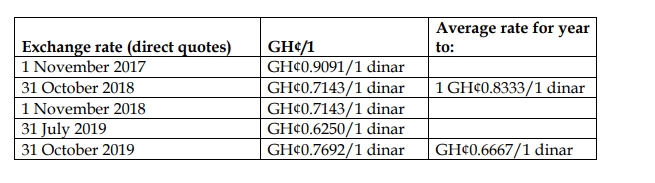
Foreign currency transactions related to purchases, sales, and investment property with exchange rate variations and reporting implications.

Medina Power Ltd has carried out certain transactions denominated in foreign currency during its financial year ended 31 October 2019 and has also conducted foreign operations through a foreign entity. Medina Power Ltd.’s functional and presentation currency is the cedi.

On 31 July 2019, Medina Power Ltd purchased goods from a foreign supplier for 16 million dinars. At 31 October 2019, the supplier had not yet been paid and the goods were still held in inventory by Medina Power Ltd.

On 31 July, Medina Power Ltd sold goods to a foreign customer for 8 million dinars, and it received payment for the goods in dinars on 31 October 2019.

Medina Power Ltd had also purchased an investment property on 1 November 2018 for 56 million dinars. At 31 October 2019, the investment property had a fair value of 48 million dinars. The company uses the fair value model in accounting for investment properties.

Medina Power Ltd wants advice on how to treat these transactions in the financial statements for the year ended 31 October 2019.

question table

Required:
Discuss the accounting treatment of the above transactions in accordance with the advice required by the directors. (You should show detailed workings as well as a discussion of the accounting treatment used.)


Inventory and payable

  • The inventory and trade payable would be recorded initially at GH¢10 million (16 million dinars x GH¢0.6250).
  • At the year-end on 31 October 2019, the amount payable is still outstanding. It should be re-translated at the closing rate to GH¢12.3 million (16 million dinars x GH¢0.7692).
  • This creates an exchange loss of GH¢2.3 million (12.3 – 10) which should be recognized in profit or loss.
  • Unless it has been impaired, the inventory (a non-monetary asset) should be recorded at GH¢10 million at the year-end.

Sale of goods

  • The sale of goods should be recorded at GH¢5 million (8 million dinars x GH¢0.6250) as revenue and as a trade receivable.
  • Payment in dinars was received on 31 October 2019 and the actual cedi value of the dinars received was GH¢6.2 million (8 million dinars x GH¢0.7692).
  • This creates a gain on exchange of GH¢1.2 million (6.2 – 5) which should be recognized in profit or loss.

Investment property

  • The investment property should be recognized on 1 November 2018 at GH¢40 million (56 million dinars x GH¢0.7143).
  • At the year-end on 31 October 2019, the property should be recognized at its fair value of GH¢36.9 million (48 million dinars x GH¢0.7692).
  • The fall in fair value (40 – 36.9 = 3.1) should be recognized in profit and loss as a loss on investment property.
  • The property is a non-monetary asset and when a gain or loss on a non-monetary item is recognized in profit or loss, the element of the gain or loss relating to exchange rates is also recognized in profit or loss.

Login or create a free account to see answers

Complete your registration to see answers

Find Related Questions by Tags, levels, etc.

Report an error

You're reporting an error for "CR – May 2020 – L3 – Q3a – Foreign Currency Transactions"

CR – May 2020 – L3 – Q3a – Foreign Currency Transactions

Foreign currency transactions related to purchases, sales, and investment property with exchange rate variations and reporting implications.

Medina Power Ltd has carried out certain transactions denominated in foreign currency during its financial year ended 31 October 2019 and has also conducted foreign operations through a foreign entity. Medina Power Ltd.’s functional and presentation currency is the cedi.

On 31 July 2019, Medina Power Ltd purchased goods from a foreign supplier for 16 million dinars. At 31 October 2019, the supplier had not yet been paid and the goods were still held in inventory by Medina Power Ltd.

On 31 July, Medina Power Ltd sold goods to a foreign customer for 8 million dinars, and it received payment for the goods in dinars on 31 October 2019.

Medina Power Ltd had also purchased an investment property on 1 November 2018 for 56 million dinars. At 31 October 2019, the investment property had a fair value of 48 million dinars. The company uses the fair value model in accounting for investment properties.

Medina Power Ltd wants advice on how to treat these transactions in the financial statements for the year ended 31 October 2019.

question table

Required:
Discuss the accounting treatment of the above transactions in accordance with the advice required by the directors. (You should show detailed workings as well as a discussion of the accounting treatment used.)


Inventory and payable

  • The inventory and trade payable would be recorded initially at GH¢10 million (16 million dinars x GH¢0.6250).
  • At the year-end on 31 October 2019, the amount payable is still outstanding. It should be re-translated at the closing rate to GH¢12.3 million (16 million dinars x GH¢0.7692).
  • This creates an exchange loss of GH¢2.3 million (12.3 – 10) which should be recognized in profit or loss.
  • Unless it has been impaired, the inventory (a non-monetary asset) should be recorded at GH¢10 million at the year-end.

Sale of goods

  • The sale of goods should be recorded at GH¢5 million (8 million dinars x GH¢0.6250) as revenue and as a trade receivable.
  • Payment in dinars was received on 31 October 2019 and the actual cedi value of the dinars received was GH¢6.2 million (8 million dinars x GH¢0.7692).
  • This creates a gain on exchange of GH¢1.2 million (6.2 – 5) which should be recognized in profit or loss.

Investment property

  • The investment property should be recognized on 1 November 2018 at GH¢40 million (56 million dinars x GH¢0.7143).
  • At the year-end on 31 October 2019, the property should be recognized at its fair value of GH¢36.9 million (48 million dinars x GH¢0.7692).
  • The fall in fair value (40 – 36.9 = 3.1) should be recognized in profit and loss as a loss on investment property.
  • The property is a non-monetary asset and when a gain or loss on a non-monetary item is recognized in profit or loss, the element of the gain or loss relating to exchange rates is also recognized in profit or loss.

Login or create a free account to see answers

Complete your registration to see answers

Find Related Questions by Tags, levels, etc.

Report an error

You're reporting an error for "CR – May 2020 – L3 – Q3a – Foreign Currency Transactions"

CR – May 2020 – Q3b(i) – Ethical Issues in Contract Bidding

This question requires a discussion on the ethical issues related to conflict of interest, confidentiality, and professional behavior in a contract bidding scenario.

You have just obtained your full membership with the Institute of Chartered Accountants (Ghana). Following this successful achievement, you have been appointed as the Head of Finance at Asasiyemedeh Company Limited, a Ghanaian company, which provides catering services. Your former employer, Akwaba Limited, is a large public sector organization operating in Accra, where, as the Financial Accountant, you had the opportunity to work on areas relating to financial accounting, procurement, contracts, and bids. One of Asasiyemedeh Company Limited’s major contracts is with Akwaba Limited, your former employer. The contract is now due for renewal, and Asasiyemedeh Company Limited is preparing a competitive bid for this contract.

You have been tasked to lead the team responsible for bidding for this contract, but you are concerned as a professional that you might breach confidentiality if you accept this role. You also suspect that your knowledge and experience of Akwaba Limited were seen as good reasons for appointing you to the position of Head of Finance at Asasiyemedeh Company Limited. You do not in any way want to let your new employer down as you are aware that the loss of such a major contract would have a significant effect on the financial performance of Asasiyemedeh Company Limited, and its performance-related bonus scheme for management members.

Required:
Discuss the ethical issues raised in the above scenario.

The ethical issues raised in the scenario include:

  1. Objectivity:
    There is a self-interest threat that arises due to the impact that losing Akwaba Limited’s contract would have on Asasiyemedeh Company Limited’s financial performance and reward policy. There is also an intimidation threat because other employees in the company may be affected by the financial implications of the contract not being renewed. Additionally, you may feel a strong desire to impress your new employer by helping to secure the renewal of the contract. The key question is whether you can safeguard against the self-interest threat posed by Asasiyemedeh Company Limited’s performance-related bonus scheme.
  2. Confidentiality:
    Clearly, there is a confidentiality threat here as you have worked with Akwaba Ltd in the past. Your previous employment with Akwaba Ltd has provided you with information which may be of value to Asasiyemedeh Company Limited. The principle of confidentiality prohibits the use of confidential information acquired as a result of your previous employment for your advantage or that of your current employer. While you have a responsibility to advance the legitimate aims of your employing organization, this should not extend to a breach of confidentiality. In this case, you (because of Asasiyemedeh Company Limited’s performance-related bonus) and Asasiyemedeh Company Limited stand to benefit from the confidential information about how bids are assessed at Akwaba Ltd. The principle would not be breached if you were in possession of information that was in the public domain, or if you were simply to use experience gained in your previous employment, so long as you do not use confidential knowledge that you acquired as a result of that employment.                           If you accept this role, can you ensure that you do not use confidential information relating to your former employer to your advantage or to the advantage of your current employer? You must be careful and professional as winning that contracts may leads to confidential breaches against you or your current employers perhaps from those bidders of the same contracts who might lose the bids
  3. Professional Behavior:
    You must demonstrate professionalism here. For example, what can you do to safeguard your reputation as a professional, the reputation of your employer, and the accountancy profession to which you belong? You must consider the Institute of Chartered Accountants (Ghana) code of ethics, applicable laws (procurement Act 914), and regulations, your current and previous contracts of employment, and your employer’s policies and procedures.

Login or create a free account to see answers

Complete your registration to see answers

Find Related Questions by Tags, levels, etc.

Report an error

You're reporting an error for "CR – May 2020 – Q3b(i) – Ethical Issues in Contract Bidding"

CR – May 2020 – Q3b(i) – Ethical Issues in Contract Bidding

This question requires a discussion on the ethical issues related to conflict of interest, confidentiality, and professional behavior in a contract bidding scenario.

You have just obtained your full membership with the Institute of Chartered Accountants (Ghana). Following this successful achievement, you have been appointed as the Head of Finance at Asasiyemedeh Company Limited, a Ghanaian company, which provides catering services. Your former employer, Akwaba Limited, is a large public sector organization operating in Accra, where, as the Financial Accountant, you had the opportunity to work on areas relating to financial accounting, procurement, contracts, and bids. One of Asasiyemedeh Company Limited’s major contracts is with Akwaba Limited, your former employer. The contract is now due for renewal, and Asasiyemedeh Company Limited is preparing a competitive bid for this contract.

You have been tasked to lead the team responsible for bidding for this contract, but you are concerned as a professional that you might breach confidentiality if you accept this role. You also suspect that your knowledge and experience of Akwaba Limited were seen as good reasons for appointing you to the position of Head of Finance at Asasiyemedeh Company Limited. You do not in any way want to let your new employer down as you are aware that the loss of such a major contract would have a significant effect on the financial performance of Asasiyemedeh Company Limited, and its performance-related bonus scheme for management members.

Required:
Discuss the ethical issues raised in the above scenario.

The ethical issues raised in the scenario include:

  1. Objectivity:
    There is a self-interest threat that arises due to the impact that losing Akwaba Limited’s contract would have on Asasiyemedeh Company Limited’s financial performance and reward policy. There is also an intimidation threat because other employees in the company may be affected by the financial implications of the contract not being renewed. Additionally, you may feel a strong desire to impress your new employer by helping to secure the renewal of the contract. The key question is whether you can safeguard against the self-interest threat posed by Asasiyemedeh Company Limited’s performance-related bonus scheme.
  2. Confidentiality:
    Clearly, there is a confidentiality threat here as you have worked with Akwaba Ltd in the past. Your previous employment with Akwaba Ltd has provided you with information which may be of value to Asasiyemedeh Company Limited. The principle of confidentiality prohibits the use of confidential information acquired as a result of your previous employment for your advantage or that of your current employer. While you have a responsibility to advance the legitimate aims of your employing organization, this should not extend to a breach of confidentiality. In this case, you (because of Asasiyemedeh Company Limited’s performance-related bonus) and Asasiyemedeh Company Limited stand to benefit from the confidential information about how bids are assessed at Akwaba Ltd. The principle would not be breached if you were in possession of information that was in the public domain, or if you were simply to use experience gained in your previous employment, so long as you do not use confidential knowledge that you acquired as a result of that employment.                           If you accept this role, can you ensure that you do not use confidential information relating to your former employer to your advantage or to the advantage of your current employer? You must be careful and professional as winning that contracts may leads to confidential breaches against you or your current employers perhaps from those bidders of the same contracts who might lose the bids
  3. Professional Behavior:
    You must demonstrate professionalism here. For example, what can you do to safeguard your reputation as a professional, the reputation of your employer, and the accountancy profession to which you belong? You must consider the Institute of Chartered Accountants (Ghana) code of ethics, applicable laws (procurement Act 914), and regulations, your current and previous contracts of employment, and your employer’s policies and procedures.

Login or create a free account to see answers

Complete your registration to see answers

Find Related Questions by Tags, levels, etc.

Report an error

You're reporting an error for "CR – May 2020 – Q3b(i) – Ethical Issues in Contract Bidding"

CR – May 2020 – Q4a – Capital Reduction Account

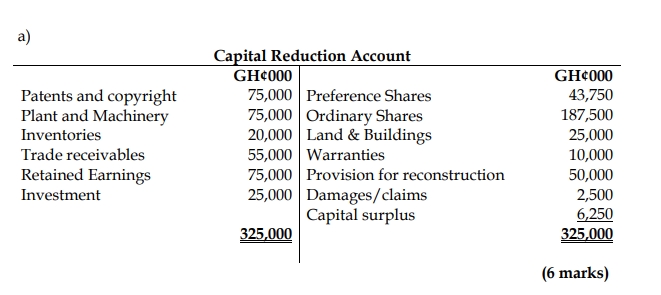
This question requires the preparation of a Capital Reduction Account for Sasasila Ltd following a reorganization.

Sasasila Ltd has been operating profitably for a number of years. However, in recent times, the company has been making losses. Below is the statement of financial position as at 30 June 2019:

Assets GH¢000
Non-Current Assets
Patents and copyrights 75,000
Land and buildings (net) 200,000
Plant and machinery (net) 150,000
Current Assets
Inventories 125,000
Trade receivables 125,000
Bank 37,500
Investments (cost) 100,000
Total Assets 812,500
Equity and liabilities:
Equity
Ordinary share capital (issued at GH¢10 each) 375,000
20% cumulative preference shares (issued at GH¢10 each) 175,000
Retained earnings (75,000)
Non-current Liabilities
15% Debentures 125,000
Current Liabilities
Interest on debentures 18,750
Trade payables 93,750
Provision for business restructuring 50,000
Provision for legal damages & claims 12,500
Provision for warranties 37,500
Total Equity and Liabilities 812,500

Additional relevant information: The following scheme of reconstruction was approved by all parties as well as the High Court with the exception of only one ordinary shareholder:

  1. The ordinary shares were to be reduced to GH¢5 per share.
  2. The preference shares were to be reduced to GH¢7.5 per share and arrears in dividends for three years were to be canceled from the company’s books.
  3. The fair values of the assets were agreed at the following values:
    • Patents and copyrights: Nil
    • Land and buildings: GH¢225,000
    • Plant and machinery: GH¢75,000
    • Investments: GH¢75,000
    • Inventories: GH¢105,000
    • Trade receivables: GH¢70,000
  4. The balance on retained earnings is to be eliminated in full.
  5. The liability for legal damages and claims was to be settled for GH¢10 million, and the provision for warranties reduced to GH¢27.5 million.
  6. The accrued debenture interest was to be paid in cash.
  7. Investments with a carrying amount of GH¢52.5 million were to be sold for cash at that value to strengthen the working capital position.
  8. The amount set aside for business restructuring was to be eliminated as well.
  9. The High Court directed a payment of GH¢0.2 million to a member who opposed the scheme for 50 ordinary shares held by him.

Prepare the Capital Reduction Account as at 30 June 2019.

answer to the question

Login or create a free account to see answers

Complete your registration to see answers

Find Related Questions by Tags, levels, etc.

Report an error

You're reporting an error for "CR – May 2020 – Q4a – Capital Reduction Account"

CR – May 2020 – Q4a – Capital Reduction Account

This question requires the preparation of a Capital Reduction Account for Sasasila Ltd following a reorganization.

Sasasila Ltd has been operating profitably for a number of years. However, in recent times, the company has been making losses. Below is the statement of financial position as at 30 June 2019:

Assets GH¢000
Non-Current Assets
Patents and copyrights 75,000
Land and buildings (net) 200,000
Plant and machinery (net) 150,000
Current Assets
Inventories 125,000
Trade receivables 125,000
Bank 37,500
Investments (cost) 100,000
Total Assets 812,500
Equity and liabilities:
Equity
Ordinary share capital (issued at GH¢10 each) 375,000
20% cumulative preference shares (issued at GH¢10 each) 175,000
Retained earnings (75,000)
Non-current Liabilities
15% Debentures 125,000
Current Liabilities
Interest on debentures 18,750
Trade payables 93,750
Provision for business restructuring 50,000
Provision for legal damages & claims 12,500
Provision for warranties 37,500
Total Equity and Liabilities 812,500

Additional relevant information: The following scheme of reconstruction was approved by all parties as well as the High Court with the exception of only one ordinary shareholder:

  1. The ordinary shares were to be reduced to GH¢5 per share.
  2. The preference shares were to be reduced to GH¢7.5 per share and arrears in dividends for three years were to be canceled from the company’s books.
  3. The fair values of the assets were agreed at the following values:
    • Patents and copyrights: Nil
    • Land and buildings: GH¢225,000
    • Plant and machinery: GH¢75,000
    • Investments: GH¢75,000
    • Inventories: GH¢105,000
    • Trade receivables: GH¢70,000
  4. The balance on retained earnings is to be eliminated in full.
  5. The liability for legal damages and claims was to be settled for GH¢10 million, and the provision for warranties reduced to GH¢27.5 million.
  6. The accrued debenture interest was to be paid in cash.
  7. Investments with a carrying amount of GH¢52.5 million were to be sold for cash at that value to strengthen the working capital position.
  8. The amount set aside for business restructuring was to be eliminated as well.
  9. The High Court directed a payment of GH¢0.2 million to a member who opposed the scheme for 50 ordinary shares held by him.

Prepare the Capital Reduction Account as at 30 June 2019.

answer to the question

Login or create a free account to see answers

Complete your registration to see answers

Find Related Questions by Tags, levels, etc.

Report an error

You're reporting an error for "CR – May 2020 – Q4a – Capital Reduction Account"

CR – May 2020 – Q4b – Statement of Financial Position for Sasasila Ltd

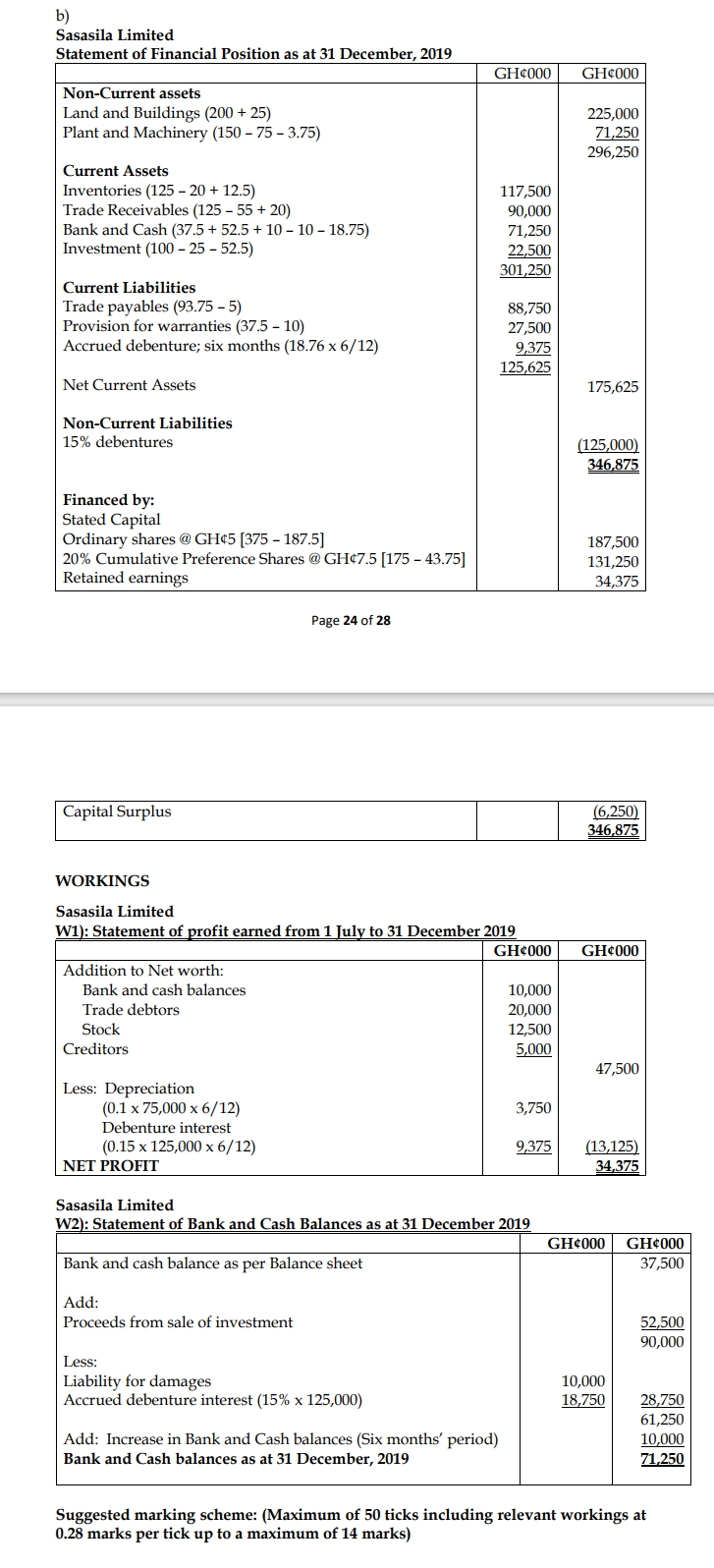
This question requires the preparation of a statement of financial position for Sasasila Ltd following its restructuring.

Prepare the statement of financial position as at 31 December 2019 for Sasasila Ltd.


Login or create a free account to see answers

Complete your registration to see answers

Find Related Questions by Tags, levels, etc.

Report an error

You're reporting an error for "CR – May 2020 – Q4b – Statement of Financial Position for Sasasila Ltd"

CR – May 2020 – Q4b – Statement of Financial Position for Sasasila Ltd

This question requires the preparation of a statement of financial position for Sasasila Ltd following its restructuring.

Prepare the statement of financial position as at 31 December 2019 for Sasasila Ltd.


Login or create a free account to see answers

Complete your registration to see answers

Find Related Questions by Tags, levels, etc.

Report an error

You're reporting an error for "CR – May 2020 – Q4b – Statement of Financial Position for Sasasila Ltd"

CR – May 2020 – Q5 – Financial Performance and Position of Bossman Ltd

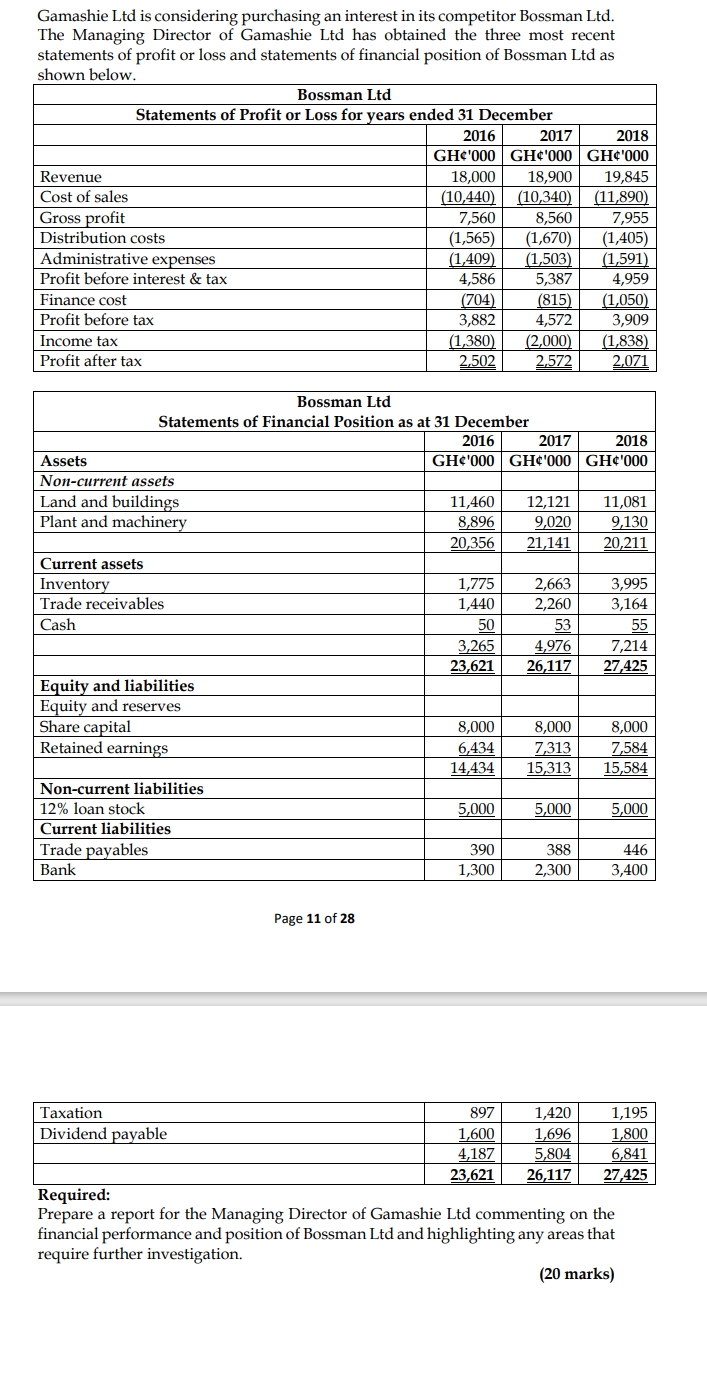
This question involves analyzing the financial performance and position of Bossman Ltd over three years using ratio analysis.

To: Managing Director, Gamashie Ltd
From: An Accountant
Date: 01/01/19
Subject: The Financial Position and Performance of Bossman Ltd


Introduction:

This report is based on the financial statements of Bossman Ltd for the years 2016, 2017, and 2018. It includes an analysis of the financial performance and position, with attention to key financial ratios calculated from the attached statements.


Financial Performance:

  • Revenue Growth: Bossman Ltd has experienced consistent revenue growth at approximately 5% per annum from GH¢18,000,000 in 2016 to GH¢19,845,000 in 2018.
  • Gross Profit Margin: The gross profit margin improved in 2017 but fell in 2018, indicating fluctuations in cost management. The margins were:
    • 2016: 42%
    • 2017: 45%
    • 2018: 40%
  • Operating Profit: Operating profit as a percentage of sales showed a similar trend to the gross profit margin. It increased from 25.5% in 2016 to 28.5% in 2017, before falling back to 25% in 2018. The decline in 2018 needs to be investigated to understand the reasons for the reduction.
  • Profit Before Tax (PBT): PBT decreased from GH¢3,882,000 in 2017 to GH¢3,909,000 in 2018, primarily due to increased finance costs. This indicates an increase in borrowing costs, which requires further investigation.

Financial Position:

  • Liquidity:
    • Current Ratio: The current ratio improved from 0.78 in 2016 to 1.05 in 2018, indicating better liquidity. However, it was below 1 in 2016 and 2017, suggesting that the company may have struggled to meet its short-term obligations during those years.
    • Quick Ratio: The quick ratio remained below 0.5 across all three years, highlighting potential issues with converting current assets (excluding inventory) into liquid assets. This indicates the company may be heavily reliant on inventory for liquidity.
  • Solvency:
    • Debt Ratio: The debt ratio increased steadily over the three years from 38.9% in 2016 to 43.2% in 2018, suggesting the company’s reliance on debt financing is increasing. This should be monitored, as it may impact the company’s financial flexibility.
  • Efficiency:
    • Receivables Collection Period: The collection period increased from 29.2 days in 2016 to 58.2 days in 2018. This could indicate deteriorating credit control or extended payment terms.
    • Inventory Turnover: Inventory turnover worsened, increasing from 62 days in 2016 to 122.6 days in 2018. This may indicate overstocking or slow-moving inventory, which ties up working capital.

Conclusion:

Bossman Ltd has shown consistent revenue growth but declining profitability. Liquidity has improved, but the quick ratio is concerning. The company’s growing reliance on debt and the extended receivables and inventory turnover periods should be investigated further to identify potential risks to financial stability.


Appendix – Ratio Analysis:

Ratios 2016 2017 2018
Gross Profit Margin 42% 45% 40%
Operating Profit Margin 25.5% 28.5% 25%
Return on Capital Employed 23.6% 27% 24.1%
Debt Ratio 38.9% 41.4% 43.2%
Current Ratio 0.78 0.86 1.05
Quick Ratio 0.36 0.40 0.47
Receivables Collection Period (days) 29.2 43.6 58.2
Inventory Turnover Period (days) 62 94 122.6

Login or create a free account to see answers

Complete your registration to see answers

Find Related Questions by Tags, levels, etc.

Report an error

You're reporting an error for "CR – May 2020 – Q5 – Financial Performance and Position of Bossman Ltd"

CR – May 2020 – Q5 – Financial Performance and Position of Bossman Ltd

This question involves analyzing the financial performance and position of Bossman Ltd over three years using ratio analysis.

To: Managing Director, Gamashie Ltd
From: An Accountant
Date: 01/01/19
Subject: The Financial Position and Performance of Bossman Ltd


Introduction:

This report is based on the financial statements of Bossman Ltd for the years 2016, 2017, and 2018. It includes an analysis of the financial performance and position, with attention to key financial ratios calculated from the attached statements.


Financial Performance:

  • Revenue Growth: Bossman Ltd has experienced consistent revenue growth at approximately 5% per annum from GH¢18,000,000 in 2016 to GH¢19,845,000 in 2018.
  • Gross Profit Margin: The gross profit margin improved in 2017 but fell in 2018, indicating fluctuations in cost management. The margins were:
    • 2016: 42%
    • 2017: 45%
    • 2018: 40%
  • Operating Profit: Operating profit as a percentage of sales showed a similar trend to the gross profit margin. It increased from 25.5% in 2016 to 28.5% in 2017, before falling back to 25% in 2018. The decline in 2018 needs to be investigated to understand the reasons for the reduction.
  • Profit Before Tax (PBT): PBT decreased from GH¢3,882,000 in 2017 to GH¢3,909,000 in 2018, primarily due to increased finance costs. This indicates an increase in borrowing costs, which requires further investigation.

Financial Position:

  • Liquidity:
    • Current Ratio: The current ratio improved from 0.78 in 2016 to 1.05 in 2018, indicating better liquidity. However, it was below 1 in 2016 and 2017, suggesting that the company may have struggled to meet its short-term obligations during those years.
    • Quick Ratio: The quick ratio remained below 0.5 across all three years, highlighting potential issues with converting current assets (excluding inventory) into liquid assets. This indicates the company may be heavily reliant on inventory for liquidity.
  • Solvency:
    • Debt Ratio: The debt ratio increased steadily over the three years from 38.9% in 2016 to 43.2% in 2018, suggesting the company’s reliance on debt financing is increasing. This should be monitored, as it may impact the company’s financial flexibility.
  • Efficiency:
    • Receivables Collection Period: The collection period increased from 29.2 days in 2016 to 58.2 days in 2018. This could indicate deteriorating credit control or extended payment terms.
    • Inventory Turnover: Inventory turnover worsened, increasing from 62 days in 2016 to 122.6 days in 2018. This may indicate overstocking or slow-moving inventory, which ties up working capital.

Conclusion:

Bossman Ltd has shown consistent revenue growth but declining profitability. Liquidity has improved, but the quick ratio is concerning. The company’s growing reliance on debt and the extended receivables and inventory turnover periods should be investigated further to identify potential risks to financial stability.


Appendix – Ratio Analysis:

Ratios 2016 2017 2018
Gross Profit Margin 42% 45% 40%
Operating Profit Margin 25.5% 28.5% 25%
Return on Capital Employed 23.6% 27% 24.1%
Debt Ratio 38.9% 41.4% 43.2%
Current Ratio 0.78 0.86 1.05
Quick Ratio 0.36 0.40 0.47
Receivables Collection Period (days) 29.2 43.6 58.2
Inventory Turnover Period (days) 62 94 122.6

Login or create a free account to see answers

Complete your registration to see answers

Find Related Questions by Tags, levels, etc.

Report an error

You're reporting an error for "CR – May 2020 – Q5 – Financial Performance and Position of Bossman Ltd"

PSAF – May 2020 – L1 – Q5a -The context of public financial management

Explain the responsibilities of the Controller and Accountant General and the objectives for adopting GIFMIS.

The Controller and Accountant General, who is appointed by the President in accordance with Article 195 of the constitution and recognized as the Chief Advisor to the Minister of Finance and government in matters relating to accountancy, has urged all Metropolitan, Municipal, and District Assemblies (MMDAs) to strictly comply with a directive to use the Ghana Integrated Financial Management Information Systems (GIFMIS) platform for all government businesses. In effect, the budgeted funds for these MMDAs would be blocked or not released to any State Agency that refuses to enroll and go live on the GIFMIS Platform.

Required:
i) Explain FIVE (5) other responsibilities of the Controller and Accountant General in accordance with section 8(4) of the Public Financial Management Act, 2016 (PFMA) Act 921.
(5 marks)

ii) Identify FIVE (5) objectives for the adoption of GIFMIS.
(5 marks)

i) Responsibilities of the Controller and Accountant General under PFMA Act 921
The Controller and Accountant General has several responsibilities under section 8(4) of the Public Financial Management Act, 2016 (PFMA) Act 921, including:

  1. Compile and manage the accounts prepared in relation to public funds.
  2. Issue general instructions to a Principal Spending Officer in accordance with the Act and its regulations.
  3. Keep, render, and publish statements on public accounts under the Act.
  4. Develop efficient accounting systems for covered entities to ensure accurate and timely financial reporting.
  5. Approve accounting instructions of covered entities to ensure consistency with public financial management practices.
  6. Receive, disburse, and provide secure custody for public funds.
  7. Authorize the opening of accounts with the Bank of Ghana and its agents for the deposit of public funds.
  8. Provide accounting officers to covered entities and be responsible for the classification and management of value books.

ii) Objectives for the adoption of GIFMIS
The adoption of the Ghana Integrated Financial Management Information Systems (GIFMIS) is aimed at achieving the following objectives:

  1. Improve treasury and budget control by providing a comprehensive and integrated financial management system.
  2. Eliminate redundancies and integrate data to ensure better financial control and reduce costs.
  3. Enhance strategic and day-to-day decision-making through quick availability of data and management information systems (MIS).
  4. Improve efficiency and transparency in financial management processes, reducing the risk of fraud and malpractices.
  5. Facilitate better cash flow management and budget control, ensuring that expenditures are aligned with available resources.
  6. Ensure better interface with financial institutions such as the Bank of Ghana and commercial banks, enhancing financial operations.
  7. Support debt and grant tracking from various agencies to the State, ensuring accurate financial reporting and accountability.
  8. Enhance fiscal budget management and control, leading to more predictable financial flows.

Login or create a free account to see answers

Complete your registration to see answers

Find Related Questions by Tags, levels, etc.

Report an error

You're reporting an error for "PSAF – May 2020 – L1 – Q5a -The context of public financial management"

PSAF – May 2020 – L1 – Q5a -The context of public financial management

Explain the responsibilities of the Controller and Accountant General and the objectives for adopting GIFMIS.

The Controller and Accountant General, who is appointed by the President in accordance with Article 195 of the constitution and recognized as the Chief Advisor to the Minister of Finance and government in matters relating to accountancy, has urged all Metropolitan, Municipal, and District Assemblies (MMDAs) to strictly comply with a directive to use the Ghana Integrated Financial Management Information Systems (GIFMIS) platform for all government businesses. In effect, the budgeted funds for these MMDAs would be blocked or not released to any State Agency that refuses to enroll and go live on the GIFMIS Platform.

Required:
i) Explain FIVE (5) other responsibilities of the Controller and Accountant General in accordance with section 8(4) of the Public Financial Management Act, 2016 (PFMA) Act 921.
(5 marks)

ii) Identify FIVE (5) objectives for the adoption of GIFMIS.
(5 marks)

i) Responsibilities of the Controller and Accountant General under PFMA Act 921
The Controller and Accountant General has several responsibilities under section 8(4) of the Public Financial Management Act, 2016 (PFMA) Act 921, including:

  1. Compile and manage the accounts prepared in relation to public funds.
  2. Issue general instructions to a Principal Spending Officer in accordance with the Act and its regulations.
  3. Keep, render, and publish statements on public accounts under the Act.
  4. Develop efficient accounting systems for covered entities to ensure accurate and timely financial reporting.
  5. Approve accounting instructions of covered entities to ensure consistency with public financial management practices.
  6. Receive, disburse, and provide secure custody for public funds.
  7. Authorize the opening of accounts with the Bank of Ghana and its agents for the deposit of public funds.
  8. Provide accounting officers to covered entities and be responsible for the classification and management of value books.

ii) Objectives for the adoption of GIFMIS
The adoption of the Ghana Integrated Financial Management Information Systems (GIFMIS) is aimed at achieving the following objectives:

  1. Improve treasury and budget control by providing a comprehensive and integrated financial management system.
  2. Eliminate redundancies and integrate data to ensure better financial control and reduce costs.
  3. Enhance strategic and day-to-day decision-making through quick availability of data and management information systems (MIS).
  4. Improve efficiency and transparency in financial management processes, reducing the risk of fraud and malpractices.
  5. Facilitate better cash flow management and budget control, ensuring that expenditures are aligned with available resources.
  6. Ensure better interface with financial institutions such as the Bank of Ghana and commercial banks, enhancing financial operations.
  7. Support debt and grant tracking from various agencies to the State, ensuring accurate financial reporting and accountability.
  8. Enhance fiscal budget management and control, leading to more predictable financial flows.

Login or create a free account to see answers

Complete your registration to see answers

Find Related Questions by Tags, levels, etc.

Report an error

You're reporting an error for "PSAF – May 2020 – L1 – Q5a -The context of public financial management"

PSAF – May 2020 – L1 – Q4b – Public sector financing initiatives

Explain different types of Public-Private Partnership arrangements.

A Public-Private Partnership (PPP) is a contractual arrangement between a public entity and a private sector party, with a clear agreement on shared objectives for the production of public infrastructure and services traditionally provided by the public sector. PPPs can have many different forms.

Required:
Explain the following types of Public-Private Partnership arrangements:
i) Operating and Maintenance Contract
(2.5 marks)

ii) Rehabilitate Operate and Transfer
(2.5 marks)

iii) Service Concession
(2.5 marks)

iv) Joint Venture
(2.5 marks)

i) Operating and Maintenance Contract
In this type of PPP arrangement, the public authority contracts with a private partner to operate and maintain a publicly owned facility or infrastructure. The private sector is partially involved, typically providing a service or managing the operation of the facility. Services or management contracts allow the private sector to provide infrastructure-related services for specified periods of time, ensuring the facility operates efficiently.

ii) Rehabilitate Operate and Transfer
Under this arrangement, the initial worn-out asset is provided by the public agency, and the private partner is required to invest in revamping the asset. The private partner is allowed to operate the rehabilitated asset for a specified period, during which they can recover their investment, and eventually, the residual asset is transferred back to the public sector or consolidated fund.

iii) Service Concession
Service concession arrangements involve contracts under which a public sector entity (the “grantor”) grants a private entity (the “operator”) the right to operate the grantor’s infrastructure (e.g., an airport, toll road, bridge, hospital, or power distribution). The infrastructure may already exist or may be constructed by the operator. The concession arrangement may also require significant upgrades to the infrastructure, with the operator allowed to recoup its investment over a specified contract period, after which the infrastructure is returned to the grantor.

iv) Joint Venture
A joint venture occurs when both the private and public sectors jointly finance, own, and operate a facility. In this arrangement, both parties share the risks and rewards associated with the venture, with clear agreements on the roles and responsibilities of each party.

Login or create a free account to see answers

Complete your registration to see answers

Find Related Questions by Tags, levels, etc.

Report an error

You're reporting an error for "PSAF – May 2020 – L1 – Q4b – Public sector financing initiatives"

PSAF – May 2020 – L1 – Q4b – Public sector financing initiatives

Explain different types of Public-Private Partnership arrangements.

A Public-Private Partnership (PPP) is a contractual arrangement between a public entity and a private sector party, with a clear agreement on shared objectives for the production of public infrastructure and services traditionally provided by the public sector. PPPs can have many different forms.

Required:
Explain the following types of Public-Private Partnership arrangements:
i) Operating and Maintenance Contract
(2.5 marks)

ii) Rehabilitate Operate and Transfer
(2.5 marks)

iii) Service Concession
(2.5 marks)

iv) Joint Venture
(2.5 marks)

i) Operating and Maintenance Contract
In this type of PPP arrangement, the public authority contracts with a private partner to operate and maintain a publicly owned facility or infrastructure. The private sector is partially involved, typically providing a service or managing the operation of the facility. Services or management contracts allow the private sector to provide infrastructure-related services for specified periods of time, ensuring the facility operates efficiently.

ii) Rehabilitate Operate and Transfer
Under this arrangement, the initial worn-out asset is provided by the public agency, and the private partner is required to invest in revamping the asset. The private partner is allowed to operate the rehabilitated asset for a specified period, during which they can recover their investment, and eventually, the residual asset is transferred back to the public sector or consolidated fund.

iii) Service Concession
Service concession arrangements involve contracts under which a public sector entity (the “grantor”) grants a private entity (the “operator”) the right to operate the grantor’s infrastructure (e.g., an airport, toll road, bridge, hospital, or power distribution). The infrastructure may already exist or may be constructed by the operator. The concession arrangement may also require significant upgrades to the infrastructure, with the operator allowed to recoup its investment over a specified contract period, after which the infrastructure is returned to the grantor.

iv) Joint Venture
A joint venture occurs when both the private and public sectors jointly finance, own, and operate a facility. In this arrangement, both parties share the risks and rewards associated with the venture, with clear agreements on the roles and responsibilities of each party.

Login or create a free account to see answers

Complete your registration to see answers

Find Related Questions by Tags, levels, etc.

Report an error

You're reporting an error for "PSAF – May 2020 – L1 – Q4b – Public sector financing initiatives"

PSAF – May 2020 – L1 – Q4a – Public Procurement

Explain the conditions under which the Public Procurement Act permits the use of established commercial practices and the approval procedure.

A newly appointed Chief Executive Officer (CEO) of a large Government Teaching Hospital has just resumed work. The Hospital is financed by 40% Internally Generated Funds and 60% subventions. At his first meeting with the Management Committee of the Hospital, the CEO briefed the Committee about his policies and strategies to improve efficiency in the Hospital’s operations. He identified the use of the Public Procurement Procedures as the major obstacle of the Hospital in achieving its objectives. He therefore suggested the use of established commercial procurement practices because a consultant advised him that it is very possible and permissible under the Public Procurement Act 2016 (Amendment) Act 914. He added that the head of an entity has the responsibility to decide whether to use public procurement rules or otherwise.

Required:
i) Explain to the Chief Executive Officer, the conditions under which the Public Procurement Act 2016 (Amendment) Act 914 permits the use of established commercial practices.
(3 marks)

ii) Describe the approval procedure involved prior to the use of established commercial practices of procurement.
(2 marks)

iii) In your opinion, would the Hospital meet the conditions for using the established commercial practices of procurement? Explain.
(2 marks)

iv) Explain THREE (3) functions of the Head of Procurement Entity under the Public Procurement Act 2016 (Amendment) Act 914.
(3 marks)

i) Conditions under which the Public Procurement Act permits the use of established commercial practices
The Public Procurement Act 2016 (Amendment) Act 914 permits the use of established commercial practices under the following conditions:

  • The entity must be legally and financially autonomous and operate under commercial law.
  • It must be beyond contention that public procurement practices are not suitable, given the strategic nature of the procurement.
  • The proposed procurement method must ensure value for money, provide competition, and maintain transparency to the extent possible.

ii) Approval procedure for using established commercial practices

  • To apply commercial procurement practices, the entity must seek approval from the Governing Board of the Public Procurement Authority.
  • Once approval is granted, it must be published in a gazette to make it official.

iii) Suitability of the Hospital for using commercial practices

  • The hospital is not legally and financially autonomous as it operates under the Ministry of Health and Ghana Health Services. Therefore, it does not qualify to apply for approval to use commercial procurement practices.
  • Given the hospital’s structure and the need for transparency in public procurement, the use of established commercial practices is not suitable. The hospital should focus on improving the efficiency of public procurement procedures instead.

iv) Functions of the Head of Procurement Entity under the Public Procurement Act 2016 (Amendment) Act 914

  • Ensure compliance with the Public Procurement Act and regulations, even when concurrent approval from a tender review committee is obtained.
  • Establish a procurement unit within the entity, staffed with qualified personnel.
  • Empanel competent and qualified evaluation panels.
  • Ensure that procurement procedures are followed, including due process and reporting requirements.
  • Facilitate contract administration and ensure compliance with contract reporting requirements.

Login or create a free account to see answers

Complete your registration to see answers

Find Related Questions by Tags, levels, etc.

Report an error

You're reporting an error for "PSAF – May 2020 – L1 – Q4a – Public Procurement"

PSAF – May 2020 – L1 – Q4a – Public Procurement

Explain the conditions under which the Public Procurement Act permits the use of established commercial practices and the approval procedure.

A newly appointed Chief Executive Officer (CEO) of a large Government Teaching Hospital has just resumed work. The Hospital is financed by 40% Internally Generated Funds and 60% subventions. At his first meeting with the Management Committee of the Hospital, the CEO briefed the Committee about his policies and strategies to improve efficiency in the Hospital’s operations. He identified the use of the Public Procurement Procedures as the major obstacle of the Hospital in achieving its objectives. He therefore suggested the use of established commercial procurement practices because a consultant advised him that it is very possible and permissible under the Public Procurement Act 2016 (Amendment) Act 914. He added that the head of an entity has the responsibility to decide whether to use public procurement rules or otherwise.

Required:
i) Explain to the Chief Executive Officer, the conditions under which the Public Procurement Act 2016 (Amendment) Act 914 permits the use of established commercial practices.
(3 marks)

ii) Describe the approval procedure involved prior to the use of established commercial practices of procurement.
(2 marks)

iii) In your opinion, would the Hospital meet the conditions for using the established commercial practices of procurement? Explain.
(2 marks)

iv) Explain THREE (3) functions of the Head of Procurement Entity under the Public Procurement Act 2016 (Amendment) Act 914.
(3 marks)

i) Conditions under which the Public Procurement Act permits the use of established commercial practices
The Public Procurement Act 2016 (Amendment) Act 914 permits the use of established commercial practices under the following conditions:

  • The entity must be legally and financially autonomous and operate under commercial law.
  • It must be beyond contention that public procurement practices are not suitable, given the strategic nature of the procurement.
  • The proposed procurement method must ensure value for money, provide competition, and maintain transparency to the extent possible.

ii) Approval procedure for using established commercial practices

  • To apply commercial procurement practices, the entity must seek approval from the Governing Board of the Public Procurement Authority.
  • Once approval is granted, it must be published in a gazette to make it official.

iii) Suitability of the Hospital for using commercial practices

  • The hospital is not legally and financially autonomous as it operates under the Ministry of Health and Ghana Health Services. Therefore, it does not qualify to apply for approval to use commercial procurement practices.
  • Given the hospital’s structure and the need for transparency in public procurement, the use of established commercial practices is not suitable. The hospital should focus on improving the efficiency of public procurement procedures instead.

iv) Functions of the Head of Procurement Entity under the Public Procurement Act 2016 (Amendment) Act 914

  • Ensure compliance with the Public Procurement Act and regulations, even when concurrent approval from a tender review committee is obtained.
  • Establish a procurement unit within the entity, staffed with qualified personnel.
  • Empanel competent and qualified evaluation panels.
  • Ensure that procurement procedures are followed, including due process and reporting requirements.
  • Facilitate contract administration and ensure compliance with contract reporting requirements.

Login or create a free account to see answers

Complete your registration to see answers

Find Related Questions by Tags, levels, etc.

Report an error

You're reporting an error for "PSAF – May 2020 – L1 – Q4a – Public Procurement"

PSAF – May 2020 – L1 – Q3b – Financial Statements Discussion and Analysis

Analyze the financial performance of the Consolidated Fund based on a Common Size Statement of Financial Performance.

Presented below is the Statement of Financial Performance of the Consolidated Fund of Ghana.

Revenue and Expenditure Statement of the Consolidated Fund for the year ended 31 December, 2018

Required:
Based on a Common Size Statement of Financial Performance, write a report discussing and analyzing the financial performance of the Consolidated Fund in line with the Recommended Practice Guide 2, Financial Statement Discussion and Analysis.

Common Size Statement of Financial Performance of the Consolidated Fund for the year ended December 31, 2018

Revenues 2018 (%) 2017 (%) 2018 Budget (%)
Direct tax 34.67 27.13 31.91
Indirect tax 46.79 56.02 53.87
Non-tax revenue 15.81 12.69 11.06
Grants 2.74 4.16 3.16
Total revenue 100.00 100.00 100.00
Expenditure
Compensation for employees 62.80 53.17 40.92
Use of goods and services 21.71 21.58 28.44
Consumption of fixed Asset 0.51 0.48
Interest 41.43 31.84 26.51
Subsidies 1.07 0.94 3.03
Other expenses 3.37 3.13 3.87
Exchange difference 1.31 0.88
Total Expenditure 132.20 112.01 102.76
Net Operation Result (-32.20) (-12.01) (-2.76)

Report on Financial Performance of Consolidated Fund for the year ended 31st December 2018

Introduction
The report provides an analysis and discussion of the financial performance of the Consolidated Fund in line with the Recommended Practice Guide (RPG). The analysis and discussions are based on the Common Size Statement of Revenue and Expenditure of the Fund for the period.

Revenue Performance
The Fund’s performance in terms of direct taxes and non-tax revenues exceeded the previous year’s results and that of the budget for the period. Direct tax revenue constituted 34.7% of the total revenue of the year as against 27.1% and 31.9% of the prior year and budget totals respectively. This may be attributed to massive tax education and technology applications introduced into the tax administration system during the period. However, indirect taxes performed below the budget and prior year performance, likely due to a sharp economic decline caused by external factors. Grants have also seen a downward trend over the period, indicating that donor support is decreasing over the years.

Expenditure Performance
Compensation of employees remains the biggest expenditure of the fund for the year, with over 60% of the total revenue generated spent on it. This exceeds the expenditure level of 2017 and even the budget of the year. The fund was expected to spend 40.9% of total revenues of the year on compensation but ended spending 62.8% on it, showing a budget overrun in excess of 29%. This may result from employment without establishment warrants or an increase in wage due to labor unrest during the period. There is a budget underrun in goods and services during the year. The fund budgeted to spend about 28% on goods and services during the year but spent only 21.7%. This may affect efficient delivery of public services as input is likely to be lacking due to failure to release budget allocations to the departments. Interestingly, over 41% of total revenue was spent on interest expense, far in excess of the budgeted proportion of 26.5%. This results from huge public debt during the period. Governments should ensure that debt levels are controlled to create fiscal space for spending on goods and services.

Conclusion
The net operating result of the Fund was a deficit of 32% compared to a deficit of 12% in 2017 and a budgeted deficit of 2.8%. This shows that the financial performance of the Fund was not good enough. Drastic measures should be taken to increase revenues from indirect revenue sources and to reduce spending on compensation of employees and interest on debt.


Login or create a free account to see answers

Complete your registration to see answers

Find Related Questions by Tags, levels, etc.

Report an error

You're reporting an error for "PSAF – May 2020 – L1 – Q3b – Financial Statements Discussion and Analysis"

PSAF – May 2020 – L1 – Q3b – Financial Statements Discussion and Analysis

Analyze the financial performance of the Consolidated Fund based on a Common Size Statement of Financial Performance.

Presented below is the Statement of Financial Performance of the Consolidated Fund of Ghana.

Revenue and Expenditure Statement of the Consolidated Fund for the year ended 31 December, 2018

Required:
Based on a Common Size Statement of Financial Performance, write a report discussing and analyzing the financial performance of the Consolidated Fund in line with the Recommended Practice Guide 2, Financial Statement Discussion and Analysis.

Common Size Statement of Financial Performance of the Consolidated Fund for the year ended December 31, 2018

Revenues 2018 (%) 2017 (%) 2018 Budget (%)
Direct tax 34.67 27.13 31.91
Indirect tax 46.79 56.02 53.87
Non-tax revenue 15.81 12.69 11.06
Grants 2.74 4.16 3.16
Total revenue 100.00 100.00 100.00
Expenditure
Compensation for employees 62.80 53.17 40.92
Use of goods and services 21.71 21.58 28.44
Consumption of fixed Asset 0.51 0.48
Interest 41.43 31.84 26.51
Subsidies 1.07 0.94 3.03
Other expenses 3.37 3.13 3.87
Exchange difference 1.31 0.88
Total Expenditure 132.20 112.01 102.76
Net Operation Result (-32.20) (-12.01) (-2.76)

Report on Financial Performance of Consolidated Fund for the year ended 31st December 2018

Introduction
The report provides an analysis and discussion of the financial performance of the Consolidated Fund in line with the Recommended Practice Guide (RPG). The analysis and discussions are based on the Common Size Statement of Revenue and Expenditure of the Fund for the period.

Revenue Performance
The Fund’s performance in terms of direct taxes and non-tax revenues exceeded the previous year’s results and that of the budget for the period. Direct tax revenue constituted 34.7% of the total revenue of the year as against 27.1% and 31.9% of the prior year and budget totals respectively. This may be attributed to massive tax education and technology applications introduced into the tax administration system during the period. However, indirect taxes performed below the budget and prior year performance, likely due to a sharp economic decline caused by external factors. Grants have also seen a downward trend over the period, indicating that donor support is decreasing over the years.

Expenditure Performance
Compensation of employees remains the biggest expenditure of the fund for the year, with over 60% of the total revenue generated spent on it. This exceeds the expenditure level of 2017 and even the budget of the year. The fund was expected to spend 40.9% of total revenues of the year on compensation but ended spending 62.8% on it, showing a budget overrun in excess of 29%. This may result from employment without establishment warrants or an increase in wage due to labor unrest during the period. There is a budget underrun in goods and services during the year. The fund budgeted to spend about 28% on goods and services during the year but spent only 21.7%. This may affect efficient delivery of public services as input is likely to be lacking due to failure to release budget allocations to the departments. Interestingly, over 41% of total revenue was spent on interest expense, far in excess of the budgeted proportion of 26.5%. This results from huge public debt during the period. Governments should ensure that debt levels are controlled to create fiscal space for spending on goods and services.

Conclusion
The net operating result of the Fund was a deficit of 32% compared to a deficit of 12% in 2017 and a budgeted deficit of 2.8%. This shows that the financial performance of the Fund was not good enough. Drastic measures should be taken to increase revenues from indirect revenue sources and to reduce spending on compensation of employees and interest on debt.


Login or create a free account to see answers

Complete your registration to see answers

Find Related Questions by Tags, levels, etc.

Report an error

You're reporting an error for "PSAF – May 2020 – L1 – Q3b – Financial Statements Discussion and Analysis"

PSAF – May 2020 – L1 – Q3a – Public expenditure and financial accountability framework

Explain control objectives in public financial management relevant to the PEFA framework and discuss internal control components.

The Public Expenditure and Financial Accountability (PEFA) framework recognizes the importance of internal control systems in achieving the desired fiscal and budgetary outcomes. Internal control systems play a vital role across every pillar of public financial management. It addresses risk and provides assurance that operations meet the control objectives of the PEFA framework. Therefore, it assesses how effectively the internal control systems operate in the country by making reference to the internal control components developed by other international organizations, specifically the Committee of Sponsoring Organizations (COSO) of the USA.

Required:
i) Explain THREE (3) control objectives in public financial management relevant to the PEFA framework of assessment.
(3 marks)

ii) Discuss FIVE (5) components of internal control in relation to the PEFA Framework.
(5 marks)

iii) Explain TWO (2) limitations of the PEFA Framework for assessing public financial management.
(2 marks)

i) Control objectives in public financial management relevant to the PEFA framework

  1. Orderly, ethical, economical, efficient, and effective operations: Ensuring that operations are executed in a manner that is ethical, efficient, and effective.
  2. Accountability obligations: Ensuring that public officers and institutions fulfill their accountability obligations.
  3. Compliance with laws and regulations: Ensuring that applicable laws and regulations are complied with.
  4. Safeguarding resources: Ensuring that resources are safeguarded against loss, misuse, and damage.

ii) Components of internal control in relation to the PEFA Framework

  1. Control environment: The values and culture of the organization, setting the tone for control at the top by which the entire organization is directed and controlled.
  2. Risk assessment: Identifying and mapping risks within the organization to ensure they are effectively managed.
  3. Control activities: Policies, procedures, and rules that ensure resources are safeguarded, such as accounting controls.
  4. Information and communication: Ensuring the right information is received by the right person at the right time.
  5. Monitoring: Reviewing and monitoring procedures to ensure deficiencies in systems and policies are corrected.

iii) Limitations of the PEFA Framework for assessing public financial management

  1. Focus on operational performance: PEFA focuses on the operational performance of key PFM system elements rather than all the various inputs and capabilities that may enable the PFM system to reach a certain level of performance.
  2. Lack of fiscal policy analysis: PEFA does not involve fiscal or expenditure policy analysis that would determine whether fiscal policy is sustainable.

Login or create a free account to see answers

Complete your registration to see answers

Find Related Questions by Tags, levels, etc.

Report an error

You're reporting an error for "PSAF – May 2020 – L1 – Q3a – Public expenditure and financial accountability framework"

PSAF – May 2020 – L1 – Q3a – Public expenditure and financial accountability framework

Explain control objectives in public financial management relevant to the PEFA framework and discuss internal control components.

The Public Expenditure and Financial Accountability (PEFA) framework recognizes the importance of internal control systems in achieving the desired fiscal and budgetary outcomes. Internal control systems play a vital role across every pillar of public financial management. It addresses risk and provides assurance that operations meet the control objectives of the PEFA framework. Therefore, it assesses how effectively the internal control systems operate in the country by making reference to the internal control components developed by other international organizations, specifically the Committee of Sponsoring Organizations (COSO) of the USA.

Required:
i) Explain THREE (3) control objectives in public financial management relevant to the PEFA framework of assessment.
(3 marks)

ii) Discuss FIVE (5) components of internal control in relation to the PEFA Framework.
(5 marks)

iii) Explain TWO (2) limitations of the PEFA Framework for assessing public financial management.
(2 marks)

i) Control objectives in public financial management relevant to the PEFA framework

  1. Orderly, ethical, economical, efficient, and effective operations: Ensuring that operations are executed in a manner that is ethical, efficient, and effective.
  2. Accountability obligations: Ensuring that public officers and institutions fulfill their accountability obligations.
  3. Compliance with laws and regulations: Ensuring that applicable laws and regulations are complied with.
  4. Safeguarding resources: Ensuring that resources are safeguarded against loss, misuse, and damage.

ii) Components of internal control in relation to the PEFA Framework

  1. Control environment: The values and culture of the organization, setting the tone for control at the top by which the entire organization is directed and controlled.
  2. Risk assessment: Identifying and mapping risks within the organization to ensure they are effectively managed.
  3. Control activities: Policies, procedures, and rules that ensure resources are safeguarded, such as accounting controls.
  4. Information and communication: Ensuring the right information is received by the right person at the right time.
  5. Monitoring: Reviewing and monitoring procedures to ensure deficiencies in systems and policies are corrected.

iii) Limitations of the PEFA Framework for assessing public financial management

  1. Focus on operational performance: PEFA focuses on the operational performance of key PFM system elements rather than all the various inputs and capabilities that may enable the PFM system to reach a certain level of performance.
  2. Lack of fiscal policy analysis: PEFA does not involve fiscal or expenditure policy analysis that would determine whether fiscal policy is sustainable.

Login or create a free account to see answers

Complete your registration to see answers

Find Related Questions by Tags, levels, etc.

Report an error

You're reporting an error for "PSAF – May 2020 – L1 – Q3a – Public expenditure and financial accountability framework"

PSAF – May 2020 – L1 – Q1d – General purpose financial reporting framework

Explain the connection between the Conceptual Framework, IPSAS, and RPGs, and illustrate a practical case where the Conceptual Framework is useful.

Some accountants hold the view that development of a Conceptual Framework for General Purpose Financial Reporting (simply, the Conceptual Framework) in the Public Sector is needless and a mere information overload on the Accountants. This argument is predicated on the fact that the Conceptual Framework does not establish authoritative requirements for financial reporting by public sector entities that adopt IPSAS, nor does it override the requirements of the International Public Sector Accounting Standards (IPSAS) or the Recommended Practice Guides (RPGs).

Required:
i) Explain the connection between the Conceptual Framework on one hand and IPSAS and RPGs on the other hand.
(2 marks)

ii) Illustrate a practical case where the Conceptual Framework would be useful to an accountant in the preparation and presentation of a General Purpose Financial Report for his organization.
(4 marks)

iii) Explain TWO (2) constraints on information included in the General Purpose Financial Reports.
(4 marks)

Login or create a free account to see answers

Complete your registration to see answers

Find Related Questions by Tags, levels, etc.

Report an error

You're reporting an error for "PSAF – May 2020 – L1 – Q1d – General purpose financial reporting framework"

PSAF – May 2020 – L1 – Q1d – General purpose financial reporting framework

Explain the connection between the Conceptual Framework, IPSAS, and RPGs, and illustrate a practical case where the Conceptual Framework is useful.

Some accountants hold the view that development of a Conceptual Framework for General Purpose Financial Reporting (simply, the Conceptual Framework) in the Public Sector is needless and a mere information overload on the Accountants. This argument is predicated on the fact that the Conceptual Framework does not establish authoritative requirements for financial reporting by public sector entities that adopt IPSAS, nor does it override the requirements of the International Public Sector Accounting Standards (IPSAS) or the Recommended Practice Guides (RPGs).

Required:
i) Explain the connection between the Conceptual Framework on one hand and IPSAS and RPGs on the other hand.
(2 marks)

ii) Illustrate a practical case where the Conceptual Framework would be useful to an accountant in the preparation and presentation of a General Purpose Financial Report for his organization.
(4 marks)

iii) Explain TWO (2) constraints on information included in the General Purpose Financial Reports.
(4 marks)

Login or create a free account to see answers

Complete your registration to see answers

Find Related Questions by Tags, levels, etc.

Report an error

You're reporting an error for "PSAF – May 2020 – L1 – Q1d – General purpose financial reporting framework"

PSAF – May 2020 – L1 – Q2 – Preparation and presentation of financial statements for central government

Prepare the Statement of Financial Performance, Statement of Financial Position, Statement of Budget Information, and Notes to the financial statements for Damsa Municipal Assembly.

Below is the extract from the records of Damsa Municipal Assembly (DMA).

Additional Information:

  1. The central government has a constitutional responsibility to pay all established post salaries of the Assembly from the Consolidated Fund. The established post salaries paid by the central government on behalf of the assembly for 2019 amounted to GH¢64,000,000. This payment has not reflected in the books of DMA.
  2. Office consumables in respect of stationery and other items bought for GH¢1,800,000 remained unused during the year. The current replacement cost of the inventories is GH¢1,050,000. Meanwhile, the net realizable value of the inventories is estimated at GH¢1,400,000. No market exists for unused office consumables and other items.
  3. Consumption of fixed capital is to be charged as follows:
    • Motor vehicles: 5 years
    • Furniture and fittings: 5 years
    • Premises: 10 years
    • Equipment: 8 years
  4. During the year, the following assets were acquired and outright payments made for them: Motor Vehicle GH¢7,000,000; Equipment GH¢4,000,000. These have been accounted for.
  5. DMA could not pay the electricity bill for the last quarter of 2019. This was brought to its attention by the Electricity Company Ltd. of Ghana. The amount involved is GH¢4,000,000.
  6. The government has assigned some young graduates to DMA as part of the Nation Builders Corp programme to support the Assembly in revenue mobilisation. The allowances amounting to GH¢2,000,000 due them from DMA for the last month of the year was outstanding. DMA promises to pay them by the end of the first quarter of 2020.
  7. Fixed deposit attracts interest of 20% per annum and some interest is due as at 31 December 2019.
  8. The market store fees received were for two years: 2019-2020.
  9. During the year, the chiefs and people of the Assembly donated a new vehicle valued at GH¢400,000 to the DMA. No record was made in the books.
  10. Extract of the 2019 Budget of the DMA is as follows:
    Decentralised transfer 185,000
    Compensation of employees 74,300
    Goods and Services 35,600
    Other expenses 1,700
    Internally Generated Funds 102,000
    Donations and grants 1,000

Required: Prepare in accordance with the IPSAS and the Public Financial Management Act, 2016 (Act 921): a) Statement of Financial Performance for the year ended 31 December 2019.
(5 marks)

b) Statement of Financial Position as at 31 December 2019.
(5 marks)

c) Statement of Budget Information in Comparison with Actuals for the year ended 31 December 2019.
(5 marks)

d) Notes to the financial statements.
(5 marks)

a) Statement of Financial Performance for the year ended 31 December 2019

Notes GH¢’000
Revenue
Decentralised transfers 168,250
Internally Generated Funds 52,730
Donations and grants 400
Total revenue 221,380
Expenses
Compensation of employees 74,300
Goods and services 35,600
Consumption of fixed capital 20,930
Other expenses 1,700
Total expenses 132,530
Surplus 88,850

b) Statement of Financial Position as at 31 December 2019


c) Statement of Budget Information and Actuals for the year ended 31 December 2019

d) Notes to the financial statements

  1. Accounting policies
    Relevant accounting policies applied to the preparation of the financial statements include the following:

    • Basis of accounting: The financial statements have been prepared on an accrual basis where transactions and events are recognized as and when they occur.
    • Cost measurement: Assets are measured on a historical cost basis except for motor vehicles donated to the assembly which was measured and recognized at fair value.
    • Consumption of fixed assets: Consumption of fixed assets is charged using the straight-line basis. The estimated useful life of the assets is as follows:
      • Motor vehicle: 5 years
      • Furniture and fittings: 5 years
      • Premises: 10 years
      • Equipment: 8 years
    • Valuation of inventory: Inventory of office consumables was valued at the lower of cost and current replacement cost in compliance with IPSAS 12: Inventory.
    • Compliance with IPSAS and PFM Act: The financial statements have been prepared in conformity with the IPSAS and the Public Financial Management Act 2016.
  2. Decentralized transfer
    • Share of DACF: GH¢68,000
    • Stool land revenue: GH¢13,000
    • Ceded revenues: GH¢11,250
    • District development facility: GH¢12,000
    • Salary subvention: GH¢64,000
      Total: GH¢168,250
  3. Internally generated fund
    • Licenses:
      • Vehicle: GH¢560
      • Hawkers: GH¢120
      • Entertainment: GH¢700
        Total: GH¢1,380
    • Fees and charges:
      • Market tolls: GH¢6,800
      • Market stores: GH¢4,550
      • Lorry parks: GH¢600
      • Adverts and promotions: GH¢1,400
        Total: GH¢13,350
    • Rates:
      • Basic: GH¢10,000
      • Property: GH¢26,000
        Total: GH¢36,000
    • Investment income:
      • Fixed deposit interest: GH¢2,000
        Total: GH¢52,730
  4. Compensation of employees
    • GOG salaries: GH¢64,000
    • Limited engagement: GH¢1,300
    • Non-established post: GH¢4,400
    • Allowances: GH¢2,100
    • Foreign travel per diem: GH¢500
    • NABCOP arrears: GH¢2,000
      Total: GH¢74,300
  5. Goods and services

    • Travel and transport: GH¢10,000
    • Seminar and Conferences: GH¢8,700
    • Independence Day celebration: GH¢5,600
    • Office consumable: GH¢4,250
    • Local consultancy: GH¢300
    • Assembly members allowances: GH¢950
    • Foreign travel: GH¢1,800
    • Electricity arrears: GH¢4,000
      Total: GH¢35,600
  6. Non-current assets schedule

    Motor v F&F Premise Equip Total
    Cost GH¢’000 GH¢’000 GH¢’000 GH¢’000
    Balance b/f 18,000 15,000 86,000 30,000
    Addition 7,400 4,000
    Total 25,400 15,000 86,000 34,000
    Depreciation
    Balance b/f 5,000 3,000 5,600 3,600
    Current year 5,080 3,000 8,600 4,250
    Total 10,080 6,000 14,200 7,850
    Carrying amounts 15,320 9,000 71,800 26,150
    1. Receivable
      • Per trial balance: GH¢300
      • Interest receivable: GH¢1,200
        Total: GH¢1,500
    2. Payables
      • Compensation of employees: GH¢4,000
      • Electricity: GH¢2,000
        Total: GH¢6,000
    3. Accumulated fund
      • Balance b/f: GH¢47,020
      • Surplus: GH¢88,850
        Total: GH¢135,870

Login or create a free account to see answers

Complete your registration to see answers

Find Related Questions by Tags, levels, etc.

Report an error

You're reporting an error for "PSAF – May 2020 – L1 – Q2 – Preparation and presentation of financial statements for central government"

PSAF – May 2020 – L1 – Q2 – Preparation and presentation of financial statements for central government

Prepare the Statement of Financial Performance, Statement of Financial Position, Statement of Budget Information, and Notes to the financial statements for Damsa Municipal Assembly.

Below is the extract from the records of Damsa Municipal Assembly (DMA).

Additional Information:

  1. The central government has a constitutional responsibility to pay all established post salaries of the Assembly from the Consolidated Fund. The established post salaries paid by the central government on behalf of the assembly for 2019 amounted to GH¢64,000,000. This payment has not reflected in the books of DMA.
  2. Office consumables in respect of stationery and other items bought for GH¢1,800,000 remained unused during the year. The current replacement cost of the inventories is GH¢1,050,000. Meanwhile, the net realizable value of the inventories is estimated at GH¢1,400,000. No market exists for unused office consumables and other items.
  3. Consumption of fixed capital is to be charged as follows:
    • Motor vehicles: 5 years
    • Furniture and fittings: 5 years
    • Premises: 10 years
    • Equipment: 8 years
  4. During the year, the following assets were acquired and outright payments made for them: Motor Vehicle GH¢7,000,000; Equipment GH¢4,000,000. These have been accounted for.
  5. DMA could not pay the electricity bill for the last quarter of 2019. This was brought to its attention by the Electricity Company Ltd. of Ghana. The amount involved is GH¢4,000,000.
  6. The government has assigned some young graduates to DMA as part of the Nation Builders Corp programme to support the Assembly in revenue mobilisation. The allowances amounting to GH¢2,000,000 due them from DMA for the last month of the year was outstanding. DMA promises to pay them by the end of the first quarter of 2020.
  7. Fixed deposit attracts interest of 20% per annum and some interest is due as at 31 December 2019.
  8. The market store fees received were for two years: 2019-2020.
  9. During the year, the chiefs and people of the Assembly donated a new vehicle valued at GH¢400,000 to the DMA. No record was made in the books.
  10. Extract of the 2019 Budget of the DMA is as follows:
    Decentralised transfer 185,000
    Compensation of employees 74,300
    Goods and Services 35,600
    Other expenses 1,700
    Internally Generated Funds 102,000
    Donations and grants 1,000

Required: Prepare in accordance with the IPSAS and the Public Financial Management Act, 2016 (Act 921): a) Statement of Financial Performance for the year ended 31 December 2019.
(5 marks)

b) Statement of Financial Position as at 31 December 2019.
(5 marks)

c) Statement of Budget Information in Comparison with Actuals for the year ended 31 December 2019.
(5 marks)

d) Notes to the financial statements.
(5 marks)

a) Statement of Financial Performance for the year ended 31 December 2019

Notes GH¢’000
Revenue
Decentralised transfers 168,250
Internally Generated Funds 52,730
Donations and grants 400
Total revenue 221,380
Expenses
Compensation of employees 74,300
Goods and services 35,600
Consumption of fixed capital 20,930
Other expenses 1,700
Total expenses 132,530
Surplus 88,850

b) Statement of Financial Position as at 31 December 2019


c) Statement of Budget Information and Actuals for the year ended 31 December 2019

d) Notes to the financial statements

  1. Accounting policies
    Relevant accounting policies applied to the preparation of the financial statements include the following:

    • Basis of accounting: The financial statements have been prepared on an accrual basis where transactions and events are recognized as and when they occur.
    • Cost measurement: Assets are measured on a historical cost basis except for motor vehicles donated to the assembly which was measured and recognized at fair value.
    • Consumption of fixed assets: Consumption of fixed assets is charged using the straight-line basis. The estimated useful life of the assets is as follows:
      • Motor vehicle: 5 years
      • Furniture and fittings: 5 years
      • Premises: 10 years
      • Equipment: 8 years
    • Valuation of inventory: Inventory of office consumables was valued at the lower of cost and current replacement cost in compliance with IPSAS 12: Inventory.
    • Compliance with IPSAS and PFM Act: The financial statements have been prepared in conformity with the IPSAS and the Public Financial Management Act 2016.
  2. Decentralized transfer
    • Share of DACF: GH¢68,000
    • Stool land revenue: GH¢13,000
    • Ceded revenues: GH¢11,250
    • District development facility: GH¢12,000
    • Salary subvention: GH¢64,000
      Total: GH¢168,250
  3. Internally generated fund
    • Licenses:
      • Vehicle: GH¢560
      • Hawkers: GH¢120
      • Entertainment: GH¢700
        Total: GH¢1,380
    • Fees and charges:
      • Market tolls: GH¢6,800
      • Market stores: GH¢4,550
      • Lorry parks: GH¢600
      • Adverts and promotions: GH¢1,400
        Total: GH¢13,350
    • Rates:
      • Basic: GH¢10,000
      • Property: GH¢26,000
        Total: GH¢36,000
    • Investment income:
      • Fixed deposit interest: GH¢2,000
        Total: GH¢52,730
  4. Compensation of employees
    • GOG salaries: GH¢64,000
    • Limited engagement: GH¢1,300
    • Non-established post: GH¢4,400
    • Allowances: GH¢2,100
    • Foreign travel per diem: GH¢500
    • NABCOP arrears: GH¢2,000
      Total: GH¢74,300
  5. Goods and services

    • Travel and transport: GH¢10,000
    • Seminar and Conferences: GH¢8,700
    • Independence Day celebration: GH¢5,600
    • Office consumable: GH¢4,250
    • Local consultancy: GH¢300
    • Assembly members allowances: GH¢950
    • Foreign travel: GH¢1,800
    • Electricity arrears: GH¢4,000
      Total: GH¢35,600
  6. Non-current assets schedule

    Motor v F&F Premise Equip Total
    Cost GH¢’000 GH¢’000 GH¢’000 GH¢’000
    Balance b/f 18,000 15,000 86,000 30,000
    Addition 7,400 4,000
    Total 25,400 15,000 86,000 34,000
    Depreciation
    Balance b/f 5,000 3,000 5,600 3,600
    Current year 5,080 3,000 8,600 4,250
    Total 10,080 6,000 14,200 7,850
    Carrying amounts 15,320 9,000 71,800 26,150
    1. Receivable
      • Per trial balance: GH¢300
      • Interest receivable: GH¢1,200
        Total: GH¢1,500
    2. Payables
      • Compensation of employees: GH¢4,000
      • Electricity: GH¢2,000
        Total: GH¢6,000
    3. Accumulated fund
      • Balance b/f: GH¢47,020
      • Surplus: GH¢88,850
        Total: GH¢135,870

Login or create a free account to see answers

Complete your registration to see answers

Find Related Questions by Tags, levels, etc.

Report an error

You're reporting an error for "PSAF – May 2020 – L1 – Q2 – Preparation and presentation of financial statements for central government"

PSAF – May 2020 – L1 – Q1c – The context of public financial management

Define what constitutes a covered entity in Public Sector Accounting and Finance.

Explain what a covered entity is in Public Sector Accounting and Finance.

The PFM Act 2016 defines a covered entity to mean:

  • Executive, Legislature, and Judiciary;
  • Constitutional bodies;
  • Ministries, Departments, Agencies, and local government authorities;
  • The public service; autonomous agencies; and
  • Statutory bodies.

Login or create a free account to see answers

Complete your registration to see answers

Find Related Questions by Tags, levels, etc.

Report an error

You're reporting an error for "PSAF – May 2020 – L1 – Q1c – The context of public financial management"

PSAF – May 2020 – L1 – Q1c – The context of public financial management

Define what constitutes a covered entity in Public Sector Accounting and Finance.

Explain what a covered entity is in Public Sector Accounting and Finance.

The PFM Act 2016 defines a covered entity to mean:

  • Executive, Legislature, and Judiciary;
  • Constitutional bodies;
  • Ministries, Departments, Agencies, and local government authorities;
  • The public service; autonomous agencies; and
  • Statutory bodies.

Login or create a free account to see answers

Complete your registration to see answers

Find Related Questions by Tags, levels, etc.

Report an error

You're reporting an error for "PSAF – May 2020 – L1 – Q1c – The context of public financial management"

PSAF – May 2020 – L1 – Q1b – Public expenditure and financial accountability framework

Explain the functions of the Internal Audit Agency Board as required by the Internal Audit Agency Act, 2003 (Act 658).

Explain TWO (2) functions of the Internal Audit Agency Board as required by the Internal Audit Agency Act, 2003, (Act 658).

The Board shall formulate policies for the Agency and shall:

  • Establish appropriate structures for the effective and efficient execution of the object of the Agency.
  • Secure the achievement of the object of the Agency.
  • Approve plans for the development and maintenance of an efficient internal audit for bodies and institutions to whom this Act applies.
  • Take reasonable and timely action on the reports submitted to it by the Director-General.

Login or create a free account to see answers

Complete your registration to see answers

Find Related Questions by Tags, levels, etc.

Report an error

You're reporting an error for "PSAF – May 2020 – L1 – Q1b – Public expenditure and financial accountability framework"

PSAF – May 2020 – L1 – Q1b – Public expenditure and financial accountability framework

Explain the functions of the Internal Audit Agency Board as required by the Internal Audit Agency Act, 2003 (Act 658).

Explain TWO (2) functions of the Internal Audit Agency Board as required by the Internal Audit Agency Act, 2003, (Act 658).

The Board shall formulate policies for the Agency and shall:

  • Establish appropriate structures for the effective and efficient execution of the object of the Agency.
  • Secure the achievement of the object of the Agency.
  • Approve plans for the development and maintenance of an efficient internal audit for bodies and institutions to whom this Act applies.
  • Take reasonable and timely action on the reports submitted to it by the Director-General.

Login or create a free account to see answers

Complete your registration to see answers

Find Related Questions by Tags, levels, etc.

Report an error

You're reporting an error for "PSAF – May 2020 – L1 – Q1b – Public expenditure and financial accountability framework"

PSAF – May 2020 – L1 – Q1a – Accounting policies for cash and accrual-based accounting systems

Discusses the differences between cash accounting policies and accrual accounting policies concerning their recognition and treatment in financial statements for various accounting elements.

Cash accounting policies and accrual accounting policies, when applied respectively to the same transaction or events of the same entity, will produce different pictures of the financial performance, position, and cash flow information of the entity. Thus, the choice of alternative policies needs to be given much consideration. The International Public Sector Accounting Standards Board (IPSASB) permits the use of cash accounting policies whilst encouraging the application of accrual accounting policies in the preparation of financial reports for the public sector.

Required:
Discuss the difference between cash accounting policies and accrual accounting policies in terms of recognition and/or treatment of the following in the Financial Statements: i) Revenue
ii) Capital asset
iii) Allowances and provisions
iv) Contingent liability

  • Revenue
    • Cash accounting policy: Revenue is recognized in the statement of cash receipt and cash payment when received. No asset is recognized when the revenue is not received at the reporting date.
    • Accrual accounting policy: Revenue is recognized when earned but not when received. Revenue receivable is treated as assets on the statement of financial position.
  • Capital asset
    • Cash accounting policy: Capital assets are recognized as expenditure for the year in which the asset was purchased or developed. No depreciation is charged to the determination of the cost of service of the period.
    • Accrual accounting policy: The asset is recognized as an asset. The cost of the asset is written off over its useful life in the determination of financial performance.
  • Allowances and provisions
    • Cash accounting policy: No room for allowances and provisions since recognition is purely on a cash basis.
    • Accrual accounting policy: Allowances and provisions are made on receivables, stock loss, and non-current assets.
  • Contingent liability
    • Cash accounting policy: Contingent liabilities are not recognized until they result in an actual cash outflow.
    • Accrual accounting policy: Contingent liabilities are recognized when they are probable and can be reasonably estimated, even if no cash outflow has yet occurred.
      ===============

Login or create a free account to see answers

Complete your registration to see answers

Find Related Questions by Tags, levels, etc.

Report an error

You're reporting an error for "PSAF – May 2020 – L1 – Q1a – Accounting policies for cash and accrual-based accounting systems"

PSAF – May 2020 – L1 – Q1a – Accounting policies for cash and accrual-based accounting systems

Discusses the differences between cash accounting policies and accrual accounting policies concerning their recognition and treatment in financial statements for various accounting elements.

Cash accounting policies and accrual accounting policies, when applied respectively to the same transaction or events of the same entity, will produce different pictures of the financial performance, position, and cash flow information of the entity. Thus, the choice of alternative policies needs to be given much consideration. The International Public Sector Accounting Standards Board (IPSASB) permits the use of cash accounting policies whilst encouraging the application of accrual accounting policies in the preparation of financial reports for the public sector.

Required:
Discuss the difference between cash accounting policies and accrual accounting policies in terms of recognition and/or treatment of the following in the Financial Statements: i) Revenue
ii) Capital asset
iii) Allowances and provisions
iv) Contingent liability

  • Revenue
    • Cash accounting policy: Revenue is recognized in the statement of cash receipt and cash payment when received. No asset is recognized when the revenue is not received at the reporting date.
    • Accrual accounting policy: Revenue is recognized when earned but not when received. Revenue receivable is treated as assets on the statement of financial position.
  • Capital asset
    • Cash accounting policy: Capital assets are recognized as expenditure for the year in which the asset was purchased or developed. No depreciation is charged to the determination of the cost of service of the period.
    • Accrual accounting policy: The asset is recognized as an asset. The cost of the asset is written off over its useful life in the determination of financial performance.
  • Allowances and provisions
    • Cash accounting policy: No room for allowances and provisions since recognition is purely on a cash basis.
    • Accrual accounting policy: Allowances and provisions are made on receivables, stock loss, and non-current assets.
  • Contingent liability
    • Cash accounting policy: Contingent liabilities are not recognized until they result in an actual cash outflow.
    • Accrual accounting policy: Contingent liabilities are recognized when they are probable and can be reasonably estimated, even if no cash outflow has yet occurred.
      ===============

Login or create a free account to see answers

Complete your registration to see answers

Find Related Questions by Tags, levels, etc.

Report an error

You're reporting an error for "PSAF – May 2020 – L1 – Q1a – Accounting policies for cash and accrual-based accounting systems"

error: Content is protected !!