Series: MAY 2020

Search 500 + past questions and counting.
  • Filter by Professional Bodies

  • Filter by Subject

  • Filter by Series

  • Filter by Topics

  • Filter by Levels

  • Filter by Professional Bodies

  • Filter by Subject

  • Filter by Series

  • Filter by Topics

  • Filter by Levels

CR – May 2020 – Q3b(ii) – Ethical Actions in Contract Bidding

This question requires recommendations for maintaining ethical standards in a contract bidding situation involving a conflict of interest.

Recommend the possible courses of action that you will take in order to be ethically responsible as expected from a Professional Accountant.


Possible courses of action

  • You should discuss the situation and your obligations with your managing director in the first place and, ask for your involvement in the preparation of the contract bid to be limited. For example, you may be able to contribute to aspects of the bid that do not in any way require you to refer to confidential knowledge about your previous employment with Akwaba Ltd.
  • If the managing director fails to understand the conflict that you are facing, probably he is not in your profession, you should request that you both discuss the matter with the board chairman or another member of staff. During these discussions, you should refer to the company’s ethical code, if it has one, as well as that of the Institute of Chartered Accountants (Ghana).
  • If there are no other formal channels available, you should make the entire board aware of your dilemma by writing formally to them. If necessary, you must refuse to take part in the bid without necessary safeguards being implemented.
  • Ultimately, disassociating yourself from Asasiyemedeh Company Limited may be the only solution. However, before taking such a step, you should seek legal advice on your employment.
  • Rights and responsibilities (subject to the rules and guidance of the Institute of Chartered Accountants, (Ghana)).
  • You should document, in detail, the steps that you take in resolving your dilemma, in case your ethical judgment is challenged in future periods.
  • Looking at this issue from Asasiyemedeh Company Limited’s perspective, it may be appropriate to suggest to the managing director or the board of your employer that a policy on conflicts of interest be developed and that the remuneration and bonus policy be reviewed in light of this contract bid with Akwaba Ltd.

Login or create a free account to see answers

Complete your registration to see answers

Find Related Questions by Tags, levels, etc.

Report an error

You're reporting an error for "CR – May 2020 – Q3b(ii) – Ethical Actions in Contract Bidding"

CR – May 2020 – Q3b(ii) – Ethical Actions in Contract Bidding

This question requires recommendations for maintaining ethical standards in a contract bidding situation involving a conflict of interest.

Recommend the possible courses of action that you will take in order to be ethically responsible as expected from a Professional Accountant.


Possible courses of action

  • You should discuss the situation and your obligations with your managing director in the first place and, ask for your involvement in the preparation of the contract bid to be limited. For example, you may be able to contribute to aspects of the bid that do not in any way require you to refer to confidential knowledge about your previous employment with Akwaba Ltd.
  • If the managing director fails to understand the conflict that you are facing, probably he is not in your profession, you should request that you both discuss the matter with the board chairman or another member of staff. During these discussions, you should refer to the company’s ethical code, if it has one, as well as that of the Institute of Chartered Accountants (Ghana).
  • If there are no other formal channels available, you should make the entire board aware of your dilemma by writing formally to them. If necessary, you must refuse to take part in the bid without necessary safeguards being implemented.
  • Ultimately, disassociating yourself from Asasiyemedeh Company Limited may be the only solution. However, before taking such a step, you should seek legal advice on your employment.
  • Rights and responsibilities (subject to the rules and guidance of the Institute of Chartered Accountants, (Ghana)).
  • You should document, in detail, the steps that you take in resolving your dilemma, in case your ethical judgment is challenged in future periods.
  • Looking at this issue from Asasiyemedeh Company Limited’s perspective, it may be appropriate to suggest to the managing director or the board of your employer that a policy on conflicts of interest be developed and that the remuneration and bonus policy be reviewed in light of this contract bid with Akwaba Ltd.

Login or create a free account to see answers

Complete your registration to see answers

Find Related Questions by Tags, levels, etc.

Report an error

You're reporting an error for "CR – May 2020 – Q3b(ii) – Ethical Actions in Contract Bidding"

CR – May 2020 – L3 – Q1 – Consolidated Statement of Financial Position

Prepare the consolidated statement of financial position for Phato Ltd and its subsidiaries as at 30 September 2019, including relevant calculations for goodwill, non-controlling interest, and asset impairments.

Phato Ltd, is a Public Limited Liability Company which operates in the service sector in Ghana. Phato Ltd has a business relationship with two other Ghanaian companies, Sakara Ltd and Saadi Ltd, which are public limited liability companies too. The draft statements of financial position of these three companies are as below as at 30 September 2019.

Phato Ltd GH¢ million Sakara Ltd GH¢ million Saadi Ltd GH¢ million
Assets:
Non-current assets
Property, plant, and equipment 460.0 150.0
Investment in subsidiaries
Sakara Ltd 365.0
Saadi Ltd 160.0
Investment in Azuri Ltd 24.0
Intangible assets 99.0 15.0
Total Non-current assets 948.0 325.0
Current assets 447.5 240.0
Total assets 1,395.5 565.0
Equity and liabilities:
Equity:
Share capital 460.0 200.0
Other components of equity 36.5 18.5
Retained earnings 447.5 221.0
Total equity 944.0 439.5
Non-current liabilities 247.5 61.5
Current liabilities 204.0 64.0
Total liabilities 451.5 125.5
Total equity and liabilities 1,395.5 565.0

Additional relevant information:

  1. Phato Ltd, on 1 October 2017, acquired 60% of the equity interests of Sakara Ltd. The cost of the investment comprised cash of GH¢360 million. At acquisition, the fair value of the non-controlling interest in Sakara Ltd was estimated at GH¢146 million. The fair value of the identifiable net assets acquired totaled GH¢417.5 million, including retained earnings of GH¢159.5 million and other components of equity at GH¢13.5 million. The excess in fair value results from non-depreciable land.
  2. Sakara Ltd, on 1 October 2018, acquired 70% of Saadi Ltd for GH¢160 million. The fair value of non-controlling interest was estimated at GH¢36 million. The fair value of the identifiable net assets of Saadi Ltd at acquisition was GH¢181 million, retained earnings GH¢53 million, and other components of equity GH¢10 million.
  3. Phato Ltd acquired a 14% interest in Azuri Ltd for GH¢9 million on 1 October 2017. On 1 April 2019, Phato Ltd acquired an additional 16% interest in Azuri Ltd for GH¢13.5 million, achieving significant influence.
  4. Phato Ltd purchased patents for GH¢5 million and incurred other development costs for product development.
  5. Impairment tests were conducted on Sakara Ltd and Saadi Ltd.

Required:
Prepare the consolidated statement of financial position for the Phato Ltd Group as at 30 September 2019.

Phato Ltd Group
Consolidated Statement of Financial Position as at 30 September 2019

Assets GH¢ million
Non-current assets
Property, plant, and equipment (460 + 150 + 155 + 44.5 + 18) 827.5
Goodwill (W3) 93.5
Intangible assets (99 + 15 + 17.5 – 4.5 -13.5) 113.5
Investment in Azuri (W7) 25.25
Total non-current assets 1,059.75
Current assets 812.5
Total assets 1,872.25
Equity and Liabilities GH¢ million
Equity attributable to owners of parent
Share capital 460
Retained earnings (W5) 489.41
Other components of equity (W5) 38.05
Total Equity attributable to owners 987.46
Non-controlling interest (W4) 192.29
Total Equity 1,179.75
Non-current liabilities 355.5
Current liabilities 337.0
Total Liabilities 692.5
Total Equity and Liabilities 1,872.25

workings for answering


Login or create a free account to see answers

Complete your registration to see answers

Find Related Questions by Tags, levels, etc.

Report an error

You're reporting an error for "CR – May 2020 – L3 – Q1 – Consolidated Statement of Financial Position"

CR – May 2020 – L3 – Q1 – Consolidated Statement of Financial Position

Prepare the consolidated statement of financial position for Phato Ltd and its subsidiaries as at 30 September 2019, including relevant calculations for goodwill, non-controlling interest, and asset impairments.

Phato Ltd, is a Public Limited Liability Company which operates in the service sector in Ghana. Phato Ltd has a business relationship with two other Ghanaian companies, Sakara Ltd and Saadi Ltd, which are public limited liability companies too. The draft statements of financial position of these three companies are as below as at 30 September 2019.

Phato Ltd GH¢ million Sakara Ltd GH¢ million Saadi Ltd GH¢ million
Assets:
Non-current assets
Property, plant, and equipment 460.0 150.0
Investment in subsidiaries
Sakara Ltd 365.0
Saadi Ltd 160.0
Investment in Azuri Ltd 24.0
Intangible assets 99.0 15.0
Total Non-current assets 948.0 325.0
Current assets 447.5 240.0
Total assets 1,395.5 565.0
Equity and liabilities:
Equity:
Share capital 460.0 200.0
Other components of equity 36.5 18.5
Retained earnings 447.5 221.0
Total equity 944.0 439.5
Non-current liabilities 247.5 61.5
Current liabilities 204.0 64.0
Total liabilities 451.5 125.5
Total equity and liabilities 1,395.5 565.0

Additional relevant information:

  1. Phato Ltd, on 1 October 2017, acquired 60% of the equity interests of Sakara Ltd. The cost of the investment comprised cash of GH¢360 million. At acquisition, the fair value of the non-controlling interest in Sakara Ltd was estimated at GH¢146 million. The fair value of the identifiable net assets acquired totaled GH¢417.5 million, including retained earnings of GH¢159.5 million and other components of equity at GH¢13.5 million. The excess in fair value results from non-depreciable land.
  2. Sakara Ltd, on 1 October 2018, acquired 70% of Saadi Ltd for GH¢160 million. The fair value of non-controlling interest was estimated at GH¢36 million. The fair value of the identifiable net assets of Saadi Ltd at acquisition was GH¢181 million, retained earnings GH¢53 million, and other components of equity GH¢10 million.
  3. Phato Ltd acquired a 14% interest in Azuri Ltd for GH¢9 million on 1 October 2017. On 1 April 2019, Phato Ltd acquired an additional 16% interest in Azuri Ltd for GH¢13.5 million, achieving significant influence.
  4. Phato Ltd purchased patents for GH¢5 million and incurred other development costs for product development.
  5. Impairment tests were conducted on Sakara Ltd and Saadi Ltd.

Required:
Prepare the consolidated statement of financial position for the Phato Ltd Group as at 30 September 2019.

Phato Ltd Group
Consolidated Statement of Financial Position as at 30 September 2019

Assets GH¢ million
Non-current assets
Property, plant, and equipment (460 + 150 + 155 + 44.5 + 18) 827.5
Goodwill (W3) 93.5
Intangible assets (99 + 15 + 17.5 – 4.5 -13.5) 113.5
Investment in Azuri (W7) 25.25
Total non-current assets 1,059.75
Current assets 812.5
Total assets 1,872.25
Equity and Liabilities GH¢ million
Equity attributable to owners of parent
Share capital 460
Retained earnings (W5) 489.41
Other components of equity (W5) 38.05
Total Equity attributable to owners 987.46
Non-controlling interest (W4) 192.29
Total Equity 1,179.75
Non-current liabilities 355.5
Current liabilities 337.0
Total Liabilities 692.5
Total Equity and Liabilities 1,872.25

workings for answering


Login or create a free account to see answers

Complete your registration to see answers

Find Related Questions by Tags, levels, etc.

Report an error

You're reporting an error for "CR – May 2020 – L3 – Q1 – Consolidated Statement of Financial Position"

CR – May 2020 – L3 – Q2a – Government Grants for Factory Construction

Discuss the accounting treatment for a government grant received for the construction of a factory, showing calculations and relevant entries.

On 1 January 2018, Asankragua Ltd (Asankragua) applied to a government agency for a grant to assist with the construction of a factory in Enchi. The proposed construction cost of the factory was GH¢52 million and the company projected that 350 people would be employed after completion. The land was already owned by Asankragua.

On 1 March 2018, the government agency offered to grant a sum amounting to 25% of the factory’s construction cost to a maximum of GH¢13 million. The grant aid was to be advanced on completion and would be repayable on demand if total employment at the factory fell below 300 people within 5 years of completion.

At the financial year end, 31 March 2018, Asankragua had accepted the offer of grant aid and had signed contracts for the construction of the factory at a total cost of GH¢52 million. Construction work was due to commence on 1 April 2018.

By 31 March 2019, the factory had been completed on budget, 400 people were employed ready to commence manufacturing activities, and the government agency agreed that the conditions necessary for the drawdown of the grant had been met.

On 1 April 2019, the factory was brought into use. It was estimated that it would have a ten-year useful economic life. On 1 June 2019, the government agency paid over the agreed GH¢13 million. In addition, the company sought and was paid an employment grant of GH¢1.2 million as employment exceeded original projections. This is expected to be payable annually for 5 years in total, at a rate of GH¢12,000 per additional person employed over 300 in each year. There are no repayment provisions attached to the employment grant.

The directors of Asankragua expect employment levels to exceed 350 people for at least 4 further years from 31 March 2020.

Required:
Demonstrate, showing calculations and relevant entries, how Asankragua Ltd should record the above transactions and events in its financial statements for years ended 31 March 2018, 2019, and 2020.

Year ended 31 March 2018:
No accounting entry is made in this financial year, as no transaction has yet been entered into. A capital commitment exists and should be disclosed in the notes. The grant approval should be disclosed also.

Year ended 31 March 2019:
At this date, the factory should be recorded at its cost of GH¢52 million. As all conditions for the payment of the grant have been met, recognition should be made of this amount receivable also. As the factory has not yet been brought into use, no depreciation will be charged for the year. Similarly, no amortisation of the grant will take place in the period.

Recognition of factory:
Dr Property, plant & equipment: GH¢52 million
Cr Cash: GH¢52 million (New factory constructed at a cost of GH¢52 million)

Recognition of grant:
Option 1:
Dr Government grant receivable (current asset): GH¢13 million
Cr Property, plant & equipment: GH¢13 million (Government grant approved, not received yet)

Option 2:
Dr Government grant receivable (current asset): GH¢13 million
Cr Deferred income – current liability: GH¢1.3 million
Cr Deferred income – non-current liability: GH¢11.7 million (Government grant approved, not received yet)

Year ended 31 March 2020:
There are several transactions to record based on the new factory. These are (1) depreciation and (2) amortisation of the grant. In addition, the cash was received from the government agency.

Receipt of grant:
Dr Cash: GH¢13 million
Cr Government grant receivable: GH¢13 million (Receipt of cash grant from government agency)

Option 1 (Depreciation of factory):
Dr Profit or loss: GH¢3.9 million
Cr Accumulated Depreciation – PPE: GH¢3.9 million (Depreciation of the cost of factory net of grant over 10 years)

Option 2 (Depreciation of factory):
Dr Profit or loss: GH¢5.2 million
Cr Accumulated Depreciation – PPE: GH¢5.2 million (Depreciation of gross factory cost over 10 years)

Amortisation of grant:
Dr Deferred income: GH¢1.3 million
Cr Profit or loss: GH¢1.3 million (Amortization of grant over 10 years, reflecting the proportional expensing of the factory to which the grant relates)

The employment grant relates entirely to the cost of employing staff in that year. Hence it should be entirely recognized as income in the year ended 31 March 2020.

Recognition of employment grant:
Dr Cash: GH¢1.2 million
Cr Profit or loss: GH¢1.2 million (Recognition of employment grant as income as received)

Initial recognition of the factory in 2019: 1 mark
Page 19 of 28
Recognition of the grant in 2019: 2 marks
Treatment of receipt of grant in 2020: 2 marks
Depreciation of factory in 2020: 1 mark
Treatment of amortization of grant: 1.5 marks
Recognition of employment grant: 1.5 marks

Login or create a free account to see answers

Complete your registration to see answers

Find Related Questions by Tags, levels, etc.

Report an error

You're reporting an error for "CR – May 2020 – L3 – Q2a – Government Grants for Factory Construction"

CR – May 2020 – L3 – Q2a – Government Grants for Factory Construction

Discuss the accounting treatment for a government grant received for the construction of a factory, showing calculations and relevant entries.

On 1 January 2018, Asankragua Ltd (Asankragua) applied to a government agency for a grant to assist with the construction of a factory in Enchi. The proposed construction cost of the factory was GH¢52 million and the company projected that 350 people would be employed after completion. The land was already owned by Asankragua.

On 1 March 2018, the government agency offered to grant a sum amounting to 25% of the factory’s construction cost to a maximum of GH¢13 million. The grant aid was to be advanced on completion and would be repayable on demand if total employment at the factory fell below 300 people within 5 years of completion.

At the financial year end, 31 March 2018, Asankragua had accepted the offer of grant aid and had signed contracts for the construction of the factory at a total cost of GH¢52 million. Construction work was due to commence on 1 April 2018.

By 31 March 2019, the factory had been completed on budget, 400 people were employed ready to commence manufacturing activities, and the government agency agreed that the conditions necessary for the drawdown of the grant had been met.

On 1 April 2019, the factory was brought into use. It was estimated that it would have a ten-year useful economic life. On 1 June 2019, the government agency paid over the agreed GH¢13 million. In addition, the company sought and was paid an employment grant of GH¢1.2 million as employment exceeded original projections. This is expected to be payable annually for 5 years in total, at a rate of GH¢12,000 per additional person employed over 300 in each year. There are no repayment provisions attached to the employment grant.

The directors of Asankragua expect employment levels to exceed 350 people for at least 4 further years from 31 March 2020.

Required:
Demonstrate, showing calculations and relevant entries, how Asankragua Ltd should record the above transactions and events in its financial statements for years ended 31 March 2018, 2019, and 2020.

Year ended 31 March 2018:
No accounting entry is made in this financial year, as no transaction has yet been entered into. A capital commitment exists and should be disclosed in the notes. The grant approval should be disclosed also.

Year ended 31 March 2019:
At this date, the factory should be recorded at its cost of GH¢52 million. As all conditions for the payment of the grant have been met, recognition should be made of this amount receivable also. As the factory has not yet been brought into use, no depreciation will be charged for the year. Similarly, no amortisation of the grant will take place in the period.

Recognition of factory:
Dr Property, plant & equipment: GH¢52 million
Cr Cash: GH¢52 million (New factory constructed at a cost of GH¢52 million)

Recognition of grant:
Option 1:
Dr Government grant receivable (current asset): GH¢13 million
Cr Property, plant & equipment: GH¢13 million (Government grant approved, not received yet)

Option 2:
Dr Government grant receivable (current asset): GH¢13 million
Cr Deferred income – current liability: GH¢1.3 million
Cr Deferred income – non-current liability: GH¢11.7 million (Government grant approved, not received yet)

Year ended 31 March 2020:
There are several transactions to record based on the new factory. These are (1) depreciation and (2) amortisation of the grant. In addition, the cash was received from the government agency.

Receipt of grant:
Dr Cash: GH¢13 million
Cr Government grant receivable: GH¢13 million (Receipt of cash grant from government agency)

Option 1 (Depreciation of factory):
Dr Profit or loss: GH¢3.9 million
Cr Accumulated Depreciation – PPE: GH¢3.9 million (Depreciation of the cost of factory net of grant over 10 years)

Option 2 (Depreciation of factory):
Dr Profit or loss: GH¢5.2 million
Cr Accumulated Depreciation – PPE: GH¢5.2 million (Depreciation of gross factory cost over 10 years)

Amortisation of grant:
Dr Deferred income: GH¢1.3 million
Cr Profit or loss: GH¢1.3 million (Amortization of grant over 10 years, reflecting the proportional expensing of the factory to which the grant relates)

The employment grant relates entirely to the cost of employing staff in that year. Hence it should be entirely recognized as income in the year ended 31 March 2020.

Recognition of employment grant:
Dr Cash: GH¢1.2 million
Cr Profit or loss: GH¢1.2 million (Recognition of employment grant as income as received)

Initial recognition of the factory in 2019: 1 mark
Page 19 of 28
Recognition of the grant in 2019: 2 marks
Treatment of receipt of grant in 2020: 2 marks
Depreciation of factory in 2020: 1 mark
Treatment of amortization of grant: 1.5 marks
Recognition of employment grant: 1.5 marks

Login or create a free account to see answers

Complete your registration to see answers

Find Related Questions by Tags, levels, etc.

Report an error

You're reporting an error for "CR – May 2020 – L3 – Q2a – Government Grants for Factory Construction"

CR – May 2020 – L3 – Q2b – Capitalization of Borrowing Costs

Dompoase Ltd incurred the following borrowing costs during the financial year 2018:

GH¢’000
Overdraft interest 12
Foreign currency loan interest (correctly translated into GH¢) 84
Foreign currency loan exchange differences on capital 140

In addition, a three-year fixed-rate GH¢2 million loan was taken out on 1 January 2018 at 6.5%. A loan set-up fee was charged at GH¢20,000. This increased the effective interest rate on the loan to 6.88%.

Required:
Determine the maximum amount that could potentially be capitalized as borrowing costs during the period (assuming an asset was being financed using all available finance).


GH¢’000
Overdraft 12
Foreign currency loan interest 84
Foreign currency loan exchange differences on capital
Effective interest on loan ((2,000 – 20) x 6.88%) 136.2

The maximum amount to capitalize is GH¢232.2k.

Login or create a free account to see answers

Complete your registration to see answers

Find Related Questions by Tags, levels, etc.

Report an error

You're reporting an error for "CR – May 2020 – L3 – Q2b – Capitalization of Borrowing Costs"

CR – May 2020 – L3 – Q2b – Capitalization of Borrowing Costs

Dompoase Ltd incurred the following borrowing costs during the financial year 2018:

GH¢’000
Overdraft interest 12
Foreign currency loan interest (correctly translated into GH¢) 84
Foreign currency loan exchange differences on capital 140

In addition, a three-year fixed-rate GH¢2 million loan was taken out on 1 January 2018 at 6.5%. A loan set-up fee was charged at GH¢20,000. This increased the effective interest rate on the loan to 6.88%.

Required:
Determine the maximum amount that could potentially be capitalized as borrowing costs during the period (assuming an asset was being financed using all available finance).


GH¢’000
Overdraft 12
Foreign currency loan interest 84
Foreign currency loan exchange differences on capital
Effective interest on loan ((2,000 – 20) x 6.88%) 136.2

The maximum amount to capitalize is GH¢232.2k.

Login or create a free account to see answers

Complete your registration to see answers

Find Related Questions by Tags, levels, etc.

Report an error

You're reporting an error for "CR – May 2020 – L3 – Q2b – Capitalization of Borrowing Costs"

CR – May 2020 – L3 – Q2c – Defined Benefit Pension Plan

Recommend the accounting treatment for a defined benefit pension plan with supporting calculations.

Nzema prepares its financial statements in accordance with International Financial Reporting Standards (IFRS) with a financial year end of 31 December 2018. On 1 January 2018, Nzema commenced a defined benefit pension plan for a number of head office employees. Under the pension scheme, Nzema has an obligation to provide these staff with agreed post-employment benefits. Nzema carries the actuarial and investment risk associated with the pension scheme.

The following information has been compiled from workings by Nzema’s accounting staff and actuarial reports for the 2018 financial year:

GH¢
Interest income on plan assets 16,500
Employer contributions to plan 550,000
Current service cost 600,000
Interest on plan liability 18,000
Fair value of plan assets at 31/12/2018 580,000
Present value of plan obligation at 31/12/2018 620,000

The Accountant was not sure which accounting standard to apply when accounting for the pension scheme. The only adjustment made to account for the scheme was to expense the company’s contributions of GH¢550,000 for the 2018 financial year in the Statement of Profit or Loss and Other Comprehensive Income and to credit the ‘Cash’ account.

Required:
Recommend, with appropriate calculations, the necessary accounting treatment for this accounting issue.

The applicable accounting standard is IAS 19: Employee Benefits. Nzema’s pension plan is a defined benefit plan since Nzema has an obligation to provide agreed post-employment benefits and carries the actuarial and investment risk.

The employer contributions were accounted for incorrectly. Under IAS 19, a defined benefit liability (or asset) is recognized on the balance sheet as the present value of the defined benefit obligation minus the fair value of plan assets.

Workings – Calculation of Actuarial Gain/Loss:

Pension Asset:

Description GH¢
Opening balance 0
Return on assets 16,500
Employer contributions 550,000
Remeasurement – Actuarial Gain 13,500
Closing balance (31/12/2018) 580,000

Pension Liability:

Description GH¢
Opening balance 0
Interest Cost 18,000
Current Service Cost 600,000
Remeasurement – Actuarial Loss 2,000
Closing balance (31/12/2018) 620,000

Net Actuarial Gain:
GH¢13,500 (gain on pension assets) – GH¢2,000 (loss on pension liabilities) = GH¢11,500

Journal Entries:

  1. Net Interest Expense (Profit or Loss):
    Dr Net Interest Expense (Profit or Loss) GH¢1,500
    Cr Pension Liability GH¢1,500
    (Net interest expense: 18,000 – 16,500)
  2. Current Service Cost (Profit or Loss):
    Dr Current Service Cost GH¢600,000
    Cr Pension Liability GH¢600,000
    (Recognition of current service cost)
  3. Actuarial Gain (Other Comprehensive Income):
    Dr Pension Liability GH¢11,500
    Cr Remeasurement – Actuarial Gain (Other Comprehensive Income) GH¢11,500
    (Recognition of actuarial gain)
  4. Correction of Previous Accounting Treatment:
    Dr Pension Liability GH¢550,000
    Cr Pension Contribution Expense (Profit or Loss) GH¢550,000
    (Correcting previous entry where contributions were expensed)
  5. Identification of the appropriate standard to be applied: 1 mark
    Net interest expense to Profit or Loss: 1 mark
    Actuarial gain on pension asset: 1 mark
    Actuarial loss on pension liability: 1 mark
    Net actuarial gain to OCI: 1 mark
    Currents service cost: 1 mark
    (Total: 20 marks)

Login or create a free account to see answers

Complete your registration to see answers

Find Related Questions by Tags, levels, etc.

Report an error

You're reporting an error for "CR – May 2020 – L3 – Q2c – Defined Benefit Pension Plan"

CR – May 2020 – L3 – Q2c – Defined Benefit Pension Plan

Recommend the accounting treatment for a defined benefit pension plan with supporting calculations.

Nzema prepares its financial statements in accordance with International Financial Reporting Standards (IFRS) with a financial year end of 31 December 2018. On 1 January 2018, Nzema commenced a defined benefit pension plan for a number of head office employees. Under the pension scheme, Nzema has an obligation to provide these staff with agreed post-employment benefits. Nzema carries the actuarial and investment risk associated with the pension scheme.

The following information has been compiled from workings by Nzema’s accounting staff and actuarial reports for the 2018 financial year:

GH¢
Interest income on plan assets 16,500
Employer contributions to plan 550,000
Current service cost 600,000
Interest on plan liability 18,000
Fair value of plan assets at 31/12/2018 580,000
Present value of plan obligation at 31/12/2018 620,000

The Accountant was not sure which accounting standard to apply when accounting for the pension scheme. The only adjustment made to account for the scheme was to expense the company’s contributions of GH¢550,000 for the 2018 financial year in the Statement of Profit or Loss and Other Comprehensive Income and to credit the ‘Cash’ account.

Required:
Recommend, with appropriate calculations, the necessary accounting treatment for this accounting issue.

The applicable accounting standard is IAS 19: Employee Benefits. Nzema’s pension plan is a defined benefit plan since Nzema has an obligation to provide agreed post-employment benefits and carries the actuarial and investment risk.

The employer contributions were accounted for incorrectly. Under IAS 19, a defined benefit liability (or asset) is recognized on the balance sheet as the present value of the defined benefit obligation minus the fair value of plan assets.

Workings – Calculation of Actuarial Gain/Loss:

Pension Asset:

Description GH¢
Opening balance 0
Return on assets 16,500
Employer contributions 550,000
Remeasurement – Actuarial Gain 13,500
Closing balance (31/12/2018) 580,000

Pension Liability:

Description GH¢
Opening balance 0
Interest Cost 18,000
Current Service Cost 600,000
Remeasurement – Actuarial Loss 2,000
Closing balance (31/12/2018) 620,000

Net Actuarial Gain:
GH¢13,500 (gain on pension assets) – GH¢2,000 (loss on pension liabilities) = GH¢11,500

Journal Entries:

  1. Net Interest Expense (Profit or Loss):
    Dr Net Interest Expense (Profit or Loss) GH¢1,500
    Cr Pension Liability GH¢1,500
    (Net interest expense: 18,000 – 16,500)
  2. Current Service Cost (Profit or Loss):
    Dr Current Service Cost GH¢600,000
    Cr Pension Liability GH¢600,000
    (Recognition of current service cost)
  3. Actuarial Gain (Other Comprehensive Income):
    Dr Pension Liability GH¢11,500
    Cr Remeasurement – Actuarial Gain (Other Comprehensive Income) GH¢11,500
    (Recognition of actuarial gain)
  4. Correction of Previous Accounting Treatment:
    Dr Pension Liability GH¢550,000
    Cr Pension Contribution Expense (Profit or Loss) GH¢550,000
    (Correcting previous entry where contributions were expensed)
  5. Identification of the appropriate standard to be applied: 1 mark
    Net interest expense to Profit or Loss: 1 mark
    Actuarial gain on pension asset: 1 mark
    Actuarial loss on pension liability: 1 mark
    Net actuarial gain to OCI: 1 mark
    Currents service cost: 1 mark
    (Total: 20 marks)

Login or create a free account to see answers

Complete your registration to see answers

Find Related Questions by Tags, levels, etc.

Report an error

You're reporting an error for "CR – May 2020 – L3 – Q2c – Defined Benefit Pension Plan"

CR – May 2020 – L3 – Q3a – Foreign Currency Transactions

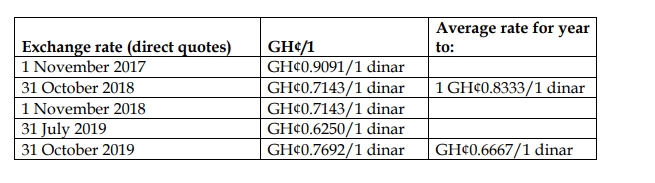
Foreign currency transactions related to purchases, sales, and investment property with exchange rate variations and reporting implications.

Medina Power Ltd has carried out certain transactions denominated in foreign currency during its financial year ended 31 October 2019 and has also conducted foreign operations through a foreign entity. Medina Power Ltd.’s functional and presentation currency is the cedi.

On 31 July 2019, Medina Power Ltd purchased goods from a foreign supplier for 16 million dinars. At 31 October 2019, the supplier had not yet been paid and the goods were still held in inventory by Medina Power Ltd.

On 31 July, Medina Power Ltd sold goods to a foreign customer for 8 million dinars, and it received payment for the goods in dinars on 31 October 2019.

Medina Power Ltd had also purchased an investment property on 1 November 2018 for 56 million dinars. At 31 October 2019, the investment property had a fair value of 48 million dinars. The company uses the fair value model in accounting for investment properties.

Medina Power Ltd wants advice on how to treat these transactions in the financial statements for the year ended 31 October 2019.

question table

Required:
Discuss the accounting treatment of the above transactions in accordance with the advice required by the directors. (You should show detailed workings as well as a discussion of the accounting treatment used.)


Inventory and payable

  • The inventory and trade payable would be recorded initially at GH¢10 million (16 million dinars x GH¢0.6250).
  • At the year-end on 31 October 2019, the amount payable is still outstanding. It should be re-translated at the closing rate to GH¢12.3 million (16 million dinars x GH¢0.7692).
  • This creates an exchange loss of GH¢2.3 million (12.3 – 10) which should be recognized in profit or loss.
  • Unless it has been impaired, the inventory (a non-monetary asset) should be recorded at GH¢10 million at the year-end.

Sale of goods

  • The sale of goods should be recorded at GH¢5 million (8 million dinars x GH¢0.6250) as revenue and as a trade receivable.
  • Payment in dinars was received on 31 October 2019 and the actual cedi value of the dinars received was GH¢6.2 million (8 million dinars x GH¢0.7692).
  • This creates a gain on exchange of GH¢1.2 million (6.2 – 5) which should be recognized in profit or loss.

Investment property

  • The investment property should be recognized on 1 November 2018 at GH¢40 million (56 million dinars x GH¢0.7143).
  • At the year-end on 31 October 2019, the property should be recognized at its fair value of GH¢36.9 million (48 million dinars x GH¢0.7692).
  • The fall in fair value (40 – 36.9 = 3.1) should be recognized in profit and loss as a loss on investment property.
  • The property is a non-monetary asset and when a gain or loss on a non-monetary item is recognized in profit or loss, the element of the gain or loss relating to exchange rates is also recognized in profit or loss.

Login or create a free account to see answers

Complete your registration to see answers

Find Related Questions by Tags, levels, etc.

Report an error

You're reporting an error for "CR – May 2020 – L3 – Q3a – Foreign Currency Transactions"

CR – May 2020 – L3 – Q3a – Foreign Currency Transactions

Foreign currency transactions related to purchases, sales, and investment property with exchange rate variations and reporting implications.

Medina Power Ltd has carried out certain transactions denominated in foreign currency during its financial year ended 31 October 2019 and has also conducted foreign operations through a foreign entity. Medina Power Ltd.’s functional and presentation currency is the cedi.

On 31 July 2019, Medina Power Ltd purchased goods from a foreign supplier for 16 million dinars. At 31 October 2019, the supplier had not yet been paid and the goods were still held in inventory by Medina Power Ltd.

On 31 July, Medina Power Ltd sold goods to a foreign customer for 8 million dinars, and it received payment for the goods in dinars on 31 October 2019.

Medina Power Ltd had also purchased an investment property on 1 November 2018 for 56 million dinars. At 31 October 2019, the investment property had a fair value of 48 million dinars. The company uses the fair value model in accounting for investment properties.

Medina Power Ltd wants advice on how to treat these transactions in the financial statements for the year ended 31 October 2019.

question table

Required:
Discuss the accounting treatment of the above transactions in accordance with the advice required by the directors. (You should show detailed workings as well as a discussion of the accounting treatment used.)


Inventory and payable

  • The inventory and trade payable would be recorded initially at GH¢10 million (16 million dinars x GH¢0.6250).
  • At the year-end on 31 October 2019, the amount payable is still outstanding. It should be re-translated at the closing rate to GH¢12.3 million (16 million dinars x GH¢0.7692).
  • This creates an exchange loss of GH¢2.3 million (12.3 – 10) which should be recognized in profit or loss.
  • Unless it has been impaired, the inventory (a non-monetary asset) should be recorded at GH¢10 million at the year-end.

Sale of goods

  • The sale of goods should be recorded at GH¢5 million (8 million dinars x GH¢0.6250) as revenue and as a trade receivable.
  • Payment in dinars was received on 31 October 2019 and the actual cedi value of the dinars received was GH¢6.2 million (8 million dinars x GH¢0.7692).
  • This creates a gain on exchange of GH¢1.2 million (6.2 – 5) which should be recognized in profit or loss.

Investment property

  • The investment property should be recognized on 1 November 2018 at GH¢40 million (56 million dinars x GH¢0.7143).
  • At the year-end on 31 October 2019, the property should be recognized at its fair value of GH¢36.9 million (48 million dinars x GH¢0.7692).
  • The fall in fair value (40 – 36.9 = 3.1) should be recognized in profit and loss as a loss on investment property.
  • The property is a non-monetary asset and when a gain or loss on a non-monetary item is recognized in profit or loss, the element of the gain or loss relating to exchange rates is also recognized in profit or loss.

Login or create a free account to see answers

Complete your registration to see answers

Find Related Questions by Tags, levels, etc.

Report an error

You're reporting an error for "CR – May 2020 – L3 – Q3a – Foreign Currency Transactions"

CR – May 2020 – Q3b(i) – Ethical Issues in Contract Bidding

This question requires a discussion on the ethical issues related to conflict of interest, confidentiality, and professional behavior in a contract bidding scenario.

You have just obtained your full membership with the Institute of Chartered Accountants (Ghana). Following this successful achievement, you have been appointed as the Head of Finance at Asasiyemedeh Company Limited, a Ghanaian company, which provides catering services. Your former employer, Akwaba Limited, is a large public sector organization operating in Accra, where, as the Financial Accountant, you had the opportunity to work on areas relating to financial accounting, procurement, contracts, and bids. One of Asasiyemedeh Company Limited’s major contracts is with Akwaba Limited, your former employer. The contract is now due for renewal, and Asasiyemedeh Company Limited is preparing a competitive bid for this contract.

You have been tasked to lead the team responsible for bidding for this contract, but you are concerned as a professional that you might breach confidentiality if you accept this role. You also suspect that your knowledge and experience of Akwaba Limited were seen as good reasons for appointing you to the position of Head of Finance at Asasiyemedeh Company Limited. You do not in any way want to let your new employer down as you are aware that the loss of such a major contract would have a significant effect on the financial performance of Asasiyemedeh Company Limited, and its performance-related bonus scheme for management members.

Required:
Discuss the ethical issues raised in the above scenario.

The ethical issues raised in the scenario include:

  1. Objectivity:
    There is a self-interest threat that arises due to the impact that losing Akwaba Limited’s contract would have on Asasiyemedeh Company Limited’s financial performance and reward policy. There is also an intimidation threat because other employees in the company may be affected by the financial implications of the contract not being renewed. Additionally, you may feel a strong desire to impress your new employer by helping to secure the renewal of the contract. The key question is whether you can safeguard against the self-interest threat posed by Asasiyemedeh Company Limited’s performance-related bonus scheme.
  2. Confidentiality:
    Clearly, there is a confidentiality threat here as you have worked with Akwaba Ltd in the past. Your previous employment with Akwaba Ltd has provided you with information which may be of value to Asasiyemedeh Company Limited. The principle of confidentiality prohibits the use of confidential information acquired as a result of your previous employment for your advantage or that of your current employer. While you have a responsibility to advance the legitimate aims of your employing organization, this should not extend to a breach of confidentiality. In this case, you (because of Asasiyemedeh Company Limited’s performance-related bonus) and Asasiyemedeh Company Limited stand to benefit from the confidential information about how bids are assessed at Akwaba Ltd. The principle would not be breached if you were in possession of information that was in the public domain, or if you were simply to use experience gained in your previous employment, so long as you do not use confidential knowledge that you acquired as a result of that employment.                           If you accept this role, can you ensure that you do not use confidential information relating to your former employer to your advantage or to the advantage of your current employer? You must be careful and professional as winning that contracts may leads to confidential breaches against you or your current employers perhaps from those bidders of the same contracts who might lose the bids
  3. Professional Behavior:
    You must demonstrate professionalism here. For example, what can you do to safeguard your reputation as a professional, the reputation of your employer, and the accountancy profession to which you belong? You must consider the Institute of Chartered Accountants (Ghana) code of ethics, applicable laws (procurement Act 914), and regulations, your current and previous contracts of employment, and your employer’s policies and procedures.

Login or create a free account to see answers

Complete your registration to see answers

Find Related Questions by Tags, levels, etc.

Report an error

You're reporting an error for "CR – May 2020 – Q3b(i) – Ethical Issues in Contract Bidding"

CR – May 2020 – Q3b(i) – Ethical Issues in Contract Bidding

This question requires a discussion on the ethical issues related to conflict of interest, confidentiality, and professional behavior in a contract bidding scenario.

You have just obtained your full membership with the Institute of Chartered Accountants (Ghana). Following this successful achievement, you have been appointed as the Head of Finance at Asasiyemedeh Company Limited, a Ghanaian company, which provides catering services. Your former employer, Akwaba Limited, is a large public sector organization operating in Accra, where, as the Financial Accountant, you had the opportunity to work on areas relating to financial accounting, procurement, contracts, and bids. One of Asasiyemedeh Company Limited’s major contracts is with Akwaba Limited, your former employer. The contract is now due for renewal, and Asasiyemedeh Company Limited is preparing a competitive bid for this contract.

You have been tasked to lead the team responsible for bidding for this contract, but you are concerned as a professional that you might breach confidentiality if you accept this role. You also suspect that your knowledge and experience of Akwaba Limited were seen as good reasons for appointing you to the position of Head of Finance at Asasiyemedeh Company Limited. You do not in any way want to let your new employer down as you are aware that the loss of such a major contract would have a significant effect on the financial performance of Asasiyemedeh Company Limited, and its performance-related bonus scheme for management members.

Required:
Discuss the ethical issues raised in the above scenario.

The ethical issues raised in the scenario include:

  1. Objectivity:
    There is a self-interest threat that arises due to the impact that losing Akwaba Limited’s contract would have on Asasiyemedeh Company Limited’s financial performance and reward policy. There is also an intimidation threat because other employees in the company may be affected by the financial implications of the contract not being renewed. Additionally, you may feel a strong desire to impress your new employer by helping to secure the renewal of the contract. The key question is whether you can safeguard against the self-interest threat posed by Asasiyemedeh Company Limited’s performance-related bonus scheme.
  2. Confidentiality:
    Clearly, there is a confidentiality threat here as you have worked with Akwaba Ltd in the past. Your previous employment with Akwaba Ltd has provided you with information which may be of value to Asasiyemedeh Company Limited. The principle of confidentiality prohibits the use of confidential information acquired as a result of your previous employment for your advantage or that of your current employer. While you have a responsibility to advance the legitimate aims of your employing organization, this should not extend to a breach of confidentiality. In this case, you (because of Asasiyemedeh Company Limited’s performance-related bonus) and Asasiyemedeh Company Limited stand to benefit from the confidential information about how bids are assessed at Akwaba Ltd. The principle would not be breached if you were in possession of information that was in the public domain, or if you were simply to use experience gained in your previous employment, so long as you do not use confidential knowledge that you acquired as a result of that employment.                           If you accept this role, can you ensure that you do not use confidential information relating to your former employer to your advantage or to the advantage of your current employer? You must be careful and professional as winning that contracts may leads to confidential breaches against you or your current employers perhaps from those bidders of the same contracts who might lose the bids
  3. Professional Behavior:
    You must demonstrate professionalism here. For example, what can you do to safeguard your reputation as a professional, the reputation of your employer, and the accountancy profession to which you belong? You must consider the Institute of Chartered Accountants (Ghana) code of ethics, applicable laws (procurement Act 914), and regulations, your current and previous contracts of employment, and your employer’s policies and procedures.

Login or create a free account to see answers

Complete your registration to see answers

Find Related Questions by Tags, levels, etc.

Report an error

You're reporting an error for "CR – May 2020 – Q3b(i) – Ethical Issues in Contract Bidding"

CR – May 2020 – Q4a – Capital Reduction Account

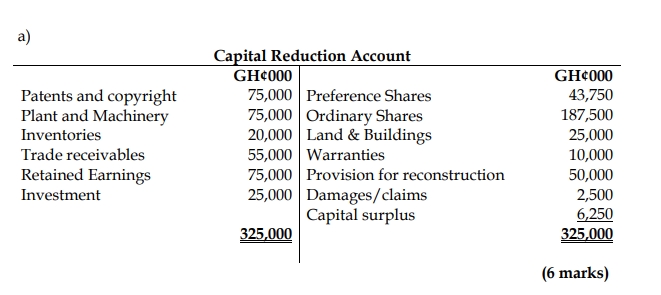
This question requires the preparation of a Capital Reduction Account for Sasasila Ltd following a reorganization.

Sasasila Ltd has been operating profitably for a number of years. However, in recent times, the company has been making losses. Below is the statement of financial position as at 30 June 2019:

Assets GH¢000
Non-Current Assets
Patents and copyrights 75,000
Land and buildings (net) 200,000
Plant and machinery (net) 150,000
Current Assets
Inventories 125,000
Trade receivables 125,000
Bank 37,500
Investments (cost) 100,000
Total Assets 812,500
Equity and liabilities:
Equity
Ordinary share capital (issued at GH¢10 each) 375,000
20% cumulative preference shares (issued at GH¢10 each) 175,000
Retained earnings (75,000)
Non-current Liabilities
15% Debentures 125,000
Current Liabilities
Interest on debentures 18,750
Trade payables 93,750
Provision for business restructuring 50,000
Provision for legal damages & claims 12,500
Provision for warranties 37,500
Total Equity and Liabilities 812,500

Additional relevant information: The following scheme of reconstruction was approved by all parties as well as the High Court with the exception of only one ordinary shareholder:

  1. The ordinary shares were to be reduced to GH¢5 per share.
  2. The preference shares were to be reduced to GH¢7.5 per share and arrears in dividends for three years were to be canceled from the company’s books.
  3. The fair values of the assets were agreed at the following values:
    • Patents and copyrights: Nil
    • Land and buildings: GH¢225,000
    • Plant and machinery: GH¢75,000
    • Investments: GH¢75,000
    • Inventories: GH¢105,000
    • Trade receivables: GH¢70,000
  4. The balance on retained earnings is to be eliminated in full.
  5. The liability for legal damages and claims was to be settled for GH¢10 million, and the provision for warranties reduced to GH¢27.5 million.
  6. The accrued debenture interest was to be paid in cash.
  7. Investments with a carrying amount of GH¢52.5 million were to be sold for cash at that value to strengthen the working capital position.
  8. The amount set aside for business restructuring was to be eliminated as well.
  9. The High Court directed a payment of GH¢0.2 million to a member who opposed the scheme for 50 ordinary shares held by him.

Prepare the Capital Reduction Account as at 30 June 2019.

answer to the question

Login or create a free account to see answers

Complete your registration to see answers

Find Related Questions by Tags, levels, etc.

Report an error

You're reporting an error for "CR – May 2020 – Q4a – Capital Reduction Account"

CR – May 2020 – Q4a – Capital Reduction Account

This question requires the preparation of a Capital Reduction Account for Sasasila Ltd following a reorganization.

Sasasila Ltd has been operating profitably for a number of years. However, in recent times, the company has been making losses. Below is the statement of financial position as at 30 June 2019:

Assets GH¢000
Non-Current Assets
Patents and copyrights 75,000
Land and buildings (net) 200,000
Plant and machinery (net) 150,000
Current Assets
Inventories 125,000
Trade receivables 125,000
Bank 37,500
Investments (cost) 100,000
Total Assets 812,500
Equity and liabilities:
Equity
Ordinary share capital (issued at GH¢10 each) 375,000
20% cumulative preference shares (issued at GH¢10 each) 175,000
Retained earnings (75,000)
Non-current Liabilities
15% Debentures 125,000
Current Liabilities
Interest on debentures 18,750
Trade payables 93,750
Provision for business restructuring 50,000
Provision for legal damages & claims 12,500
Provision for warranties 37,500
Total Equity and Liabilities 812,500

Additional relevant information: The following scheme of reconstruction was approved by all parties as well as the High Court with the exception of only one ordinary shareholder:

  1. The ordinary shares were to be reduced to GH¢5 per share.
  2. The preference shares were to be reduced to GH¢7.5 per share and arrears in dividends for three years were to be canceled from the company’s books.
  3. The fair values of the assets were agreed at the following values:
    • Patents and copyrights: Nil
    • Land and buildings: GH¢225,000
    • Plant and machinery: GH¢75,000
    • Investments: GH¢75,000
    • Inventories: GH¢105,000
    • Trade receivables: GH¢70,000
  4. The balance on retained earnings is to be eliminated in full.
  5. The liability for legal damages and claims was to be settled for GH¢10 million, and the provision for warranties reduced to GH¢27.5 million.
  6. The accrued debenture interest was to be paid in cash.
  7. Investments with a carrying amount of GH¢52.5 million were to be sold for cash at that value to strengthen the working capital position.
  8. The amount set aside for business restructuring was to be eliminated as well.
  9. The High Court directed a payment of GH¢0.2 million to a member who opposed the scheme for 50 ordinary shares held by him.

Prepare the Capital Reduction Account as at 30 June 2019.

answer to the question

Login or create a free account to see answers

Complete your registration to see answers

Find Related Questions by Tags, levels, etc.

Report an error

You're reporting an error for "CR – May 2020 – Q4a – Capital Reduction Account"

CR – May 2020 – Q4b – Statement of Financial Position for Sasasila Ltd

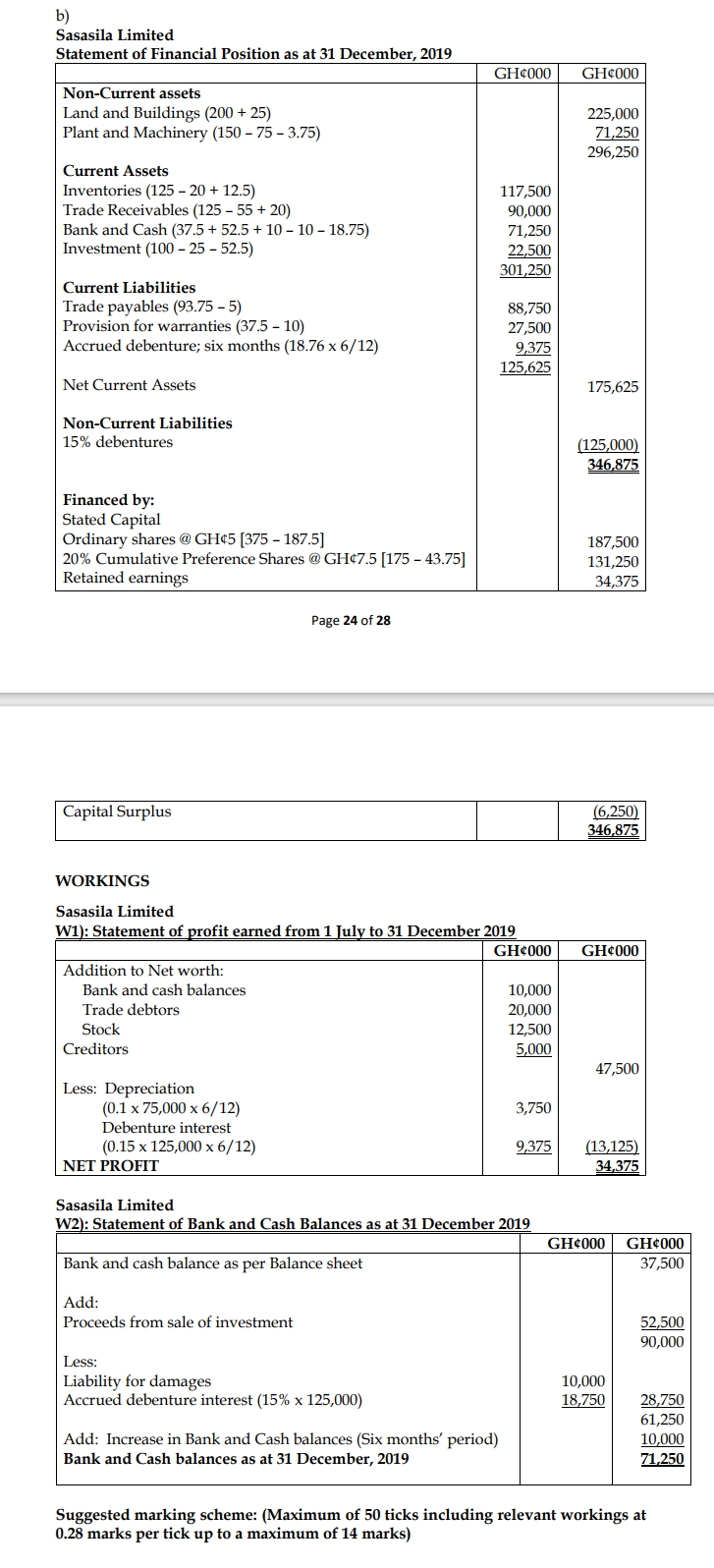
This question requires the preparation of a statement of financial position for Sasasila Ltd following its restructuring.

Prepare the statement of financial position as at 31 December 2019 for Sasasila Ltd.


Login or create a free account to see answers

Complete your registration to see answers

Find Related Questions by Tags, levels, etc.

Report an error

You're reporting an error for "CR – May 2020 – Q4b – Statement of Financial Position for Sasasila Ltd"

CR – May 2020 – Q4b – Statement of Financial Position for Sasasila Ltd

This question requires the preparation of a statement of financial position for Sasasila Ltd following its restructuring.

Prepare the statement of financial position as at 31 December 2019 for Sasasila Ltd.


Login or create a free account to see answers

Complete your registration to see answers

Find Related Questions by Tags, levels, etc.

Report an error

You're reporting an error for "CR – May 2020 – Q4b – Statement of Financial Position for Sasasila Ltd"

CR – May 2020 – Q5 – Financial Performance and Position of Bossman Ltd

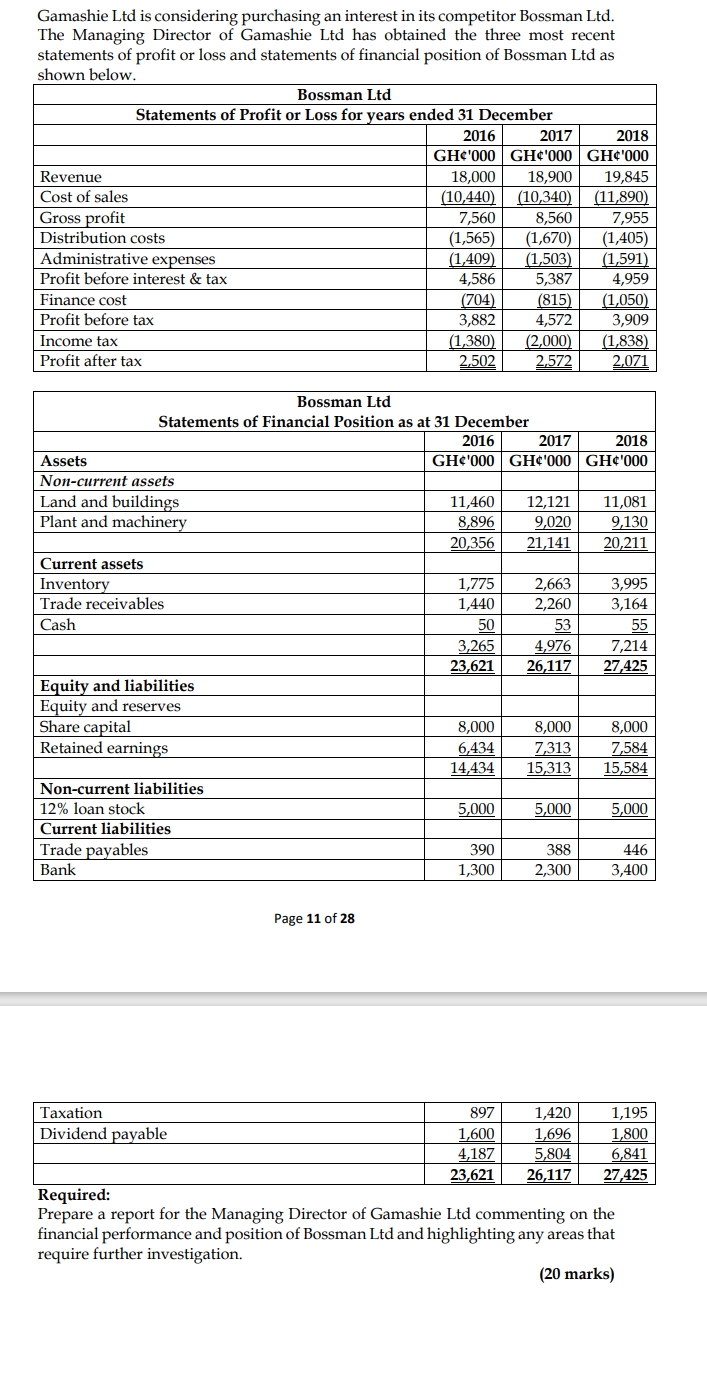
This question involves analyzing the financial performance and position of Bossman Ltd over three years using ratio analysis.

To: Managing Director, Gamashie Ltd
From: An Accountant
Date: 01/01/19
Subject: The Financial Position and Performance of Bossman Ltd


Introduction:

This report is based on the financial statements of Bossman Ltd for the years 2016, 2017, and 2018. It includes an analysis of the financial performance and position, with attention to key financial ratios calculated from the attached statements.


Financial Performance:

  • Revenue Growth: Bossman Ltd has experienced consistent revenue growth at approximately 5% per annum from GH¢18,000,000 in 2016 to GH¢19,845,000 in 2018.
  • Gross Profit Margin: The gross profit margin improved in 2017 but fell in 2018, indicating fluctuations in cost management. The margins were:
    • 2016: 42%
    • 2017: 45%
    • 2018: 40%
  • Operating Profit: Operating profit as a percentage of sales showed a similar trend to the gross profit margin. It increased from 25.5% in 2016 to 28.5% in 2017, before falling back to 25% in 2018. The decline in 2018 needs to be investigated to understand the reasons for the reduction.
  • Profit Before Tax (PBT): PBT decreased from GH¢3,882,000 in 2017 to GH¢3,909,000 in 2018, primarily due to increased finance costs. This indicates an increase in borrowing costs, which requires further investigation.

Financial Position:

  • Liquidity:
    • Current Ratio: The current ratio improved from 0.78 in 2016 to 1.05 in 2018, indicating better liquidity. However, it was below 1 in 2016 and 2017, suggesting that the company may have struggled to meet its short-term obligations during those years.
    • Quick Ratio: The quick ratio remained below 0.5 across all three years, highlighting potential issues with converting current assets (excluding inventory) into liquid assets. This indicates the company may be heavily reliant on inventory for liquidity.
  • Solvency:
    • Debt Ratio: The debt ratio increased steadily over the three years from 38.9% in 2016 to 43.2% in 2018, suggesting the company’s reliance on debt financing is increasing. This should be monitored, as it may impact the company’s financial flexibility.
  • Efficiency:
    • Receivables Collection Period: The collection period increased from 29.2 days in 2016 to 58.2 days in 2018. This could indicate deteriorating credit control or extended payment terms.
    • Inventory Turnover: Inventory turnover worsened, increasing from 62 days in 2016 to 122.6 days in 2018. This may indicate overstocking or slow-moving inventory, which ties up working capital.

Conclusion:

Bossman Ltd has shown consistent revenue growth but declining profitability. Liquidity has improved, but the quick ratio is concerning. The company’s growing reliance on debt and the extended receivables and inventory turnover periods should be investigated further to identify potential risks to financial stability.


Appendix – Ratio Analysis:

Ratios 2016 2017 2018
Gross Profit Margin 42% 45% 40%
Operating Profit Margin 25.5% 28.5% 25%
Return on Capital Employed 23.6% 27% 24.1%
Debt Ratio 38.9% 41.4% 43.2%
Current Ratio 0.78 0.86 1.05
Quick Ratio 0.36 0.40 0.47
Receivables Collection Period (days) 29.2 43.6 58.2
Inventory Turnover Period (days) 62 94 122.6

Login or create a free account to see answers

Complete your registration to see answers

Find Related Questions by Tags, levels, etc.

Report an error

You're reporting an error for "CR – May 2020 – Q5 – Financial Performance and Position of Bossman Ltd"

CR – May 2020 – Q5 – Financial Performance and Position of Bossman Ltd

This question involves analyzing the financial performance and position of Bossman Ltd over three years using ratio analysis.

To: Managing Director, Gamashie Ltd
From: An Accountant
Date: 01/01/19
Subject: The Financial Position and Performance of Bossman Ltd


Introduction:

This report is based on the financial statements of Bossman Ltd for the years 2016, 2017, and 2018. It includes an analysis of the financial performance and position, with attention to key financial ratios calculated from the attached statements.


Financial Performance:

  • Revenue Growth: Bossman Ltd has experienced consistent revenue growth at approximately 5% per annum from GH¢18,000,000 in 2016 to GH¢19,845,000 in 2018.
  • Gross Profit Margin: The gross profit margin improved in 2017 but fell in 2018, indicating fluctuations in cost management. The margins were:
    • 2016: 42%
    • 2017: 45%
    • 2018: 40%
  • Operating Profit: Operating profit as a percentage of sales showed a similar trend to the gross profit margin. It increased from 25.5% in 2016 to 28.5% in 2017, before falling back to 25% in 2018. The decline in 2018 needs to be investigated to understand the reasons for the reduction.
  • Profit Before Tax (PBT): PBT decreased from GH¢3,882,000 in 2017 to GH¢3,909,000 in 2018, primarily due to increased finance costs. This indicates an increase in borrowing costs, which requires further investigation.

Financial Position:

  • Liquidity:
    • Current Ratio: The current ratio improved from 0.78 in 2016 to 1.05 in 2018, indicating better liquidity. However, it was below 1 in 2016 and 2017, suggesting that the company may have struggled to meet its short-term obligations during those years.
    • Quick Ratio: The quick ratio remained below 0.5 across all three years, highlighting potential issues with converting current assets (excluding inventory) into liquid assets. This indicates the company may be heavily reliant on inventory for liquidity.
  • Solvency:
    • Debt Ratio: The debt ratio increased steadily over the three years from 38.9% in 2016 to 43.2% in 2018, suggesting the company’s reliance on debt financing is increasing. This should be monitored, as it may impact the company’s financial flexibility.
  • Efficiency:
    • Receivables Collection Period: The collection period increased from 29.2 days in 2016 to 58.2 days in 2018. This could indicate deteriorating credit control or extended payment terms.
    • Inventory Turnover: Inventory turnover worsened, increasing from 62 days in 2016 to 122.6 days in 2018. This may indicate overstocking or slow-moving inventory, which ties up working capital.

Conclusion:

Bossman Ltd has shown consistent revenue growth but declining profitability. Liquidity has improved, but the quick ratio is concerning. The company’s growing reliance on debt and the extended receivables and inventory turnover periods should be investigated further to identify potential risks to financial stability.


Appendix – Ratio Analysis:

Ratios 2016 2017 2018
Gross Profit Margin 42% 45% 40%
Operating Profit Margin 25.5% 28.5% 25%
Return on Capital Employed 23.6% 27% 24.1%
Debt Ratio 38.9% 41.4% 43.2%
Current Ratio 0.78 0.86 1.05
Quick Ratio 0.36 0.40 0.47
Receivables Collection Period (days) 29.2 43.6 58.2
Inventory Turnover Period (days) 62 94 122.6

Login or create a free account to see answers

Complete your registration to see answers

Find Related Questions by Tags, levels, etc.

Report an error

You're reporting an error for "CR – May 2020 – Q5 – Financial Performance and Position of Bossman Ltd"

AAA – May 2020 – Q5b – Reporting, Evaluation and Review

Discuss the impact of unresolved audit issues on the audit report and recommend completion stage procedures for two client scenarios.

You are the audit manager of Onipa Hia & Co., a local firm of Chartered Accountants located in Adabraka in the Greater Accra Region. You are currently reviewing the audit files for several of your clients for which the audit fieldwork is complete. The Audit Senior has raised the following issues:

African Designs Co. Ltd (ADCL)
ADCL’s year-end is 30 September; however, subsequent to the year-end, the company’s sales ledger has been corrupted by a computer virus. ADCL’s Finance Director was able to produce the financial statements prior to this occurring; however, the audit team has been unable to access the sales ledger to undertake detailed testing of revenue or year-end receivables. All other accounting records are unaffected, and there are no backups available for the sales ledger. ADCL’s revenue is GH¢15.6 million, its receivables are GH¢3.4 million, and profit before tax is GH¢2 million.

Ghana Design Co. Ltd (GDCL)
GDCL has experienced difficult trading conditions, and as a result, it has lost significant market share. The cash flow forecast has been reviewed during the audit fieldwork, and it shows a significant net cash outflow. Management is confident that further funding can be obtained and so have prepared the financial statements on a going concern basis with no additional disclosures; the Audit Senior is highly skeptical about this. The prior year’s financial statements showed a profit before tax of GH¢1.2 million; however, the current year’s loss before tax is GH¢4.4 million, and the forecast net cash outflow for the next 12 months is GH¢3.2 million.

Required:
For each of the two issues:
i) Describe the impact on the audit report if the issues remain unresolved. (5 marks)
ii) Recommend procedures the audit team should undertake at the completion stage to try to resolve the issue. (5 marks)

i)African Designs Co. Ltd (ADCL)
ADCL’s sales ledger has been corrupted by a computer virus; hence no detailed testing has been performed on revenue and receivables. The audit team will need to see if they can confirm revenue and receivables in an alternative manner. If they are unable to do this, then two significant balances in the financial statements will not have been confirmed. Revenue and receivables are both higher than the total profit before tax (PBT) of GH¢2 million; receivables are 170% of PBT and revenue is nearly eight times the PBT; hence this is a very material issue.

The auditors will need to modify the audit report as they are unable to obtain sufficient appropriate evidence in relation to two material and pervasive areas, being receivables and revenue. Therefore a disclaimer of opinion will be required. A basis for disclaimer of opinion paragraph will be required to explain the limitation in relation to the lack of evidence over revenue and receivables. The opinion paragraph will be a disclaimer of opinion and will state that we are unable to form an opinion on the financial statements.
(3 marks)

Ghana Design Co. Ltd (GDCL)
GDCL is facing going concern problems as it has experienced difficult trading conditions and it has a negative cash outflow. However, the financial statements have been prepared on a going concern basis, even though it is possible that the company is not a going concern. The prior year’s financial statements showed a profit of GH¢1.2 million and the current financial statements show a loss before tax of GH¢4.4 million, the net cash outflow of GH¢3.2 million represents 73% of this loss (3.2/4.4 million) and hence is a material issue. The auditor will issue a qualified opinion.
(2 marks)

ii) Procedures to be adopted include:

African Design Company Limited

  • Discuss with management whether they have any alternative records which detail revenue and receivables for the year.
  • Attempt to perform analytical procedures, such as proof in total or monthly comparison to last year, to gain comfort in total for revenue and for receivables. (2 points @ 1 mark each = 2 marks)

Ghana Design Company Limited

  • Discussion with management: Management should be asked to explain the reasons why they consider the going concern assumption to be valid. They should be asked about their future plans for the business since they anticipated a loss for next year, the possible implications of these for the going concern assumption should be discussed extensively with management.
  • Cash flow Forecast: The cash flow should be discussed with management. The assumptions in the forecast should be checked and if appropriate challenged. Since there is a forecast of cash shortage, the auditors should discuss with management their plans for obtaining the additional financing that will be required.
  • Review of sales order book: If this indicates a decline in sales order, the issue should be discussed with management.
  • Review ageing receivables: Check a list of ageing receivables and assess the average
  • Time to pay. If customers are taking longer to pay this may have adverse implication for operational cash flow.
  • Information on the funding source: Discuss with management the source of funding expected and determine whether it is feasible and reliable
  • Letters of Representation: After discussing the issue with management, the auditor should obtain letter of representation from management confirming their opinion that the entity is a going concern. (3 points @ 1 mark each =3 marks)

Login or create a free account to see answers

Complete your registration to see answers

Find Related Questions by Tags, levels, etc.

Report an error

You're reporting an error for "AAA – May 2020 – Q5b – Reporting, Evaluation and Review"

AAA – May 2020 – Q5b – Reporting, Evaluation and Review

Discuss the impact of unresolved audit issues on the audit report and recommend completion stage procedures for two client scenarios.

You are the audit manager of Onipa Hia & Co., a local firm of Chartered Accountants located in Adabraka in the Greater Accra Region. You are currently reviewing the audit files for several of your clients for which the audit fieldwork is complete. The Audit Senior has raised the following issues:

African Designs Co. Ltd (ADCL)
ADCL’s year-end is 30 September; however, subsequent to the year-end, the company’s sales ledger has been corrupted by a computer virus. ADCL’s Finance Director was able to produce the financial statements prior to this occurring; however, the audit team has been unable to access the sales ledger to undertake detailed testing of revenue or year-end receivables. All other accounting records are unaffected, and there are no backups available for the sales ledger. ADCL’s revenue is GH¢15.6 million, its receivables are GH¢3.4 million, and profit before tax is GH¢2 million.

Ghana Design Co. Ltd (GDCL)
GDCL has experienced difficult trading conditions, and as a result, it has lost significant market share. The cash flow forecast has been reviewed during the audit fieldwork, and it shows a significant net cash outflow. Management is confident that further funding can be obtained and so have prepared the financial statements on a going concern basis with no additional disclosures; the Audit Senior is highly skeptical about this. The prior year’s financial statements showed a profit before tax of GH¢1.2 million; however, the current year’s loss before tax is GH¢4.4 million, and the forecast net cash outflow for the next 12 months is GH¢3.2 million.

Required:
For each of the two issues:
i) Describe the impact on the audit report if the issues remain unresolved. (5 marks)
ii) Recommend procedures the audit team should undertake at the completion stage to try to resolve the issue. (5 marks)

i)African Designs Co. Ltd (ADCL)
ADCL’s sales ledger has been corrupted by a computer virus; hence no detailed testing has been performed on revenue and receivables. The audit team will need to see if they can confirm revenue and receivables in an alternative manner. If they are unable to do this, then two significant balances in the financial statements will not have been confirmed. Revenue and receivables are both higher than the total profit before tax (PBT) of GH¢2 million; receivables are 170% of PBT and revenue is nearly eight times the PBT; hence this is a very material issue.

The auditors will need to modify the audit report as they are unable to obtain sufficient appropriate evidence in relation to two material and pervasive areas, being receivables and revenue. Therefore a disclaimer of opinion will be required. A basis for disclaimer of opinion paragraph will be required to explain the limitation in relation to the lack of evidence over revenue and receivables. The opinion paragraph will be a disclaimer of opinion and will state that we are unable to form an opinion on the financial statements.
(3 marks)

Ghana Design Co. Ltd (GDCL)
GDCL is facing going concern problems as it has experienced difficult trading conditions and it has a negative cash outflow. However, the financial statements have been prepared on a going concern basis, even though it is possible that the company is not a going concern. The prior year’s financial statements showed a profit of GH¢1.2 million and the current financial statements show a loss before tax of GH¢4.4 million, the net cash outflow of GH¢3.2 million represents 73% of this loss (3.2/4.4 million) and hence is a material issue. The auditor will issue a qualified opinion.
(2 marks)

ii) Procedures to be adopted include:

African Design Company Limited

  • Discuss with management whether they have any alternative records which detail revenue and receivables for the year.
  • Attempt to perform analytical procedures, such as proof in total or monthly comparison to last year, to gain comfort in total for revenue and for receivables. (2 points @ 1 mark each = 2 marks)

Ghana Design Company Limited

  • Discussion with management: Management should be asked to explain the reasons why they consider the going concern assumption to be valid. They should be asked about their future plans for the business since they anticipated a loss for next year, the possible implications of these for the going concern assumption should be discussed extensively with management.
  • Cash flow Forecast: The cash flow should be discussed with management. The assumptions in the forecast should be checked and if appropriate challenged. Since there is a forecast of cash shortage, the auditors should discuss with management their plans for obtaining the additional financing that will be required.
  • Review of sales order book: If this indicates a decline in sales order, the issue should be discussed with management.
  • Review ageing receivables: Check a list of ageing receivables and assess the average
  • Time to pay. If customers are taking longer to pay this may have adverse implication for operational cash flow.
  • Information on the funding source: Discuss with management the source of funding expected and determine whether it is feasible and reliable
  • Letters of Representation: After discussing the issue with management, the auditor should obtain letter of representation from management confirming their opinion that the entity is a going concern. (3 points @ 1 mark each =3 marks)

Login or create a free account to see answers

Complete your registration to see answers

Find Related Questions by Tags, levels, etc.

Report an error

You're reporting an error for "AAA – May 2020 – Q5b – Reporting, Evaluation and Review"

AAA – May 2020 – L3 – Q5a – The regulatory environment

Analyze the factors influencing the development of new auditing standards and discuss the procedures involved in their creation.

The auditing profession is very dynamic and constantly confronted with new challenges emanating from the political and economic spheres. To meet these challenges the global authority responsible for the regulation of accountancy profession, The International Federation of Accountants (IFAC) has been ensuring that the standards for conduct of audit and assurance engagements are revised and brought up to date all the time.

Required:

i) Analyze the factors that influence the development of new Auditing Standards. (6 marks)

ii) Discuss the procedures for developing new Auditing Standards. (4 marks)

i) Factors giving rise to new Auditing Standards: International Standards on Auditing (ISAs) are produced by the International Auditing and Assurance Standard Board (IAASB), a technical committee of the International Federation of Accountants (IFAC). New International Auditing Standards arise as a result of the following:

  1. Response to new legal requirements:
    • When new laws are enacted which have global implications for auditing and assurance practice, the IAASB will review the existing standards to determine whether they can adequately address the new legal requirements. If the existing standards are not adequate, a new standard will be produced to replace the existing inadequate one.
  2. Changes in the economic and business environments:
    • Changes are constantly taking place in the economic and business environment. To remain relevant to the business environment, the Standard board on its own initiative or on the prompting of the IFAC governing council produces a new standard to respond to the new demands on the profession. For example, the introduction of ICT into business processes and reporting of financial information electronically required the International Standards on Auditing to guide auditors.
  3. Demands from industry players and the general public:
    • Clients and other stakeholders continue to express dissatisfaction about the performance of their external auditors even though some of the demands may be informed by e.g. the expectation gap. To maintain the goodwill of the client and other stakeholders, the board will respond by revising the existing standards or come out with a completely new standard, for example, the revision on International Standards on Auditing 700/701 to make the auditors’ report on general purpose financial statements more user-friendly.
  4. Self-introspection:
    • The IFAC council itself may find that an existing standard has become inadequate or irresponsive to the needs of practitioners and their clientele and would initiate action for the standard board to revise the existing standards or produce a completely new standard.

(4 points well explained @ 1½ marks each = 6 Marks)

ii) The procedures for developing a new standard:

  • When the need arises for a new standard, the standard board is charged by IFAC council to initiate action.
  • The board will initially review the existing standards to determine its adequacy to address the need. The board may determine that the existing standard should be revised or a new standard should be produced.
  • The board then produces an exposure draft.
  • The exposure draft is widely circulated to professional accountancy bodies, governments, industry players, and regulators for comments.
  • The comments received are taken into account in producing a new standard for the attention of the IFAC Council.
  • The Council studies the amended draft and suggests improvements which are incorporated.
  • The final draft is debated and voted on by the Council.
  • The approved version becomes the new standard after a waiting period.

(Any 4 points @ 1 mark each = 4 Marks)

Login or create a free account to see answers

Complete your registration to see answers

Find Related Questions by Tags, levels, etc.

Report an error

You're reporting an error for "AAA – May 2020 – L3 – Q5a – The regulatory environment"

AAA – May 2020 – L3 – Q5a – The regulatory environment

Analyze the factors influencing the development of new auditing standards and discuss the procedures involved in their creation.

The auditing profession is very dynamic and constantly confronted with new challenges emanating from the political and economic spheres. To meet these challenges the global authority responsible for the regulation of accountancy profession, The International Federation of Accountants (IFAC) has been ensuring that the standards for conduct of audit and assurance engagements are revised and brought up to date all the time.

Required:

i) Analyze the factors that influence the development of new Auditing Standards. (6 marks)

ii) Discuss the procedures for developing new Auditing Standards. (4 marks)

i) Factors giving rise to new Auditing Standards: International Standards on Auditing (ISAs) are produced by the International Auditing and Assurance Standard Board (IAASB), a technical committee of the International Federation of Accountants (IFAC). New International Auditing Standards arise as a result of the following:

  1. Response to new legal requirements:
    • When new laws are enacted which have global implications for auditing and assurance practice, the IAASB will review the existing standards to determine whether they can adequately address the new legal requirements. If the existing standards are not adequate, a new standard will be produced to replace the existing inadequate one.
  2. Changes in the economic and business environments:
    • Changes are constantly taking place in the economic and business environment. To remain relevant to the business environment, the Standard board on its own initiative or on the prompting of the IFAC governing council produces a new standard to respond to the new demands on the profession. For example, the introduction of ICT into business processes and reporting of financial information electronically required the International Standards on Auditing to guide auditors.
  3. Demands from industry players and the general public:
    • Clients and other stakeholders continue to express dissatisfaction about the performance of their external auditors even though some of the demands may be informed by e.g. the expectation gap. To maintain the goodwill of the client and other stakeholders, the board will respond by revising the existing standards or come out with a completely new standard, for example, the revision on International Standards on Auditing 700/701 to make the auditors’ report on general purpose financial statements more user-friendly.
  4. Self-introspection:
    • The IFAC council itself may find that an existing standard has become inadequate or irresponsive to the needs of practitioners and their clientele and would initiate action for the standard board to revise the existing standards or produce a completely new standard.

(4 points well explained @ 1½ marks each = 6 Marks)

ii) The procedures for developing a new standard:

  • When the need arises for a new standard, the standard board is charged by IFAC council to initiate action.
  • The board will initially review the existing standards to determine its adequacy to address the need. The board may determine that the existing standard should be revised or a new standard should be produced.
  • The board then produces an exposure draft.
  • The exposure draft is widely circulated to professional accountancy bodies, governments, industry players, and regulators for comments.
  • The comments received are taken into account in producing a new standard for the attention of the IFAC Council.
  • The Council studies the amended draft and suggests improvements which are incorporated.
  • The final draft is debated and voted on by the Council.
  • The approved version becomes the new standard after a waiting period.

(Any 4 points @ 1 mark each = 4 Marks)

Login or create a free account to see answers

Complete your registration to see answers

Find Related Questions by Tags, levels, etc.

Report an error

You're reporting an error for "AAA – May 2020 – L3 – Q5a – The regulatory environment"

AAA – May 2020 – L3 – Q4b -Government external audit and public accountability, Public sector audit

Discuss the role of performance audit and the Auditor-General’s concerns in auditing the construction of the Greater Accra Regional Hospital.

The Auditor-General has a responsibility to ensure that government business is being performed in a manner which will bring development and benefits to the citizens. Various aspects of the conduct of government business will engage the attention of the Auditor-General, for example execution of contracts for the construction of a regional hospital.

Required: i) Briefly discuss what performance audit entails? (2 marks)

ii) In carrying out the performance audit, evaluate the THREE (3) main factors that the Auditor-General will be concerned with in relation to the construction of the Greater Accra Regional Hospital. (8 marks)

(Total: 10 marks)


i) Performance audit involves systematic review of part or all of an organization’s activities in relation to the efficient and effective use of resources. The purpose of performance audit is to assess performance, identify areas for improvement, and develop recommendations.

(2 marks)

ii) In this respect the three factors that the Auditor General will be concerned with in carrying out performance audit on the construction of the regional hospital will be:

  1. Economy: The audit will be designed to check whether the resources used in the construction were obtained at the least cost for best quality or the quantity of items used was least expected under the circumstances.
  2. Efficiency: The measure of the relationship between input and output. Where output is greater than the value of the input, efficiency is achieved. However, defining output for social and other services is a very difficult task.
  3. Effectiveness: This deals with the ability to achieve the set targets. In the case of the Regional hospital, measuring effectiveness will involve whether the intended capacity and facilities have been attained as well as the completion and commissioning of the hospital for public use within the set time frame.
  4. Check whether the contract for the construction was awarded in line with the Public Procurement Act.

(4 points well explained @ 2 marks each = 8 marks)

(Total: 10 marks)

Login or create a free account to see answers

Complete your registration to see answers

Find Related Questions by Tags, levels, etc.

Report an error

You're reporting an error for "AAA – May 2020 – L3 – Q4b -Government external audit and public accountability, Public sector audit"

AAA – May 2020 – L3 – Q4b -Government external audit and public accountability, Public sector audit

Discuss the role of performance audit and the Auditor-General’s concerns in auditing the construction of the Greater Accra Regional Hospital.

The Auditor-General has a responsibility to ensure that government business is being performed in a manner which will bring development and benefits to the citizens. Various aspects of the conduct of government business will engage the attention of the Auditor-General, for example execution of contracts for the construction of a regional hospital.

Required: i) Briefly discuss what performance audit entails? (2 marks)

ii) In carrying out the performance audit, evaluate the THREE (3) main factors that the Auditor-General will be concerned with in relation to the construction of the Greater Accra Regional Hospital. (8 marks)

(Total: 10 marks)


i) Performance audit involves systematic review of part or all of an organization’s activities in relation to the efficient and effective use of resources. The purpose of performance audit is to assess performance, identify areas for improvement, and develop recommendations.

(2 marks)

ii) In this respect the three factors that the Auditor General will be concerned with in carrying out performance audit on the construction of the regional hospital will be:

  1. Economy: The audit will be designed to check whether the resources used in the construction were obtained at the least cost for best quality or the quantity of items used was least expected under the circumstances.
  2. Efficiency: The measure of the relationship between input and output. Where output is greater than the value of the input, efficiency is achieved. However, defining output for social and other services is a very difficult task.
  3. Effectiveness: This deals with the ability to achieve the set targets. In the case of the Regional hospital, measuring effectiveness will involve whether the intended capacity and facilities have been attained as well as the completion and commissioning of the hospital for public use within the set time frame.
  4. Check whether the contract for the construction was awarded in line with the Public Procurement Act.

(4 points well explained @ 2 marks each = 8 marks)

(Total: 10 marks)

Login or create a free account to see answers

Complete your registration to see answers

Find Related Questions by Tags, levels, etc.

Report an error

You're reporting an error for "AAA – May 2020 – L3 – Q4b -Government external audit and public accountability, Public sector audit"

AAA – May 2020 – L3 – Q4a – Government external audit and public accountability

Analyze the role and constitutional status of the Auditor-General of Ghana in ensuring public accountability to combat corruption.

a) Among the factors hindering the development of third-world countries is corruption. Corruption has been an obstacle for doing business in many countries. It occurs often in locally funded contracts and several measures have been adopted to curb it but it still persists. One of such measures is the creation of the office of the Auditor-General in many countries.

Required:
Assess the role and constitutional status of the Auditor-General of Ghana in ensuring public accountability as a means of fighting corruption.
(10 marks)

The Auditor-General is the head of Ghana Audit Service, which is the supreme audit institution of Ghana. The Audit Service was established under the 1992 constitution of Ghana as part of the Public Service of Ghana. The Auditor General is part of the Audit Service board which is responsible for making regulations for the effective and efficient administration of the Ghana Audit Service.

Constitutional provisions in respect of the Auditor General: Constitution of Ghana (1992). The constitution makes the following key provisions in respect of the Auditor General:

  • The Auditor General shall audit public accounts of Ghana, as well as all public offices, including courts, central and local government, and any public corporation or other body established by an act of Parliament.
  • The Auditor General shall have access to all books, records, returns and other documents relating or relevant to those accounts.
  • The Auditor General must submit his report to Parliament within six months of the year end of each set of accounts.
  • The Auditor General must draw attention to any irregularities in the accounts, and to any other matter which in his opinion ought to be brought to the notice of Parliament.
  • The President may request the Auditor-General to audit the accounts of any organization within his remit.
  • The Auditor General may disallow any item of expenditure which is contrary to the law. Furthermore, he may then make a surcharge for this amount for any sum not accounted for, or the amount of the loss.

Additional requirements include:

  • The public accounts being audited, including underlying accounting systems, must be kept in a form approved by the Auditor General. Any changes to the accounting system must be approved by the Auditor General.
  • Internal auditors of any public body audited by the Auditor General must also submit copies of their report to him.
  • The Bank of Ghana also lies within the jurisdiction of the Auditor General. It is required to submit a statement of foreign exchange receipts and payments or transfer in or outside Ghana.

The Auditor General shall examine the accounts to ascertain whether:

  • The accounts have been properly kept.
  • All public monies are accounted for fully, and the rules and procedures applicable are sufficient to secure an effective check on the assessment, collection, and proper allocation of revenue.
  • Monies have been expended for the purposes for which they were appropriated and the expenditures have been made as authorized.
  • Essential records are maintained and the rules and procedures applied are sufficient to safeguard and control public funds properly.
  • Programmes and activities have been undertaken with due regard to economy, efficiency, and effectiveness.
  • The auditor is required to examine the reports on public accounts made to the Controller and Accountant General.

The Auditor General must adhere to international practices and, in particular, emerging practices such as environmental and forensic audits. If the Auditor General will exercise the constitutional responsiblities imposed on him properly, he will ensure public accountability and contribute to fighting corruption in the public sector.

(Any 10 points @ 1 mark each =10 marks)

Login or create a free account to see answers

Complete your registration to see answers

Find Related Questions by Tags, levels, etc.

Report an error

You're reporting an error for "AAA – May 2020 – L3 – Q4a – Government external audit and public accountability"

AAA – May 2020 – L3 – Q4a – Government external audit and public accountability

Analyze the role and constitutional status of the Auditor-General of Ghana in ensuring public accountability to combat corruption.

a) Among the factors hindering the development of third-world countries is corruption. Corruption has been an obstacle for doing business in many countries. It occurs often in locally funded contracts and several measures have been adopted to curb it but it still persists. One of such measures is the creation of the office of the Auditor-General in many countries.

Required:
Assess the role and constitutional status of the Auditor-General of Ghana in ensuring public accountability as a means of fighting corruption.
(10 marks)

The Auditor-General is the head of Ghana Audit Service, which is the supreme audit institution of Ghana. The Audit Service was established under the 1992 constitution of Ghana as part of the Public Service of Ghana. The Auditor General is part of the Audit Service board which is responsible for making regulations for the effective and efficient administration of the Ghana Audit Service.

Constitutional provisions in respect of the Auditor General: Constitution of Ghana (1992). The constitution makes the following key provisions in respect of the Auditor General:

  • The Auditor General shall audit public accounts of Ghana, as well as all public offices, including courts, central and local government, and any public corporation or other body established by an act of Parliament.
  • The Auditor General shall have access to all books, records, returns and other documents relating or relevant to those accounts.
  • The Auditor General must submit his report to Parliament within six months of the year end of each set of accounts.
  • The Auditor General must draw attention to any irregularities in the accounts, and to any other matter which in his opinion ought to be brought to the notice of Parliament.
  • The President may request the Auditor-General to audit the accounts of any organization within his remit.
  • The Auditor General may disallow any item of expenditure which is contrary to the law. Furthermore, he may then make a surcharge for this amount for any sum not accounted for, or the amount of the loss.

Additional requirements include:

  • The public accounts being audited, including underlying accounting systems, must be kept in a form approved by the Auditor General. Any changes to the accounting system must be approved by the Auditor General.
  • Internal auditors of any public body audited by the Auditor General must also submit copies of their report to him.
  • The Bank of Ghana also lies within the jurisdiction of the Auditor General. It is required to submit a statement of foreign exchange receipts and payments or transfer in or outside Ghana.

The Auditor General shall examine the accounts to ascertain whether:

  • The accounts have been properly kept.
  • All public monies are accounted for fully, and the rules and procedures applicable are sufficient to secure an effective check on the assessment, collection, and proper allocation of revenue.
  • Monies have been expended for the purposes for which they were appropriated and the expenditures have been made as authorized.
  • Essential records are maintained and the rules and procedures applied are sufficient to safeguard and control public funds properly.
  • Programmes and activities have been undertaken with due regard to economy, efficiency, and effectiveness.
  • The auditor is required to examine the reports on public accounts made to the Controller and Accountant General.

The Auditor General must adhere to international practices and, in particular, emerging practices such as environmental and forensic audits. If the Auditor General will exercise the constitutional responsiblities imposed on him properly, he will ensure public accountability and contribute to fighting corruption in the public sector.

(Any 10 points @ 1 mark each =10 marks)

Login or create a free account to see answers

Complete your registration to see answers

Find Related Questions by Tags, levels, etc.

Report an error

You're reporting an error for "AAA – May 2020 – L3 – Q4a – Government external audit and public accountability"

AAA – May 2020 – L3 – Q3 – Audit evidence, Evaluation and review

Discusses audit procedures for accounting estimates, the appropriateness of written representations, and additional audit procedures.

GGC Co. Ltd (GGCL) specializes in manufacturing equipment which can help to reduce toxic emissions in the production of chemicals. The company has grown rapidly over the past eight years, and this is partly due to the warranties that the company gives to its customers. It guarantees its products for five years, and if problems arise during this period, it undertakes to fix them or provide a replacement.

You are the manager responsible for the audit of GGCL, and you are performing the final review stage of the audit and have come across the following issues:

Receivable balance owing from Nhyira Co. Ltd
GGCL has a material receivable balance owed by its customer, Nhyira Co. Ltd. During the year-end audit, your team reviewed the aging of this balance and found that no payments had been received from Nhyira Co. Ltd for over six months. GGCL would not allow this balance to be circularized. Instead, management has assured your team that they will provide a written representation confirming that the balance is recoverable.

Warranty provision
The warranty provision included within the statement of financial position is material. The audit team has performed testing over the calculations and assumptions which are consistent with prior years. The team has requested a written representation from management confirming that the basis and amount of the provision are reasonable. Management is yet to confirm acceptance of this representation.

Required:

  1. Describe the audit procedures required in respect of accounting estimates.
    (8 marks)
  2. For each of the two issues above:
    i) Discuss the appropriateness of written representations as a form of audit evidence; and
    (6 marks)
    ii) Describe additional procedures the auditor should now perform in order to reach a conclusion on the balance to be included in the financial statements.
    (6 marks)

(Total: 20 marks)

a) Procedures the auditor should adopt in respect of auditing accounting estimates include:

  • Enquire of management how the accounting estimate is made and the data on which it is based.
  • Determine whether events occurring up to the date of the auditor’s report (after the reporting period) provide audit evidence regarding the accounting estimate.
  • Review the method of measurement used and assess the reasonableness of assumptions made.
  • Test the operating effectiveness of the controls over how management made the accounting estimate.
  • Develop an expectation of the possible estimate (point estimate) or a range of amounts to evaluate management’s estimate.
  • Review the judgments and decisions made by management in the making of accounting estimates to identify whether there are indicators of possible management bias.
  • Evaluate overall whether the accounting estimates in the financial statements are either reasonable or misstated.
  • Obtain sufficient appropriate audit evidence about whether the disclosures in the financial statements related to accounting estimates and estimation uncertainty are reasonable.
  • Obtain written representations from management and, where appropriate, those charged with governance whether they believe significant assumptions used in making accounting estimates are reasonable.

(Any 8 points @ 1 mark each = 8 marks)

b) Appropriateness of written representations

i) Receivables balance owing from Nhyira Co. Ltd

The written representation proposed by management is intended to verify valuation, existence, and rights and obligations of a material receivables balance. As management has refused to allow the auditor to circularize the balance and there has been little activity on the account for the past six months, there is very little evidence that has been obtained by the auditor.

This representation would constitute entity-generated evidence and is less reliable than auditor-generated evidence or evidence from an external source. If related control systems operate effectively, then this evidence becomes more reliable. In addition, if the representation is written as opposed to oral, then this will increase the reliability as an evidence source.

Overall, this representation is a weak form of evidence, as there were more reliable evidence options available, such as the circularization, but this was not undertaken.

(3 marks)

Warranty provision

In this case, the auditor has performed some testing of the provision in order to obtain auditor-generated evidence. The team has tested the calculations and assumptions. None of this is evidence from an external source.

The very nature of this provision means that it is difficult for the auditor to obtain a significant amount of reliable evidence as to the level of future warranty claims. Hence the written representation, whilst being an entity-generated source of evidence, would still be useful as there are few other alternatives.

(3 marks)

ii) Receivable balance owing from Nhyira Co. Ltd

In order to reach a conclusion on the balance, the following procedures should be performed:

  • Discuss with management the reasons as to why a circularisation request was refused.
  • Review the post year-end period to identify whether any cash has now been received from Nhyira Co. Ltd.
  • Review correspondence with Nhyira Co. Ltd to assess reasons for the continued non-payment.
  • Review board minutes and legal correspondence to assess whether any legal action is being taken to recover the amounts due.
  • Discuss with management whether a provision or write-down is now required.
  • Consider the impact on the audit opinion if the balance is considered to be materially misstated.

(Any 3 points @ 1 mark each = 3 marks)

Warranty Provisions

In order to reach a conclusion on the balance, the following procedures should be performed:

  • Review the post year-end period to compare the level of claims actually made against the amounts provided.
  • Review the level of prior year provisions with the amounts claimed to assess the reasonableness of management’s forecasting.
  • Review board minutes to assess whether any changes are required to the level of the provision as a result of an increased or decreased level of claims by customers.

(3 points @ 1 mark each = 3 marks)

(Total: 20 marks)


Login or create a free account to see answers

Complete your registration to see answers

Find Related Questions by Tags, levels, etc.

Report an error

You're reporting an error for "AAA – May 2020 – L3 – Q3 – Audit evidence, Evaluation and review"

AAA – May 2020 – L3 – Q3 – Audit evidence, Evaluation and review

Discusses audit procedures for accounting estimates, the appropriateness of written representations, and additional audit procedures.

GGC Co. Ltd (GGCL) specializes in manufacturing equipment which can help to reduce toxic emissions in the production of chemicals. The company has grown rapidly over the past eight years, and this is partly due to the warranties that the company gives to its customers. It guarantees its products for five years, and if problems arise during this period, it undertakes to fix them or provide a replacement.

You are the manager responsible for the audit of GGCL, and you are performing the final review stage of the audit and have come across the following issues:

Receivable balance owing from Nhyira Co. Ltd
GGCL has a material receivable balance owed by its customer, Nhyira Co. Ltd. During the year-end audit, your team reviewed the aging of this balance and found that no payments had been received from Nhyira Co. Ltd for over six months. GGCL would not allow this balance to be circularized. Instead, management has assured your team that they will provide a written representation confirming that the balance is recoverable.

Warranty provision
The warranty provision included within the statement of financial position is material. The audit team has performed testing over the calculations and assumptions which are consistent with prior years. The team has requested a written representation from management confirming that the basis and amount of the provision are reasonable. Management is yet to confirm acceptance of this representation.

Required:

  1. Describe the audit procedures required in respect of accounting estimates.
    (8 marks)
  2. For each of the two issues above:
    i) Discuss the appropriateness of written representations as a form of audit evidence; and
    (6 marks)
    ii) Describe additional procedures the auditor should now perform in order to reach a conclusion on the balance to be included in the financial statements.
    (6 marks)

(Total: 20 marks)

a) Procedures the auditor should adopt in respect of auditing accounting estimates include:

  • Enquire of management how the accounting estimate is made and the data on which it is based.
  • Determine whether events occurring up to the date of the auditor’s report (after the reporting period) provide audit evidence regarding the accounting estimate.
  • Review the method of measurement used and assess the reasonableness of assumptions made.
  • Test the operating effectiveness of the controls over how management made the accounting estimate.
  • Develop an expectation of the possible estimate (point estimate) or a range of amounts to evaluate management’s estimate.
  • Review the judgments and decisions made by management in the making of accounting estimates to identify whether there are indicators of possible management bias.
  • Evaluate overall whether the accounting estimates in the financial statements are either reasonable or misstated.
  • Obtain sufficient appropriate audit evidence about whether the disclosures in the financial statements related to accounting estimates and estimation uncertainty are reasonable.
  • Obtain written representations from management and, where appropriate, those charged with governance whether they believe significant assumptions used in making accounting estimates are reasonable.

(Any 8 points @ 1 mark each = 8 marks)

b) Appropriateness of written representations

i) Receivables balance owing from Nhyira Co. Ltd

The written representation proposed by management is intended to verify valuation, existence, and rights and obligations of a material receivables balance. As management has refused to allow the auditor to circularize the balance and there has been little activity on the account for the past six months, there is very little evidence that has been obtained by the auditor.

This representation would constitute entity-generated evidence and is less reliable than auditor-generated evidence or evidence from an external source. If related control systems operate effectively, then this evidence becomes more reliable. In addition, if the representation is written as opposed to oral, then this will increase the reliability as an evidence source.

Overall, this representation is a weak form of evidence, as there were more reliable evidence options available, such as the circularization, but this was not undertaken.

(3 marks)

Warranty provision

In this case, the auditor has performed some testing of the provision in order to obtain auditor-generated evidence. The team has tested the calculations and assumptions. None of this is evidence from an external source.

The very nature of this provision means that it is difficult for the auditor to obtain a significant amount of reliable evidence as to the level of future warranty claims. Hence the written representation, whilst being an entity-generated source of evidence, would still be useful as there are few other alternatives.

(3 marks)

ii) Receivable balance owing from Nhyira Co. Ltd

In order to reach a conclusion on the balance, the following procedures should be performed:

  • Discuss with management the reasons as to why a circularisation request was refused.
  • Review the post year-end period to identify whether any cash has now been received from Nhyira Co. Ltd.
  • Review correspondence with Nhyira Co. Ltd to assess reasons for the continued non-payment.
  • Review board minutes and legal correspondence to assess whether any legal action is being taken to recover the amounts due.
  • Discuss with management whether a provision or write-down is now required.
  • Consider the impact on the audit opinion if the balance is considered to be materially misstated.

(Any 3 points @ 1 mark each = 3 marks)

Warranty Provisions

In order to reach a conclusion on the balance, the following procedures should be performed:

  • Review the post year-end period to compare the level of claims actually made against the amounts provided.
  • Review the level of prior year provisions with the amounts claimed to assess the reasonableness of management’s forecasting.
  • Review board minutes to assess whether any changes are required to the level of the provision as a result of an increased or decreased level of claims by customers.

(3 points @ 1 mark each = 3 marks)

(Total: 20 marks)


Login or create a free account to see answers

Complete your registration to see answers

Find Related Questions by Tags, levels, etc.

Report an error

You're reporting an error for "AAA – May 2020 – L3 – Q3 – Audit evidence, Evaluation and review"

AAA – May 2020 – Q2 – Assurance Services

Evaluate the risks, audit implications, and ethical considerations for accepting an engagement to provide assurance on EnvironmentalCare Ghana's Sustainability Report, focusing on environmental and social KPIs.

You are a manager in Sustainability Ghana, an independent member of Sustainability International, a global firm of Chartered Certified Accountants. You are responsible for evaluating proposed engagements and for recommending to a team of partners whether or not an engagement should be accepted by your firm.

EnvironmentalCare Ghana, a listed company, is an existing audit client and is an international energy producing company, with a global network including 220 countries and 300,000 employees. The company offers electricity using renewable resources to individual and corporate customers, as well as storage and logistical services.

EnvironmentalCare Ghana takes its corporate social responsibility seriously, and publishes social and environmental key performance indicators (KPIs) in a Sustainability Report, which is published with the financial statements in the annual report. Partly in response to requests from shareholders and pressure groups, EnvironmentalCare Ghana’s management has decided that in the forthcoming annual report, the KPIs should be accompanied by an independent assurance report. An approach has been made to your firm to provide this report in addition to the audit.

To help in your evaluation of this potential engagement, you have been given an extract from the draft Sustainability Report, containing some of the KPIs published by EnvironmentalCare Ghana. In total, 25 environmental KPIs, and 50 social KPIs are disclosed.

Extract from Sustainability Report Year ended 31 December 2018 Draft Year ended 31 December 2017 Actual
CO2 emissions (million tonnes) 26.8 28.3
Energy use (million kilowatt hours) 4,895 5,250
Charitable donations (GH¢ million) 10.5 8.2
Number of serious accidents in the workplace 60 68
Average annual expenditure on training per employee GH¢180 GH¢175

You have also had a meeting with Kofi Ghana, the manager responsible for the audit of EnvironmentalCare Ghana, and notes of the meeting are given below.

Notes from meeting with audit manager, Kofi Ghana

  • Sustainability Ghana has audited EnvironmentalCare Ghana for three years, and it is a major audit client of the firm, due to its global presence and recent listing on two major stock exchanges. The audit is managed from the Airport office, which is also the location of the global headquarters of EnvironmentalCare Ghana. The audit work is nearly complete, and the annual report is to be published in about four weeks, in time for the company’s meeting, scheduled for 31 January 2019.
  • No work has been done on the KPIs, other than review them for consistency, as we would with any ‘other information’ issued with the financial statements. The KPIs are produced by EnvironmentalCare Ghana’s Sustainability Department, located in Fartown. There has been no visit to EnvironmentalCare Ghana’s offices in Fartown as it is in a remote location overseas, and the department’s based there are not relevant to the audit.
  • Audit procedures were performed on the charitable donations, as disclosed in a note to the financial statements, and our evidence indicates that there have been donations of GH¢9 million this year, which is the amount disclosed in the note. However, the draft KPI has a different figure of GH¢10.5 million, and this is the figure highlighted in the draft Chairman’s Statement as well as the draft Sustainability Report. GH¢9 million is material to the financial statements.
    Your firm has recently established a sustainability reporting assurance team based at the
    Airport office and if the engagement to report on the Sustainability Report is accepted, it
    would be performed by members of that team, who would not be involved with the audit.
    Required:
    a) Identify and explain the matters to be evaluated in making the acceptance decision to
    perform an assurance engagement on the Sustainability Report of EnvironmentalCare
    Ghana. (14 marks)
    b) Recommend procedures that could be used to verify the following draft KPIs:
    i) The number of serious accidents in the workplace; and (3 marks)
    ii) The average annual expenditure on training per employee. (3 marks)
    (Total: 20 marks)

a) Matters that should be considered in making acceptance decision

Objectivity

The proposed assurance engagement represents a non-audit service. IFAC’s Code of Ethics for Professional Accountants adopted by Institute of Chartered Accountants- Ghana does not prohibit the provision of additional assurance services to an audit client, however, the audit firm must carefully consider whether the provision of the additional service creates a threat to objectivity and independence of the firm or members of the audit team. For example, when the total fees generated by a client represent a large proportion of a firm’s total fees, the perceived dependence on the client for fee income creates a self-interest threat. Due to the nature of the proposed engagement, self-review and advocacy threats may also be created, as the Sustainability Report is published with the audited financial statements, and the audit firm could be perceived to be promoting the interests of its client by providing an assurance report on the key performance indicators (KPIs).

Sustainability Ghana should only accept the invitation to provide the assurance engagement after careful consideration of objectivity, and a review as to whether safeguards can reduce any threat to objectivity to an acceptable level. As EnvironmentalCare Ghana is a ‘major client’, the fee level from providing both the audit and the assurance services could breach the permitted level of recurring fees allowed from one client. The fact that the company is listed means that the assessment of objectivity is particularly important, and a second partner review of the objectivity of the situation may be considered necessary.

The fact that a separate team, with no involvement with the audit, will be working on the KPIs strengthens the objectivity of the assignment.

EnvironmentalCare Ghana’s requirements

Assurance engagements can vary in terms of the level of work that is expected, and the level of assurance that is required. This will clearly impact on the scale of the assignment. For example, EnvironmentalCare Ghana may require specific procedures to be performed on certain KPIs to provide a high level of assurance, whereas a lower level of assurance may be acceptable for other KPIs. Sustainability Ghana should also clarify the expected form and content and expected wording of the assurance report itself, and whether any specific third party will be using the Sustainability Report for a particular purpose, as this may create risk exposure for the firm.

Competence

The audit firm’s sustainability reporting assurance team has only been recently established, and the firm may not have sufficient experienced staff to perform the assurance engagement. The fundamental principle of professional competence and due care requires that members of an engagement team should possess sufficient skill and knowledge to be able to perform the assignment, and be able to apply their skill and knowledge appropriately in the circumstances of the engagement. Some of EnvironmentalCare Ghana’s KPIs appear quite specialised – verification of CO2 emissions for example, may require specialist knowledge and expertise. Sustainability Ghana could bring in experts to perform this work, if necessary, but this would have cost implications and would reduce the recoverability of the assignment.

Scale of the engagement

The Sustainability Report contains 75 KPIs, and presumably a lot of written content in addition. All of these KPIs will need to be verified, and the written content of the report reviewed for accuracy and consistency, meaning that this is a relatively large engagement. Sustainability Ghana should consider whether the newly established sustainability reporting assurance team has enough resources to perform the engagement within the required time scale, bearing in mind the time pressure which is further discussed below.

Time pressure

Given that the financial statements are scheduled to be published in four weeks, it is doubtful whether the assurance assignment could be completed, and a report issued, in time for it to be included in the annual report, particularly given the global nature of the assignment. Sustainability Ghana may wish to clarify with EnvironmentalCare Ghana’s management whether they intend to publish the assurance report within the annual report, as they have done previously, or whether a separate report will be issued at a later point in time, which would allow more time for the assurance engagement to be conducted.

Fee level and profitability

Such a potentially large-scale assignment should attract a large fee. Costs will have to be carefully managed to ensure the profitability of the engagement, especially considering that overseas travel will be involved, as presumably much of the field work will be performed at EnvironmentalCare Ghana’s Sustainability Department in Fartown. The fee level would need to be negotiated bearing in mind the specialist nature of the work, and the urgency of the assignment, both of which mean that a high fee could be commanded.

Global engagement

The firm’s sustainability reporting team is situated in a different country to EnvironmentalCare Ghana’s Sustainability Department. Although this does not on its own mean that the assignment should not be taken on, it makes the assignment logistically difficult. Members of the assurance department must be willing to travel overseas to conduct at least some of their work, as it would be difficult to perform the engagement without visiting the department responsible for providing the KPIs. Other locations may also need to be visited. There are also cost implications of the travel, which will need to be built into the proposed fee for the engagement. Language may also present a barrier to accepting the engagement, depending on the language used in Fartown’s location.

Risk

EnvironmentalCare Ghana is a large company with a global presence. It is listed on several stock exchanges, and so it appears to have a high public profile. In addition, pressure groups are keen to see the added credibility of an assurance report issued in relation to the KPIs disclosed. For all of these reasons, there will be scrutiny of the Sustainability Report and the assurance report. Sustainability Ghana should bear in mind that this creates a risk exposure for the firm. If the assignment were taken, the firm would have to carefully manage this risk exposure through thorough planning of the engagement and applying strong quality control measures. The firm would also need to ensure that the fee is commensurate with the level of risk exposure. Given the inconsistency that has come to light regarding one of the draft KPIs, which appears to overstate charitable donations made by the company, we may need to consider that management are trying to show the company’s KPIs in a favorable way, which adds to the risk of the engagement.

Commercial consideration

If Sustainability Ghana does not accept the assurance engagement, the firm risks losing the audit client in future years to another firm that would be willing to provide both services. As EnvironmentalCare Ghana is a prestigious client, this commercial consideration will be important, but should not override any ethical considerations.
(Any 7 points well explained points @ 2 marks each = 14 marks)

b) Procedures to verify the number of serious accidents in the workplace

i)

  • Review records held by human resources, which summarize the number and type of accidents reported in the workplace.
  • Review the accident log book from a sample of locations.
  • Discuss the definition of a ‘serious’ accident (as opposed to a ‘minor’ accident) and establish the nature of criteria applied to an accident to determine whether it is serious.
  • Review correspondence with legal advisors which may indicate legal action being taken against EnvironmentalCare Ghana in respect of serious accidents in the workplace.
  • Review minutes of board meetings for discussions of any serious accidents and associated repercussions for the company.
  • Ascertain through discussion with management and/or legal advisors if EnvironmentalCare Ghana has any convictions for health and safety offenses during the year (which could indicate that serious accidents have occurred).
  • Enquire as to whether the company has received any health and safety visits (the regulatory authority would usually perform one if an employee has a serious accident). Review documentation from any health and safety visits for evidence of any serious accidents.
  • Consider talking to employees to identify if any accidents have not been recorded in the accident book.

(Any 3 points @ 1 mark each = 3 marks)

ii) Procedures to verify the annual training spend per employee

  • Review EnvironmentalCare Ghana’s approved training budget in comparison to previous years to ascertain the overall level of planned spending on training.
  • Obtain a breakdown of the total training spend and review for any items misclassified as training costs.
  • Agree significant components of the total training spend to supporting documentation such as contracts with training providers and to invoices received from those providers.
  • Agree the total amount spent on significant training programs to cash book and/or bank statements.
  • Using data on the total number of employees provided by the payroll department, recalculate the annual training spend per employee.

(Any 3 points @ 1 mark each = 3 marks)

Login or create a free account to see answers

Complete your registration to see answers

Find Related Questions by Tags, levels, etc.

Report an error

You're reporting an error for "AAA – May 2020 – Q2 – Assurance Services"

AAA – May 2020 – Q2 – Assurance Services

Evaluate the risks, audit implications, and ethical considerations for accepting an engagement to provide assurance on EnvironmentalCare Ghana's Sustainability Report, focusing on environmental and social KPIs.

You are a manager in Sustainability Ghana, an independent member of Sustainability International, a global firm of Chartered Certified Accountants. You are responsible for evaluating proposed engagements and for recommending to a team of partners whether or not an engagement should be accepted by your firm.

EnvironmentalCare Ghana, a listed company, is an existing audit client and is an international energy producing company, with a global network including 220 countries and 300,000 employees. The company offers electricity using renewable resources to individual and corporate customers, as well as storage and logistical services.

EnvironmentalCare Ghana takes its corporate social responsibility seriously, and publishes social and environmental key performance indicators (KPIs) in a Sustainability Report, which is published with the financial statements in the annual report. Partly in response to requests from shareholders and pressure groups, EnvironmentalCare Ghana’s management has decided that in the forthcoming annual report, the KPIs should be accompanied by an independent assurance report. An approach has been made to your firm to provide this report in addition to the audit.

To help in your evaluation of this potential engagement, you have been given an extract from the draft Sustainability Report, containing some of the KPIs published by EnvironmentalCare Ghana. In total, 25 environmental KPIs, and 50 social KPIs are disclosed.

Extract from Sustainability Report Year ended 31 December 2018 Draft Year ended 31 December 2017 Actual
CO2 emissions (million tonnes) 26.8 28.3
Energy use (million kilowatt hours) 4,895 5,250
Charitable donations (GH¢ million) 10.5 8.2
Number of serious accidents in the workplace 60 68
Average annual expenditure on training per employee GH¢180 GH¢175

You have also had a meeting with Kofi Ghana, the manager responsible for the audit of EnvironmentalCare Ghana, and notes of the meeting are given below.

Notes from meeting with audit manager, Kofi Ghana

  • Sustainability Ghana has audited EnvironmentalCare Ghana for three years, and it is a major audit client of the firm, due to its global presence and recent listing on two major stock exchanges. The audit is managed from the Airport office, which is also the location of the global headquarters of EnvironmentalCare Ghana. The audit work is nearly complete, and the annual report is to be published in about four weeks, in time for the company’s meeting, scheduled for 31 January 2019.
  • No work has been done on the KPIs, other than review them for consistency, as we would with any ‘other information’ issued with the financial statements. The KPIs are produced by EnvironmentalCare Ghana’s Sustainability Department, located in Fartown. There has been no visit to EnvironmentalCare Ghana’s offices in Fartown as it is in a remote location overseas, and the department’s based there are not relevant to the audit.
  • Audit procedures were performed on the charitable donations, as disclosed in a note to the financial statements, and our evidence indicates that there have been donations of GH¢9 million this year, which is the amount disclosed in the note. However, the draft KPI has a different figure of GH¢10.5 million, and this is the figure highlighted in the draft Chairman’s Statement as well as the draft Sustainability Report. GH¢9 million is material to the financial statements.
    Your firm has recently established a sustainability reporting assurance team based at the
    Airport office and if the engagement to report on the Sustainability Report is accepted, it
    would be performed by members of that team, who would not be involved with the audit.
    Required:
    a) Identify and explain the matters to be evaluated in making the acceptance decision to
    perform an assurance engagement on the Sustainability Report of EnvironmentalCare
    Ghana. (14 marks)
    b) Recommend procedures that could be used to verify the following draft KPIs:
    i) The number of serious accidents in the workplace; and (3 marks)
    ii) The average annual expenditure on training per employee. (3 marks)
    (Total: 20 marks)

a) Matters that should be considered in making acceptance decision

Objectivity

The proposed assurance engagement represents a non-audit service. IFAC’s Code of Ethics for Professional Accountants adopted by Institute of Chartered Accountants- Ghana does not prohibit the provision of additional assurance services to an audit client, however, the audit firm must carefully consider whether the provision of the additional service creates a threat to objectivity and independence of the firm or members of the audit team. For example, when the total fees generated by a client represent a large proportion of a firm’s total fees, the perceived dependence on the client for fee income creates a self-interest threat. Due to the nature of the proposed engagement, self-review and advocacy threats may also be created, as the Sustainability Report is published with the audited financial statements, and the audit firm could be perceived to be promoting the interests of its client by providing an assurance report on the key performance indicators (KPIs).

Sustainability Ghana should only accept the invitation to provide the assurance engagement after careful consideration of objectivity, and a review as to whether safeguards can reduce any threat to objectivity to an acceptable level. As EnvironmentalCare Ghana is a ‘major client’, the fee level from providing both the audit and the assurance services could breach the permitted level of recurring fees allowed from one client. The fact that the company is listed means that the assessment of objectivity is particularly important, and a second partner review of the objectivity of the situation may be considered necessary.

The fact that a separate team, with no involvement with the audit, will be working on the KPIs strengthens the objectivity of the assignment.

EnvironmentalCare Ghana’s requirements

Assurance engagements can vary in terms of the level of work that is expected, and the level of assurance that is required. This will clearly impact on the scale of the assignment. For example, EnvironmentalCare Ghana may require specific procedures to be performed on certain KPIs to provide a high level of assurance, whereas a lower level of assurance may be acceptable for other KPIs. Sustainability Ghana should also clarify the expected form and content and expected wording of the assurance report itself, and whether any specific third party will be using the Sustainability Report for a particular purpose, as this may create risk exposure for the firm.

Competence

The audit firm’s sustainability reporting assurance team has only been recently established, and the firm may not have sufficient experienced staff to perform the assurance engagement. The fundamental principle of professional competence and due care requires that members of an engagement team should possess sufficient skill and knowledge to be able to perform the assignment, and be able to apply their skill and knowledge appropriately in the circumstances of the engagement. Some of EnvironmentalCare Ghana’s KPIs appear quite specialised – verification of CO2 emissions for example, may require specialist knowledge and expertise. Sustainability Ghana could bring in experts to perform this work, if necessary, but this would have cost implications and would reduce the recoverability of the assignment.

Scale of the engagement

The Sustainability Report contains 75 KPIs, and presumably a lot of written content in addition. All of these KPIs will need to be verified, and the written content of the report reviewed for accuracy and consistency, meaning that this is a relatively large engagement. Sustainability Ghana should consider whether the newly established sustainability reporting assurance team has enough resources to perform the engagement within the required time scale, bearing in mind the time pressure which is further discussed below.

Time pressure

Given that the financial statements are scheduled to be published in four weeks, it is doubtful whether the assurance assignment could be completed, and a report issued, in time for it to be included in the annual report, particularly given the global nature of the assignment. Sustainability Ghana may wish to clarify with EnvironmentalCare Ghana’s management whether they intend to publish the assurance report within the annual report, as they have done previously, or whether a separate report will be issued at a later point in time, which would allow more time for the assurance engagement to be conducted.

Fee level and profitability

Such a potentially large-scale assignment should attract a large fee. Costs will have to be carefully managed to ensure the profitability of the engagement, especially considering that overseas travel will be involved, as presumably much of the field work will be performed at EnvironmentalCare Ghana’s Sustainability Department in Fartown. The fee level would need to be negotiated bearing in mind the specialist nature of the work, and the urgency of the assignment, both of which mean that a high fee could be commanded.

Global engagement

The firm’s sustainability reporting team is situated in a different country to EnvironmentalCare Ghana’s Sustainability Department. Although this does not on its own mean that the assignment should not be taken on, it makes the assignment logistically difficult. Members of the assurance department must be willing to travel overseas to conduct at least some of their work, as it would be difficult to perform the engagement without visiting the department responsible for providing the KPIs. Other locations may also need to be visited. There are also cost implications of the travel, which will need to be built into the proposed fee for the engagement. Language may also present a barrier to accepting the engagement, depending on the language used in Fartown’s location.

Risk

EnvironmentalCare Ghana is a large company with a global presence. It is listed on several stock exchanges, and so it appears to have a high public profile. In addition, pressure groups are keen to see the added credibility of an assurance report issued in relation to the KPIs disclosed. For all of these reasons, there will be scrutiny of the Sustainability Report and the assurance report. Sustainability Ghana should bear in mind that this creates a risk exposure for the firm. If the assignment were taken, the firm would have to carefully manage this risk exposure through thorough planning of the engagement and applying strong quality control measures. The firm would also need to ensure that the fee is commensurate with the level of risk exposure. Given the inconsistency that has come to light regarding one of the draft KPIs, which appears to overstate charitable donations made by the company, we may need to consider that management are trying to show the company’s KPIs in a favorable way, which adds to the risk of the engagement.

Commercial consideration

If Sustainability Ghana does not accept the assurance engagement, the firm risks losing the audit client in future years to another firm that would be willing to provide both services. As EnvironmentalCare Ghana is a prestigious client, this commercial consideration will be important, but should not override any ethical considerations.
(Any 7 points well explained points @ 2 marks each = 14 marks)

b) Procedures to verify the number of serious accidents in the workplace

i)

  • Review records held by human resources, which summarize the number and type of accidents reported in the workplace.
  • Review the accident log book from a sample of locations.
  • Discuss the definition of a ‘serious’ accident (as opposed to a ‘minor’ accident) and establish the nature of criteria applied to an accident to determine whether it is serious.
  • Review correspondence with legal advisors which may indicate legal action being taken against EnvironmentalCare Ghana in respect of serious accidents in the workplace.
  • Review minutes of board meetings for discussions of any serious accidents and associated repercussions for the company.
  • Ascertain through discussion with management and/or legal advisors if EnvironmentalCare Ghana has any convictions for health and safety offenses during the year (which could indicate that serious accidents have occurred).
  • Enquire as to whether the company has received any health and safety visits (the regulatory authority would usually perform one if an employee has a serious accident). Review documentation from any health and safety visits for evidence of any serious accidents.
  • Consider talking to employees to identify if any accidents have not been recorded in the accident book.

(Any 3 points @ 1 mark each = 3 marks)

ii) Procedures to verify the annual training spend per employee

  • Review EnvironmentalCare Ghana’s approved training budget in comparison to previous years to ascertain the overall level of planned spending on training.
  • Obtain a breakdown of the total training spend and review for any items misclassified as training costs.
  • Agree significant components of the total training spend to supporting documentation such as contracts with training providers and to invoices received from those providers.
  • Agree the total amount spent on significant training programs to cash book and/or bank statements.
  • Using data on the total number of employees provided by the payroll department, recalculate the annual training spend per employee.

(Any 3 points @ 1 mark each = 3 marks)

Login or create a free account to see answers

Complete your registration to see answers

Find Related Questions by Tags, levels, etc.

Report an error

You're reporting an error for "AAA – May 2020 – Q2 – Assurance Services"

AAA – May 2020 – L3 – Q1b – Planning, Audit evidence

Analyze specific issues pertinent to the audit of Mobilefone Ltd, including risks associated with the rapid growth of the client, weak internal controls, and the introduction of new products.

Mobilefone Ltd (Mobilefone) is a large communication group which operates from several locations around the world. It has recently announced plans to expand its operations where it will offer a range of mobile communication facilities and provide internet services such as access, navigation, and internet-related software and services.

You are an Audit Manager of Kasim Hamza & Co. and you have been assigned with the planning work for the audit of Mobilefone, and this will be the second year in which your firm has provided its audit services.

You have just met with the Finance Director (FD) of Mobilefone prior to agreeing on the engagement letter for this year. The FD has informed you that Mobilefone has continued to grow quickly, with financial accounting systems changing rapidly and appropriate control systems being difficult to maintain. Additional services in terms of review and implementation of control systems have been requested. An internal audit department has recently been established within Mobilefone, and the controller wants you to ensure that external audit work is limited by using this department.

You have also learned that Mobilefone is to market a new type of mobile telephone, which is able to intercept messages from the emergency services. The legal status of this telephone is unclear at present, and development is not being publicized. The granting of the franchise to market the mobile telephone is dependent on the financial stability of Mobilefone. The FD has indicated that Kasim Hamza & Co. may be asked to provide a report to the mobile telephone franchiser regarding Mobilefone’s cash flow forecast for the year ending 31 March 2019, to support the franchise application.

Required:
As part of risk assessment procedures for the audit of Mobilefone for the year ending 31 March 2019, analyze FIVE (5) specific issues pertinent to this particular audit.
(10 marks)

Provide the range of services required

Mobilefone Ltd. requires an enhanced range of services this year including review of and implementation of additional control systems. This service provides the following risks:

  • Skills necessary Kasim Hamza & Co must check whether they can provide these services. Kasim Hamza & Co is only a seven partner firm and so the company must ensure it has the necessary staff and skills to undertake this work.
  • Self-review threat There is a self-review threat. If Kasim Hamza & Co are to implement new control systems then they may also be auditing those systems as part of the statutory audit. Kasim Hamza & Co must ensure different staff implement and audit the systems. Preferably different departments in the firm should undertake the work. If insufficient staff are available then Kasim Hamza & Co must refuse the additional systems work.
  • Acceptance of non-audit work There is a possibility that Kasim Hamza & Co will be breaching ethical or statutory guidelines by accepting the work. Kasim Hamza & Co will need to ensure that the firm follows guidance in the Ethical Standards to limit any self-review threat.
  • Fee income Acceptance of additional work will result in additional fee income for Kasim Hamza & Co. IFAC Code of Ethics and Conduct states that the amount of fee income derived from any one client should not exceed 15% for non-listed audit clients. Kasim Hamza & Co will need to ensure that total fee income from Mobilefone Ltd. does not breach these guidelines.
  • Client growth Mobilefone Ltd is growing quickly. The company has poor internal controls providing high risk of financial misstatement. Kasim Hamza & Co will need to ensure sufficient staff of appropriate experience are available and that enough time is allocated to the audit to complete all audit procedures.
  • Internal audit Client expectations regarding the use of internal audit may be difficult to meet. As a new department, it will take time for the internal auditors to understand the systems at Mobilefone Ltd and produce any useful reports. Expectation of reduced fee will have to be managed carefully and checks made to ensure the auditor does not limit work because of fee pressure.
  • Association threat Mobilefone Ltd are producing a new mobile telephone. The legal status of the telephone is currently uncertain; it may be illegal. Kasim Hamza & Co need to determine the likelihood that the telephone is illegal. The audit firm may not wish to be associated with a company producing illegal products.
  • Report on cash flow The mobile telephone application also requires a report on Mobilefone Ltd’s cash flow forecast. This will be a separate engagement, with risk to Kasim Hamza & Co because Mobilefone Ltd may attempt to show an unrealistic cash position in the forecast. Mobilefone Ltd must determine exactly what type of report is required (positive or negative) and ensure they have the time and staff with the necessary skills to provide the service
  • Possible going concern It is not clear whether failure to obtain a new mobile telephone licence will result in mobilefone Ltd no longer being a going concern. Kasim Hamza & Co will need to review the cash flow forecasts closely to determine the company’s status in the future. (Any 5 points well explained @ 2 marks each = 10 marks)

Login or create a free account to see answers

Complete your registration to see answers

Find Related Questions by Tags, levels, etc.

Report an error

You're reporting an error for "AAA – May 2020 – L3 – Q1b – Planning, Audit evidence"

AAA – May 2020 – L3 – Q1b – Planning, Audit evidence

Analyze specific issues pertinent to the audit of Mobilefone Ltd, including risks associated with the rapid growth of the client, weak internal controls, and the introduction of new products.

Mobilefone Ltd (Mobilefone) is a large communication group which operates from several locations around the world. It has recently announced plans to expand its operations where it will offer a range of mobile communication facilities and provide internet services such as access, navigation, and internet-related software and services.

You are an Audit Manager of Kasim Hamza & Co. and you have been assigned with the planning work for the audit of Mobilefone, and this will be the second year in which your firm has provided its audit services.

You have just met with the Finance Director (FD) of Mobilefone prior to agreeing on the engagement letter for this year. The FD has informed you that Mobilefone has continued to grow quickly, with financial accounting systems changing rapidly and appropriate control systems being difficult to maintain. Additional services in terms of review and implementation of control systems have been requested. An internal audit department has recently been established within Mobilefone, and the controller wants you to ensure that external audit work is limited by using this department.

You have also learned that Mobilefone is to market a new type of mobile telephone, which is able to intercept messages from the emergency services. The legal status of this telephone is unclear at present, and development is not being publicized. The granting of the franchise to market the mobile telephone is dependent on the financial stability of Mobilefone. The FD has indicated that Kasim Hamza & Co. may be asked to provide a report to the mobile telephone franchiser regarding Mobilefone’s cash flow forecast for the year ending 31 March 2019, to support the franchise application.

Required:
As part of risk assessment procedures for the audit of Mobilefone for the year ending 31 March 2019, analyze FIVE (5) specific issues pertinent to this particular audit.
(10 marks)

Provide the range of services required

Mobilefone Ltd. requires an enhanced range of services this year including review of and implementation of additional control systems. This service provides the following risks:

  • Skills necessary Kasim Hamza & Co must check whether they can provide these services. Kasim Hamza & Co is only a seven partner firm and so the company must ensure it has the necessary staff and skills to undertake this work.
  • Self-review threat There is a self-review threat. If Kasim Hamza & Co are to implement new control systems then they may also be auditing those systems as part of the statutory audit. Kasim Hamza & Co must ensure different staff implement and audit the systems. Preferably different departments in the firm should undertake the work. If insufficient staff are available then Kasim Hamza & Co must refuse the additional systems work.
  • Acceptance of non-audit work There is a possibility that Kasim Hamza & Co will be breaching ethical or statutory guidelines by accepting the work. Kasim Hamza & Co will need to ensure that the firm follows guidance in the Ethical Standards to limit any self-review threat.
  • Fee income Acceptance of additional work will result in additional fee income for Kasim Hamza & Co. IFAC Code of Ethics and Conduct states that the amount of fee income derived from any one client should not exceed 15% for non-listed audit clients. Kasim Hamza & Co will need to ensure that total fee income from Mobilefone Ltd. does not breach these guidelines.
  • Client growth Mobilefone Ltd is growing quickly. The company has poor internal controls providing high risk of financial misstatement. Kasim Hamza & Co will need to ensure sufficient staff of appropriate experience are available and that enough time is allocated to the audit to complete all audit procedures.
  • Internal audit Client expectations regarding the use of internal audit may be difficult to meet. As a new department, it will take time for the internal auditors to understand the systems at Mobilefone Ltd and produce any useful reports. Expectation of reduced fee will have to be managed carefully and checks made to ensure the auditor does not limit work because of fee pressure.
  • Association threat Mobilefone Ltd are producing a new mobile telephone. The legal status of the telephone is currently uncertain; it may be illegal. Kasim Hamza & Co need to determine the likelihood that the telephone is illegal. The audit firm may not wish to be associated with a company producing illegal products.
  • Report on cash flow The mobile telephone application also requires a report on Mobilefone Ltd’s cash flow forecast. This will be a separate engagement, with risk to Kasim Hamza & Co because Mobilefone Ltd may attempt to show an unrealistic cash position in the forecast. Mobilefone Ltd must determine exactly what type of report is required (positive or negative) and ensure they have the time and staff with the necessary skills to provide the service
  • Possible going concern It is not clear whether failure to obtain a new mobile telephone licence will result in mobilefone Ltd no longer being a going concern. Kasim Hamza & Co will need to review the cash flow forecasts closely to determine the company’s status in the future. (Any 5 points well explained @ 2 marks each = 10 marks)

Login or create a free account to see answers

Complete your registration to see answers

Find Related Questions by Tags, levels, etc.

Report an error

You're reporting an error for "AAA – May 2020 – L3 – Q1b – Planning, Audit evidence"

AAA – May 2020 – L3 – Q1a -Rules of professional conduct, Professional responsibility and liability

Discuss five ethical issues arising for auditors when performing an audit engagement.

You are an audit manager at Abdulai Afriyie & Co., a firm of Chartered Accountants. You are currently preparing the audit of Adoma Mining & Jewelleries Ltd for the year ended 28 February 2019. Adoma Mining & Jewelleries Ltd is a small Mining and Minerals Company which offers an extensive range of services that covers exploration, jewellery production, industrial applications, decommissioning and closure. You reviewed the previous years’ files for this client and noted the following:

i) The previous financial statements were prepared by the Consulting Division of Abdulai Afriyie & Co. and there is nothing in any of the files to suggest any particular difficulty with the assignment.

ii) In the course of the review of the files, it was observed there is a note explaining that on the completion of the assignment, each member of the consulting team with whom the client had come into contact, was given a gift of “presentation box” of the client’s Jewelleries. These presentation boxes contain samples of each of the different jewelleries produced by the client. These boxes are not available for sale but are sometimes given as gifts (for example, at Christmas) to loyal customers and others such as school principals who are seen to bring business to the client. Since this was a non-assurance assignment, the gifts were automatically and gratefully accepted.

iii) In early January 2019, the company received correspondence from the Ghana Revenue Authority (GRA) claiming that the company has failed to pay certain mineral royalties which are usually charged on the jewellery manufactured. Normally, these levies are automatically deducted when miners or mining companies sell minerals to dealers. In this case, all of the minerals extracted were used to make jewels and ornaments by the company itself; and so the company never considered the possibility that such royalties might apply to it. The Chief Executive Officer (CEO) of Adoma Mining & Jewelleries Ltd tells you that he has done some research into the issue. It is his view that an argument can be made that the royalties do not apply in this case. However, should they apply, the amounts outstanding could be material since a number of years of non-payment might be involved. The CEO is aware that Abdulai Afriyie & Co. has a lot of Jewelleries based clients and has asked if Abdulai Afriyie & Co. would handle this matter as a separate assignment in addition to the audit.

Required:
Discuss FIVE (5) ethical issues that may arise for Abdulai Afriyie & Co. in relation to the audit of Adoma Mining & Jewelleries Ltd. (10 marks)

The following may give rise to ethical issues for Abdulai Afriyie and Co:

  1. The preparation of accounts as well as auditing them.
  2. The request to deal with the failure to pay royalties and
  3. The offer of a gift from the client to members of the audit team.

These issues are addressed below: Accountants producing and then auditing the financial statements of companies is a near-universal practice in the case of private, unlisted entities. Similarly, conducting specific extra assignments on behalf of the client would not be unusual. However, these situations are not without ethical difficulties. In particular, the following threats arise:

Threat Discussion of threat in this case
Self-Interest threat Probably not excessively severe in this case but both points of the question will, if they are accepted, mean that extra revenue will be received from the client and thus we will need to be aware of any consequent impairment of our independence.
Self-Review threat In either of these cases we will inevitably (as a practice) be reviewing our own work and so there is a danger that we will not bring to bear on such a review the same degree of professional scepticism as we would in the case of the work of an outsider. In the case of the potential charge to royalties we may leave ourselves in the invidious position of feeling the need to insist on an accrual for a charge the existence or quantum of which we are, simultaneously, rigorously denying.
Familiarity threat Doing a lot of work for the client and having very frequent contact with them could lead us to lose or dilute our professional scepticism in relation to the client. In simple terms, we might become too trusting of the client because we know them very well. The use of different teams for different assignments would be an important safeguard.
Advocacy threat The assignment in point ii) of the question will, almost by definition, require us to “take the side of the client” and argue the client’s case. We are, therefore, advocating for the client and, for an auditor, that is fundamentally dangerous. The decision on whether to accept will depend on issues such as the materiality of the amounts potentially involved; the degree of disputatiousness likely to arise (in as much as that can be measured); and our ability, as a practice, to put safeguards in place.
Management threat In the case of both points i) and ii) there is a danger that we, as auditors, will take decisions that should properly be made by the client. For example, decisions about accounting policies should be made by the client. In the second case, the decision on how far to pursue action against the Ghana Revenue Authority on the levies issue should purely be one for the client. The difficulty arises because, if we accept the assignment, we will be advising the client, but we must ensure that the client comes to their own decision.

(5 points well explained @ 2 marks each = 10 marks)

Login or create a free account to see answers

Complete your registration to see answers

Find Related Questions by Tags, levels, etc.

Report an error

You're reporting an error for "AAA – May 2020 – L3 – Q1a -Rules of professional conduct, Professional responsibility and liability"

AAA – May 2020 – L3 – Q1a -Rules of professional conduct, Professional responsibility and liability

Discuss five ethical issues arising for auditors when performing an audit engagement.

You are an audit manager at Abdulai Afriyie & Co., a firm of Chartered Accountants. You are currently preparing the audit of Adoma Mining & Jewelleries Ltd for the year ended 28 February 2019. Adoma Mining & Jewelleries Ltd is a small Mining and Minerals Company which offers an extensive range of services that covers exploration, jewellery production, industrial applications, decommissioning and closure. You reviewed the previous years’ files for this client and noted the following:

i) The previous financial statements were prepared by the Consulting Division of Abdulai Afriyie & Co. and there is nothing in any of the files to suggest any particular difficulty with the assignment.

ii) In the course of the review of the files, it was observed there is a note explaining that on the completion of the assignment, each member of the consulting team with whom the client had come into contact, was given a gift of “presentation box” of the client’s Jewelleries. These presentation boxes contain samples of each of the different jewelleries produced by the client. These boxes are not available for sale but are sometimes given as gifts (for example, at Christmas) to loyal customers and others such as school principals who are seen to bring business to the client. Since this was a non-assurance assignment, the gifts were automatically and gratefully accepted.

iii) In early January 2019, the company received correspondence from the Ghana Revenue Authority (GRA) claiming that the company has failed to pay certain mineral royalties which are usually charged on the jewellery manufactured. Normally, these levies are automatically deducted when miners or mining companies sell minerals to dealers. In this case, all of the minerals extracted were used to make jewels and ornaments by the company itself; and so the company never considered the possibility that such royalties might apply to it. The Chief Executive Officer (CEO) of Adoma Mining & Jewelleries Ltd tells you that he has done some research into the issue. It is his view that an argument can be made that the royalties do not apply in this case. However, should they apply, the amounts outstanding could be material since a number of years of non-payment might be involved. The CEO is aware that Abdulai Afriyie & Co. has a lot of Jewelleries based clients and has asked if Abdulai Afriyie & Co. would handle this matter as a separate assignment in addition to the audit.

Required:
Discuss FIVE (5) ethical issues that may arise for Abdulai Afriyie & Co. in relation to the audit of Adoma Mining & Jewelleries Ltd. (10 marks)

The following may give rise to ethical issues for Abdulai Afriyie and Co:

  1. The preparation of accounts as well as auditing them.
  2. The request to deal with the failure to pay royalties and
  3. The offer of a gift from the client to members of the audit team.

These issues are addressed below: Accountants producing and then auditing the financial statements of companies is a near-universal practice in the case of private, unlisted entities. Similarly, conducting specific extra assignments on behalf of the client would not be unusual. However, these situations are not without ethical difficulties. In particular, the following threats arise:

Threat Discussion of threat in this case
Self-Interest threat Probably not excessively severe in this case but both points of the question will, if they are accepted, mean that extra revenue will be received from the client and thus we will need to be aware of any consequent impairment of our independence.
Self-Review threat In either of these cases we will inevitably (as a practice) be reviewing our own work and so there is a danger that we will not bring to bear on such a review the same degree of professional scepticism as we would in the case of the work of an outsider. In the case of the potential charge to royalties we may leave ourselves in the invidious position of feeling the need to insist on an accrual for a charge the existence or quantum of which we are, simultaneously, rigorously denying.
Familiarity threat Doing a lot of work for the client and having very frequent contact with them could lead us to lose or dilute our professional scepticism in relation to the client. In simple terms, we might become too trusting of the client because we know them very well. The use of different teams for different assignments would be an important safeguard.
Advocacy threat The assignment in point ii) of the question will, almost by definition, require us to “take the side of the client” and argue the client’s case. We are, therefore, advocating for the client and, for an auditor, that is fundamentally dangerous. The decision on whether to accept will depend on issues such as the materiality of the amounts potentially involved; the degree of disputatiousness likely to arise (in as much as that can be measured); and our ability, as a practice, to put safeguards in place.
Management threat In the case of both points i) and ii) there is a danger that we, as auditors, will take decisions that should properly be made by the client. For example, decisions about accounting policies should be made by the client. In the second case, the decision on how far to pursue action against the Ghana Revenue Authority on the levies issue should purely be one for the client. The difficulty arises because, if we accept the assignment, we will be advising the client, but we must ensure that the client comes to their own decision.

(5 points well explained @ 2 marks each = 10 marks)

Login or create a free account to see answers

Complete your registration to see answers

Find Related Questions by Tags, levels, etc.

Report an error

You're reporting an error for "AAA – May 2020 – L3 – Q1a -Rules of professional conduct, Professional responsibility and liability"

PSAF – May 2020 – L1 – Q5c – General purpose financial reporting framework

Explain the qualitative characteristics of GPFR based on observations of a public sector entity’s financial report.

Below are some observations made after an assessment of the General-Purpose Financial Report (GPFR) prepared by a public sector entity in 2018:

i) Not only were transactions not treated in accordance with the IPSAS, some were omitted unknowingly.
ii) In presenting the financial performance, position, and cash flow for the current financial year, 2018, the accountant has also provided information on the current year’s budget.
iii) Investment amounting to GH¢1,000,000 in short-term security reported in the financial position lacks supporting documents even though the investment may exist.
iv) The financial report was dated 30 June 2019, which is an improvement over the previous years, which was signed in September 2018.

Required:
In line with the Conceptual Framework for GPFR by public sector entity:
Explain the qualitative characteristics of GPFR for each observation in (i) to (iv) above and explain how each of the observations affects the usefulness of the GPFRs to the users.
(5 marks)

i) Observation: Transactions not treated in accordance with IPSAS and some omitted unknowingly

  • Qualitative Characteristic: Faithful Representation
    Faithful representation means that the financial information accurately reflects the transactions and events it purports to represent. The error in treatment and omission of transactions undermines the faithful representation of the financial statements, which decreases the reliability of the information for users.

ii) Observation: Presentation of financial performance, position, and cash flow along with budget information

  • Qualitative Characteristic: Comparability and Relevance
    Comparability allows users to identify similarities and differences between two sets of phenomena. Relevance ensures that the information provided is capable of making a difference in decision-making. By including budget information, the financial report enhances both comparability and relevance, allowing users to assess performance against the budget and make informed decisions.

iii) Observation: Investment in short-term security lacks supporting documents

  • Qualitative Characteristic: Verifiability
    Verifiability assures users that the information in the GPFR faithfully represents the economic phenomena it purports to represent. The lack of supporting documents for the investment undermines the verifiability of the information, which could lead users to question the accuracy and completeness of the financial statements.

iv) Observation: Financial report dated 30 June 2019, an improvement over the previous year

  • Qualitative Characteristic: Timeliness
    Timeliness means having the information available for users before it loses its capacity to be useful for accountability and decision-making purposes. Although the report’s timeliness has improved, issuing it six months after the year-end (30 June) still diminishes its usefulness. Information provided late may lose its relevance, reducing its effectiveness for users who need timely data for decision-making.

Login or create a free account to see answers

Complete your registration to see answers

Find Related Questions by Tags, levels, etc.

Report an error

You're reporting an error for "PSAF – May 2020 – L1 – Q5c – General purpose financial reporting framework"

PSAF – May 2020 – L1 – Q5c – General purpose financial reporting framework

Explain the qualitative characteristics of GPFR based on observations of a public sector entity’s financial report.

Below are some observations made after an assessment of the General-Purpose Financial Report (GPFR) prepared by a public sector entity in 2018:

i) Not only were transactions not treated in accordance with the IPSAS, some were omitted unknowingly.
ii) In presenting the financial performance, position, and cash flow for the current financial year, 2018, the accountant has also provided information on the current year’s budget.
iii) Investment amounting to GH¢1,000,000 in short-term security reported in the financial position lacks supporting documents even though the investment may exist.
iv) The financial report was dated 30 June 2019, which is an improvement over the previous years, which was signed in September 2018.

Required:
In line with the Conceptual Framework for GPFR by public sector entity:
Explain the qualitative characteristics of GPFR for each observation in (i) to (iv) above and explain how each of the observations affects the usefulness of the GPFRs to the users.
(5 marks)

i) Observation: Transactions not treated in accordance with IPSAS and some omitted unknowingly

  • Qualitative Characteristic: Faithful Representation
    Faithful representation means that the financial information accurately reflects the transactions and events it purports to represent. The error in treatment and omission of transactions undermines the faithful representation of the financial statements, which decreases the reliability of the information for users.

ii) Observation: Presentation of financial performance, position, and cash flow along with budget information

  • Qualitative Characteristic: Comparability and Relevance
    Comparability allows users to identify similarities and differences between two sets of phenomena. Relevance ensures that the information provided is capable of making a difference in decision-making. By including budget information, the financial report enhances both comparability and relevance, allowing users to assess performance against the budget and make informed decisions.

iii) Observation: Investment in short-term security lacks supporting documents

  • Qualitative Characteristic: Verifiability
    Verifiability assures users that the information in the GPFR faithfully represents the economic phenomena it purports to represent. The lack of supporting documents for the investment undermines the verifiability of the information, which could lead users to question the accuracy and completeness of the financial statements.

iv) Observation: Financial report dated 30 June 2019, an improvement over the previous year

  • Qualitative Characteristic: Timeliness
    Timeliness means having the information available for users before it loses its capacity to be useful for accountability and decision-making purposes. Although the report’s timeliness has improved, issuing it six months after the year-end (30 June) still diminishes its usefulness. Information provided late may lose its relevance, reducing its effectiveness for users who need timely data for decision-making.

Login or create a free account to see answers

Complete your registration to see answers

Find Related Questions by Tags, levels, etc.

Report an error

You're reporting an error for "PSAF – May 2020 – L1 – Q5c – General purpose financial reporting framework"

PSAF – May 2020 – L1 – Q5b – The context of public financial management

State and explain the areas where Parliament is expected to provide oversight responsibilities under the Public Financial Management Act 2016 (Act 921).

Parliament of the Republic of Ghana performs several functions such as the enactment of laws, securitization of law, approval of the national budget, among others. However, in reference to section 11(1) of the Public Financial Management Act 2016 (Act 921), Parliament shall also provide oversight responsibilities in several areas. In achieving this, the Speaker of Parliament may assign responsibilities under this to a committee of Parliament or an Office established by Parliament.

Required:
State and explain FIVE (5) areas you expect Parliament of the 4th Republic to provide these oversight responsibilities.
(5 marks)

Areas of Parliamentary Oversight Responsibilities under the Public Financial Management Act 2016 (Act 921)

  1. Matters relating to budget and finance
    Parliament is responsible for overseeing the preparation, approval, and monitoring of the national budget, ensuring that public funds are allocated and used in accordance with national priorities.
  2. Government expenditure
    Parliament monitors government spending to ensure that expenditures are made in accordance with the approved budget and that funds are used effectively and efficiently for their intended purposes.
  3. Performance reporting
    Parliament reviews performance reports from government entities to assess whether they are achieving their objectives and delivering public services effectively.
  4. Post-legislative scrutiny
    Parliament ensures that laws passed are implemented effectively and that their intended outcomes are being achieved, taking corrective actions where necessary.
  5. Impact of financial policy measures on the economy
    Parliament evaluates the impact of financial policies on the overall economy, ensuring that such policies contribute to economic growth, stability, and the welfare of the citizens.

Login or create a free account to see answers

Complete your registration to see answers

Find Related Questions by Tags, levels, etc.

Report an error

You're reporting an error for "PSAF – May 2020 – L1 – Q5b – The context of public financial management"

PSAF – May 2020 – L1 – Q5b – The context of public financial management

State and explain the areas where Parliament is expected to provide oversight responsibilities under the Public Financial Management Act 2016 (Act 921).

Parliament of the Republic of Ghana performs several functions such as the enactment of laws, securitization of law, approval of the national budget, among others. However, in reference to section 11(1) of the Public Financial Management Act 2016 (Act 921), Parliament shall also provide oversight responsibilities in several areas. In achieving this, the Speaker of Parliament may assign responsibilities under this to a committee of Parliament or an Office established by Parliament.

Required:
State and explain FIVE (5) areas you expect Parliament of the 4th Republic to provide these oversight responsibilities.
(5 marks)

Areas of Parliamentary Oversight Responsibilities under the Public Financial Management Act 2016 (Act 921)

  1. Matters relating to budget and finance
    Parliament is responsible for overseeing the preparation, approval, and monitoring of the national budget, ensuring that public funds are allocated and used in accordance with national priorities.
  2. Government expenditure
    Parliament monitors government spending to ensure that expenditures are made in accordance with the approved budget and that funds are used effectively and efficiently for their intended purposes.
  3. Performance reporting
    Parliament reviews performance reports from government entities to assess whether they are achieving their objectives and delivering public services effectively.
  4. Post-legislative scrutiny
    Parliament ensures that laws passed are implemented effectively and that their intended outcomes are being achieved, taking corrective actions where necessary.
  5. Impact of financial policy measures on the economy
    Parliament evaluates the impact of financial policies on the overall economy, ensuring that such policies contribute to economic growth, stability, and the welfare of the citizens.

Login or create a free account to see answers

Complete your registration to see answers

Find Related Questions by Tags, levels, etc.

Report an error

You're reporting an error for "PSAF – May 2020 – L1 – Q5b – The context of public financial management"

error: Content is protected !!