Series: MAY 2015

Search 500 + past questions and counting.
  • Filter by Professional Bodies

  • Filter by Subject

  • Filter by Series

  • Filter by Topics

  • Filter by Levels

  • Filter by Professional Bodies

  • Filter by Subject

  • Filter by Series

  • Filter by Topics

  • Filter by Levels

BMF – May 2015 – L1 – SB – Q6 – Basics of Business Finance and Financial Markets

Describe the Boston Consulting Group (BCG) matrix used for business portfolio management.

Describe the Boston Consulting Group (BCG) matrix.

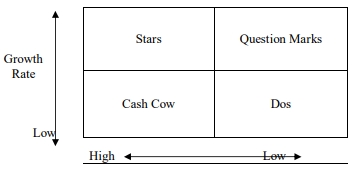
The Boston Consulting Group (BCG) matrix is a model by which businesses are
classified in relation to market growth and relative market share.
The strategy of each business is determined on the basis of the following factors:
(i) The growth rate of its market
(ii) The market share it enjoys

The matrix can be depicted by the following quadrant:

b. Product-Market Strategies:

i. Stars:
Stars operate in high-growth markets and dominate their sectors. They require substantial investment to maintain market position but promise high returns. The recommended product-market strategy is to continue heavy investment in advertising, promotion, and product development to ensure growth in market share and revenue.

ii. Question Marks (Problem Children):
These products operate in high-growth markets but have low market share. They create opportunities for long-term growth but need significant cash investments. The suggested strategy is to either invest heavily to turn them into stars or divest if the market position does not improve. This may involve strategic decisions like harvesting or liquidation.

iii. Cash Cows:
These products have high market share in low-growth markets. They generate consistent cash flows but offer limited growth opportunities. The strategy is to maintain or consolidate their position, using their revenue to fund other areas of the business that require investment (such as Stars or Question Marks).

iv. Dogs:
Dogs have low market share in low-growth markets, providing little to no profit potential. The strategy is often to divest or liquidate these products, as they are not worth the continued investment given their bleak future.

c. Weaknesses of the BCG Matrix:

  1. The model ignores the synergies between different business units, which can affect overall profitability.
  2. High market share does not always guarantee profitability, as it depends on other factors such as cost structure and competitive advantage.

Login or create a free account to see answers

Complete your registration to see answers

Find Related Questions by Tags, levels, etc.

Report an error

You're reporting an error for "BMF – May 2015 – L1 – SB – Q6 – Basics of Business Finance and Financial Markets"

BMF – May 2015 – L1 – SB – Q6 – Basics of Business Finance and Financial Markets

Describe the Boston Consulting Group (BCG) matrix used for business portfolio management.

Describe the Boston Consulting Group (BCG) matrix.

The Boston Consulting Group (BCG) matrix is a model by which businesses are
classified in relation to market growth and relative market share.
The strategy of each business is determined on the basis of the following factors:
(i) The growth rate of its market
(ii) The market share it enjoys

The matrix can be depicted by the following quadrant:
b. Product-Market Strategies:

i. Stars:
Stars operate in high-growth markets and dominate their sectors. They require substantial investment to maintain market position but promise high returns. The recommended product-market strategy is to continue heavy investment in advertising, promotion, and product development to ensure growth in market share and revenue.

ii. Question Marks (Problem Children):
These products operate in high-growth markets but have low market share. They create opportunities for long-term growth but need significant cash investments. The suggested strategy is to either invest heavily to turn them into stars or divest if the market position does not improve. This may involve strategic decisions like harvesting or liquidation.

iii. Cash Cows:
These products have high market share in low-growth markets. They generate consistent cash flows but offer limited growth opportunities. The strategy is to maintain or consolidate their position, using their revenue to fund other areas of the business that require investment (such as Stars or Question Marks).

iv. Dogs:
Dogs have low market share in low-growth markets, providing little to no profit potential. The strategy is often to divest or liquidate these products, as they are not worth the continued investment given their bleak future.

c. Weaknesses of the BCG Matrix:

  1. The model ignores the synergies between different business units, which can affect overall profitability.
  2. High market share does not always guarantee profitability, as it depends on other factors such as cost structure and competitive advantage.

Login or create a free account to see answers

Complete your registration to see answers

Find Related Questions by Tags, levels, etc.

Report an error

You're reporting an error for "BMF – May 2015 – L1 – SB – Q6 – Basics of Business Finance and Financial Markets"

BMF – May 2015 – L1 – SB – Q5b – Management, Individual, and Organisational Behaviour

Discuss hygiene factors and motivators in Herzberg’s two-factor theory.

Write briefly on the following:
i. Hygiene factors
ii. Motivators

i. Hygiene Factors: These are factors that can lead to dissatisfaction in the workplace if they are absent or inadequate, but their presence does not necessarily create satisfaction. They include aspects like working conditions, salary, company policies, job security, and relationships with supervisors and colleagues. Inadequate hygiene factors result in employee dissatisfaction, but improving these factors alone will not boost job satisfaction.

ii. Motivators: These are factors that positively influence job satisfaction and encourage employees to improve performance. They include recognition, responsibility, opportunities for advancement, achievement, and personal growth. Unlike hygiene factors, motivators directly impact an employee’s level of job satisfaction and contribute to higher levels of performance and motivation.

Login or create a free account to see answers

Complete your registration to see answers

Find Related Questions by Tags, levels, etc.

Report an error

You're reporting an error for "BMF – May 2015 – L1 – SB – Q5b – Management, Individual, and Organisational Behaviour"

BMF – May 2015 – L1 – SB – Q5b – Management, Individual, and Organisational Behaviour

Discuss hygiene factors and motivators in Herzberg’s two-factor theory.

Write briefly on the following:
i. Hygiene factors
ii. Motivators

i. Hygiene Factors: These are factors that can lead to dissatisfaction in the workplace if they are absent or inadequate, but their presence does not necessarily create satisfaction. They include aspects like working conditions, salary, company policies, job security, and relationships with supervisors and colleagues. Inadequate hygiene factors result in employee dissatisfaction, but improving these factors alone will not boost job satisfaction.

ii. Motivators: These are factors that positively influence job satisfaction and encourage employees to improve performance. They include recognition, responsibility, opportunities for advancement, achievement, and personal growth. Unlike hygiene factors, motivators directly impact an employee’s level of job satisfaction and contribute to higher levels of performance and motivation.

Login or create a free account to see answers

Complete your registration to see answers

Find Related Questions by Tags, levels, etc.

Report an error

You're reporting an error for "BMF – May 2015 – L1 – SB – Q5b – Management, Individual, and Organisational Behaviour"

BMF – May 2015 – L1 – SB – Q5a – Management, Individual, and Organisational Behaviour

List and explain the five levels of human needs as per Maslow’s hierarchy.

List and explain the FIVE general types of human needs in ascending order.

  1. Physiological Needs: These are the basic survival needs for human life, such as food, water, shelter, air, and clothing. In an organizational context, these are equated to adequate salary, heat, and air to ensure employees’ survival and well-being.
  2. Safety Needs: Once physiological needs are met, individuals seek protection and security, both physically and psychologically. In the workplace, this relates to job security, safe working conditions, and a stable environment free from physical harm.
  3. Belongingness/Social Needs: After safety, individuals look for social connections, love, and belonging. In an organization, this refers to forming relationships with colleagues and feeling accepted as part of a team. Employees value a friendly work environment and camaraderie among coworkers.
  4. Esteem Needs: These involve the need for recognition, respect, and self-esteem. Employees strive to achieve recognition for their work, which can be fulfilled through awards, promotions, or being acknowledged as valuable team members.
  5. Self-Actualization Needs: The highest level, where individuals strive to realize their full potential. In the workplace, this involves opportunities for personal growth, creativity, and achieving career goals. Managers can help employees meet these needs by providing challenging tasks and encouraging innovation.

Login or create a free account to see answers

Complete your registration to see answers

Find Related Questions by Tags, levels, etc.

Report an error

You're reporting an error for "BMF – May 2015 – L1 – SB – Q5a – Management, Individual, and Organisational Behaviour"

BMF – May 2015 – L1 – SB – Q5a – Management, Individual, and Organisational Behaviour

List and explain the five levels of human needs as per Maslow’s hierarchy.

List and explain the FIVE general types of human needs in ascending order.

  1. Physiological Needs: These are the basic survival needs for human life, such as food, water, shelter, air, and clothing. In an organizational context, these are equated to adequate salary, heat, and air to ensure employees’ survival and well-being.
  2. Safety Needs: Once physiological needs are met, individuals seek protection and security, both physically and psychologically. In the workplace, this relates to job security, safe working conditions, and a stable environment free from physical harm.
  3. Belongingness/Social Needs: After safety, individuals look for social connections, love, and belonging. In an organization, this refers to forming relationships with colleagues and feeling accepted as part of a team. Employees value a friendly work environment and camaraderie among coworkers.
  4. Esteem Needs: These involve the need for recognition, respect, and self-esteem. Employees strive to achieve recognition for their work, which can be fulfilled through awards, promotions, or being acknowledged as valuable team members.
  5. Self-Actualization Needs: The highest level, where individuals strive to realize their full potential. In the workplace, this involves opportunities for personal growth, creativity, and achieving career goals. Managers can help employees meet these needs by providing challenging tasks and encouraging innovation.

Login or create a free account to see answers

Complete your registration to see answers

Find Related Questions by Tags, levels, etc.

Report an error

You're reporting an error for "BMF – May 2015 – L1 – SB – Q5a – Management, Individual, and Organisational Behaviour"

BMF – May 2015 – L1 – SB – Q4 – Basics of Business Finance and Financial Markets

Discuss major cash flow items in capital investment projects and explain the payback period investment appraisal method.

a. List and explain FOUR major cashflow items to be included in a capital investment project. (8 Marks)
b.
i. Explain the payback period technique of investment appraisal. (4 Marks)
ii. State TWO advantages and TWO disadvantages of payback period. (8 Marks)

a. Major cashflow items to be included in a capital investment project:

  1. Initial capital outlay: This is the cash expenditure required at the beginning of the project, usually spent on fixed assets.
  2. Operating cash flows: These include cash inflows from sales and cash outflows for operating expenses like wages, utilities, and materials.
  3. Terminal cash flows: These are the cash flows at the end of the project, such as salvage value or disposal of assets.
  4. Incremental cash flows: These refer to the additional cash flows generated directly by the investment, which wouldn’t have been earned otherwise.

b. i. Payback Period Investment Appraisal Technique:
This technique calculates the time needed for the cash inflows generated by a project to recover the initial investment. It emphasizes liquidity by focusing on the period over which the project will generate enough cash inflows to cover the initial outlay. It does not take into account the time value of money or cash flows beyond the payback period.

ii. Advantages of Payback Period:

  1. Simple to calculate and understand.
  2. It is useful for projects where liquidity is important because it focuses on recovering the initial investment quickly.

Disadvantages of Payback Period:

  1. It ignores cash flows that occur after the payback period, potentially overlooking the profitability of longer-term projects.
  2. It does not consider the time value of money.

Login or create a free account to see answers

Complete your registration to see answers

Find Related Questions by Tags, levels, etc.

Report an error

You're reporting an error for "BMF – May 2015 – L1 – SB – Q4 – Basics of Business Finance and Financial Markets"

BMF – May 2015 – L1 – SB – Q4 – Basics of Business Finance and Financial Markets

Discuss major cash flow items in capital investment projects and explain the payback period investment appraisal method.

a. List and explain FOUR major cashflow items to be included in a capital investment project. (8 Marks)
b.
i. Explain the payback period technique of investment appraisal. (4 Marks)
ii. State TWO advantages and TWO disadvantages of payback period. (8 Marks)

a. Major cashflow items to be included in a capital investment project:

  1. Initial capital outlay: This is the cash expenditure required at the beginning of the project, usually spent on fixed assets.
  2. Operating cash flows: These include cash inflows from sales and cash outflows for operating expenses like wages, utilities, and materials.
  3. Terminal cash flows: These are the cash flows at the end of the project, such as salvage value or disposal of assets.
  4. Incremental cash flows: These refer to the additional cash flows generated directly by the investment, which wouldn’t have been earned otherwise.

b. i. Payback Period Investment Appraisal Technique:
This technique calculates the time needed for the cash inflows generated by a project to recover the initial investment. It emphasizes liquidity by focusing on the period over which the project will generate enough cash inflows to cover the initial outlay. It does not take into account the time value of money or cash flows beyond the payback period.

ii. Advantages of Payback Period:

  1. Simple to calculate and understand.
  2. It is useful for projects where liquidity is important because it focuses on recovering the initial investment quickly.

Disadvantages of Payback Period:

  1. It ignores cash flows that occur after the payback period, potentially overlooking the profitability of longer-term projects.
  2. It does not consider the time value of money.

Login or create a free account to see answers

Complete your registration to see answers

Find Related Questions by Tags, levels, etc.

Report an error

You're reporting an error for "BMF – May 2015 – L1 – SB – Q4 – Basics of Business Finance and Financial Markets"

BMF – May 2015 – L1 – SB – Q3 – The Role of Professional Accountants in Business and Society

Discuss reasons for government involvement in the Nigerian financial system and mechanisms for intervention.

a. State FIVE reasons for the increasing role of Government in the Nigerian Financial System.
(10 Marks)

b. State FIVE mechanisms for government intervention in the financial system.
(10 Marks)

a. Reasons for the Increasing Role of Government in the Nigerian Financial System:

  1. To maintain monetary stability: The government needs to ensure that the financial system remains stable to control inflation and manage the economy effectively.
  2. To promote economic growth: Government interventions are essential to stimulate growth and support the development of various sectors of the economy.
  3. To ensure healthy competition: By regulating the financial system, the government prevents monopolies and ensures fair competition, both domestically and internationally.
  4. To protect the public from fraud and exploitation: Government policies are crucial to safeguarding the public from unethical financial practices.
  5. To attract foreign investment: A stable financial system encourages international investors, contributing to the growth of the economy.

b. Mechanisms for Government Intervention in the Financial System:

  1. Open Market Operations (OMO): The government buys and sells treasury bills and bonds to control the money supply.
  2. Changes in monetary policy rates (MPR): Adjusting the MPR influences interest rates, which in turn affects borrowing and investment levels in the economy.
  3. Liquidity ratio adjustments: The government can change the liquidity ratio to control the amount of cash that banks must hold as reserves, impacting the availability of credit.
  4. Fiscal policy (taxation and spending): The government uses taxes and public spending to influence the financial system and stimulate or slow down the economy.
  5. Recapitalization of banks: To maintain stability, the government may require banks to recapitalize, ensuring that they have enough funds to meet their obligations.

Login or create a free account to see answers

Complete your registration to see answers

Find Related Questions by Tags, levels, etc.

Report an error

You're reporting an error for "BMF – May 2015 – L1 – SB – Q3 – The Role of Professional Accountants in Business and Society"

BMF – May 2015 – L1 – SB – Q3 – The Role of Professional Accountants in Business and Society

Discuss reasons for government involvement in the Nigerian financial system and mechanisms for intervention.

a. State FIVE reasons for the increasing role of Government in the Nigerian Financial System.
(10 Marks)

b. State FIVE mechanisms for government intervention in the financial system.
(10 Marks)

a. Reasons for the Increasing Role of Government in the Nigerian Financial System:

  1. To maintain monetary stability: The government needs to ensure that the financial system remains stable to control inflation and manage the economy effectively.
  2. To promote economic growth: Government interventions are essential to stimulate growth and support the development of various sectors of the economy.
  3. To ensure healthy competition: By regulating the financial system, the government prevents monopolies and ensures fair competition, both domestically and internationally.
  4. To protect the public from fraud and exploitation: Government policies are crucial to safeguarding the public from unethical financial practices.
  5. To attract foreign investment: A stable financial system encourages international investors, contributing to the growth of the economy.

b. Mechanisms for Government Intervention in the Financial System:

  1. Open Market Operations (OMO): The government buys and sells treasury bills and bonds to control the money supply.
  2. Changes in monetary policy rates (MPR): Adjusting the MPR influences interest rates, which in turn affects borrowing and investment levels in the economy.
  3. Liquidity ratio adjustments: The government can change the liquidity ratio to control the amount of cash that banks must hold as reserves, impacting the availability of credit.
  4. Fiscal policy (taxation and spending): The government uses taxes and public spending to influence the financial system and stimulate or slow down the economy.
  5. Recapitalization of banks: To maintain stability, the government may require banks to recapitalize, ensuring that they have enough funds to meet their obligations.

Login or create a free account to see answers

Complete your registration to see answers

Find Related Questions by Tags, levels, etc.

Report an error

You're reporting an error for "BMF – May 2015 – L1 – SB – Q3 – The Role of Professional Accountants in Business and Society"

BMF – May 2015 – L1 – SB – Q2 – The Business Environment

Discuss four external environmental factors that impact business operations.

Businesses do not operate in a vacuum. There is a combination of internal and external factors that affect how businesses function.
State and explain any FOUR external environmental factors that affect a business.

  1. Political Factors:
    Political factors affect the level of opportunities and threats within the business environment. Factors such as the stability of the political system, government policies, and regulations have a major influence on how businesses operate. A change in government or political instability can affect market conditions and disrupt business operations.
  2. Economic Factors:
    Economic conditions, including inflation rates, interest rates, economic growth, and exchange rates, play a crucial role in business performance. A strong economy encourages businesses to expand, whereas a weak economy may force businesses to downsize or halt operations.
  3. Socio-Cultural Factors:
    Socio-cultural aspects include the beliefs, values, attitudes, and lifestyles of people. These factors influence consumer behavior and market demand. A business must understand these cultural nuances to tailor products and services that meet the expectations of its customers.
  4. Technological Factors:
    The level of technological advancement within a country or industry determines the efficiency of production processes and service delivery. Businesses must keep up with technological changes to remain competitive. This includes automation, internet usage, and new software or tools that improve operational efficiency.

Login or create a free account to see answers

Complete your registration to see answers

Find Related Questions by Tags, levels, etc.

Report an error

You're reporting an error for "BMF – May 2015 – L1 – SB – Q2 – The Business Environment"

BMF – May 2015 – L1 – SB – Q2 – The Business Environment

Discuss four external environmental factors that impact business operations.

Businesses do not operate in a vacuum. There is a combination of internal and external factors that affect how businesses function.
State and explain any FOUR external environmental factors that affect a business.

  1. Political Factors:
    Political factors affect the level of opportunities and threats within the business environment. Factors such as the stability of the political system, government policies, and regulations have a major influence on how businesses operate. A change in government or political instability can affect market conditions and disrupt business operations.
  2. Economic Factors:
    Economic conditions, including inflation rates, interest rates, economic growth, and exchange rates, play a crucial role in business performance. A strong economy encourages businesses to expand, whereas a weak economy may force businesses to downsize or halt operations.
  3. Socio-Cultural Factors:
    Socio-cultural aspects include the beliefs, values, attitudes, and lifestyles of people. These factors influence consumer behavior and market demand. A business must understand these cultural nuances to tailor products and services that meet the expectations of its customers.
  4. Technological Factors:
    The level of technological advancement within a country or industry determines the efficiency of production processes and service delivery. Businesses must keep up with technological changes to remain competitive. This includes automation, internet usage, and new software or tools that improve operational efficiency.

Login or create a free account to see answers

Complete your registration to see answers

Find Related Questions by Tags, levels, etc.

Report an error

You're reporting an error for "BMF – May 2015 – L1 – SB – Q2 – The Business Environment"

BMF – May 2015 – L1 – SB – Q1b – Business and Organizational Structures and Choices

Identifying the advantages of a partnership business.

Identify FIVE advantages of a partnership business.

  1. Shared management and pooled knowledge: Partners bring in varied expertise and skills to manage the business.
  2. Attraction of more financial resources: Partnerships can attract more capital compared to sole proprietorships.
  3. Continuity in comparison with sole proprietorship: Unlike sole proprietorships, partnerships can continue even when one partner exits.
  4. Division of labor: Partners can divide work based on their strengths, leading to more efficient management.
  5. Sharing of risks and losses: The risks and financial losses are shared among partners, reducing the burden on a single individual.

Login or create a free account to see answers

Complete your registration to see answers

Find Related Questions by Tags, levels, etc.

Report an error

You're reporting an error for "BMF – May 2015 – L1 – SB – Q1b – Business and Organizational Structures and Choices"

BMF – May 2015 – L1 – SB – Q1b – Business and Organizational Structures and Choices

Identifying the advantages of a partnership business.

Identify FIVE advantages of a partnership business.

  1. Shared management and pooled knowledge: Partners bring in varied expertise and skills to manage the business.
  2. Attraction of more financial resources: Partnerships can attract more capital compared to sole proprietorships.
  3. Continuity in comparison with sole proprietorship: Unlike sole proprietorships, partnerships can continue even when one partner exits.
  4. Division of labor: Partners can divide work based on their strengths, leading to more efficient management.
  5. Sharing of risks and losses: The risks and financial losses are shared among partners, reducing the burden on a single individual.

Login or create a free account to see answers

Complete your registration to see answers

Find Related Questions by Tags, levels, etc.

Report an error

You're reporting an error for "BMF – May 2015 – L1 – SB – Q1b – Business and Organizational Structures and Choices"

BMF – May 2015 – L1 – SB – Q1a – Business and Organizational Structures and Choices

Features of the Memorandum of Association, Articles of Association, and Public Sector Entities.

State FIVE features of each of the following:
i. Memorandum of Association (5 Marks)
ii. Articles of Association (5 Marks)
iii. Public Sector Entity (5 Marks)

i. Features of Memorandum of Association:

  • The name of the company.
  • The names and addresses of the shareholders.
  • The number of shares held by each shareholder.
  • The location of the registered office.
  • The objectives of the company.

ii. Features of Articles of Association:

  • The internal relations of the company.
  • The rights of shareholders.
  • How meetings are convened.
  • Appointment and renewal of directors and other officers.
  • Power and duties of directors.

iii. Features of Public Sector Entity:

  • It is owned by the government.
  • It is created by an Act of Parliament.
  • It is managed by a board of directors appointed by the government.
  • It renders essential services.
  • It is not established for profit.

Login or create a free account to see answers

Complete your registration to see answers

Find Related Questions by Tags, levels, etc.

Report an error

You're reporting an error for "BMF – May 2015 – L1 – SB – Q1a – Business and Organizational Structures and Choices"

BMF – May 2015 – L1 – SB – Q1a – Business and Organizational Structures and Choices

Features of the Memorandum of Association, Articles of Association, and Public Sector Entities.

State FIVE features of each of the following:
i. Memorandum of Association (5 Marks)
ii. Articles of Association (5 Marks)
iii. Public Sector Entity (5 Marks)

i. Features of Memorandum of Association:

  • The name of the company.
  • The names and addresses of the shareholders.
  • The number of shares held by each shareholder.
  • The location of the registered office.
  • The objectives of the company.

ii. Features of Articles of Association:

  • The internal relations of the company.
  • The rights of shareholders.
  • How meetings are convened.
  • Appointment and renewal of directors and other officers.
  • Power and duties of directors.

iii. Features of Public Sector Entity:

  • It is owned by the government.
  • It is created by an Act of Parliament.
  • It is managed by a board of directors appointed by the government.
  • It renders essential services.
  • It is not established for profit.

Login or create a free account to see answers

Complete your registration to see answers

Find Related Questions by Tags, levels, etc.

Report an error

You're reporting an error for "BMF – May 2015 – L1 – SB – Q1a – Business and Organizational Structures and Choices"

BMF – MAY 2015 – L1 – SA – Q20 – Communications in Business

Defining the process of information transmission in business contexts.

The process of transmission of information from one person, group or organisation to another is called:

A. Decoding
B. Communication
C. Globalization
D. Presentation
E. Translation

Answer: B. Communication

Explanation:
Communication refers to the process of transmitting information from one entity to another, encompassing various methods and channels. It is essential for effective interaction within and between organizations.

Login or create a free account to see answers

Complete your registration to see answers

Find Related Questions by Tags, levels, etc.

Report an error

You're reporting an error for "BMF – MAY 2015 – L1 – SA – Q20 – Communications in Business"

BMF – MAY 2015 – L1 – SA – Q20 – Communications in Business

Defining the process of information transmission in business contexts.

The process of transmission of information from one person, group or organisation to another is called:

A. Decoding
B. Communication
C. Globalization
D. Presentation
E. Translation

Answer: B. Communication

Explanation:
Communication refers to the process of transmitting information from one entity to another, encompassing various methods and channels. It is essential for effective interaction within and between organizations.

Login or create a free account to see answers

Complete your registration to see answers

Find Related Questions by Tags, levels, etc.

Report an error

You're reporting an error for "BMF – MAY 2015 – L1 – SA – Q20 – Communications in Business"

BMF – MAY 2015 – L1 – SA – Q19 – Management, Individual, and Organisational Behaviour

Identifying the leadership style based on authority and control over rewards.

A leadership style in which the leader has the authority to withhold or give reward and punishment is referred to as ………………. style.

A. Democratic leadership
B. Participative leadership
C. Contingency leadership
D. Autocratic leadership
E. Laissez faire leadership

Answer: D. Autocratic leadership

Explanation:
Autocratic leadership is characterized by a leader who has significant control over decision-making and the authority to reward or punish subordinates. This style does not typically involve team input or collaboration, focusing instead on the leader’s authority and directives.

Login or create a free account to see answers

Complete your registration to see answers

Find Related Questions by Tags, levels, etc.

Report an error

You're reporting an error for "BMF – MAY 2015 – L1 – SA – Q19 – Management, Individual, and Organisational Behaviour"

BMF – MAY 2015 – L1 – SA – Q19 – Management, Individual, and Organisational Behaviour

Identifying the leadership style based on authority and control over rewards.

A leadership style in which the leader has the authority to withhold or give reward and punishment is referred to as ………………. style.

A. Democratic leadership
B. Participative leadership
C. Contingency leadership
D. Autocratic leadership
E. Laissez faire leadership

Answer: D. Autocratic leadership

Explanation:
Autocratic leadership is characterized by a leader who has significant control over decision-making and the authority to reward or punish subordinates. This style does not typically involve team input or collaboration, focusing instead on the leader’s authority and directives.

Login or create a free account to see answers

Complete your registration to see answers

Find Related Questions by Tags, levels, etc.

Report an error

You're reporting an error for "BMF – MAY 2015 – L1 – SA – Q19 – Management, Individual, and Organisational Behaviour"

MI – May 2015 – L1 – SA – Q2 – Budgeting

Identify which component is NOT part of the working capital cycle.

Which of the following is NOT a component of the working capital cycle?
A. Debtors
B. Finished goods
C. Work-in-progress
D. Raw materials
E. Overdraft

E. Overdraft

Explanation:
Overdraft is a financing tool, not a component of the working capital cycle, which includes assets like debtors, finished goods, work-in-progress, and raw materials.

Login or create a free account to see answers

Complete your registration to see answers

Find Related Questions by Tags, levels, etc.

Report an error

You're reporting an error for "MI – May 2015 – L1 – SA – Q2 – Budgeting"

MI – May 2015 – L1 – SA – Q2 – Budgeting

Identify which component is NOT part of the working capital cycle.

Which of the following is NOT a component of the working capital cycle?
A. Debtors
B. Finished goods
C. Work-in-progress
D. Raw materials
E. Overdraft

E. Overdraft

Explanation:
Overdraft is a financing tool, not a component of the working capital cycle, which includes assets like debtors, finished goods, work-in-progress, and raw materials.

Login or create a free account to see answers

Complete your registration to see answers

Find Related Questions by Tags, levels, etc.

Report an error

You're reporting an error for "MI – May 2015 – L1 – SA – Q2 – Budgeting"

MI – May 2015 – L1 – SA – Q1 – Costing Methods

Identify which option is not a costing method.

Which of the following is NOT a costing method?
A. Batch costing
B. Operation costing
C. Job costing
D. Standard costing
E. Service costing

Answer:
D. Standard costing

Explanation:
Standard costing is a cost control technique rather than a method for accumulating costs. The other options listed (Batch, Operation, Job, and Service costing) are all recognized methods for determining the cost of specific products or services in management accounting.

Login or create a free account to see answers

Complete your registration to see answers

Find Related Questions by Tags, levels, etc.

Report an error

You're reporting an error for "MI – May 2015 – L1 – SA – Q1 – Costing Methods"

MI – May 2015 – L1 – SA – Q1 – Costing Methods

Identify which option is not a costing method.

Which of the following is NOT a costing method?
A. Batch costing
B. Operation costing
C. Job costing
D. Standard costing
E. Service costing

Answer:
D. Standard costing

Explanation:
Standard costing is a cost control technique rather than a method for accumulating costs. The other options listed (Batch, Operation, Job, and Service costing) are all recognized methods for determining the cost of specific products or services in management accounting.

Login or create a free account to see answers

Complete your registration to see answers

Find Related Questions by Tags, levels, etc.

Report an error

You're reporting an error for "MI – May 2015 – L1 – SA – Q1 – Costing Methods"

FA – May 2015 – L1 – Q6 – Financial Statements Preparation

Prepare a statement of cash flows using the direct method for the year ended 31 December 2014 with given financial data.

Financial data extracted from the books of Kandor Enterprises Limited for the year ended 31 December 2014 are shown below:

Details N’000
Revenue 6,990
Decrease in receivables 177
Cost of sales 5,128
Increase in inventories 1,483
Increase in payables 613
Selling and distribution expenses 300
Administrative expenses 343
Loss on disposal of non-current assets 6
Depreciation charges for the year 62
Ordinary shares issued for cash 400
Purchase of property, plant, and equipment 113
Income tax paid 198
Proceeds from disposal of non-current assets 3
Repayment of loan notes 10
Dividend paid 86
Interest paid on loan notes 191
Cash and cash equivalent at the beginning of the year (409)

Required:
Prepare the Statement of Cash Flows for the year ended 31 December 2014 using the direct method, showing:
a. Net cash flow from operating activities (5 Marks)
b. Net cash flow from investing activities (5 Marks)
c. Net cash flow from financing activities (5 Marks)
d. Cash and cash equivalents at the end of the year (5 Marks)

Show all workings.

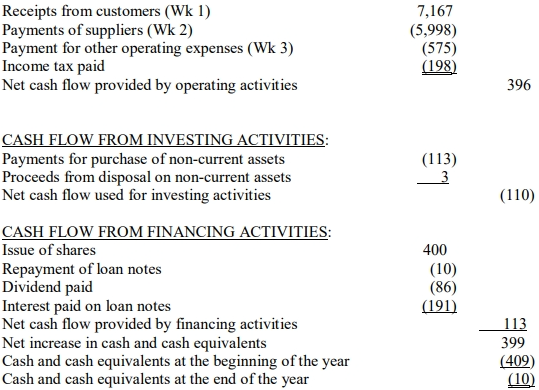
KANDOR ENTERPRISES LIMITED
STATEMENT OF CASH FLOWS FOR THE YEAR ENDED DECEMBER 31, 2014

KANDOR ENTERPRISES LIMITED
WORKING NOTES

Wk 1: Determination of total receipts from customer

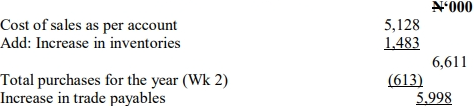
Wk 2: Determination of payment to suppliers

Wk 3: Cash paid for other expenses

Login or create a free account to see answers

Complete your registration to see answers

Find Related Questions by Tags, levels, etc.

Report an error

You're reporting an error for "FA – May 2015 – L1 – Q6 – Financial Statements Preparation"

FA – May 2015 – L1 – Q6 – Financial Statements Preparation

Prepare a statement of cash flows using the direct method for the year ended 31 December 2014 with given financial data.

Financial data extracted from the books of Kandor Enterprises Limited for the year ended 31 December 2014 are shown below:

Details N’000
Revenue 6,990
Decrease in receivables 177
Cost of sales 5,128
Increase in inventories 1,483
Increase in payables 613
Selling and distribution expenses 300
Administrative expenses 343
Loss on disposal of non-current assets 6
Depreciation charges for the year 62
Ordinary shares issued for cash 400
Purchase of property, plant, and equipment 113
Income tax paid 198
Proceeds from disposal of non-current assets 3
Repayment of loan notes 10
Dividend paid 86
Interest paid on loan notes 191
Cash and cash equivalent at the beginning of the year (409)

Required:
Prepare the Statement of Cash Flows for the year ended 31 December 2014 using the direct method, showing:
a. Net cash flow from operating activities (5 Marks)
b. Net cash flow from investing activities (5 Marks)
c. Net cash flow from financing activities (5 Marks)
d. Cash and cash equivalents at the end of the year (5 Marks)

Show all workings.

KANDOR ENTERPRISES LIMITED
STATEMENT OF CASH FLOWS FOR THE YEAR ENDED DECEMBER 31, 2014

KANDOR ENTERPRISES LIMITED
WORKING NOTES

Wk 1: Determination of total receipts from customer

Wk 2: Determination of payment to suppliers

Wk 3: Cash paid for other expenses

Login or create a free account to see answers

Complete your registration to see answers

Find Related Questions by Tags, levels, etc.

Report an error

You're reporting an error for "FA – May 2015 – L1 – Q6 – Financial Statements Preparation"

FA – May 2015 – L1 – Q4b – Trial Balance: Usefulness and Limitations

Prepare a trial balance from the extracted balances of Omoba Enterprises and recompute the entity’s capital for the period under review.

The following balances were extracted from the books of Omoba Enterprises as at 31 December 2013:

Details N’000
Accumulated depreciation 85,000
Administrative expenses 775,000
Accounts payables 585,000
Subscription 15,000
Rent and rates 130,000
Accounts receivables 475,000
Postage and stationery 125,000
Newspapers & periodicals 40,000
Utility 35,000
Allowances for Bad debt 85,000
Property, plant and equipment 925,000
Retained earnings 575,000
Audit fees 85,000
Revenue 2,500,000
Cost of sales 800,000
Other income 82,000
Cash and bank balances 882,000
Capital 375,000

Required:
i. Use the information above to extract a trial balance of Omoba Enterprises as at 31 December, 2013. (12 Marks)
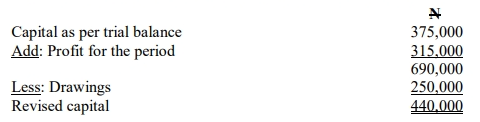
ii. Use the information below to recompute the entity’s capital for the period under review:

  • Drawings: N250,000
  • Profit for the period: N315,000

(i) Trial Balance of Omoba Enterprises as at 31 December 2013:

Details Debit (N’000) Credit (N’000)
Accumulated depreciation 85,000
Administrative expenses 775,000
Accounts payables 585,000
Subscription 15,000
Rent and rates 130,000
Accounts receivables 475,000
Postage and stationery 125,000
Newspapers & periodicals 40,000
Utility 35,000
Allowances for Bad debt 85,000
Property, plant, and equipment 925,000
Retained earnings 575,000
Audit fees 85,000
Revenue 2,500,000
Cost of sales 800,000
Other income 82,000
Cash and bank balances 882,000
Capital 375,000
Total 4,287,000 4,287,000

(ii) Recomputed Capital for Omoba Enterprises:


Login or create a free account to see answers

Complete your registration to see answers

Find Related Questions by Tags, levels, etc.

Report an error

You're reporting an error for "FA – May 2015 – L1 – Q4b – Trial Balance: Usefulness and Limitations"

FA – May 2015 – L1 – Q4b – Trial Balance: Usefulness and Limitations

Prepare a trial balance from the extracted balances of Omoba Enterprises and recompute the entity’s capital for the period under review.

The following balances were extracted from the books of Omoba Enterprises as at 31 December 2013:

Details N’000
Accumulated depreciation 85,000
Administrative expenses 775,000
Accounts payables 585,000
Subscription 15,000
Rent and rates 130,000
Accounts receivables 475,000
Postage and stationery 125,000
Newspapers & periodicals 40,000
Utility 35,000
Allowances for Bad debt 85,000
Property, plant and equipment 925,000
Retained earnings 575,000
Audit fees 85,000
Revenue 2,500,000
Cost of sales 800,000
Other income 82,000
Cash and bank balances 882,000
Capital 375,000

Required:
i. Use the information above to extract a trial balance of Omoba Enterprises as at 31 December, 2013. (12 Marks)
ii. Use the information below to recompute the entity’s capital for the period under review:

  • Drawings: N250,000
  • Profit for the period: N315,000

(i) Trial Balance of Omoba Enterprises as at 31 December 2013:

Details Debit (N’000) Credit (N’000)
Accumulated depreciation 85,000
Administrative expenses 775,000
Accounts payables 585,000
Subscription 15,000
Rent and rates 130,000
Accounts receivables 475,000
Postage and stationery 125,000
Newspapers & periodicals 40,000
Utility 35,000
Allowances for Bad debt 85,000
Property, plant, and equipment 925,000
Retained earnings 575,000
Audit fees 85,000
Revenue 2,500,000
Cost of sales 800,000
Other income 82,000
Cash and bank balances 882,000
Capital 375,000
Total 4,287,000 4,287,000

(ii) Recomputed Capital for Omoba Enterprises:


Login or create a free account to see answers

Complete your registration to see answers

Find Related Questions by Tags, levels, etc.

Report an error

You're reporting an error for "FA – May 2015 – L1 – Q4b – Trial Balance: Usefulness and Limitations"

FA – May 2015 – L1 – Q4a – Trial Balance: Usefulness and Limitations

Identify the uses of a trial balance, errors that lead to a difference in trial balance figures, and errors that do not affect the balancing of the trial balance.

The purpose of a trial balance is to prove the accuracy of the General Ledger accounts of a business. However, the “balancing” of the debit side and the credit side of a trial balance does not guarantee that there is no error in the General Ledger accounts.

i. State TWO uses of a trial balance to an entity. (2 Marks)
ii. State FOUR errors that may lead to difference in trial balance total figures. (2 Marks)
iii. State FOUR errors that may NOT affect the “balancing” of a trial balance. (2 Marks)

(i) Two uses of a trial balance to an entity:

  1. Proving the arithmetical accuracy of all the ledger postings.
  2. Showing ledger balances at a glance.

(ii) Four errors that may lead to a difference in trial balance total figures:

  1. Casting error.
  2. Transposition error.
  3. Wrong amount being transferred from ledger to the trial balance.
  4. Omission of ledger balances in the trial balance.

(iii) Four errors that may NOT affect the “balancing” of a trial balance:

  1. Error of omission.
  2. Error of original entry.
  3. Error of principle.
  4. Compensating error.

Login or create a free account to see answers

Complete your registration to see answers

Find Related Questions by Tags, levels, etc.

Report an error

You're reporting an error for "FA – May 2015 – L1 – Q4a – Trial Balance: Usefulness and Limitations"

FA – May 2015 – L1 – Q4a – Trial Balance: Usefulness and Limitations

Identify the uses of a trial balance, errors that lead to a difference in trial balance figures, and errors that do not affect the balancing of the trial balance.

The purpose of a trial balance is to prove the accuracy of the General Ledger accounts of a business. However, the “balancing” of the debit side and the credit side of a trial balance does not guarantee that there is no error in the General Ledger accounts.

i. State TWO uses of a trial balance to an entity. (2 Marks)
ii. State FOUR errors that may lead to difference in trial balance total figures. (2 Marks)
iii. State FOUR errors that may NOT affect the “balancing” of a trial balance. (2 Marks)

(i) Two uses of a trial balance to an entity:

  1. Proving the arithmetical accuracy of all the ledger postings.
  2. Showing ledger balances at a glance.

(ii) Four errors that may lead to a difference in trial balance total figures:

  1. Casting error.
  2. Transposition error.
  3. Wrong amount being transferred from ledger to the trial balance.
  4. Omission of ledger balances in the trial balance.

(iii) Four errors that may NOT affect the “balancing” of a trial balance:

  1. Error of omission.
  2. Error of original entry.
  3. Error of principle.
  4. Compensating error.

Login or create a free account to see answers

Complete your registration to see answers

Find Related Questions by Tags, levels, etc.

Report an error

You're reporting an error for "FA – May 2015 – L1 – Q4a – Trial Balance: Usefulness and Limitations"

FA – May 2015 – L1 – Q3a – Recording Financial Transactions (Including Source Documents, Books of Prime Entry, and Cash Books)

Prepare Receivables, Payables control accounts, Opening Capital, Statement of Profit or Loss, and Statement of Financial Position using given data from single entry

Mr. Ken Stevenson keeps single entry books of account. He had the following balances on 1 January, 2013:

N
Inventory
Payables
Prepaid insurance
Bank overdraft
Furniture
Motor vehicles
Receivables
Borrowings

The following information is extracted from his cash book in respect of the year ended 31 December 2013:

DR N CR N
Revenue 279,500
Receipt from trade receivables 536,400
815,900 815,900

He had the following balances on 31 December 2013:

N
Motor vehicles
Inventory
Furniture
Receivables
Payables
Borrowings

Additional information:
(i) Interest on Borrowings to be accrued for at 5% per annum.
(ii) Bad debts of N12,600 are to be written off while 5% allowance is to be made on the net receivables at 31 December, 2013.
(iii) Depreciation is to be charged on the non-current assets at the rate of 10% per annum.

You are required to prepare:

a. Receivables control account (2 Marks)
b. Payables control account (2 Marks)
c. The opening capital (2 Marks)
d. Statement of Profit or Loss for the year ended 31 December 2013 (8 Marks)
e. Statement of Financial Position as at 31 December 2013 (6 Marks)

(a) Receivables control account

N N
Bal b/f 458,500 Receipt from trade receivables 536,400
Credit revenue (Difference) 581,600 Bad debt 12,600
Bal c/d 491,100
1,040,100 1,040,100
Bal b/d 491,100

(b) Payables control account

N N
Payments to trade payables 284,000 Bal b/f 258,600
Bal c/d 336,600 Purchases (Difference) 362,000
620,600 620,600
Bal b/d 336,600

(c) Opening capital

N
Assets:
Motor vehicles
Furniture
Inventory
Receivables
Prepaid insurance
Total assets
Less: Liabilities
Payables
Bank overdraft
Borrowings
Total liabilities
Opening capital

(d) Statement of Profit or Loss for the year ended 31 December 2013

N N N
Revenue (Wk 1) 861,100
COST OF SALES:
Opening inventory 64,800
Purchases (Wk 2) 449,300
514,100
Closing inventory (72,200)
(441,900)
GROSS PROFIT 419,200
OPERATING EXPENSES:
Insurance (Wk 3) 12,000
Loan interest (Wk 4) 32,500
Increase in allowance for bad debt (Wk 5) 24,555
Miscellaneous 43,800
Electricity 26,500
Salaries 150,000
Bad debt 12,600
Depreciation:
Motor vehicles 80,000
Furniture 32,790 112,790
Total operating expenses (414,745)
NET PROFIT 4,455

(e) Statement of Financial Position as at 31 December 2013

Cost Depreciation Carrying Amount
Motor vehicles 800,000 80,000
Furniture 327,900 32,790
Total non-current assets 1,127,900 112,790

CURRENT ASSETS:

N
Inventory
Trade receivables
Allowance for bad debt (Wk 5)
Cash and bank balances
Total current assets

TOTAL ASSETS: 1,677,655

EQUITY AND LIABILITIES:

N
Opening capital
Net profit
Total equity
Less: Drawings
Closing equity

NON-CURRENT LIABILITIES:

N
Borrowings

CURRENT LIABILITIES:

N
Trade payables
Accrued Borrowings interest (Wk 4)
Total liabilities

TOTAL EQUITY AND LIABILITIES: 1,677,655

Login or create a free account to see answers

Complete your registration to see answers

Find Related Questions by Tags, levels, etc.

Report an error

You're reporting an error for "FA – May 2015 – L1 – Q3a – Recording Financial Transactions (Including Source Documents, Books of Prime Entry, and Cash Books)"

FA – May 2015 – L1 – Q3a – Recording Financial Transactions (Including Source Documents, Books of Prime Entry, and Cash Books)

Prepare Receivables, Payables control accounts, Opening Capital, Statement of Profit or Loss, and Statement of Financial Position using given data from single entry

Mr. Ken Stevenson keeps single entry books of account. He had the following balances on 1 January, 2013:

N
Inventory
Payables
Prepaid insurance
Bank overdraft
Furniture
Motor vehicles
Receivables
Borrowings

The following information is extracted from his cash book in respect of the year ended 31 December 2013:

DR N CR N
Revenue 279,500
Receipt from trade receivables 536,400
815,900 815,900

He had the following balances on 31 December 2013:

N
Motor vehicles
Inventory
Furniture
Receivables
Payables
Borrowings

Additional information:
(i) Interest on Borrowings to be accrued for at 5% per annum.
(ii) Bad debts of N12,600 are to be written off while 5% allowance is to be made on the net receivables at 31 December, 2013.
(iii) Depreciation is to be charged on the non-current assets at the rate of 10% per annum.

You are required to prepare:

a. Receivables control account (2 Marks)
b. Payables control account (2 Marks)
c. The opening capital (2 Marks)
d. Statement of Profit or Loss for the year ended 31 December 2013 (8 Marks)
e. Statement of Financial Position as at 31 December 2013 (6 Marks)

(a) Receivables control account

N N
Bal b/f 458,500 Receipt from trade receivables 536,400
Credit revenue (Difference) 581,600 Bad debt 12,600
Bal c/d 491,100
1,040,100 1,040,100
Bal b/d 491,100

(b) Payables control account

N N
Payments to trade payables 284,000 Bal b/f 258,600
Bal c/d 336,600 Purchases (Difference) 362,000
620,600 620,600
Bal b/d 336,600

(c) Opening capital

N
Assets:
Motor vehicles
Furniture
Inventory
Receivables
Prepaid insurance
Total assets
Less: Liabilities
Payables
Bank overdraft
Borrowings
Total liabilities
Opening capital

(d) Statement of Profit or Loss for the year ended 31 December 2013

N N N
Revenue (Wk 1) 861,100
COST OF SALES:
Opening inventory 64,800
Purchases (Wk 2) 449,300
514,100
Closing inventory (72,200)
(441,900)
GROSS PROFIT 419,200
OPERATING EXPENSES:
Insurance (Wk 3) 12,000
Loan interest (Wk 4) 32,500
Increase in allowance for bad debt (Wk 5) 24,555
Miscellaneous 43,800
Electricity 26,500
Salaries 150,000
Bad debt 12,600
Depreciation:
Motor vehicles 80,000
Furniture 32,790 112,790
Total operating expenses (414,745)
NET PROFIT 4,455

(e) Statement of Financial Position as at 31 December 2013

Cost Depreciation Carrying Amount
Motor vehicles 800,000 80,000
Furniture 327,900 32,790
Total non-current assets 1,127,900 112,790

CURRENT ASSETS:

N
Inventory
Trade receivables
Allowance for bad debt (Wk 5)
Cash and bank balances
Total current assets

TOTAL ASSETS: 1,677,655

EQUITY AND LIABILITIES:

N
Opening capital
Net profit
Total equity
Less: Drawings
Closing equity

NON-CURRENT LIABILITIES:

N
Borrowings

CURRENT LIABILITIES:

N
Trade payables
Accrued Borrowings interest (Wk 4)
Total liabilities

TOTAL EQUITY AND LIABILITIES: 1,677,655

Login or create a free account to see answers

Complete your registration to see answers

Find Related Questions by Tags, levels, etc.

Report an error

You're reporting an error for "FA – May 2015 – L1 – Q3a – Recording Financial Transactions (Including Source Documents, Books of Prime Entry, and Cash Books)"

FA – MAY 2015 – L1 – SB – Q2 – Financial Statements Preparation

Prepare an extended trial balance and adjustments for Salfo Enterprises based on ledger balances.

The following is a list of balances extracted from the ledger of Salfo Enterprises:

N
Inventory on 1 January 2013 30,600
Revenue 245,340
Purchases 160,200
Salaries and wages 52,110
Furniture and fittings 92,500
Office expenses 16,200
Trade receivables 50,400
Trade payables 22,400
Cash in hand and at bank 6,230
Drawings 15,500
Capital 156,000

Additional information:

  1. Inventory on 31 December 2013: N38,000
  2. Prepaid office expenses: N2,300
  3. Accrued wages: N1,500
  4. Depreciation is to be charged on furniture and fittings at 10% per annum on cost.

Required: a. Prepare the initial trial balance. (4 Marks)
b. Record the necessary adjustments. (8 Marks)
c. Prepare the adjusted trial balance. (8 Marks)

Salfo Enterprises – Extended Trial Balance as at December 31, 2013

Details Closing Balance (N) Adjustments (N) Revised Closing Balance (N)
Opening inventory 30,600 30,600
Revenue 245,340 245,340
Purchases 160,200 160,200
Salaries and wages 52,110 1,500 53,610
Furniture and fittings 92,500 92,500
Office expenses 16,200 2,300 13,900
Trade receivables 50,400 50,400
Trade payables 22,400 22,400
Cash in hand and bank 6,230 6,230
Drawings 15,500 15,500
Capital 156,000 156,000
Closing inventory 38,000 38,000
Prepaid office expenses 2,300 2,300
Accrued wages 1,500 1,500
Depreciation – Furniture 9,250 9,250
Accumulated depreciation – Furniture 9,250
Totals 423,740 51,050 472,490

Login or create a free account to see answers

Complete your registration to see answers

Find Related Questions by Tags, levels, etc.

Report an error

You're reporting an error for "FA – MAY 2015 – L1 – SB – Q2 – Financial Statements Preparation"

FA – MAY 2015 – L1 – SB – Q2 – Financial Statements Preparation

Prepare an extended trial balance and adjustments for Salfo Enterprises based on ledger balances.

The following is a list of balances extracted from the ledger of Salfo Enterprises:

N
Inventory on 1 January 2013 30,600
Revenue 245,340
Purchases 160,200
Salaries and wages 52,110
Furniture and fittings 92,500
Office expenses 16,200
Trade receivables 50,400
Trade payables 22,400
Cash in hand and at bank 6,230
Drawings 15,500
Capital 156,000

Additional information:

  1. Inventory on 31 December 2013: N38,000
  2. Prepaid office expenses: N2,300
  3. Accrued wages: N1,500
  4. Depreciation is to be charged on furniture and fittings at 10% per annum on cost.

Required: a. Prepare the initial trial balance. (4 Marks)
b. Record the necessary adjustments. (8 Marks)
c. Prepare the adjusted trial balance. (8 Marks)

Salfo Enterprises – Extended Trial Balance as at December 31, 2013

Details Closing Balance (N) Adjustments (N) Revised Closing Balance (N)
Opening inventory 30,600 30,600
Revenue 245,340 245,340
Purchases 160,200 160,200
Salaries and wages 52,110 1,500 53,610
Furniture and fittings 92,500 92,500
Office expenses 16,200 2,300 13,900
Trade receivables 50,400 50,400
Trade payables 22,400 22,400
Cash in hand and bank 6,230 6,230
Drawings 15,500 15,500
Capital 156,000 156,000
Closing inventory 38,000 38,000
Prepaid office expenses 2,300 2,300
Accrued wages 1,500 1,500
Depreciation – Furniture 9,250 9,250
Accumulated depreciation – Furniture 9,250
Totals 423,740 51,050 472,490

Login or create a free account to see answers

Complete your registration to see answers

Find Related Questions by Tags, levels, etc.

Report an error

You're reporting an error for "FA – MAY 2015 – L1 – SB – Q2 – Financial Statements Preparation"

FA – MAY 2015 – L1 – SB – Q1b – Recording Financial Transactions (Including Source Documents, Books of Prime Entry, and Cash Books)

Provide journal entries for transactions in a trading company.

Babariga Trading Company has the following extracts from its financial records as at 31 January 2014:

Date Transaction Description Amount (N’000)
Jan 1 Cash in hand 50
Jan 1 Cash at bank 150
Jan 1 Receivables 300
Jan 1 Inventory 100
Jan 2 Purchased goods for cash 70
Jan 5 Goods bought from Faleye 500
Jan 9 Bought shop fittings and paid by cheque 27
Jan 12 Cash sales 129
Jan 15 Goods sold to Okonkwo 100
Jan 16 Paid Faleye by cheque on account 400
Jan 17 Cash sales 350
Jan 18 Paid cash into bank 150
Jan 20 Bought goods from Faruk 140
Jan 25 Sold goods to Shola 150
Jan 28 Bought desk-top computer by cheque 70
Jan 31 Paid for stationery in cash 40

Required:
Use Journal entries to record the above balances and transactions in the books of Babariga Trading Company. (14 Marks)

Babariga Trading Company – Journal Entries for the Period Ended January 31, 2014

Date Particulars Dr (N’000) Cr (N’000)
Jan 1 Cash account 50
Bank account 150
Trade receivables control account 300
Inventory account 100
Capital account (Difference) 600
Being opening balances for January 2014
Jan 2 Purchases account 70
Cash account 70
Being cash purchases recorded
Jan 5 Purchases account 500
Trade payables – Faleye account 500
Being credit purchase from Faleye
Jan 9 Shop fittings account 27
Bank account 27
Being shop fittings purchased by cheque
Jan 12 Cash account 129
Revenue account 129
Being recording of cash sales
Jan 15 Trade receivables – Okonkwo account 100
Revenue account 100
Being sale of goods on credit to Okonkwo
Jan 16 Trade payables – Faleye account 400
Bank account 400
Being part payment to Faleye by cheque
Jan 17 Cash account 350
Revenue account 350
Being recording of cash sales
Jan 18 Bank account 150
Cash account 150
Being cash paid into bank
Jan 20 Purchases account 140
Trade payables – Faruk account 140
Being purchase of goods from Faruk
Jan 25 Trade receivables – Shola account 150
Revenue account 150
Being sale of goods on credit to Shola
Jan 28 Office equipment account 70
Bank account 70
Being purchase of desk-top computer
Jan 31 Stationery account 40
Cash account 40
Being payment for stationery in cash

Login or create a free account to see answers

Complete your registration to see answers

Find Related Questions by Tags, levels, etc.

Report an error

You're reporting an error for "FA – MAY 2015 – L1 – SB – Q1b – Recording Financial Transactions (Including Source Documents, Books of Prime Entry, and Cash Books)"

FA – MAY 2015 – L1 – SB – Q1b – Recording Financial Transactions (Including Source Documents, Books of Prime Entry, and Cash Books)

Provide journal entries for transactions in a trading company.

Babariga Trading Company has the following extracts from its financial records as at 31 January 2014:

Date Transaction Description Amount (N’000)
Jan 1 Cash in hand 50
Jan 1 Cash at bank 150
Jan 1 Receivables 300
Jan 1 Inventory 100
Jan 2 Purchased goods for cash 70
Jan 5 Goods bought from Faleye 500
Jan 9 Bought shop fittings and paid by cheque 27
Jan 12 Cash sales 129
Jan 15 Goods sold to Okonkwo 100
Jan 16 Paid Faleye by cheque on account 400
Jan 17 Cash sales 350
Jan 18 Paid cash into bank 150
Jan 20 Bought goods from Faruk 140
Jan 25 Sold goods to Shola 150
Jan 28 Bought desk-top computer by cheque 70
Jan 31 Paid for stationery in cash 40

Required:
Use Journal entries to record the above balances and transactions in the books of Babariga Trading Company. (14 Marks)

Babariga Trading Company – Journal Entries for the Period Ended January 31, 2014

Date Particulars Dr (N’000) Cr (N’000)
Jan 1 Cash account 50
Bank account 150
Trade receivables control account 300
Inventory account 100
Capital account (Difference) 600
Being opening balances for January 2014
Jan 2 Purchases account 70
Cash account 70
Being cash purchases recorded
Jan 5 Purchases account 500
Trade payables – Faleye account 500
Being credit purchase from Faleye
Jan 9 Shop fittings account 27
Bank account 27
Being shop fittings purchased by cheque
Jan 12 Cash account 129
Revenue account 129
Being recording of cash sales
Jan 15 Trade receivables – Okonkwo account 100
Revenue account 100
Being sale of goods on credit to Okonkwo
Jan 16 Trade payables – Faleye account 400
Bank account 400
Being part payment to Faleye by cheque
Jan 17 Cash account 350
Revenue account 350
Being recording of cash sales
Jan 18 Bank account 150
Cash account 150
Being cash paid into bank
Jan 20 Purchases account 140
Trade payables – Faruk account 140
Being purchase of goods from Faruk
Jan 25 Trade receivables – Shola account 150
Revenue account 150
Being sale of goods on credit to Shola
Jan 28 Office equipment account 70
Bank account 70
Being purchase of desk-top computer
Jan 31 Stationery account 40
Cash account 40
Being payment for stationery in cash

Login or create a free account to see answers

Complete your registration to see answers

Find Related Questions by Tags, levels, etc.

Report an error

You're reporting an error for "FA – MAY 2015 – L1 – SB – Q1b – Recording Financial Transactions (Including Source Documents, Books of Prime Entry, and Cash Books)"

FA – MAY 2015 – L1 – SB – Q1a – Elements of Financial Statements

Define income and list characteristics of capital and revenue income.

The elements which are directly related to the measurement of profit are Income and Expenses.

i. In line with the above statement, what is Income? (2 Marks)
ii. List TWO characteristics each of Capital Income and Revenue Income. (4 Marks)

i. Income is the increase in economic benefits in the form of inflows or enhancements of assets, or decreases in liabilities, that result in increases in equity, other than contributions from equity participants.

ii. Characteristics of Capital Income:

  • It is not frequently earned.
  • It arises from the sale of non-current assets such as property, plant, and equipment.

Characteristics of Revenue Income:

  • It is frequently earned from the sale of goods or services.
  • It arises from normal business activities, such as sales of goods or rendering of services.

Login or create a free account to see answers

Complete your registration to see answers

Find Related Questions by Tags, levels, etc.

Report an error

You're reporting an error for "FA – MAY 2015 – L1 – SB – Q1a – Elements of Financial Statements"

FA – MAY 2015 – L1 – SB – Q1a – Elements of Financial Statements

Define income and list characteristics of capital and revenue income.

The elements which are directly related to the measurement of profit are Income and Expenses.

i. In line with the above statement, what is Income? (2 Marks)
ii. List TWO characteristics each of Capital Income and Revenue Income. (4 Marks)

i. Income is the increase in economic benefits in the form of inflows or enhancements of assets, or decreases in liabilities, that result in increases in equity, other than contributions from equity participants.

ii. Characteristics of Capital Income:

  • It is not frequently earned.
  • It arises from the sale of non-current assets such as property, plant, and equipment.

Characteristics of Revenue Income:

  • It is frequently earned from the sale of goods or services.
  • It arises from normal business activities, such as sales of goods or rendering of services.

Login or create a free account to see answers

Complete your registration to see answers

Find Related Questions by Tags, levels, etc.

Report an error

You're reporting an error for "FA – MAY 2015 – L1 – SB – Q1a – Elements of Financial Statements"

error: Content is protected !!