Series: MAR 2024

Search 500 + past questions and counting.
  • Filter by Professional Bodies

  • Filter by Subject

  • Filter by Series

  • Filter by Topics

  • Filter by Levels

  • Filter by Professional Bodies

  • Filter by Subject

  • Filter by Series

  • Filter by Topics

  • Filter by Levels

PSAF – March 2024 – L2 – Q4a – Public Financial Management, Public Procurement

Describe and explain the four broad roles of NEDs identified in the Higgs Guidance (2003).

Prestige’s Board acknowledges that by adopting and implementing the highest standards of
corporate governance, this sets the standards and values for the entire Company. The
Company seeks to comply with best practice in all areas of corporate governance and
continues to review the Company’s procedures to maintain proper control and
accountability.
Required

There are nine members on Prestige’s Board of Directors. They include the Chairman, Chief Executive, three executive directors, and four non-executive directors (NEDs). Describe and explain four broad roles for NEDs identified in the document published in the UK in 2003, known as the Higgs Guidance.

  1. Strategy Role:
    • NEDs are responsible for contributing to the development of the company’s strategy. By providing an independent perspective, they help the board in shaping and reviewing the strategic direction and long-term plans of the company. NEDs must ensure that strategic decisions are in the best interest of the shareholders and other stakeholders.
  2. Monitoring and Control Role:
    • NEDs are tasked with monitoring the performance of the executive management and ensuring that the company is being run efficiently and in accordance with approved policies and standards. This includes overseeing financial performance, internal controls, and risk management procedures. NEDs play a critical role in holding executive directors accountable for their decisions and actions.
  3. Risk Management Role:
    • NEDs help to identify key risks facing the business and ensure that appropriate measures are in place to manage those risks. Their independent status allows them to challenge executive decisions and ensure that all significant risks are addressed before the board makes any major decisions.
  4. Corporate Governance Role:
    • NEDs ensure that the company adheres to high standards of corporate governance, including compliance with legal and regulatory requirements. They are responsible for ensuring that the board operates transparently and that the interests of minority shareholders and other stakeholders are protected. This role also includes ensuring that the company follows ethical practices and maintains a strong corporate culture.

Login or create a free account to see answers

Complete your registration to see answers

Find Related Questions by Tags, levels, etc.

Report an error

You're reporting an error for "PSAF – March 2024 – L2 – Q4a – Public Financial Management, Public Procurement"

PSAF – March 2024 – L2 – Q4a – Public Financial Management, Public Procurement

Describe and explain the four broad roles of NEDs identified in the Higgs Guidance (2003).

Prestige’s Board acknowledges that by adopting and implementing the highest standards of
corporate governance, this sets the standards and values for the entire Company. The
Company seeks to comply with best practice in all areas of corporate governance and
continues to review the Company’s procedures to maintain proper control and
accountability.
Required

There are nine members on Prestige’s Board of Directors. They include the Chairman, Chief Executive, three executive directors, and four non-executive directors (NEDs). Describe and explain four broad roles for NEDs identified in the document published in the UK in 2003, known as the Higgs Guidance.

  1. Strategy Role:
    • NEDs are responsible for contributing to the development of the company’s strategy. By providing an independent perspective, they help the board in shaping and reviewing the strategic direction and long-term plans of the company. NEDs must ensure that strategic decisions are in the best interest of the shareholders and other stakeholders.
  2. Monitoring and Control Role:
    • NEDs are tasked with monitoring the performance of the executive management and ensuring that the company is being run efficiently and in accordance with approved policies and standards. This includes overseeing financial performance, internal controls, and risk management procedures. NEDs play a critical role in holding executive directors accountable for their decisions and actions.
  3. Risk Management Role:
    • NEDs help to identify key risks facing the business and ensure that appropriate measures are in place to manage those risks. Their independent status allows them to challenge executive decisions and ensure that all significant risks are addressed before the board makes any major decisions.
  4. Corporate Governance Role:
    • NEDs ensure that the company adheres to high standards of corporate governance, including compliance with legal and regulatory requirements. They are responsible for ensuring that the board operates transparently and that the interests of minority shareholders and other stakeholders are protected. This role also includes ensuring that the company follows ethical practices and maintains a strong corporate culture.

Login or create a free account to see answers

Complete your registration to see answers

Find Related Questions by Tags, levels, etc.

Report an error

You're reporting an error for "PSAF – March 2024 – L2 – Q4a – Public Financial Management, Public Procurement"

SCS – MAR 2024 – L3 – Q6b – Strategy, stakeholders, and mission

Explain how Principles V and VI of the OECD Principles of Corporate Governance could be applied at Prestige.

Prestige’s Board acknowledges that by adopting and implementing the highest standards of
corporate governance, this sets the standards and values for the entire Company. The
Company seeks to comply with best practice in all areas of corporate governance and
continues to review the Company’s procedures to maintain proper control and
accountability.
Required

Describe and explain how Principles V and VI of the OECD Principles of Corporate Governance – 2015 Edition, could be applied at Prestige to ensure good corporate governance practices.

  1. Principle V – Disclosure and Transparency:
    • This principle emphasizes the importance of full and accurate disclosure of all material matters related to the company, including financial statements, ownership, and governance structures. At Prestige, applying this principle would involve ensuring that financial reports are transparent, timely, and comply with relevant regulations. Prestige would need to disclose key information such as conflicts of interest, related-party transactions, and executive compensation. Proper application of this principle would build trust among stakeholders and provide them with the information necessary to assess the company’s performance and governance.
  2. Principle VI – Responsibilities of the Board:
    • Principle VI highlights the need for the board to be accountable to the company and its shareholders and to act in the best interests of the company. At Prestige, this would involve the board taking responsibility for overseeing the company’s strategic direction, risk management, and overall governance framework. The board must act with due diligence, ensuring that it has appropriate internal controls and that all directors, both executive and non-executive, are held accountable for their actions. The board should also foster an ethical corporate culture and ensure that the company complies with both local and international legal and regulatory requirements.

Login or create a free account to see answers

Complete your registration to see answers

Find Related Questions by Tags, levels, etc.

Report an error

You're reporting an error for "SCS – MAR 2024 – L3 – Q6b – Strategy, stakeholders, and mission"

SCS – MAR 2024 – L3 – Q6b – Strategy, stakeholders, and mission

This Question Has a Case Study: 

Explain how Principles V and VI of the OECD Principles of Corporate Governance could be applied at Prestige.

Prestige’s Board acknowledges that by adopting and implementing the highest standards of
corporate governance, this sets the standards and values for the entire Company. The
Company seeks to comply with best practice in all areas of corporate governance and
continues to review the Company’s procedures to maintain proper control and
accountability.
Required

Describe and explain how Principles V and VI of the OECD Principles of Corporate Governance – 2015 Edition, could be applied at Prestige to ensure good corporate governance practices.

  1. Principle V – Disclosure and Transparency:
    • This principle emphasizes the importance of full and accurate disclosure of all material matters related to the company, including financial statements, ownership, and governance structures. At Prestige, applying this principle would involve ensuring that financial reports are transparent, timely, and comply with relevant regulations. Prestige would need to disclose key information such as conflicts of interest, related-party transactions, and executive compensation. Proper application of this principle would build trust among stakeholders and provide them with the information necessary to assess the company’s performance and governance.
  2. Principle VI – Responsibilities of the Board:
    • Principle VI highlights the need for the board to be accountable to the company and its shareholders and to act in the best interests of the company. At Prestige, this would involve the board taking responsibility for overseeing the company’s strategic direction, risk management, and overall governance framework. The board must act with due diligence, ensuring that it has appropriate internal controls and that all directors, both executive and non-executive, are held accountable for their actions. The board should also foster an ethical corporate culture and ensure that the company complies with both local and international legal and regulatory requirements.

Login or create a free account to see answers

Complete your registration to see answers

Find Related Questions by Tags, levels, etc.

Report an error

You're reporting an error for "SCS – MAR 2024 – L3 – Q6b – Strategy, stakeholders, and mission"

SCS – MAR 2024 – L3 – Q6a – Strategy, stakeholders, and mission

Describe and explain 5 key issues in corporate governance for Prestige.

Prestige’s Board acknowledges that by adopting and implementing the highest standards of corporate governance, this sets the standards and values for the entire Company. The Company seeks to comply with best practices in all areas of corporate governance and continues to review its procedures to maintain proper control and accountability.

Required:
Describe and explain five key issues in corporate governance that would establish how well or badly Prestige is governed.

  1. Board Structure and Independence:
    • A key issue is the composition of the board, ensuring that there is an appropriate mix of executive and non-executive directors (NEDs). The presence of independent NEDs is crucial in providing an objective perspective and balancing the power of the executive directors. At Prestige, the board’s structure, including the number of independent NEDs, will determine the board’s effectiveness.
  2. Accountability and Transparency:
    • Good corporate governance requires transparent decision-making and accountability to shareholders and stakeholders. Prestige must ensure that financial reports, internal controls, and risk management procedures are robust and disclosed accurately. The transparency of the board’s actions and its decisions, especially in areas like remuneration and major investments, will be a measure of good governance.
  3. Risk Management:
    • Effective corporate governance includes identifying, assessing, and mitigating risks. Prestige must have strong systems in place to manage operational, financial, and reputational risks. Failure to do so can harm the company’s performance and stakeholder confidence.
  4. Ethical Leadership and Corporate Social Responsibility (CSR):
    • The board should lead by example in promoting an ethical culture throughout the company. Prestige’s commitment to CSR, environmental sustainability, and ethical decision-making will influence how it is perceived by stakeholders. Poor ethical standards or failure to meet CSR obligations can damage the company’s reputation.
  5. Compliance with Regulations and Laws:
    • Ensuring compliance with local and international regulations is essential for good corporate governance. Prestige must ensure that it adheres to corporate governance codes, listing rules, and legal obligations. Failure to comply with relevant laws could result in legal penalties and damage to the company’s reputation.

Login or create a free account to see answers

Complete your registration to see answers

Find Related Questions by Tags, levels, etc.

Report an error

You're reporting an error for "SCS – MAR 2024 – L3 – Q6a – Strategy, stakeholders, and mission"

SCS – MAR 2024 – L3 – Q6a – Strategy, stakeholders, and mission

This Question Has a Case Study: 

Describe and explain 5 key issues in corporate governance for Prestige.

Prestige’s Board acknowledges that by adopting and implementing the highest standards of corporate governance, this sets the standards and values for the entire Company. The Company seeks to comply with best practices in all areas of corporate governance and continues to review its procedures to maintain proper control and accountability.

Required:
Describe and explain five key issues in corporate governance that would establish how well or badly Prestige is governed.

  1. Board Structure and Independence:
    • A key issue is the composition of the board, ensuring that there is an appropriate mix of executive and non-executive directors (NEDs). The presence of independent NEDs is crucial in providing an objective perspective and balancing the power of the executive directors. At Prestige, the board’s structure, including the number of independent NEDs, will determine the board’s effectiveness.
  2. Accountability and Transparency:
    • Good corporate governance requires transparent decision-making and accountability to shareholders and stakeholders. Prestige must ensure that financial reports, internal controls, and risk management procedures are robust and disclosed accurately. The transparency of the board’s actions and its decisions, especially in areas like remuneration and major investments, will be a measure of good governance.
  3. Risk Management:
    • Effective corporate governance includes identifying, assessing, and mitigating risks. Prestige must have strong systems in place to manage operational, financial, and reputational risks. Failure to do so can harm the company’s performance and stakeholder confidence.
  4. Ethical Leadership and Corporate Social Responsibility (CSR):
    • The board should lead by example in promoting an ethical culture throughout the company. Prestige’s commitment to CSR, environmental sustainability, and ethical decision-making will influence how it is perceived by stakeholders. Poor ethical standards or failure to meet CSR obligations can damage the company’s reputation.
  5. Compliance with Regulations and Laws:
    • Ensuring compliance with local and international regulations is essential for good corporate governance. Prestige must ensure that it adheres to corporate governance codes, listing rules, and legal obligations. Failure to comply with relevant laws could result in legal penalties and damage to the company’s reputation.

Login or create a free account to see answers

Complete your registration to see answers

Find Related Questions by Tags, levels, etc.

Report an error

You're reporting an error for "SCS – MAR 2024 – L3 – Q6a – Strategy, stakeholders, and mission"

SCS – MAR 2024 – L3 – Q5c – International financial management

Evaluate the factors restricting foreign investment despite potential good returns.

With reference to Option Three, evaluate the factors that restrict foreign investment despite the perceived potential for good returns. 

  1. Political Instability:
    • Countries with a history of political instability or where there is a risk of sudden government changes or social unrest can deter foreign investors, even if potential returns are high. The risk of expropriation or policy shifts is a significant concern.
  2. Weak Rule of Law:
    • In some regions, the enforcement of legal contracts and property rights can be weak or inconsistent. This makes it difficult for foreign investors to have confidence that their investments will be protected, thus limiting their willingness to enter the market.
  3. Regulatory Barriers:
    • Excessive regulation, complex bureaucratic processes, or restrictions on foreign ownership can act as a deterrent to investment. Some countries impose barriers such as high tariffs, restrictive labor laws, or industry-specific regulations that make it difficult for foreign companies to operate profitably.
  4. Currency and Exchange Rate Risk:
    • Volatile exchange rates can lead to unpredictable returns for foreign investors. If a country’s currency depreciates significantly, it could erode the value of profits made in that country when converted back to the investor’s home currency.
  5. Competition from Local and Other Foreign Firms:
    • Intense competition from local companies or other foreign investors, particularly those from emerging economies like China and India, can reduce the attractiveness of foreign direct investment. These competitors may have better local knowledge, lower cost structures, or favorable relationships with government officials, making it hard for new entrants to compete.

Login or create a free account to see answers

Complete your registration to see answers

Find Related Questions by Tags, levels, etc.

Report an error

You're reporting an error for "SCS – MAR 2024 – L3 – Q5c – International financial management"

SCS – MAR 2024 – L3 – Q5c – International financial management

This Question Has a Case Study: 

Evaluate the factors restricting foreign investment despite potential good returns.

With reference to Option Three, evaluate the factors that restrict foreign investment despite the perceived potential for good returns. 

  1. Political Instability:
    • Countries with a history of political instability or where there is a risk of sudden government changes or social unrest can deter foreign investors, even if potential returns are high. The risk of expropriation or policy shifts is a significant concern.
  2. Weak Rule of Law:
    • In some regions, the enforcement of legal contracts and property rights can be weak or inconsistent. This makes it difficult for foreign investors to have confidence that their investments will be protected, thus limiting their willingness to enter the market.
  3. Regulatory Barriers:
    • Excessive regulation, complex bureaucratic processes, or restrictions on foreign ownership can act as a deterrent to investment. Some countries impose barriers such as high tariffs, restrictive labor laws, or industry-specific regulations that make it difficult for foreign companies to operate profitably.
  4. Currency and Exchange Rate Risk:
    • Volatile exchange rates can lead to unpredictable returns for foreign investors. If a country’s currency depreciates significantly, it could erode the value of profits made in that country when converted back to the investor’s home currency.
  5. Competition from Local and Other Foreign Firms:
    • Intense competition from local companies or other foreign investors, particularly those from emerging economies like China and India, can reduce the attractiveness of foreign direct investment. These competitors may have better local knowledge, lower cost structures, or favorable relationships with government officials, making it hard for new entrants to compete.

Login or create a free account to see answers

Complete your registration to see answers

Find Related Questions by Tags, levels, etc.

Report an error

You're reporting an error for "SCS – MAR 2024 – L3 – Q5c – International financial management"

SCS – MAR 2024 – L3 – Q5b – Financial management

Calculate the effective rate of borrowing for three months and explain the advantages of convertible bonds.

With reference to Option Two:

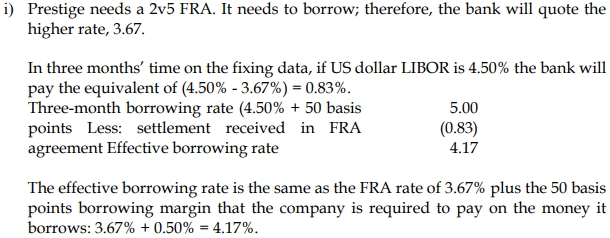
i) What would be its effective rate of borrowing for the three months if US dollar LIBOR is 4.50% at the start of the notional interest period for the FRA? (2 marks)
ii) What are the advantages of Convertible Bonds? (3 marks)

ii) Advantages of Convertible Bonds:

  1. Lower Interest Rates: Convertible bonds typically offer lower interest rates than traditional bonds because investors are compensated by the option to convert the bonds into shares if the company’s stock performs well.
  2. Deferred Dilution: While convertible bonds offer the potential for equity conversion, dilution of ownership only occurs when the bonds are converted, allowing the company to defer issuing more shares and the impact on earnings per share.
  3. Attractive to Investors: Investors find convertible bonds appealing because they offer the stability of bond payments with the potential upside of converting into equity if the company’s stock price rises.
  4. Access to Capital: For companies like Prestige, convertible bonds can provide access to capital without immediately diluting shareholder equity and may be a more cost-effective option than issuing straight equity.

Login or create a free account to see answers

Complete your registration to see answers

Find Related Questions by Tags, levels, etc.

Report an error

You're reporting an error for "SCS – MAR 2024 – L3 – Q5b – Financial management"

SCS – MAR 2024 – L3 – Q5b – Financial management

This Question Has a Case Study: 

Calculate the effective rate of borrowing for three months and explain the advantages of convertible bonds.

With reference to Option Two:

i) What would be its effective rate of borrowing for the three months if US dollar LIBOR is 4.50% at the start of the notional interest period for the FRA? (2 marks)
ii) What are the advantages of Convertible Bonds? (3 marks)

ii) Advantages of Convertible Bonds:

  1. Lower Interest Rates: Convertible bonds typically offer lower interest rates than traditional bonds because investors are compensated by the option to convert the bonds into shares if the company’s stock performs well.
  2. Deferred Dilution: While convertible bonds offer the potential for equity conversion, dilution of ownership only occurs when the bonds are converted, allowing the company to defer issuing more shares and the impact on earnings per share.
  3. Attractive to Investors: Investors find convertible bonds appealing because they offer the stability of bond payments with the potential upside of converting into equity if the company’s stock price rises.
  4. Access to Capital: For companies like Prestige, convertible bonds can provide access to capital without immediately diluting shareholder equity and may be a more cost-effective option than issuing straight equity.

Login or create a free account to see answers

Complete your registration to see answers

Find Related Questions by Tags, levels, etc.

Report an error

You're reporting an error for "SCS – MAR 2024 – L3 – Q5b – Financial management"

SCS – MAR 2024 – L3 – Q5a – Financial management

Calculate various financial ratios including ROCE, EPS, DPS, and TSR based on given financial data.

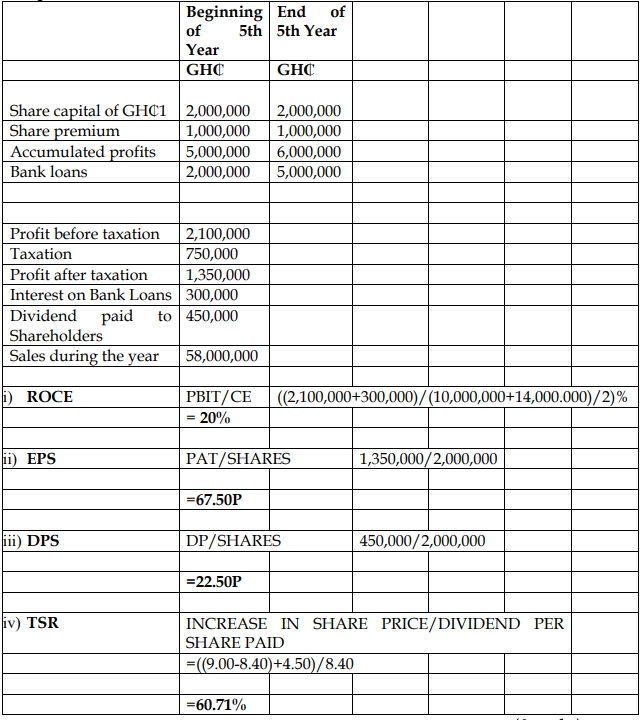
With reference to the information in Option One available to Prestige as presented by Professor Joseph Laing, a business consultant, calculate the following:

i) Return on Capital Employed (ROCE) (1 mark)
ii) Earnings Per Share (EPS) (1 mark)
iii) Dividend Per Share (DPS) (2 marks)
iv) Total Shareholders Return (TSR) (2 marks)
v) Explain the difference between ROCE and Accounting Rate of Return, their essential features, and relationship (4 marks)

v) Difference between ROCE and Accounting Rate of Return (ARR):

  • ROCE is a measure of the return on capital employed in the business, calculated by dividing the profit before interest and tax (PBIT) by the average capital employed. It reflects the overall efficiency of the company in generating profits from its available capital.
  • ARR, on the other hand, measures the accounting profit from a specific capital project, usually before interest and tax, as a percentage of the capital invested in that project.
  • The key difference lies in their scope: while ROCE assesses the return from the entire business or company, ARR focuses on specific capital projects. Both are used to evaluate the efficiency of capital usage, but ARR is project-specific, whereas ROCE is company-wide.

Login or create a free account to see answers

Complete your registration to see answers

Find Related Questions by Tags, levels, etc.

Report an error

You're reporting an error for "SCS – MAR 2024 – L3 – Q5a – Financial management"

SCS – MAR 2024 – L3 – Q5a – Financial management

This Question Has a Case Study: 

Calculate various financial ratios including ROCE, EPS, DPS, and TSR based on given financial data.

With reference to the information in Option One available to Prestige as presented by Professor Joseph Laing, a business consultant, calculate the following:

i) Return on Capital Employed (ROCE) (1 mark)
ii) Earnings Per Share (EPS) (1 mark)
iii) Dividend Per Share (DPS) (2 marks)
iv) Total Shareholders Return (TSR) (2 marks)
v) Explain the difference between ROCE and Accounting Rate of Return, their essential features, and relationship (4 marks)

v) Difference between ROCE and Accounting Rate of Return (ARR):

  • ROCE is a measure of the return on capital employed in the business, calculated by dividing the profit before interest and tax (PBIT) by the average capital employed. It reflects the overall efficiency of the company in generating profits from its available capital.
  • ARR, on the other hand, measures the accounting profit from a specific capital project, usually before interest and tax, as a percentage of the capital invested in that project.
  • The key difference lies in their scope: while ROCE assesses the return from the entire business or company, ARR focuses on specific capital projects. Both are used to evaluate the efficiency of capital usage, but ARR is project-specific, whereas ROCE is company-wide.

Login or create a free account to see answers

Complete your registration to see answers

Find Related Questions by Tags, levels, etc.

Report an error

You're reporting an error for "SCS – MAR 2024 – L3 – Q5a – Financial management"

SCS – MAR 2024 – L3 – Q4b – Strategy implementation

Advise on an appropriate HR strategy to harmonize the organizational structure for effective delivery at Prestige.

Each company acquired or merged by Prestige was allowed to maintain its human resource structure.

Required:
Analyze and advise on an appropriate HR strategy Prestige should adopt to harmonize the organizational structure for effective delivery of the company’s objectives.

  1. Strategic Workforce Planning:
    • Prestige should develop a workforce plan to address the complexities introduced by mergers and acquisitions. This plan should estimate the required number of employees, their skills, and potential future needs based on the company’s objectives, particularly in innovation and technology adoption.
  2. HR Consistency with Corporate Strategy:
    • The HR strategy should align with both the corporate and divisional strategies to ensure that the required number and type of employees are available at the right time to support business operations across regions.
  3. Assessment of Current Workforce:
    • Prestige should conduct an audit of its current workforce, assessing skills, experience, and attrition rates. This would help in identifying gaps and surpluses that need to be addressed through recruitment, training, or redundancy.
  4. Recruitment and Training:
    • The strategy should focus on recruiting the necessary talent to fill gaps, while also implementing training and development programs to upskill existing employees. This will help align employee capabilities with the company’s strategic needs, especially in areas such as IT, finance, and project management.
  5. Performance Management:
    • Implementing a robust performance appraisal system would enable Prestige to monitor the development of employees’ skills and performance, ensuring that key objectives are met. This would also identify areas where employees may require additional training or support.
  6. Promotion and Career Development:
    • Providing clear promotion paths and career development opportunities would encourage employee retention and foster motivation within the workforce, helping Prestige maintain a skilled and experienced team.
  7. Handling Redundancies:
    • Where there are surplus employees due to structural changes, Prestige should have a clear policy for managing redundancies in a way that minimizes disruption while ensuring fairness and compliance with labor laws.
  8. Labor Relations and Employee Welfare:
    • Ensuring good labor relations through clear communication and employee engagement initiatives will help reduce resistance to change. Compensation, health and safety, and employee well-being should be central to the HR strategy to foster a positive workplace environment.
  9. Technological Impact on HR:
    • Prestige should anticipate and manage the impact of technological changes on its workforce, particularly in relation to automation, digital skills, and remote working capabilities.

Factors to Consider:

  • Population trends and labor market conditions.
  • Changes in government policies affecting employment.
  • The availability of specific skills within the workforce.
  • Competition for talent from other businesses.
  • Trends in outsourcing and subcontracting.

Login or create a free account to see answers

Complete your registration to see answers

Find Related Questions by Tags, levels, etc.

Report an error

You're reporting an error for "SCS – MAR 2024 – L3 – Q4b – Strategy implementation"

SCS – MAR 2024 – L3 – Q4b – Strategy implementation

This Question Has a Case Study: 

Advise on an appropriate HR strategy to harmonize the organizational structure for effective delivery at Prestige.

Each company acquired or merged by Prestige was allowed to maintain its human resource structure.

Required:
Analyze and advise on an appropriate HR strategy Prestige should adopt to harmonize the organizational structure for effective delivery of the company’s objectives.

  1. Strategic Workforce Planning:
    • Prestige should develop a workforce plan to address the complexities introduced by mergers and acquisitions. This plan should estimate the required number of employees, their skills, and potential future needs based on the company’s objectives, particularly in innovation and technology adoption.
  2. HR Consistency with Corporate Strategy:
    • The HR strategy should align with both the corporate and divisional strategies to ensure that the required number and type of employees are available at the right time to support business operations across regions.
  3. Assessment of Current Workforce:
    • Prestige should conduct an audit of its current workforce, assessing skills, experience, and attrition rates. This would help in identifying gaps and surpluses that need to be addressed through recruitment, training, or redundancy.
  4. Recruitment and Training:
    • The strategy should focus on recruiting the necessary talent to fill gaps, while also implementing training and development programs to upskill existing employees. This will help align employee capabilities with the company’s strategic needs, especially in areas such as IT, finance, and project management.
  5. Performance Management:
    • Implementing a robust performance appraisal system would enable Prestige to monitor the development of employees’ skills and performance, ensuring that key objectives are met. This would also identify areas where employees may require additional training or support.
  6. Promotion and Career Development:
    • Providing clear promotion paths and career development opportunities would encourage employee retention and foster motivation within the workforce, helping Prestige maintain a skilled and experienced team.
  7. Handling Redundancies:
    • Where there are surplus employees due to structural changes, Prestige should have a clear policy for managing redundancies in a way that minimizes disruption while ensuring fairness and compliance with labor laws.
  8. Labor Relations and Employee Welfare:
    • Ensuring good labor relations through clear communication and employee engagement initiatives will help reduce resistance to change. Compensation, health and safety, and employee well-being should be central to the HR strategy to foster a positive workplace environment.
  9. Technological Impact on HR:
    • Prestige should anticipate and manage the impact of technological changes on its workforce, particularly in relation to automation, digital skills, and remote working capabilities.

Factors to Consider:

  • Population trends and labor market conditions.
  • Changes in government policies affecting employment.
  • The availability of specific skills within the workforce.
  • Competition for talent from other businesses.
  • Trends in outsourcing and subcontracting.

Login or create a free account to see answers

Complete your registration to see answers

Find Related Questions by Tags, levels, etc.

Report an error

You're reporting an error for "SCS – MAR 2024 – L3 – Q4b – Strategy implementation"

SCS – MAR 2024 – L3 – Q4a – Strategy implementation

Explain how Prestige could leverage ICT using the four broad stages of e-business development to compete.

Prestige’s Board has shifted from their long-standing reluctance to venture into foreign markets to seriously consider the possibility of expansion overseas. An important implication of this decision is that as the size of the market increases, competition becomes international. The main rivals are no longer local suppliers to a domestic market.

Required:
Using the four broad stages of development to a full e-business model, explain how Prestige could leverage ICT to compete.

  1. Web Presence:
    • Prestige could set up a website to display its property listings and services. The website can serve as a platform to provide detailed information about the houses for sale, available property types, and contact details. This would enhance visibility and reach beyond local markets.
  2. E-Commerce:
    • Prestige can integrate e-commerce capabilities on its website, allowing potential buyers to make inquiries, schedule viewings, or even complete purchases online. They can also use e-commerce platforms to manage orders and payments from suppliers and partners.
  3. Integrated E-Commerce:
    • Prestige could utilize ICT to gather and analyze customer data to understand their preferences and buying behavior. By establishing two-way communication channels, the company could use customer feedback to improve its product offerings and tailor marketing strategies, boosting customer satisfaction.
  4. E-Business:
    • ICT can drive Prestige’s business strategy by making e-business a fundamental part of its operations. E-business can enhance efficiency in sales, marketing, procurement, and customer service, aligning business operations with digital transformation to gain a competitive edge in the global market.

Login or create a free account to see answers

Complete your registration to see answers

Find Related Questions by Tags, levels, etc.

Report an error

You're reporting an error for "SCS – MAR 2024 – L3 – Q4a – Strategy implementation"

SCS – MAR 2024 – L3 – Q4a – Strategy implementation

This Question Has a Case Study: 

Explain how Prestige could leverage ICT using the four broad stages of e-business development to compete.

Prestige’s Board has shifted from their long-standing reluctance to venture into foreign markets to seriously consider the possibility of expansion overseas. An important implication of this decision is that as the size of the market increases, competition becomes international. The main rivals are no longer local suppliers to a domestic market.

Required:
Using the four broad stages of development to a full e-business model, explain how Prestige could leverage ICT to compete.

  1. Web Presence:
    • Prestige could set up a website to display its property listings and services. The website can serve as a platform to provide detailed information about the houses for sale, available property types, and contact details. This would enhance visibility and reach beyond local markets.
  2. E-Commerce:
    • Prestige can integrate e-commerce capabilities on its website, allowing potential buyers to make inquiries, schedule viewings, or even complete purchases online. They can also use e-commerce platforms to manage orders and payments from suppliers and partners.
  3. Integrated E-Commerce:
    • Prestige could utilize ICT to gather and analyze customer data to understand their preferences and buying behavior. By establishing two-way communication channels, the company could use customer feedback to improve its product offerings and tailor marketing strategies, boosting customer satisfaction.
  4. E-Business:
    • ICT can drive Prestige’s business strategy by making e-business a fundamental part of its operations. E-business can enhance efficiency in sales, marketing, procurement, and customer service, aligning business operations with digital transformation to gain a competitive edge in the global market.

Login or create a free account to see answers

Complete your registration to see answers

Find Related Questions by Tags, levels, etc.

Report an error

You're reporting an error for "SCS – MAR 2024 – L3 – Q4a – Strategy implementation"

SCS – MAR 2024 – L3 – Q3 – Functional strategies

Explain the potential benefits of resource sharing through common IT systems at Prestige.

When five years ago the present regional divisional structure of Greater Accra, Ashanti, and Eastern was formalized, an attempt was made to ensure that common systems and ways of working were adopted across each of the three regions. However, due to the pressures on the Company, this was never fully implemented.

Required:
Explain the potential benefits of resource sharing (configuring an organization’s computing system in such a way that the information and resources within it can be accessed, and remotely accessed, across multiple administrative domains) to Prestige if they adopt common IT systems.

  1. Ease of Access: A common IT system allows staff to access systems, software, and files from any location with an internet connection. This supports collaborative working across regions.
  2. Accuracy: Having a single source of data ensures accuracy by eliminating multiple similar versions scattered across the organization. This provides reliable information to all divisions.
  3. Cost Savings: Resource sharing avoids duplication of work across divisions. Generating similar data for similar purposes can be costly, so producing data once and sharing it reduces inefficiencies and costs for Prestige.
  4. Facilitates Remote Working: IT resource sharing enables remote working, increasing flexibility. Employees can work from any location, enhancing motivation and potentially creating cost savings by allowing work from home.
  5. Transparency: Resource sharing promotes transparency across the organization by making information easily accessible to all relevant parties. This can improve decision-making and operational efficiency.

Login or create a free account to see answers

Complete your registration to see answers

Find Related Questions by Tags, levels, etc.

Report an error

You're reporting an error for "SCS – MAR 2024 – L3 – Q3 – Functional strategies"

SCS – MAR 2024 – L3 – Q3 – Functional strategies

This Question Has a Case Study: 

Explain the potential benefits of resource sharing through common IT systems at Prestige.

When five years ago the present regional divisional structure of Greater Accra, Ashanti, and Eastern was formalized, an attempt was made to ensure that common systems and ways of working were adopted across each of the three regions. However, due to the pressures on the Company, this was never fully implemented.

Required:
Explain the potential benefits of resource sharing (configuring an organization’s computing system in such a way that the information and resources within it can be accessed, and remotely accessed, across multiple administrative domains) to Prestige if they adopt common IT systems.

  1. Ease of Access: A common IT system allows staff to access systems, software, and files from any location with an internet connection. This supports collaborative working across regions.
  2. Accuracy: Having a single source of data ensures accuracy by eliminating multiple similar versions scattered across the organization. This provides reliable information to all divisions.
  3. Cost Savings: Resource sharing avoids duplication of work across divisions. Generating similar data for similar purposes can be costly, so producing data once and sharing it reduces inefficiencies and costs for Prestige.
  4. Facilitates Remote Working: IT resource sharing enables remote working, increasing flexibility. Employees can work from any location, enhancing motivation and potentially creating cost savings by allowing work from home.
  5. Transparency: Resource sharing promotes transparency across the organization by making information easily accessible to all relevant parties. This can improve decision-making and operational efficiency.

Login or create a free account to see answers

Complete your registration to see answers

Find Related Questions by Tags, levels, etc.

Report an error

You're reporting an error for "SCS – MAR 2024 – L3 – Q3 – Functional strategies"

SCS – MAR 2024 – L3 – Q2 – Competitive advantage

Apply and appraise Porter’s three strategies for sustaining competitive advantage for Prestige Designers Ltd.

A strategic clock can be used to consider different business strategies for gaining competitive advantage, based on providing a combination of price and perceived benefits. Porter has suggested three strategies for sustaining competitive advantage over rival firms and their products or services. They are a cost leadership strategy, a differentiation strategy, and a focus strategy.

Required:
Apply and appraise how effective the suggested three strategies for sustaining competitive advantage over rival firms would be useful to Prestige. (10 marks)

  1. Cost Leadership Strategy:
    • Prestige must compete effectively on price by offering its housing stock at a lower price than rivals.
    • The company should have excellent cost control systems and continually plan for further reductions in costs to remain the cost leader in the market.
    • Prestige, being a large company, can benefit from economies of scale compared to smaller competitors.
    • To achieve reasonable profit margins, Prestige must sell large volumes of homes at a lower profit margin per unit.
  2. Differentiation Strategy:
    • Prestige’s products must be distinct from those of its competitors in a way that customers can recognize, potentially leveraging the “Vintage” brand which focuses on low-cost housing for young buyers.
    • The company could innovate and incorporate modern methods of construction (MMC) and sustainability-related methods to differentiate its products.
    • Customers might be willing to pay more for homes with unique features and higher perceived value.
    • Prestige should invest in delivering superior value to customers, even if that means higher upfront costs.
  3. Focus Strategy:
    • Prestige could focus on segmented consumer markets by selecting specific segments, such as the middle-class or younger first-time home buyers, as the primary market for their products.
    • The company could concentrate on serving a particular type of customer or region, allowing it to tailor its offerings to the unique demands of that segment.

Login or create a free account to see answers

Complete your registration to see answers

Find Related Questions by Tags, levels, etc.

Report an error

You're reporting an error for "SCS – MAR 2024 – L3 – Q2 – Competitive advantage"

SCS – MAR 2024 – L3 – Q2 – Competitive advantage

This Question Has a Case Study: 

Apply and appraise Porter’s three strategies for sustaining competitive advantage for Prestige Designers Ltd.

A strategic clock can be used to consider different business strategies for gaining competitive advantage, based on providing a combination of price and perceived benefits. Porter has suggested three strategies for sustaining competitive advantage over rival firms and their products or services. They are a cost leadership strategy, a differentiation strategy, and a focus strategy.

Required:
Apply and appraise how effective the suggested three strategies for sustaining competitive advantage over rival firms would be useful to Prestige. (10 marks)

  1. Cost Leadership Strategy:
    • Prestige must compete effectively on price by offering its housing stock at a lower price than rivals.
    • The company should have excellent cost control systems and continually plan for further reductions in costs to remain the cost leader in the market.
    • Prestige, being a large company, can benefit from economies of scale compared to smaller competitors.
    • To achieve reasonable profit margins, Prestige must sell large volumes of homes at a lower profit margin per unit.
  2. Differentiation Strategy:
    • Prestige’s products must be distinct from those of its competitors in a way that customers can recognize, potentially leveraging the “Vintage” brand which focuses on low-cost housing for young buyers.
    • The company could innovate and incorporate modern methods of construction (MMC) and sustainability-related methods to differentiate its products.
    • Customers might be willing to pay more for homes with unique features and higher perceived value.
    • Prestige should invest in delivering superior value to customers, even if that means higher upfront costs.
  3. Focus Strategy:
    • Prestige could focus on segmented consumer markets by selecting specific segments, such as the middle-class or younger first-time home buyers, as the primary market for their products.
    • The company could concentrate on serving a particular type of customer or region, allowing it to tailor its offerings to the unique demands of that segment.

Login or create a free account to see answers

Complete your registration to see answers

Find Related Questions by Tags, levels, etc.

Report an error

You're reporting an error for "SCS – MAR 2024 – L3 – Q2 – Competitive advantage"

PSAF – March 2024 – L2 – Q4a – Public Financial Management, Public Procurement

Explain procurement irregularities and conditions under which procurement processes can be canceled; discuss PPP risks.

a) In a recent Auditor General’s Report to Parliament, several Ministries Departments and Agencies were cited for various financial management irregularities. Included in the report were Stores and Procurement irregularities covering the following:
i) Uncompetitive Tendering
ii) Unplanned Procurement
iii) Contract splitting

Required:
Explain the above irregularities in the context of the Public Procurement Amendment Act, 2016 (Act 914). (6 marks)

b) Under the procurement laws of Ghana, a procurement entity may for specific and justifiable reasons, cancel the procurement proceedings before the expiry of the deadline for the submission of the tenders.
Required:
Outline FOUR (4) conditions under which a procurement entity may activate this provision under the Public Procurement Amendment Act, 2016 (Act 914). (4 marks)

c) University of Communication is a Public University in Ghana. The University has a student population of about Forty Thousand (40,000). The University is located in a very populous environment, and the community lacks a modern Hospital that could provide good health care for the students and the community at large. Due to financial constraints, the University can currently boast of only one clinic that barely serves the full health needs of the students. The University intends to use the Public-Private Partnership (PPP) arrangement to construct an ultra-modern hospital in the University to provide the full health care of the University community.

In addition to the internally generated fund from the operations of the new hospital, it will also serve as a practical learning centre for the University. In this regard, the University has been approached by Trust Investors Ltd, a private company that intends to construct the ultra-modern hospital in the University to serve these purposes using a Build Operate and Transfer (BOT) arrangement. Negotiations are just at the preliminary stage, and you have been contracted as the consultant to assist the parties to enter into a successful PPP arrangement. The parties are eager to know the inherent risks they are exposed to under such an arrangement.

Required:
Write a report to the parties, outlining THREE (3) risks each that the two parties are exposed to. (10 marks)

a)
i) Uncompetitive Tendering: The Public Procurement Act requires that a Procurement Entity shall procure goods, services, or works by competitive tendering except where competitive tendering is not appropriate. A competitive procurement provides the platform for alternative tenders to be obtained from interested suppliers with the objective of obtaining value for money. It includes international competitive tendering, national competitive tendering, request for quotation, and restricted tendering. If the procurement entity uses any method of procurement other than competitive tendering, that is referred to as uncompetitive procurement. The Act, however, allows such uncompetitive procurements if it qualifies under the provisions under the Act, e.g., Sole Sourcing Procurement.

ii) Unplanned Procurement: The Public Procurement Act, 2003, Act 663 states that a procurement entity shall prepare a procurement plan to support its approved programme and the plan shall indicate (a) contract packages descriptions or lots, (b) estimated cost for each package, (c) the procurement method approvals needed, and (d) processing steps and times. This plan is reviewed and approved by the Entity Tender Committee, after which it is documented and forwarded to the board as the annual procurement plan. All procurement of an entity in any fiscal year must, therefore, be in line with the Annual Procurement Plan. Any procurement outside the plan is described as unplanned procurement and could be said to be outside the approved programme of the entity.

iii) Contract Splitting: Contract splitting refers to a condition where a procurement entity divides a procurement order into parts or lowers the value of a procurement order to avoid the application of the procedures for public procurement in the Act. This is usually undertaken by procurement entities for the convenience of using the request for quotation procurement method, which is said to be more subjective compared to other competitive tendering methods.

b)
A procurement entity under Section 28A (1) of the Public Procurement (Amendment) Act, 2016 (Act 914) may, for specific and fully justified reasons, cancel the procurement proceedings before the expiry of the deadline for the submission of the tenders where:

  • The entity discovers an imperfection in the wording of the request for submission of tenders, which could mislead tenderers.
  • The procurement entity decides to carry out the work subject of the tender by itself.
  • There is a cut in the budget intended for performing the contract.
  • No bid has been submitted.
  • Exceptional circumstances or a force majeure render normal performance of the contract impossible.
  • The economic or technical data of the project has fundamentally changed.

c)
Report to Parties on Risks in PPP Arrangement

Risks that Trust Investors Ltd are exposed to:

  1. Construction Risk: This encompasses the many issues that may be encountered during the construction phase of a project, such as cost overruns, building material defects, construction delays, planning regulation, structural integrity issues with existing infrastructure, technical deficiencies, health risk, and worksite accidents.
  2. Financing Risk: This describes the risk that the full funding required for the project will not be obtained or will be obtained at interest rates that would prevent the project from achieving its expected benefits. This might be due to the circumstances of the specific parties to the arrangement (e.g., their credit status or debt limitations) or investor perceptions of the risk of a project. For example, if Trust Investors Ltd obtains a USD-denominated debt, and the exchange rate deteriorates, who bears the exchange rate risk?
  3. Demand Risk: This risk relates to variability in the amount of service required or consumed by users of the Ultra-Modern Hospital. Users in this case could be the University itself, third-party users such as people living in the community, or both. If the Ultra-Modern Hospital experiences low patronage, it could pose a problem in recovering the full investment and returns.

Risks that University of Communication is exposed to:

  1. Operational and Maintenance Risk: This risk encompasses a broad range of risks that exist after the Ultra-Modern Hospital facility becomes operational. These could include fees increases, shortages of materials, increases in labour costs, damage due to natural disasters, and deferred maintenance costs.
  2. Residual Value Risk: This risk relates to the possible difference between the market price of the Ultra-Modern Hospital facility at the end of the PPP arrangement and the original market price expectation. For instance, if the hospital’s residual value is lower than expected due to poor maintenance, the University might incur losses.
  3. Availability Risk: This is the risk that Trust Investors Ltd will not have available resources to expand in order to accommodate the increase in demand for services when the need arises better than the University could have done.

Login or create a free account to see answers

Complete your registration to see answers

Find Related Questions by Tags, levels, etc.

Report an error

You're reporting an error for "PSAF – March 2024 – L2 – Q4a – Public Financial Management, Public Procurement"

PSAF – March 2024 – L2 – Q4a – Public Financial Management, Public Procurement

Explain procurement irregularities and conditions under which procurement processes can be canceled; discuss PPP risks.

a) In a recent Auditor General’s Report to Parliament, several Ministries Departments and Agencies were cited for various financial management irregularities. Included in the report were Stores and Procurement irregularities covering the following:
i) Uncompetitive Tendering
ii) Unplanned Procurement
iii) Contract splitting

Required:
Explain the above irregularities in the context of the Public Procurement Amendment Act, 2016 (Act 914). (6 marks)

b) Under the procurement laws of Ghana, a procurement entity may for specific and justifiable reasons, cancel the procurement proceedings before the expiry of the deadline for the submission of the tenders.
Required:
Outline FOUR (4) conditions under which a procurement entity may activate this provision under the Public Procurement Amendment Act, 2016 (Act 914). (4 marks)

c) University of Communication is a Public University in Ghana. The University has a student population of about Forty Thousand (40,000). The University is located in a very populous environment, and the community lacks a modern Hospital that could provide good health care for the students and the community at large. Due to financial constraints, the University can currently boast of only one clinic that barely serves the full health needs of the students. The University intends to use the Public-Private Partnership (PPP) arrangement to construct an ultra-modern hospital in the University to provide the full health care of the University community.

In addition to the internally generated fund from the operations of the new hospital, it will also serve as a practical learning centre for the University. In this regard, the University has been approached by Trust Investors Ltd, a private company that intends to construct the ultra-modern hospital in the University to serve these purposes using a Build Operate and Transfer (BOT) arrangement. Negotiations are just at the preliminary stage, and you have been contracted as the consultant to assist the parties to enter into a successful PPP arrangement. The parties are eager to know the inherent risks they are exposed to under such an arrangement.

Required:
Write a report to the parties, outlining THREE (3) risks each that the two parties are exposed to. (10 marks)

a)
i) Uncompetitive Tendering: The Public Procurement Act requires that a Procurement Entity shall procure goods, services, or works by competitive tendering except where competitive tendering is not appropriate. A competitive procurement provides the platform for alternative tenders to be obtained from interested suppliers with the objective of obtaining value for money. It includes international competitive tendering, national competitive tendering, request for quotation, and restricted tendering. If the procurement entity uses any method of procurement other than competitive tendering, that is referred to as uncompetitive procurement. The Act, however, allows such uncompetitive procurements if it qualifies under the provisions under the Act, e.g., Sole Sourcing Procurement.

ii) Unplanned Procurement: The Public Procurement Act, 2003, Act 663 states that a procurement entity shall prepare a procurement plan to support its approved programme and the plan shall indicate (a) contract packages descriptions or lots, (b) estimated cost for each package, (c) the procurement method approvals needed, and (d) processing steps and times. This plan is reviewed and approved by the Entity Tender Committee, after which it is documented and forwarded to the board as the annual procurement plan. All procurement of an entity in any fiscal year must, therefore, be in line with the Annual Procurement Plan. Any procurement outside the plan is described as unplanned procurement and could be said to be outside the approved programme of the entity.

iii) Contract Splitting: Contract splitting refers to a condition where a procurement entity divides a procurement order into parts or lowers the value of a procurement order to avoid the application of the procedures for public procurement in the Act. This is usually undertaken by procurement entities for the convenience of using the request for quotation procurement method, which is said to be more subjective compared to other competitive tendering methods.

b)
A procurement entity under Section 28A (1) of the Public Procurement (Amendment) Act, 2016 (Act 914) may, for specific and fully justified reasons, cancel the procurement proceedings before the expiry of the deadline for the submission of the tenders where:

  • The entity discovers an imperfection in the wording of the request for submission of tenders, which could mislead tenderers.
  • The procurement entity decides to carry out the work subject of the tender by itself.
  • There is a cut in the budget intended for performing the contract.
  • No bid has been submitted.
  • Exceptional circumstances or a force majeure render normal performance of the contract impossible.
  • The economic or technical data of the project has fundamentally changed.

c)
Report to Parties on Risks in PPP Arrangement

Risks that Trust Investors Ltd are exposed to:

  1. Construction Risk: This encompasses the many issues that may be encountered during the construction phase of a project, such as cost overruns, building material defects, construction delays, planning regulation, structural integrity issues with existing infrastructure, technical deficiencies, health risk, and worksite accidents.
  2. Financing Risk: This describes the risk that the full funding required for the project will not be obtained or will be obtained at interest rates that would prevent the project from achieving its expected benefits. This might be due to the circumstances of the specific parties to the arrangement (e.g., their credit status or debt limitations) or investor perceptions of the risk of a project. For example, if Trust Investors Ltd obtains a USD-denominated debt, and the exchange rate deteriorates, who bears the exchange rate risk?
  3. Demand Risk: This risk relates to variability in the amount of service required or consumed by users of the Ultra-Modern Hospital. Users in this case could be the University itself, third-party users such as people living in the community, or both. If the Ultra-Modern Hospital experiences low patronage, it could pose a problem in recovering the full investment and returns.

Risks that University of Communication is exposed to:

  1. Operational and Maintenance Risk: This risk encompasses a broad range of risks that exist after the Ultra-Modern Hospital facility becomes operational. These could include fees increases, shortages of materials, increases in labour costs, damage due to natural disasters, and deferred maintenance costs.
  2. Residual Value Risk: This risk relates to the possible difference between the market price of the Ultra-Modern Hospital facility at the end of the PPP arrangement and the original market price expectation. For instance, if the hospital’s residual value is lower than expected due to poor maintenance, the University might incur losses.
  3. Availability Risk: This is the risk that Trust Investors Ltd will not have available resources to expand in order to accommodate the increase in demand for services when the need arises better than the University could have done.

Login or create a free account to see answers

Complete your registration to see answers

Find Related Questions by Tags, levels, etc.

Report an error

You're reporting an error for "PSAF – March 2024 – L2 – Q4a – Public Financial Management, Public Procurement"

PSAF – March 2024 – L2 – Q3 – PEFA Framework and Budget Performance Report

Discuss the benefits of the PEFA framework, sources of information for PEFA assessment, and the preparation and interpretation of a budget performance report.

a) The Public Financial Management Regulation, LI 2378 defines Public Financial Management (PFM) as laws, rules, systems, and processes used by the Government to mobilize revenue, allocate public funds, undertake public spending, account for funds, and audit results. In 2001, a group of development partners initiated the Public Expenditure and Financial Accountability (PEFA) framework to assess the status of public financial management at central and local government levels. Since then, Ghana has subjected itself to periodic assessments in an attempt to improve the country’s PFM system.

Required:
i) Discuss FOUR (4) benefits the use of the PEFA framework can bring to a country. (6 marks)
ii) Explain FOUR (4) sources of information for PEFA assessment. (4 marks)


b) Budget Performance Report is one of the major accountability provisions under the Public Financial Management laws. Regulation 215(2) of the Public Financial Management Regulation, 2019, LI 2378 provides that each Principal Account Holder shall not later than 31 March of the ensuing year submit an annual budget performance report to parliament. The following is an extract from the GIFMIS platform representing Government of Ghana funding for the Ministry of Sanitation for the year 2023.

Budget Item Annual Appropriation (GH¢’000) YTD Warrant (GH¢’000) YTD Payments (GH¢’000)
Compensation of Employees 25,500 18,280 17,450
Goods and Services 5,000 3,450 3,400
Capital Expenditure 8,780 1,220 550
Total 39,280 22,950 21,400

Required:
i) Explain the meaning of Annual Appropriation and YTD Warrant to the Principal Account Holder of the ministry. (2 marks)
ii) Enumerate TWO (2) issues that should be specified in the Annual Budget Performance Report to be submitted by the Principal Account Holder according to the Regulations 215 of LI 2378. (2 marks)
iii) Prepare a Statement of Budget Performance Report for the year 2023 showing the budget-warrant outturns and warrant utilization rates. (3 marks)
iv) Interpret the budget performance statement in (iii) above to facilitate the Minister’s upcoming meeting with the select committee of parliament as required under the law. (3 marks)

a)
i) Benefits of the PEFA framework to countries:

  1. Assessment of PFM Performance: The PEFA framework provides a standardized methodology for assessing the performance of a country’s public financial management system. By conducting PEFA assessments, countries can identify strengths and weaknesses in their PFM systems, enabling them to prioritize reforms and improve accountability and transparency.
  2. Basis for Reform Planning and Prioritization: PEFA assessments serve as a diagnostic tool for governments, helping them identify areas for improvement in their PFM systems. Based on the findings of the assessment, countries can develop action plans and prioritize reforms to address deficiencies and strengthen financial management practices.
  3. Monitoring and Evaluation of Reform Progress: The PEFA framework allows countries to monitor and evaluate the progress of PFM reforms over time. By conducting periodic PEFA assessments, governments can track improvements in PFM performance, measure the effectiveness of reform initiatives, and adjust strategies as needed to achieve desired outcomes.
  4. Enhanced Donor Coordination and Support: PEFA assessments provide a common language and set of benchmarks for donors, governments, and other stakeholders involved in supporting PFM reforms. By aligning donor assistance with the findings of PEFA assessments, countries can ensure that reform efforts are coordinated, targeted, and effectively implemented.
  5. Promotion of Transparency and Accountability: The PEFA framework promotes
    transparency and accountability in public financial management by providing a
    systematic approach for assessing the integrity, reliability, and timeliness of fiscal
    information. By enhancing the credibility of financial reporting, PEFA assessments
    contribute to greater trust and confidence in government institutions.
  6. Capacity Building and Institutional Strengthening: Through the process of
    conducting PEFA assessments and implementing reforms, countries can build the
    capacity of government institutions and officials involved in financial
    management. By strengthening institutional capacity, countries can improve their
    ability to manage public resources efficiently and effectively.
  7. International Benchmarking and Comparison: PEFA assessments allow
    countries to benchmark their PFM performance against international standards
    and best practices. By comparing performance indicators with peer countries,
    governments can identify areas of relative strength and weakness, learn from
    successful experiences and adopt innovative approaches to PFM reform.

ii) Sources of information for PEFA assessment:

  1. Legislation: Government financial management laws and regulations provide the legal framework for public financial management and are a primary source of information for PEFA assessments.
  2. Government Policy Papers: These documents outline government strategies, policies, and priorities, which can offer insights into the PFM environment.
  3. Budget Documents: The annual budget and related financial documents provide critical data on planned and actual revenue, expenditure, and financing activities.
  4. Reports and Statistics: Official reports and statistics, including those from national statistical agencies, provide quantitative data necessary for assessing PFM performance.
  5. Recent surveys.
  6. Analytical work at national, regional or international levels.
  7. Interview of key stakeholders.

b)
i) Meaning of Annual Appropriation and YTD Warrant:

  • Annual Appropriation: This refers to the total amount of money that has been authorized by Parliament to be spent by a covered entity during the fiscal year. It represents the maximum budgetary allocation permitted for expenditure.
  • YTD Warrant: Year-to-date (YTD) Warrant refers to the amount that has been approved by the Ministry of Finance for release from the Annual Appropriation. It is the actual amount made available to the entity for spending up to the reporting date.

(1 mark each = 2 marks)

ii) Issues to be specified in the Annual Budget Performance Report:

  1. Achievements of the Covered Entity: A summary of what has been accomplished in relation to the goals and objectives set for the fiscal year.
  2. Annual Work Plan: Details of the planned activities and projects for the year, along with any deviations or modifications.

(Any 2 points @ 1 mark each = 2 marks)

iii) Statement of Budget Performance Report for the year 2023:

Budget Item Annual Appropriation (GH¢’000) YTD Warrant (GH¢’000) YTD Payments (GH¢’000) Budget-Warrant Outturn (GH¢’000) Warrant Burn Rate (%)
Compensation of Employees 25,500 18,280 17,450 7,220 (28.31%) 95%
Goods and Services 5,000 3,450 3,400 1,550 (31.00%) 99%
Capital Expenditure 8,780 1,220 550 7,560 (86.10%) 45%
Total 39,280 22,950 21,400 16,330 (41.57%) 93.25%

(3 marks evenly spread using ticks)

iv) Interpretation of Budget Performance:

  • Budget-Warrant Outturn: The overall budget performance shows that 41.57% of the ministry’s budget was not released by the government. This would likely impact the ministry’s ability to fully implement its planned activities, especially in capital expenditures, which had the lowest release rate at only 13.9%. The non-release of a significant portion of the budget may have constrained the ministry’s service delivery and project execution.
  • Warrant Burn Rate: Despite the limited releases, the ministry managed to utilize 93.25% of the total warrants issued, with a near-complete utilization rate for Goods and Services at 99%. However, the Capital Expenditure category showed a significant underutilization, with only 45% of the released funds being spent. This suggests potential delays in project execution or issues with the procurement process.

Login or create a free account to see answers

Complete your registration to see answers

Find Related Questions by Tags, levels, etc.

Report an error

You're reporting an error for "PSAF – March 2024 – L2 – Q3 – PEFA Framework and Budget Performance Report"

PSAF – March 2024 – L2 – Q3 – PEFA Framework and Budget Performance Report

Discuss the benefits of the PEFA framework, sources of information for PEFA assessment, and the preparation and interpretation of a budget performance report.

a) The Public Financial Management Regulation, LI 2378 defines Public Financial Management (PFM) as laws, rules, systems, and processes used by the Government to mobilize revenue, allocate public funds, undertake public spending, account for funds, and audit results. In 2001, a group of development partners initiated the Public Expenditure and Financial Accountability (PEFA) framework to assess the status of public financial management at central and local government levels. Since then, Ghana has subjected itself to periodic assessments in an attempt to improve the country’s PFM system.

Required:
i) Discuss FOUR (4) benefits the use of the PEFA framework can bring to a country. (6 marks)
ii) Explain FOUR (4) sources of information for PEFA assessment. (4 marks)


b) Budget Performance Report is one of the major accountability provisions under the Public Financial Management laws. Regulation 215(2) of the Public Financial Management Regulation, 2019, LI 2378 provides that each Principal Account Holder shall not later than 31 March of the ensuing year submit an annual budget performance report to parliament. The following is an extract from the GIFMIS platform representing Government of Ghana funding for the Ministry of Sanitation for the year 2023.

Budget Item Annual Appropriation (GH¢’000) YTD Warrant (GH¢’000) YTD Payments (GH¢’000)
Compensation of Employees 25,500 18,280 17,450
Goods and Services 5,000 3,450 3,400
Capital Expenditure 8,780 1,220 550
Total 39,280 22,950 21,400

Required:
i) Explain the meaning of Annual Appropriation and YTD Warrant to the Principal Account Holder of the ministry. (2 marks)
ii) Enumerate TWO (2) issues that should be specified in the Annual Budget Performance Report to be submitted by the Principal Account Holder according to the Regulations 215 of LI 2378. (2 marks)
iii) Prepare a Statement of Budget Performance Report for the year 2023 showing the budget-warrant outturns and warrant utilization rates. (3 marks)
iv) Interpret the budget performance statement in (iii) above to facilitate the Minister’s upcoming meeting with the select committee of parliament as required under the law. (3 marks)

a)
i) Benefits of the PEFA framework to countries:

  1. Assessment of PFM Performance: The PEFA framework provides a standardized methodology for assessing the performance of a country’s public financial management system. By conducting PEFA assessments, countries can identify strengths and weaknesses in their PFM systems, enabling them to prioritize reforms and improve accountability and transparency.
  2. Basis for Reform Planning and Prioritization: PEFA assessments serve as a diagnostic tool for governments, helping them identify areas for improvement in their PFM systems. Based on the findings of the assessment, countries can develop action plans and prioritize reforms to address deficiencies and strengthen financial management practices.
  3. Monitoring and Evaluation of Reform Progress: The PEFA framework allows countries to monitor and evaluate the progress of PFM reforms over time. By conducting periodic PEFA assessments, governments can track improvements in PFM performance, measure the effectiveness of reform initiatives, and adjust strategies as needed to achieve desired outcomes.
  4. Enhanced Donor Coordination and Support: PEFA assessments provide a common language and set of benchmarks for donors, governments, and other stakeholders involved in supporting PFM reforms. By aligning donor assistance with the findings of PEFA assessments, countries can ensure that reform efforts are coordinated, targeted, and effectively implemented.
  5. Promotion of Transparency and Accountability: The PEFA framework promotes
    transparency and accountability in public financial management by providing a
    systematic approach for assessing the integrity, reliability, and timeliness of fiscal
    information. By enhancing the credibility of financial reporting, PEFA assessments
    contribute to greater trust and confidence in government institutions.
  6. Capacity Building and Institutional Strengthening: Through the process of
    conducting PEFA assessments and implementing reforms, countries can build the
    capacity of government institutions and officials involved in financial
    management. By strengthening institutional capacity, countries can improve their
    ability to manage public resources efficiently and effectively.
  7. International Benchmarking and Comparison: PEFA assessments allow
    countries to benchmark their PFM performance against international standards
    and best practices. By comparing performance indicators with peer countries,
    governments can identify areas of relative strength and weakness, learn from
    successful experiences and adopt innovative approaches to PFM reform.

ii) Sources of information for PEFA assessment:

  1. Legislation: Government financial management laws and regulations provide the legal framework for public financial management and are a primary source of information for PEFA assessments.
  2. Government Policy Papers: These documents outline government strategies, policies, and priorities, which can offer insights into the PFM environment.
  3. Budget Documents: The annual budget and related financial documents provide critical data on planned and actual revenue, expenditure, and financing activities.
  4. Reports and Statistics: Official reports and statistics, including those from national statistical agencies, provide quantitative data necessary for assessing PFM performance.
  5. Recent surveys.
  6. Analytical work at national, regional or international levels.
  7. Interview of key stakeholders.

b)
i) Meaning of Annual Appropriation and YTD Warrant:

  • Annual Appropriation: This refers to the total amount of money that has been authorized by Parliament to be spent by a covered entity during the fiscal year. It represents the maximum budgetary allocation permitted for expenditure.
  • YTD Warrant: Year-to-date (YTD) Warrant refers to the amount that has been approved by the Ministry of Finance for release from the Annual Appropriation. It is the actual amount made available to the entity for spending up to the reporting date.

(1 mark each = 2 marks)

ii) Issues to be specified in the Annual Budget Performance Report:

  1. Achievements of the Covered Entity: A summary of what has been accomplished in relation to the goals and objectives set for the fiscal year.
  2. Annual Work Plan: Details of the planned activities and projects for the year, along with any deviations or modifications.

(Any 2 points @ 1 mark each = 2 marks)

iii) Statement of Budget Performance Report for the year 2023:

Budget Item Annual Appropriation (GH¢’000) YTD Warrant (GH¢’000) YTD Payments (GH¢’000) Budget-Warrant Outturn (GH¢’000) Warrant Burn Rate (%)
Compensation of Employees 25,500 18,280 17,450 7,220 (28.31%) 95%
Goods and Services 5,000 3,450 3,400 1,550 (31.00%) 99%
Capital Expenditure 8,780 1,220 550 7,560 (86.10%) 45%
Total 39,280 22,950 21,400 16,330 (41.57%) 93.25%

(3 marks evenly spread using ticks)

iv) Interpretation of Budget Performance:

  • Budget-Warrant Outturn: The overall budget performance shows that 41.57% of the ministry’s budget was not released by the government. This would likely impact the ministry’s ability to fully implement its planned activities, especially in capital expenditures, which had the lowest release rate at only 13.9%. The non-release of a significant portion of the budget may have constrained the ministry’s service delivery and project execution.
  • Warrant Burn Rate: Despite the limited releases, the ministry managed to utilize 93.25% of the total warrants issued, with a near-complete utilization rate for Goods and Services at 99%. However, the Capital Expenditure category showed a significant underutilization, with only 45% of the released funds being spent. This suggests potential delays in project execution or issues with the procurement process.

Login or create a free account to see answers

Complete your registration to see answers

Find Related Questions by Tags, levels, etc.

Report an error

You're reporting an error for "PSAF – March 2024 – L2 – Q3 – PEFA Framework and Budget Performance Report"

PSAF – March 2024 – L2 – Q2 – Preparation of Financial Statements for Central Government

Prepare the Statement of Financial Performance, Statement of Financial Position, and Statement of Budget Information for a central government department based on the given trial balance.

The following Trial Balance was extracted from the records of the Department of Social Integration, a central government department, for the year ended 31 December 2023.

Additional Information:

  1. The Department prepares its financial statements in compliance with the International Public Sector Accounting Standards, the Public Financial Management Act 2016, Act 921, and the Chart of Accounts of the Government of Ghana.
  2. Included in printing materials and stationery is a closing inventory valued at cost of GH¢380,000. The estimated net realizable value and replacement cost of the inventory are GH¢320,000 and GH¢330,000 respectively. The printing is not for commercial purposes.
  3. In June 2023, the government conducted a massive recruitment into the civil services, of which 20 employees were posted to the Department. However, they have not been paid salaries for the period. The amount owed to these employees is GH¢2,500,000 and this should be reflected in the financial statement of the period.
  4. The Department currently pays rent for two of its Regional Offices, and at the end of the year rent of GH¢200,000 was outstanding. Further, the Department also rented part of its premises at the Headquarters. At the end of the financial year, an amount of GH¢150,000 was received to cover 2024 rent. Meanwhile, GH¢20,000 rent has not been received from tenants for the year 2023. These transactions have not been accounted for.
  5. Depreciation of fixed assets is charged on a straight-line basis as follows:
Assets Estimated useful life (in years)
Motor vehicle 5 years
Furniture 4 years
Computers 3 years
Premises 20 years
  1. It was revealed that computer accessories costing GH¢340,000 acquired in 2022 were accounted for as goods and services. However, the Auditor for the 2023 financial year recommended that the transaction should be accounted for as a non-current asset. The recommendation is yet to be implemented.
  2. The budget extract of the Department for 2023 is as follows:
Item GH¢’000
Approved budget allocation 20,000
Internally generated fund 3,000
Donor support 1,000
Compensation for employees 10,000
Use of Goods and Services 6,000
Other expenses 5,500

Required: Prepare in compliance with the International Public Sector Accounting Standards, the Public Financial Management Act 2016, and the Chart of Accounts of Ghana: a) A Statement of Financial Performance for the year ended 31 December 2023.

b) A Statement of Financial Position as at 31 December 2023.

c) A Separate Statement of Budget Information in comparison with the Actuals for the year ended 31 December 2023.

a) Statement of Financial Performance for the year ended 31 December 2023:

Revenue GH¢’000
Receipts from Government 17,100
Internally generated fund 1,720
Donation 1,200
Total Revenue 20,020
Expenses
Compensation for employees 12,520
Goods and Services 5,110
Consumption of fixed capital 38,100
Other expenses 5,000
Total Expenses 60,730
Net Deficit (40,710)

b) Statement of Financial Position as at 31 December 2023:

Non-current Assets GH¢’000
Property, Plant, and Equipment 155,527
Current Assets
Inventory 330
Receivable 3,020
Fixed Deposit 1,000
Cash and Cash equivalent 10,000
Total Current Assets 14,350
Total Assets 169,877
Liabilities and Fund
Payable 9,100
Tender Security 900
Rent advanced 150
Total Liabilities 10,150
Accumulated Fund 159,727
Total Liabilities and Fund 169,877

c) Statement of Budget Information in Comparison with the Actuals for the year ended 31 December 2023:

Item Budget Actual Variance Variance %
Revenues
Receipts from Government 20,000 17,100 2,900 86
Internally Generated Fund 3,000 1,720 1,280 57
Donation 1,000 1,200 (-200) 120
Total Revenues 24,000 20,020 3,980 83
Expenses
Compensation of employees 10,000 12,520 (-2,520) 125
Goods and Services 6,000 5,110 890 85
Other expenses 5,500 5,000 500 91
Total Expenses 21,500 22,630 (-1,130) 105
Surplus/Deficit 2,500 (-2,610) 5,110 (-104)

Workings:

  • Receipts from Government:
    • Compensation for employees = GH¢7,000,000
    • Use of goods and services = GH¢5,600,000
    • Capital expenditures = GH¢4,500,000
    • Total Receipts from Government = GH¢17,100,000
  • Compensation for Employees:
    • Established post salaries = GH¢4,000,000
    • Salaries outstanding = GH¢2,500,000
    • Non-established post salaries = GH¢1,500,000
    • Car maintenance allowance = GH¢800,000
    • Travel allowance = GH¢1,100,000
    • Cost of living allowance = GH¢1,800,000
    • Pensions and gratuity = GH¢400,000
    • SSF contribution = GH¢120,000
    • Rounding = GH¢100,000
    • Utility allowance = GH¢200,000
    • Total Compensation for Employees = GH¢12,520,000
  • Goods and Services:
    • Travel and transport = GH¢560,000
    • Repairs and maintenance = GH¢340,000
    • Training, seminars, and conferences = GH¢660,000
    • Local consultancy = GH¢890,000
    • General cleaning = GH¢125,000
    • Printing materials:
      • Opening inventory = GH¢860,000
      • Purchases = GH¢800,000
      • Closing inventory = (GH¢330,000)
      • Total Printing materials = GH¢1,330,000
    • Utilities = GH¢650,000
    • Rent = GH¢300,000
    • Rent accrued = GH¢200,000
    • Bank charges = GH¢10,000
    • Special audit fees = GH¢45,000
    • Total Goods and Services = GH¢5,110,000
  • Internally Generated Fund:
    • Trial balance = GH¢1,850,000
    • Receivable = GH¢20,000
    • Advance = (GH¢150,000)
    • Total Internally Generated Fund = GH¢1,720,000
  • Receivables:
    • Per Trial Balance = GH¢3,000,000
    • Rent Receivable = GH¢20,000
    • Total Receivables = GH¢3,020,000
  • Payables:
    • Per Trial Balance = GH¢6,400,000
    • Salaries accrued = GH¢2,500,000
    • Rent payable = GH¢200,000
    • Total Payables = GH¢9,100,000

Non-current Asset Schedule:

Assets Motor Vehicle Furniture Computers Premises Total
Cost
Balance b/d 84,000 42,000 14,000 120,400 260,400
Adjustment 0 0 340 0 340
Total Cost 84,000 42,000 14,340 120,400 260,740
Depreciation
Balance b/d 25,000 16,000 4,000 22,000 67,000
Adjustment 0 0 113 0 113
Charge for the year 16,800 10,500 4,780 6,020 38,100
Total Depreciation 41,800 26,500 8,893 28,020 105,213
Carrying Amount 42,200 15,500 5,447 92,380 155,527

Statement of Changes in Net Assets for the year ended 31 December 2023:

Item GH¢’000
Accumulated fund balance as at 31 Dec 2022 200,210
Prior year adjustment 227
Adjusted Accumulated Fund Balance 200,437
Deficit for the year (40,710)
Accumulated Fund Balance as at 31 Dec 2023 159,727

Login or create a free account to see answers

Complete your registration to see answers

Find Related Questions by Tags, levels, etc.

Report an error

You're reporting an error for "PSAF – March 2024 – L2 – Q2 – Preparation of Financial Statements for Central Government"

PSAF – March 2024 – L2 – Q2 – Preparation of Financial Statements for Central Government

Prepare the Statement of Financial Performance, Statement of Financial Position, and Statement of Budget Information for a central government department based on the given trial balance.

The following Trial Balance was extracted from the records of the Department of Social Integration, a central government department, for the year ended 31 December 2023.

Additional Information:

  1. The Department prepares its financial statements in compliance with the International Public Sector Accounting Standards, the Public Financial Management Act 2016, Act 921, and the Chart of Accounts of the Government of Ghana.
  2. Included in printing materials and stationery is a closing inventory valued at cost of GH¢380,000. The estimated net realizable value and replacement cost of the inventory are GH¢320,000 and GH¢330,000 respectively. The printing is not for commercial purposes.
  3. In June 2023, the government conducted a massive recruitment into the civil services, of which 20 employees were posted to the Department. However, they have not been paid salaries for the period. The amount owed to these employees is GH¢2,500,000 and this should be reflected in the financial statement of the period.
  4. The Department currently pays rent for two of its Regional Offices, and at the end of the year rent of GH¢200,000 was outstanding. Further, the Department also rented part of its premises at the Headquarters. At the end of the financial year, an amount of GH¢150,000 was received to cover 2024 rent. Meanwhile, GH¢20,000 rent has not been received from tenants for the year 2023. These transactions have not been accounted for.
  5. Depreciation of fixed assets is charged on a straight-line basis as follows:
Assets Estimated useful life (in years)
Motor vehicle 5 years
Furniture 4 years
Computers 3 years
Premises 20 years
  1. It was revealed that computer accessories costing GH¢340,000 acquired in 2022 were accounted for as goods and services. However, the Auditor for the 2023 financial year recommended that the transaction should be accounted for as a non-current asset. The recommendation is yet to be implemented.
  2. The budget extract of the Department for 2023 is as follows:
Item GH¢’000
Approved budget allocation 20,000
Internally generated fund 3,000
Donor support 1,000
Compensation for employees 10,000
Use of Goods and Services 6,000
Other expenses 5,500

Required: Prepare in compliance with the International Public Sector Accounting Standards, the Public Financial Management Act 2016, and the Chart of Accounts of Ghana: a) A Statement of Financial Performance for the year ended 31 December 2023.

b) A Statement of Financial Position as at 31 December 2023.

c) A Separate Statement of Budget Information in comparison with the Actuals for the year ended 31 December 2023.

a) Statement of Financial Performance for the year ended 31 December 2023:

Revenue GH¢’000
Receipts from Government 17,100
Internally generated fund 1,720
Donation 1,200
Total Revenue 20,020
Expenses
Compensation for employees 12,520
Goods and Services 5,110
Consumption of fixed capital 38,100
Other expenses 5,000
Total Expenses 60,730
Net Deficit (40,710)

b) Statement of Financial Position as at 31 December 2023:

Non-current Assets GH¢’000
Property, Plant, and Equipment 155,527
Current Assets
Inventory 330
Receivable 3,020
Fixed Deposit 1,000
Cash and Cash equivalent 10,000
Total Current Assets 14,350
Total Assets 169,877
Liabilities and Fund
Payable 9,100
Tender Security 900
Rent advanced 150
Total Liabilities 10,150
Accumulated Fund 159,727
Total Liabilities and Fund 169,877

c) Statement of Budget Information in Comparison with the Actuals for the year ended 31 December 2023:

Item Budget Actual Variance Variance %
Revenues
Receipts from Government 20,000 17,100 2,900 86
Internally Generated Fund 3,000 1,720 1,280 57
Donation 1,000 1,200 (-200) 120
Total Revenues 24,000 20,020 3,980 83
Expenses
Compensation of employees 10,000 12,520 (-2,520) 125
Goods and Services 6,000 5,110 890 85
Other expenses 5,500 5,000 500 91
Total Expenses 21,500 22,630 (-1,130) 105
Surplus/Deficit 2,500 (-2,610) 5,110 (-104)

Workings:

  • Receipts from Government:
    • Compensation for employees = GH¢7,000,000
    • Use of goods and services = GH¢5,600,000
    • Capital expenditures = GH¢4,500,000
    • Total Receipts from Government = GH¢17,100,000
  • Compensation for Employees:
    • Established post salaries = GH¢4,000,000
    • Salaries outstanding = GH¢2,500,000
    • Non-established post salaries = GH¢1,500,000
    • Car maintenance allowance = GH¢800,000
    • Travel allowance = GH¢1,100,000
    • Cost of living allowance = GH¢1,800,000
    • Pensions and gratuity = GH¢400,000
    • SSF contribution = GH¢120,000
    • Rounding = GH¢100,000
    • Utility allowance = GH¢200,000
    • Total Compensation for Employees = GH¢12,520,000
  • Goods and Services:
    • Travel and transport = GH¢560,000
    • Repairs and maintenance = GH¢340,000
    • Training, seminars, and conferences = GH¢660,000
    • Local consultancy = GH¢890,000
    • General cleaning = GH¢125,000
    • Printing materials:
      • Opening inventory = GH¢860,000
      • Purchases = GH¢800,000
      • Closing inventory = (GH¢330,000)
      • Total Printing materials = GH¢1,330,000
    • Utilities = GH¢650,000
    • Rent = GH¢300,000
    • Rent accrued = GH¢200,000
    • Bank charges = GH¢10,000
    • Special audit fees = GH¢45,000
    • Total Goods and Services = GH¢5,110,000
  • Internally Generated Fund:
    • Trial balance = GH¢1,850,000
    • Receivable = GH¢20,000
    • Advance = (GH¢150,000)
    • Total Internally Generated Fund = GH¢1,720,000
  • Receivables:
    • Per Trial Balance = GH¢3,000,000
    • Rent Receivable = GH¢20,000
    • Total Receivables = GH¢3,020,000
  • Payables:
    • Per Trial Balance = GH¢6,400,000
    • Salaries accrued = GH¢2,500,000
    • Rent payable = GH¢200,000
    • Total Payables = GH¢9,100,000

Non-current Asset Schedule:

Assets Motor Vehicle Furniture Computers Premises Total
Cost
Balance b/d 84,000 42,000 14,000 120,400 260,400
Adjustment 0 0 340 0 340
Total Cost 84,000 42,000 14,340 120,400 260,740
Depreciation
Balance b/d 25,000 16,000 4,000 22,000 67,000
Adjustment 0 0 113 0 113
Charge for the year 16,800 10,500 4,780 6,020 38,100
Total Depreciation 41,800 26,500 8,893 28,020 105,213
Carrying Amount 42,200 15,500 5,447 92,380 155,527

Statement of Changes in Net Assets for the year ended 31 December 2023:

Item GH¢’000
Accumulated fund balance as at 31 Dec 2022 200,210
Prior year adjustment 227
Adjusted Accumulated Fund Balance 200,437
Deficit for the year (40,710)
Accumulated Fund Balance as at 31 Dec 2023 159,727

Login or create a free account to see answers

Complete your registration to see answers

Find Related Questions by Tags, levels, etc.

Report an error

You're reporting an error for "PSAF – March 2024 – L2 – Q2 – Preparation of Financial Statements for Central Government"

PSAF – March 2024 – L2 – Q1 – Accrual Basis Challenges and Measurement Objectives

Discuss the challenges in adopting accrual basis accounting and the objectives and bases of measurement in public sector financial reporting.

a) Changing from cash accounting to accrual accounting is necessary to improve financial reporting and transparency in the public sector. However, it is not going to be without systemic and structural challenges.

Required:
i) Explain FIVE (5) challenges involved in adopting Accrual Basis Accounting. (5 marks)
ii) Explain FIVE (5) measures Ghana can put in place to successfully implement Accrual Basis Accounting. (5 marks)

b) Measurement of assets is a very important aspect of financial reporting. Preparers of financial statements should always consider the objective of measurement to ensure that the financial statements provide information that is useful to users for accountability and decision-making purposes.

Required:
i) Explain the objectives of measurement in financial reporting of public sector entities. (4 marks)
ii) Explain FOUR (4) bases of measurement of assets and provide in each situation where it is applied in financial reporting. (6 marks)

a)
i) Challenges involved in adopting Accrual Basis Accounting:

  1. Transition Period: Shifting from cash-basis to accrual accounting requires a significant transition period, during which existing systems, processes, and staff skills need to be upgraded and adapted.
  2. Complexity: Accrual accounting is often more complex than cash-basis accounting, requiring a deeper understanding of financial principles and practices. This complexity can pose challenges for governments and public sector entities with limited resources and expertise.
  3. Data Availability and Quality: Accrual accounting relies on timely and accurate data on assets, liabilities, revenues, and expenses. Ensuring the availability and quality of such data can be challenging, particularly in countries with limited information systems and data management capacities.
  4. Costs: Implementing accrual accounting can be costly, requiring investments in training, IT systems, and staff capacity-building. Governments may face budgetary constraints and competing priorities when allocating resources for accounting reforms.
  5. Cultural and Organisational Change: Adopting accrual accounting often necessitates cultural and organisational change within government entities. Staff may need to develop new skills, attitudes, and behaviors to comply with accrual accounting principles, which can meet resistance and require strong leadership and change management strategies.
  6. Legal and Regulatory Frameworks: Accrual accounting may require changes to
    existing legal and regulatory frameworks governing public sector financial
    management. Governments may need to revise laws, regulations, and policies to
    align with accrual accounting requirements, which can be a complex and time-consuming process.
  7. Capacity Building and Training: Implementing accrual accounting requires
    comprehensive training and capacity-building initiatives for accounting
    professionals, finance staff, and other stakeholders. Governments may face
    challenges in providing sufficient training and support to ensure that staff
    understand and comply with accrual accounting principles
  8. Public Sector Specificities: Accrual accounting standards may not always be
    tailored to the unique characteristics and needs of the public sector. Governments
    may need to adapt and customize accounting practices to address specific
    challenges, such as budgetary constraints, multiple funding sources, and public
    service delivery obligations.
  9. Monitoring and Compliance: Ensuring ongoing compliance with accrual
    accounting standards requires robust monitoring, oversight, and quality assurance
    mechanisms. Governments may face challenges in monitoring compliance,
    identifying areas for improvement, and addressing deficiencies in financial
    reporting practices.

ii) Measures Ghana can put in place to successfully implement Accrual Basis Accounting:

  1. Support and political will of government: Key decision-makers, including the presidency, cabinet, and parliamentary select committee on finance, need to support such an agenda.
  2. Support from regulatory bodies: The Institute of Chartered Accountants, Ghana (ICAG) and the Controller and Accountant General’s Department (CAGD) are the main regulatory bodies to ensure the successful implementation of Accrual Accounting in Ghana. ICAG will support in the training of staff of institutions on Accrual Accounting, and CAGD will ensure government agencies are applying the rules of Accrual Accounting in their financial activities.
  3. Recruitment and Training of qualified staff: Some public-sector entities have low capacity in financial management and training. There is a need to recruit and train qualified accountants and intensify training of personnel. There should be a well-structured program for all the donor communities on the key issues and requirements of Accrual Accounting.
  4. Learning from other countries: Ghana can learn from countries like Switzerland and South Africa that have successfully implemented Accrual Accounting.
  5. Strict enforcement of laws: Enforcement of laws such as the Public Financial Management Act, Public Financial Management Regulations, and IPSAS through monitoring, evaluation, and sanctions is crucial.
  6. Structural changes: Institutions need structural changes to do away with their Modified Accrual Basis
    of Accounting to effectively and efficiently implement the full Accrual Accounting
    Basis, such the as the full implementation of GIFMIS.
  7. Development of needs assessment and implementation plan will help to
    systematically implement the accrual basis of accounting.

b)

i) Objective of measurement: The objective of measurement is to select measurement bases that fairly reflect the cost of services, operational capacity, and financial capacity of the entity in a manner that is useful in holding the entity to account and for decision-making purposes. This includes assessing the cost of services, operational capacity, and financial capacity.

ii) Bases of measurement:

  1. Historical Cost: The consideration given to acquire or develop an asset, representing the cost incurred at the time of acquisition. It is entity-specific and used in measuring assets like motor vehicles acquired historically.
  2. Market Value: The amount for which an asset could be exchanged between knowledgeable, willing parties in an arm’s length transaction. It’s used where market evidence is strong, such as valuing donated assets.
  3. Replacement Cost: The most economic cost required to replace the service potential of an asset at the reporting date. It’s used for non-commercial inventory valuation.
  4. Net Selling Price: The amount obtainable from selling an asset, minus costs of sale. Used in inventory for sale valuations, it reflects entity-specific constraints.
  5. Value in Use: The present value of the asset’s remaining service potential or ability to generate economic benefits, used in situations like lease payments and financial instruments.

Login or create a free account to see answers

Complete your registration to see answers

Find Related Questions by Tags, levels, etc.

Report an error

You're reporting an error for "PSAF – March 2024 – L2 – Q1 – Accrual Basis Challenges and Measurement Objectives"

PSAF – March 2024 – L2 – Q1 – Accrual Basis Challenges and Measurement Objectives

Discuss the challenges in adopting accrual basis accounting and the objectives and bases of measurement in public sector financial reporting.

a) Changing from cash accounting to accrual accounting is necessary to improve financial reporting and transparency in the public sector. However, it is not going to be without systemic and structural challenges.

Required:
i) Explain FIVE (5) challenges involved in adopting Accrual Basis Accounting. (5 marks)
ii) Explain FIVE (5) measures Ghana can put in place to successfully implement Accrual Basis Accounting. (5 marks)

b) Measurement of assets is a very important aspect of financial reporting. Preparers of financial statements should always consider the objective of measurement to ensure that the financial statements provide information that is useful to users for accountability and decision-making purposes.

Required:
i) Explain the objectives of measurement in financial reporting of public sector entities. (4 marks)
ii) Explain FOUR (4) bases of measurement of assets and provide in each situation where it is applied in financial reporting. (6 marks)

a)
i) Challenges involved in adopting Accrual Basis Accounting:

  1. Transition Period: Shifting from cash-basis to accrual accounting requires a significant transition period, during which existing systems, processes, and staff skills need to be upgraded and adapted.
  2. Complexity: Accrual accounting is often more complex than cash-basis accounting, requiring a deeper understanding of financial principles and practices. This complexity can pose challenges for governments and public sector entities with limited resources and expertise.
  3. Data Availability and Quality: Accrual accounting relies on timely and accurate data on assets, liabilities, revenues, and expenses. Ensuring the availability and quality of such data can be challenging, particularly in countries with limited information systems and data management capacities.
  4. Costs: Implementing accrual accounting can be costly, requiring investments in training, IT systems, and staff capacity-building. Governments may face budgetary constraints and competing priorities when allocating resources for accounting reforms.
  5. Cultural and Organisational Change: Adopting accrual accounting often necessitates cultural and organisational change within government entities. Staff may need to develop new skills, attitudes, and behaviors to comply with accrual accounting principles, which can meet resistance and require strong leadership and change management strategies.
  6. Legal and Regulatory Frameworks: Accrual accounting may require changes to
    existing legal and regulatory frameworks governing public sector financial
    management. Governments may need to revise laws, regulations, and policies to
    align with accrual accounting requirements, which can be a complex and time-consuming process.
  7. Capacity Building and Training: Implementing accrual accounting requires
    comprehensive training and capacity-building initiatives for accounting
    professionals, finance staff, and other stakeholders. Governments may face
    challenges in providing sufficient training and support to ensure that staff
    understand and comply with accrual accounting principles
  8. Public Sector Specificities: Accrual accounting standards may not always be
    tailored to the unique characteristics and needs of the public sector. Governments
    may need to adapt and customize accounting practices to address specific
    challenges, such as budgetary constraints, multiple funding sources, and public
    service delivery obligations.
  9. Monitoring and Compliance: Ensuring ongoing compliance with accrual
    accounting standards requires robust monitoring, oversight, and quality assurance
    mechanisms. Governments may face challenges in monitoring compliance,
    identifying areas for improvement, and addressing deficiencies in financial
    reporting practices.

ii) Measures Ghana can put in place to successfully implement Accrual Basis Accounting:

  1. Support and political will of government: Key decision-makers, including the presidency, cabinet, and parliamentary select committee on finance, need to support such an agenda.
  2. Support from regulatory bodies: The Institute of Chartered Accountants, Ghana (ICAG) and the Controller and Accountant General’s Department (CAGD) are the main regulatory bodies to ensure the successful implementation of Accrual Accounting in Ghana. ICAG will support in the training of staff of institutions on Accrual Accounting, and CAGD will ensure government agencies are applying the rules of Accrual Accounting in their financial activities.
  3. Recruitment and Training of qualified staff: Some public-sector entities have low capacity in financial management and training. There is a need to recruit and train qualified accountants and intensify training of personnel. There should be a well-structured program for all the donor communities on the key issues and requirements of Accrual Accounting.
  4. Learning from other countries: Ghana can learn from countries like Switzerland and South Africa that have successfully implemented Accrual Accounting.
  5. Strict enforcement of laws: Enforcement of laws such as the Public Financial Management Act, Public Financial Management Regulations, and IPSAS through monitoring, evaluation, and sanctions is crucial.
  6. Structural changes: Institutions need structural changes to do away with their Modified Accrual Basis
    of Accounting to effectively and efficiently implement the full Accrual Accounting
    Basis, such the as the full implementation of GIFMIS.
  7. Development of needs assessment and implementation plan will help to
    systematically implement the accrual basis of accounting.

b)

i) Objective of measurement: The objective of measurement is to select measurement bases that fairly reflect the cost of services, operational capacity, and financial capacity of the entity in a manner that is useful in holding the entity to account and for decision-making purposes. This includes assessing the cost of services, operational capacity, and financial capacity.

ii) Bases of measurement:

  1. Historical Cost: The consideration given to acquire or develop an asset, representing the cost incurred at the time of acquisition. It is entity-specific and used in measuring assets like motor vehicles acquired historically.
  2. Market Value: The amount for which an asset could be exchanged between knowledgeable, willing parties in an arm’s length transaction. It’s used where market evidence is strong, such as valuing donated assets.
  3. Replacement Cost: The most economic cost required to replace the service potential of an asset at the reporting date. It’s used for non-commercial inventory valuation.
  4. Net Selling Price: The amount obtainable from selling an asset, minus costs of sale. Used in inventory for sale valuations, it reflects entity-specific constraints.
  5. Value in Use: The present value of the asset’s remaining service potential or ability to generate economic benefits, used in situations like lease payments and financial instruments.

Login or create a free account to see answers

Complete your registration to see answers

Find Related Questions by Tags, levels, etc.

Report an error

You're reporting an error for "PSAF – March 2024 – L2 – Q1 – Accrual Basis Challenges and Measurement Objectives"

FA – Mar 2024 – L1 – Q5 – Interpretation of financial statements (Financial Ratios)

Calculate financial ratios and report on the reasons for Ziekah Ltd's deteriorating cash flow.

You are the financial accountant for Ziekah Ltd, a company that manufactures household furniture. Ziekah Ltd has experienced both a reduction in sales revenue and cash flow during the last financial period. You are provided with the following information regarding Ziekah Ltd for the years ended 31 October 2022 and 2023:

Statement of Profit or Loss for Years Ended

2023 (GH¢000) 2022 (GH¢000)
Revenue 1,000 1,400
Cost of sales (600) (700)
Gross profit 400 700
Operating expenses (150) (280)
Operating profit 250 420
Interest on debentures (60) (100)
Profit before tax 190 320
Tax (24) (40)
Profit after tax 166 280

Statement of Financial Position as at

2023 (GH¢000) 2022 (GH¢000)
Non-current assets
Property, plant, and equipment 2,320 2,400
Intangible assets 1,300 800
Total non-current assets 3,620 3,200
Current assets
Inventory 82 78
Trade receivables 138 134
Bank 300
Total current assets 220 512
Total assets 3,840 3,712
Equity and liabilities
Issued share capital 1,600 1,600
Retained earnings 1,224 1,058
Total equity 2,824 2,658
Non-current liabilities
10% Debentures 600 1,000
Current liabilities
Bank overdraft 342
Trade payables 74 54
Total current liabilities 416 54
Total equity and liabilities 3,840 3,712

Required:

a) Calculate the following ratios for both years:

  • i) Operating profit margin.
  • ii) Return on capital employed.
  • iii) Acid test ratio.
  • iv) Receivable days.

(8 marks)

b) Write a report to the Managing Director of Ziekah Ltd explaining why the cash flow of the company has deteriorated during the current financial year. You should base your report on both the ratios calculated in (a) and any additional information provided in the financial statements.

a) Calculation of Ratios

b) Report to the Managing Director of Ziekah Ltd

To: Managing Director, Ziekah Ltd
From: Financial Accountant
Date: March 2024
Subject: Analysis of Deteriorating Cash Flow

Introduction: The purpose of this report is to analyze the reasons for the deteriorating cash flow of Ziekah Ltd during the current financial year, based on the financial ratios calculated and other relevant information.

Analysis:

  1. Operating Profit Margin:
    • The operating profit margin has decreased from 30% in 2022 to 25% in 2023, indicating that the company is generating less profit from its revenue. This decline could be due to increased costs or lower sales prices, which has negatively impacted cash inflows.
  2. Return on Capital Employed (ROCE):
    • ROCE has dropped significantly from 10.91% in 2022 to 7.73% in 2023, reflecting a reduced efficiency in using capital to generate profits. This decrease suggests that the company’s investments are not yielding as high returns as they did in the previous year, which could be straining cash resources.
  3. Acid Test Ratio:
    • The acid test ratio has fallen sharply from 8.04:1 in 2022 to 0.33:1 in 2023, indicating a serious liquidity issue. The company’s ability to meet its short-term obligations without relying on inventory has drastically weakened, suggesting that cash flow is under significant pressure.
  4. Receivable Days:
    • The receivable days have increased from 34.93 days in 2022 to 50.37 days in 2023, meaning it is taking longer for the company to collect payments from customers. This delay in cash collection is likely contributing to the cash flow problems.

Conclusion: The analysis indicates that the company’s cash flow issues stem from a combination of reduced profitability, inefficiency in capital usage, poor liquidity, and slower customer payments. To address these issues, Ziekah Ltd may need to focus on cost control, improving operational efficiency, and enhancing its credit control procedures to accelerate cash collections.

Recommendations:

  1. Review and reduce operating expenses to improve profitability.
  2. Reassess capital investments to ensure they are generating adequate returns.
  3. Improve liquidity management by maintaining a better balance between current assets and liabilities.
  4. Implement stricter credit policies to reduce receivable days and improve cash inflows.

Login or create a free account to see answers

Complete your registration to see answers

Find Related Questions by Tags, levels, etc.

Report an error

You're reporting an error for "FA – Mar 2024 – L1 – Q5 – Interpretation of financial statements (Financial Ratios)"

FA – Mar 2024 – L1 – Q5 – Interpretation of financial statements (Financial Ratios)

Calculate financial ratios and report on the reasons for Ziekah Ltd's deteriorating cash flow.

You are the financial accountant for Ziekah Ltd, a company that manufactures household furniture. Ziekah Ltd has experienced both a reduction in sales revenue and cash flow during the last financial period. You are provided with the following information regarding Ziekah Ltd for the years ended 31 October 2022 and 2023:

Statement of Profit or Loss for Years Ended

2023 (GH¢000) 2022 (GH¢000)
Revenue 1,000 1,400
Cost of sales (600) (700)
Gross profit 400 700
Operating expenses (150) (280)
Operating profit 250 420
Interest on debentures (60) (100)
Profit before tax 190 320
Tax (24) (40)
Profit after tax 166 280

Statement of Financial Position as at

2023 (GH¢000) 2022 (GH¢000)
Non-current assets
Property, plant, and equipment 2,320 2,400
Intangible assets 1,300 800
Total non-current assets 3,620 3,200
Current assets
Inventory 82 78
Trade receivables 138 134
Bank 300
Total current assets 220 512
Total assets 3,840 3,712
Equity and liabilities
Issued share capital 1,600 1,600
Retained earnings 1,224 1,058
Total equity 2,824 2,658
Non-current liabilities
10% Debentures 600 1,000
Current liabilities
Bank overdraft 342
Trade payables 74 54
Total current liabilities 416 54
Total equity and liabilities 3,840 3,712

Required:

a) Calculate the following ratios for both years:

  • i) Operating profit margin.
  • ii) Return on capital employed.
  • iii) Acid test ratio.
  • iv) Receivable days.

(8 marks)

b) Write a report to the Managing Director of Ziekah Ltd explaining why the cash flow of the company has deteriorated during the current financial year. You should base your report on both the ratios calculated in (a) and any additional information provided in the financial statements.

a) Calculation of Ratios

b) Report to the Managing Director of Ziekah Ltd

To: Managing Director, Ziekah Ltd
From: Financial Accountant
Date: March 2024
Subject: Analysis of Deteriorating Cash Flow

Introduction: The purpose of this report is to analyze the reasons for the deteriorating cash flow of Ziekah Ltd during the current financial year, based on the financial ratios calculated and other relevant information.

Analysis:

  1. Operating Profit Margin:
    • The operating profit margin has decreased from 30% in 2022 to 25% in 2023, indicating that the company is generating less profit from its revenue. This decline could be due to increased costs or lower sales prices, which has negatively impacted cash inflows.
  2. Return on Capital Employed (ROCE):
    • ROCE has dropped significantly from 10.91% in 2022 to 7.73% in 2023, reflecting a reduced efficiency in using capital to generate profits. This decrease suggests that the company’s investments are not yielding as high returns as they did in the previous year, which could be straining cash resources.
  3. Acid Test Ratio:
    • The acid test ratio has fallen sharply from 8.04:1 in 2022 to 0.33:1 in 2023, indicating a serious liquidity issue. The company’s ability to meet its short-term obligations without relying on inventory has drastically weakened, suggesting that cash flow is under significant pressure.
  4. Receivable Days:
    • The receivable days have increased from 34.93 days in 2022 to 50.37 days in 2023, meaning it is taking longer for the company to collect payments from customers. This delay in cash collection is likely contributing to the cash flow problems.

Conclusion: The analysis indicates that the company’s cash flow issues stem from a combination of reduced profitability, inefficiency in capital usage, poor liquidity, and slower customer payments. To address these issues, Ziekah Ltd may need to focus on cost control, improving operational efficiency, and enhancing its credit control procedures to accelerate cash collections.

Recommendations:

  1. Review and reduce operating expenses to improve profitability.
  2. Reassess capital investments to ensure they are generating adequate returns.
  3. Improve liquidity management by maintaining a better balance between current assets and liabilities.
  4. Implement stricter credit policies to reduce receivable days and improve cash inflows.

Login or create a free account to see answers

Complete your registration to see answers

Find Related Questions by Tags, levels, etc.

Report an error

You're reporting an error for "FA – Mar 2024 – L1 – Q5 – Interpretation of financial statements (Financial Ratios)"

FA – Mar 2024 – L1 – Q4 – Non-current assets and depreciation | Preparation of financial statements of a sole trader

Prepare the Statement of Profit or Loss and Statement of Financial Position for Kontiba Enterprise, including necessary adjustments.

Kontiba Enterprise

Statement of Profit or Loss for the year ended 30 September 2023

The following information is also available:
1) Only 10 months’ salaries are shown in the Trial Balance. An equal amount is paid for
salaries for each month of the year.
2) As at 30 September 2023, GH¢2,560 had been prepaid for insurance, whilst GH¢328 was
owing for general expenses.
3) GH¢3,680 had been charged to general expenses for the owner’s private holiday.
4) As at 30 September 2023, inventory was valued at GH¢18,000.
5) A customer, owing GH¢4,032 has been declared bankrupt. This amount is to be written
off in full.
6) An allowance for receivables is to be maintained at 3% of the receivables balance.
7) As at 30 September 2023, the business’s land was valued at GH¢80,000. Land is not
depreciated.
8) Depreciation is to be provided as follows:
Buildings: 4% per annum using the straight line method.
Equipment: 25% per annum using the straight line method.
Page 7 of 20

Motor vehicles: 40% per annum using the reducing balance method.
9) There were no additions or disposals of non-current assets during the financial year.

Required:
i) Prepare the statement of profit or loss for the year ended 30 September 2023. (10 marks)
ii) Prepare the statement of financial position as at 30 September 2023. (10 marks)

a) Kontiba Enterprise

Statement of Profit or Loss for the year ended 30 September 2023

b) Kontiba Enterprise

Statement of Financial Position as at 30 September 2023

Login or create a free account to see answers

Complete your registration to see answers

Find Related Questions by Tags, levels, etc.

Report an error

You're reporting an error for "FA – Mar 2024 – L1 – Q4 – Non-current assets and depreciation | Preparation of financial statements of a sole trader"

FA – Mar 2024 – L1 – Q4 – Non-current assets and depreciation | Preparation of financial statements of a sole trader

Prepare the Statement of Profit or Loss and Statement of Financial Position for Kontiba Enterprise, including necessary adjustments.

Kontiba Enterprise

Statement of Profit or Loss for the year ended 30 September 2023

The following information is also available:
1) Only 10 months’ salaries are shown in the Trial Balance. An equal amount is paid for
salaries for each month of the year.
2) As at 30 September 2023, GH¢2,560 had been prepaid for insurance, whilst GH¢328 was
owing for general expenses.
3) GH¢3,680 had been charged to general expenses for the owner’s private holiday.
4) As at 30 September 2023, inventory was valued at GH¢18,000.
5) A customer, owing GH¢4,032 has been declared bankrupt. This amount is to be written
off in full.
6) An allowance for receivables is to be maintained at 3% of the receivables balance.
7) As at 30 September 2023, the business’s land was valued at GH¢80,000. Land is not
depreciated.
8) Depreciation is to be provided as follows:
Buildings: 4% per annum using the straight line method.
Equipment: 25% per annum using the straight line method.
Page 7 of 20

Motor vehicles: 40% per annum using the reducing balance method.
9) There were no additions or disposals of non-current assets during the financial year.

Required:
i) Prepare the statement of profit or loss for the year ended 30 September 2023. (10 marks)
ii) Prepare the statement of financial position as at 30 September 2023. (10 marks)

a) Kontiba Enterprise

Statement of Profit or Loss for the year ended 30 September 2023

b) Kontiba Enterprise

Statement of Financial Position as at 30 September 2023

Login or create a free account to see answers

Complete your registration to see answers

Find Related Questions by Tags, levels, etc.

Report an error

You're reporting an error for "FA – Mar 2024 – L1 – Q4 – Non-current assets and depreciation | Preparation of financial statements of a sole trader"

FA – Mar 2024 – L1 – Q3b – Bank reconciliations

Prepare an adjusted cash book and a bank reconciliation statement following identified errors.

The accountant of Abeiku Ltd has prepared a trial balance but found that the total of debit balances is GH¢691,680 and the total of credit balances is GH¢689,720.

On investigation, the following errors were discovered in the book-keeping:

  1. Total purchases were recorded at GH¢80 below their correct value, although the total value of trade payables was correctly recorded.
  2. Total telephone expenses were recorded at GH¢800 above their correct amount, although the total value of the amounts payable was correctly recorded.
  3. Purchase returns of GH¢440 were recorded as a debit entry in the sales returns account, but the correct entry had been made in the trade payables control account.
  4. Equipment costing GH¢1,600 had been recorded as a debit entry in the repairs and maintenance account.
  5. Rental expenses of GH¢4,392 were entered incorrectly as GH¢4,932 in the expense account but were entered correctly in the bank account in the ledger.
  6. Bank charges of GH¢160 have been omitted entirely from the ledger.

Required:

i) Prepare journal entries for the correction of the errors. (6 marks)

b) Abeiku Limited Journal Entries:

Login or create a free account to see answers

Complete your registration to see answers

Find Related Questions by Tags, levels, etc.

Report an error

You're reporting an error for "FA – Mar 2024 – L1 – Q3b – Bank reconciliations"

FA – Mar 2024 – L1 – Q3b – Bank reconciliations

Prepare an adjusted cash book and a bank reconciliation statement following identified errors.

The accountant of Abeiku Ltd has prepared a trial balance but found that the total of debit balances is GH¢691,680 and the total of credit balances is GH¢689,720.

On investigation, the following errors were discovered in the book-keeping:

  1. Total purchases were recorded at GH¢80 below their correct value, although the total value of trade payables was correctly recorded.
  2. Total telephone expenses were recorded at GH¢800 above their correct amount, although the total value of the amounts payable was correctly recorded.
  3. Purchase returns of GH¢440 were recorded as a debit entry in the sales returns account, but the correct entry had been made in the trade payables control account.
  4. Equipment costing GH¢1,600 had been recorded as a debit entry in the repairs and maintenance account.
  5. Rental expenses of GH¢4,392 were entered incorrectly as GH¢4,932 in the expense account but were entered correctly in the bank account in the ledger.
  6. Bank charges of GH¢160 have been omitted entirely from the ledger.

Required:

i) Prepare journal entries for the correction of the errors. (6 marks)

b) Abeiku Limited Journal Entries:

Login or create a free account to see answers

Complete your registration to see answers

Find Related Questions by Tags, levels, etc.

Report an error

You're reporting an error for "FA – Mar 2024 – L1 – Q3b – Bank reconciliations"

FA – Mar 2024 – L1 – Q3a – Bank reconciliations

Prepare a bank reconciliation statement and an adjusted cash book for Malik & Company.

i) Mr. Malik is a sole trader and carries on business under the name “Malik & Company”. The balance on his cash book at 31 December 2023 did not agree with the balance as per the bank statement, which shows a credit balance of GH¢183,750.

An examination of the cash book and bank statement disclosed the following:

  1. A deposit of GH¢24,600 made on 29 December 2023 and recorded in the cashbook had been credited by the bank on 1 January 2024.
  2. Bank charges of GH¢850 have not been entered in the cash book.
  3. A debit of GH¢2,100 appeared on the bank statement for an unpaid cheque which had been returned marked “out of date”. The cheque was re-dated by his customer and paid into the bank again on 3 January 2024. The earlier transaction was recorded in the cashbook.
  4. A standing order for payment of an annual subscription amounting to GH¢500 has not been entered in the cash book.
  5. On 26 December 2023, Mr. Malik had given the cashier a cheque for GH¢5,000 to pay into his personal account at the bank. The cashier deposited it into the business account by mistake.
  6. On 27 December 2023, a customer had made an online transfer of GH¢24,950 in payment against goods supplied. The advice was received and recorded in the cash book on 2 January 2024.
  7. On 30 September 2023, Mr. Malik entered into a hire purchase agreement and issued a standing order to the bank to pay a sum of GH¢1,300 on day 10 of each month, commencing from October 2023. No entries have been made in the cash book for these payments.
  8. A cheque for GH¢18,200 received from Mr. Adoboe had been entered twice in the cash book.

Required:

i) Prepare the adjusted cash book for Malik & Company in a format which clearly indicates whether each entry is a debit or credit. (7 marks)

ii) Prepare a reconciliation of the bank statement balance to the adjusted cash book balance. (7 marks)

a) Malik & Company
Bank Reconciliation Statement as at 31 December, 2023

Login or create a free account to see answers

Complete your registration to see answers

Find Related Questions by Tags, levels, etc.

Report an error

You're reporting an error for "FA – Mar 2024 – L1 – Q3a – Bank reconciliations"

FA – Mar 2024 – L1 – Q3a – Bank reconciliations

Prepare a bank reconciliation statement and an adjusted cash book for Malik & Company.

i) Mr. Malik is a sole trader and carries on business under the name “Malik & Company”. The balance on his cash book at 31 December 2023 did not agree with the balance as per the bank statement, which shows a credit balance of GH¢183,750.

An examination of the cash book and bank statement disclosed the following:

  1. A deposit of GH¢24,600 made on 29 December 2023 and recorded in the cashbook had been credited by the bank on 1 January 2024.
  2. Bank charges of GH¢850 have not been entered in the cash book.
  3. A debit of GH¢2,100 appeared on the bank statement for an unpaid cheque which had been returned marked “out of date”. The cheque was re-dated by his customer and paid into the bank again on 3 January 2024. The earlier transaction was recorded in the cashbook.
  4. A standing order for payment of an annual subscription amounting to GH¢500 has not been entered in the cash book.
  5. On 26 December 2023, Mr. Malik had given the cashier a cheque for GH¢5,000 to pay into his personal account at the bank. The cashier deposited it into the business account by mistake.
  6. On 27 December 2023, a customer had made an online transfer of GH¢24,950 in payment against goods supplied. The advice was received and recorded in the cash book on 2 January 2024.
  7. On 30 September 2023, Mr. Malik entered into a hire purchase agreement and issued a standing order to the bank to pay a sum of GH¢1,300 on day 10 of each month, commencing from October 2023. No entries have been made in the cash book for these payments.
  8. A cheque for GH¢18,200 received from Mr. Adoboe had been entered twice in the cash book.

Required:

i) Prepare the adjusted cash book for Malik & Company in a format which clearly indicates whether each entry is a debit or credit. (7 marks)

ii) Prepare a reconciliation of the bank statement balance to the adjusted cash book balance. (7 marks)

a) Malik & Company
Bank Reconciliation Statement as at 31 December, 2023

Login or create a free account to see answers

Complete your registration to see answers

Find Related Questions by Tags, levels, etc.

Report an error

You're reporting an error for "FA – Mar 2024 – L1 – Q3a – Bank reconciliations"

FA – Mar 2024 – L1 – Q2b – Preparation of Partnership accounts

Prepare the capital accounts for Armah, Siameh, and Benya following the admission of a new partner.

Armah and Siameh were in partnership and shared profits and losses in the ratio of 3:2 respectively. The balances on the partners’ capital accounts at July 1, 2022, were: Armah GH¢187,500, Siameh GH¢300,000.

Due to expansion of their business, Benya was admitted as a partner on October 1, 2022, under the following arrangements:

i) The new profit-sharing ratio between Armah, Siameh, and Benya would be 35%, 35%, and 30% respectively.

ii) Benya was to introduce capital of GH¢375,000 but was unable to bring cash into the business immediately. Instead, he contributed his share of goodwill of GH¢180,000.

iii) Goodwill was valued at GH¢450,000 and was to be written off immediately after Benya’s admission. The existing partners agreed that goodwill should not be retained in the books of the partnership.

Required:

Prepare the partners’ capital accounts to reflect the admission of Benya into the partnership. (10 marks)

Partners’ Capital Accounts

Partners’ Capital accounts for the year to June 30, 2023


Login or create a free account to see answers

Complete your registration to see answers

Find Related Questions by Tags, levels, etc.

Report an error

You're reporting an error for "FA – Mar 2024 – L1 – Q2b – Preparation of Partnership accounts"

FA – Mar 2024 – L1 – Q2b – Preparation of Partnership accounts

Prepare the capital accounts for Armah, Siameh, and Benya following the admission of a new partner.

Armah and Siameh were in partnership and shared profits and losses in the ratio of 3:2 respectively. The balances on the partners’ capital accounts at July 1, 2022, were: Armah GH¢187,500, Siameh GH¢300,000.

Due to expansion of their business, Benya was admitted as a partner on October 1, 2022, under the following arrangements:

i) The new profit-sharing ratio between Armah, Siameh, and Benya would be 35%, 35%, and 30% respectively.

ii) Benya was to introduce capital of GH¢375,000 but was unable to bring cash into the business immediately. Instead, he contributed his share of goodwill of GH¢180,000.

iii) Goodwill was valued at GH¢450,000 and was to be written off immediately after Benya’s admission. The existing partners agreed that goodwill should not be retained in the books of the partnership.

Required:

Prepare the partners’ capital accounts to reflect the admission of Benya into the partnership. (10 marks)

Partners’ Capital Accounts

Partners’ Capital accounts for the year to June 30, 2023


Login or create a free account to see answers

Complete your registration to see answers

Find Related Questions by Tags, levels, etc.

Report an error

You're reporting an error for "FA – Mar 2024 – L1 – Q2b – Preparation of Partnership accounts"

FA – Mar 2024 – L1 – Q2a – Bad and doubtful debt

Prepare the trade receivables, bad debt expense, and allowance for doubtful debts accounts for Lukay's sales transactions over three years.

Lukay is a wholesaler who is into the distribution of soft drinks. Lukay has been in operation for some time now, and the following transactions in relation to sales occurred in the first 3 years:

Year 1
Lukay made credit sales of GH¢60,000 and received GH¢45,000 from his credit customers. At the end of the year, she decided to write off Abrantie’s debt of GH¢2,400, made a specific allowance for Keke’s debt totaling GH¢1,050, and created a general allowance of 5% of the remaining trade receivables balance.

Year 2
During the second year of trading, Lukay made credit sales of GH¢90,000 and received cash of GH¢84,000, including GH¢1,200 from Abrantie. He decided to write off Keke’s debt and create a specific allowance against 50% of Yakubu’s total debt of GH¢1,800. He decided that his general allowance should now be 8% of the remaining trade receivables balance.

Year 3
Lukay made credit sales of GH¢150,000 and received cash of GH¢120,000. Additionally, he also received a cheque from Yakubu for GH¢1,800. At the year-end, he decided to create a specific allowance against Atia’s debt of GH¢15,000 and maintained his general allowance at 8%.

Required:

For each of the above years, show the trade receivables account, bad debt expense account, and allowance for doubtful debts account, and the statement of financial position extract as at each year-end. (10 marks)

Trade Receivables Account

Tutorial Notes:

  • Recovery of Written-Off Debts: If Abrantie’s receipt was not included in the GH¢280,000 but recorded as a receipt from a non-active customer, it should be credited directly to the bad debt expense account as a recovery.
  • Allowance Adjustment: There’s no need to adjust Keke’s write-off against the allowance account, even if it was previously provided for. The previously made allowance is “released” to the expense account since it’s no longer needed.
  • Provision vs. Write-Off: Since Yakubu’s debt was only provided against and not written off, a “reinstatement” adjustment would be incorrect.

Bad debt expenses a/c

Allowance for doubtful debts a/c


Login or create a free account to see answers

Complete your registration to see answers

Find Related Questions by Tags, levels, etc.

Report an error

You're reporting an error for "FA – Mar 2024 – L1 – Q2a – Bad and doubtful debt"

FA – Mar 2024 – L1 – Q2a – Bad and doubtful debt

Prepare the trade receivables, bad debt expense, and allowance for doubtful debts accounts for Lukay's sales transactions over three years.

Lukay is a wholesaler who is into the distribution of soft drinks. Lukay has been in operation for some time now, and the following transactions in relation to sales occurred in the first 3 years:

Year 1
Lukay made credit sales of GH¢60,000 and received GH¢45,000 from his credit customers. At the end of the year, she decided to write off Abrantie’s debt of GH¢2,400, made a specific allowance for Keke’s debt totaling GH¢1,050, and created a general allowance of 5% of the remaining trade receivables balance.

Year 2
During the second year of trading, Lukay made credit sales of GH¢90,000 and received cash of GH¢84,000, including GH¢1,200 from Abrantie. He decided to write off Keke’s debt and create a specific allowance against 50% of Yakubu’s total debt of GH¢1,800. He decided that his general allowance should now be 8% of the remaining trade receivables balance.

Year 3
Lukay made credit sales of GH¢150,000 and received cash of GH¢120,000. Additionally, he also received a cheque from Yakubu for GH¢1,800. At the year-end, he decided to create a specific allowance against Atia’s debt of GH¢15,000 and maintained his general allowance at 8%.

Required:

For each of the above years, show the trade receivables account, bad debt expense account, and allowance for doubtful debts account, and the statement of financial position extract as at each year-end. (10 marks)

Trade Receivables Account

Tutorial Notes:

  • Recovery of Written-Off Debts: If Abrantie’s receipt was not included in the GH¢280,000 but recorded as a receipt from a non-active customer, it should be credited directly to the bad debt expense account as a recovery.
  • Allowance Adjustment: There’s no need to adjust Keke’s write-off against the allowance account, even if it was previously provided for. The previously made allowance is “released” to the expense account since it’s no longer needed.
  • Provision vs. Write-Off: Since Yakubu’s debt was only provided against and not written off, a “reinstatement” adjustment would be incorrect.

Bad debt expenses a/c

Allowance for doubtful debts a/c


Login or create a free account to see answers

Complete your registration to see answers

Find Related Questions by Tags, levels, etc.

Report an error

You're reporting an error for "FA – Mar 2024 – L1 – Q2a – Bad and doubtful debt"

error: Content is protected !!